As Europe’s migrant crisis grows far and wide, many Russian media are recalling the late Libyan leader Muamar Gaddafi’s gloom prophecy made several months before his violent death. “Now listen you, people of NATO. You’re bombing a wall which stood in the way of African migration to Europe, and in the way of Al-Qaeda terrorists. This wall was Libya. You‘re breaking it. You’re idiots, and you will burn in Hell for thousands of migrants from Africa and for supporting Al-Qaeda. It will be so. I never lie. And I do not lie now,” said Gaddafi in an open letter obtained by the Russian daily Zavtra and published in May 2011 several months before the Lybian leader was killed.
Since the beginning of the year 500,000 refugees have arrived in Europe. The migrant crisis has become number one priority for the EU countries, European Commission President Jean-Claude Juncker told the European Parliament in his annual message regarding the state of affairs in the European Union.
“It is Europe today that represents a beacon of hope, a haven of stability in the eyes of women and men in the Middle East and in Africa. That is something to be proud of and not something to fear,” said Juncker.
The question what caused the migrant crisis in Europe has evoked a deluge of comments from the expert community and Russian society in general. Europe is about to lose its reputation of the most stable place in the world, largely because the leading European countries and the United States have been shaking loose the regimes precisely in those countries whose people are now storming railway stations in the EU, experts say.
“That the refugee crisis is an outcome of US-European policies is clear to the naked eye,” says senior research fellow Boris Dolgov, of the Oriental Studies Institute under the Russian Academy of Sciences. “The destruction of Iraq, the destruction of Libya and attempts to topple Bashar Assad in Syria with the hands of Islamic radicals — that’s what EU and US policies are all about, and the hundreds of refugees are a result of that policy,” he told TASS.
“It’s a very serious and multi-faceted problem,” Professor Irina Zvyagelskaya, of the oriental studies department at the Moscow state institute of international relations MGIMO, told TASS. “The civil war in Syria and tensions in Iraq and Libya keep fueling the flow of migrants, but that is not the only cause. I agree with those who see the current events as a trend towards another mass resettlement of peoples, which leave the weaker countries with ineffective economies. There are systemic problems that cause people to abandon their homes and take to the road. And the liberal European legislation allows many of them to not only stay in Europe, but also to live there on social benefits without seeking employment.”
“These people are exhausted, angry and humiliated. They have no idea of European values, lifestyles and traditions, multi-culturalism or tolerance. They will never agree to abide by European laws,” says Russian author, playwright and stage director Yevgeny Grishkovets in his blog. “They will never feel grateful to the people whose countries they have managed to get into with such problems, because the very same states first turned their own home countries into a bloodbath.”
“Angela Merkel vows modern German society and Europe are prepared for problems… That’s a lie and nonsense! I am certain that many of those in France, Italy and Germany, who are pretending compassion and shaking their heads in bewilderment at the news more migrants have drowned or died of suffocation or fatigue on the way, in reality are saying to themselves something like this: ‘This serves them right! That will teach others a lesson!” says Grishkovets.
Columnist and blogger Vitaly Tretyakov wonders why the European Union has walked into this trap which it will never be able to get out of.
“The reasons are many, but all of them are confined to arrogance and exaggerated self-confidence. In most cases this high-handedness is never expressed aloud, but the ‘Europeans’ always feel superiority over everybody else in this world.”
“It remains to be seen whether the European Union succumbed to Washington’s pressures or preferred to manifest solidarity with the United States when it decided to speed up the so-called ‘process of democratization’ in North Africa and the Middle East. Whatever the case, by doing so it helped thrust open Pandora’s Box. Now a vast territory has plunged into civil wars and armed chaos and millions of refugees were forced to flee for life,” Tretyakov said.
A American woman in the US hurls a stream of abuse at a parking attendant for a few minutes over a $15 garage fine – and there are so many swear words it would make even the most hard-boiled men wince.
The woman and her girlfriend arrived at the garage on Broadway in New York seven minutes late to collect their car and were slapped a $15 fine.
Instead of coughing up, one of them went berserk and turned the air blue. In the three-minute clip, the woman keeps humiliating the man who is not shown.
She lashes out at the attendant accusing him of poor English skills, being a looser and mocking his place of birth and job.
“Why don’t you learn to speak English? You f**king idiot! You’re garbage! You’re a piece of s**t!” she keeps on shouting for several minutes.
No one present at the scene tried to bring the woman to reason and curtail her ethnocentric rant.
Five people have been arrested over sporadic violence in Sydney, where right-wing activists from the ‘Reclaim Australia’ movement held a protest with police trying to keep them separated from a counter-rally by pro-tolerance protesters.
Some 150 Reclaim Australia activists gathered in Sydney’s Martin Place to protest against what they called the Islamization of the country, some of them wearing Spartan outfits and carrying Eureka flags, controversial symbols of rebellion in Australia.
Separated by a police-enforced buffer zone, a counter-protest standing for multiculturalism and against Islamophobia gathered.
The five were arrested over violent clashes between the two rallies, AAP reported. Police said at least two of the arrests may lead to charges.
“We respect your right to protest and police will facilitate that and work to support peaceful demonstration on every occasion. But those who wish to come and commit offences, intimidate or be offensive will be arrested,” NSW Assistant Commissioner Alan Clarke told SBS News.
Similar pro and counter-rallies were held in other Australian cities on Sunday, including Brisbane, Perth, Hobart and Canberra, with no major incidents reported. In Mackay, Federal Coalition MP George Christensen addressed a Reclaim Australia rally, calling for action to defend the nation’s values.
“Our voice says we will not surrender, we will not sit idly by and watch the Australian culture and the Australian lifestyle that we love, and that is envied around the world … we are not going to see that surrendered and handed over to those who hate us for who we are and what we stand for,” he said.
Police said the Sunday rallies demonstrated a “good level of compliance” by the protesters, an improvement compared to the altercations of Saturday’s rally in Melbourne, when police had to use pepper spray to maintain order.
Reclaim Australia says it stands for maintaining Australia’s national identity and is against the spread of Islam in the country. Their critics consider them racist and accuse of neo-Nazi leanings.
“Claiming to be a patriot is one thing and being too patriot[ic] is another. We [Muslims] are a 2 percent minority here, so to say that radical Islam is taking over Australia is completely false, there’s no reality to it,” Waseem Razvi, president of Australia’s Islamic Research and Education Academy, told RT.
“A real patriot would not stand against minorities, but stand alongside the minorities, respecting the constitution and respecting the multicultural spirit of Australia,” he said.
The weekend protests come during this year’s Eid al-fitr festivities, when Muslims celebrate the end of the holy month of Ramadan.
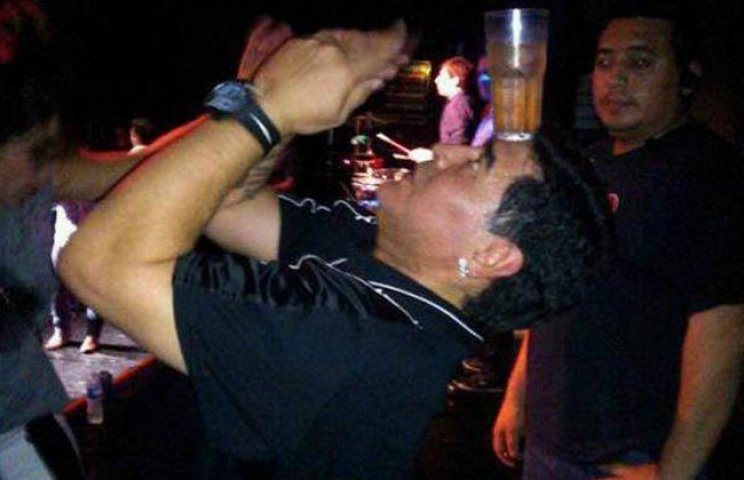
Argentine football player and coach Diego Maradona says he will run for the presidency of the International Federation of Association Footbal (FIFA), a journalist close to the star says.
“He told me he would be a candidate for president of FIFA and authorized me to communicate it,” Uruguayan journalist Victor Hugo Morales tweeted.
Maradona has been a harsh critic of incumbent FIFA president, 79-year-old Swiss Sepp Blatter. Blatter is under considerable pressure from investigations into claims of corruption by the FBI and Swiss authorities.
The scandal, which has already led to charges against 18 senior FIFA officials, has forced Blatter to announce he would resign soon. He made the announcement just days after defiantly winning his fifth term as FIFA president in late May.
Blatter will stay acting president until a successor is chosen between December 2015 and March 2016 – and Diego Maradona could be that successor.
Maradona is one of the most controversial figures in the history of football. The 54-year-old has played for seven football clubs and Argentina’s national team.
He was also addicted to cocaine for almost two decades, which had him suspended for 15 months in 1991 after he failed a drug test. He overcame the addiction in 2005, but it caused him heart problems.
After retiring from the field, he managed several football teams, including Argentina’s national squad. His latest job was managing the Dubai-based club Al Wasl.
With Maradona as FIFA-president the organization will probably focus on being much more anti-European. Global soccer has been one of the most effective vehicles to promote multiculturlism.
Roodepoort Primary School will reopen on Tuesday, albeit under heavy police guard. The school was indefinitely closed down by Gauteng MEC Panyaza Lesufi on Friday after one group of coloured parents had been protesting the appointment of a black principal.
The announcement of the school’s reopening was made a meeting held with another group of parents on Monday night. Lesufi says he was concerned about the children who were caught in the crossfire.
At Monday night’s meeting, it transpired that many parents had not known the details of the happenings at the school, although they were aware that something was amiss as their children had frequently been going home early from school.
This group of parents showed support for Lesufi and celebrated the announcement that the school would be reopened.
The dissenting coloured community members and parents who have been protesting held a separate meeting on Monday night and threatened that they would wreak havoc if the school was not reopened by Tuesday.
The protesting parents want the new principal’s appointment to be rescinded despite a KPMG report claiming that the appointment was legitimate.
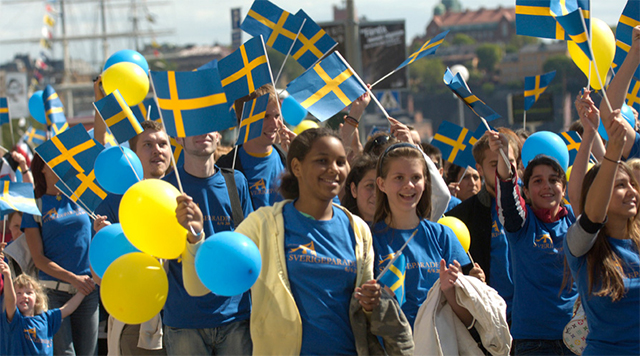
In a recent article it was predicted that Sweden, one of the world’s most progressive nations, will end up impoverished and third world by the year 2030. That is only fifteen years from now. The United Nations Human Development Index has corroborated this decline, stating that the land of Volvo, Knäckebröd and Selma Lagerlöf will end up lower on the list than Bulgaria and Cuba in due time. On the contrary, its Nordic neighbours, Norway and Finland are still going strong.
Because of Sweden’s unique position in the world, with its praised lavish welfare system, envied by many European nations (until recently though), this decline merits concern as to where the rest of the world will be, perhaps not in say fifteen years from now, but a bit further down the line. By being too progressive, it appears that retrogression becomes the necessary consequence.
Many conservative opinion makers have been quick to point out the devastating effect of multiculturalism that has racked this part of the world, and without a doubt, that is the most succinct contributor to the stalemate this nation has now reached. However, a greater danger lies in a more hidden corner of Swedish society.
Regardless of the fact that this nation boasts a luxury automobile industry, builds exclusive cameras and has ownership of mega-stores selling cupboards and beds, the Swedish people in a real sense lack individualism, freedom of speech and a true democratic spirit. The average Swede is rude and narrow-minded, their development stunted by their impossible yearning for equality. This makes them the perfect candidates for the various social experiments that the country is known for. Individualism has never truly set in and the Swedes therefore lack a well-developed sense of right and wrong. Such could be seen how the Nobel Committee unabashedly showered South African terrorists with Nobel Peace Prizes while the same organisation funded eugenics at home. The Karolinska Institute sterilised as many as 63 000 of its own citizens for fear of contaminating the purity of the Swedish race, while in the same period they aimed to destroy the white South African. Thus, in a strict sense, Sweden is amoral.
This hypocrisy has to do with the fact that the Swedes have — historically speaking — always been subjected to elitism and did not have the necessary checks in place to stave off acts of despotism. Whereas other European nations looked westward and had a history of feudalism and clashing aristocracies that protected them from staunch totalitarianism, the western European nations gradually started granting rights to the peasantry, the Magna Charta being a case in point. On the other hand, Sweden looked eastward towards Russia, lacked feudalism, shunned rights for the common people and could easily be coaxed into a centralised state. Few, if any rights were granted to the lower classes and the entire religious and political life in Sweden today have arisen from one leitmotif, ie. total centralised power. Even the Lutheran church — that one last beacon of spiritual freedom — was used as an instrument of political control by the authorities in much the same way the Roman church had done before the Reformation.
Modern Sweden may have all the external trappings of a democracy, but this is only at face value. This modernisation drive happened only fairly recently compared to other European nations, and the Social Democrats had the expediency of calling these modern developments “ours”. Because of this, they have held onto their position all throughout, having only been defeated once or twice by an “opposition” party for a short while. The modernisation drive was not a result of looking inward, but rather a reaction to outward circumstances, an astute way of keeping up with the Germans.
Given the Swedish penchant for equality, the strict Lutheran teaching and the secularisation that took place in the latter half of the twentieth century, Marxist and socialist teachings were facilitated with tremendous ease. Ideals of universal freedom in equality became the norm and was held in high esteem by the intellectual and political classes. Especially after the sexual revolution swept across the West in the 1960s and 1970s, the broad concept of “freedom” became redefined in terms of sexual emancipation. In fact even Swedish journalists stationed in foreign nations were quick to call on Sweden’s “enlightened and free” society by referring to the lack of sexual liberation elsewhere, apparently oblivious to the fact that their home country had only managed to exchange one form of political control for another. Where sexual abstinence was used as a means of controlling society before, the secularisation drive took to the other extreme of sexualising society for the sake of social control. By doing so, the elite attempted to lull the populace into a state of docility by drawing attention to their lower freedoms and away from cultivating good morals, spirituality, and wisdom, their higher freedoms.
Needless to say, such diversions only served to create a nation of infants and helped further to advance the state’s authority over them. In this sense, Sweden has become a quintessential Huxleyan Brave New World, a warning first uttered by author Roland Huntford in his work The New Totalitarians, a critique of the Swedish welfare state.
However, even the Swedish elite has now much to answer for. The current situation has reached a turning point and the ideals that were indoctrinated over the years have either come to naught or turned against them. Such could be seen how their ideological love child – black South Africans – over there are stirring the national pot. Quite recently, a South African born Muslim rapper, currently residing in Sweden produced a rap video blatantly uttering how “We wogs will exterminate you all” and “Come here Swedish girls, I will stick a knife in your pussy; All Swedes you will DIE, DIE, DIE, DIE, DIE”. This was uploaded on youtube under the name Ikasaify2. As far as I know, the Swedish authorities haven’t dealt with this person yet.
In another incident an immigrant from South Africa and Somalia who raped a Swedish woman to death successfully fought against deportation. Even though he is a notorious rapist, he would still be able to live off the Swedish state. The prosecutor in this regard justified his decision that he would endanger the lives of Somali women should he be deported back. Creating a menace in his own back yard thus seems preferable to stemming this tide elsewhere. The inability of changing the ways of a tribe of hunter-gatherers into a sedentary and productive people are realities that equality and universalism could not answer for, and the Swedes are now experiencing this head on.
However, the same collectivist thought-pattern that swayed them into multiculturalism could also now be their salvation. The Swedish government by all means has lost its credibility and in order to regain this, should make concessions to its people. Ranking at number two of nations with the highest incidence of rape in the world, a fact well expounded by local and international media, government would be hard-pressed to ignore this demoralising form of crime which is nothing short of pandemic.
It would be in everyone’s best interest if the Swedish people regain their inner strength to fend off this tide. Norway has recently deported a large number of foreign born convicted criminals and the crime rate has dropped dramatically.
There was a marked difference between the Brazilian and British coverage on the Brazilian soccer defeat of 1-7 against Germany.
The Brazilian sport daily Lance called the crushing loss of Brazil against Germany “The Biggest Shame in History.” “The Maracanazo becomes nothing and literally a thing of the past,” the newspaper said on its website.
Newspapers and TV commentators called the defeat the “Mineirazo,” an allusion to the Mineirao Stadium in Belo Horizonte and Brazil’s traumatic Word Cup defeat at home in 1950 known as the “Maracanazo.”
Brazil’s President Dilma Rousseff added to the gloom.
“Like every Brazilian, I am very, very sad about this defeat. I am immensely sorry for all of us. Fans and our players,” she wrote on Twitter.
Brazil’s national media dubbed the team’s record loss – equal to a 6-0 defeat by Uruguay in 1920 – the “Shame of Shames”.
Spanish sports paper Marca wrote: “The Germans … can lay claim that Tuesday night’s beat-down of Brazil is the most dominating performance in World Cup history. Adding to the indignity of it all, the crowd shouted ‘Ole!’ with each completed German pass to complete the darkest hour in the history of Brazilian football.”
The British nevertheless still tried very hard to sell their multicultural melting pot ideology to the losers by pretending to be heartbroken over their loss.
In the Daily Mirror, Martin Lipton, himself a wreck, “feared” for a football nation.
“In shame. In humiliation. In tears of utter shock, disbelief, disrepair, records rewritten for all the wrong reasons.
“The hearts of a nation of 200 million people were not just broken here in the Estadio Mineirao last night.
They were smashed into a billion tiny pieces. Irreparably.”
Other British commentators had similar pronouncements to make. “It was simply too much. Too brutal, Too excruciating. Too painful to watch,” cried Martin Samuel in the Daily Mail.
“Six minutes of football that would live in the memory — Brazil 0 Germany 1, to Brazil 0 Germany 5. In six minutes. Six minutes. It needed repeating, digesting. There has never been a World Cup semi-final like this.”
Brazil invested $11 billion to host this tournament.
‘MPs do not represent the people of Britain properly because they are too white’
David Cameron, the Prime Minister, said there is ‘much more to be done’ to encourage more people from ethnic minority backgrounds to enter Parliament.
The Prime Minister said there is “much more to be done” to encourage more people from ethnic minority backgrounds to enter Parliament.
Mr Cameron made the comments in a preface to a book, “Rainbow over Westminster”, which charts the increasing number of MPs who are black or from ethnic minority backgrounds.
In the preface, Mr Cameron said that the book “serves as a reminder – that there is much more to be done.
“Our Parliament is still nowhere near representative enough of the country we live in today.
“We should not presume that this will simply correct itself over time. History isn’t written for us: it is written by us.”
Mr Cameron said that he hoped the book – which is edited by the Labour MP Keith Vaz, who became the first British Indian to sit in the Commons for over 60 years when he was elected in 1987 – would help “to open up politics further”.
Since the first MP was elected 172 years ago, there have been 38 ethnic minority MPs in the Commons. Today 26 out of 650 MPs are from BME backgrounds.
In the 2010 election 16 men and women from black and ethnic minority backgrounds were elected – a quintupling on the three who were elected in 1987.
In an introduction, John Bercow, the Commons’ Speaker, said: “We need to ensure that we continue to benefit from the greater diversity of elected representatives.”
Mark Hammond, chief executive of the Equality and Human Rights Commission, said: “Parliament should be drawing from the widest talent pool so that people from a range of backgrounds have the opportunity to take part in political life and help make fair and well-informed decisions.”
Mr Cameron’s remarks come after research published last month from the Policy Exchange thinktank, which said that non-white people will make up between 20 and 30 per cent of the population by 2050. The current share is around 14 per cent.
The think-tank, which has close links to the Conservative Party leadership, also highlighted the differing political leanings of different ethnic groups, advising politicians not to treat non-white voters as a uniform group.
The coming growth in Britain’s non-white population is largely explained by a higher birth-rate among ethnic minority Britons.
A quarter of all children under 10 in the UK are from ethnic minorities.
By contrast, 95 per cent of people aged over 60 are white.
The Conservative Party is doing more to reach out to black and ethnic minority groups, although it refuses to make such moves public.
In April, Michael Gove, the Education secretary and a Tory moderniser, issued the said the Tories should reclaim the term “multi-culturalism”.
He told an audience at the Asian Business Awards told the 500-strong black tie dinner at a hotel in central London earlier this month that Britain was a “stronger country” because of its history of immigration.
He said: “The answer to how we make our country strong in the future is that we welcome talent from whenever it comes and we celebrate the fact that we are stronger together as a United Kingdom, as a multi-cultural nation than we could ever be if we looked back to the past.”
From a node in the neoconservative network, a Fox News studio, Charles Krauthammer has complained about the eviction of the Ukrainian Navy from the city of Sevastopol, where it was headquartered. Not a word did the commentator say about the city’s location: Sevastopol is on the Crimean Peninsula. It would appear that the city now falls within Crimean jurisdiction – starting March 16, the day the people of Crimea voted to secede from Ukraine.
By most estimates, between 97 and 93 percent of Crimean voters said yes to a reunion with Russia. High too was voter turnout. McClatchy pegs it at 83 percent of registered voters in Crimea. BBC News was agreed, also reporting a ballot of “more than 80 percent.” Zerohedge.com counted a “paltry” 73 percent turnout, still “higher than every U.S. presidential election since 1900.”
As rocker Ted Nugent might say, the Russians and Crimeans are blood brothers. Nugent got into trouble for using this perfectly proper appellation to describe his affinity for a politician, of all people: Texas Republican gubernatorial hopeful Greg Abbott. Notwithstanding that in the land of the terminally stupid, linguistic flourish can land one in hot water – blood brother is a good, if colorful, turn of phrase that denotes fealty between like-minded people. Steeped in state-enforced multiculturalism, America’s deracinated, self-anointed cognoscenti have a hard time grasping the blood-brother connections between the people of Russia and Crimea.
For no apparent reason other than that it is pro-Russian, Americans have reflexively aligned themselves against the swell for secession in southern Ukraine. Separatist referenda in Kosovo, Catalonia, South Sudan and Scotland have been accepted without demur by a political and media establishment unprepared to countenance a similar referendum in Crimea.
Guided by the pack animals of politics and punditry who seldom fail to shed darkness on whatever topic they tackle, a nation that struggles to locate the disputed territories on the map has been convinced of the menace posed by Russia. According to a CNN poll, 69 percent of Americans say they see Russia as a threat. A Rasmussen Report poll indicated that “52 percent support U.S. diplomatic action against Russia over Crimea.”
Helping to drive American Russophobia is the implacable logic exemplified by Bill O’Reilly of “The Factor,” yet another node in the network mentioned. At the suggestion that there are similarities between Russian and American military bellicosity, the TV host foams at the mouth. Fulmination is followed not by argument, but by a form of ad hominem or psychologizing.
It is absolutely verboten on this popular and powerful show to compare Russia’s “excursion” into Ukraine to America’s naturally illicit and illegal occupations of Iraq, Afghanistan and Libya. In defense of their reflexive rejection of the reasonable, if inaccurate, comparison – for decades the U.S. has been far more aggressive than Russia in its forays abroad – Bill and his gang “argued” (on March 3) as follows:
President Vladimir Putin is a thug. That’s why his actions can’t be contrasted with the actions of “a good country” like the U.S. By “logical” extension, George Bush and Barack Obama are never to be fingered as thugs.
Why, Billy, some of you will inquire? Is it because these thugs are American? Precisely.
Next, Bill O’Reilly’s mind-reading gifts were galvanized to negate the juxtaposition of the actions on the ground of the Russian and American governments. Putin, it would appear, seeks the recrudescence of the Russian empire. On the other hand, the U.S., with a military presence in 148 countries and 900 bases worldwide, has neither sought nor achieved empire status.
Why, Billy, some of you will ask? Is it because the U.S. is a good country? You got it!
Be it in Belgium, Germany, Italy, Spain, Turkey, the United Kingdom, Japan, Bahrain, Djibouti, South Korea, Iraq, Kyrgyzstan, Afghanistan and Kuwait – even Aruba, Iceland, Indonesia, Kenya, Norway and Peru – wherever it plants its military boot, a “good country” is never an empire, only a force for good.
Me, O’Reilly would dismiss as “anti-American.” But what of former secretary of state Henry Kissinger? While Kissinger has condemned Russia’s annexation of Crimea, he excoriated “the demonization of Vladimir Putin.” This antipathy “is not a policy; it is an alibi for the absence of one.” “The United States needs to avoid treating Russia as an aberrant to be patiently taught rules of conduct established by Washington,” wrote the statesman in the Washington Post.
Is Henry Kissinger anti-American or simply smarter than some Americans?
At least Secretary of State John Kerry hung on to his sense of humor. “Unless you are the United States of America, you just don’t invade another country on phony pretext in order to assert your interests,” Kerry lectured the congenitally incurious David Gregory, of “Meet the Press.”
I ad-libbed. Except for the first eight words in quotation marks, Secretary Kerry did indeed say the foregoing. Given America’s military record, the missing words are implied.
The O’Reilly school of “thought” could – and does – counteract that Crimea’s vote to join Russia was tainted by fraud. This is certainly possible. Nevertheless, it is none of our business. Americans have their own tyrants to dethrone.
We’re supposed to be the freest people in the world, aren’t we? Is this claim not the moral basis for America’s we-know-best global meddling? But if we Americans are the freest people in the world, where’s our right to a referendum on, say, that “little” legislative “blip” called Obamacare? And if we’re so bleeding free, where’s our right to secede from D.C.?
With violence and anti-white racism rising in South Africa, Afrikaners need international support to survive. Our unique testimony of how a Western nation is being dominated by non-Westerners may just save the whole of our civilization!
It is now commonly accepted that Afrikaners and South African whites generally are in deep trouble. There are now two, no three, major black political parties who are trying to outbid one another in confiscating white-owned land, taxing us more, putting stricter racial quotas on our rugby and cricket teams, swamping the remaining white-majority schools with black pupils and making it harder for white students to gain entry to university. Even local taxes are used in an attempt to bankrupt many white-owned small businesses or family-owned farms.
All in all, the multicultural experiment is failing dismally in South Africa. Violence and mayhem are rising (70 000 of us killed since 1994), like corruption, environmental degradation and intolerance among South Africa’s linguistic and ethnic groups. Foreign Africans, like white farmers, are routinely killed and more often than not the police and the criminal justice system are turning a blind eye.
The city of Pretoria, with the Voortrekker Monument in the foreground
To many people overseas, South Africa is a lost cause, a sinking ship only worth abandoning. Yet, the very failure of our society presents a powerful argument against political correctness that may still save us and European civilization. It will take decades for Europe or North America to reach the state of advanced decay that South Africa finds itself in. We are ahead of the curve, as they say. We are the empirical proof that multiculturalism, affirmative action, the adulation of black people simply because they are black, lead straight to disaster!
But still, the skeptic may ask, why is it worth saving three or four million million whites in South Africa when the entire European/Western civilization is currently at risk? When support is needed to save France, Britain, the USA, from a programmed demise and takeover by other cultures, why bother about South Africa?
I accept that laying down our lives for most of the twentieth century in at least four wars fought for the Allies of for the West, does not count for much. But here are some persuasive reasons why you should support us now, in our final battle for survival. It is not a physical, but a spiritual battle, one of the will. We have many enemies and few friends… Yet we continue, against all odds, to resist being murdered, being acculturated, being assimilated!
Why the Afrikaner people is worth saving (and supporting)
Most of us come from Northern Europe which, for the last 300 years or so, ever since the Enlightenment, has produced some of the foremost breakthroughs in science, philosophy, art, music and literature. If it is worth saving Northern Europeans, it is worth saving us. In fact, we are a unique group of interbred Dutch, Germans, French and Scots who mostly speak a modernised Germanic dialect called Afrikaans. During the twentieth century we were united during a great national movement that was only brought down through foreign intervention, terror, intense propaganda, financial sanctions and more. Instead of getting a federal system and tolerance for ethnic diversity, we got Leninism and ethnic domination, even a slow genocide during which we are being killed one by one, family by family.
To many people, language is but a means of communication. Yet without Milton or the English Romantic poets, the English language would never have expressed a unique national identity, nor would German have acquired a high status without Goethe, Russian without Pushkin and Dostoevsky, etc. The astonishing aspect about our language, Afrikaans, is that, while evolving into a simplified grammar, its lexicon or vocabulary has remained more or less intact since the European Middle Ages, much more so than even the major European languages. We maintain a unique link with our distant past in Europe. There is some evidence that most of Northern Europe spoke dialects very similar to Afrikaans from 1300 to 1600 when Low German was the lingua franca of the Hanseatic League, a forerunner of the European Union which bound hundreds of cities together, from Russia to England and the Low Countries. This trade and seafarer’s tongue finally beached right here in South Africa in 1652. We nurtured and cared for this language which today, against the hostility of the state and global corporations who would like to see it disappear, remains a vehicle for cultural and scientific expression, for teaching anything from law to mathematics, from film to cooking, from information technology to accounting or high finance.
After more than three centuries in Africa, we have become hardy and strong. Is there any other country in the world where blacks have to impose racial quotas favouring themselves because they feel threatened by the sporting prowess of whites? Not to mention the most radical affirmative action programme on earth, in order to starve us economically, intellectually, even literally, so as to prevent us from producing food on our farms, like we have done since the 1650s!
The battle for South Africa is not over. One would have thought our fate was sealed in 1994 when Nelson Mandela became president of this country, after the dismal failure of the then Afrikaner leadership during the negotiations at Kempton Park. An avowed communist and co-conspirator of the East German Stasi, Joe Slovo, triumphed over them all. Yet, such is our resilience in the face of terror, farm murders, racial and language discrimination, economic and educational injustices, that after 20 years of very hostile government we are still here!
The unique contribution of Afrikaners to the future of Europe?
Just today I saw a French TV debate on Ce soir ou jamais! in which a Cameroonian author, Léonora Miano, told Elisabeth Lévy “not to be afraid of becoming a minority in France”. Lévy took the risk of articulating the apprehension of many French people in seeing their country changed culturally by immigration. With supreme arrogance, Miano told her bluntly that “this is what is called a mutation” and “it is going to happen”.
What wil life be like once the French are a minority in France, the Dutch a minority in the Netherlands, the Italians a minority in Italy, and so on? Well, they need look no further than South Africa to find the nightmarish answer. Once one becomes a minority under a non-Western majority, one is simply forced to undergo constant violence, debasement, humiliation and impoverishment through racial and ethnic quotas.
The testimony that we Afrikaners bring to the international debate on immigration, multiculturalism, race and ethnicity, may yet save Western and European civilization! Yet for that possibility to be realised, we ourselves need to survive.
We did not ask to be cast ashore in 1652, yet we have made the most of our opportunity by building the most successful country in Africa, a country where we are today cast as foreigners. We are denied access to the very institutions our forebears had founded while our names are removed from towns, streets and buildings, to bring home to us that we are the racial and cultural “other”. We are good enough to pay taxes but not to be counted as full citizens; a myriad of laws impose a fundamental inequality on us under the pretext of ensuring, precisely, “racial equality”.
In South Africa, as there will no doubt soon be all over the world, something caled “fair discrimination”, which is nothing other than anti-white racism.
If you believe our voice and unique testimony should be heard and that we do not deserve simply being killed or expelled from our own country, then we humbly ask you to support our struggle for dignity, equality and fair treatment by the black majority and their radical communist allies. For our long-term survival, like that of the Palestinians, only self-government will suffice.
I was still pondering the implications of “black colonialism” as set out in a previous column when it struck me that some of South Africa’s ethnic categories are completely wrong.
Afrikaners were the first group in the country to refer to themselves as “Africans”, as long ago as 1707 when Hendrik Biebouw said: “Ik ben een Afrikaander.” However, today Afrikaners have been defined as an out-group by South African legislation that simply classes them as “whites”.
Most of our affirmative-action legislation has been imported from the USA and BEE is just an adapted form of what is called “minority procurement” over there. So there is nothing “African” about the current race-classification system!
In German, “Afrikaner” means simply “African”, yet the current laws define Afrikaners as Europeans. The ultimate irony is that ANC and especially SACP ideology has been constructed by recent immigrants from Lithuania (like Joe Slovo) and, of course, Britain.
Imposing racial quotas on everything from the medical schools at Afrikaans universities to the Blue Bulls rugby team is bad enough. But stripping us of our age-old Africanness by legislative fiat represents the ultimate insult, making us interlopers in our own country.
Searching for answers, I reread Thabo Mbeki’s “I am an African” speech, but it is simply a fanciful restatement of American multiculturalism, with echoes of (Swedish) Gunnar Myrdal’s “melting pot” idea. So nothing “African” there, either.
We urgently need to bring back the term “Bantu” and I have begun to recommend its use on social media and everywhere else. There seems to be a certain squeamishness about using this word, meaning “people”, which is unfathomable. Even the famous Xhosa definition of “ubuntu” contains it: “Ubuntu ungamntu ngabanye abantu.”
Anthropologists, linguists and other people in need of proper definitions have never stopped referring to the “Bantu peoples”, “Bantu languages”, etc. Even Bantu education has been rehabilitated by such leading authorities as Dr. Mamphela Ramphele and a lecturer at Wits Business School, Mr. Rabelani Dagada, both of whom consider it better than the current schooling system.
The first ANC-supporting newspaper in the 1920s was called Abanthu-Batho and today there is a clothing brand which is thus advertised: “Abantu is a ladies wear brand which creates timeless pieces which speak to the South African audience.”
The Bantu peoples inhabit East and Southern Africa. For them or their Lithuanian theorists to arrogate unto themselves the sole right to being called “Africans” is not only intellectually unsound, but also unfair. After all, there are 200 million North Africans, including Egyptians, Arabs, Berbers, Copts and so on, who are Africans, by definition. West Africa too, is given the cold shoulder by Bantu imperialism.
In the nineteen-twenties some leading German and French anthropologists claimed, upon the basis of very ancient mining activity in these parts, that whites may have inhabited both South Africa and Zimbabwe as long ago as 3500 B.C. They must have been the first Afrikaners and we should venerate them as our true founding fathers, together with the Khoi and San.
Either we must qualify for affirmative action like other “Africans” – and even the Chinese! – or the Bantu must clearly announce their pretensions to being a kind of continental nobility with special privileges.
The following are extracts from a speech by the then British foreign secretary, Robin Cook, to the Social Market Foundation in London during April 2001 in which he defines Britain as a multicultural country, with chicken tikka masala as its national dish. These extracts were published in The Guardian newspaper on 19 April 2011.
Tonight I want to celebrate Britishness. As Foreign Secretary I see every day the importance of our relations with foreign countries to the strength of our economy, to the security of our nation, to the safety of our people against organised crime, even to the health of our environment. A globalised world demands more foreign contacts than even Britain has experienced in the past.
I also know that we are likely to make our way more successfully in the world if we are secure in our British identity, and confident about its future. That security and confidence is important for the inner strength it gives us in our conduct of business with others. I want to argue the case why we can be confident about the strength and the future of British identity.
Sadly, it has become fashionable for some to argue that British identity is under siege, perhaps even in a state of terminal decline. The threat is said to come in three forms.
First, the arrival of immigrants who, allegedly, do not share our cultural values and who fail to support the England cricket team. Few dare to state this case explicitly, but it is the unmistakable subliminal message.
Second, our continued membership of the European Union, which is said to be absorbing member states into a country called Europe.
Third, the devolution of power to Scotland, Wales and Northern Ireland, which is seen as a step to the break-up of the UK.
This evening, I want to set out the reasons for being optimistic about the future of Britain and Britishness. Indeed, I want to go further and argue that in each of the areas where the pessimists identify a threat, we should instead see developments that will strengthen and renew British identity.
Multicultural Britain
The first element in the debate about the future of Britishness is the changing ethnic composition of the British people themselves. The British are not a race, but a gathering of countless different races and communities, the vast majority of which were not indigenous to these islands.
In the pre-industrial era, when transport and communications were often easier by sea than by land, Britain was unusually open to external influence; first through foreign invasion, then, after Britain achieved naval supremacy, through commerce and imperial expansion. It is not their purity that makes the British unique, but the sheer pluralism of their ancestry.
London was first established as the capital of a Celtic Britain by Romans from Italy. They were in turn driven out by Saxons and Angles from Germany. The great cathedrals of this land were built mostly by Norman Bishops, but the religion practised in them was secured by the succession of a Dutch Prince. Outside our Parliament, Richard the Lionheart proudly sits astride his steed. A symbol of British courage and defiance. Yet he spoke French much of his life and depended on the Jewish community of England to put up the ransom that freed him from prison.
The idea that Britain was a pure Anglo-Saxon society before the arrival of communities from the Caribbean, Asia and Africa is fantasy. But if this view of British identity is false to our past, it is false to our future too. The global era has produced population movements of a breadth and richness without parallel in history.
Todays London is a perfect hub of the globe. It is home to over 30 ethnic communities of at least 10,000 residents each. In this city tonight, over 300 languages will be spoken by families over their evening meal at home.
This pluralism is not a burden we must reluctantly accept. It is an immense asset that contributes to the cultural and economic vitality of our nation.
Legitimate immigration is the necessary and unavoidable result of economic success, which generates a demand for labour faster than can be met by the birth-rate of a modern developed country. Every country needs firm but fair immigration laws. There is no more evil business than trafficking in human beings and nothing corrodes social cohesion worse than a furtive underground of illegal migrants beyond legal protection against exploitation. But we must also create an open and inclusive society that welcomes incomers for their contribution to our growth and prosperity. Our measures to attract specialists in information technology is a good example.
Our cultural diversity is one of the reasons why Britain continues to be the preferred location for multinational companies setting up in Europe. The national airline of a major European country has recently relocated its booking operation to London precisely because of the linguistic variety of the staff whom it can recruit here.
And it isn’t just our economy that has been enriched by the arrival of new communities. Our lifestyles and cultural horizons have also been broadened in the process. This point is perhaps more readily understood by young Britons, who are more open to new influences and more likely to have been educated in a multi-ethnic environment. But it reaches into every aspect of our national life.
Chicken Tikka Massala is now a true British national dish, not only because it is the most popular, but because it is a perfect illustration of the way Britain absorbs and adapts external influences. Chicken Tikka is an Indian dish. The Massala sauce was added to satisfy the desire of British people to have their meat served in gravy.
Coming to terms with multiculturalism as a positive force for our economy and society will have significant implications for our understanding of Britishness.
The modern notion of national identity cannot be based on race and ethnicity, but must be based on shared ideals and aspirations. Some of the most successful countries in the modern world, such as the United States and Canada, are immigrant societies. Their experience shows how cultural diversity, allied to a shared concept of equal citizenship, can be a source of enormous strength. We should draw inspiration from their experience.
Britishness and European integration
To deny that Britain is European is to deny both our geography and our history. Our culture, our security, and our prosperity, are inseparable from the continent of Europe.
Underlying the anti-European case is the belief that there is an alternative future available to Britain. It used to be argued that the European Union is not Europe and that Britain could exist perfectly comfortably as one of a number of European countries maintaining a loose association with Brussels. But with the majority of non-EU states now clamouring for full membership, the changing geopolitics of Europe have consigned that argument to the past.
Some anti-Europeans now argue that Britain’s destiny lies outside Europe, as part of the English-speaking world and a member of NAFTA.
Yet Britain trades three times more with the rest of the EU than we do with NAFTA. The reason why over four thousand US companies have located here is because they want to export to Europe. If they only wanted to sell to NAFTA, they would have stayed at home.
Europe is where our domestic quality of life is most directly at stake, whether the issue is environmental standards, the fight against organised crime, policy on asylum or stability on the continent.
But it is not simply a question of economic and political realism that ties Britain to Europe, compelling as those arguments are. Britain is also a European country in the more profound sense of sharing European assumptions about how society should be organised. The last international survey of social attitudes put Britain squarely within the European mainstream on our approach to social justice and public services, such as health.
There are strong ties of kinship between Britain and North America. These are an immense asset to us in the modern world. The US and the UK are each others closest allies. But our value as an ally to our friends in Washington is in direct proportion to our influence with our partners in Europe.
I do not accept that to acknowledge our European identity diminishes our Britishness. Nor do I accept that membership of the European Union is a threat to our national identity.
None of our European partners, with their own proud national traditions, seem afflicted by this self-doubt and insecurity. The idea that the French, the Germans or the Spanish are attempting to erase their national identities by constructing a country called Europe is the mother of all Euromyths. On the contrary, our partners see their membership of a successful European Union as underwriting, not undermining, their assertion of national identity.
For France, Germany and Italy, the European Community was central to the renewal of their nations and the regeneration of their economies in the post-War period. To Spain, Portugal and Greece, joining the European Community was an affirmation of their freedom from fascism and a guarantee of a democratic future. To Austria and Finland, joining the European Community was a celebration of the end of the Cold War, which enabled them to make a free choice in their national orientation.
The same is true of the dozen new candidates for membership from the former communist bloc. All of them aspire to membership of the European Union because it will be an affirmation of their regained independence. None of them see it as a threat to their national identity.
Ireland joined at the same time as Britain. Its period of membership has transformed Ireland into a country with a dynamic economy and a cosmopolitan society. The result has been a new assertiveness of national identity, and confidence in their culture. We can see that for ourselves in Britain through the new affection for Irish music and dance, and the attachment to Irish pubs.
Britain has everything to gain from being a leading partner in a strong Europe. All we have to lose is the timidity which prevents us from embracing our European destiny and from recognising that it is a source of confidence in our nations future.
In the aftermath of Nice, it is clearer than ever that a strong Europe requires strong nations. With the accession of up to twelve new member states, the European Union is set to become even more diverse. In the next Inter-Governmental Conference, the challenge is to find the right balance between European and national decision-making and to enhance the EU’s legitimacy by harnessing the democratic traditions of its member states.
This is a debate that Britain can play a pivotal role in shaping. But we can only do so if we reject insular nationalism and the politics of fear by engaging fully and confidently in Europe.
Britishness and devolution
The last of the three perceived threats to Britishness is the new flexibility in our modern constitution.
The devolution of power to Scotland, Wales and Northern Ireland will stand the test of time as one of this Governments most radical and significant achievements. The creation of a Scottish Parliament and Welsh Assembly allows both nations to choose the policies that are right for them through their own democratic structures. In Northern Ireland, devolution was needed for a different reason – to enable the communities of a divided society to share power and to work together to build a common future. In all three cases, I am convinced that our reforms were essential.
Let us put to bed the scare stories about devolution leading to the Death of Britain. Devolution has been a success for Scotland and for Wales, but it has also been a success for Britain. The votes for devolution in the referendums were not votes for separation. They were votes to remain in the United Kingdom with a new constitutional settlement. By recognising the United Kingdoms diversity, devolution has guaranteed its future. It is striking that today opinion polls in Scotland show that support for separation from the rest of Britain is lower than at the time of the referendum four years ago.
Centuries of living together and working together have created enduring bonds between each of the constituent nations that make up Britain. Our future together in a single state is all the more secure if we each respect the distinctive identity that makes some of us Scottish and others Welsh or English. That mutual respect strengthens our common identity as British.
Our peoples already practise this subsidiarity of identity in their expressions of sporting loyalty. They watch Scotland, England, Wales or Northern Ireland at football. They cheer for the British team in the Olympics. And they support Europe at golf in the Ryder Cup. In context, each is a valid expression of our identity.
We should not fear the consequences of applying this principle in political life. In Scotland, the legal and educational systems are important expressions of Scottishness. At a British level, there is a strong attachment to institutions such as the National Health Service, the BBC and the armed forces. In Europe, we work with fourteen other nations to build the Single Market and to use our joint strength in trade negotiations. Action at one level does not invalidate our commitment to work at the other levels. On the contrary, they reinforce each other.
I get impatient when I see opinion polls that ask respondents whether they feel more Scottish or English than British, or more British than European, as if these choices were mutually exclusive. Identity is not a finite substance to be shared out between competing loyalties. It embraces numerous dimensions, each of which serves to amplify and reinforce the others.
Conclusion
In our thousand years of history, the homogeneity of British identity that some people assume to be the norm was confined to a relatively brief period. It lasted from the Victorian era of imperial expansion to the aftermath of the Second World War and depended on the unifying force of those two extraordinary experiences. The diversity of modern Britain expressed through devolution and multiculturalism is more consistent with the historical experience of our islands.
Far from making Britishness redundant, it makes the need for a shared framework of values and institutions all the more relevant. To act as a unifying force, that framework must be one that reflects the realities of contemporary Britain.
It is natural for every nation to be proud of its identity. We should be proud to be British. But we should be proud of the real Britain of the modern age.
Proud that the strength of the British character reflects the influences of the many different communities who have made their home here over the centuries. Proud that openness, mutual respect and generosity of spirit are essential British values.
We should be proud that those British values have made Britain a successful multi-ethnic society. We should welcome that pluralism as a unique asset for Britain in a modern world where our prosperity, our security and our influence depend on the health of our relations with other peoples around the globe.
Tolerance is important, but it is not enough. We should celebrate the enormous contribution of the many communities in Britain to strengthening our economy, to supporting our public services, and to enriching our culture and cuisine. And we should recognise that its diversity is part of the reason why Britain is a great place to live.
Muslim rioters threw rocks and set fires following a police check of a completely veiled woman in Trappes, a western suburb of Paris, newspaper Le Parisien reported Saturday.
The gathering of 200 to 400 people became “violent” at about 8:30 pm (1830 GMT) Friday, the report said. The mob vandalized a bus shelter and set refuse bins on fire.
Two police officers were injured, a police union spokesman said. An unconfirmed report said that one boy was injured and rushed to hospital.
Police surrounded their station with emergency vehicles to protect it from the rioters.
The mob in the town of 30,000, 30 kilometres from central Paris, was angered by the arrest of a 21-year-old man on Thursday, who attacked a police officer after objecting to a police check of his fully veiled wife.
In France, the wearing of burqas and other veils in public is prohibited. – dpa
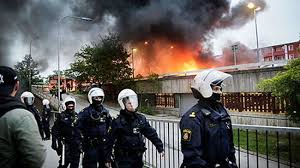
Automobiles were torched and police confronted stone-wielding youths in Stockholm’s suburbs early Sunday as riots, which erupted following reports that police had killed an elderly immigrant, enter their first week.
Pockets of violence and vandalism continue to pose a challenge to police in Stockholm, the Swedish capital that is home to an increasingly diverse 2 million residents. “When it comes to car fires, there have been a few, spread out in various locations, but not as many as in recent days,” Stockholm police spokesperson Lars Bystroem told Swedish Radio.
In Vaarberg, a suburb south of Stockholm, police were attacked by stone-throwing youths, while in Jordbro, another southern neighborhood, police resorted to teargas as they met resistance while attempting to arrest several individuals, AFP reported.
Violence has broken out in other parts of the country as well. In Orebro, a town in central Sweden, some two dozen masked youths set fire to three cars and a school and attempted to torch a police station, Reuters reported, citing police. About 200 km (124 miles) to the southwest in the city of Linkoping, several vehicles were set alight and youths tried to torch a school and a kindergarten.“With the strong presence on the streets of the good forces, and the police reinforcements, I think we are well on our way towards calmer times in the coming days.” The riots began one week ago in Husby, a predominantly immigrant suburb of Stockholm, following the fatal police shooting of an elderly man who police said was brandishing a machete in his home.
Analysts believe the shooting ignited deep-seated frustration among disenfranchised youths – many of whom have not assimilated into Swedish society and are unemployed – who claim to have suffered from police brutality and racism to the country due to its attractive social programs.
The Scandinavian country is ranked as one of Europe’s most popular destinations for immigrants, both in absolute numbers and relative to its size, but critics say the new arrivals are failing to learn even the basic language skills necessary to find employment, and despite free government assistance programs.
Ingrid Carlqvist, editor-in-chief of Dispatch International, told RT that Sweden is an attractive destination for immigrants because the government gives them “money for nothing.”
“For the last 20 years or so, we have seen so many immigrants coming to Sweden [who] really don’t like Sweden,” Carlqvist said. “They don’t want to integrate, they don’t want to live in this society – working and paying taxes, and so on – they come here because they know Sweden will give them money for nothing.
“[The police] could use water cannons, they could [enforce curfews]; there are so many things they could do within the law, but they don’t do it.” The change in Sweden’s domestic dynamics comes at a time when far-right groups are commanding attention across the EU, with many residents furious over austerity measures, high unemployment and the general consensus that the individuals most responsible for triggering the collapse of the global economy have escaped responsibility.
“We have tried harder than any other European country to integrate, spending billions on a welfare system that is designed to help jobless immigrants and guarantee them a good quality of life,” Marc Abramsson, leader of the National Democrats Party, told the Telegraph.
“Yet we have areas where there are ethnic groups that just don’t identify with Swedish society. They see the police and even the fire brigade as part of the state, and they attack them. Multiculturalism does not recognize how humans actually function, Abramsson added, emphasizing that such a stance should not be confused with racism.
According to the OECD, Sweden still ranks among the nine most equal member-states of the organization, but inequality rates surged by one-third between 1985 and 2008 – the largest increase among OECD countries, the organization said in a report released earlier this year. – RT
This website uses cookies to improve your experience. We'll assume you're ok with this, but you can opt-out if you wish. Cookie settingsACCEPT
Privacy & Cookies Policy
Privacy Overview
This website uses cookies to improve your experience while you navigate through the website. Out of these cookies, the cookies that are categorized as necessary are stored on your browser as they are essential for the working of basic functionalities of the website. We also use third-party cookies that help us analyze and understand how you use this website. These cookies will be stored in your browser only with your consent. You also have the option to opt-out of these cookies. But opting out of some of these cookies may have an effect on your browsing experience.
Necessary cookies are absolutely essential for the website to function properly. This category only includes cookies that ensures basic functionalities and security features of the website. These cookies do not store any personal information.
Any cookies that may not be particularly necessary for the website to function and is used specifically to collect user personal data via analytics, ads, other embedded contents are termed as non-necessary cookies. It is mandatory to procure user consent prior to running these cookies on your website.