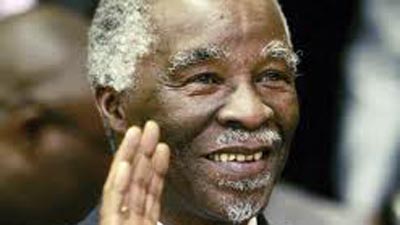
The Anglo-Xhosa politician and former South African president Thabo Mbeki says the legacy of Afrikaner rule still hangs over the country, and it’s now up to the youth to bring change.
According to media reports, the former head of state addressed matric history students at Westerford High School in Cape Town today.
The students heard Mbeki speak about the secret negotiations between the former Afrikaner government and the African National Congress (ANC) in the 1980s.
You could hear a pin drop as the small group paid close attention to every detail Mbeki shared with them.
The former president relived the late 1980s when the ANC held secret negotiations to take over the country with, among others, the Afrikaner organisation, the Broederbond, the then ruling National Party, the international community, and ultimately the government itself.
He also told of meetings in Switzerland and other parts of the world as part of the ANC’s quest for power and instituting radical Afrocentric rule in South Africa.
Mbeki says the legacy of Afrikaner rule is still prevalent and it’s up to today’s youth to change society.
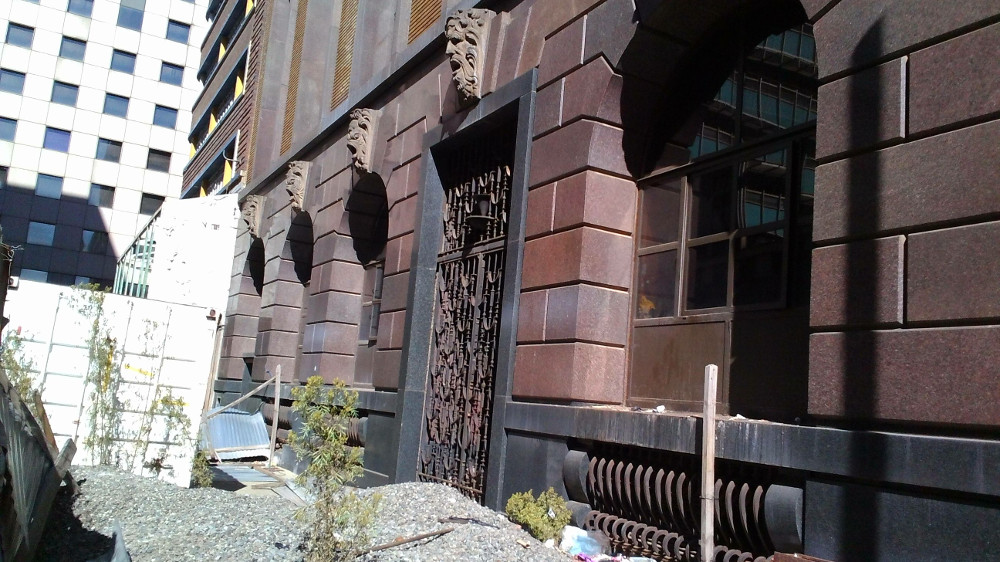
The ANC has changed names of Afrikaner towns, ethnically cleansed Afrikaners from government service and state-owned companies, banned Afrikaans on campuses and incited its followers to “kill a Boer, kill a farmer”. It has also demolished buildings designed by Afrikaner modernist architects and removed paintings and books by Afrikaners from public collections.
But eradicating Afrikaner influence and heritage from the country seems to be more difficult than the ANC foresaw when it took control of the country.
At the same time, Mbeki says transformation is a national crisis.
Rhodes Must Fall member Chumani Maxwelewho was at the forefront of the removal of the Cecil John Rhodes statue, also attended the talk.
He asked Mbeki about the lack of transformation at higher education institutions.
And the former president said, “Things are changing; if you look at the teaching style it is not transforming fast enough. More needs to be done.”
ANC national chairwoman Baleka Mbete believes there is an internal plot to unseat President Jacob Zuma before he completes his second term.
Speaking at the ANC Limpopo provincial general council in Polokwane on Sunday night, Mbete said Zuma’s detractors who failed to oust him as party leader in Mangaung in 2012 had regrouped to plot his downfall.
Without mentioning names, Mbete said: “There are people there in Parliament who’ve allowed themselves to become part of a whole huge ‘Zuma must go’ agenda.”
She said Zuma’s foes within the party were plotting with opposition politicians by holding clandestine meetings.
The plan, she said, was to oust Zuma during the ANC national general council (NGC) in October. The NGC is held between national conferences, and it is meant to, among other things, evaluate the performance of national executive committee members, of which Zuma forms part, according to the ANC constitution.
This isn’t the first time Zuma’s name has been mentioned in relation to a conspiracy.
The so-called Special Browse Mole Report of 2007 suggested that Angolan intelligence forces plotted to support the then axed deputy president Zuma’s attempt to take over the presidency.
The report had been compiled by the disbanded crime-fighting unit, the Scorpions. It led to then president Thabo Mbeki’s downfall at Polokwane in December 2007.
Subsequently, Zuma was elected to steer the ANC.
On Monday night, an ANC regional leader in Limpopo, commenting anonymously, said that if the allegations were true, those behind the plot were wasting their time.
“If it’s true that there is a plot to remove that man in the PGC (provincial general council), it means those people don’t understand ANC politics.
“Africa is rising — let the South African corporate world become part of the story of the rising of the African continent,” said Thabo Mbeki, the former ANC leader and South African president.
“That means looking beyond something called the bottom line.”
Mbeki said there were still obstacles facing Africa but that a lot had been achieved and political cohesion on the continent was important. The former ANC leader who had been ousted by Jacob Zuma, often referred to this dream of an “African Renaissance” while he was still president.
Speaking at the Old Mutual Wisdom Forum dinner in Johannesburg, Mbeki said realising that there were problems was already a step in the right direction of unlocking the wealth of the African continent.
“I think the first and most positive thing happening in this continent is the recognition that we have these particular challenges,” he stated.
“The recognition that we have these challenges means you have taken the steps to fighting these challenges.”
He said other countries were investing in Africa because the “political risk” was less.
“I have a sense that over a period of time… political risk has been diminished.”
Part of diminishing the risk was consciousness, according to Mbeki.
“All of us or many of us are very conscious of a bad past. A bad past of wars… All negatives,” he said.
“A majority of people say we don’t want to go back.”
Mbeki said there had been a commitment on the African continent to stop the outbreaks of violence.
Mbeki said it was not only important to take steps to stop the fighting but to ask questions on why the fighting started in the first place.
Africa was rich in resources and there was competition, he said.
“A lot of the time the reason for conflict is the failure amongst ourselves to build a common political cohesion,” he said.
Meanwhile, business scientist Dr Anil Gupta said that the youth had a big role to play in Africa rising.
“Young people are more demanding,” he said.
“The young people of Africa are an asset in more ways than one.”
Africa should be careful of complacency and slowing down.
“Hopefully the young people are less complacent because they are more informed,” he said.
Gupta said there was a “resource curse” — wealth from commodities was held by a minority while the vast majority remained unemployed.
Manufacturing should become an area of investment, he said.
“A vast majority of the poor are not going to become IT workers,” he said.
BETWEEN THE FREEDOM FRONT, THE AFRICAN NATIONAL CONGRESS AND THE SOUTH AFRICAN GOVERNMENT/NATIONAL party taking note of the Constitution of the Republic of South Africa, Act 200 of 1993 as amended; and taking note of the unsigned Memorandum of Agreement between the African National Congress (ANC) and the Afrikaner Volksfront (AVF), dated December 21, 1993; and taking note of Constitutional Principle XXXIV, dealing with the issue of self-determination; and subsequent to the discussions between the delegations of the ANC, the AVF, the South African Government and eventually the Freedom Front (FF) –
The parties represented by these delegations record the following agreement:
1. The parties agree to address, through a process of negotiations, the idea of Afrikaner self-determination, including the concept of a Volkstaat.
2. The parties further agree that in the consideration of these matters, they shall not exclude the possibility of local and/or regional and other forms of expression of such self-determination.
3. They agree that their negotiations shall be guided by the need to be consistent with and shall be governed by the requirement to pay due consideration to Constitutional Principle XXXIV, other provisions of the Constitution of the Republic of South Africa, Act 200 of 1993 as amended, and that the parties take note of the Memorandum of Agreement, as referred to above.
3.1 Such consideration shall therefore include matters such as:
3.1.1 substantial proven support for the idea of self-determination including the concept of a Volkstaat;
3.1.2 the principles of democracy, non-racialism and fundamental rights; and
3.1.3 the promotion of peace and national reconciliation.
4. The parties further agree that in pursuit of 3.1.1 above, the support for the idea of self-determination in a Volkstaat will be indicated by the electoral support which parties with a specific mandate to pursue the realisation of a Volkstaat, will gain in the forthcoming election.
4.1 The parties also agree that, to facilitate the consideration of the idea of a Volkstaat after the elections, such electoral support should be measured not only nationally, but also by counting the provincial votes at the level of:
4.1.1 the electoral district, and
4.1.2 wherever practical the polling stations as indicated by the parties to, and agreed to by, the Independent Electoral Commission.
5. The parties agree that the task of the Volkstaatraad shall be to investigate and report to the Constitutional Assembly and the Commission on the Provincial Government on measures which can give effect to the idea of Afrikaner self-determination, including the concept of the Volkstaat.
6. The parties further agree that the Volkstaatraad shall form such advisory bodies as it may determine.
7. In addition to the issue of self-determination, the parties also undertake to discuss among themselves and reach agreement on matters relating to matters affecting stability in the agricultural sector and the impact of the process of transition on this sector, and also matters of stability including the issue of indemnity inasmuch as the matter has not been resolved.
8. The parties further agree that they will address all matters of concern to them through negotiations and that this shall not exclude the possibility of international mediation to help resolve such matters as may be in dispute and/or difficult to conclude.
8.1 The parties also agree that paragraph 8.0 shall not be read to mean that any of the deliberations of the Constitutional Assembly are subject to international mediation, unless the Constitutional Assembly duly amends the Constitution to enable this to happen.
8.2 The parties also affirm that, where this Accord refers to the South African Government, it refers to the South African Government which will rule South Africa until the April 1994-elections.
signed by: gen. constand viljoen, leader:
freedom front mr thabo mbeki, national chairman:
african national congress mr roelf meyer, minister of constitutional development and of communication on behalf of the government and the national party witnessed by:
I was still pondering the implications of “black colonialism” as set out in a previous column when it struck me that some of South Africa’s ethnic categories are completely wrong.
Afrikaners were the first group in the country to refer to themselves as “Africans”, as long ago as 1707 when Hendrik Biebouw said: “Ik ben een Afrikaander.” However, today Afrikaners have been defined as an out-group by South African legislation that simply classes them as “whites”.
Most of our affirmative-action legislation has been imported from the USA and BEE is just an adapted form of what is called “minority procurement” over there. So there is nothing “African” about the current race-classification system!
In German, “Afrikaner” means simply “African”, yet the current laws define Afrikaners as Europeans. The ultimate irony is that ANC and especially SACP ideology has been constructed by recent immigrants from Lithuania (like Joe Slovo) and, of course, Britain.
Imposing racial quotas on everything from the medical schools at Afrikaans universities to the Blue Bulls rugby team is bad enough. But stripping us of our age-old Africanness by legislative fiat represents the ultimate insult, making us interlopers in our own country.
Searching for answers, I reread Thabo Mbeki’s “I am an African” speech, but it is simply a fanciful restatement of American multiculturalism, with echoes of (Swedish) Gunnar Myrdal’s “melting pot” idea. So nothing “African” there, either.
We urgently need to bring back the term “Bantu” and I have begun to recommend its use on social media and everywhere else. There seems to be a certain squeamishness about using this word, meaning “people”, which is unfathomable. Even the famous Xhosa definition of “ubuntu” contains it: “Ubuntu ungamntu ngabanye abantu.”
Anthropologists, linguists and other people in need of proper definitions have never stopped referring to the “Bantu peoples”, “Bantu languages”, etc. Even Bantu education has been rehabilitated by such leading authorities as Dr. Mamphela Ramphele and a lecturer at Wits Business School, Mr. Rabelani Dagada, both of whom consider it better than the current schooling system.
The first ANC-supporting newspaper in the 1920s was called Abanthu-Batho and today there is a clothing brand which is thus advertised: “Abantu is a ladies wear brand which creates timeless pieces which speak to the South African audience.”
The Bantu peoples inhabit East and Southern Africa. For them or their Lithuanian theorists to arrogate unto themselves the sole right to being called “Africans” is not only intellectually unsound, but also unfair. After all, there are 200 million North Africans, including Egyptians, Arabs, Berbers, Copts and so on, who are Africans, by definition. West Africa too, is given the cold shoulder by Bantu imperialism.
In the nineteen-twenties some leading German and French anthropologists claimed, upon the basis of very ancient mining activity in these parts, that whites may have inhabited both South Africa and Zimbabwe as long ago as 3500 B.C. They must have been the first Afrikaners and we should venerate them as our true founding fathers, together with the Khoi and San.
Either we must qualify for affirmative action like other “Africans” – and even the Chinese! – or the Bantu must clearly announce their pretensions to being a kind of continental nobility with special privileges.
Former SA president Thabo Mbeki says Zimbabweans should be allowed to determine their own future. His statement comes after the recent disputed elections in Zimbabwe.
Addressing the students of the Thabo Mbeki African Leadership Institute in Pretoria, Mbeki said it was worrying that long before the Zimbabwean elections, some forces sought to discredit them.
Meanwhile, Zimbabwe’s opposition, Movement for Democratic Change (MDC), says it is ready to challenge the election results.
This after President Robert Mugabe won the presidential poll with over 61 % of the vote, while his Zanu-PF party obtained a two-thirds majority in parliamentary elections.
Both the United States and Britain have expressed doubts over the credibility of the presidential and parliamentary elections. US American Secretary of State, John Kerry, says he does not believe the official results represent a credible expression of the will of the people.
President Jacob Zuma has congratulated President Robert Mugabe and his Zanu-PF on their election success.
MDC spokesperson, Douglas Mwonzora says they party has serious concerns.
The bewildered herd must be governed by a specialized class whose interests reach beyond the locality. (Walther Lippmann)
Knowledge is power… and power is money. In order to make big money, you need big money.
The first big fund to invest in Naspers was Comerica Foreign Equity. This fund is run by World Asset Management, the investment arm of HSBC. This bank has its main (private) office on Tortola, the largest of the British Virgin Islands.
And guess where Naspers’s investment arm, MIH Holdings Limited, is located? Yes, in the exact same street of this tax-haven of the (mostly) British elite. Just think about the above every time you pay a small fortune to watch M-Net, SuperSport, DSTV, et cetera.
Now, HSBC is the world’s 3rd largest bank with $2.36 trillion in assets. Formerly known as Hong Kong Shanghai Bank Corporation, HSBC is one of the most unscrupulous banks ever. It has been the cash cow of the British elite since its inception as a repository for British Crown opium proceeds accrued during the Chinese Opium Wars.
Armed with a royal charter, Lord Shelbourne started the Chinese opium trade in 1783 with merchants from the East India Company. Shelbourne’s main spin-doctor was Adam Smith. The latter worked for the East India Company, which was formed from the slave-trading Levant Company and later became known as Chatham House. The latter is home to the Royal Institute for International Affairs (RIIA), the second most influential think tank in the world.
The RIIA was founded in 1920. Its American sister institute, the Council on Foreign Relations (CFR), was founded one year later. Walther Lippmann, the Pulitzer-Prize essayist, journalist and mass-media genius was one of the founding members of the CFR. But more about him later. Needless to say, these two organizations, the RIIA and CFR, work hand in hand.
Now, the CFR is run by some of the best brains in America. They are truly exceptional people. They basically run the State Department, the CIA and are connected to nearly everybody that matters in the business and academia in America, and globally.
The CIA operates under the cover of various organizations when it comes to furthering America’s strategic and economic interests. The Ford Foundation is one of the main fronts of the CIA (i.e. the CFR).
In June 1985, this foundation hosted the first ever meeting between the ANC and the Broederbond (i.e. the NP).
The conference took place in Glen Cove, Long Island on June 1st. The main players were Professor JP De Lange (Head of the Broederbond) and ANC officials, Thabo Mbeki, Mac Maharaj and Seretse Choadi.
This meeting did not produce the results the CFR were hoping for. So they summoned the (economic) artillery, David Rockefeller.
Along with being a CFR director for 46 years, David Rockefeller served as chairman of the board from 1970-85 and was the organization’s honorary chairman till 2001. During this time, he was also chairman of Chase Manhattan Bank.
On 31st July 1985, Chase Manhattan decided not to roll over South Africa’s debt. Apparently Pik Botha’s traitor heart nearly stopped beating: “I will never forget the night of July 31 when [Minister of Finance] Barend du Plessis phoned me … [He said]: ‘Pik, I must tell you that the country is facing inevitable bankruptcy … The process has started.'” (source).
The rest is history.
So what has this got to do with Naspers? Well, it just shows that Naspers is just another appendage of interest groups beyond the borders of South Africa. In other words, it does not serve the interests of South Africans. But then, neither do other media giants in South Africa.
Caxton/CTP’s chairman in the early 1990s was Van Zyl Slabbert, who also became the chairman of the Johannesburg Stock Exchange. Slabbert was the useful idiot of CFR member George Soros. The latter, through his Open Society Foundation, sponsored Slabbert and super-useful idiot Max Du Preez… especially with his anti-Afrikaner Vrye Weekblad newspaper.
So, every time you hear about the Davos Afrikaner called Koos Bekker, the big boss of the 33rd largest media company in the world called Naspers (worth R344 billion or $34,88 billion) just know that he is just another witting puppet on an Anglo-American string.
He is just like those rich Boer farmers who became hensoppers during the Anglo-Boer War… selling out their own people purely for profit. Nothing more, nothing less.
Meaning that the “Who is Naspers?” question is not really that interesting. The really interesting question is the “why” behind Naspers.
It is a fact that people can only make sense of Reality through “ideal meanings”. Those ideal “pictures in your head” prevent you, more often than not, to “… come to judgment by critical thinking” (Walther Lippmann).
Journalism is “intelligence work” and journalists are a link between policymakers and the public, according to Lippmann.
Meaning that journalists (and the media companies that employ them, e.g. Naspers) always sanitize the Truth at the behest of their pay-masters…
Former president Thabo Mbeki says he believes Nelson Mandela will be sent home soon to recuperate, reports Eyewitness News.
Thabo Mbeki said he knew the ailing elder statesman’s doctors and that they were doing an excellent job, the station reported.
He was speaking at a memorial lecture for former ANC president Zaccheus Mahabane on Saturday.
Mandela spent his 37th day in the Mediclinic Heart Hospital in Pretoria on Sunday. He was admitted on June 8 due to a recurring lung infection.
Last week, the presidency said Mandela was responding to treatment but was still in a critical but stable condition.
Meanwhile, visitors outside the hospital on Sunday said they were there to teach Mandela’s legacy and be part of history.
Knowing Madiba
Spruitview resident Vusumzi Makalima brought his four children to the hospital to teach them about Mandela.
“The kids wanted to know where Madiba was … what he did, and why he was in prison,” he said.
“I wanted to teach them about what he did for the country, and show them where he was hospitalised.”
He said the visit was about teaching Mandela’s legacy to his children so they would not forget.
Another Johannesburg resident also visited to be a part of history.
“This will go down in the history books and I wanted to be a part of history,” said Joel Mdantshe.
“Mandela will be a man in the history books that will not be forgotten.”
Mdantshe and his friends posed for pictures at the shrine and said they would keep the pictures safe to remember that they visited the hospital where Mandela was.
“Even if we can’t see him, we will remember that we were here, so close to him, just the building standing between us and Tata,” said Mdantshe. – Sapa
Former president Thabo Mbeki’s nephew died in Sweden last year under what now appears to have been suspicious circumstances.
Swedish police are facing accusations of brutality leading to his death. They have also been accused of attempting a cover-up.
Sunday World can reveal that Magnus Moerane (41), the son of Mbeki’s cousin Sophia Moerane, suffered fractures to his skull after being apprehended by the police in Stockholm in October.
It has emerged that Magnus was declared dead on arrival at a Stockholm hospital. But the police told Moerane that Magnus had been admitted to the intensive care unit of the hospital and could not be saved.
It took the intervention of the South African embassy in Sweden for Moerane to get full disclosure about her son’s death and access to the autopsy reports.
“The mission wrote a diplomatic note to the Swedish Foreign Ministry in which it was indicated that Moerane was not satisfied with the initial information provided, and that the embassy requested the authorities to provide a full disclosure around the circumstances of the death of Magnus Moerane.
“The Swedish authorities gave full co-operation to the SA embassy and provided the results of their investigations, including a second autopsy, to the embassy,” said Department of International Relations and Co-operation spokesman Clayson Monyela. He said the embassy could not interfere in the legal processes of a sovereign state.
Moerane believes her son was the victim of a racist assault by the police, similar to the shooting of a 69-year-old man of Portuguese origin in Stockholm last month, sparking riots.
A 73-year-old retired nurse, Moerane said she had known that her worst nightmare would soon become a reality when the police refused to show her the file on her son.
She reported Magnus missing a day after not hearing from him and after going to his flat.
Moerane last saw her son on October 30. He was dead the next day.
“The police told me to get an attorney because there was a problem,” she said.
Moerane’s ordeal worsened when she was told that she did not qualify for legal aid because she did not have home insurance.
She said her persistence in demanding answers from the police eventually led to them breaking the news of Magnus’s death to her and her youngest son, Vuyo (35).
“A man came into the room and said that, according to the report, the police had apprehended Magnus. They were forced to give him a bear-hug (tackle) to restrain him because he was big and tall.
“They said Magnus broke loose and fell on the concrete, which fractured his skull,” said Moerane.
Moerane phoned Mbeki a few weeks ago to tell him of the death of her son and the circumstances.
“I said: ‘Motswala (cousin), it’s bad.’ He went quiet and said: ‘I’m shocked,'” Moerane said.
Mbeki’s office was unavailable for comment at the time of publication.
Magnus was the eldest son of Mbeki’s cousin Moerane – the fifth child of Mbeki’s late uncle, Michael Moerane.
Michael Moerane was the elder brother of Mbeki’s mother, Epainette. He was a renowned music teacher and classical music composer.
The police said that after the 41-year-old fell he was put into a police car, then suffered seizures followed by heart failure .
The autopsy report said Magnus died from “the breaking of of the skull base and wounds in the brain tissues.
The report further said: “The injuries to the head have a look that can be the result of an unidentified blunt object.”
Swedish police commissioner Marianne Oman, who dealt with the case, was unavailable for comment.
Moerane said a three-paragraph letter from deputy chief district attorney Kay Engfeldt proved her theory that a cover-up was being attempted.
In the letter, Engfeldt said she had found “no reason for investigation” of Magnus’s death.
Engfeldt wrote: “Known facts: A man has died in connection with a police intervention. It gives no suggestion that a crime has been committed by someone from the police.”
Engfeldt’s decision came after a final autopsy report stated that Magnus died from “acute poisoning by Sertraline”.
Sertraline is an antidepressant used to treat depression, and obsessive-compulsive disorder, panic disorder and anxiety disorders.
But Moerane refuses to accept this version of events.
She believes her son was the victim of racial profiling – condoned by the Swedish government to rid its borders of illegal immigrants.
“Police brutality and racial profiling are common here,”Moerane said.
She added: “I am saddened that I had to bury my son in a country that didn’t want him. We might as well have remained in South Africa and have him die a noble death because he was fighting apartheid.”
Magnus worked at Arrow Nordic Components AB from 1998 to 2001.
He was diagnosed with Asperger syndrome, an autism spectrum disorder that results in difficulty with social interactions.
The Swedish embassy in Pretoria said it had not received any information from the Swedish Ministry of Justice concerning the Sunday World’s inquiry into the ambiguities surrounding the death of Magnus Moerane.- Sunday World
There is an email joke currently doing the rounds, which contains more than just a grain of truth. A black boy asks his mom: “Mommy, what is democracy?” His mother answers that democracy is something that allows the black majority to elect a government which will use the money provided by the mostly white tax base for all kinds of goodies to black people, including housing, expensive cars for black officials and child grants. The boy then asks his mother whether the mostly white taxpayers don’t complain about this. His mom answers: “Yes, they do, and that’s what we call racism.”
The often-imaginary concept known as racism can mean almost anything. For example, Makaziwe Mandela complains that the extensive media interest in her father’s feared passing away is somehow “racist.” Nobody knows how she arrived at that particular conclusion, but apparently it is racist for Agence France Presse to set up its cameras outside the Pretoria Heart Hospital.
While some may accept that a media frenzy indeed somehow equals racism, it is notable how well Mkaziwe Mandela and the rest of the Mandela gang have done financially by being victims of racism. Were it not for their imaginary victimhood, they would merely have been a bunch of below-average nonentities. And I would certainly include Nelson Mandela in the latter group of mediocrities.
People such as US president Obama continuously refer to the so-called “Madiba legacy”. However, nobody can supply a good definition of exactly what this so-called legacy is supposed to entail. Mandela was jailed for a failed terrorist conspiracy, although it was thought up mostly by white communists. Mandela is nobody’s intellectual, clearly, and did not have much in the way of strategic thinking to contribute to the failed terror plot. He stayed in jail longer than necessary because of his hard-line refusal to renounce violence. Cyril Ramaphosa and Joe Slovo were more important ANC negotiators at Codesa than Mandela was. After only one mediocre term as president, during which Thabo Mbeki was the real power behind the scenes, and during which the country exploded into an orgy of criminal violence, Mandela retired to enjoy his wealth.
(Funny thing that, incidentally. How does a person who’s been in jail for 27 years get to be so filthy rich so quickly? A South African president only earned approximately 200,000 US dollars per annum at the time.)
Let me then repeat my question: What, exactly, is meant by Mandela’s legacy? What did he actually do, except to participate in a failed terrorist plot? The answer is simple. Mandela, once described as somebody of only average intelligence by a black American writer, is really a professional victim of imaginary racism, and this has proven extremely lucrative for both Mandela and the rest of the Mandela gang.
It would not be far-fetched to say that South Africa’s biggest industry is not mining, financial services or agriculture. It is rather extorting money in the name of imaginary white racism, by posing as professional black victims of racism. This, then, is Mandela’s true and only legacy. He is the most famous professional victim of imaginary white racism in the world, a poster boy for white guilt, as another writer put it. He was jailed for plotting to commit violent acts of terror against innocent civilians, white and black, but somehow he has managed to transform himself into the victim of his own conspiracy to commit terror. Perhaps Osama Bin Laden should have taken a cue from Mandela and transformed himself into the actual victim of 9/11, so that he too could be feted by liberal whites, instead of being deservedly eliminated by Seal Team 6.
One sees this phenomenon in all walks of South African life. The entire ANC; all its elected officials and its supporters who have been appointed to the public service after whites, as well as competence, were ethnically cleansed from the civil service, are really making a living by being professional victims of so-called racism. The logic, if that is the right term, is that they may not be competent to run a government or a municipality (or even a brothel), but that the world owes them because they are victims. The civil service and municipalities are, predictably, collapsing because of this mentality.
Exploiting misplaced white guilt is also a highly profitable pursuit. Prior to 1994 Scandinavian donors were lining up to hand over money to fraudsters like the Reverend Allan Boesak, who promptly abused their donations to buy luxury cars and a large home. His black victimhood, incidentally, didn’t prevent him from marrying a white journalist. He clearly didn’t think that one through – he could have doubled the household income if both he and his spouse were both to become professional black victims.
The private sector is by no means immune to this. Black Economic Empowerment of BEE is nothing but a huge and racially-based extortion racket aimed at blackmailing companies into handing over chunks of their equity to connected ANC cadres. Should they resist, they are threatened with being exposed as “racists”, which is the worst crime imaginable these days, worse even than raping and murdering babies.
When one realizes that professional victimhood – of imaginary racism perpetrated by those evil whites – is the biggest growth industry in South Africa, if not also in loony-left universities in the USA, you gain an entirely new perspective on many issues.
For example: the Affirmative-Action rector of the University of the Free State, Jonathan Jansen, is wont to vociferously condemn imaginary white racism, by writing acres of column space shrilly condemning such iniquity, but says nary a word about the endemicm, murderous violence and drug culture amongst his own ethnic group. Perhaps Jansen feels it’s better to be shot to death during a drive-by shooting at a crack house, than it is to suffer an imaginary racial slur. What Jansen is really doing, however, is affirming his credentials as a victim because of the post he currently occupies to the powers that be, because he knows his appointment was political, and not based on academic or managerial merit.
When Makaziwe Mandela draws the ridiculous conclusion that media interest equals racism, it’s not about racism at all. It is really a marketing ploy. She is affirming her status as a professional victim to the world, and naïve white liberals are falling over themselves to further enrich her and the rest of the Mandela gang.
This industry is so pervasive that it even extends into the field of religion. The same Boesak fraudster mentioned above was involved in drawing up a document known as the Confession of Belhar, which is nothing but a sorry political tract pointing the finger at whites, posing as a serious theological document. This document is being forced down the throats of whites belonging to the largest white church grouping in South Africa, the Dutch Reformed Church. In addition to confessing to sinning against God, whites are also now apparently expected to confess to the mortal sin of racism during their Sunday sermons.
It is an open question for how long whites will continue to entertain and endure this absurd situation.
Oh, wait, silly me! Yes, of course!
It would be racist to resist.
This column was first published in Afrikaans earlier today.
South African President, Thabo Mbeki, Howard University President, H. Patrick Swygert, and Distinguished Professor Joseph E. Harris
President H. Patrick Swygert, President of Howard University; Mr. Frank Savage, Chairperson, Alliance Capital; Dr Joseph Harris, Committee Chairperson.
Ladies and Gentlemen.
It is an honour for me to receive the Doctor of Laws Degree from Howard University. This honour is not for me alone, but it is also a recognition of the people of South Africa, many of whom sacrificed their lives for the democracy we now enjoy.
John Berger in a poem titled “Dream” writes:
“In a pocket of earth
I buried all the accents
Of my mother tongue
There they lie
Like needles of pine
Assembled by ants.
One day the stumbling cry
Of another wanderer
May set them alight
Then warm and comforted
He will hear all night
The truth as lullaby.”
Buried in the pocket of South African soil a story of human evolution is unfolding as scientists assemble the remains of our ancestors.
South Africa has dolomite caves in which some of the most significant human fossils in our evolutionary history are found. These include Homo fossils, which are ancestors of humanity. This is one of the many indicators of the African origin of hominids and humans.
Furthermore, there is evidence of human existence in South Africa dating back to 250 000 years ago. We have recently found anatomically modern human remains belonging to an earlier period of human existence. This complete human form was found in the southern coast of the Cape in South Africa. We have bone tools, decorated ochre and ostrich eggshell at several sites in the country. There is, again in South Africa, evidence of the earliest systematic exploitation of marine foods including shellfish, and well-made stone tools that only appear in Europe many years later. Some of the earliest depictions of humankind are captured in the oldest and largest rock paintings, which are found in South Africa.
All of these demonstrate that Africa is indeed the cradle of humanity.
Recently, about a decade ago, the Sinologist Martin Bernal caused a huge stir in western academic circles by publishing a book, “Black Athena”, suggesting that the origins of Ancient Greek and, consequently, European civilisation lay in Africa and Asia.
It soon became evident from the academic heat generated by Bernal’s thesis that to most Europeans, even those schooled in the best universities, the notion that the Greeks owed anything to Africa was unpalatable. The chagrin he occasioned among some of his interlocutors betrayed that, what was really at stake, was not ancient history but 20th century politics. In their enthusiasm to refute him, many a reckless statement was uttered and published.
Despite the controversies, the question remains that if Africa occupies such a central place in the evolution of humanity, why is it that that which defines Africa seems to be war, conflict, power struggles, disease and even greed.
The history of Africa is one of slavery, colonialism, neo-colonialism and racism, which conditions have for many years impacted negatively on the development of the Continent. In addition, the cold war also contributed to the exploitation and underdevelopment of Africa.
Almost everyday in the media we see images of a continent at war with itself. There are stories about the collapse of civilian governments, life-threatening drought, famine, natural disasters, military coups – all of which might well give the unwary consumers the impression that ours is a continent teetering on the brink of total collapse.
This is often reinforced by the opinion that this continent has produced little of value.
Yet Africa produces hides and leather, even though the majority of Africans are bare-footed. Africa produces cocoa, yet African children do not eat chocolate. Africa produces some of the world’s most expensive diamonds and other precious stones, yet it is the poorest continent on earth. Africa’s natural wealth in gold, platinum and other strategic minerals is legendary, yet millions of Africans starve!
The end of the twentieth century should mark the end of that era. In the new century Africans are now making a new beginning. The commencement of the third millennium is witnessing the emergence of a new generation of African leaders, steeled in the harsh school of post-independence Africa.
It is a generation nurtured on the post-colonial experiences of Africa and the Caribbean. This is a generation, which has seen the end of the cold war; which has been witness to, and participants in Africa’s greatest success – political liberation – but has also been witness to her most tragic and disheartening failures. History has decreed that it will be this generation of leaders who lead our continent and the African peoples into the 21st century.
Already signs of Africa’s rebirth are there for us to see. More countries in Africa have embraced democratic governance than was the case ten years ago. In our own Region of Southern Africa, five countries have successfully held democratic elections in the past year alone.
There has been an unprecedented economic growth in many parts of Africa, including three countries which are amongst the fastest growing economies in the world.
Furthermore, for the first time in the history of our continent, Africans are beginning to tackle their own problems, seeking solutions to some of the seemingly intractable conflicts by addressing their root causes.
The movement for the renewal of Africa has from the beginning involved both the Africans living on the continent and those of the diaspora.
It is this diverse African humanity, with its vast untapped potential, that has to be harnessed for this movement. A Renaissance must entail Africa and the African peoples catching up with the rest of the world. One of the impediments towards the realisation of our renaissance is the question of racism.
As a response to this problem, South Africa will host the United Nations conference on racism and xenophobia next year. In preparation, South Africa will hold a national conference which will work on practical mechanisms which must translate into closing the chasm that still separates Black and White. The South African contribution will obviously be stilted if only a fraction of our population contributes to the resolution of the question of racism.
The international climate in which we are called upon to act is decisively different from that of Europe in the 15th century. An African renaissance will have to unfold in co-operation with sister countries, rather than at their expense. It is in that context that the African populations of the Caribbean and the Americas assume a special significance. To catch up, Africa needs the accumulated skills, talents and capacity of the Africans of the diaspora.
The African-American community in the USA constitutes the largest body of Africans living in the developed countries of the North. Provided it is mobilised, the political weight of this community could be a formidable factor in determining the direction of US African policy and in support of the renaissance.
When we factor in the African states themselves, the Caribbean states and these huge African minorities in the Americas, the potential of a focused programme of action becomes very real. Its voice in the fora of the world could not be stilled and its capacity for collective action seems almost infinite.
This will have to be accompanied by a great continent-wide cultural revival – based on the spreading of literacy, numeracy and knowledge of the sciences. In the age of the Internet, the mastery of modern technology is a must for success. The schools, adult education projects, colleges, the universities and other institutions of higher learning would have to assume a leading role in such a revival.
A meaningful cultural revival would necessarily entail a critical revisiting of indigenous African cultural institutions, customary practices and mores, in order to review, re-assess and where necessary, reform, restructure and modernise these so as to harmonise them with the larger cultural project.
It is clear, despite what the Afro-pessimists may say, that Africa’s contribution to humanity is at least equal to that of other continents. Africa can make an even greater mark during the next millennium provided we all join hands and refuse to be distracted by temporary setbacks.
A renewed sense of common purpose among Africans, centred on the as yet unrealised potential of African humanity is essential.
We need to ensure that we are no longer vulnerable to curable diseases and find appropriate and effective ways of reversing the debilitating trend of diseases such as TB, Malaria and AIDS.
We have to focus our energies on basic programmes that will ensure that we have infrastructure and programmes for clean water, proper roads, basic hygiene and sufficient clinics and hospitals.
We should do these things inspired by the words of Callisto Madavo, Vice-President for Africa at the World Bank:
“Africa is poised for transformation in both political and economic spheres, which even optimists would have been weary of predicting ten years ago.”
In this political and economic transformation of Africa, all of us will be able to ensure that “the accents of our mother tongue” shall never be buried, but that as we reclaim them, they shall bring us together as never before.
Mr President, ladies and gentlemen;
May I, on behalf of the entire South African nation, and on my own behalf, extend our sincerest appreciation for the role you played in our struggle against apartheid. I would like to assure you that our victory is also your victory. As we rebuild our country and continent, we urge you to continue to participate with us in the new partnership that must surely bring about a better life for all our people.
I know that I can count on your continued support in our new struggle for African renewal.
South African police prevented the country’s anti-nationalist opposition leader from using a public road leading to President Jacob Zuma’s house in his home village on Sunday, citing valid safety concerns.
DA invasion bore a strong resemblance to its youth subsidy march to Cosatu House in Johannesburg earlier this year. Their campaign, in May, resulted in a bruising street battle when Cosatu members attacked DA supporters and ended in injuries.
South African media have reported the government plans to spend some 250 million rand ($28.61 million) on President Jacob Zuma’s home village, angering the opposition Democratic Alliance (DA) which had wanted to deliver letters from school children who lack textbooks, to illustrate where money should be spent.
Police in riot gear turned back DA leader Helen Zille and a small group of supporters on their way to inspect Zuma’s residence in the village of Nkandla, in KwaZulu-Natal province.
“We will not allow the ANC to declare certain areas “no-go zones” in our country,” Zille said in a statement after filing a complaint against Zuma’s ruling African National Congress for blocking a public road.
Zille, however has said nothing about the mismanagement of funds by Nelson Mandela and former president Thabo Mbeki, as both were sympathetic to British concerns. Mbeki has alledgedly helped himself to billions of Rands of taxpayers money.
The ruling ANC, which has been in power since the end of white minority rule in 1994, is often accused of corruption with funds from the national budget not always reaching the intended millions who continue to live in poverty 18 years after the advent of democracy, but the DA has singled out nationalist leaders for criticism, like Zuma.
But Nelson Mandela’s 100 year-old party continues to enjoy mass support, securing more than 60 percent of the vote in all four national elections since 1994.
Police said they could not allow Zille to pass on Sunday due to concerns for her own safety as there were angry ANC members waiting for her next to Zuma’s home.
Zille’s DA has its origins in the old apartheid structures of whites before 1994, and has made no inroads with the black electorate.
The DA said it would give Zuma’s administration 72 hours to release information on the funding of the projects in Nkandla before going to court. The president’s spokesman responded by saying Zille was “just looking for publicity.”
Former President Thabo Mbeki has warned of more Arab spring uprisings on the continent if African leaders continued to be “preoccupied” with enriching themselves and not being concerned about “the lives of the people”.
In an interview with The Sunday Independent, Mbeki said the patience of the youth and ordinary Africans was waning, and that their frustrations could explode.
He wrote in The Thinker magazine in September, quoting poet Langston Hughes, that if the African dream is deferred for much longer it will explode.
Asked this week if the explosion could amount to uprisings such as the Arab spring, Mbeki said: “If the African population continues to experience similar conditions as happened in Tunisia and Egypt, similar conditions of standards of living not improving, facing crises all the time, and a small elite which lives well and eats better every day, and flaunts its wealth… in the end these ordinary African people, like the ordinary African people of Tunisia, surely will say enough is enough, I think it is imperative of all our governments to clearly focus on this matter.”
Mbeki said he sensed some exasperation among African youth when he interacted with them throughout the continent.
“There is a level of impatience. And the determination to see things change for the better… It is the responsibility of government to respond to that voice and for the youth to understand their role, not rebellion, but to reconstruct the continent,” he said.
Mbeki wrote in The Thinker earlier that there were some African leaders, including some in SA, who came to power to accumulate wealth.
“You will see it in many parts of the continent where people assume positions of leadership… as an opportunity for self-enrichment.
“We’ve seen the same phenomenon here in South Africa, we are not immune… and somebody who is preoccupied with that is not about to be concerned about ‘what did I do wrong yesterday which has impacted negatively on the lives of the people’. [They are] not interested in that.”
He said this was partly why the AU failed to reflect on its successes and failures on its 10th anniversary this year. He told The Sunday Independent he hoped the 50th anniversary of the Organisation of African Unity, the AU’s predecessor, would provide an opportunity to review progress on continental issues.
“I think it is important not just to make speeches and say we celebrate. But say what has been our experience in the last 50 years, what has gone right and what has gone wrong.”
In The Thinker, he blasted the AU for being “consumed by the eminently subsidiary matter of who should chair the AU Commission, reflecting the malaise that is poisoning the African body politic”.
The scene at Marikana, north west of Johannesburg, last week
Over the past few days PRAAG obtained new information about the Marikana massacre that is currently still making frontpage news in South Africa. It appears as if the miners of the Association of Mineworkers and Construction Union (AMCU) were deliberately murdered by the police as part of a campaign to get rid of the bothersome union.
AMCU was busy replacing the NUM (National Union of Mineworkers) as the majority union at the mine. The NUM is affiliated with COSATU, which is a member of the ANC regime’s so-called “tripartite alliance”. Before the shooting started, police ordered the media to leave the area.
Lauren Clifford-Holmes, the multimedia editor for the Johannesburg Mail & Guardian, was prevented last Thursday night from speaking to injured mineworkers. However, she stumbled upon two workers at Lonmin who confirmed that strife between the two trade unions was responsible for the problems, as NUM representatives were not re-elected by dissatisfied miners.
Cyril Ramaphosa
Black businessman and high-ranking ANC politician, Cyril Ramaphosa, apparently owns a contract to supply labour to the Lonmin mine at Marikana via his company Shanduka. “Ramaphosa and the NUM is practising a form of slave labour at the mine,” a source said at Marikana. “He is supplying labour at about R12 000 ($1500) per worker per month, but only pay his workers R4000 ($500) per month, thereby pocketing the difference. As a former NUM chief, he is able to control the union leaders and sees to it that he maintains this grotesque form of exploitation.”
However, NUM’s rival, AMCU, demands that the R12 000 received by Shanduka as labour broker in terms of the contract, should be paid directly to workers. Particularly the rock drillers, who perform the most difficult and dangerous work, felt that they were entitled to this wage, given that this was the tariff already received by Cyril Ramaphosa’s company for work at the mine.
An ex-policeman that PRAAG spoke to, but who prefers to remain anonymous, said that judging from the photographs he had seen, the workers were not attacking the police, but were fleeing from an area where a second police contingent was throwing tear gas at them. “One could see how some of them were trying to protect their eyes and faces. They thought they were fleeing to a safe place, where the heavily armed policemen mowed them down with automatic weapons, however,” said the ex-policeman.
The motive for the mass murder at the Lonmin mine at Marikana was apparently the protection of Shanduka’s lucrative service contract for supplying labour to the mine. Shanduka has already annouced that it will donate R2 million for the funeral of the 34 workers.
The workers are mostly from Lesotho, an independent country, and areas in the Eastern Cape. It would therefore be difficult for them to defend their rights and lives against the ANC-controlled state, cooperating closely with the British-controlled mining company. Until now, the only questions abut the massacre have come from black politicians and activists from outside governing ANC circles.
A group known as the September National Imbizi did a local investitagion and talked to an eyewitness alleging that the mineworkers were “drawn into an ambush” and that they were first bombarded with a “blue substance”, after which they were shot dead during the confusion. Many were executed while trying to hide among rocks and under bushes. On the websit of September National Imbizo, the eyewitness is referred to as “our friend”:
“…our friend shows us how several people were shot while they were hiding between the rocks and under bushes. We see for ourselves splatters of blood that indicate the determination to dig workers out of their hiding holes and shoot them dead. All sorts of items of clothing and shoes, soiled with blood lie all around the scene.”
The website also claims:
“What is clear from what we are told is that this was an ambush. The video material in mainstream media showing workers charging at the police was in fact workers running away from bullets being hurled from behind. Why would workers, armed with knobkierries [African-style clubs – ed.] charge at armed police? The workers were completely surrounded and what we’ve been seeing in the media is only half the story. There was clearly a mission: shoot to kill, thus the deployment of the army.”
Other strange incidents took place.
The media were kept away from the scene for hours so that it would be difficult to reconstruct the exact events. A contact of The Star newspaper was shot dead during the massacre. The police also forced a photographer from the Johannesburg Mail & Guardian to delete his photographs. Why were the police so scared that particular evidence regarding the shooting would leak out?
A video shown in the Netherlands, contained a Vodafone ambulance on the scene. The same vido was later shown in South Africa on News24.com, but without the ambulance, indicating that the video must have been edited.
Beforehand SAPA reported the following statement by the leader of the AMCU:
“We are not safe. Our phones have been tapped,” the Association of Mineworkers and Construction Union president Joseph Mathenjwa told a crowd in the Wonderkop informal settlement at Lonmin.
“We have been democratically colonised – workers work under very harsh conditions.”
After the massacre Mathenjwa demanded a really independent investigation, but the ANC simply appointed one of its own ministers, Collins Chabane, to lead the commission of enquiry. Under the previous, so-called “apartheid government” judges were always appointed to commissions of enquiry.
What Mathenjwa is probably referring to when he talks of “democratic colonisation”, is that workers are paid R4000 per month while Cyril Ramphosa is receiving three times as much per worker.
A Johannesburg businessman PRAAG spoke to and who is also in the services sector, confirmed that the ANC’s cadres have virtually instituted a system of “slave labour” in the country. The former officers of their militia, Umkhonto we Sizwe, is currently providing labour to the mines by recruting foreigners. Few, if any, mines still employ workers directly.
“Everything which the ANC described as apartheid, including the system of migrant labour, now applies, except in a far worse degree,” said the businessman. “The ANC’s cadres control everything. They have dug themselves into all sectors of the economy. They do not rule, they are in business. The state is for them just another business, with resources that they may use to enrich themselves. That is what BEE stands for, Black Elite Enrichment.”
Among those state resources controlled by the ANC, is the police force. Was it used to punish the AMCU and “make an example” of the rival union? In the run-up to the 1994 elections the ANC committed necklace murders against so-called “sell-outs”. Where tens of millions of rand are at issue in the provision of labour to a mine, one may therefore expect that an organisation as ruthless as the ANC will use all means at its disposal to eliminate a rival.
During the shooting a journalist from The Star, Poloko Tau, tweeted from the scene: “Auto guns creacking [sic] and cocked like 100 at a time, scary … warzone down here, 1st shot fired … journalist running, diving and hiding amid shots, water canon spewing water at the strikers … my contact has just been shot dead …”
After the Marikana massacre, some people simply “disappeared”. SAPA reported the following:
“Around 100 women arrived at the Ga-Rankuwa Magistrate’s Court outside Pretoria today where more than 250 protesters were expected to appear for public violence.
One woman, Nombulelo Jali, 37, wept hysterically. She said police did not know what happened to her husband Themba Khalo Jali, 40, who she says was arrested on Thursday.
‘I have come all the way from Harding in KwaZulu-Natal but we can’t find him. We have frantically searched everywhere and we can’t locate him. Police took him,’ said Jali.”
Julius Malema alleges that many of the striking workers are currently detained “irregularly in a private prison”. His friend and ex-colleague from the ANC Youth League, Floyd Shivambu, also said that many of the workers were shot in the back, which would indicate that they were running away from the police when they were shot.
This could not be verified, as a security blanket has been pulled over the area and journalists are not allowed at the mine hospital.
The narrow links between the British-controlled mining houses and the ANC may be traced back many decades. The first contact between the Afrikaner establishment and the exiled ANC was arranged by the mining company Consolidated Goldfields in England during the eighties. On that occasion Thabo Mbeki and Willie Esterhuyse met each other. Their relationship later played a crucial role in the capitulation of the Afrikaner government as Esterhuyse had persuaded several cabinet ministers that the ANC could be “trusted”.
The mining houses also played a leading role in portraying the ANC as the new government for South Africa and probably entered into private agreements with the so-called “liberation movement”.
Yesterday the chairman of Lonmin, Roger Phillimore, blamed “apartheid” for the poor conditions in which his mineworkers have to live, knowing that Shanduka and Lonmin are pocketing the greater share of the mine’s income for themselves.
Riah Phiyega
Julius Malema held Jacob Zuma and Cyril Ramaphosa responsible for the mass murder: “They presided over the massacre of our people… Not even the apartheid government killed as many.”
It is unclear whether the police’s actions will be investigated internally, as the executive director of South Africa’s Independent Police Investigative Directorate, Mr. Francois Beukman, has recently resigned “to pursue other interests”. He is leaving the service at the end of the month. His contract would only have expired in August 2014. At any rate, the new national police commissioner, Riah Phiyega, does not consider the shooting of 34 people “to be a massacre”.
This website uses cookies to improve your experience. We'll assume you're ok with this, but you can opt-out if you wish. Cookie settingsACCEPT
Privacy & Cookies Policy
Privacy Overview
This website uses cookies to improve your experience while you navigate through the website. Out of these cookies, the cookies that are categorized as necessary are stored on your browser as they are essential for the working of basic functionalities of the website. We also use third-party cookies that help us analyze and understand how you use this website. These cookies will be stored in your browser only with your consent. You also have the option to opt-out of these cookies. But opting out of some of these cookies may have an effect on your browsing experience.
Necessary cookies are absolutely essential for the website to function properly. This category only includes cookies that ensures basic functionalities and security features of the website. These cookies do not store any personal information.
Any cookies that may not be particularly necessary for the website to function and is used specifically to collect user personal data via analytics, ads, other embedded contents are termed as non-necessary cookies. It is mandatory to procure user consent prior to running these cookies on your website.