‘We can’t think like Africans’

Mac Maharaj
Mac Maharaj

Presidential spokesman Mac Maharaj has apologised for the Malawi comments made by President Jacob Zuma.

“I have received numerous calls from Malawians being angry and after long discussions, they come around and say, yes, let’s not make a mountain of a molehill,” Maharaj said on Wednesday.

“Let me apologise for that and withdraw it,” he said.

He was interviewed on Power FM where he tried to explain the context of the statements made by Zuma at the Gauteng ANC’s manifesto forum in Johannesburg on Monday night.

In a clip on the EyeWitness News website, Zuma is heard saying: “We can’t think like Africans, in Africa, generally. We are in Johannesburg, this is Johannesburg. It’s not some national road in Malawi.”

Maharaj said Zuma was speaking in the context of two points on the highways but these did not come out in reporting by the media.

“Firstly, he was saying we need to enforce the user-pay principle for the national highways because it is not correct that people in the remote parts of South Africa should do the petrol levy and pay for the roads used in Gauteng,” said Maharaj.

He said the road should not be seen as a local road in a local area but as part of the transport system at the heart of the country’s economy.

“If that system through neglect of infrastructure chokes, the South African economy chokes.”

He said the comments did not reflect how Zuma thought or acted in forums about Africa.

“Our records are clear in that we are the champions of trying to get Africa to see itself as one and enter the global stage on a basis of equality with the rest of the players of the world economy,” said Maharaj.

Democratic Alliance parliamentary leader Lindiwe Mazibuko said Zuma must explain the blunder to Parliament.

She said the comments were unacceptable, and an insult to South Africans and to the people of Malawi.

“It is for this reason that I will today submit three urgent parliamentary questions to President Zuma enquiring whether he has followed due process and sent an official apology or clarified his comments to the High Commissioner of the Republic of Malawi; and whether he will retract and/or apologise for his unacceptable insults to both South Africans and the people of Malawi,” Mazibuko said in a statement.

She said lambasting people for “thinking like Africans” was an insult to every citizen on the continent, including all South Africans.

“It is now time for President Zuma to recognise that what he said was unacceptable, to stop the ineffective spin, and do what is expected of him: retract and apologise without delay,” she said. – Sapa

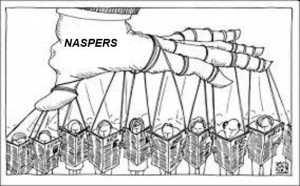
Who is Naspers?

naspers_cartoon

by Albert Brenner

The bewildered herd must be governed by a specialized class whose interests reach beyond the locality. (Walther Lippmann)

Knowledge is power… and power is money. In order to make big money, you need big money.

The first big fund to invest in Naspers was Comerica Foreign Equity. This fund is run by World Asset Management, the investment arm of HSBC. This bank has its main (private) office on Tortola, the largest of the British Virgin Islands.

And guess where Naspers’s investment arm, MIH Holdings Limited, is located? Yes, in the exact same street of this tax-haven of the (mostly) British elite. Just think about the above every time you pay a small fortune to watch M-Net, SuperSport, DSTV, et cetera.

Now, HSBC is the world’s 3rd largest bank with $2.36 trillion in assets. Formerly known as Hong Kong Shanghai Bank Corporation, HSBC is one of the most unscrupulous banks ever. It has been the cash cow of the British elite since its inception as a repository for British Crown opium proceeds accrued during the Chinese Opium Wars.

Armed with a royal charter, Lord Shelbourne started the Chinese opium trade in 1783 with merchants from the East India Company. Shelbourne’s main spin-doctor was Adam Smith. The latter worked for the East India Company, which was formed from the slave-trading Levant Company and later became known as Chatham House. The latter is home to the Royal Institute for International Affairs (RIIA), the second most influential think tank in the world.

The RIIA was founded in 1920. Its American sister institute, the Council on Foreign Relations (CFR), was founded one year later. Walther Lippmann, the Pulitzer-Prize essayist, journalist and mass-media genius was one of the founding members of the CFR. But more about him later. Needless to say, these two organizations, the RIIA and CFR, work hand in hand.

Now, the CFR is run by some of the best brains in America. They are truly exceptional people. They basically run the State Department, the CIA and are connected to nearly everybody that matters in the business and academia in America, and globally.

The CIA operates under the cover of various organizations when it comes to furthering America’s strategic and economic interests. The Ford Foundation is one of the main fronts of the CIA (i.e. the CFR).

In June 1985, this foundation hosted the first ever meeting between the ANC and the Broederbond (i.e. the NP).

The conference took place in Glen Cove, Long Island on June 1st. The main players were Professor JP De Lange (Head of the Broederbond) and ANC officials, Thabo Mbeki, Mac Maharaj and Seretse Choadi.

This meeting did not produce the results the CFR were hoping for. So they summoned the (economic) artillery, David Rockefeller.

Along with being a CFR director for 46 years, David Rockefeller served as chairman of the board from 1970-85 and was the organization’s honorary chairman till 2001. During this time, he was also chairman of Chase Manhattan Bank.

On 31st July 1985, Chase Manhattan decided not to roll over South Africa’s debt. Apparently Pik Botha’s traitor heart nearly stopped beating: “I will never forget the night of July 31 when [Minister of Finance] Barend du Plessis phoned me … [He said]: ‘Pik, I must tell you that the country is facing inevitable bankruptcy … The process has started.'” (source).

The rest is history.

So what has this got to do with Naspers? Well, it just shows that Naspers is just another appendage of interest groups beyond the borders of South Africa. In other words, it does not serve the interests of South Africans. But then, neither do other media giants in South Africa.

Caxton/CTP’s chairman in the early 1990s was Van Zyl Slabbert, who also became the chairman of the Johannesburg Stock Exchange. Slabbert was the useful idiot of CFR member George Soros. The latter, through his Open Society Foundation, sponsored Slabbert and super-useful idiot Max Du Preez… especially with his anti-Afrikaner Vrye Weekblad newspaper.

So, every time you hear about the Davos Afrikaner called Koos Bekker, the big boss of the 33rd largest media company in the world called Naspers (worth R344 billion or $34,88 billion) just know that he is just another witting puppet on an Anglo-American string.

He is just like those rich Boer farmers who became hensoppers during the Anglo-Boer War… selling out their own people purely for profit. Nothing more, nothing less.

Meaning that the “Who is Naspers?” question is not really that interesting. The really interesting question is the “why” behind Naspers.

Answering this question will take us through the wonderful worlds of Baudrillard (e.g. see my article Mandela’s Empire), Noam Chomsky’s Manufacturing Consent: The Political Economy of the Mass Media, the Washington Consensus, Bretton Woods, Walther Lippmann’s  Public Opinion… all the way back to Edmund Husserl`s phenomenology (e.g. see my article Why Mandela).

It is a fact that people can only make sense of Reality through “ideal meanings”. Those ideal “pictures in your head” prevent you, more often than not, to “… come to judgment by critical thinking” (Walther Lippmann).

Journalism is “intelligence work” and journalists are a link between policymakers and the public, according to Lippmann.

Meaning that journalists (and the media companies that employ them, e.g. Naspers) always sanitize the Truth at the behest of their pay-masters…

(to be continued)

Zuma guard linked to ‘blue light’ crash

blue_lightThe black BMW which sped through a red traffic light and crashed in Braamfontein was registered to a presidential bodyguard, The Star reported on Thursday.

Maj-Gen Mzingaye Mxolisi Dladla, of the police’s presidential protection service, reportedly refused to comment to the newspaper about the car, which was reportedly part of a blue light convoy.

“I don’t discuss anything about my unit, to any paper,” he was quoted as saying.

According to The Star, presidency spokesman Mac Maharaj said he could not comment on the crash, as “all blue light protection is under the SAPS, you need to ask them”.

It was reported that President Jacob Zuma retained Dladla as his personal bodyguard after he was dismissed as deputy president in 2005.

When Zuma became president, Dladla was one of the bodyguards in Zuma’s closest circle, known as the Echo Group and was appointed head of the presidential protection service.

On Tuesday, the car reportedly registered to Dladla was involved in a crash near the Nelson Mandela Bridge in Braamfontein.

When photographers began taking pictures of the crash, the car’s number plates were removed.

Johannesburg metro police spokesman Chief Superintendent Wayne Minnaar told the newspaper the police would investigate the crash. – Sapa

Nelson Mandela: journalists moved from hospital

A fence was erected on Monday evening next to one of the entrances of the Pretoria hospital where former President Nelson Mandela was believed to be.

Police officers set up the barrier where numerous journalists had been camped out, close to a busy street in Arcadia. Tshwane metro police officers ordered journalists to move their cars.

There was speculation that President Jacob Zuma was expected to arrive at the hospital.

Around 10 uniformed policemen stood at the entrance, along with officers in civilian clothes. Several police cars were driven into and out of the hospital. All vehicles entering the hospital premises were inspected.

Earlier on Monday presidency spokesman Mac Maharaj said Mandela was receiving intensive care.

“Today the doctors are saying his condition is unchanged,” he told reporters from his office at the Union Buildings.

“He is under expert attention and they [doctors] are doing everything to keep him comfortable.” Maharaj said a report in The Star suggesting the Mandela family had barred ANC and government officials from visiting Madiba was unfortunate.

“It’s very unfortunate that one particular newspaper chose to run with that as a headline. I’ve read that report and it has no single source it attributes to, except three unnamed sources.

“There are restrictions which arise from the fact that Madiba is under intensive care. Those are medical restrictions to control movement of people [to exclude the] possibility of visitors bringing infection into the environment,” said Maharaj.

The Star newspaper reported that the Mandela family had taken charge of the 94-year-old Nobel Peace Prize winner’s hospital stay, banning everyone, including government leaders and senior party officials, from visiting him.

The African National Congress on Monday said it was unaware of this.

Maharaj confirmed Zuma was scheduled to visit Mandela in hospital, but did not say when.

“As head of state, president Zuma will visit at the appropriate time. We just want Madiba to get better.” ANC MP and Mandela’s ex-wife, Winnie Madikizela-Mandela, had also been at the hospital. – Sapa

Mandela in intensive care: Mac Maharaj

Journalists waiting for news during a previous Mandela hospitalisation

Former president Nelson Mandela is receiving intensive care at a Pretoria hospital, presidency spokesman Mac Maharaj said on Monday.

“Today the doctors are saying his condition is unchanged,” he told reporters from his office at the Union Buildings.

“He is under expert attention and they [doctors] are doing everything to keep him comfortable.”

Maharaj said a report in The Star suggesting the Mandela family had barred the ANC and government from visiting Madiba were unfortunate.

“There is no substance to that. It’s very unfortunate that one particular newspaper chose to run with that as a headline. I’ve read that report and it has no single source it attributes to, except three unnamed sources.

“There are restrictions which arise from the fact that Madiba is under intensive care. Those are medical restrictions to control movement of people [to exclude the] possibility of visitors bringing infection into the environment,” said Maharaj.

The Star newspaper reported that the Mandela family had taken charge of the 94-year-old Nobel Peace Prize winner’s hospital stay, banning everyone, including government leaders and senior party officials, from visiting him.

The African National Congress on Monday said it was unaware of this.

Maharaj said President Jacob Zuma was scheduled to visit Mandela in hospital, but did not say when.

“His [Zuma’s] focus now is to allow the medical team every opportunity to concentrate on their job. To allow the closest relatives to go there and be close to him. As head of state, president Zuma will visit at the appropriate time. We just want Madiba to get better.”

ANC MP and Mandela’s ex-wife, Winnie Madikizela-Mandela, had been at the hospital.

Maharaj said the 48 hours between Saturday to Monday, when there was no update on Mandela’s health, was caused by the lack of progress on the elder statesman’s health.

“You would not want a repetition of the same thing over and over. I know you want him to get better, but we can’t give you good news if it’s false. We can’t give you bad news when it’s not true.

Local and international journalists spent the day outside the two entrances to the Pretoria hospital where Mandela was believed to be. Security guards had been posted at the entrances.

More than 10 broadcast vans were there. Some journalists had erected small tents and others had generators. Passers-by stopped to ask about Mandela. – Sapa

No cultural group ís to blame for gender-based violence – SA presidency

The campaign to fight violence against women and children must be waged by all South Africans, black and white. In addition, no single cultural group can or should be blamed for this serious scourge which affects all sectors of society.

The Presidency has noted comments attributed to Minister of Women, Children and Persons with Disability, Ms LuluXingwana. Clarity from the Ministry has not yet been obtained with regards to the comments.

We wish to assure the Afrikaner community and all South Africans that government’s commitment to non-racialism and diversity as enshrined in the Constitution of the Republic,remains unwavering.

The contribution of Afrikaner males in the fight against gender-based violence and also generally to the building of a united, caring and prosperous South Africa, is as valuable as that of all South Africans. The nation should focus energies on finding solutions.

Enquiries: Mac Maharaj on 079 879 3203.

Issued by: The Presidency

Pretoria

SA’s OK, says Presidency

President Jacob Zuma

The Presidency moved to counter the negative publicity SA has been attracting abroad, with President Jacob Zuma’s spokesman,, insisting it was “grossly incorrect” to suggest SA was “on a downhill slide”.

Maharaj was responding to last week’s cover story by the influential business journal The Economist, headlined “Cry the beloved country – South Africa’s sad decline”.

The assertions in the article “cannot go unchallenged as they are so misleading”, Maharaj said in a statement issued on Sunday.

“It is grossly incorrect to suggest that South Africa is on a downhill slide.”

He said while two ratings agencies may have downgraded SA’s creditworthiness, many other countries had experienced the same fate.

“It is a sign of the times. The world is going through a period of serious economic upheaval,” Maharaj said.

“Despite the challenges, South Africa is getting many things right,” he insisted.

The article notes: “According to the World Economic Forum, South Africa ranks 132nd out of 144 countries for its primary education, and 143rd in science and maths.”

It also notes that since Nelson Mandela retired in 1999, the country had been “woefully led”.

Maharaj said SA was privileged to have had Mandela as its first democratically elected president. However, this did not make the country immune from economic, social or political challenges, more so given the legacy arising from colonial oppression and apartheid, he said.

“Despite the challenges, South Africa is getting many things right.

“The economy possesses the necessary dynamism to position the country as a competitive player in a difficult global economic environment. In direct contrast to the Economist article, a strong vote of confidence on South Africa was given in the last week by the international business community with the country’s recent inclusion in Citigroup’s World Government Bond Index.”

Maharaj said SA’s success was visible when benchmarking the country against other emerging market economies such as the Brics and Next 11 countries.

“With regards to financial market development, South Africa ranks first among the Brics nations and third overall in the world.”

His statement came as Zuma continued to come under attack at home, particularly over the spending of hundreds of millions of rand of public funds on his private homestead at Nkandla, KZN.

United Democratic Movement leader Bantu Holomisa accused Zuma of underestimating South Africans’ intelligence and misleading the country by claiming last week that a large part of the work at the estate had been done by his family.

City Press on Sunday said it had documents revealing that multimillion-rand payments to at least nine contractors had been authorised last Friday, just days before Zuma emerged from a summit of government, business and labour to address the crisis in the mining sector, where it was agreed that private sector executives would commit to a salaries and bonus freeze.

But while “Nkandlagate” has provided the opposition a stick with which to beat the ANC, it is the wildcat strikes, violence and intimidation disrupting production in the mining sector that are causing jitters among investors and that prompted the critical assessments published last week.

The government also came under fire in articles in The Wall Street Journal, Washington Post and Financial Times following the decision by ratings agencies to downgrade SA’s sovereign debt rating.

Cosatu has called on Police Minister Nathi Mthethwa to spur the police to get to the bottom of “the wave of violence, intimidation and killings of National Union of Mineworkers shop stewards and activists. Cosatu said it believed there was a concerted campaign to “wipe out” NUM in the beleaguered platinum sector. – Cape Argus