 Former British Prime Minister Margaret Thatcher was an “attractive” woman, who did more to help South Africa to “get rid of apartheid” than any other leader in her time, former foreign affairs minister Pik Botha said yesterday.
Thatcher died yesterday following a stroke. She was 87.
Botha, who served as the last foreign minister of the apartheid government, said while Thatcher was a staunch opponent of apartheid, she “listened”, and “understood” the issues that South Africa faced in abolishing it.
“She and [US President] Ronald Reagan did more to move South Africa to get rid of apartheid and towards a new constitution than any other leader outside the country,” said Botha, who served in the first post-apartheid government from 1994 to 1996 under President Nelson Mandela. He joined the ANC in 2000, but later criticised some of its policies.
The ANC’s tribute to Thatcher differed sharply from Botha’s in its assessment of her role in the dismantling of apartheid.
Though acknowledging that she was a major leader on the world stage, the ruling party said: “The ANC was on the receiving end of her policy in terms of refusing to recognise the ANC as the representatives of South Africans and her failure to isolate apartheid after it had been described as a crime against humanity.”
Botha met Thatcher in the early 1970s when he and other officials were invited to the UK. He later had several run-ins with her, when the two countries clashed on issues such as the Falklands war and the deportation of the “Coventry Four”, a group of South Africans arrested in London while attempting to smuggle arms to South Africa.
But, said Botha, “she helped me in so many ways to keep South Africa going internationally”.
He remembers a “historically critical moment”, on April 1 1989 – the day UN Resolution 435 was to have been implemented in then South West Africa (Namibia). The resolution was a UN-adopted proposal for a ceasefire between the South African Defence Force and the People’s Liberation Army of Namibia, and a UN-supervised election in the country.
“[Thatcher and I] met at Windhoek Airport and we heard that Swapo had come over the [Namibia/Angola] border in their thousands, heavily armed,” said Botha.
“Our troops were contained in their barracks, and she said [that] under no circumstances were we allowed to release them to fight the incursion. But she then helped me persuade UN Secretary-General Pérez de Cuéllar to allow the SADF troops to fight the incursion. If our troops weren’t freed to repel them then South West Africa would not have gone to elections peacefully,” said Botha. “Her death saddens me tremendously,” he added.
ANC spokesman Jackson Mthembu said: “Her tenure as prime minister redefined British politics and public administration and these impacted greatly on European politics and governance. Long after her passing on, her impact will still be felt and her views [will be] a subject of discussion.”
Former president FW de Klerk said Thatcher was a steadfast critic of apartheid. But, he added: “She consistently, and correctly, believed that much more could be achieved through constructive engagement with the South African government than through draconian sanctions and isolation.”
Social media was overflowing with people writing “Ding Dong!” in reference to the Wizard of Oz song, and posting pictures of themselves drinking in celebration of “Margaret Thatcher Death Day”.
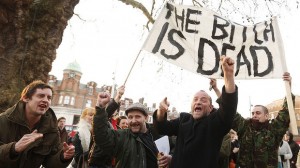
Hundreds of people took to the streets in Brixton, an area of south London in Britain which suffered serious rioting in the 1980s, to celebrate Lady Thatcher’s death. Holding notices saying ‘‘Rejoice – Thatcher is dead’’, about 200 people gathered in the neighbourhood, a hotspot of alternative culture, and toasted her passing by drinking and dancing to hip-hop and reggae songs blaring from sound systems.
‘‘I’m very, very pleased. She did so much damage to this country,’’ said one man brandishing an original newspaper billboard from 1990 announcing Thatcher’s resignation. Others scrawled ‘‘Good Riddance’’ on the pavement.
‘‘We’ve got the bunting out at home,’’ said Clare Truscott, a woman in her 50s wearing a sparkly beret and holding a homemade sign reading ‘‘Ding dong, the witch is dead’’.
‘‘I’m from the north, where there were no jobs, where the industry was rapidly disappearing, and her policies ensured it went more quickly.’’
Brixton was the scene of fierce riots in 1981, two years after Lady Thatcher became prime minister. Carole Roper, a full-time carer in her 50s from north London, said: ‘‘We’re here to celebrate her death.’’
Sipping from a can of beer, she insisted: ‘‘I don’t think it’s vindictive. It’s not so much about the death of Thatcher but what she has done, the policies she introduced to this country.‘‘
Compare the coverage to that when Chavez died – she’s being eulogised. It’s been wall to wall coverage on the BBC, but she did nothing to help the poor people of this country.’’
In the Scottish city of Glasgow more than 300 people gathered to hold their own impromptu ‘‘party’’. Anti-capitalist campaigners shouted, ‘‘Maggie, Maggie, Maggie’’ while the crowd replied ‘‘dead, dead, dead’’.
Among her old foes many – at least temporarily – laid aside old grudges and paid public tribute to her achievements as Britain’s first female prime minister.
But others did not hesitate to express their continuing disgust and anger at Lady Thatcher’s policies and her (in their words) disastrous, divisive impact on Britain’s industry and people.
George Galloway, the Respect member of parliament for Bradford West and former Labour firebrand, led the charge with a simple Tweet: “Tramp the dirt down”.
It was a reference to a 1988 Elvis Costello song of the same name, a virulent attack on the then prime minister that contains the lines “when they finally put you in the ground / I’ll stand on your grave and tramp the dirt down.”
Mr Galloway added on Twitter: “Thatcher described Nelson Mandela as a ‘terrorist’. I was there. I saw her lips move. May she burn in the hellfires.”
His Twitter feed quickly became an echo chamber for criticism of Thatcherite policies, which one commenter said were “selling off public utilities, encouraging personal greed and befriending murderous dictators”.
On Facebook, a campaign was launched to take the Wizard of Oz song ‘Ding Dong! The Witch is Dead‘ to No. 1. – AFP, additional reporting by Sapa
IN HER OWN WORDS
“I don’t think there will be a woman prime minister in my lifetime.” – as Education Secretary in 1973. She became Britain’s first woman prime minister in 1979.
Where there is discord, may we bring harmony. Where there is error, may we bring truth. Where there is doubt, may we bring faith. And where there is despair, may we bring hope.” – Quoting St Francis of Assisi, on her 1979 election victory.
“I am not a consensus politician. I’m a conviction politician.” – 1979
“I don’t mind how much my ministers talk, as long as they do what I say.” – 1980
“We had to fight the enemy without in the Falklands. We always have to be aware of the enemy within, which is much more difficult to fight and more dangerous to liberty.” – On the 1984-85 miners’ strike, which provoked some of the fiercest union opposition to her policies.
“To those waiting with bated breath for that favourite media catch phrase, the U-turn, I have only one thing to say: You turn if you want to. The lady’s not for turning.” – At the 1980 Conservative Party conference to colleagues urging her to soften her economic policies which were raising unemployment.
“This is a day I was not meant to see.” – To reporters the day after surviving a deadly 1984 Irish Republican Army bomb attack on the Conservative Party conference.
“We have become a grandmother.” – On the birth of her first grandchild, 1989.
“No! No! No!” At the House of Commons in 1990, the climax of an anti-European outburst that moved Geoffrey Howe to quit as deputy prime minister and deliver a resignation speech which called for her to be challenged for her job.
“I fight on, I fight to win.” – In November 1990, after failing to win enough votes to avoid a second round in the Conservative leadership contest. She resigned the next day.
“It’s a funny old world.” – On her decision to quit in 1990. – Reuters


