Small towns are collapsing across South Africa. How it’s starting to affect farming

Wandile Sihlobo, University of the Witwatersrand

Farming and agribusiness play a crucial role in sustaining the economies of small towns and rural areas. There is a lot of evidence of this in the economic literature and in the popular media. This dependency has its inherent risks.

International literature tends to focus on the devastation of small towns in times of drought or when farming lobby groups argue for particular policies. In South Africa, a different pattern has emerged. This is when municipalities fail to provide basic services to their communities and businesses. These services include water and sanitation, electricity, roads and technological infrastructure.

South Africa has a three-tier system of governance. National government sets national economic development policy and drives the search for investment by both domestic and international investors. Provincial government plays a big role too in searching for investment and executing government’s policies and programmes. The most successful province has been the Western Cape, which has achieved the status of the country’s technology hub. But where the investors are located within a province depends on municipalities, specifically how well run they are.

South African municipalities are in deep trouble. For many years households and residents have felt the impact. They have resorted increasingly to mounting protests across the country. But lately, there is growing evidence that governance and service delivery failures are also directly affecting the functioning and efficiencies of farming and agribusinesses in small towns.

A case in point is the recent decision by the food and beverages group Clover to move its cheese production from Lichtenburg, a town in the North West province of South Africa, to an existing plant outside Durban in KwaZulu-Natal due to “ongoing poor service delivery”.

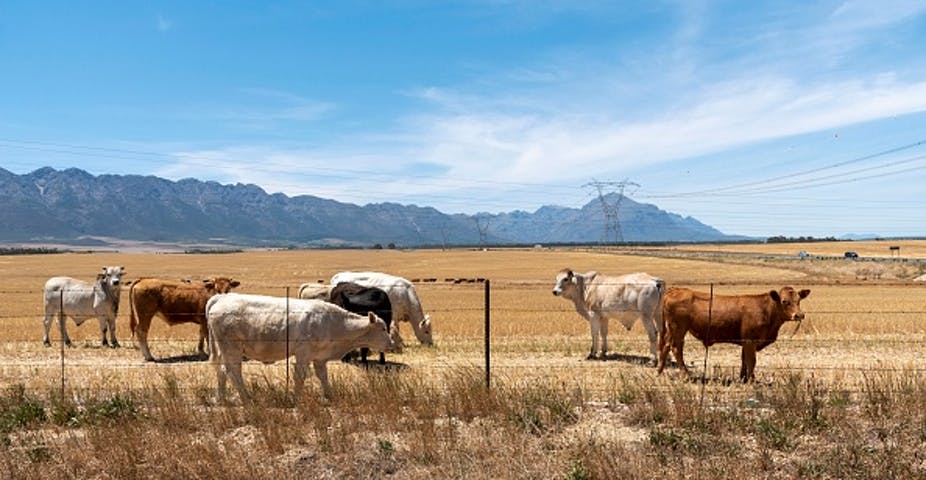
Lichtenburg is part of the country’s maize producing triangle. Three provinces – Free State, Mpumalanga, North West – account for 84% of the country’s maize production, according to latest estimates of the 2020/21 season.

State of collapse

South Africa’s finance minister, Tito Mboweni, recently painted a gloomy picture of the state of municipalities in the country. There are about 278 municipalities in South Africa. Mboweni said that 163 municipalities were in financial distress, 40 were battling to deliver basic services, and 102 had adopted budgets for 2021/22 that they cannot fund.

A growing number are also failing to collect revenue from residents and businesses for electricity, water and property taxes.

Mboweni added:

And, for the first time in our democracy, the national executive has been ordered by a high court to constitutionally intervene in the affairs of a municipality owing to
a financial and service delivery failure.

Municipalities in rural areas and small towns are worst off. A recent study by the Tshwane University of Technology researchers stated that

the level of service delivery in rural communities is less compared to urban areas, and there is no sign of improvement.

Consequences

The multiplier effects of Clover’s decision to relocate are likely to be large. The closure of the firm in such a small town is likely to have a number of negative spillover effects across the local economy.

The company, according to official statements from the government, provided 380 permanent jobs and 40 temporary jobs. It also employs 20 general workers and 20 truck drivers and cleaners.

In addition, the plant gave farmers market access for their produce, and a range of businesses bought and sold products from the company. The income from these activities would have supported many other businesses in the community.

Clover is not the first major company to decry poor municipal services. There’s the long running case of Astral Foods, a poultry producer that also supplies animal feed, and the Lekwa Municipality. Astral has lost millions of rands in production because of failures by the municipality in the Mpumalanga province to provide its poultry plant with water and electricity.

These two cases illustrate how efficiency and economic sustainability of agribusinesses depend on delivery of basic services. Without them, levels of investment in the businesses will shrink in such towns. Importantly, this may affect the sustainability of agribusinesses as some might incur more costs as they try themselves to provide the services that were supposed to be provided by local governments.

The farmers face a similar challenge, directly and indirectly. The agribusiness provides a range of solutions and market access to local farmers. If agribusinesses’ sustainability is threatened, farmers suffer too. More directly, poor roads, unreliable electricity supply and water supply directly affect the profitability and sustainability of farming operations.

Importantly, these are all entities that provide job opportunities to the least skilled South Africans and indirectly sustain the communities around small towns.

The way forward

President Cyril Ramaphosa set out an economic reform and recovery agenda for the country in October 2020. In it he identified agriculture and agro-processing (food security) as one of the drivers of economic growth and job creation, especially in small towns.

But a vibrant agriculture and agribusiness won’t develop if poor service delivery by municipalities continues.

There are some basic practical interventions the government could make. These include ensuring that a municipality has competent management, financial officers, civil and electrical engineers, as well as competent political leadership.

The Financial and Fiscal Commission, an independent constitutional advisory body on financial fiscal matters in the country, recently argued municipalities should look closely at their wage bills. This would ensure that salaries didn’t crowd out money for critical service delivery functions. These include waste removal, waste management, sewerage systems, roads and water provision.

These improvements need to happen simultaneously and not before or after agriculture revitalisation, which is supported by the government’s Agricultural and Agro-processing Master Plans. These seek to expand and grow South Africa’s agriculture and agro-processing.

But a healthy farming sector rests on towns that are functional and that have the basics in place.

This is a challenge that the South African government should face head-on.The Conversation

Wandile Sihlobo, Visiting Research Fellow, Wits School of Governance, University of the Witwatersrand

This article is republished from The Conversation under a Creative Commons license. Read the original article.
Two farm attacks in two days, Brendin Horner, 21, tortured and killed

It is clear that a slow war is being fought against South Africa’s white farmers and this slow racial war is increasingly also being taken to towns and cities. The murder of a white farm manager, Brendin Horner (21), serves as proof that the South African government’s rural safety plan is failing.

Horner was tortured and murdered on the farm De Rots near Paul Roux on the evening of Thursday 1 October 2020, in the Free State. Bheki Cele, the South African Minister of the Police, recently said that “farmers must not complain if they get hurt”, suggesting that the victims of farm attacks were the ones who were to blame if they become the targets of violent crime.

Horner’s lifeless body was found tied to a steel pole about 100 metres from the farm gate on the farm De Rots early on Friday morning 2 October. He was in a standing position with a rope tied around his neck.

He had been stabbed several times and it was clear that he had been in a violent struggle to defend himself. Sources told FWM that his knuckles were bloodied from trying to fight back.

Herkie Viljoen of Free State Agriculture told Netwerk24 that Brendin went to visit another farm in the area on Thursday evening where his father Robbie lives, but left before 1900. He never arrived home.

His girlfriend Lenize Taljaard waited for him on De Rots and when Brendin did not come home, the Taljaard and Horner families started a search for Brendin. In the morning they called in the help of the police.

Brendin’s cap with a knife on top of it was found near the farm gate and then his body which was bound to a pole. His vehicle was found abandoned in the area a distance from there and there were blood stains on the seats.

Brendin worked for Gilly Scheepers, a well known farmer and owner of Bloukruin Farm. A shocked Scheepers told Netwerk24 that attackers came to kill the youngest of his employees for an unknown reason because he did not have enemies.

Meanwhile, the ANC clearly plans to implement collective farming, or a kolkhoz system similar to the disastrous project from the former Soviet Union. Ernst Roets of Afriforum has pointed out that the 900 state farms that the ANC says it will give to new black owners will remain in State hands. New occupants will just rent from the State denying them private ownership.

The fact that the ANC is now looking for new black occupants for their state farms also indicates that whatever was done on the land previously, has failed.

Another farm was attacked the very next day. On Friday 2 October 2020 a vehicle with 5 black occupants arrived on the farm of Paul Da Cruz in the Losberg area in Fochville, just after Paul and a worker left.

The occupants of the vehicle asked to speak to Paul’s wife Karen. The mistake that she made was to ask them what they wanted when an owner should be enforcing access control instead.

The strangers took out a firearm and detained Karen. The initial 5 attackers were joined by 4 others. Paul was then overpowered when he arrived home.

Paul da Cruz later told Netwerk24 that the attackers took 2 laptops and a number of firearms that were in the safe after threatening that they would hurt them if they did not hand over the firearms.

Da Cruz also said it was clear that the attackers knew exactly what was happening on the farm yard and knew the layout. Which means the attackers had either surveilled the place beforehand or had informants on the property.

Fortunately in this instance the family was not injured but they were obviously traumatized.

Farm attacks and murders are out of control and cannot be considered ordinary crimes, particularly when the cruelty associated with these incidences is taken into account, South African opposition party, the Freedom Front Plus said in a statement.

Karel Combrinck: Too good to be true

Recently it was announced that very large sums of money emanating fom various sources have been ear-marked for aid to the South African government to help it address problems arising from the Covid-19 epidemic. An amount of 4,3 billion Dollars (US$ 4 300 000 000) was among others allocated by the International Monetary Fund. Even more amazingly, a loan was made to the South African government by (believe it it not ) by the African Development Bank. As is generally known in South Africa, a considerable portion of these funds have already been stolen or misappropriated (in South Africa “misappropriated” is a euphemism for stolen). How much, if any,  of these funds will ever go towards relieving the plight of ordinary South Africans remains to be seen. What we do know is that nothing will go to South African whites as has been decided by the racist ANC government.

Questions that arise are first of all, where do the immense sums of money come from which the IMF so lavishly throws around and whence the generosity towards the incompetent and corrupt South African government? The question is made more poignant by the fact that all three the most important credit-rating agencies have awarded South Africa the well-deserved distinction of junk status.

The IMF was established in 1944 at the UN Monetary and Financial Conference in Bretton Woods, USA. The original purpose was to place the world economy back on track after the devastation of the World War. Twenty-nine countries signed the treaty at the time and 189 countries subsequently joined. The activities of the IMF are therefore funded largely by contributions made by member states on a quota basis, that is to say each member contributes according to the size of its economy. The moneys in the final instance come from the pockets of ordinary tax payers as usual.

A further question concerns the generosity of the IMF towards South Africa. Voices have been heard expressing surprise, indeed dismay,  at the billions “lent” to a bankrupt state from which there is little chance that the moneys will ever be recovered. Over the explanation for this apparent idiocy we can only speculate. A purely economic initiative it is clearly not. One possible explanation is that the ” international community ” represented in the IMF which were largely responsible for the creation of a junk democracy in South Africa cannot stand by idly while their creature is failing. Under normal circumstances too many questions would have been asked, but now, of course, they have the Covid-19 smokescreen to hide behind.

In the unlikely event of the loan ever being repaid after having been plundered,  then it will be at the expense, once again, of the South African taxpayer. Paying taxes is the one right to which white South Africans are fully entitled. But, we suppose, this is what the international community regard as ” fair “.

There is also the possibility that in the case of non-repayment of their loan that the IMF could force the South African Government to sell national assets as happened in Greece where the Greek government had to sell their main sea port of Piraeus, a number of islands, historical monuments and art works as well as fourteen airports in order to repay their loan debts. It is dangerous to place oneself at the mercy of the great financial forces of this world. Such concerns are however immaterial in the eyes of the ANC fat cats interested only in the short-term gravy train. And at the moment, for them, the going is too good to be true.

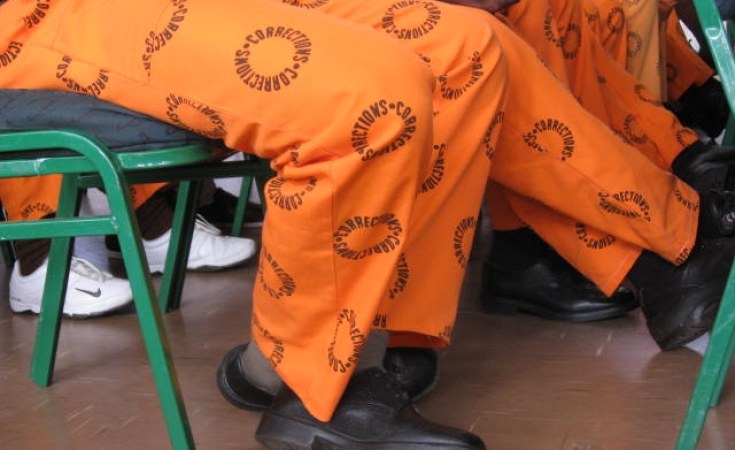
South African prisoners riot for a ‘mass release’, citing Covid-19

Whereas President Cyril Ramaphosa already released 19 000 inmates out of a total prison population of 155 000 in May this year, prisoners in Gauteng province are rioting for another mass release. They claim that they are at risk of the Covid-19 virus that has already cause a number of deaths among both warders and prisoners.

One of the prisons where riots have been noted, is the vicious “Sun City” prison in Soweto, ironically nick-named after the famous casino and hotel complex in the former homeland of Bophutatswana.

The country’s Department of Correctional Services (DCS) has declines to react to their demands, saying that the riots are being “orchestrated… by unruly elements intent on forcing the government into a mass release of prisoners”

Prisoners are alleging that not all of the 19 000 “low-risk inmates” have been freed, following upon Ramaphosa’s parole announcement. According to them, overcrowding is still at 30% in all prisons. Despite a rise in South African crime rates and convictions since the ANC regime took over, the regime has not built any new prisons.

A DCS spokesperson, Singabakho Nxumalo, said out that infections in prisons have been rising in line with national trends; that 1012 active cases existed for inmates and officials, with only 88 active cases out of a community 146 732 offenders countrywide.

Sources within the prisons, however, said over the past week alone, clinics, kitchens, security and records offices at Sun City – Johannesburg Correctional Centre – and at Kgosi Mampuru II in Pretoria, had to close down as numbers of Covid-19 infections increased inside the facilities.

An anoymous inmate told the Sunday Independent newspaper “there were delays in the preparation of food after some prisoners were quarantined because of the virus” at the hat a Kgosi Mampuru II prison in Pretoria (formerly Pretoria Central Prison).

An internal memo posted on the prison walls at the facility announced that it had 28 active cases and one death. But an official said the notice was two weeks out of date because more people had tested positive and a colleague was buried just last week.

“There are inmates who worked in the kitchen, who are currently under quarantine. These are inmates who prepared meals for us, so we’ve seen a delay in our meal preparations.

“This is supposed to be a rehabilitation centre, but there is no rehabilitation, whatsoever.

“We were told that 19000 low-risk inmates would be released to curb the spread of the virus, but not even 40 were released from this side, Kgosi Mampuru,” he said.

However, Nxumalo is adamant that there isn’t a crisis in correctional facilities saying: “Our officials do report for duty. Those who were in direct contact with positive cases have been placed in quarantine, so as isolating those who have tested positive.

“No sections in any of our facilities have been closed down due to Covid-19. We decontaminate sites where there are positive cases and open them for operations.

“This is going to be the norm moving forward across all institutions in the country”.

He said a picture is being painted of a chaotic environment with the hope that the public will be mobilised and pushed for the mass release of prisoners.

“Fortunately, numbers do tell the truth. Unfortunately, some individuals purporting to be representing the interest of offenders have engaged in an offensive campaign, misinforming the public.

“Only 195 inmates in the whole country have the virus in their system and thus require daily monitoring and treatment.

“It must be emphasised that such will never happen (the mass release). We live in a democratic state where the rule of law is supreme.”

We’ll confiscate the assets of white South Africans – Ace Magashule

Last Saturday the ANC secretary general, Ace Magashule, who has himself been accused of large-scale corruption, stated that the assets of white South Africans will be confiscated without compensation. He sketched a kind of Marxist-Leninist future for the country in which private property, banks and industries will be nationalised and “Africanised”.

“Our people demand service delivery, sustainable jobs, efficient health services, and an accountable government,” he said in a speech loaded with rhetoric while delivering the annual Walter Sisulu memorial lecture in Bloemfontein in the Free State.

Their hope still lay with the ANC, which dare not betray them. The people were refusing to be subtenants and squatters in the land of their birth. This was the current challenge – to better the quality of life of the people, and this could only be done when the ANC remained an unapologetic fighting force, he said.

“We must increase the capacity of the ANC and alliance partners to wage an unrelenting struggle against the theft of our wealth and our dignity.”

Economic self-determination of the African people was the next vital frontier of struggle. “We can never waver or falter in our determination to achieve that. Africans must build our own industries, and manufacture the very goods that we need. In fact, to put it bluntly, we must consume what we produce.

“We must go back to basics and rebuild our own economy, starting with the township economy. We too have come of age, and are willing to take charge of our affairs. [Former president] Nelson Mandela once warned us that: ‘Resentment is like drinking poison and then hoping it will kill your enemies’.

“So it must not be argued that we are motivated by hate. We are motivated by the quest for justice. It is an irrefutable truth that for long as the poor are poor, the rich cannot sleep at night. As we remember comrade Walter Sisilu we dare not betray our true struggle for cheap media headlines, nor for the crumbs that come from the well laden table of white monopoly capital.

“We dare not betray our people with a view to gain favours from those who owe us our very wealth. Comrades, we must be resolute and steadfast. We are heading for troubled times, and we are surely coming for what is ours,” Magashule said.

The ANC was unwavering in its determination to implement the resolutions of the 54th national conference.

“Our determination is to foster a new momentum for the fundamental radical economic transformation (RET) of our socio-economic landscape. Our mandate is to expropriate land without compensation… to nationalise the Reserve Bank… to transform the financial institutions and banks in order to serve the needs of our people… to stop privatisation of state-own[ed] enterprises… the transfer of the political and socio-economic power into the hands of the overwhelming majority of our people, Africans in particular, and the black people in general,” Magashule said.

South Africa’s land expropriation will be aimed at ‘whites only’ – minister

The land expropriation policy of South Africa’s ruling party, the ANC, will specifically target white people, according to Zweli Mkhize, the minister of cooperative governance and traditional affairs. Neither the property of black citizens nor land controlled by traditional (black) leaders “would be targeted”, he said.

The ANC, which has a long-standing and close relationship to the South African Communist Party, is an Afro-Marxist party that has long threatened to nationalise all farmland in South Africa. Last year the party adopted a policy of “land expropriation without compensation”, which was also adopted by the South African parliament in February this year (2018).

The party also wants to change the South African constitution to allow it to confiscated land at will from white citizens.

The government met with representatives of the National House of Traditional Leaders over that body’s worries about the planned redistribution process, Mkhize’s ministry said in an emailed statement on Friday.

“A wrong impression has been created that the discussion on land expropriation includes land in the hands of traditional leaders,” Mkhize stated.

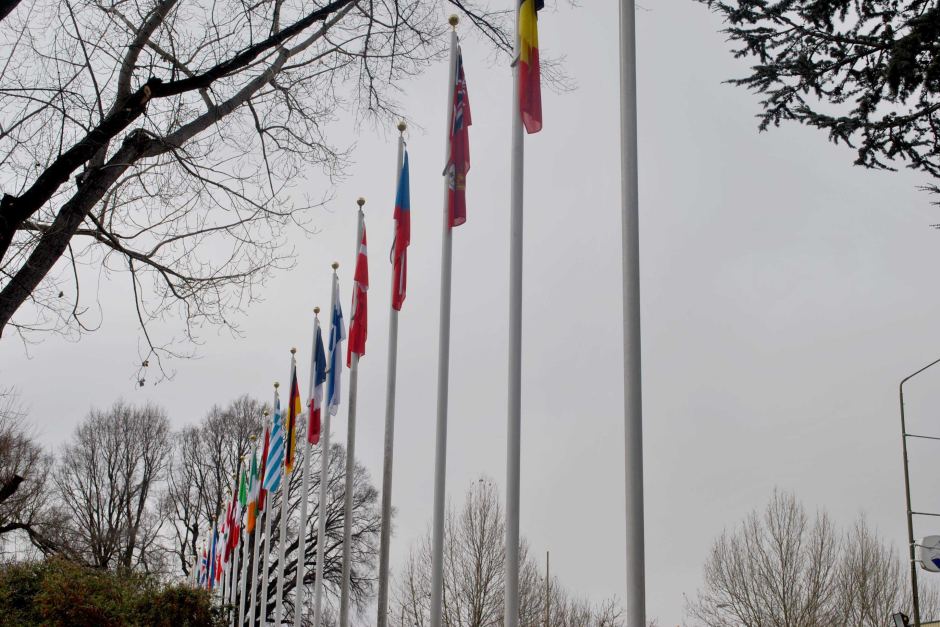
ANC ambassador in Australia tries to have old SA flag removed from Cooma

The Cooma-Monaro Shire Mayor has defended a decision to continue flying the former South African flag at Cooma in south east New South Wales.

The flag is part of the historic Avenue of Flags along the town’s main street, which was put up to represent the nationalities of workers involved in building the Snowy Mountains Scheme.

The flag’s presence has been the subject of controversy in recent years, with some ex-pats calling for the old flag to be replaced with the current one.

The South African High Commission has been in discussions with the Cooma-Monaro Shire Council over the issue, and the council has now decided to fly South Africa’s present day flag in a separate location near the town’s Centennial Park.

But Mayor Dean Lynch said there was still no need to take down the former South African flag.

“They’re historic flags; this is nothing about politics,” he said.

“They’re the flags that people lived, worked and died under while the Snowy scheme was being built.”

South African High Commissioner Sibusiso Ndebele said he raised concerns with the council after seeing a report online that referred to “some sort of honouring of the apartheid flag” in the town.

“We wanted to check up [with the council] because the Australian Government had taken a position that … they supported the creation of a democracy, so Australia can’t be seen to be supporting the old,” Mr Ndebele said.

“That’s how I understood it until we had discussions with Mayor Dean Lynch last Friday.

“He took us to lunch and explained they have got this historical flag avenue that represents the countries that built the hydro electric power in the late 50s.

“We are arranging now on our national day to put up a flag which will take pride of place there at Cooma of the South African flag as it exists now alongside with other flags.”

Cr Lynch said the old South African flag was not the only one in the town that had “negative” political associations.

“We fly a number of historic flags, one of them being Yugoslav flag which of course was another oppressive regime,” he said.

“But also there’s other old flags there – the old Canadian flag, the old American flag minus the star.

“Those flags are the flags of the day and that’s just history.” – Australian Broadcasting Corporation

One shot, bricks fly at ANC meeting

Bricks were thrown and a branch member was shot during a general meeting of a Limpopo ANC branch on Saturday.

The incident took place apparently because there were differing opinions on who should be nominated as treasurer after the position was left vacant by the late Education MEC Thembi Nwendamutswu.

Branch member Bigboy Nkuna was shot and injured during a struggle with another member.

Police said the fight happened at Relela in Mapani.

It was alleged that the victim was chasing the armed man before he was shot in the stomach.

Police spokesperson Colonel Ronel Otto confirmed a case had been opened, but said no one had been arrested.

Otto said a group of angry ANC members retaliated by torching the house and car of the suspected gunman.

Source: News24

Government to present affidavit on Bashir’s departure

Government is expected to present an affidavit to the High Court in Pretoria on Wednesday on why it let Sudanese President Omar al-Bashir leave the country against the interim court order prohibiting his departure.

The court also ruled that al-Bashir should be detained under an International Criminal Court (ICC) indictment on war crime charges.

Government will have to explain why it allowed the Sudanese President to leave the country.

Government earlier said it offered al-Bashir immunity because he was attending an African Union summit in Johannesburg. The ICC in Hague indicted al-Bashir for war crimes in Sudan’s western Darfur in 2003.

The ANC is calling on government to temporarily suspend South Africa’s membership of the International Criminal Court.

It follows controversy over Sudanese president Omar al-Bashir’s recent trip to South Africa.

The ANC has already urged government to work with other African states to protect the ICC from so-called undue influence from non-member states.

The party says the ICC is no longer useful.

Instead, the ANC says the court has allowed itself to be a proxy for powerful non-member states who want to persecute African leaders and effect regime change on the continent.

Opposition MPs said the government had undermined the rule of law it had sworn to protect by helping al-Bashir, who is facing genocide and crimes against humanity in the International Criminal Court, leave South Africa.

The ANC insisted the issue was sub judice.

Said DA MP Stevens Mokgalapa: “The government, under President [Jacob] Zuma, has failed to uphold the constitution, has failed the people of South Africa and those who were murdered and displaced in Darfur.”

DA MP James Selfe asked the government to stop referring to al-Bashir as “his excellency”.

“The only thing he is excellent at is killing people,” said Selfe.

He pointed out that al-Bashir stood accused of a leading role in the genocide of 300000 black Africans.

Several MPs acknowledged that the International Criminal Court is unfairly targeting African leaders.

The Economic Freedom Fighters’ Chief Whip Floyd Shivambu says the court’s prosecution selection process needs to be reviewed.

“We do not agree with the selective prosecution of the ICC for Africans, because it looks like it has only existed for Africans since its establishment.”

“Also it was naive for whoever took the government to court to think that it can be wise to arrest a head of state here in South Africa. It was going to lead to instability in the origin country where he came from, it was going to even threaten our security in South Africa, but also it was going to lead to the undermining of the statute of South Africa in the international context,” Shivambu added.

COPE leader Mosiuoa Lekota said what had been done in the name of South Africa was a serious crime.

The Freedom Front Plus says government has exposed the ANC as a party that does not respect human rights.

“Sir, forget about Fifa. The Al-Bashir crisis makes the Fifa version look like a Sunday school picnic,” Freedom Front Plus leader, Pieter Mulder said.

“No other executive act has ever exposed the ANC as a human rights violator on such a grand scale to the whole world. Ons gaan die prys betaal hiervoor vir baie jare nog.”

DA struggles to keep anti-white sentiments down

The DA has effectively outlawed the use of all racial terminology, in particular the “B-word” (boer) and the “H-word” (hotnot), both derogatory words used to describe whites and coloureds, respectively, saying they are just as bad as the “K-word” in a bid to cover-up anti-white sentiments surfacing.

Many were shocked by comments recently made in particular by a senior party member, whose name is known to the Cape Argus, who openly declared that he did not vote for “Athol Trollip because he’s white”.

Senior party members and several councillors told the Cape Argus they were “flabbergasted” when the member made the comments, stunning the meeting into silence.

In its quest to combat “across the board” racism in the party, the DA Western Cape Provincial Council met at the weekend to discuss among others the terms used to refer to white, black and coloured people living in the province.

“Boer” is not a term for all whites. It is only used against Afrikaners.

DA provincial leader Patricia de Lille, who is leading the “anti-racism” charge, confirmed that she made reference to the use of the K-word, the B-word and the H-word during discussions.

“The DA does not tolerate the use of racist language. We consider all derogatory words equally repulsive,” she said adding that the party will take disciplinary steps against any DA public representative or employee or member who uses racist language.

The meeting, chaired by provincial party chairman Anton Bredell, consisted of a three-member panel which included Premier Helen Zille, De Lille and deputy provincial leader Bongikosi Madikizela.

Members say issues that raised eyebrows included claims that the “coloured majority was being neglected for the needs of a small black voter base”.

Similarly, concerns were raised about black party leaders being chosen above coloureds, while calls were made that service delivery should be focused on the majority race in the province – the coloureds – who had faithfully voted for the DA.

Afrikaans schools win first round against forced anglicization

Disgruntled parents of single-medium Afrikaans schools dragged Gauteng education MEC Panyaza Lesufi to court and won the first round.

Fedsas said Lesufi’s decision to make parents apply for admission electronically was merely an effort to take control of the placement of pupils.

The Federation of Governing Bodies of SA Schools’ (Fedsas) chief executive officer, Paul Colditz, said Lesufi’s decision undermined the Schools Act, which stated school governing bodies are responsible for schools’ admissions policy.

The South Gauteng High Court on Tuesday reinforced the status quo when it ordered that a process by which school governing bodies submit to school district directors lists of both successful and unsuccessful candidates for the 2016 school year, should continue.

After lengthy court proceedings, the Federation of Governing Bodies of South African Schools (Fedsas) won part of its battle in an urgent interdict against what it sees as a deliberate strategy by the Gauteng education department to turn Afrikaans-only schools into English institutions.

The MEC announced earlier this year no parent should have to queue outside school buildings to try to ensure admission to a school of their choice. These application should be done electronically at all Gauteng schools.

Fedsas had sent an urgent letter to the head of education in Gauteng, Boy Ngobeni, demanding the allegedly irregular requirements of the electronic system be retracted.

Fedsas came into possession of leaked departmental documents last month, in which only Afrikaans single-medium schools, 124 of them, were to be targeted to become English schools.

The education department insisted on moving forward with the electronic admission selection, which resulted in Fedsas taking the department to court. Colditz said the e-platform in its current form does not allow for schools’ admissions and language policy, which also goes against the Schools Act.

“The e-platform takes into account two criteria for placement: whether a parent or guardian lives or works within the school’s area and whether an applicant has a sibling in the same school.”

Colditz said Lesufi’s copy-and-paste project would destroy schools instead of building them up.

“Parents take their children to school looking at the culture, language and the standard of the school. Letting this e-platform take over would mean the school would not have control over who they admit.

“We request parents to apply at the school of their choice as a matter of urgency and to avoid applying electronically. Applications via the central e-platform will lead to schools having no record of applications,” said Colditz.

“It is shocking that, even though Fedsas was successful with a court case in which large sections of the admissions regulations were scrapped in 2013, the department is still interfering with schools’ admissions and language policies.

“We want to make it very clear Fedsas is in favour of cooperating with education role-players.”

Colditz said improved processes “should not complicate matters further”.

Source: The Citizen

ANC to march on Eskom

The ANC in Johannesburg will lead a march of Soweto residents to Eskom offices in Diepkloof on Thursday. The march follows last Friday’s power cuts in Soweto which lasted for more than ten hours.

Meanwhile, many of Soweto’s resident feel entitled to free electricity as it was one of the things promised to them when the country gained democracy in 1994, a local told News24.

The man, who refused to be named, said the late former president Nelson Mandela’s promise of a better South Africa with free education, free electricity, free water and sanitation had not been realised.

“It’s sad he died without having had implemented those things,” the man told News24 on Wednesday.

He was speaking just days after the area of Orlando in Soweto had erupted in protests, with locals rejecting Eskom’s move to install prepaid electricity meters in the area.

Many of the locals have demanded a flat rate of R400, which would be less than they should be paying for power consumption.

One unemployed woman who owns a house in Orlando, Soweto, admitted to not paying the monthly bills which she received.

She did not want the prepaid meter to be installed in her yard either because it would probably mean paying for electricity.

South African business ‘schocked’ by new black ownership rules

Unless South African businesses hand over large chunks of equity to black shareholders, they will no longer be awarded so-called “BEE points” by government, which means that they could be forced out of business. According to the Johannesburg financial newspaper, Business Day, “the Department of Trade and Industry sprung a surprise on business, issuing an unexpected ‘clarification notice’ on Tuesday that broad-based empowerment and employee share ownership schemes will no longer count as much as individual share ownership on the black economic empowerment (BEE) scorecard.”

The notice astounded lawyers and verification agencies and will substantially alter the ratings of companies that have placed a portion of their ownership in the hands of employees or community organisations.

The notice also set out to clarify a range of issues relating to the new codes of good practice, which were due to come into effect on May 1, and explain their staggered implementation.

Of the 25 points on the new scorecard that can be earned for black ownership, broad-based and employee share ownership schemes can contribute only a maximum of three points. They cannot count towards the voting rights of black people or the economic interest they hold in the company, which are the other elements on the scorecard.

Under the previous score-card, broad-based and employee ownership schemes were used in the general calculation of black ownership, provided they were manifested in voting rights and reflected genuine economic interests, such as dividend payments and the ability to trade shares. The change was not canvassed with stakeholders or verification agencies.

Keith Levenstein, CEO of empowerment verification agency Econoserve said it would affect hundreds if not thousands of broad-based schemes.

“It is going to instantly drop these companies on the scorecard by as much as 20 points and imply they do not meet the element of ownership,” he said.

Empowerdex described the news as a “big shocker” and Mazar’s managing partner Tony Balshaw called it “devastating”.

“A significant number of nonlisted multinationals and large-and medium-sized enterprises have done empowerment deals based on employee or broad ownership schemes. The effect on them could be to drop at least three ratings levels of the eight,” said Mr Balshaw.

Chief director of the Department of Trade and Industry Takalani Tambani said the idea behind the change was to ensure that ownership by black individuals was given greater priority by the business community.

“The message is government views the ownership as important to transform the economy. For us to effectively do that, we want to see black people participating meaningfully in the core of the economy.

“Passive shareholding will not be able to transform this economy. Passive shareholders are not the real drivers of the business,” he said.

ANC politicians have previously used their positions to acquire stakes in businesses, sometimes for free. The use of the phrase “private shareholding” might imply that businesses are going to be pressurised to offer risk-free equity deals to the ruling nomenklatura, their family members and friends.


ANC proposes Jurassic Park of white symbols and statues

The ANC government’s proposed plan to rid the country of white statues and symbols includes the appointment of a task team to ensure the acceleration of the process of identification‚ consultation and relocation of statues for a period of between a minimum of three years and a maximum of not more than five years.

Above all‚ the plan includes a special programme to be established to celebrate African history “on the continental scale” to affirm black identity‚ as an antidote for white South African “exceptionalism”.

The term “exceptionalism” alludes to a recently coined phrase depicting Neocons in the US, and has little to do with South Africa or the besieged white minority in the country. The use of the term nevertheless indicates the regime’s level of confusion.

An audit of existing names‚ symbols and sites will be made “to identify those that are considered offensive”, meaning white. These will need to be changed within a specified period, the regime says.

In the instances where there may be “a need for disposal of some of the symbols and statues‚ proper disposal processes and guideline policies will be designed”.

An anti-white racial campaign will thus be launched together with a series of vigorous public re-education sessions.

The establishment of a historical theme park, a kind of Jurassic Park, giving a detailed history and narrative of the evolution of the South African society is part of the scheme.

Transformation of the heritage landscape will be informed and replaced by black and gay symbols or themes that focus on unity, the ANC says.