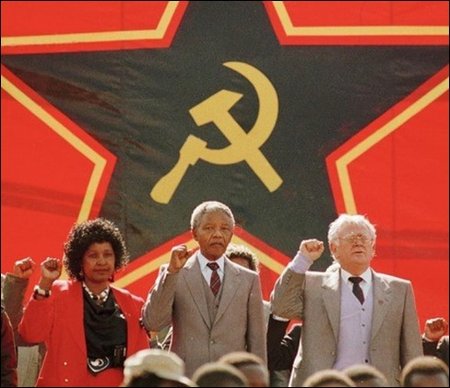
South Africa’s land expropriation will be aimed at ‘whites only’ – minister

The land expropriation policy of South Africa’s ruling party, the ANC, will specifically target white people, according to Zweli Mkhize, the minister of cooperative governance and traditional affairs. Neither the property of black citizens nor land controlled by traditional (black) leaders “would be targeted”, he said.

The ANC, which has a long-standing and close relationship to the South African Communist Party, is an Afro-Marxist party that has long threatened to nationalise all farmland in South Africa. Last year the party adopted a policy of “land expropriation without compensation”, which was also adopted by the South African parliament in February this year (2018).

The party also wants to change the South African constitution to allow it to confiscated land at will from white citizens.

The government met with representatives of the National House of Traditional Leaders over that body’s worries about the planned redistribution process, Mkhize’s ministry said in an emailed statement on Friday.

“A wrong impression has been created that the discussion on land expropriation includes land in the hands of traditional leaders,” Mkhize stated.

Open letter from Gaye Derby-Lewis to the S. African Communist Party and Mrs. L. Hani

In the matter between Clive Derby-Lewis and Minister of Justice and Correctional Services/Mrs. L. Hani/the SA Communist Party concerning Derby-Lewis’s application for prison release on medical grounds (Case No. 78689/2014), the Gauteng High Court ordered, inter alia, that the second and third respondents make a submission to the court no later than January 9, 2015.

Gaye Derby-Lewis
Gaye Derby-Lewis

Since the TRC hearings in the late nineties, the SA Communist Party, its officials, spokespersons and other sundry commentators such as Tokyo Sexwale, Bantu Holomisa and others have taken it upon themselves to issue regular statements about a so-called “wider conspiracy” and that Clive Derby-Lewis has not “told all” about the Hani assassination in 1993.

The Derby-Lewis family has regularly called upon the SACP to produce the proof of a ”wider conspiracy” and nothing has ever been forthcoming.

Now that Clive Derby-Lewis is terminally ill, the SACP and Mrs. Hani have inserted themselves into a medical-parole application and will make submissions to the court.

On 3 December, Mrs. Hani is reported as saying that Derby-Lewis “did not tell the truth” about her husband’s murder. How does she know this? Her lawyer explained that the crux of his client’s submission is that “this belief (of Derby-Lewis not telling the truth) comes from the trial, the TRC and subsequent proceedings that were brought by Derby-Lewis in seeking parole”. We would like to advise this lawyer that he speaks nonsense. The original trial judgment mentioned nothing about a wider conspiracy. Subsequently, three confidential investigations by none other than the ANC and the SACP (and another agency) came to our attention, and all came to the same conclusion – that there was no wider conspiracy.

The TRC was declared “not a court of law” by none other than its head Bishop Desmond Tutu. On the contrary, it was considered by many to be a biased political witch hunt.

There is no proof whatsoever that there was a wider conspiracy and that Derby-Lewis didn’t tell the truth. We wish to caution the second and third correspondents that if their submission contains assertions of wider conspiracies and no proof is provided, then they are guilty of defeating the ends of justice, and we will lay charges on that basis against them.

This is one time that this fairy story will be challenged in court.

Gaye Derby-Lewis

17 December 2014

How the Left lost control of South Africa

Not a day goes by without us here in South Africa being reminded of the “glorious revolution” of 1994, led by Nelson and Winnie Mandela, black fists held aloft. Perhaps “glorious revolution” is an apt term, borrowed from English history, although in our case an English king was not forced to abdicate. Rather, the “black Englishman” as Nelson Mandela once referred to himself, was crowned as a kind of global emperor of the politically correct.

danr2The triumphalism of the once marginal South African Left, confined to the four English universities and a few fringe communist publications has been understandably boundless. A small band of exiled left-extremists managed to take over Africa’s only industrial state, immediately implementing their identity-destroying policies while pillaging the state coffers with a lust and zest also harking back to the days of Francis Drake and his merry band of pirates or “privateers”.

As I argue in my essay, Raiders of the lost Empire, Britain and especially the British media played a major role in the takeover of South Africa and re-imagining the country as a more extreme and politically correct version of the United Kingdom and the United States. The plan of turning South Africa into a de facto one-party state “ruled until Jesus comes” by the darling parties of the Anglo-Saxon media, the ANC and its Communist Party sibling, was prematurely fêted as a fait accompli. Through the manufactured consensus brought by an unfettered control of the mass media, the Left enjoyed an iron grip on the ANC/SACP and through that vehicle, over the majority-black voter. Voting districts were also drawn in such a way that the country’s ethnic minorities, especially whites and Afrikaners, were all but disenfranchised. One is allowed to vote for the opposition, as long as it does not really matter.

The plan was perfect, the spoils were rich. Entire state institutions, government departments and large municipalities were raided by the feasting socialist, anti-racist, “anti-apartheid” victors arriving in ostentatious German cars and Italian designer clothing, while flashing – like the infamous Julius Malema – one’s chunky Breitling watch.

Even muted criticism of the system, the much-vaunted “democracy” was met with guffaws of contempt and satisfied howls of Schadenfreude directed at the losers. Not to forget the usual blast of vilification about “apartheid nostalgia”, “white supremacism”, “fascism”, “Nazism”, “Hitlerism”, “racism”, “sexism” and all the other -isms that dumb left-wing ideologues have rattled off since time immemorial, from the camp commanders of Stalin’s gulag or Pol Pot’s Khmer Rouge fanatics to Mao’s Red Guards or professors at the University of Cape Town.

However, the one thing that our masters of the universe had not foreseen, was that the ANC itself could change. Instead of being, like the SABC and the liberal media, a “toy telephone” for the thieving, venal oligarchy, Zuma’s ANC has become increasingly traditional, starting with the dancing, polygamous Zulu leader himself. The ANC is also shying away from full communism, including the confiscation of land in a remake of “death to the Kulaks”, as advocated by the Marxist crazies at Cape universities and various Johannesburg think-tanks funded by George Soros or the Ford Foundation. There is apparently some diffidence on the part of Zuma in hastening towards a full-on collectivisation programme à la Zimbabwe.

Among the effervescent, Marxist-jargon-spouting pundits lamenting that the revolution “has not gone far enough” or that “the whites are still in control” (even though they lack any form of power and are, in the words of Steve Hofmeyr, “being killed like flies”), there is horror at the return of some form of South Africanism. Not the imported, quasi-American, spanking “new South Africa”, but the hated South Africa of old, that combination of white industry, conservatism and black tribalism.

For the self-styled South African revolutionary, there is one thing worse than the present with its rampant crime, corruption and shortages of water and electricity, and that would be a return to tradition. Whites espousing heterosexual marriage and polite language without four-letter expletives, or singing Die Stem, on the one hand, and blacks embracing their African languages, customs and identity, on the other; that would be the ultimate horror, a “nightmare” come true.

Not for nothing did a certain Nomboniso Gasa of the University of Cape Town express her misgivings about the approach to the system of tribal chiefs or “traditional leadership” taken by the ANC. She writes in Business Day this week:

Thus, in December 2003, the Traditional Leadership and Governance Framework Act was enacted. It reproduced apartheid spatial design down to the finest details of Bantustan boundaries and ascribed identities. It also entrenched those ascribed identities, based on spatial design and ethnic affiliation… Whatever the reasons, this does not augur well for common citizenship in SA. It is a mind-blowing departure from the approach of one nation, one law.

Elsewhere in her article she refers to “the smokescreen of ‘culture’ and ‘custom'” and a spurious sensitivity around “these issues”. What does she mean by that? As a black person and an African, surely it could not be sensitive for her to talk about her own culture? However, given the enthusiasm with which her article was subsequently tweeted and retweeted among the white-liberal and cultural-Marxist set, it looks as if the “sensitivity” she is referring to has more to do with the current predicament of the Great White (and English) Left in South Africa that sees control of the revolution slipping from its grasp… After all, to a mob whose intellectual mainstay is accusing other whites of being “racist” or “sexist”, it would hardly do to start denouncing black culture and traditions in the name of, as Jean-Paul Sartre defined the great Karl, “a German intellectual who lived in London during the nineteenth century”.

In short, despite the violence and mayhem plaguing us, South Africa is going through a “reality check”, with the country’s ethnic, cultural and ethnic diversity – mocked at, sneered at, and even denied for so long by the Left – finally emerging from the alcoholic haze of the mythical “one-beer nation” (for those who have read my essay referred to above).

For the Left, there would be one thing worse than whites clamouring for a return to “apartheid” or ethnic federation in South Africa and that would be blacks demanding the same! Any sign of blacks reasserting their tribal rights within defined geographical areas is therefore anathema, to say the least. In a final adieu to the system that it had created, apparently the former National Party in 1994 handed over control of the Ngonyama Trust to the Zulu nation. Currently the land holdings of the trust constitute three million hectares, controlled by a board chaired by the Zulu king.

According to Nomboniso Gasa, there are “16-million citizens who live in these former Bantustans”. That may be an underestimation, given that the population growth rate in those largely rural areas is so much higher than in metropolitan, urbanised South Africa.

At a more fundamental level, South African blacks are not embracing American-style multiculturalism and its ready-made racial identity and consciousness with as much alacrity as the cultural Marxists have hoped. It is highly significant that many TV soap operas in black languages, watched by millions of people, revolve around quintessentially tribal and ethnic issues, such as marrying outside one’s tribe, the influence of the ancestors in one’s life or being obedient to one’s rural chief even while living in the city.

In South Africa, the official dogma is that race, ethnicity and identity do not exist. At best they are “relics of our apartheid past”. The reality, however, is quite different. Leftist colonialism, the attempt to turn South African blacks into carbon copies of politically-correct, “non-racial”, “non-sexist” Anglo-Americans, has failed dismally.

The ironic comment that South Africa, given its many casinos and the proliferation of African kitsch, “has become a big Bantustan”, possesses another corollary in that more autocratic forms of tribal rule will increasingly assert themselves, as has been the case in most other African countries.

Whether that is good or bad depends on one’s point of view. The fact is that the imported clichés and petty socialist doctrines of the South African Left prevented it from predicting this development. Even the most lowly Afrikaner bureaucrat serving in the department of Bantu administration during the 1960s would have been able to predict the resurgence of ethnic identity and its geographic expression in South Africa, simply on the basis of his greater knowledge and understanding of the people inhabiting this land.

Liberals and Marxists are mostly indistinguishable in South Africa, having mostly the same opinions, and collectively constitute the all-conquering Left. They have also gluttonously fed at the trough of government corruption for the last twenty years, and will no doubt fight to regain control of the party and the masses voting for it. Despite ruling the roost in the media and the universities, our Left, to use an appositely proletarian idiom, “has its work cut out for it”.

If you liked this column, you will be completely ecstatic about this excerpt from Raiders of the lost Empire.


South African Communist Party should not prevent Clive Derby-Lewis’s release

Jeremy Cronin’s opinions on the release of Clive Derby-Lewis as reported in Business Day not so long ago reflect the extraodinary powers of the South African Communist Party that endure almost 25 years after the collapse of the Berlin Wall.

roodt_dan4Comrade Cronin alludes to “intelligence, military and arms dealer networks” that may have been behind Chris Hani’s assassination, seeing Derby-Lewis as simply a puppet and “dad’s army white supremacist”. Logically, then, there should be no harm in granting him parole as he is probably himself ignorant of these wider, counter-revolutionary forces against which the Party and the State are valiantly resisting, from the safety of their black luxury cars.

Ridiculous and anachronistic as South African communism might be, it must be worrying to the few thinking people left in our country that prominent communists may override state departments, the courts and even the minister concerned, when it comes to the release of a prisoner on parole. We know that Schabir Shaik and Jackie Selebi found it extremely easy to be released on medical parole, yet Cronin scoffs at the notion that Derby-Lewis should even be allowed to die in dignity, at home and surrounded by his family.

Since the 1970s, French intellectuals have shown how totalitarianism was hard-wired into the thinking of Marx, Engels and Lenin. However, underlying the egalitarian fanaticism of communists, were also the ethnic prejudices of a Stalin, a Beria, a Pol Pot or a Mengistu that meted out mass murder to Ukrainians, Poles, Chinese or the ethnic minorities of Ethiopia.

Communism is a secular religion that precludes political pluralism or tolerance. In our country, Joe Slovo, Chris Hani and others practised urban terrorism, as they saw themselves as above the law, including the Geneva Conventions that prohibited attacks on civilians and non-combatants.

While Cronin polishes his own conspiracy theories, he forgets how the SACP used to be in cahoots with the murderous East European regimes and their intelligence agencies, including the Stasi.

Not only is the SACP caught in an ideological time warp, but it has always demonstrated equally dated Boerehaat tendencies. The fact that Derby-Lewis had sided with Afrikaners in the historical conflict that has always plagued South Africa, makes him that much more hated.

All decent people should insist that Derby-Lewis – a former MP and no common criminal – be released, regardless of ideology. At the same time, we may ask: Why should communists be treated with kid gloves for their past crimes against our civilians? Like the Americans, we should claim civil damages from communist terrorists in local and international courts. Many of them are still alive and culpable.

Mandela one of the world’s communist greats – SACP confirms his membership

Winnie and Nelson Mandela, as well as Joe Slovo of the SACP, singing "Kill the whites"
Winnie and Nelson Mandela, as well as Joe Slovo of the SACP, singing “Kill the whites”

In a statement a few days ago, the South African Communist Party confirmed Nelson Mandela’s membership, calling him “one of the greatest revolutionaries of the 20th century”. The party proudly announed that Mandela was very much a communist during the time of his arrest for sabotage and treason.

One of Mandela’s most famous literary contributions is his political essay, How to be a good communist.

Said national spokesman for the South African Communist Party, Alex Mashilo:

“At his arrest in August 1962, Nelson Mandela was not only a member of the then underground South African Communist Party, but was also a member of our Party’s Central Committee. To us as South African communists, Cde Mandela shall forever symbolise the monumental contribution of the SACP in our liberation struggle. The contribution of communists in the struggle to achieve the South African freedom has very few parallels in the history of our country. After his release from prison in 1990, Cde Madiba became a great and close friend of the communists till his last days.”

The party is of the opinion that the passing away of “Comrade Mandela” marks an end to the life of one of the greatest revolutionaries of the 20th century, who fought for freedom and against all forms of oppression in both their countries and globally.

Mashilo caled for greater euality in South Africa and continued:

“As part of the masses that make history, Cde Mandela’s contribution in the struggle for freedom was located and steeled in the collective membership and leadership of our revolutionary national liberation movement as led by the ANC – for he was not an island. In Cde Mandela we had a brave and courageous soldier, patriot and internationalist who, to borrow from Che Guevara, was a true revolutionary guided by great feelings of love for his people, an outstanding feature of all genuine people’s revolutionaries.”

– praag.org and SACP press release

White genocide a figment of Steve Hofmeyr’s racist imagination – SACP

Winnie and Nelson Mandela, as well as Joe Slovo of the SACP, singing "Kill the whites"
Winnie and Nelson Mandela, as well as Joe Slovo of the SACP, singing “Kill the whites”

SACP condemns theft of its Red October Campaign

The South African Communist Party (SACP) has noted with disgust the right-wing theft of its Red October Campaign by an essentially racist grouping that has marched to the Union Buildings on Thursday, 10 October 2013. Organised, among others, by the controversial Steve Hofmeyr and Sunette Bridges under our revolutionary banner of the Red October Campaign, the march comprised unpatriotic activities such as the waving of the old South African flag. Amongst the demands of these racist right wingers was an end to “white genocide”, something that does not exist, except in a figment of their racist imagination.

Our Red October Campaign stands as a monument and tribute to the Great October Socialist Revolution of 1917 in Russia, which was the first successful working class revolution to overthrow capitalism and tyranny and established a socialist order. This October revolution paved the way for socialist revolutions in other parts of Europe and the rest of the world. The 1917 Great October Socialist Revolution in Russia also provided an inspiration to many national liberation movements, like our own in South Africa, to get rid of the racist colonial apartheid system that these racists are now hankering back to.

The march in Tshwane at the Union Buildings stands in direct contrast to the noble objectives of freedom, equality, non-racialism and non-sexism, as the objectives that all those inspired by the 1917 revolution have sought to achieve. We call upon these racists to desist from attempts to steal our highly successful Red October campaign that has been waged by the SACP over the past fourteen years. Theirs has no place in a democratic South Africa.

Claims that whites are facing genocide in South Africa must be dismissed with the contempt it deserves. We call upon the working class, including the white working class, to identify with the SACP’s Red October Campaign, and not be misled by racists who do not have their interests at heart.

The Red October Campaign is not an imitation inspired by playing with red balloons on the green grass of the Union Buildings. Since its inauguration by the SACP in South Africa the campaign has resulted in important achievements for the working class and the poor. This includes advances and a shift in policy in land redistribution and agrarian transformation, health care transformation particularly through the adoption of a move towards the National Health Insurance, rural development, progress towards the transformation of the financial sector, to mention but a few.

Statement issued by the SACP Headquarters, October 14 2013

SA Communist boss Nzimande attacks ‘liberals’

Blade Nizmande
Blade Nzimande

South African liberals were waging an “ideological offensive” at the tripartite alliance, SA Communist Party secretary-general Blade Nzimande said on Monday.

“Here we see a very clear convergence between the liberal ideological offensive and what we have characterised as the new tendency,” he told the Congress of SA Trade Unions’ 11th national congress in Midrand.

“Our leadership and movement is being judged… through a targeted attack on the movement as a whole, especially Cosatu and the ANC, with a particular focus on the president of the ANC and the republic, comrade Jacob Zuma.”

He said liberals, led by the Democratic Alliance, often “opportunistically” wanted to be seen as friends of the working class.

“They will stand up against e-tolling in Gauteng, not because they really care about the working class, but in opposition to the ANC government, and yet be completely silent about the fact that the DA has tolled Chapman’s Peak in Cape Town and seeks to build more physical structures there,” Nzimande said.

“They will take the ANC government to court over textbooks in Limpopo, but not go to court when the DA is unilaterally closing schools in the Western Cape.”

He said the offensive was being waged against the alliance to promote the idea that it was leaderless, and the print media was supporting it.

“The SACP has consistently raised this matter, and again warning that none within our ranks should be confused by this liberal agenda and be tempted to form alliances blindly.”

The DA was “flirting with anarchy” and would help form non-governmental organisations to oppose the government but not against the brutality against farm workers and labour brokers.

“They opportunistically seek alliances with the working class in order to advance elite interests, embarrass the ANC government, but tell the working class to go jump when it comes to challenging established capitalist interests,” Nzimande said.

“But, of course, not all NGOs are retrogressive either. We, the alliance as a whole, need to actively engage in this terrain of ‘civil society’ and contribute to the building of a progressive NGO movement.” – Sapa

‘Radical phase of transition’ needs ‘radical and militant campaigning’ – Cosatu

Do not underestimate “enemies” seeking to create divisions before the ANC’s December elective conference in Mangaung, Cosatu president Sidumo Dlamini said on Monday.

“Comrades, we must not make a mistake and underestimate the enemy,” he told the Congress of SA Trade Unions’ (Cosatu) 11th national congress in Midrand.

“The systematic attack we see today directed at us is based on evidence of what a united alliance is capable of doing to defend and advance the NDR [National Democratic Revolution].”

But, these enemies were making a mistake, Dlamini said.

“We will not go to Mangaung divided; but we will go there with a clear class agenda to defend and advance the progressive outcomes of [the last ANC conference in] Polokwane.”

Dlamini said it was for this reason that the African National Congress, the SA Communist Party, and Cosatu, as the tripartite alliance, needed to ensure they were unified around “class interests”.

“We must not allow tactical differences to be elevated to strategic differences,” Dlamini said.

“They [the enemies] have seen what a united alliance can achieve. It is because of this proven track record of resilient struggle and victories that the rightwing and the demagogues would prefer to have us divided and weak going to the 53rd national congress of the ANC.”

He said the “plight of workers” was being used to weaken the alliance.

“The strategy includes buying the emotions of the masses and society and us[ing] that support to stab Cosatu and the liberation movement in the back and allow it to bleed to near death so that they… come as heroes to save the movement,” Dlamini said.

“We must not fall into a trap of competing with demagogues. Instead we should honestly be with the workers to listen to them and engage the employers; force them to address the demands raised by the workers.”

Cosatu’s congress should be used by workers to tell it where it had deviated from its mission.

“These four days will be your opportunity to tell us on our faces where we have deviated. An organisation becomes stronger by purging itself.”

Cosatu also had to respond to “systematic attacks” against it in the wake of the Marikana shooting, Dlamini said.

“The problem in Marikana is not rivalry between unions, nor can it simply be put as being a widening gap between leaders and members.

“This will obviously be a matter which we will have to honestly confront during our discussions, but the central issue is that workers in the mines are rising against their continued exploitation by employers,” Dlamini said.

“Mineworkers cannot be expected to keep quiet and say ‘thank you baas’ when they know that the financial officer of Lonmin, Alan Ferguson, earns R10,254,972 a year or R854,581 a month, which is 152 times higher than the salary of a rock drill operator.”

Last month, 34 striking workers were shot dead and 78 were wounded when police opened fire on them at Lonmin’s Marikana mine in North West.

“Workers… [were] simply saying we produce wealth and we want our reasonable share and they expect to be given a fair share,” Dlamini said.

“It is not just workers from North West that are speaking; this is a reflection of the demands being harboured by millions of our people.”

It was “interesting to note” that most of the richest people in South Africa came from those in charge of the mining sector.

Dlamini said the attack on Cosatu was similar to an attack on it by the Democratic Alliance, which marched to Cosatu’s headquarters in Johannesburg earlier this year.

“The majority of those in the DA march were the African people being instigated to march against other African workers,” he said.

“A strategy that was used by the apartheid government to set blacks against each other, the same strategy we saw being used at Marikana where African workers are being set against each other.”

The reality was that more than six million workers lived on less than R10 a day.

“It is for this reason that we will continue to argue that it is mistaken to think that any kind of job will reduce poverty,” Dlamini said.

“If employment is to be the primary instrument to fight poverty and inequality, then such employment will have to be decent and labour brokers cannot deliver decent jobs and similarly the youth wage subsidy cannot deliver decent jobs except making employers richer through the provision of cheap labour by our children.”

Dlamini said South Africa needed to look to models of social and economic justice used by several South American countries.

Brazil, under President Lula da Silva, defied conventional economic prescriptions, and advanced economic strategies to redistribute incomes by raising wage levels and social protection.

“The… radical phase of our transition will not happen if we do not build a radical and militant campaigning Cosatu, SACP, and ANC as mass-based organisations, which derive their perspectives from the masses,” Dlamini said.

“We need to build these as organisations that do not identify with the people out of pity, but [which are] grounded on the masses and connect with community struggles… [and build] them as fighting organisations that must continue to enjoy respect and credibility by the working class.” – Sapa

South African Communist Party supports boycotts of ‘apartheid Israel’

The SACP commends the cancelation of a trip of various leaders of different sectors to visit Israel. Furthermore we welcome the statements of government as articulated by the Deputy Minister of International Relations, cde Ebrahim Ebrahim.

The SACP has witnessed attempts by the South African Zionist Federation, the South African Jewish Board of Deputies and the Office of the Chief Rabbi to isolate the Deputy Minister as if he is not expressing government policy. These remarks are consistent with government’s intention for instance to classify goods coming from the Israeli Occupied Territories as such. Similarly we recall that the University of Johannesburg has cut ties as well with the University of Ben Gurion. The comments by the Deputy Minister and the cancellation of the visits must be seen as part of a set of actions by progressives around the world to put pressure on apartheid Israel to change its policies regarding Palestine

Attempts to make turn these statements into individual comments smack of opportunism and are part of the divide and rule tactics which we should not accept. Our principled stance against apartheid Israel’s occupation of Palestine remains.

The SACP also wishes to strongly condemn the hypocrisy and double standards of the Israeli government when only a week ago it prevented a Non- Aligned Movement delegation, made up of no less than Ministers coming from different countries, to go to Ramallah in Palestine. Amongst these Ministers was our own Deputy National Chairperson, cde Thulas Nxesi, who was sent there by the South African government. It is time now that all the progressive forces must refuse to be intimidated by apartheid Israel and deepen solidarity actions with the oppressed people of Palestine.

Apartheid Israel has for all intents and purposes failed to adhere to international resolutions on the necessity to free the Palestinian people and their legitimate aspirations for an independent Palestinian state, with East Jerusalem as its capital. The SACP supports the broad framework of boycott and divestment directed against apartheid Israel.

Statement issued by the SACP, August 15 2012