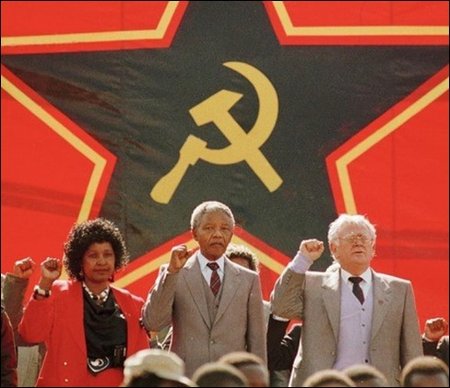
A summit should be held to discuss the country’s judiciary in the light of recent court judgments involving the executive, SA Communist Party secretary Blade Nzimande told delegates at the party’s special national congress on Wednesday.
”We are not attacking the judiciary, but are saying there has been a deliberate overreach by the judiciary. It can’t be the mandate of the judiciary to rule on matters of the executive…it is against the spirit of the separation of powers,” said Nzimande.
”As the SACP we are going convene a summit on the judiciary and the issue of separation of powers, because we want to open a debate and not attack… we’ve been told we are attacking the judiciary whenever we raise this issue,” he said.
Nzimande added that the SACP was not friends with Sudanese president Omar Al-Bashir, but agreed with government’s decision to not arrest him when he was in South Africa for the 25th African Union summit in Johannesburg in June.
”We are not friends with Bashir, he has committed serious atrocities…but South Africa is not a colony. This issue was a direct attack on our national sovereignty,” he explained. “Government was correct to not arrest Bashir.”
Bashir has been indicted by the ICC for war crimes, crimes against humanity, and genocide against some of the tribes of Sudan’s western Darfur region. Two warrants of arrest were issued against him in 2009 and 2010.
It is known that the ANC driven Government of South Africa has opposing external to internal relational policies.
Its general purpose is to confuse both the foreign investor and local citizen. However, according to the ANC’s website – the NEC (National Executive Committee of the ANC), calls for the following:
“—destroy the old order”
Clearly they have been advantaged by the old profitable order, but they plan on moving forward soon to destroy it in exchange for an as yet undefined socialism without it actually being a socialist approach. This “officially” comprises the development of jobs through micro-, medium, large companies and cooperatives to be sponsored by the Post Office.
On the other hand the Umsebenzi Online available from the SACP website describes how the world battle for hegemony should locally be engaged via a more robust SABC (South African Broadcasting Corporation), with certain implications for other local media organizations (and news sites).
It is quite clear that the SACP is more intellectual, where it even attempts to describe the entire “world balance of forces” leaning towards the left – something Albert Brenner from Praag touched on earlier.
In this same period a recent BMI Strategic Workshop was held with some 100 white haired white gentlemen with facilitators like Llewellyn Lewis and presenters like Theo Venter from North West University. During the day interesting statements were made such as that the general discourse is determined by the small parties with the EFF on the one side and FF on the other.
A well-known (local Indian) economist with “political connections” was asked why the government is going the wrong way despite being advised correctly, pointing to low growth figures compared to countries across its borders. His answer was that the ruling party simply does not have the capacity to understand such advice.
Connecting the dots described above paints an uneasy picture, sometimes known as a “scenario”. Various such scenarios have recently seen the light of day, delivered by the likes of by Frans Cronje and Sampie Terreblanche, and before them Clem Sunter.
Someone said the discourse is determined by the ruling class, and maybe they believe that and want that to be true, but the private sector communications and technological advantage rules the roost, because the infrastructure is independent of the State.
Therefore, while Venter and his ilk are entertaining a highly educated crowd, the fact of the matter is that the old order is going to be destroyed and the only advantage we have is to communicate more effectively.
Not tomorrow like the typical State Owned Enterprise, but today, like driven private and commercial citizens.
Clive Derby-Lewis, one of the men convicted of killing SACP secretary general Chris Hani, should be freed, the Front Nasionaal (FN) said on Saturday.
Derby-Lewis is South Africa’s most famous remaining political prisoner, said the group’s deputy leader Dan Roodt in Pretoria, where a march was being held by the convicted killer’s supporters.
In demanding his release, the Afrikaner FN emphasized that it did not mean this as a political statement.
“That might seem like a paradox. Clive is, after all, a consummate politician, a statesman and a leading figure of the conservative movement in South Africa,” said Roodt.
The FN believed freeing Derby-Lewis was the right thing to do.
They demanded his release in the name of “justice, in the name of God or Christian charity and in the name of civilised values”.
“For such an appeal to reason and reasonableness, they will call us right-wing. Or fascists. Or boorish Boers. But we reject all labels and slogans,” Roodt said.
Hani was shot dead in the driveway of his home on April 10 1993.
Derby-Lewis, who was sentenced to 25 years behind bars, has already served more than 20 years of his sentence.
The 78-year-old man, who has been diagnosed with cancer, has twice been denied medical parole.
The SA Communist Party in the Western Cape were due to hold Chris Hani memorial lectures on Saturday.
“…Twenty-one years ago, comrade Chris was assassinated by ignorant cowards outside his residence in Boksburg,” provincial spokesman Masonwabe Sokoyi said in a statement.
He did not comment on millions of “ignorant cowards”, Germans and Eastern Europeans who welcomed the end of communism.
“In the month of April all SACP structures commemorate and pay homage to a virtuous and humble leader of the working class.”
Both the “virtuous leader” Hani and his wife Limpho were having extra-marital affairs when Hani was shot, however.
The SACP supported virulent action against the adulterous comrade Zwelizima Vavi, head of Cosatu.
The 50-year-old Vavi has been fighting to keep his job over the past few months after a probe into whether he is still suitable to lead.
This is not the first time the married father of six – from both his current and previous marriages – has been accused of sexual misconduct.
In 2006, then Cosatu president Willie Madisha compiled a dossier in which he accused Vavi of sexually harassing a married female Cosatu employee. The charges did not stand then.
Around the same time, Vavi was also accused of using the federation’s credit card to bankroll an extra-marital affair, using it to splurge on his and his mistress’ foreign trips without the federation’s knowledge.
City Press reported on how her distraught former husband Bheki Ngema tried in vain to get Madisha to institute disciplinary proceedings against Vavi, and to force Vavi to fork out R700 000 “as compensation so my children would not suffer much”.
Vavi, who lives in Sandton, is thus not a paragon of virtue on matters sexual, and his 14-year career in the federation could come to an end.
The extramarital affair could force him out as Vavi is also swimming against the political tide.
Cosatu’s general secretary is also not the first local politician to be embroiled in a sex or rape scandal.
Here are some others:
» Jacob Zuma
In December 2005, Zuma was charged with the rape of an HIV-positive family friend in what was to become one of the country’s major sex scandals in recent history. He was acquitted in May 2006.
» John Steenhuisen
The DA’s KwaZulu-Natal leader was forced to resign in 2010 after an affair with the party’s provincial spin doctor Terry Kass-Beaumont became public.
» Narend Singh
News of the 2006 sex scandal followed the emergence of a DVD of a tryst between Singh and Roseanne Narandas, wife of jeweller Bob Narandas.
By then, the DVD had been sold around Durban for weeks.
Singh resigned his post as Kwazulu-Natal MEC for arts, culture and tourism, but remained a member of the provincial legislature for the IFP.
» Fikile Mbalula
In 2011, the sports minister had an affair with model Joyce Molamu, whom he paid R10 000 to have an abortion. They had sex twice, said Mbalula, who publicly apologised.
» Malusi Gigaba
The public enterprises minister was sued for R1.7 million in 2011 by a friend, Luka Sandhlane, for having an affair with his wife and ruining their marriage. Gigaba apologised to Sandhlane, who reconciled with his wife.
» Albert Mncwango
The former IFP national organiser had his rape conviction and 10-year sentence overturned by the Pietermaritzburg High Court in 2005. Mncwango – who spent 19 days in jail before successfully appealing – said the rape charge was trumped-up to destabilise the IFP’s elections campaign at the time.
» Mbulelo Goniwe
Goniwe was axed as ANC chief whip and MP in 2006 after being found guilty of sexual harassment. He asked ANC parliamentary administrative assistant Nomawele Njongo to have sex with him after she helped serve dinner to guests at his home.
» Jonas White
The Cederberg mayor was kicked out of the ANC last month for allegedly sending an image of his genitals “embellished with a strawberry and cream” to his deputy, Lorna Scheepers. He is also facing a criminal investigation for alleged sexual harassment.
But Chris Hani strangely has not been knocked off his perch.
It is alleged that Hani still enjoys the protection of advocate Gerrie Nel, the Oscar trial star, and advocate George Bizos.
At the past weekend the SACP in Gauteng marched to the Kgosi Mampuru correctional facility, handing over a memorandum to the Department of Correctional Services with demands including that any parole application by Hani’s killers, Clive Derby-Lewis and Janusz Walus be denied. They were both given life sentences, and have served 20 years. Mr Derby-Lewis was denied parole in 2011 and again last year. He was stabbed twice in prison in recent months.
The main reason the SACP opposes their amnesty application is their refusal to divulge the “full circumstances of the killing”.
“They have not disclosed the fuller wider conspiracy and there clearly was one,” says SACP deputy secretary-general Jeremy Cronin, who represented the party when the pair applied for amnesty. Another factor is the continued endorsement of their “toxic” views publicly. Mr Cronin referred to a letter in a national newspaper this week that described Derby-Lewis in glowing terms. The author said “if he (Derby-Lewis) did what he did to prevent communism, then he did very well”.
“This was a letter indicating support for the assassination, basically,” Mr Cronin says.
“Considering whether he should be released or not, that’s another factor, there are people out there who praise them … they are not just lone lunatics who did something very stupid. There are forces who have not been uncovered, who are still lurking in our society; and secondly, there are people who are brazenly supporting what they did, and the newspaper letting that be published.”
He says more should be done to uncover the truth behind the killing of Hani. The SACP does not simply want amnesty denied to them, but it also wants the “networks” to which they belonged uncovered.
Mr Cronin, too, is cautious about treading into the terrain of “what Chris Hani would say” about South Africa today. But he does feel Hani would have been proud that the ANC has remained in power. Hani was the chief of staff of Umkhonto weSizwe and an ANC national executive committee member.
Mr Cronin says the complications inside the alliance would not have surprised Hani, but the factional battle in the Congress of South African Trade Unions would have been a cause for concern.
“Sometimes the stories we tell of a heroic past are a little one-sided. Hani would have been the first to (acknowledge) there were many, many challenges — and (that there) always are in real struggle. He knew real-life organisations have their complexities and complications, and it’s important to build those organisations, to respect their unity, but at the same time be principled.” Hani would have been a “huge asset” and would not have criticised from the “outside”.
Former intelligence minister and SACP leader Ronnie Kasrils has been in the firing line for his criticism of the ANC after he said he found it difficult to urge people to vote for the party today.
Mr Kasrils agrees more has to be done to uncover all the facts behind Hani’s death. He recalls Hani’s outstanding achievements and unblemished record, in a country plagued by challenges such as maladministration, cronyism and corruption. Quoting a biography of Hani, he says Hani believed that if the ANC did not deliver, the people should not hesitate “to march against them”.
There are many lessons to draw from Hani’s teachings. “I mean, none of us would have believed and imagined we would see police shoot people during protests … Marikana, Andries Tatane and the list goes on … so this is something we need to consider if we learn lessons from what Chris had to say.”
Young Communist League secretary Buti Manamela says Hani believed socialism was about “simple things” such as education, health, shelter and food security. He told Hani’s memorial service on Thursday the SACP had ensured these issues remained on the ANC’s agenda.
Blade telling Nkwinti to take white farms, not mines
Higher Education Minister Blade Nzimande and member of the SACP has described what is being written about President Jacob Zuma and his Nkandla residence as “white people’s lies”.
He has been the General Secretary of the South African Communist Party since 1998.
Nzimande was speaking at an event to honour President Zuma held at the University of Zululand, at KwaDlangezwa.
Nzimande has heaped praise on President Zuma, saying it is appropriate to honour him for his contribution to peace in KwaZulu-Natal and education in the country.
He’s dismissed as “lies perpetuated by white people” reports about Nkandla and Zuma.
In 2007 Malawian businessman Charles Modise claimed he made a R500,000 donation to the South African Communist Party in 2002.
He claimed he gave the money, packed in black plastic bags, to Willy Madisha, who in turn swore he transported the money in the boot of his car to SACP general secretary Nzimande. However, Nzimande denied ever receiving the money, also calling the allegations “lies perpetuated by white people”.
Despite being a Communist, Mzimande is against the nationalisation of mines, strangely stating that it is not “inherently progressive” as it depended on which class interests were being advanced.
Nzimande supports the accelerated transfer of white-owned land to blacks however and warned earlier that South Africa would become like Zimbabwe if whites continue to own land.
Nzimande said the people needed to know why banks were still financing farmers using the “same [free market] methods used during apartheid”.
“One of the biggest obstacles facing land reform is the willing buyer-willing seller principal,” he said.
He said with that principle, it was those who already owned the land—and not the landless—who benefited.
What is the shelf life of a system that rewards confidence-gaming sociopaths rather than competence?
Let’s connect the dots of natural selection and the pathology of power.
In his 2012 book The Wisdom of Psychopaths: What Saints, Spies, and Serial Killers Can Teach Us About Success, author Kevin Dutton described how the attributes of sociopathology are in a sense value-neutral: the sociopathological attributes that characterize a dangerous criminal may also characterize a cool, high-performing neurosurgeon.
As Dutton explains in his essay What Psychopaths Teach Us about How to Succeed(Scientific American):
Psychopaths are fearless, confident, charismatic, ruthless and focused. Yet, contrary to popular belief, they are not necessarily violent. Far from its being an open-and-shut case–you’re either a psychopath or you’re not–there are, instead, inner and outer zones of the disorder: a bit like the fare zones on a subway map. There is a spectrum of psychopathy along which each of us has our place, with only a small minority of A-listers resident in the “inner city.”
While there is obviously a place for high-functioning sociopaths in professions which reward those characteristics, what about sociopaths who substitute deviousness and deception for competence? For some context, let’s turn to the Pathology Of Power by Norman Cousins, published in 1988.
Cousins was particularly concerned with the National Security State, a.k.a. the military-industrial complex, which at that point in U.S. history was engaged in a Cold War with the Soviet Empire. Cousins described the pathology of power thusly:
Connected to the tendency of power to corrupt are yet other tendencies that emerge from the pages of the historians:
1. The tendency of power to drive intelligence underground;
2. The tendency of power to become a theology, admitting no other gods before it;
3. The tendency of power to distort and damage the traditions and institutions it was designed to protect;
4. The tendency of power to create a language of its own, making other forms of communication incoherent and irrelevant;
5. The tendency of power to set the stage for its own use.
In broader terms, we might add: the tendency of power to manifest hubris, arrogance, bullying, deception and the substitution of rule by Elites for rule of law.
Natural selection isn’t only operative in Nature; it is equally operative in human organizations, economies and societies. People respond to whatever set of incentives and disincentives are present. If deceiving and conning others is heavily incentivized, while integrity and honesty are punished, people will gravitate to running cons and embezzlement schemes.
What behaviors does our Status Quo reward? Misrepresentation, obfuscation, legalized looting, embezzlement, fraud, a variety of cons, gaming the system, deviousness, lying and cleverly designed deceptions.
Let’s connect the pathology of power and the behaviors selected by our Status Quo. What we end up with is a system that selects for a specific category of sociopaths: those whose only competence is in running cons.
No wonder we have a leadership that is selected not for competence but for deviousness. What’s incentivized in our system is spinning half-truths and propaganda with a straight face and running cons that entrench the pathology of power.
What is the shelf life of a system that rewards confidence-gaming sociopaths rather than competence? Unless we change the incentives and disincentives, the system is doomed.
Winnie and Nelson Mandela, as well as Joe Slovo of the SACP, singing “Kill the whites”
SACP condemns theft of its Red October Campaign
The South African Communist Party (SACP) has noted with disgust the right-wing theft of its Red October Campaign by an essentially racist grouping that has marched to the Union Buildings on Thursday, 10 October 2013. Organised, among others, by the controversial Steve Hofmeyr and Sunette Bridges under our revolutionary banner of the Red October Campaign, the march comprised unpatriotic activities such as the waving of the old South African flag. Amongst the demands of these racist right wingers was an end to “white genocide”, something that does not exist, except in a figment of their racist imagination.
Our Red October Campaign stands as a monument and tribute to the Great October Socialist Revolution of 1917 in Russia, which was the first successful working class revolution to overthrow capitalism and tyranny and established a socialist order. This October revolution paved the way for socialist revolutions in other parts of Europe and the rest of the world. The 1917 Great October Socialist Revolution in Russia also provided an inspiration to many national liberation movements, like our own in South Africa, to get rid of the racist colonial apartheid system that these racists are now hankering back to.
The march in Tshwane at the Union Buildings stands in direct contrast to the noble objectives of freedom, equality, non-racialism and non-sexism, as the objectives that all those inspired by the 1917 revolution have sought to achieve. We call upon these racists to desist from attempts to steal our highly successful Red October campaign that has been waged by the SACP over the past fourteen years. Theirs has no place in a democratic South Africa.
Claims that whites are facing genocide in South Africa must be dismissed with the contempt it deserves. We call upon the working class, including the white working class, to identify with the SACP’s Red October Campaign, and not be misled by racists who do not have their interests at heart.
The Red October Campaign is not an imitation inspired by playing with red balloons on the green grass of the Union Buildings. Since its inauguration by the SACP in South Africa the campaign has resulted in important achievements for the working class and the poor. This includes advances and a shift in policy in land redistribution and agrarian transformation, health care transformation particularly through the adoption of a move towards the National Health Insurance, rural development, progress towards the transformation of the financial sector, to mention but a few.
Statement issued by the SACP Headquarters, October 14 2013
Residents of Tlokwe, North West, should back the ANC in next year’s national elections, the SA Communist Party said on Sunday.
“The SACP calls upon all ANC members and SACP cadres, including Cosatu members to ensure that we mobilise the people of Tlokwe to vote for the ANC overwhelming [sic], so that we can rightly re-claim this municipality from the party of the baases and madams,” SACP general secretary Blade Nzimande said in a speech prepared for delivery.
He was speaking at the Ikageng Stadium in Potchefstroom ahead of the party’s 92nd birthday celebrations next month. The celebrations would be held in Tlokwe, the municipality which has its seat in the town.
Nzimande said they condemned those African National Congress members who had voted with the Democratic Alliance and other opposition parties to unseat ANC mayor Maphetle Maphetle.
He was replaced by DA councillor Annette Combrink in July, the second time since November. The North West ANC’s disciplinary committee expelled the councillors concerned, resulting in them losing their seats.
Nzimande said the ANC should fix the problems in the area.
“It is important that the ANC itself must act with speed to attend to whatever problems, including suspected corruption, against its own cadres. But, no matter what grievance any ANC cadre may have, this cannot be translated to the betrayal of the ANC,” he said. – Sapa
Mrs. Margaret Thatcher famously stated in the nineteen-eighties that “Anyone who thinks the ANC will form the government of South Africa is living in cloud cuckoo-land.”
For this, she was ridiculed by the British radicals, with Bishop Trevor Huddleston of the Anti-Apartheid Movement in the forefront. Since that time, all the anti-apartheid secrets have been revealed, including the active role played by British radicals, especially within the Anglican Church, in undermining what was then still the sovereign government of South Africa.
Whereas the ANC and SACP also enjoyed Soviet and East German support, the financial and organisational muscle for the South African revolution was provided by Sweden and the Anglican Church. Another radical priest, Canon John Collins of St. Paul’s in London, oversaw a vast network of agents who channelled funds in the name of the Defence and Aid Fund into South Africa for political trials and to support the relatives of imprisoned revolutionaries. Under today’s banking laws, money may no longer be laundered in such a fashion.
On the website of the Canon Collins Trust, a document boasts that one hundred million pounds were distributed in support of attempts to overthrow the much-vilified reformist government of PW Botha. Revolution, and not reform, was what everyone had preached back then.
However, as South Africa pursues its dream of an egalitarian society at all costs, there is a certain revolutionary fatigue setting in, even among the most ardent supporters of the ANC. And the second phase of the revolution, or “second transition” as it has been euphemistically called, still lies ahead of us. During that phase, most white farmers will lose their land and large swathes of private industry, including the mines, may be nationalised. Mayhem and ethnic conflict will probably result.
Increasingly, to paraphrase a line from Joyce’s Ulysses, the New South Africa is a nightmare from which we are trying to awake.
Over the past thirteen days, there have been seventeen victims of farm attacks in South Africa. Not all have died, but the death rate is high. Some were horribly tortured. Another ten people were killed at the Lonmin platinum mine at Marikana amid strife between the mine and two competing trade unions.
The American NGO, Genocide Watch, has already classified South Africa as a category 5 (out of a possible 8) genocide risk, with polarisation between groups taking place. On his recent visit to South Africa, Dr. Gregory Stanton of Genocide Watch stated that the atrocities committed against Afrikaner farmers “were signs of genocide and that there is enough suspicion that it is being organised”.
Stanton also asserted an intrinsic connection between communist ideology and genocide. In this, he is supported by the post-Maoist philosophers of France, the so-called nouveaux philosophes, who broke with Marxism in the nineteen-seventies and also saw the germ of crimes against humanity in the concepts of Marx and Lenin.
In the minds of the ANC “comrades”, transformation is both necessary and inevitable, echoing classical Marxist-Leninism. Ordinary human lives or cultures will not stand in the way of their grand strategy to effect a radical change in South Africa. In almost every public appearance, ANC leaders use the Marxist cliché “moving forward”, indicating the country’s march towards a millenarian goal.
Afrikaner children at high school listen to the iconoclastic band Fokofpolisiekar, voicing their frustrations with violence, affirmative action and social decay in songs such as “Brand Suid-Afrika”. And certainly the impression that South Africa is burning, sometimes literally, is not amiss. If only the BBC, NBC and other major TV networks overseas had been filming all of this as they did during the seventies and eighties, already there would have been an impression that South Africa was experiencing a crisis.
After almost two decades of ANC rule, it appears that Mrs. Thatcher’s cuckoos are coming home to roost. Like ZANU PF in Zimbabwe, the ANC has not been able to make the transition from a crypto-communist liberation movement waving AK-47s to a political party managing Africa’s only industrial state. In its rhetoric and its thinking, it is stuck in a time warp, sometime before Ché Guevara got shot in Bolivia.
The ANC’s British supporters, as well as Sweden, saw fit to launch the ANC in its successful bid for power in South Africa. In fact, on 27 April 2004, the Swedish ambassador in Pretoria stated on Radiosondergrense, but speaking English, that “without the help of Sweden, the ANC would never have ruled South Africa”.
To many outside South Africa, the ANC still represents the party of Nelson Mandela. To them he personifies the romantic hero, a kind of black Ché Guevara who went to prison to liberate the South African masses. However, to the racial and ethnic minorities who suffer under ANC rule, with its accompanying threats of “kill a Boer, kill a farmer”, the movement is a Frankenstein let loose. The modern ANC was made in Britain, but it has grafted itself onto the South African state, blurring the boundaries between itself and the republic.
Through its culture of tenderpreneurs and high-spending officials, it has arguably become one of the richest political parties in the world, unassailable in the polls. In a vast country where electioneering is prohibitively expensive, oppositon parties face a permanent financial and propaganda disadvantage. The SANDF has been transformed, precisely, into nothing more than an ANC militia, an extension of Umkhonto we Sizwe. So even if the ANC is outvoted in 2019 or 2024 or when Jesus returns, as Zuma has stated, it will probably cling onto power, just like ZANU PF or the Angolan MPLA has done.
Of course, that paragon of human rights and democracy, Robert Mugabe, was also enthusiastically backed by British diplomats at Lancaster House and fêted by Fleet Street as a great African leader. The British penchant for radical chic has found a ready outlet in Southern Africa, to devastating effect.
However, like all radical movements, the ANC will overplay its hand. The question is not if but when. The further issue is how much damage it will do to South Africa and how many more massacres of Afrikaner families will take place before a realignment occurs.
Kwadlangezwa – The SA Communist Party would like to see Sasol [JSE:SOL] nationalised, but if this could not be achieved immediately the petro-chemical giant should then be subjected to a windfall tax on extra profits.
SACP deputy general secretary Jeremy Cronin said this was one of the many draft resolutions that emerged from the party’s four-day long congress that wrapped up on Sunday at the University of Zululand near Empangeni on.
Speaking at a press briefing following the end of the 13th National Congress, Cronin said that while the party’s aim was for the total nationalisation of Sasol, there was “no reason why we should not propose a windfall tax”.
He said the SACP believed Sasol was raking in huge profits. It cost the company $40 (about R331) to produce the equivalent of a barrel and it was being paid at the going world market price for oil, which was close to $100 (about R826) a barrel.
Cronin said a resolution to call for the re-nationalisation of AcelorMittal SA [JSE:ACL] (formerly Iscor) was based on the fact that the SACP believed it was being stripped by its international parent company.
He said another draft resolution called for the transformation of the SA National Defence Force (SANDF).
Cronin said the colour composition of the SANDF was not at the centre of the call for transformation, but rather they way it was run and operated.
Media ownership was also an issue that was hotly debated by delegates, according to Cronin.
The role of the national broadcaster in particular received much attention with a draft resolution calling for 60 percent of the broadcaster’s budget to come from public funding.
Cronin said there was also a move against foreign ownership of media in the country and that there should be greater diversity.
General secretary Blade Nzimande’s failure to arrive at an SACP fundraising gala dinner was raised at the press conference – with Nzimande saying it was not a snub to deputy president Kgalema Motlanthe, who spoke at the event on Saturday night.
“I was simply exhausted. There was nothing else.”
During his closing address to the congress, Nzimande said others were laying claim to Nelson Mandela’s legacy and using it against the SA Communist Party and its allies.
“Our revolution is not for sale.”
Without making a direct reference to the Democratic Alliance, but referring to “those in the Western Cape”, he warned that the former president’s legacy was being used against the party to discredit it.
In his speech the long-serving party member again repeated calls for “tender-trepeneurs” to be flushed out of the party.
He also called on municipalities to stop outsourcing work, but instead to increase their own capacity and employ more people.
Referring to the African National Congress’ recent policy conference, Nzimande said he welcomed the resolutions from that conference.
The ANC had accepted that “it can no longer be business as usual”.
The SACP was more united than ever and a clear indication of this fact was that the party’s leadership had been elected by consensus, Nzimande said.
The SACP has welcomed the Broad Based Black Economic Empowerment (BBBEE) Amendment Bill which would see the assigning of a commissioner to solely investigate incidents of fronting.
“The SACP urges government to move with the necessary speed to finalise provisions in law that allows for fronting to be criminalised,” said spokesman Malesela Maleka on Wednesday.
Fronting is when companies place unqualified black individuals in high positions so the companies seem to be complying with the BEE Act.
The black individuals are made to look as though they own the company or have decision-making powers in the company when they actually do not.
“Such levels of dishonesty are nothing but corruption. Those who are involved in fronting are merely reproducing a parasitic, compradorial and colonial type relation between black sections of the capitalist class and established capital,” said Maleka.
“The SACP calls on government to act decisively and criminalise fronting, to investigate the nature and extent of the practice and to act against those involved.”
On Tuesday Minister of Trade and Industry Rob Davies said the Amendment Bill would put in place strict measures to tackle fronting.
He said a commissioner would be assigned to receive cases of fronting and investigate them.
Davies said ordinary law enforcement officers did not have the capacity to investigate transactions to see where fronting was taking place.
“We welcome government’s decision to appoint a commissioner to deal with this scourge,” said Maleka.
– SAPA
This website uses cookies to improve your experience. We'll assume you're ok with this, but you can opt-out if you wish. Cookie settingsACCEPT
Privacy & Cookies Policy
Privacy Overview
This website uses cookies to improve your experience while you navigate through the website. Out of these cookies, the cookies that are categorized as necessary are stored on your browser as they are essential for the working of basic functionalities of the website. We also use third-party cookies that help us analyze and understand how you use this website. These cookies will be stored in your browser only with your consent. You also have the option to opt-out of these cookies. But opting out of some of these cookies may have an effect on your browsing experience.
Necessary cookies are absolutely essential for the website to function properly. This category only includes cookies that ensures basic functionalities and security features of the website. These cookies do not store any personal information.
Any cookies that may not be particularly necessary for the website to function and is used specifically to collect user personal data via analytics, ads, other embedded contents are termed as non-necessary cookies. It is mandatory to procure user consent prior to running these cookies on your website.