Contractors and Public Works officials responsible for the security upgrades at President Jacob Zuma’s private residence should pay back the money that had been wasted because of grossly inflated prices and also face prosecution, said the parliamentary ad hoc committee on Nkandla on Wednesday.
This was the view the chairman of the committee, Cedric Frolick, expressed during a visit by the committee to Zuma’s Nkandla homestead on Wednesday to assess the work done on the controversial upgrades.
“People responsible for the inflation of prices should be held accountable in line with the findings in the SIU report that disciplinary and other action as well as criminal prosecution must be pursued against individuals, contractors and any public works officials responsible,” he said.
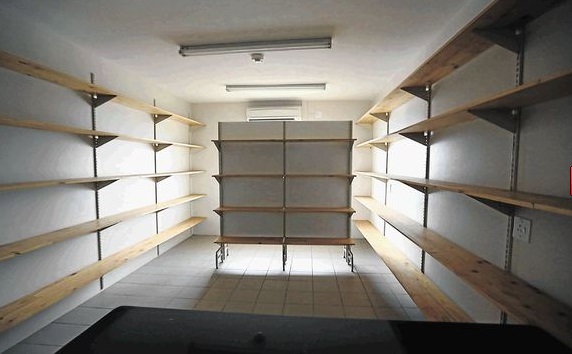
Committee members were taken on a tour of the compound, but they did not go into Zuma’s private quarters. One of the things they had come to see was the security barracks consisting of 21 houses to be used by members of the SANDF and police officers.
Frolick said what they saw was a gross inflation of prices and the president was not “secure in comfort” as there was still a lot of incomplete work around the compound.
“What I saw here today is not worth the R200-plus million claimed. We have seen a gross inflation of prices. In fact, when we entered the president’s office that is the so-called visitors’ centre it was actually a modest place – my constituency office is four times bigger than the place.”
The twenty-one thatch-roofed houses built for police and soldiers tasked with protecting Zuma stood mostly empty, gathering dust, the verandas covered with goat and cattle droppings.
The only sign that people were living there were a few makeshift beds in one of the rondavels.
The police and SA National Defence Force members meant to occupy the houses – apparently built at a cost of at least R6-million each – are staying in nearby park homes until the completion of parliament’s investigation of the expenditure of R246-million on “security upgrades” at Nkandla.
SANDF Brigadier-General Siphiwe Shezi said the unused clinic was meant for locals, government officials, dignitaries visiting the president and army officials deployed in the province.
“Even US President Barrack Obama can be treated here if he gets bitten by a snake while in the province.”
President Jacob Zuma’s salary increase has been approved, even after opposition parties fought against it, EWN reports.
In January, the Independent Commission on the Remuneration of Public Office Bearers recommended a 5% increase for all office bearers, including the president, deputy president, ministers, deputy ministers and members of parliament, and came before the National Assembly on Thursday for approval.
With the 5% increase, Zuma’s salary will increase by about R130 000, meaning that he would earn just over R2.7m per year.
President Jacob Zuma on Wednesday heavily criticised opposition MPs, accusing them of being unpatriotic and of being in a state of denial over the amount of damage apartheid had done to South Africa.
Replying to the debate on his budget vote on Wednesday, Mr Zuma retreated into blaming apartheid for the crises in education and at Eskom, and chastised MPs for talking down the country at a time when it was “doing well”.
He said many opposition MPs had finally learnt how to pronounce Nkandla and now could talk about little else.
During the debate, opposition MPs took issue with Mr Zuma’s contention that the country was on an upward path.
“Some of the honourable members on the opposition benches need to accept the fact that reversing the legacy of apartheid will take decades. The damage was extensive. The structure of the apartheid economy will also take longer to transform. We will continue to work steadily towards this goal, so that we build an inclusive economy that will create jobs and help us build a better life for our people.”
Mr Zuma also criticised Democratic Alliance (DA) leader Mmusi Maimane, albeit without naming him, saying that he had nothing to offer but the refrain — uttered earlier this year — that he was a broken president presiding over a broken country. He also turned to the matter of the recent behaviour of MPs which has seen presidential question time disrupted, MPs being dragged from the house for poor decorum, and filibustering.
“I will be failing in my duty if I do not comment on how our democratic Parliament is conducting its business during this term. As elected leaders of our people in Parliament, we have a joint responsibility to build our country. The conduct of some (members) raises doubt about their commitment to the work of Parliament.” He had hoped matters of decorum would be taken seriously so South Africans were not disappointed.
Zuma took issue with DA MP Michael Cardo, who accused him of conducting an imperial presidency and of shoring up his position with dubious appointments to high office.
“Honourable Cardo, I would caution against problematising all professionals who are appointed to senior positions. Your stereotyping of all appointees as being cronies and pliable is unfortunate and uncalled for.”
Most of the senior appointments in state and public institutions, he said, were doing a hard and thankless task in which they were attacked every day for doing their jobs. “We should be cautious about stereotyping and stigmatisation of black professionals, as it works against the nonracial society we are working so hard to build.”
Blade telling Nkwinti to take white farms, not mines
Higher Education Minister Blade Nzimande and member of the SACP has described what is being written about President Jacob Zuma and his Nkandla residence as “white people’s lies”.
He has been the General Secretary of the South African Communist Party since 1998.
Nzimande was speaking at an event to honour President Zuma held at the University of Zululand, at KwaDlangezwa.
Nzimande has heaped praise on President Zuma, saying it is appropriate to honour him for his contribution to peace in KwaZulu-Natal and education in the country.
He’s dismissed as “lies perpetuated by white people” reports about Nkandla and Zuma.
In 2007 Malawian businessman Charles Modise claimed he made a R500,000 donation to the South African Communist Party in 2002.
He claimed he gave the money, packed in black plastic bags, to Willy Madisha, who in turn swore he transported the money in the boot of his car to SACP general secretary Nzimande. However, Nzimande denied ever receiving the money, also calling the allegations “lies perpetuated by white people”.
Despite being a Communist, Mzimande is against the nationalisation of mines, strangely stating that it is not “inherently progressive” as it depended on which class interests were being advanced.
Nzimande supports the accelerated transfer of white-owned land to blacks however and warned earlier that South Africa would become like Zimbabwe if whites continue to own land.
Nzimande said the people needed to know why banks were still financing farmers using the “same [free market] methods used during apartheid”.
“One of the biggest obstacles facing land reform is the willing buyer-willing seller principal,” he said.
He said with that principle, it was those who already owned the land—and not the landless—who benefited.
Ever since Britain started getting seriously interested in South Africa after the discovery of diamonds at Kimberley in 1866, there have been at least two conflicting views of the country. Throughout the twentieth century too, South Africa has borne the brunt of the Western ideological revolutions, all the way from colonialism and so-called “white supremacy” to contemporary political correctness. In fact, in the aftermath of the Mandela funeral, one could almost speak of the West’s religious devotion to black Africans who are being endowed with all the capricious amoral innocence of Greek gods.
More precisely, South Africa has been the theatre of an “epistemic war” if I could be excused such a French-sounding term. Apart from the very palpable shifts in demographic, political, economic and military power towards South African blacks, locals are also acutely aware of how the Western world view is no longer the dominant one in South Africa.
A few years ago I spoke to a liberal, anglophone, Jewish woman who lived in Johannesburg but who had some connection to the huge Baragwanath hospital in Soweto, one of the proud achievements of the former Afrikaner-led government. Within the Afrikaner mind, blacks had wanted not real political power but hospitals, schools, universities and jobs which is why they put so much effort into constructing such public institutions. Those institutions are currently being derided as having been entirely useless and a sop, or an insult to blacks, especically to the divine black leaders such as Mandela.
The point is, however, that since the black takeover in the country “they have changed the frame of reference” as my liberal Jewish friend put it. But she wasn’t really speaking in general terms, referring to the broad sweep of history and politics. First and foremost, she was speaking in medical terms. What she was saying, was that with the new order had come a new way of looking at healthcare, at patients and the function of a hospital. In short, the age-old belief systems of Africans have been reasserting themselves and “success” is no longer measured in white or European terms. That is why, when whites decry the deterioration of the state hospital system, as well as standards of professionalism and hygiene there, blacks are quick to retort with the ubiquitous cry of “racism”. After all, blacks are now in charge and they make the rules and set the standards against which a hospital, a school, a university or even a government will be measured.
It is really hard to understand the hullabaloo over President Zuma’s expenditure on what amounts to a private Zulu homestead or kraal at Nkandla. Compared to the billions being frittered away in corruption and unauthorised expenditure, the R240 million (about $20 million) involved seems almost paltry.
It is a truism of historians and philosophers alike, that one’s assessment of a situation – any situation – depends on one’s perspective. Not so long ago I read a paragraph by French political philosopher Alain de Benoist wherein he said:
… I am not fighting for the white race. I am not fighting for France. I am fighting for a world view. I am a philosopher, a theoretician, and I fight to explain my world view. And in this world view, Europe, race, culture, and identity all have roles. They are not excluded. But mainly I am working in defense of a world view. Of course, I am very interested in the future and destiny of my own nation, race, and culture, but I am also interested in the future of every other group.
That all sounds very interesting, but somewhat abstract. To the Afrikaner farmer who is being attacked in his or her home by a group of blacks who had imbibed some form of “medicine” or muti to make them invincible, the quesion is one, not of philosophy but of survival.
At a more mundane or political level, the clash is one of perspectives, even a traditional fight between the left and the right. In South Africa, any statement expressing concern over the future of whites or their well-being is almost always characterised as “right-wing”. Blacks are simply too good-natured and inherently moral ever to commit evil on a significant scale against whites.
This is also the foreign perspective. A Marxist theologian in Germany or a pro-white militant in America would concur that whites “have no place in South Africa, at the southern tip of a black continent”. On the other hand, the Afrikaner perspective is quite the opposite. They feel deeply rooted in South Africa and reject the “black supremacism” of both the foreign whites and the anglicised, superficially Westernised blacks who see them as being “not indigenous” to the country or the continent.
For most of the twentieth century, there has been a perspectival war around the notion of whether Afrikaners or whites really “belong” in South Africa or not. Once, I was shocked to see the former leader of the opposition, Tony Leon, being bluntly told by a BBC announcer on the programme Hard Talk that he was a “white politician” and that South Africa had always been “their country” – meaning that of the blacks – even in former centuries when their numbers were limited to about a million, nomadically drifting through parts of a mostly unpopulated territory twice the size of France.
Buy Dan Roodt’s book through Amazon.com
History, as the ruling ANC politicians usually put it in their quasi-communist way, is “a terrain of ideological struggle”. Needless to say, whites have lost that ideological struggle – or the perspectival war over the past – hands down. It is now better to kiss the feet of Mandela’s bronze colosssus than to voice your own opinions or interpretation of history.
Faulkner, that strange author from the American South who uses the “N word” in his novels but depicts his own Southern whites with relentless cynicism, once wrote: “The past is never dead. It’s not even past.” So there will always be a feud over history, everyone’s history.
But looking at the future of South Africa, or even our present safety in a physical sense, it also depends on one’s perspective. To foreigners and overseas correspondents in South Africa, this is Mandelatopia, a liberal democracy with same-sex marriages and universal suffrage – although cannabis is not yet quite legal. According to this view, which is based on a very superficial “multicultural” reading, “South Africa belongs to all who live in it, united in our diversity”, as it is stated in our incongruous constitution, replete with rancour and affirmative-action clauses.
Many whites, especially women, have a sense of impending doom. The crime, corruption and general sense of lawlessness portend worse to come. Usually, they are not arguing against the dominant ideology with its illusions of democratic bliss. Rather, they intuit some kind of typically African implosion or civil war during which whites will be punished for all the evil they have wrought in their zeal to “uplift” and “civlise” blacks, admittedly ridiculous notions within the present context.
To the pessimist or the more intuitive analyst, South Africa’s future represents the “chronicle of a death foretold”, or many deaths, if you will pardon my paraphrasing the fetching title of Gabriel Márquez’s little novel. It will be Zimbabwe on a much vaster scale, and much bloodier. It is already much bloodier, and ultimately the country will be ethnically cleansed of its Caucasian undesirables, probably to universal acclaim.
Depending on one’s point of view, South Africa is either a “problem that has been happily solved” or a disaster in the making. Looking at the past, especially the nineteenth century when indigenous whites were as weak as they are now and were regularly massacred by blacks, as well as the history of postcolonial Africa, I am not macho enough to cast all caution to the winds and believe in the foreign male fantasy of a South Africa that is some kind of Switzerland or Singapore, clean, tolerant and law-abiding.
There being no common ground in this war of perspectives, no rational debate will take place either. I am inclined to trust those “womanly” truths that are as unspeakable as they are likely to come to pass.
The SABC reports that the Nkandla Municipality in northern KwaZulu-Natal, where President Jacob Zuma’s home is situated, has distributed groceries to needy families headed by single parents as part of celebrating Women’s Day.
Mayor Makhosonke Ntuli says, in one of the families they visited, there are thirteen children, but only three are being covered by child support grants.
Ntuli says social assistance for such families is essential.
“We are celebrating this day by visiting these families that do not have food. We identified this family even the house they are living in is not a proper house, they don’t have food and no one is working in the family. We gave her the grocery of almost a month but we are also going to have to do other interventions to see that her life and the children is improving,” says Ntuli.
South African police prevented the country’s anti-nationalist opposition leader from using a public road leading to President Jacob Zuma’s house in his home village on Sunday, citing valid safety concerns.
DA invasion bore a strong resemblance to its youth subsidy march to Cosatu House in Johannesburg earlier this year. Their campaign, in May, resulted in a bruising street battle when Cosatu members attacked DA supporters and ended in injuries.
South African media have reported the government plans to spend some 250 million rand ($28.61 million) on President Jacob Zuma’s home village, angering the opposition Democratic Alliance (DA) which had wanted to deliver letters from school children who lack textbooks, to illustrate where money should be spent.
Police in riot gear turned back DA leader Helen Zille and a small group of supporters on their way to inspect Zuma’s residence in the village of Nkandla, in KwaZulu-Natal province.
“We will not allow the ANC to declare certain areas “no-go zones” in our country,” Zille said in a statement after filing a complaint against Zuma’s ruling African National Congress for blocking a public road.
Zille, however has said nothing about the mismanagement of funds by Nelson Mandela and former president Thabo Mbeki, as both were sympathetic to British concerns. Mbeki has alledgedly helped himself to billions of Rands of taxpayers money.
The ruling ANC, which has been in power since the end of white minority rule in 1994, is often accused of corruption with funds from the national budget not always reaching the intended millions who continue to live in poverty 18 years after the advent of democracy, but the DA has singled out nationalist leaders for criticism, like Zuma.
But Nelson Mandela’s 100 year-old party continues to enjoy mass support, securing more than 60 percent of the vote in all four national elections since 1994.
Police said they could not allow Zille to pass on Sunday due to concerns for her own safety as there were angry ANC members waiting for her next to Zuma’s home.
Zille’s DA has its origins in the old apartheid structures of whites before 1994, and has made no inroads with the black electorate.
The DA said it would give Zuma’s administration 72 hours to release information on the funding of the projects in Nkandla before going to court. The president’s spokesman responded by saying Zille was “just looking for publicity.”
Julius Malema on Tuesday severely criticised President Jacob Zuma for the reported R203m upgrades to his Nkandla home in KwaZulu-Natal.
This amounted to stealing and was not right, Malema told striking mineworkers in Virginia, in the Free State.
“They want to give you [miners] R16 000 but they give another man R250m to build a house,” Malema said.
Malema was addressing a group at the Meloding Stadium. Many women and children were among the striking workers who arrived to hear him talk.
He asked why Zuma’s other three homes, in Johannesburg, Durban and Cape Town, maintained by the state, could not be used for international visitors.
“Who goes to Nkandla of all places? There’s no wisdom there, nothing to learn, unless its about cultural aspects,” Malema said.
Malema told the miners that Zuma has no respect for the country’s Constitution.
“How can Zuma ask miners to respect the Constitution if he does not,” he asked them.
He was referring to a recent Constitutional Court judgment that found invalid the appointment of Menzi Simelane as National Director of Public Prosecutions.
In reading the unanimous judgment, Judge Zak Yacoob said the court reached a number of legal conclusions, including that the NDPP’s appointment was not a matter to be determined by the subjective opinion of the president.
Malema told the miners Zuma hired Simelane against the guidelines stipulated by the Constitution. It was Zuma’s responsibility to protect the Constitution, yet he ignored it.
He referred to a recent court decision when the National Prosecuting Authority (NPA) was ordered to hand over tapes to the Democratic Alliance in relation to corruption charges against Zuma being dropped.
The NPA dropped the charges against Zuma just before he was elected African National Congress president and president of the country.
Malema told the miners that their struggle was his struggle. He also urged the community to stand by the striking workers. – Sapa
This website uses cookies to improve your experience. We'll assume you're ok with this, but you can opt-out if you wish. Cookie settingsACCEPT
Privacy & Cookies Policy
Privacy Overview
This website uses cookies to improve your experience while you navigate through the website. Out of these cookies, the cookies that are categorized as necessary are stored on your browser as they are essential for the working of basic functionalities of the website. We also use third-party cookies that help us analyze and understand how you use this website. These cookies will be stored in your browser only with your consent. You also have the option to opt-out of these cookies. But opting out of some of these cookies may have an effect on your browsing experience.
Necessary cookies are absolutely essential for the website to function properly. This category only includes cookies that ensures basic functionalities and security features of the website. These cookies do not store any personal information.
Any cookies that may not be particularly necessary for the website to function and is used specifically to collect user personal data via analytics, ads, other embedded contents are termed as non-necessary cookies. It is mandatory to procure user consent prior to running these cookies on your website.