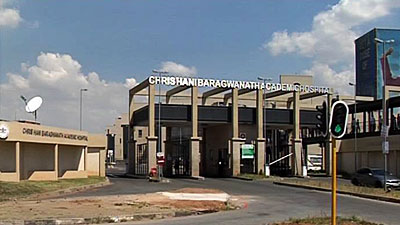
Baragwanath Hospital Chaos

By: Nathan Geffen and Ben Stanwix/Ground Up

A doctor at South Africa’s largest hospital, Chris Hani Baragwanath Academic Hospital (CHBAH) in Soweto, has described chaotic planning and management that is putting patient care at risk.

The doctor spoke on condition of anonymity. Employees at the hospital are scared to speak out. One doctor told GroundUp that “colleagues who work at Bara” are not “willing to get involved due to their previous experiences with clamp downs and retaliation from senior management.”

GroundUp has made extensive attempts to get responses from officials at the Gauteng Department of Health. These are described at the end of the article. In the end, only one official responded and he wrote, “I am not officially able to consent but can add some clarity”. We have included his responses below each allegation.

Breakdown of referral system

CHBAH is a tertiary hospital. Patients who attend the hospital are supposed to be referred there from other health facilities, which do not have the technology or expertise to deal with a particular patient issue. The referral system, says the doctor, has effectively broken down.

“Clinics that feed Bara have such basic equipment that they end up sending people up the referral system for most basic stuff, including blood tests and ECGs. So if you come into a small clinic with chest pain, the health worker has to refer you up, because even though he or she might be pretty sure you have nothing serious, he or she can’t take the chance, and there’s no ECG in the clinic, or it has broken down or no one knows that they’re there. This breakdown of the referral system causes congestion right up the system all the way into Bara.”

“Jabulani is a district hospital that has just opened with the idea of relieving Bara. It’s a first step in right direction. But it is still not enough. There are millions of people living in Soweto. There needs to be more.”

“For the patient this means they’ve sat for hours at the clinic waiting. They don’t get the care they should have. Often, they need to arrange their own transport to Jabulani or Bara. And then they sit for several more hours. They might get shouted at, ‘Why do you come to Jabulani just for an ECG?’ And sometimes the patients will even be chased away.”

The official who responded unofficially told GroundUp that “procurement of equipment is a challenge in the clinics and this does sometime lead to referrals to Bara not being appropriate but this is more of an exception than the rule.” He also said, “ECG machines are a challenge because the leads are at the moment difficult to procure but this should improve over the next few months.”

According to the doctor, the referral problems have worsened in April because of poor planning. Gauteng Health Department has been paying for 500 beds at a private facility called Clinix Selby Park Hospital to manage its overflow. The doctor says, “Gauteng Health’s management has now realised they don’t want to pay for these 500 beds because it’s too expensive and they would rather spend the money on state resources. So they ended this in April with a limited backup plan: 20 more beds in Jabulani Hospital from April, and then the intention of about hundred or so beds at Lenasia South, which will be converted into a district hospital. But clearly there’s a massive shortfall from April. And Bara is going to become even more clogged.”

The Health Department official responded, “The Selby 500 beds were shared between Bara, Charlotte-Maxeke, Helen Joseph and other Hospitals. The department has made arrangements for all hospitals to add additional beds to cater for these patients. This includes Carletonville, Yusuf Dadoo, Leratong Hospitals etcetera.”

Planless renovations

The doctor explained that for hundreds of patients, the first port of call at Bara is Medical Casualty. Here patients are referred either to another unit at Bara, Selby or Jabulani hospitals. Bara’s administration are planning on renovating Medical Casualty. Doctors and nurses at Casualty have been moved 20 minutes drive away to Jabulani while the renovations are ongoing. “How will patients know this? The lab at Jabulani is not yet functional. They send their stuff to Bara lab, so there’s a labyrinth of complex connections between the two hospitals which could potentially break down,” said the doctor.

The health department official responded, “I believe this renovation will be managed by Bara and it is necessary as the floor has become unsafe.”

A day at Bara

The doctor described the complexity of managing patients at Bara. “The enormity of Bara puts patients at risk because of the distances that have to be covered when moving critically ill patients. So to take someone from the maternity area to ICU, you have to take them across a road. There is hospital transport that transfers people around. They sometimes provide an ambulance, but sometimes patients simply cross the road.”

“Just understanding how the Bara system works is a daunting task for new health workers at the hospital. One of the systems you have to learn how to use is that there are ten medical wards with approximately 60 beds in a ward. When you are on call in the medical admissions award, you admit 20 or 30 patients on an intake shift. So you come in the next day and have to find them. And there are 600 options,” explained the doctor.

“There’s no electronic database so this is the system you have to use. You start off on your home ward and you look at the written patient list for the patient you want. There’s a book for patients at other wards but whether your patient’s location is recorded depends on a nurse having recorded it. If you can’t find the patient and you still have time before your rounds, you have to phone around. Sometimes you start ward rounds not knowing where all your patients are. Sometimes you don’t find the patient. A few days later you might get a call, ‘Doctor, you haven’t seen this patient for a few days.’ If they need urgent care, what can you do? If you phone all the wards and they don’t know where your patient is, how can you?

“And then how much more difficult must it be for friends and family who want to locate their loved ones?”

GroundUp’s attempts to get an official response

On 31 March we emailed Gauteng Department of Health to request a response to the doctor’s allegations. We used two email addresses listed on the department website: General Enquiries and Complaints about Services. We received no response.

On 2 April, the department responded. We were promised that contact would be made with regard to the initial queries. Emails we subsequently received indicated that on 7 April our queries were passed to Mr Chris Maxon, the department spokesperson, and Ms Merylin Deoraj, PA to the CEO of Bara.

On 9 April, we received an email from the hospital’s communications and public relations officer, Nkosiyethu Mazibuko, requesting more information and assuring us that “the department views these allegations in a serious note”.

We then emailed detailed notes on the allegations. Receipt of our email was acknowledged on 10 April and we were promised a response by 13 April.

Dr Sandile Mfenyana, Bara’s CEO, Goodhope Maseko, deputy-CEO, Monde Ntebe, Bara’s communications head, and Lesemang Matuka, the Gauteng health department’s director of of communications, were all brought in on the email correspondence at one point or another.

We were also in contact with Mr Mazibuko, the hospital’s public relations officer by cell phone. We received constant reassurance that a response was imminent, as the following images show:

Correspondence-on-14-and-15-April-203x360

Correspondence-on-15-and-16-April

More-correspondence-on-16-April.

Correspondence-on-17-April.

GroundUp then contacted Mr Monde Ntebe, who heads hospital communications in the health department, as well as Mr Prince Hamnca, the MEC’s spokesperon on 17 April. Neither responded to emails. After calling Mr Ntebe on his cellphone he apologised for the “totally unacceptable” delay and promised to attend to the allegations. GroundUp received a message from Mr Ntebe on 21 April saying he needed to confer with the CEO and spokesperson of the hospital before commenting. This is the latest response we have received from Bara’s head of communications, and the last communication we received (23 April):

The-official-who-sent-the-unofficial-response-that-we-quoted-from-in-the-article-also-did-so-on-23-April.

This article was first published on Ground Up.

South Africa’s war of perspectives and the whites’ dwindling fortunes

roodt_dan_wiki

by Dan Roodt dan[at]praag.org

Ever since Britain started getting seriously interested in South Africa after the discovery of diamonds at Kimberley in 1866, there have been at least two conflicting views of the country. Throughout the twentieth century too, South Africa has borne the brunt of the Western ideological revolutions, all the way from colonialism and so-called “white supremacy” to contemporary political correctness. In fact, in the aftermath of the Mandela funeral, one could almost speak of the West’s religious devotion to black Africans who are being endowed with all the capricious amoral innocence of Greek gods.

More precisely, South Africa has been the theatre of an “epistemic war” if I could be excused such a French-sounding term. Apart from the very palpable shifts in demographic, political, economic and military power towards South African blacks, locals are also acutely aware of how the Western world view is no longer the dominant one in South Africa.

A few years ago I spoke to a liberal, anglophone, Jewish woman who lived in Johannesburg but who had some connection to the huge Baragwanath hospital in Soweto, one of the proud achievements of the former Afrikaner-led government. Within the Afrikaner mind, blacks had wanted not real political power but hospitals, schools, universities and jobs which is why they put so much effort into constructing such public institutions. Those institutions are currently being derided as having been entirely useless and a sop, or an insult to blacks, especically to the divine black leaders such as Mandela.

The point is, however, that since the black takeover in the country “they have changed the frame of reference” as my liberal Jewish friend put it. But she wasn’t really speaking in general terms, referring to the broad sweep of history and politics. First and foremost, she was speaking in medical terms. What she was saying, was that with the new order had come a new way of looking at healthcare, at patients and the function of a hospital. In short, the age-old belief systems of Africans have been reasserting themselves and “success” is no longer measured in white or European terms. That is why, when whites decry the deterioration of the state hospital system, as well as standards of professionalism and hygiene there, blacks are quick to retort with the ubiquitous cry of “racism”. After all, blacks are now in charge and they make the rules and set the standards against which a hospital, a school, a university or even a government will be measured.

It is really hard to understand the hullabaloo over President Zuma’s expenditure on what amounts to a private Zulu homestead or kraal at Nkandla. Compared to the billions being frittered away in corruption and unauthorised expenditure, the R240 million (about $20 million) involved seems almost paltry.

It is a truism of historians and philosophers alike, that one’s assessment of a situation – any situation – depends on one’s perspective. Not so long ago I read a paragraph by French political philosopher Alain de Benoist wherein he said:

… I am not fighting for the white race. I am not fighting for France. I am fighting for a world view. I am a philosopher, a theoretician, and I fight to explain my world view. And in this world view, Europe, race, culture, and identity all have roles. They are not excluded. But mainly I am working in defense of a world view. Of course, I am very interested in the future and destiny of my own nation, race, and culture, but I am also interested in the future of every other group.

That all sounds very interesting, but somewhat abstract. To the Afrikaner farmer who is being attacked in his or her home by a group of blacks who had imbibed some form of “medicine” or muti to make them invincible, the quesion is one, not of philosophy but of survival.

At a more mundane or political level, the clash is one of perspectives, even a traditional fight between the left and the right. In South Africa, any statement expressing concern over the future of whites or their well-being is almost always characterised as “right-wing”. Blacks are simply too good-natured and inherently moral ever to commit evil on a significant scale against whites.

This is also the foreign perspective. A Marxist theologian in Germany or a pro-white militant in America would concur that whites “have no place in South Africa, at the southern tip of a black continent”. On the other hand, the Afrikaner perspective is quite the opposite. They feel deeply rooted in South Africa and reject the “black supremacism” of both the foreign whites and the anglicised, superficially Westernised blacks who see them as being “not indigenous” to the country or the continent.

For most of the twentieth century, there has been a perspectival war around the notion of whether Afrikaners or whites really “belong” in South Africa or not. Once, I was shocked to see the former leader of the opposition, Tony Leon, being bluntly told by a BBC announcer on the programme Hard Talk that he was a “white politician” and that South Africa had always been “their country” – meaning that of the blacks – even in former centuries when their numbers were limited to about a million, nomadically drifting through parts of a mostly unpopulated territory twice the size of France.

Buy Dan Roodt's book through Amazon.com
Buy Dan Roodt’s book through Amazon.com

History, as the ruling ANC politicians usually put it in their quasi-communist way, is “a terrain of ideological struggle”. Needless to say, whites have lost that ideological struggle – or the perspectival war over the past – hands down. It is now better to kiss the feet of Mandela’s bronze colosssus than to voice your own opinions or interpretation of history.

Faulkner, that strange author from the American South who uses the “N word” in his novels but depicts his own Southern whites with relentless cynicism, once wrote: “The past is never dead. It’s not even past.” So there will always be a feud over history, everyone’s history.

But looking at the future of South Africa, or even our present safety in a physical sense, it also depends on one’s perspective. To foreigners and overseas correspondents in South Africa, this is Mandelatopia, a liberal democracy with same-sex marriages and universal suffrage – although cannabis is not yet quite legal. According to this view, which is based on a very superficial “multicultural” reading, “South Africa belongs to all who live in it, united in our diversity”, as it is stated in our incongruous constitution, replete with rancour and affirmative-action clauses.

Many whites, especially women, have a sense of impending doom. The crime, corruption and general sense of lawlessness portend worse to come. Usually, they are not arguing against the dominant ideology with its illusions of democratic bliss. Rather, they intuit some kind of typically African implosion or civil war during which whites will be punished for all the evil they have wrought in their zeal to “uplift” and “civlise” blacks, admittedly ridiculous notions within the present context.

To the pessimist or the more intuitive analyst, South Africa’s future represents the “chronicle of a death foretold”, or many deaths, if you will pardon my paraphrasing the fetching title of Gabriel Márquez’s little novel. It will be Zimbabwe on a much vaster scale, and much bloodier. It is already much bloodier, and ultimately the country will be ethnically cleansed of its Caucasian undesirables, probably to universal acclaim.

Depending on one’s point of view, South Africa is either a “problem that has been happily solved” or a disaster in the making. Looking at the past, especially the nineteenth century when indigenous whites were as weak as they are now and were regularly massacred by blacks, as well as the history of postcolonial Africa, I am not macho enough to cast all caution to the winds and believe in the foreign male fantasy of a South Africa that is some kind of Switzerland or Singapore, clean, tolerant and law-abiding.

There being no common ground in this war of perspectives, no rational debate will take place either. I am inclined to trust those “womanly” truths that are as unspeakable as they are likely to come to pass.

Donate or subscribe to praag!