EU official denies reponsibility in migrant crisis

The crisis of mass migration of refugees from Africa was not caused by European countries, but by autocratic leaders, a European official said on Tuesday.

Roeland van de Geer, European Union ambassador to South Africa, said the cause of the crisis in North Africa “lies squarely with its own leaders”.

Speaking after a meeting between President Jacob Zuma and the diplomatic corps, he told reporters he believed that this lack of democratic values was driving the multitudes to risk life an limb and life to reach Europe.

“So we lay the responsibility for what is happening in the countries of the Maghreb clearly in the hands of the leaders who were dictators and did not respect democracy,” said Van der Geer.

Earlier on Tuesday, President Jacob Zuma blamed European countries for the Libyan refugee crisis.

Addressing numerous ambassadors and high commissioners in Pretoria, Zuma said European countries had ignored the African Union’s proposal for peaceful intervention in Libya, destabilising the country, and should therefore welcome refugees from the north African country.

“What has happened? The consistent, systematic bombing by NATO forces undermined the security and caused conflicts that are continuing in Libya and neighbouring countries. That is why we have this problem (of refugees). It has not just popped up from nowhere,” Zuma said at the Sefako Makgatho Presidential Guesthouse in Pretoria.

Zuma said African countries were ignored when they repeatedly proposed an alternative road map to the “destabilisation” of Libya.

“Today, those who were part of destabilising that part of the world don’t want to accept the refugees. It is their responsibility. They caused it and they must now address it. That is of absolute importance. It is the painful truth,” said Zuma.

He said South Africa was ready to assist Libya in post-conflict reconstruction and development projects. The southern African economic powerhouse also offered to help Libya with reconciliation efforts, and to formulate a Constitution for Libya.

Libya’s long time leader Muammar Gaddafi died in October 2011 during the Battle of Sirte. He was captured by National Transitional Council forces after he had been hiding in a culvert. He was killed shortly after his capture.

On Tuesday, Zuma claimed that before the 2011 Arab Spring, and the killing of Gaddafi, there were no refugees in the northern part of Africa.

“It was all quiet. Things were normal in the north of Africa. It was the action taken, the bombarding of Libya, and the killing of its leader, that opened the floodgates, firstly for serious tensions within Libya.

“The beginning of the refugee (crisis), at least from the African side, was triggered by that undermining of the security situation. As people grapple with the problem of refugees, we forget easily, we might think Africa suddenly has a problem where refugees are flooding Europe,” said Zuma.

Commenting on the Syrian crisis, Zuma said European countries should not shut down their doors to the multitudes of refugees.

“It took the painful drowning of a four-year-old Syrian child to shake the world into action. Attempts to shut the borders by some European countries will not assist the situation,” said Zuma.

He said the international community must not support external military interference “or any action in Syria” that is not in line with United Nations’ charters.

“As immediate relief for the refugees, we call on our European Union partners as well as Syria’s regional neighbours to assist the Syrian refugees, in full accordance and compliance with all Human Rights and Humanitarian laws,” said Zuma.

“We pledge our support to the EU as it grapples with this challenging situation.”

Source: ANA
Striking Marikana miners were killers says Zuma

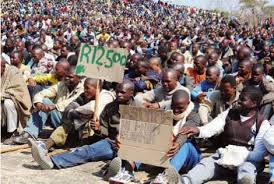
President Jacob Zuma has shown little sympathy for the victims and relatives of the Marikana massacre after he announced that the slain and wounded miners had themselves been killers.

The Tshwane University of Technology (TUT) south campus hall was packed to listen to Zuma’s address on Tuesday.

Some said the president had contravened presidential decorum by addressing the students on the deaths of the miners while families were still waiting for the Farlam Commission’s report into the Marikana massacre.

Zuma stunned his audience when he said the striking miners had been killers before they were shot on August 16, 2012, referring to the killing of 10 people ahead of the massacre.

He said the police had been forced to stop the violence that had been prevailing at the time.

“Even the Marikana miners were shot after killing people,” he said.

Zuma’s salary increases

President Jacob Zuma’s salary increase has been approved, even after opposition parties fought against it, EWN reports.

In January, the Independent Commission on the Remuneration of Public Office Bearers recommended a 5% increase for all office bearers, including the president, deputy president, ministers, deputy ministers and members of parliament, and came before the National Assembly on Thursday for approval.

With the 5% increase, Zuma’s salary will increase by about R130 000, meaning that he would earn just over R2.7m per year.

Zuma arrives for AmaXhosa King’s coronation

President Jacob Zuma has arrived in Nqadu Great place in the Eastern Cape for the coronation of AmaXhosa King Mpendulo Zwelonke Sigcawu.

Zuma joins dignitaries which include traditional leaders, academics and politicians from the rest of Africa and abroad.

Locals from various villages are lining the streets ululating and sing traditional songs.

Roads leading to the Nqadu great place are busy with a convoy of cars.

Dignitaries in their traditional attire are in a good mood

The President is going to officiate in this historic coronation.

It is the first coronation in five decades after the coronation of King Xolilizwe Sigcau in 1965.

‘West still treats Africa as former vassals’

Western “colonial” states are not interested in South Africa’s development, but rather want to take its natural resources and never give anything back, pres. Jacob Zuma, told RT. It’s China’s investment that Zuma sees as a way to prosperity.

“The Western world or the European countries, in particular, came to Africa [in the 19th century] to colonize and they had been taking the resources of Africa,” Zuma said.

But even after the continent decolonized itself in the mid-20th century, its relationship with the US, UK, France and other Western countries “remained the same,” he stressed.

“They still regard us as the Third World, as a kind of people, who must be related to as the former subject [state], etc. That talks also to the economics… Their intention has never been to make the former colonial countries develop,” the president explained.

Zuma believes things “would never be the same” with China, which has been heavily investing in Africa since the early 2000s, as it came to the continent “as equals.”

“The Chinese come differently. They come to do business with us. They are ready to help… The results would be that African countries will be empowered,” he said.

China is educating African students and building highways in many countries, while the Western states “only built roads from mining areas to harbors,” the president added.

China is currently South Africa’s top trading partner, and Zuma expressed confidence that recent attacks on foreigners, in which Chinese citizens were affected, won’t lead to a cool down in relations between Pretoria and Beijing.

“The issue of xenophobia was exaggerated in South Africa,” he said, adding that the true reasons for the attacks lay outside racial issues.

The South African leader pointed out that thousands across the country had taken to the streets to protest xenophobia after five people died in violence in Durban in mid-April.

Despite “some things here and there,” South Africa was one of only two African nations approved as one of the 57 founding members of the Chinese-led Asian Infrastructure Investment Bank (AIIB).

Beijing and Pretoria will also join efforts to establish the BRICS bank (New Development Bank), with South Africa set to host the new financial institution’s regional center. The countries comprising the BRICS group are Brazil, Russia, India, China and South Africa.

Zuma criticized existing international financial institutions, such as the International Monetary Fund and the International Bank for Reconstruction and Development, saying that “it’s very difficult to pinpoint the real exemplary kind of delivery by these institutions,” and that African countries “got into more difficulties” by relying on their assistance.

The idea of the New Development Bank has “brought the fresh breath in the system,” he said.

“BRICS has brought the bank, which is a developer; which is going to operate differently… It’s focusing on the Third World, not just on the Third World, but whomever else. And it’s actually aimed at helping to uplift countries that need help,” the president said.

Meeting with Zuma, Russian President Vladimir Putin advocated BRICS development as a vehicle for improving the economies of Russia and South Africa.

Zuma arrived in Moscow on Vladimir Putin’s invitation as guest at the May 9 military parade dedicated to the 70th anniversary of Victory over Nazi Germany.

He stressed the importance of the occasion as “at times, people have got short memories. They might be forgetting that we came from a very serious situation, which led to many deaths.”

The South African president observed that the Soviet Union had “suffered a great deal” during World War II, noting that “the turning point of the defeat of fascism was done by the Russians.”

Source: RT

Merkel, Zuma in Moscow for V-day celebrations

Ukraine’s settlement and possibilities for the restoration of cooperation between Russia and Germany will be high on the agenda of talks in the Kremlin on Sunday between Russian President Vladimir Putin and German Chancellor Angela Merkel, who is arriving in Moscow to attend celebrations in honour of the 70th anniversary of the World War II Victory.

Before the talks, the two leaders together will lay wreaths at the Tomb of the Unknown Soldier near the Kremlin wall.

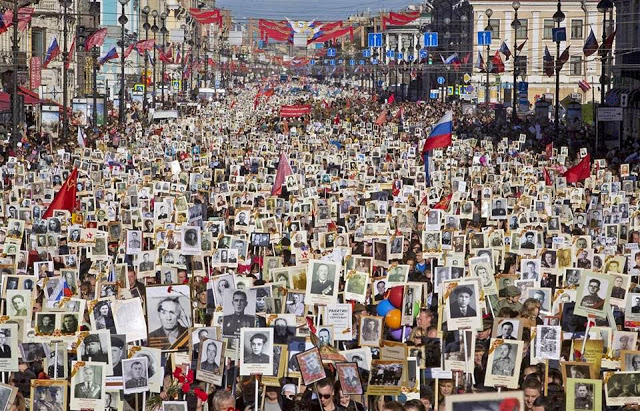
Putin also spoke of the ‘Immortal Regiment‘ initiative’s importance earlier, while marching with over 300,000 people in Moscow’s Red Square, Saturday. “It was born not in cabinets, nor in administrative structures, but in the hearts of our people,” Putin told the interviewer.

“The sides will discuss, in particular, measures to boost trade and economic relations,” he said. In 2014, for the first time in recent years, a 6.5% decline in the Russian-German trade turnover volume was recorded, to $70.1 billion, compared to the previous year.

At the same time, the Russian economy has accumulated more than $21 billion of German investment. There are more than 6,000 companies with German participation operating in Russia, including about 800 – with 100% German capital. The volume of Russian investment in Germany is about $850 million.

The Kremlin also says the two countries have the traditionally intense cultural and humanitarian contacts and inter-regional cooperation.

The meeting with Merkel will complete the four-day “marathon” of international meetings that Putin has held on the sidelines of the Victory Day celebrations.

Since May 7, he has held talks with the leaders of the CIS (Commonwealth of Independent States) countries and the Eurasian Economic Union (EAEU), as well as with the leaders of Cuba, Mongolia, China, India, Vietnam, the Czech Republic, South Africa, as well as with the UN Secretary-General.

The South African president arrived in Moscow on Friday to join in commemorations of the 70th anniversary of the Allied victory.

Zuma urged on Saturday to endorse a “meaningful” reform of the United Nations to build a more just world order, the presidency said in a statement.

Meanwhile Martin Charmoy, head of Prosperity Capital Management fund in London, predicted that trade between Russia and China will reach $200 billion in the next several years.

Russia and China are quickly becoming close friends, a growing threat to European markets, Martin Charmoy, head of Prosperity Capital Management fund in London, said.

The analyst also predicted that trade between Russia and China will reach $200 billion in the next several years.
“Russia and China are becoming best friends,” Charmoy concluded.

Meanwhile, the analysts said European companies that once were very successful in the Russian market are losing their positions due to sanctions and the geopolitical situation.

This week during the Chinese President Xi Jinping’s visit to Moscow, a wide range of agreements in the trade, economic and energy fields were inked. The main issue on the agenda was an agreement to couple the Eurasian Economic Union and the Silk Road projects.

Last year, Russia’s gas-producing giant Gazprom and Chinese CNPC signed a deal to supply China with 38 billion cubic meters of gas per year over the next 30 years.

The total sum of the contract is estimated to be $400 billion, the largest Gazprom contract ever. The gas price is attached to the oil price. The supplies are planned to start in four to six years.

Source: Sputnik News/Itar-TASS

Zuma’s pilot found guilty of murder

Former presidential pilot Pule Ramolefi was sentenced on Tuesday in the Alexandra Magistrate’s Court in Johannesburg to 15 years in prison for murder.

The court heard that Ramolefi, who joined the South African Civil Aviation Authority in 2003, has been pilot to “the country’s dignitaries… as well as the number one citizen of South Africa [President Jacob Zuma]”.

He stabbed and killed Sibusiso Buthelezi, who had an affair with his wife.

Ramolefi offered several alternatives to evade prison time, including offering the Buthelezis compensation for their loss, paying a fine and establishing a trust fund in the deceased man’s name.

He also committed to offering aviation training to underprivileged young people.

These offers were turned down by Nqobi Buthelezi, who told the court how the “brutal death” of his younger brother still haunted his elderly parents.

After the sentence was handed down, the Buthelezis showed signs of relief. The case was postponed to Thursday when Ramolefi is expected to apply for leave to appeal.

ANC national chairwoman warns of plot to unseat Zuma

ANC national chairwoman Baleka Mbete believes there is an internal plot to unseat President Jacob Zuma before he completes his second term.

Speaking at the ANC Limpopo provincial general council in Polokwane on Sunday night, Mbete said Zuma’s detractors who failed to oust him as party leader in Mangaung in 2012 had regrouped to plot his downfall.

Without mentioning names, Mbete said: “There are people there in Parliament who’ve allowed themselves to become part of a whole huge ‘Zuma must go’ agenda.”

She said Zuma’s foes within the party were plotting with opposition politicians by holding clandestine meetings.

The plan, she said, was to oust Zuma during the ANC national general council (NGC) in October. The NGC is held between national conferences, and it is meant to, among other things, evaluate the performance of national executive committee members, of which Zuma forms part, according to the ANC constitution.

This isn’t the first time Zuma’s name has been mentioned in relation to a conspiracy.

The so-called Special Browse Mole Report of 2007 suggested that Angolan intelligence forces plotted to support the then axed deputy president Zuma’s attempt to take over the presidency.

The report had been compiled by the disbanded crime-fighting unit, the Scorpions. It led to then president Thabo Mbeki’s downfall at Polokwane in December 2007.

Subsequently, Zuma was elected to steer the ANC.

On Monday night, an ANC regional leader in Limpopo, commenting anonymously, said that if the allegations were true, those behind the plot were wasting their time.

“If it’s true that there is a plot to remove that man in the PGC (provincial general council), it means those people don’t understand ANC politics.

“Zuma is well entrenched now,” he added.

Source: IOL

Mugabe defends Zuma

President Jacob Zuma was defended from an unexpected quarter on Wednesday, when visiting Zimbabwean President Robert Mugabe urged the South African media to “stop tarnishing him”.

“You can tarnish me – I don’t care,” he said at a media conference after he had met Zuma for official talks on his first state visit to South Africa since 1994.

“We are Africans. We don’t tarnish our leaders,” he said, adding that while political opponents could have disagreements, they should support national unity.

Though Mugabe sniped at his old enemies such as former British prime minister Tony Blair and Western governments more generally, he also showed flashes of surprising humility.

He and his ministers had exchanged some very harsh words when Zuma was trying to mediate an agreement between Mugabe’s Zanu-PF and the Movement for Democratic Change (MDC) a few years ago. But on Wednesday he was full of praise for Zuma, congratulating him for his government’s efforts to resolve the recent political dispute in Lesotho and for its peacekeeping work in the Democratic Republic of Congo.

He also thanked Pretoria for its tolerance of illegal Zimbabwean immigrants, “as our people have really offended… by jumping the border and disturbing your social systems.”

He said this problem had been discussed in the talks on Wednesday, “and we said we must find ways of controlling the movement of people which have not been sanctioned”.

And he referred to South Africa as Zimbabwe’s “elder brother” economically, appealing to it to help Zimbabwe add value to its extensive natural resources.

South Africa rolled out the red carpet for Mugabe, receiving him with full honours on only his second state visit, and raising diplomatic relations to the highest level.

In his long and rambling speech at the media conference, Mugabe also ironically thanked South African journalists for giving him so much publicity “as a real dictator”.

But he insisted that he wasn’t such a dictator after all, citing the way he had let his old enemy, the late Ian Smith, who was the prime minister of the former Rhodesia, keep not only his own farm, but also his father’s farm.

Source: IFS

Pandor acting president

Science and Technology Minister Naledi Pandor will be acting president until Tuesday while Jacob Zuma is away on a working trip this week, the presidency said.

Zuma was travelling to Algeria to meet President Abdelaziz Bouteflika for a South Africa-Algeria binational commission meeting, spokesman Mac Maharaj said on Monday.

Deputy President Cyril Ramaphosa was in Lesotho in his capacity as Southern African Development Community facilitator, for the closure of the body’s facilitation office in the region following successful elections.

The SADC facilitation mission to Lesotho, led by Ramaphosa, will end on Monday, his office said.

Ramaphosa was in Maseru to close the Southern African Development Community (SADC) offices, where an official ceremony would take place, his spokesman Ronnie Mamoepa said in statement.

“The closing ceremony marks the end of the facilitation mission following the successful SADC intervention which culminated in the recently held elections declared credible, free and fair by elections observers,” Mamoepa said.

“The elections arose from provisions of the Maseru Facilitation Accord signed by all Lesotho’s political parties and facilitated by deputy president Ramaphosa as part of efforts to create political stability in the country.”

During this period, law enforcement agencies signed the Maseru Security Accord which resulted in three senior defence and police officers taking a leave of absence. This helped stabilise the security situation in Lesotho.

Ramaphosa hoped Lesotho’s political role-players would continue to focus on constitutional and security sector reforms, Mamoepa said. He was expected back in the country on Tuesday.

US, EU companies say ANC legislation a cause for concern

European and US businesses with operations based in South Africa said legislation coming from the ANC was a cause for concern.

The compulsory black ownership element in the new broad-based black economic empowerment codes were weighing on US companies in SA.

American Chamber of Commerce SA executive director Carol O’Brien said they were struggling with compliance, given that their parent companies in the US did not “sell off ownership”.

O’Brien said the Private Security Industry Regulation Amendment Bill, the Promotion and Protection of Investment Bill, the intellectual property policy paper and the Expropriation Bill were some of the other proposed laws alarming investors.

The French ambassador, Elisabeth Barbier, echoed her sentiments and said French businesses are worried about their investments too.

The American chamber represents 250 of the 600 US companies with operations in SA, such as General Electric and Google. A 2012 survey showed the 89 chamber members that participated invested R278bn in SA.

President Jacob Zuma’s announcement in his state of the nation address that foreigners would be limited to owning a certain amount of land was worrying, said O’Brien.

The Americans however welcomed Zuma’s decision to refer the Mineral and Petroleum Resources Development Amendment Bill back to Parliament. He cited inadequate public consultation as the reason.

One white farmer killed every second day in SA

The killing-spree against white farmers continues unabated.

Two black men were arrested for the murder of an elderly white woman at Erfbloem farm near Theunissen, Free State police said on Tuesday.

The two blacks, aged 21 and 22, were accused of killing an Afrikaner woman Martie Bester, 68, whose body was found inside a burnt house on the farm, said Captain Harry Nagel.

“Police recovered three of the stolen firearms as well as ammunition, a computer, jewellery, compact discs and clothing.”

Bester’s Toyota Hilux was found burnt on the farm.

The pair would appear in the Theunissen Magistrate’s Court on Wednesday.

On Monday, too, another two black suspects were arrested for the murder of an elderly white couple on Kwaagakraal farm near Bainsvlei, Bloemfontein.

The bodies of the couple, aged 70 and 72, were dumped near the farm at Waaikraal, Nagel said at the time.

“The couple had been shot and killed during a robbery in which a television set, firearms and vehicle were taken.”

Nagel said they arrested the two blacks, aged 20 and 25, after receiving a tip-off about a suspicious vehicle in the area. The pair then showed the police where the bodies were.

A third black suspect, aged 19, was later arrested at Kelly’s View. He was in possession of a stolen television set and firearm.

The three would appear in the Bloemfontein Magistrate’s Court on Wednesday.

Seven whites have been killed on farms by blacks since the beginning of the year, which means one murder almost every second day.

Three whites were killed in the past 48 hours on farms in the Free State province alone.

President Jacob Zuma recently warned white farmers about “living conditions” of black farm workers, but agricultural unions say the claims are unfounded.

Worryingly, the president who entertains his audience with singing “Kill a Boer, kill a farmer” and “Bring me my machine gun”, has remained silent on the scourge.

Zuma reiterates that Eskom’s problems are the fault of whites and ‘apartheid’

President Jacob Zuma used the ANC’s January 8 birthday rally to absolve his government from responsibility of the energy crises gripping the country, according to reports from the ANC shindig in Cape Town.

Zuma told over 50 000 of ANC supporters gathered at the Green Point Stadium on Saturday that “the ANC government should not feel guilty for the lack of power in the country”.

“The energy problem is not our problem today. It is a problem of apartheid which we are resolving,” he said.

Zuma reaffirmed comments he made in the past that apartheid was responsible for the rolling blackouts affecting the country.

“The reality is that we are dealing with the legacy of apartheid, which was skewed to deal with the minority and not the majority,” the president said.

Once upon a time, under National Party rule, South Africa had the cheapest power in the world, with excess production exported or sold at risible rates to aluminium smelters. Yet yesterday the country had to contend with a new round of “load shedding” as the state utility Eskom ran out of electricity again. The power utility said it was due to “high electricity demand and the unavailability” of some generating units. Stage one allows for up to 1 000MW of the national load to be shed, stage two for up to 2 000MW and stage three for up to 4 000MW.

Eskom has been fanatical about affirmative action and has laid off scores of white engineers, leaving the company without engineering and financial expertise but with high-salaried affirmative-action freeloaders.

“When commentators comment on energy they forget this (that apartheid was responsible for the lack of energy). They want to put the blame on the democratic government,” said Zuma.

The Mail & Guardian reported on Friday that Eskom would run out of money by the end of January.

However, Zuma refuses to shoulder any blame for the electricity mess in South Africa.

“The ANC government is accelerating the pace to bring the Medupi and Kusile power stations onto the grid and we are licensing independent power producers,” he said.

“We continue to evaluate options to maximise our energy mix including coal, gas, nuclear, solar and renewables,” he added.

A nuclear plan has also been announced by Zuma.

“The ANC is therefore putting energy as one of our apex priorities,” he said.

‘Monopoly capital’
Zuma’s speech focussed on the Freedom Charter, a Marxist document drawn up by Rusty Bernstein and others in 1955 and has since served as a central party manifesto to both the Communist Party and the ANC. He warned against monopoly capital:

“We must break the stranglehold of monopoly capital on our economic development. It is imperative that the Competitions Commission continues to address monopolistic, collusive and anti-competitive behaviour and become even bolder in their preventative and punitive measures.”

Zuma’s statements on the economy were warmly received by the Communist Party and its main trade union, Cosatu.

Cosatu President Sdumo Dlamini said he was “satisfied that the president raised the debate of racial transformation in the financial sector”.

“But it will remain a speech if there is no implementation,” he added.

Zuma wants banking to become more affordable too.

“Banking has become much more accessible to the majority of South Africans, but the excessive bank charges and fees mean that many people still cannot afford bank services,” he said.

The ANC is also preparing to implement a Zimbabwe-style “land reform” in South Africa, pushing white farmers off the land.

“We commit that the land will be returned to our people and the ANC calls on its government to act with the necessary speed to put the legislation in place, this year, to ensure that this happens.”

Whites should never have come to South Africa: Zuma

The president of South Africa, Jacob Zuma, said last night that whites should never have come to South Africa and that all of the country’s problems were their doing.

“You must remember that a man called Jan van Riebeek arrived here on April 6, 1652 and that was the start of the trouble in this country,” Zuma told the Friday evening event, where guests paid R3m ($300 000) to sit at his table.

“What followed were a lot of struggles and war,” he said, adding that colonialisation and the disenfranchisement of African people found its fullest expression two and a half centuries later with the declaration of the Union of South Africa.

He said the ANC was formed in 1912 in Bloemfontein as a reaction to white rule, not as a political party but as a military movement and liberation army.

“This is important for us to understand why the ANC is different from other political parties.”

It was formed not just by South Africans but by the southern African region as a “vehicle to liberate black people” and Africans throughout the continent have long reminded its leadership that they too have a stake in the party because of its historical legacy.

Although the opposition DA ruled the Western Cape province, the ANC still ruled “the whole country” Zuma said. He also described the DA as a “small little party”, of no consequence in the de faco one-party state that is South Africa.