How corruption in South Africa is deeply rooted in the country’s past and why that matters

Steven Friedman, University of Johannesburg

When South Africans express shock at corruption, few seem to know that it is perhaps the country’s oldest tradition.

Citizen anger about corruption, a constant theme in South African political debate, reacts to a very real problem. This was underlined recently by news that well-connected people had enriched themselves at the expense of efforts to contain COVID-19. What is not real is the widespread belief that corruption is both new and easy to fix.

Reactions to corruption portray it as a product of African National Congress (ANC) rule (or majority rule for those who cling to the prejudice that black people cannot govern). In this view, it will disappear when the governing party gets serious about corruption or loses power.

In reality, however, corruption has been a constant feature of South African political life for much of the past 350 years. It is deeply embedded and it will take a concerted effort, over years, not days, to defeat it.

Colonialism, apartheid and corruption

Corruption in South Africa dates back to colonisation in 1652. Jan van Riebeeck, the Dutch East India company employee who was sent to colonise the Cape, got the job because he was given a second chance after he was fired for ignoring the company ban on using his office to pursue personal financial interests.

The period of Dutch rule he began, which lasted until 1795, was marked by tax evasion and corruption by public officials. Under British rule, which followed that of the Dutch, public spending was directed to serve private interests. The most prominent colonialist of the time, Cecil John Rhodes, was forced to resign after he gave a friend an 18-year monopoly catering contract for the government-run railways (JL McCracken; The Cape Parliament 1854-1910. London, Oxford University Press, 1967, p.115).

Paul Kruger’s Transvaal Republic, the Afrikaner-governed state against which the British fought at the turn of the century, was riddled with nepotism and economic favours for the connected. The British administration which replaced it served the interests of mine owners on whom it bestowed special privileges. What today is called “state capture”, the use of the state to serve private interests, was common to Afrikaner and British rule.

Given this history, it is not surprising that corruption was a constant feature of the apartheid period. Black people were its chief victims, since they had no rights and so no way of protecting themselves against abuse. But they were not the only ones, as politicians and officials used government power for personal gain.

The most corrupt period in the country’s history was the last few years of apartheid, when the attempt to combat the successful international sanctions campaign made corruption, protected by government secrecy, the core government strategy. This was often done with the collusion of private businesses.

Blurring the lines

By the time majority rule was achieved in 1994, corruption had become deeply embedded in the way the government operated and in how business related to the government. This directly affected the way South Africa was governed after 1994, despite the efforts of Nelson Mandela and his deputy, Thabo Mbeki.

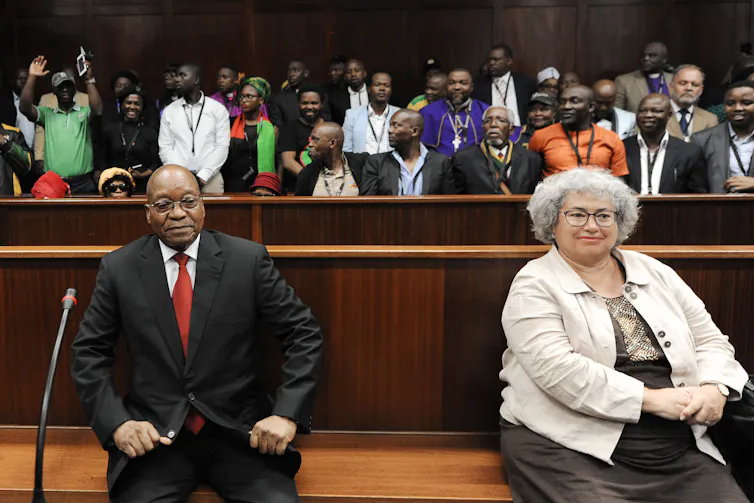
Former South African president Jacob Zuma and French arms company Thales, represented by Christine Guerrier, appear at the High Court in Durban on corruption charges.
Felix Dlangamandla/AFP via Getty Images

A particular feature of the last years of apartheid was a blurring of the public and private which was continued into the new order in at least two ways.

The first was obviously corrupt – the illicit networks which operated during the last years of apartheid recruited people in the new government: former enemies quickly became business partners.

The second was more complicated. It was widely assumed that the ANC would soon govern but its senior officials lacked the means to live the lifestyle expected of people of standing. Businesses, for motives both pure and impure, stepped in to help with cars, homes and private schools.

When businesses realised they would need black business partners, the only candidates they knew were the political activists with whom they negotiated. So, it was to them that they offered the shares and seats on boards which were essential if business was to adapt to new political realities.

The seeds of post-1994 corruption were, therefore, deeply planted in the country’s past. But corruption since then is also a symptom of another way in which the past was carried over into what was meant to be a new society. Before 1994, the groups which controlled the state used it to ensure that they controlled the economy too.

British rule gave English-speaking mine-owners special favours which allowed them to run the economy. After 1948, white Afrikaner rule was used to build the power and wealth of Afrikaans-owned business. But the post-1994 democracy has offered black business at best a role as junior partners of their white counterparts. Corruption has, therefore, become the means which some black people who want to rise to the top use to seek to achieve the dominant role enjoyed by previous business classes whose group controlled the state.

Corruption is also a symptom of the fact that the settlement which brought democracy left intact an economy which is highly concentrated so that new entrants find it hard to make their way in. Some turn to politics to achieve the middle- or upper-middle class life they are denied by an economy they cannot penetrate, no matter how hard-working and enterprising they are. It therefore answers a widespread need, which may explain why the corrupt networks are deep-rooted, particularly at the local and provincial level.

Tackling corruption

So, corruption is far more deeply rooted than current accounts would have us believe. Reformers such as President Cyril Ramaphosa confront a widespread reality which, because it reflects patterns which go back many years and springs from the exclusion of many from the benefits which democracy was meant to bring, is tenacious and can survive shocks.

Removing a few high-profile people will not change much because the networks will survive, as they have done since the departure of former president Jacob Zuma and the Gupta family, who were meant to be the cause of all the problems.

None of this means that sharply reducing corruption in South Africa is impossible. But a successful attempt to do this will need more than the instant cures favoured by the national debate – some high-profile convictions and barring people accused of corruption from public office.

Deep-rooted problems created over centuries demand thorough-going solutions which will take time to work. While this requires more patience and understanding than the national debate seems willing to offer, the alternative is many more years of public railing at corruption while the problem remains because its causes have been ignored.The Conversation

Steven Friedman, Professor of Political Studies, University of Johannesburg

This article is republished from The Conversation under a Creative Commons license. Read the original article.

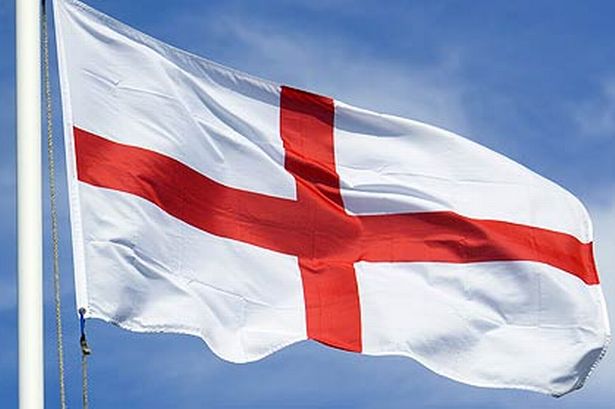
English the least patriotic nation

It may be St George’s Day in April, but don’t expect a sea of red and white flags to be flying across the nation.

England is the least patriotic country in Europe, according to a survey that found only 10% of people would proudly display our national emblem in public.

Political correctness and fears of being branded racist because of the flag’s links with far-right groups have left folk too “scared” to fly the cross.

But, incredibly, just one in three people actually knows when St George’s Day is, the survey by This England magazine found. Editor Stephen Garnett said: “It was shocking to see the results.

“We’re disappointed English people are afraid of displaying the St George’s Cross. We want to reclaim the flag from extremists by asking as many people as possible to fly it.

“It was shocking to see the amount of people who don’t fly the flag because of fear of being judged. It was also very worrying that so many said political correctness stopped them celebrating their national pride.”

The study found most English people gave themselves 5.8 out of 10 when asked how patriotic they felt. The Dutch are Europe’s most loyal at 7.18, narrowly ahead of the Welsh on 7.06.

Four out of 10 participants said they felt England has completely lost its identity.

Source: The Mirror

War on white Christians gaining in the US

The culture war against Christianity is picking up speed, says Patrick Buchanan.

Last week came word Saint Louis University will remove a heroic-sized statue of Father Pierre-Jean De Smet S.J. from the front of Fusz Hall, where it has stood for 60 years.

The statue depicts De Smet holding aloft a crucifix as he ministers to two American Indians, one of whom is kneeling.

Historically, the statue is accurate. Father De Smet, “Blackrobe,” as he was known, was a 19th-century missionary to Indian tribes who converted thousands. A friend of Sitting Bull, he spent his last years in St. Louis.

And as the mission of this Jesuit university is, presumably, to instruct the Catholic young in their faith and send them out into the world to bring the good news of Jesus Christ as Lord and savior to nonbelievers, what exactly is the problem here?

According to SLU Assistant Vice President for Communications Clayton Berry, “some faculty and staff … raised questions about whether the sculpture is culturally sensitive.” Senior Ryan McKinley is more specific: “The statue of De Smet depicts a history of colonialism, imperialism, racism and of Christian and white supremacy.”

The faculty and staff are ashamed of the truth for which Saint Louis University was supposed to stand.

The SLU president should have been honest with the iconoclasts. SLU is a Catholic university that welcomes students and faculty not of the faith. Instead, they try to hide who they are.

‘West still treats Africa as former vassals’

Western “colonial” states are not interested in South Africa’s development, but rather want to take its natural resources and never give anything back, pres. Jacob Zuma, told RT. It’s China’s investment that Zuma sees as a way to prosperity.

“The Western world or the European countries, in particular, came to Africa [in the 19th century] to colonize and they had been taking the resources of Africa,” Zuma said.

But even after the continent decolonized itself in the mid-20th century, its relationship with the US, UK, France and other Western countries “remained the same,” he stressed.

“They still regard us as the Third World, as a kind of people, who must be related to as the former subject [state], etc. That talks also to the economics… Their intention has never been to make the former colonial countries develop,” the president explained.

Zuma believes things “would never be the same” with China, which has been heavily investing in Africa since the early 2000s, as it came to the continent “as equals.”

“The Chinese come differently. They come to do business with us. They are ready to help… The results would be that African countries will be empowered,” he said.

China is educating African students and building highways in many countries, while the Western states “only built roads from mining areas to harbors,” the president added.

China is currently South Africa’s top trading partner, and Zuma expressed confidence that recent attacks on foreigners, in which Chinese citizens were affected, won’t lead to a cool down in relations between Pretoria and Beijing.

“The issue of xenophobia was exaggerated in South Africa,” he said, adding that the true reasons for the attacks lay outside racial issues.

The South African leader pointed out that thousands across the country had taken to the streets to protest xenophobia after five people died in violence in Durban in mid-April.

Despite “some things here and there,” South Africa was one of only two African nations approved as one of the 57 founding members of the Chinese-led Asian Infrastructure Investment Bank (AIIB).

Beijing and Pretoria will also join efforts to establish the BRICS bank (New Development Bank), with South Africa set to host the new financial institution’s regional center. The countries comprising the BRICS group are Brazil, Russia, India, China and South Africa.

Zuma criticized existing international financial institutions, such as the International Monetary Fund and the International Bank for Reconstruction and Development, saying that “it’s very difficult to pinpoint the real exemplary kind of delivery by these institutions,” and that African countries “got into more difficulties” by relying on their assistance.

The idea of the New Development Bank has “brought the fresh breath in the system,” he said.

“BRICS has brought the bank, which is a developer; which is going to operate differently… It’s focusing on the Third World, not just on the Third World, but whomever else. And it’s actually aimed at helping to uplift countries that need help,” the president said.

Meeting with Zuma, Russian President Vladimir Putin advocated BRICS development as a vehicle for improving the economies of Russia and South Africa.

Zuma arrived in Moscow on Vladimir Putin’s invitation as guest at the May 9 military parade dedicated to the 70th anniversary of Victory over Nazi Germany.

He stressed the importance of the occasion as “at times, people have got short memories. They might be forgetting that we came from a very serious situation, which led to many deaths.”

The South African president observed that the Soviet Union had “suffered a great deal” during World War II, noting that “the turning point of the defeat of fascism was done by the Russians.”

Source: RT

Could ignorance about Paul Kruger be real?

Tshwane officials on Monday said it was still unclear who had defaced the historical statue of Paul Kruger at Church Square in the Pretoria city centre.

“No one has claimed responsibility for it,” said mayoral spokesperson Blessing Manale.

Kruger’s bronze statue was defaced with lime green paint on Sunday. Strangely, security cameras did not capture the vandals.

Manale said the mayor had been expecting to receive a petition from the African National Congress Youth League on Tuesday.

Displaying their ignorance or perhaps their paymasters, both the ANC Youth League and EFF have called for the removal of the statue, describing Kruger as a “colonial and apartheid figure”.

Kruger, an Afrikaner, served as president of the Zuid-Afrikaanse Republiek in the late 1800s, well before the British introduced apartheid to exploit mining labour.

Kruger represents the ultimate resistance against British colonialism in Africa and was lauded by European governments in his day for his efforts.

Security tightened

Security had since been “tightened” at several points around the capital city which have historic statues.

“The city has decided to up security at the Voortrekker Monument, Freedom Park, the City Hall and at the Union Buildings,” Manale declared.

The defacing of Kruger comes amid calls for historic statues to be removed from central areas.

Last week, the Economic Freedom Fighters [EFF] in the Nelson Mandela Bay region claimed responsibility for the torching of the War Memorial statue in Uitenhage’s Market Square.

“Unfortunately we could not topple the statue, as the police came and stopped us,” said deputy chairperson for the region, Bo Madwara.

Cecil John Rhodes’ days are numbered

After a week of student protest, UCT vice-chancellor Max Price has given up on the statue of colonial war criminal and génocidaire Cecil John Rhodes. Price says it should be moved from its “pride of place, at the focal point of the campus”.

In an attempt to stop the protests, Price yesterday announced a fast-track plan for the controversial statue, hated by both black and white.

But Price’s appeasement gesture will do little to quell the spread of black protests against lack of “transformation” and “racial equality”. SRC president Ramabina Mahapa described the new plan as “meaningless”.

Using the hashtag #Rhodes SoWhite, students in Grahamstown yesterday staged a demonstration too about the slow pace of transformation and lack of inclusiveness at Rhodes University.

The chairman of the Higher Education Transformation Network, Lucky Thekisho, singled out the North West and Stellenbosch universities as white scourges.

The three different campuses of North West University needed to be unified so that resources could be more equally spread, while student initiations were a racially divisive issue at Stellenbosch, he said.

UCT students began protesting 10 days ago after a political science student, Chumani Maxwele emtied a bucket of faeces over the statue of Rhodes.

Maxwele has told The Times he wants to end the division between black and white students at UCT and to eradicate whiteness which is still rampant at the institution.

Price defended Rhodes and said “This will not compromise our ability to record and debate the role Rhodes played in the city’s and continent’s history.”

Nine former presidents of the UCT SRC have written an open letter to the university council expressing their support for the removal of the statue.

Heritage Western Cape spokesman Andew Hall said the statue was an “icon of national heritage”. The provincial government has appealed to “stakeholders from the heritage committee” and “laws” in an effort to stop the removal.

The province has never sought input from any so-called stakeholders when it summarily trashed and removed Afrikaner monuments in Cape Town.

“It cannot just be broken down. The university will have to get a permit before making any changes to it and they will have to recommend what needs to happen with the statue. Without appeals, the process could take 30 days,” Hall declared.

The DA’s coloured federal chairman Wilmot James, a former dean of humanities at UCT, confirmed that Rhodes was a war criminal. “Cecil John Rhodes did awful things as part of his colonial project,” he said. Wilmot nevertheless tried to defend Rhodes’ “contribution to education”.

Rhodes started the British war effort, supported by troops from several regions in the British Empire, including blacks, the Australian colonies, Canada, India and New Zealand, to plunder the rich Boer republics where gold had just been discovered in the nineteenth century.

For this purpose concentration camps for white Afrikaners were set up in which almost 30 000 Afrikaner women and children perished. Black British troops were ordered to rape white Afrikaner women and girls.

It formed part of the British “Scorched Earth” policy which included the systematic destruction of crops and slaughtering of livestock, the burning down of churches, homesteads and farms, and the poisoning of wells and salting of fields.

Britain’s shameful part in Mugabe’s tyranny

I can’t imagine that anyone in his right mind would actually want to go to the 91st birthday party of Robert Gabriel Mugabe which takes place this Saturday.

It promises to be an event of truly spectacular moral ugliness. While his people are starving, the ancient despot will convoke 20,000 cronies at a kind of golf club-cum-safari lodge near the Victoria Falls. In scenes reminiscent of the more disgusting and luxurious behaviour of the emperor Commodus, he will cause various exotic beasts to be slaughtered for the feast.

Five impalas will be roasted, two sables, two buffaloes – and then, to the ululations of his drunken Zanu-PF supporters, there will be a series of culinary climaxes, each more revolting than the last. A local farmer has procured two elephants, and after these rare and majestic creatures have been butchered for the delectation of the semi-deified Mugabe, there will be one more type of meat to come – an animal that you might think was semi-sacred, whose killing should be taboo, a creature that people would never normally dream of eating. Yes, a lion, the king of the animal kingdom, will lay down its life before the meat-maddened mob and have the honour of surrendering its mortal flesh to the palsied gullet of the man who still calls himself the “Hitler of Africa”.

And then, at last, the cake will appear, predicted to weigh 200lb, and in the most depraved and demoralising vignette of all, this crowd of brainwashed Zimbabweans will sweetly sing Happy Birthday to the man who has impoverished their country. This birthday party is predicted to cost $1 million at a time when Zimbabweans are living on 35 cents a day. Teachers across the country have been forced to contribute $10 each to put on the show.

The whole exercise is utterly nauseating – and my only question, as I say, is who on earth would want to be there?

Who is going to be toasting Mugabe in champagne and Tusker lager? Who is going to feature in the photo spread in the Zimbabwean equivalent of Hello! or OK!? I doubt that Britain will be represented at all – but by rights there is one man who damn well should be there, one man who should be down on the dance floor with Mugabe’s buxom assistants, and flashing his familiar glistering smile at the gathering.

If there were any justice in the world, that man would break off from giving advice to sundry other dubious regimes and help old Bob with the job of blowing out his candles. And that man, naturally, is Tony Blair.

Zimbabwe is now the second poorest nation on earth – beaten only by Congo for overall grimness. The people are so badly malnourished that one in three children is physically stunted, according to the UN. If you go there you see the ravages of HIV, the emaciated figures standing listlessly on street corners. Companies are constantly going to the wall.

But it is vital to recognise that Zimbabwe was not always like this, and did not have to be like this. This Mugabe tyranny is no accident – and Britain played a shameful part in the disaster. Readers will remember the 1979 Lancaster House Agreement, by which Margaret Thatcher granted independence to Rhodesia. At that time the country was a breadbasket, a flourishing agricultural producer, with about 6,000 commercial farmers. The only trouble with those farmers was that the most successful of them were white – and Mugabe’s long reign has been characterised by one overwhelming objective: to exterminate the last vestiges of white power, whether political or economic.

As he has said: “The white man is here as a second citizen. The only man you can trust is a dead white man.” So it was crucial that the Lancaster House Agreement protected the interests of these white farmers. They could, of course, be bought out, but their land could not be simply seized. There had to be a “willing buyer, willing seller”. The British government agreed to fund the arrangement, compensating the former colonial farmers for land that they gave up. Under that arrangement the white farmers were able to survive – more or less; Zimbabwe remained economically viable – more or less.

And then in 1997, along came Tony Blair and New Labour, and in a fit of avowed anti-colonialist fervour they unilaterally scrapped the arrangement. The overseas development minister, Clare Short, made it clear that neither she nor Blair gave a stuff about the former colonial farmers. As she put it at the time: “I should make it clear that we do not accept that Britain has a special responsibility to meet the costs of land purchase in Zimbabwe. We are a new government from diverse backgrounds, without links to former colonial interests. My own origins are Irish and, as you know, we were colonised not colonisers.”

It was that betrayal of Lancaster House that gave Mugabe his pretext to launch his pogroms against the whites. I remember going to a place called Mazowe, not far from Harare, where Mugabe now has one of his vast personal ranches. I met an old ex-Rhodesian couple whose family came from near London, whose kitchen dresser bore the medals their relatives had won fighting for this country. I remember them physically trembling with fear of the Zanu-PF thugs who were waiting at the gate to their farm; and it wasn’t long before they were gone – driven out by sheer intimidation. They died not long afterwards.

The Labour government enlisted this country in all sorts of wars around the world, some more disastrous than others. British soldiers went to fight and die in Iraq, in Afghanistan, in the Balkans. Here we had people with close relatives in our own country – yes, our own kith and kin – and we did absolutely nothing. We turned our backs on the very people who were actually indispensable to the economic well-being of Zimbabwe, and Labour essentially allowed Mugabe to launch a racist tyranny.

The two criminals, Blair and Bob enjoying a moment together

It was Labour’s betrayal of the Lancaster House Agreement – driven by political correctness and cowardice – that gave Mugabe the pretext for the despotic confiscations by which he has rewarded his supporters. And that is why Blair should be there: to mark Labour’s special contribution to the tyrant’s longevity in office.

Boris Johnson is the Lord Mayor of London and a former journalist. This article is from the Telegraph newspaper.

How Churchill starved 4 million Indians

By Ramtanu Maitra

Madhusree Mukerjee’s book [Churchill’s Secret War: The British Empire and the Ravaging of India during World War II, New York, Basic Books, 2010] is not a denunciation of British rule of India, but a meticulous chronicling of the role of the British Raj in furthering a famine in Bengal, and suppressing the fact that this deliberate holocaust took 4 million lives. British historians, including Sir Winston Churchill in his five-volume memoir, glossed over this rather ‘irrelevant incident.’ Historians around the world have made little effort either to find out how many lost their lives in the 1943 famine, or what role the British colonialists played to cause this man-made famine.

However, in 1999, Dr. Gideon Polya, a professor at La Trobe University in Victoria, Australia, made the following observation in an interview: “The wartime Bengal Famine has become a ‘forgotten holocaust’ and has been effectively deleted from our history books, from school and university curricula and from general public perception. To the best of my knowledge, Churchill only wrote of it once, in a secret letter to Roosevelt dated April 29th 1944 in which he made the following remarkable plea for help in shipping Australian grain to India: ‘I am no longer justified in not asking for your help.’ Churchill’s six-volume History of the Second World War fails to mention the cataclysm that was responsible for about 90% of total British Empire casualties in that conflict, but makes the extraordinary obverse claim: ‘No great portion of the world population was so effectively protected from the horrors and perils of the World War as were the people of Hindustan. They were carried through the struggle on the shoulders of our small island.’”

Mukerjee, a Bengali herself, has conducted extensive research to document what she writes, and also interacted with those who survived the holocaust and lost their parents, children, and other relatives. In Bengal, millions were dying because of food shortages caused by British looting to feed the troops engaged in World War II, and partly due to nature’s fury in the midst of a well-developed independence movement, which led to the end of the British rule in 1947. She documents the British War Cabinet’s role, Churchill’s, in particular, in exacerbating the food shortages, stonewalling attempts to send food from other countries to alleviate the crisis, and, in fact, justifying the necessity to cull those who are not only ‘inferior,’ but who breed like rabbits.

The author points out that Churchill, explaining why he defended the stockpiling of food within Britain, while millions died of starvation in Bengal, told his private secretary that ‘the Hindus were a foul race, protected by their mere pullulation from the doom that is their due.’ Pullulation, Mukerjee notes, means rapid breeding.

Mukerjee cites the notes from the British War Cabinet meetings that were released in 2006, which show that Churchill’s decision not to send food to starving Bengal was anchored on the analysis that, after the war, Europe would need a lot of food, and food prices would be high, and for Britain to import food at that time would prove costly. Moreover, surplus stocks built up in Britain by the denial of food to Indians would be worth a lot more on the world market after the war. On the basis of this analysis, Churchill resolved in 1942 to build up a stock of 27 million tons through civilian imports.

The British East India Company

The author reaches back in history to document the looting of Bengal by the rapacious British East India Company, which began in the mid-1750s to form the backbone of what became the mighty British Empire, and which made Bengal, once a much more prosperous province than the entire British Isles, so vulnerable later. The book does not deal, however, with the devastation of the region’s farmlands, Bengal and Bihar, in particular. These farmlands had been wrecked by opium cultivation and indigo plantation by the British. To learn about that barbaric role of the British, one must read Amitav Ghosh’s Sea of Poppy, and Dinabandhu Mitra’s Nil Darpan (Mirror to Indigo Cultivation), written in Bengali in the mid-19th century.

However, Mukerjee does provide some figures of the looting by the East India Company that filled the coffers in London. Bengal fell under East India Company control in 1757, and ‘within five years,’ the author reports, ‘Bengal became India’s poorest province.’ The Company directors were looting freely and paying His Majesty’s Government £400,000 annually. For centuries, gold and silver had poured into Bengal, but, by 1769, all that was gone. Between 1766 and 1768, the author notes, Bengal imported £624,375 worth of goods and exported £6,311,250: The amount going out was ten times that which was coming in.

Churchill, or Hitler: Take Your Pick

One of the interesting aspects in this book is the author’s observation that when it came to India, there was hardly any difference between Hitler and Churchill. Both were avowed racists and killers; both loved wars and had a particular hatred for the Indian people; and both were eager to see Mohandas Karamchand Gandhi, known as Mahatma Gandhi, or Gandhiji, killed. The author notes that Hitler was a great admirer of Britain and the British Raj. Indeed, the British bankers did a yeoman’s job to get Hitler to seize power and build his Third Reich.

Hitler’s and Churchill’s common view on how to deal with the growing demand of the Indian leaders, Gandhi in particular, is most revealing. In November 1937, Hitler, during his meeting with the Viscount of Halifax (formerly Lord Irwin, Viceroy of India), advised him to ‘shoot Gandhi, and if this doesn’t suffice to reduce them to submission, shoot a dozen leading members of Congress; and if that doesn’t suffice, shoot 200 and so on until order is established… You will see how quickly they will collapse as soon you make it clear that you mean business.’

Gandhi was eventually assassinated in January 1948, a few years after Hitler had shot himself, and a few months after the British finally left India. While Hitler was advising fellow representatives of a ‘superior race’ to shoot Gandhi and other Congress Party leaders, Churchill was spitting venom against Gandhi. In 1931, after Gandhi was released from one of many times that he was imprisoned, Churchill charged Viceroy Irwin with ‘craven capitulation.’

He said: ‘It is alarming and also nauseating to see Mr. Gandhi, a seditious Middle Temple lawyer, now posing as a fakir [selfless person] of a type well known in the East, striding half-naked up the steps of the Viceregal palace, while he is still organizing and conducting a defiant campaign of civil disobedience to parley in equal terms with the representative of the King-Emperor.’ In 1944, British historian Penderel Moon recorded Churchill saying: ‘He [Gandhi] is a thoroughly evil force, hostile to us in every fiber, largely in the hands of native vested interests.’ On another occasion, Churchill sent a note to then-Viceroy Archibald Wavell, asking why Gandhi was not dead yet.

What is also revealing is that Churchill’s major domo in his aggressive service of the British Empire was Frederick Alexander Lindemann (1886-1957), a German-born and English-bred racist, anti-Semite, and physicist. His German origins were somewhat covered up when he was made Baron Cherwell (1941), while serving in the Statistics Division or S branch. Lindemann attended War Cabinet meetings as Churchill’s science advisor, and saw Churchill almost daily during the war.

Mukerjee writes: On most matters, Lindemann’s and Churchill’s opinions converged, and when they did not, the scientist worked ceaselessly to change his friend’s mind.’ Naturally, his objective was to provide rationales for whichever course the prime minister as interpreted by the professor wished to follow. As a result, when the famine was raging in Bengal and starved bodies littered the rural areas, with people lacking strength of their own to bury them, Lindemann would pronounce judgment on the best use of shipping space, the inadequacy of British supplies, the optimal size of mustard gas stockpiles, and the necessity for carpet bombing of German cities. And, when the time came, Professor Lindemann would expound the pointlessness of sending famine relief to Bengal.

Churchill’s Dr. Mengele

Mukerjee pointed out, in an article published elsewhere, ‘that Lord Cherwell considered the rescuing of imperial subjects to be an inefficient use of resources may be deduced from the drafts of a lecture he had delivered during the 1930s… In the lecture, he outlined a science-based solution to the challenging problem of perpetuating imperial control over subject peoples. The professor envisioned that technologies such as surgery, mind control, and drug and hormone manipulations would one day allow humans to be fine-tuned for specific tasks. Furthermore, he postulated, at the low end of the race and class spectrum one could remove from ‘helots’ (Greek for slaves) the ability to suffer or to feel ambition” thereby creating a lobotomized subclass that would do all the unpleasant work without once thinking of revolution or of voting rights. The result would be a perfectly peaceable and stable society, ‘led by supermen and served by helots.’

Lord Cherwell evidently considered the existence of certain peoples to be justified only to the extent that they served their racial and class superiors, which may explain his reluctance to expend resources on imperial subjects who were unimportant to the war effort. Churchill himself may have subscribed to such a view. After attending one of the War Cabinet debates on sending famine relief, for instance, Field Marshal Wavell noted in his diary that Churchill wanted to feed ‘only those [Indians] actually fighting or making munitions or working some particular railways.’

Lord Cherwell was so allergic to people with dark skin colour that after his retirement he wanted to settle in a warm country such as Jamaica, but the thought of spending his days with black people was too much, so he stayed shivering at Oxford.

Famine That Killed 4 Million

The 1943 famine was not only man-made, but the outcome of the British Empire’s looting of India, using free trade as one of its vicious weapons. The whitewashing of Indian famines extends to two centuries of famine in British India. How many Indians died in these famines has not been fully established, but one figure indicates that at least 28 million died in the 19th-century famines. A 1933 survey revealed that 41% of India’s inhabitants were ‘poorly nourished,’ and another 20% ‘very badly nourished,’ with the statistics for Bengal being worst of all: 47% and 31%, respectively. By the time World War II hit, India was importing between 1 and 2 million tons of rice a year from Burma and Thailand.

In her book, Mukerjee writes that a more meaningful measure would be life expectancy, which can be calculated after 1871, when the first nationwide census took place. Life expectancy for a newborn Indian hovered around 24 until 1920, and then rose slowly. In contrast, life expectancy in Great Britain improved significantly throughout the Victorian era, to reach 47 by its end. This was mostly due to better nutrition provided by the crops that were raised in British India, and exported to the imperial headquarters. While Indian nationalists demanded that cereals not be allowed to be exported in times of famine, the British authorities pressed home the ‘virtues of free trade,’ and local administrators who curbed exports or otherwise interfered with market forces were severely chastised. Mukerjee points out that even during devastating famines, the government rigorously collected agricultural taxes; thereby feeding whatever harvest there was into the free market.

The crux of the matter was that India’s agricultural exports had become crucial to the British Empire’s economy. In 1905, arguing in favour of free trade, Churchill observed: ‘The harvests of the world are at our disposal, and, by a system which averages climatic risks, we secure not merely a low but a fairly stable price. With that marvelous operation by which the crowded population of this island is fed, we cannot take the responsibility of interfering.’

The famine that killed 4 million Indians in Bengal was orchestrated from outside. ‘Since 1939,’ Mukerjee wrote, ‘the United Kingdom had been drawing grain and manufactures from India for the war effort, and the colonial government had been printing money to pay for these purchases. The resulting inflation had combined with other factors to precipitate famine in early 1943. The following summer, the Government of India asked the War Cabinet for half a million tons of wheat by year-end. The cereal would feed India’s two-million-strong army and workers in war-related industries; if any happened to be left over, it would relieve starvation. The mere news of the arrival of substantial imports would cause prices to fall, because speculators would anticipate a drop in prices and release any hoarded grain to the market. Churchill’s close friend and technical advisor, Lord Cherwell, demurred, however: he erroneously argued that India’s food problem could not be solved by imports. In any case, expending valuable shipping on Indians ‘scarcely seems justified unless the Ministry of War Transport cannot find any other use for it,’ he added in a draft memo. (In the final version, this sentence was changed to a straightforward recommendation against sending grain.)

Near the end of her book, Mukerjee provides the following anecdote: “In June 1953, after witnessing the coronation of Queen Elizabeth, Churchill found himself standing next to Nehru’s daughter, Indira Gandhi, while they both waited for their cars to drive up. ‘You must have hated the British for the treatment meted out to your father,’ Churchill said. ‘It is remarkable how he and you have overcome that bitterness and hatred.’

‘We never hated you,’ she answered.

‘I did, but I don’t now,’ he replied.

Indira Gandhi might have been generous, or she might have been muttering under her breath: ‘We loathe you.’”

The next time Prime Minister David Cameron and his ilk come prancing to India seeking a bailout of Britain’s dwindled, technologically obsolete industrial sector, Prime Minister Manmohan Singh, or the future powers-that-be, and the Indian people, must demand, not only the return of the crown jewels looted from India, but an admission and apology for the 4 million Indians they starved to death in 1943-45. No compensation would suffice.

This book should be read by those in the West, as well as elsewhere, who have been brought up with the anglophile version of the British Empire. The book documents that those who served the British Empire were not just perfidious; they were killers, just as the Nazis were.

Churchill’s Secret War: The British Empire and the Ravaging of India during World War II

Madhusree Mukerjee; New York: Basic Books, 2010; 332 pages, hardbound, $28.95

Source: http://www.vijayvaani.com/

Following the hated white colonialists

White colonialism has spawned a stampede of black immigrants to Europe as hundreds of migrants attempted again to cross the Spanish border into the EU.

Over 200 immigrants attempted to cross the border fence between Morocco and the Spanish enclave of Melilla for the second time in 24 hours on Wednesday. Around 100 of them remained on the fence or in no-man’s land between the two fences.

The incident occurred at around 6:30am, while other small groups of immigrants attempted to cross at other points across the border.

immis

‘92% of South African whites are racist’

I read the previous column by Jonny Steinberg on Oscar Pistorius. In my view that article was too general and gave an incorrect view on the opinions of blacks.

Though I now stay in an upmarket suburb, I spend lots of my time in the townships. In those circles, the majority of people I have spoken to are not really concerned about Oscar but are concerned about the judgment itself. It really confused them. It created more doubts than certainty about the legal system in our country and the interpretation of laws. In a nutshell, most middle-class and informed Africans were embarrassed by it. They are even reluctant to talk about it. However, the most fortunate part of our judicial system is its corrective mechanisms. To err is human.

On the current article I wish to remind Mr Steinberg that not all whites still live in the past. Maybe, about 92% of them still do. It is expecting too much from the 92% (this figure is an estimate) of white people to embrace reconciliation and not be racist. Why would they now do that? They have failed to do so in the past 600 years of the history of mankind. During those years most white people have enforced and supported slavery, racism, colonialism, apartheid and other forms of prejudices against blacks, and Africans in particular.

In my view reconciliation is too abstract a concept to embrace or even attempt to “enforce”. The best way would be for government to, among other things, enforce and implement laws that would make economic growth possible, make equitable economic redistribution possible, expedite cultural emancipation for Africans and outlaw any form of racism and/or prejudice in this country.

It is unfortunate that most of my fellow countrymen cannot define what racism is ( or other forms of prejudices such as tribalism, sexism ). It has become the most abused term; especially by the majority of white South Africans. Maybe it’s because they have never experienced racism. – Thulani Ngcobo Midrand (Originally published as a letter in Business Day)

‘White conservatives behind SA’s rape epidemic’

One Bruce Gorton writes in Timeslive that white conservatives are the ones behind the South African corrective rape epidemic.

“Sure there are liberal rapists, but they aren’t doing it to people specifically for being gay,” Gorton says.

Consider this – before colonialism in Africa there wasn’t much of a tradition of homophobia. That is something that came in with the missionaries – but now it is the traditionalists, those who go on about African culture, who are most opposed to gay rights.

Meanwhile the white conservatives in South Africa are pretty much in agreement – it is the same thing from cultures that are supposed to hate each other.

Conservatives don’t give a damn about their culture, they care about excuses to make other people miserable.

In rural America, people who proudly self-identify as rednecks, are driving four-by-four trucks specially modded to belch out black smoke at the push of a button.

They spend $500 and $5,000 for these modifications, which actually reduce the power of their engines, so they can set out to “roll coal” on pedestrians, people ridding bicycles, and driving small cars on the highway.

Which is to say, congratulations America’s right wing, you are now real-world Captain Planet villains.

These are people who specifically foul the air with poison gas, in a way that reduces visibility for fellow motorists, because they don’t like clean air.

And they are the American conservative movement. That is what the American right wing is all about – simple, pointless spite.

The chief sin in conservative ideology is not hurting other people, it is being politically correct.

And conservatives will go to a special effort to be arsehole to other people in order to protest the idea that showing some consideration for other people is a good thing.

They don’t just roll coal on America’s highways.

Consider how Americans view the current president. I disagree with a lot of Barack Obama’s policies, I think he is way too comfortable playing Peeping Tom on everybody’s email, phone discussions and Internet usage.

But that isn’t what America’s conservatives criticise, no they claim he is a “Kenyan Muslim” – because they are all about bullying people for being non-white and non-Christian.

Wait, you express disgust at the basic xenophobia, religious bigotry and racism inherent in accusing a black man of being an African of another religion as if that is some sort of knock-down argument against his presidency?

Well now you’re just being politically correct.

That is American conservatism, and more than that, that is the conservatism of just about everybody else.

This is the heart of homophobia, of sexism, of racism, of all the other little hateful bits of shit that cling to the shoes of society – not ignorance but the pure, unadulterated wish to make the world worse.

The BNP don’t protest for a better Britain, they fight for the British value of bullying foreigners. Australia’s conservatives don’t want a better Australia, they want to ship refugees off to countries with laws very similar to the ones they were fleeing in the first place.

They’re all about just rolling coal over the rest of humanity.

The new SA colonials have arrived

fujianWithout as much as a whisper the South African government allowed at least 400.000 Chinese to swamp the country during the past six years. Chinese migrants, mainly from the overpopulated Fujian province in China, have been shipped off to South Africa at an alarming rate. Spreading all over the country, even in the remotest parts, between 6 000 and 12 000 “Chinese shops” sprang up.

New York also began to witness an influx of Fuzhounese Chinese-Americans. Fuzhou is the capitol city of the Fujian province of China, located in the southeast. Fuzhounese immigrants were attracted by promises of opportunity in New York (other destinations of interest were Japan, Australia, and Europe). Many undocumented immigrants came to New York as well, brought to the United States through human smuggling practices that had become widespread in the towns outside Fuzhou.

Today there are over 400.000 Chinese-Americans living in New York.

Emigrants who traveled to New York lived both in Fuzhou itself and in smaller villages outside of Fuzhou. The quantity of Fuzhounese immigrants measure into the tens of thousands. Fuzhounese immigrants in New York now outnumber Cantonese immigrants. Parts of the Lower East Side Chinatown and Sunset Park Chinatown are coming to be described as “Little Fuzhou” to acknowledge the growing Fuzhounese population.

Since the arrival of Fuzhounese people in Manhattan, Chinatown has expanded dramatically. Parts of the Lower East Side that originally belonged to Little Italy were now being assimilated into the ever-growing “Little Fuzhou”

Prof Colin McCarthy, retired from the University of Stellenbosch, first noted the “Chinese colonization” in South Africa. Says Prof McCarthy: “All the evidence indicates that the project to set up such an extensive network of Chinese shops, all following the same pattern and targeting the same market, was well researched, well planned, well organized and well financed”.

The young, unemployed couples from Fujian province settled into the network – pushing up cheap Chinese plastic, products and clothing into a lucrative retail chain far bigger than Pick ‘n Pay, Pep Stores or Edgars. To make matters worse: most of the Chinese shops are not registered and do not pay any taxes in South Africa’ not even import or export duties – in fact, China puts its clothing exports to South Africa to R11,3 billion in 2010; whilst South Africa’s failing statistics put the Chinese clothing imports at only R6,7 billion! It means that in one single year R4,6 billion worth of Chinese clothing entered South Africa illegally.

A South African Revenue Services employee spilled the beans on a small Chinese shop in a rural area where, when raided by SARS, R1,2 million was found under the counter.

Janet Wilhelm of the HSRC observes: “It is amazing how so many people can enter a country seemingly unnoticed!” She quotes the SAPS Aliens Investigation Unit as saying “Many Chinese travel to South Africa via Mbabane, Maputo and Maseru from where they enter South Africa with false identity documents by road”.

Patrick Chong, chairman of the Chinese Association of South Africa, says: “Many would enter on tourist or student visas then simply stay”.

Researches of Noseweek followed the Chen family where one pioneer settled illegally in South Africa, spreading within four years to 172 members of the family scattered across Lesotho trading Chinese products.

The South African ANC government officially proclaimed Chinese as “honorary blacks”, making them exempt from affirmative action, quotas and Black Economic Empowerment.

It is ironic that while populists like Malema and Shivangu walk about claiming “land and minerals for the South African people”, the ANC government has allowed at least 400 000 additional Indians and Pakistanis, at least 400 000 Chinese and at least 10 million illegal’s from Zimbabwe, Nigeria, Mozambique, Angola and now also Zambia into the country.

Source: southafricatoday.net

France provides maps of Africa’s real borders

africamapsFrance has provided maps from its archives on African borders to the African Union.

France was one of the top colonisers of Africa and was involved in creating borders of most of the countries.

The AU’s Director for Peace and Security, Wane El-Ghassim, says knowing this kind of information will help curb some of the conflicts we still see today.

He says when borders are not clearly defined there is a huge risk of tensions resulting in conflict.

El-Ghassim says borders were defined by treaties signed by colonisers as a result these countries have a lot of information on Africa.

This is why the AU is trying to generate as much information as possible from the colonisers.

Africa has 80 000km of borders, but only 30% are precisely demarcated and this has been a source of disagreements among many countries in the continent.

Meanwhile, Analyst and Senior lecturer at Wits University, Koffi Kouakou, says Africa should not be relying on outsiders to give them information. He says it is important for Africans to have their own information.

Zambia’s ethnic worries

Great Scott, it's a white face!
Great Scott, it’s a white face! Guy Scott with President Sata (left)

Zambia recently woke up to a story in state-owned media that a group calling itself Tongas Under Oath had killed two people belonging to President Michael Sata’s ethnic group, and was now in the process of removing settlers from the ethnically Tonga Southern Province. However, the story did not wash with the citizens who simply viewed it as an attempt by the ruling Patriotic Front (PF) government to clamp down on the opposition United Party for National Development (UPND).

Zambia’s third largest opposition party is led by Hakainde Hichilema, a Tonga who has been very critical of the Sata government. And as is often the case in Zambian politics, Hichilema is the latest in a line of fearless opposition leaders whose increasing popular support is likely to result in electoral success.

Prior to the release of the letter allegedly written by the Tongas Under Oath group, Hichilema was arrested and charged after he claimed that the PF government was planning to send youths to Sudan to train as militias. A few days later, the opposition’s headquarters in the capital, Lusaka, were searched by the police looking for seditious materials.

They did not find any but a few days later a far more sinister letter about an assasination plot was sent to President Sata with a date stamp from Mazabuka, a town in Southern Province.

No one was ever arrested in the Tongas Under Oath terror plot however, since President Sata himself admitted that the supposedly incriminating letter was not authored in the Southern Province, but in Lusaka.

Despite Zambia’s obvious ethnic struggles, the white British Zambian Vice-President Guy Scott said recently in an unusually frank interview: “The South Africans are very backward in terms of historical development. I hate South Africans… actually they’ve been the cause of so much trouble in this part of the world.”

The comments ruffled feathers on social media and appeared to threaten relations between the former liberation struggle allies.

During the interview in Lusaka, Scott mocked South Africa’s membership of the Brics developing economies, compared President Jacob Zuma with FW de Klerk and opined: “I have a suspicion the blacks model themselves on the whites now that they’re in power. ‘Don’t you know who we are, man?'”

He also defended the Zimbabwean president, Robert Mugabe, and spoke out against Zuma’s attempts to mediate in that country on behalf of the Southern African Development Community.

Recalling a meeting between Mugabe and the Zambian president, Michael Sata, Scott said, without irony: “Michael the other day was saying, ‘You have to get this thing sorted out among yourself, you don’t want to go to SADC – it’s a new kind of colonialism’.”

The Daily Maverick’s Simon Allison quickly came to Scott’s rescue and tried to defend his strange comments. – ISN/ The Guardian