How corruption in South Africa is deeply rooted in the country’s past and why that matters

Steven Friedman, University of Johannesburg

When South Africans express shock at corruption, few seem to know that it is perhaps the country’s oldest tradition.

Citizen anger about corruption, a constant theme in South African political debate, reacts to a very real problem. This was underlined recently by news that well-connected people had enriched themselves at the expense of efforts to contain COVID-19. What is not real is the widespread belief that corruption is both new and easy to fix.

Reactions to corruption portray it as a product of African National Congress (ANC) rule (or majority rule for those who cling to the prejudice that black people cannot govern). In this view, it will disappear when the governing party gets serious about corruption or loses power.

In reality, however, corruption has been a constant feature of South African political life for much of the past 350 years. It is deeply embedded and it will take a concerted effort, over years, not days, to defeat it.

Colonialism, apartheid and corruption

Corruption in South Africa dates back to colonisation in 1652. Jan van Riebeeck, the Dutch East India company employee who was sent to colonise the Cape, got the job because he was given a second chance after he was fired for ignoring the company ban on using his office to pursue personal financial interests.

The period of Dutch rule he began, which lasted until 1795, was marked by tax evasion and corruption by public officials. Under British rule, which followed that of the Dutch, public spending was directed to serve private interests. The most prominent colonialist of the time, Cecil John Rhodes, was forced to resign after he gave a friend an 18-year monopoly catering contract for the government-run railways (JL McCracken; The Cape Parliament 1854-1910. London, Oxford University Press, 1967, p.115).

Paul Kruger’s Transvaal Republic, the Afrikaner-governed state against which the British fought at the turn of the century, was riddled with nepotism and economic favours for the connected. The British administration which replaced it served the interests of mine owners on whom it bestowed special privileges. What today is called “state capture”, the use of the state to serve private interests, was common to Afrikaner and British rule.

Given this history, it is not surprising that corruption was a constant feature of the apartheid period. Black people were its chief victims, since they had no rights and so no way of protecting themselves against abuse. But they were not the only ones, as politicians and officials used government power for personal gain.

The most corrupt period in the country’s history was the last few years of apartheid, when the attempt to combat the successful international sanctions campaign made corruption, protected by government secrecy, the core government strategy. This was often done with the collusion of private businesses.

Blurring the lines

By the time majority rule was achieved in 1994, corruption had become deeply embedded in the way the government operated and in how business related to the government. This directly affected the way South Africa was governed after 1994, despite the efforts of Nelson Mandela and his deputy, Thabo Mbeki.
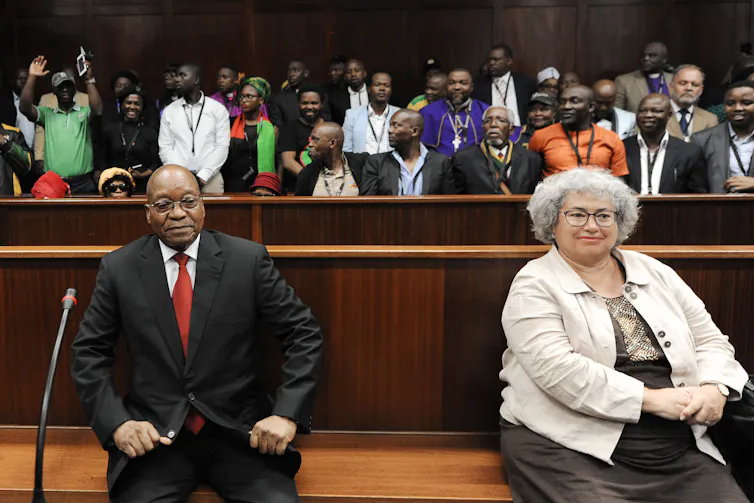
Former South African president Jacob Zuma and French arms company Thales, represented by Christine Guerrier, appear at the High Court in Durban on corruption charges.
Felix Dlangamandla/AFP via Getty Images

A particular feature of the last years of apartheid was a blurring of the public and private which was continued into the new order in at least two ways.

The first was obviously corrupt – the illicit networks which operated during the last years of apartheid recruited people in the new government: former enemies quickly became business partners.

The second was more complicated. It was widely assumed that the ANC would soon govern but its senior officials lacked the means to live the lifestyle expected of people of standing. Businesses, for motives both pure and impure, stepped in to help with cars, homes and private schools.

When businesses realised they would need black business partners, the only candidates they knew were the political activists with whom they negotiated. So, it was to them that they offered the shares and seats on boards which were essential if business was to adapt to new political realities.

The seeds of post-1994 corruption were, therefore, deeply planted in the country’s past. But corruption since then is also a symptom of another way in which the past was carried over into what was meant to be a new society. Before 1994, the groups which controlled the state used it to ensure that they controlled the economy too.

British rule gave English-speaking mine-owners special favours which allowed them to run the economy. After 1948, white Afrikaner rule was used to build the power and wealth of Afrikaans-owned business. But the post-1994 democracy has offered black business at best a role as junior partners of their white counterparts. Corruption has, therefore, become the means which some black people who want to rise to the top use to seek to achieve the dominant role enjoyed by previous business classes whose group controlled the state.

Corruption is also a symptom of the fact that the settlement which brought democracy left intact an economy which is highly concentrated so that new entrants find it hard to make their way in. Some turn to politics to achieve the middle- or upper-middle class life they are denied by an economy they cannot penetrate, no matter how hard-working and enterprising they are. It therefore answers a widespread need, which may explain why the corrupt networks are deep-rooted, particularly at the local and provincial level.

Tackling corruption

So, corruption is far more deeply rooted than current accounts would have us believe. Reformers such as President Cyril Ramaphosa confront a widespread reality which, because it reflects patterns which go back many years and springs from the exclusion of many from the benefits which democracy was meant to bring, is tenacious and can survive shocks.

Removing a few high-profile people will not change much because the networks will survive, as they have done since the departure of former president Jacob Zuma and the Gupta family, who were meant to be the cause of all the problems.

None of this means that sharply reducing corruption in South Africa is impossible. But a successful attempt to do this will need more than the instant cures favoured by the national debate – some high-profile convictions and barring people accused of corruption from public office.

Deep-rooted problems created over centuries demand thorough-going solutions which will take time to work. While this requires more patience and understanding than the national debate seems willing to offer, the alternative is many more years of public railing at corruption while the problem remains because its causes have been ignored.The Conversation

Steven Friedman, Professor of Political Studies, University of Johannesburg

This article is republished from The Conversation under a Creative Commons license. Read the original article.

Provincial government laments ‘barbarity’ of S. Africa’s child murders

rape_girls_feetThe Gauteng government on Wednesday condemned the murder of children in the province after two girls’ bodies were found earlier this week.

“What kind of a society are we who allow such acts of barbarity to occur in our midst?” premier Nomvula Mokonyane asked in a statement.

“It is time we, the government and communities, make this province a no-go area for child murderers and abusers.”

On Monday, police said a four-year-old girl was found hanged in Katlehong, Johannesburg.

The half-naked body was found by a passer-by hanging from a tree in an open veld, said Colonel Lungelo Dlamini.

In a separate incident also on Monday, a five-year-old girl was found dead beneath a pile of rubble in Diepsloot, northern Johannesburg.

She was thought to have been suffocated with a plastic bag, said Dlamini.

Mokonyane sent the province’s condolences to the girls’ families.

She said the provincial government was concerned about the levels of child abuse and murders that had taken place in Gauteng in recent weeks.

Those who witnessed child abuse needed to report the incidents.

“Just as the saying goes, ‘it takes a community to raise a child,’ it also takes a community to protect a child,” Mokonyane said. – Sapa

In defence of pale males

Another pale male: Argentine model and presenter Mario Guerci

by TAU Bulletin

The state of the nation is no more ludicrously evident than Gauteng premier Nomvula Mokonyane’s recent “warning” that “pale males” would return to government in Gauteng if SA’s opposition Democratic Alliance party wins next year’s provincial election.

“It can’t happen, it will not happen” she declared. “Reversals in transformation are unacceptable, and the Gauteng public must be spared the “white gevaar”  (danger).

Where in the world are efficiency, skills, creativity and diligence seen as a danger? Only in South Africa, where so-called liberation credentials, party membership and loyalty trump the need to maintain the first world country and its infrastructure which was handed to the ANC on a plate after the 1994 election.

Ms. Mokonyane’s racial invective and resentment has been received with a muted tolerance. Despite the non-racial assurances in the Founding Provisions of South Africa’s constitution, the governing party’s racial diatribes against, mostly, whites continue apace. Indeed, they seem to have increased. The State President’s YouTube clip where he urges his supporters to “kill the boers” and that his cabinet would “kill with a machine gun” is still running, without any apparent move by YouTube to take it out of circulation. (Yet a YouTube clip made by two white South Africans saying they refuse to apologize for being who they are was taken off within a few days of its appearance on the internet.)

South Africa has two parallel universes – the ANC’s self-delusion and the reality. The fact that the country has dramatically slipped down the world’s various achievement indexes over the past nineteen years has either escaped Ms. Mokonyane’s notice, or she is disingenuous in the extreme. Does the rather corpulent Ms. Mokonyane not realize that 90% of the food she and her countrymen consume is produced by pale males? That virtually everything she takes for granted in this country was created by pale males?

From where did the railways, roads, commercial farms, schools, hospitals, potable water and electricity transmission emanate?  The very language she uses in a legislature which is not part of her cultural heritage is a language of the pale male. The news print that distributes her humbug is not of her culture either. But she is selective in her vitriol.  When this lady shops, she hurries to the pale males’ luxury shopping centers:  she was recently seen at up market Hyde Park “posing proudly with her R10 000 LK Bennet shoes and matching handbag”. (Tony Leon, Business Day 30.7.13).  Pale males are excoriated but they are good enough to produce and supply the luxuries which she and her fellow anti-white friends cannot live without.

There is no empirical evidence to show that without the intervention of others in Africa (including pale males), Ms. Mokonyane’s culture would have evolved any further than that of those “lost” tribes one finds in the Amazon and Papua New Guinea.  She should be grateful that that particular ship sailed around the Cape of Good Hope many years ago and that it decided to stop for victuals. Non-pale male groups who could have manned that ship may not have been so conciliatory to the locals, then and now.

Who created the Sasols, the Iscors, the Eskoms and the country’s nuclear capacity? Who rid the country of the tste tste fly and malaria? Who developed Africa’s premier agricultural and veterinary service, used by the whole continent? Who produces maize and other grain surpluses year after year on the continent that cannot feed itself?

And, conversely, who is busy destroying what used to be the African continent’s pin-up country?

Certainly not pale males. Ms. Mokonyane and her compatriots should look in the mirror. But if one’s modus vivendi  is self delusion, then blame is the name of the game. The world has taken note of the Africa of today. It is not a pretty picture. Zimbabwe went from the continent’s bread basket to a basket case. Few if any of the continent’s governments can feed their people. Corruption, nepotism, inefficiency and venality are the order of the day. South Africa is no exception.  Who is to blame for Liberia’s status as an African cesspool, or for Ethiopia’s failed state ranking? Colonialism? Apartheid? Pale males? Neither of these countries was subjected to colonialism or apartheid. They are travesties because the people who live there are who they are.

South Africa today could certainly do with some pale males to put things right. But this is not the ANC’s priority: a deep racial inferiority complex trumps practicality.

The facts

Pale males around the world are denounced by the non-achievers with relentless regularity. Whites in the United States complain about this as well.  We quote Fred Reed from the US’s Nationalist Times:

“I am weary of the endless denunciation of ‘white privilege’; the calls to abolish all tests in which whites excel, and the need to make universities and police forces and advanced placement classes ‘look like American demographics’.  It might be well to note the utter dependence of the US on white men who have contributed virtually everything that keeps the affirmative action classes from living in mud huts.”

Reed continues with examples of this contribution: “Euclidean geometry, parabolic geometry, hyperbolic geometry and projective geometry.  Physical chemistry, organic chemistry, biochemistry. Classical mechanics. The indeterminacy principle. The wave equation. The Parthenon. Air conditioning. Number theory.  Romanesque architecture. Gothic architecture.  Information theory.  Entropy. Enthalpy. Almost every symphony ever written. Pierre August Renoir. The diatonic scale. The mathematics behind the twelfth root of two and all that. The Bohr-Sommerfeld atom. The purine pyrimidine structure of the DNA ladder. Single sideband radio. All other radio. Dentistry. The internal combustion engine. Turbojets, turbofans, Doppler beam-sharpening. Penicillin. Airplanes. Surgery. The mammogram. The Pill. The condom. Polio vaccine. The integrated circuit.

“The computer, computational fluid dynamics. Euripides, Sophocles, Aristophanes, Homer. Glass. Rubber. Nylon. Roads. Buildings.  Acetyl-cholinesterase inhibitors. Silicone. The automobile. Bug spray. Public cryptography.”

“Like it or not white men can do these things, have done them, and continue to do them. The evidence shows that all groups receiving affirmative action have not done them, and cannot do them, which is why they need affirmative action.

“The pattern of white men doing difficult things continues. Consider the founders of companies in information technologies. Not quite all white, but all men. Anyone who watched the landing of Curiosity on Mars will have noticed that Mission Control consisted overwhelmingly of white men. If I were rude, I would say to those who criticize: invent your own things.”

Reed cites South Africa as an example of a tragedy in the making. “A constantly dwindling number of whites are at the mercy of a predatory welfare class and it’s possible they can’t and won’t carry the rest of the population. If things get worse for them, they will simply flee the country.”

Whether this scenario plays itself out in South Africa is up to the whites. But Ms. Mokonyane mustn’t take too much for granted. Her dislike of pale males borders on the obsessive, to the point where common sense and practical considerations for the benefit of all South Africans are cast aside in an all-consuming and embittered realization that her ANC cannot feed its people, cannot govern, and are no better than what the world has seen emanate from the rest of the continent over the past fifty years. She knows this, the ANC knows this, and the world knows it. Keeping out the pale males won’t improve the ANC. This racial animosity is inimical not only to whites but, eventually, to the future of all South Africans.
The pale male acrimony is however selective. Ex president Nelson Mandela was not interned in an ANC-run hospital. The new ANC elite have quietly bought houses in so-called white areas. They send their children to white schools. They want the pale male’s education system. (Every university in South Africa is a white creation). What is the yardstick against which anything of worth in South Africa is judged if not against a pale male-created yardstick? Are the elite’s suits bought from Nigeria or Italy? Is there such a thing as a Ghanian IPod? Do they fly Air Kenya or British Airways? Do they go to Mali for their holidays or to Paris?

A South African business journalist refers to “the African No” – “a jumbled melee of endless meetings, unreturned phone calls and ignored e-mails”. Compare this approach with the white world. The United States for example accounts for 4,5% of the world’s population but 25% of the world’s GDP. When people flee their terrible countries they try for Europe, Australia and other pale male bastions. They don’t want to emigrate to Zambia or the Sudan.
A cursory trawl through South Africa’s productive sector sees pale males as police divers, as rescue helicopter pilots, as paramedics, as the donors to charities, as the bedrock of the taxpayer base, as the underpinners of the medical profession, the service industry, the banking and the mining sector. The country is divided into the producers and the consumers, and we know on which side of the divide the pale male sits.

Virtually all of the productive farms that were handed over to ANC supporters under the government’s land redistribution policy failed:  a pithy example of pale male producers and ANC-created destruction.

It is a pity that more media space is not given to a frank analysis of who are the drivers of the South African economy, instead of to those who talk about nationalization, about transformation, about white racism and so-called privilege. South Africans might get a clearer picture of who is really important in the grand scheme of things, as opposed to those who can talk the leg off an iron pot, hold press conferences,  fly all over the world first class, endlessly discuss turnaround strategies and blame everyone but themselves for their shortcomings.  Within ten years, South Africa’s social spending (including huge government employee wage bills) will exceed government revenue. Employee compensation as a share of government income went from 31,7% in 2008 to 44,3% in 2012. South Africa’s pale males are a finite group – even they cannot hope to foot the bill for this parasite profligacy forever.

Maybe then South Africa will value its pale males, but it may be too late.

(Extract from Nationalist Times courtesy of Impact magazine)

11-year old Soweto rape victim recovering

rape_girls_feetAn 11-year-old Soweto girl who was raped and stabbed is recovering in hospital, Gauteng police said on Thursday.

“She is no longer in ICU,” Warrant Officer Kay Makhubela said.

The girl and her little brother were asleep in a house in Bram Fischerville when she was attacked on Wednesday morning. She was raped and stabbed three times in the upper body. No arrests had been made.

Gauteng premier Nomvula Mokonyane on Thursday condemned the rape and appealed to police to bring the perpetrator to book.

“We are calling on the police to leave no stone unturned in finding the perpetrator who did this to an innocent child,” she said in a statement.

She said rape and abuse against women and children could not be allowed to rear its ugly head.

“Our thoughts and prayers are with this little girl and her family.”

Mokonyane said rape was a hideous crime that contravened the basic human rights of women and girls.

“We cannot allow such horrific incidents to go unchallenged in our communities.” – Sapa