Angry coloured fans have declared war on “white” Springbok rugby, demanding more players of colour in the national squad.
Supporters Against Racist Rugby Associations (SARRA) was launched in Mossel Bay at the weekend and things got off to a fiery start.
The group, supported by former Bok coach Peter de Villiers, set a Green and Gold jersey on fire, and said they will continue to destroy shirts until their demands are met.
National coach Heyneke Meyer is due to name his 31-man squad to play in next month’s Rugby World Cup on Friday.
De Villiers was the keynote speaker and told supporters even though he was the first Bok coach to beat the All Blacks five times, his achievements meant nothing to his South African Rugby Union (Saru) bosses and he was ridiculed in the local media.
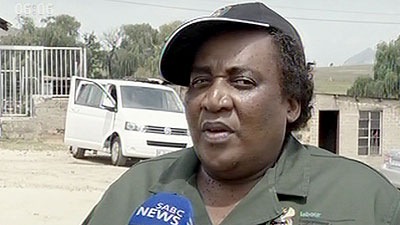
The leader of SARRA, Dawid Kamfer, says they decided to burn the jersey to show their anger at what they believe is the exclusion of “talented players of colour” from the Bok squad.
Kamfer says: “We want the coloured players to have a fair chance to play for the Springboks, we asked people and they agreed that Heyneke Meyer and [Saru President] Oregan Hoskins let us down.”
Kamfer said the IRB world rankings says it all – SA is ranked fifth, after New Zealand, Ireland and England.
“Peter de Villiers was a coloured coach who took us to number two. Today we’re at number five and no one is saying anything,” he notes.
Several wine farmers, including rugby star Schalk Burger’s family, were on high alert as a raging fire destroyed about 1700ha of bush in the Wellington area outside Cape Town.
Firefighters said the fire spread up Bain’s Kloof Pass and onto the Groenberg mountain.
On the Schalk Burger & Sons wine estate, the family was up all night at the weekend keeping watch.
The devastating fires come in the wake of deputy President Cyril Ramaphosa calling on white farmers in the Boland Region to stop the eviction of farm workers.
ANC Provincial Chairperson Marius Fransman called a moratorium on what he calls “mass evictions” of farm workers earlier.
Ramaphosa warned white farmers to embrace the “transformation process” of handing over white property to black workers for no compensation.
He expressed his anger at the evictions, saying that it is totally unacceptable. “We cannot accept a situation where working people particularly on farms are treated as badly,” he said, but could give no examples of mistreatment.
During the door-to-door Campaign in Mbekweni Township, Ramaphosa interacted with various families. He visited a family where a 29-year-old disabled woman, Nthabiseng Tofile resides.
Nthabiseng’s mother told Ramaphosa that her daughter became disabled after an Eskom Pole fell on her in 2004. She was living in a township at the time and not on a farm.
A pending by-election is to take place in the Mbekweni area soon. Fransman says Ramaphosa’s visit has nothing to do with the by-election. He is confident that the ANC will retain the ward.
“Luckily, the fire did not come close to us,” said Schalk’s father, Tiaan Burger.
Another farmer, who did not want to be named, said his farm was on the slopes of the Groenberg.
“The flames were humongous and my father single-handedly started bulldozing a firebreak in the early hours. Our family came from Cape Town to help,” an owner said.
Alien vegetation and fynbos were razed on the mountain and on private property.
The South African Human Rights Commission (SAHRC) said because black English has not yet been fully established, South African universities remain largely “untransformed”.
On Thursday the Commission launched a virulent anti-white tirade against universities who dare to admit white students. The SAHRC cited, without irony, verbal “racist attacks” against black students outside of universities to make their case.
“The [commission] remains deeply concerned about the lack of transformation taking place in South African society 20 years into its democratic dispensation. Even more concerning is the lack of transformation, and a spike in racist incidents, at institutions of higher learning,” commission spokesman Isaac Mangena said in a statement yesterday, on the first day of the hearing in Johannesburg.
Commissioner Lindiwe Mokate said that black students were largely the victims of racial incidents, with an increase in them being called an Arabic slur, namely kaffirs.
The “k-word” has featured in a number of “complaints” the commission received between April 2013 and February this year, making up 45% of the 529 equality complaints it received in that period.
This sole “grievance” is somewhat strange as many blacks refer to themselves as “niggers” or “kaffirs”. Most of these “complaints” do not stem from universities, but the SAHRC felt compelled to include them to make their case for black English.
The Commission clearly needed sorely missing “evidence” of a “wider problem of discrimination”, in order to blacken the last vestiges of paleness at higher education institutions where black students are still performing poorly.
The Department of Higher Education, a clearly partisan nonprofit organisation the Higher Education Transformation Network (HETN), the Nelson Mandela Metropolitan University and the North-West University made their submissions and were interrogated, Nazi-style, by the commission on Thursday.
Executive director of the Higher Education Transformation Network, Sethole Legoabe, told the commission that racism in higher education was “rampant”.
The HETN declined to divulge their funding when PRAAG contacted them.
The North-West University came under fire for the racial composition of its campuses.
Its Potchefstroom campus remains predominantly white (74%) and Afrikaans speaking, while its Mafikeng campus is predominantly black (97%).
Commission panellists ignored language differences, only focusing on race and English.
The university’s recently appointed vice-chancellor, Dan Kgwadi, explained that the university’s demographics were due to the predominance of Afrikaans at the Potchefstroom campus but promised that “strategic plans” are in place for attracting 30% black student population by 2020.
The SAHRC said the blackening and anglicisation in the university was a “human rights issue”, but given the ridiculous arguments in favour of black English, many now suspect that it is simply a convenient way of destroying Afrikaans institutions.
Public service managers are being encouraged to keep posts vacant rather than fill them with whites, an SA Institute of Race Relations (SAIRR) says.
“In the name of transformation, managers in the public service have actually been incentivised to keep whites out for racial and ideological reasons. Better to leave a vacancy unfilled than to put a white person into it,” SAIRR consultant John Kane-Berman said in the newsletter, published on Tuesday.
He said this was a “lose-lose-lose situation” and “madness”.
In the newsletter, Kane-Berman was responding to the death of three babies in Bloemhof, North West, due to water contamination caused by a sewage spill.
Earlier in June, the SAIRR reportedly blamed affirmative action for the deaths, and said the policy should be scrapped.
The institute said black empowerment policies had seen unqualified people appointed to positions where their incompetence affected poor and vulnerable communities.
“The Bloemhof municipality lost its capacity to maintain the sewer plant,” chief executive Frans Cronje was quoted as saying at the time.
“There is no doubt that the officials responsible for these deaths were appointed, at least in part, on grounds of race-based affirmative action and that a direct causal link therefore exists between the policy and the deaths.”
Kane-Berman said those appointed to posts were unqualified and were appointed only because they are black.
“Posts are sometimes left vacant if the only person available to fill them is white. It further means that experienced people who happen to be white get out of the public service because they are denied promotion or encouraged to take early retirement.”
The problem is further complicated by a lack of accountability in government, with politicians accountable to party headquarters, rather than to the electorate.
“People who fail to do their jobs, or who defraud the state, do so because they know they can get away with it,” he said.
The mix, he said, was toxic.
“Our system of government is indeed poisoned by a toxic mix of affirmative action, cadre deployment, and impunity.
“Filling a racial quota or supporting the right party, or the right faction within it, are often more important.”
South Africa was suffering from a crumbling health system and a rising disease burden, he said.
“Hospitals and clinics don’t run themselves. They are run by people. When things go wrong… it is not the result of happenstance or bad luck or just one of those things. It is the result of decisions made or actions taken, or not taken, by those people.
“So it is a logical inference that something is wrong with the criteria according to which appointments in these facilities are made.”
He said healthcare management was in crisis, infrastructure and equipment in health facilities were in a desperate state, facilities in rural areas faced dire shortages, and those in urban areas were under severe strain due to a growing population.
“Again, it is a reasonable inference that affirmative action and cadre deployment in the public service compound the problems arising from the country’s skills backlogs, and failure to train government professionals,” he said.
Kane-Berman said anger at nepotism, corruption, and lack of accountability were behind numerous protests across the country.
Quoting from a report by the Commission for Employment Equity, he said Africans presently held 69 percent of top management jobs in government.
“But Africans within the 35 to 64 age cohort from which one would expect top managers to be drawn make up only 36 percent of the economically active population, while only 4.1 percent of over 20s have post-school training.
“This suggests that affirmative action has been rigorously implemented in the public sector regardless of levels of experience or formal qualification.”
He said it was widely recognised that South Africa was plagued by corruption, nepotism, incompetence, and lack of accountability.
“A few people are beginning to identify cadre deployment as a problem. Very few people are willing to identify affirmative action as part of the problem,” he said.
“South Africans need to wake up to the tragic results of the policies being implemented in their name.”
The Deputy President of Black Management Forum Koko Khumalo says a Gender Desk will be launched on Saturday, August 24 in Polokwane. She says the theme for the day is “Planning Beyond Lifetime”. Khumalo says the rationale for this theme is to address that women are the centre of families.
She says the Black Management Forum Gender Desk will ask members why they don’t see themselves going beyond their current level at the workplace. Khumalo further says that they are also going to do their own survey so that their members can talk about their experiences and relevant actions can be taken.
According to Khumalo, women must not only be empowered in the boardroom because the Black Management Forum stands for the development of Black Managerial Leadership. She adds that the reason it’s called Gender Desk and not women empowerment is because gender issues are not only related to women. “For women to get the equation right they need men to play a significant role.”
Women are said to play an essential role in the society. Khumalo says if a woman do not come from a supportive background it is equally hard for her to get escalated at work and produce results. “When I walk into the boardroom, I play as an equal not as a woman,” she says. – SABC
Another pale male: Argentine model and presenter Mario Guerci
by TAU Bulletin
The state of the nation is no more ludicrously evident than Gauteng premier Nomvula Mokonyane’s recent “warning” that “pale males” would return to government in Gauteng if SA’s opposition Democratic Alliance party wins next year’s provincial election.
“It can’t happen, it will not happen” she declared. “Reversals in transformation are unacceptable, and the Gauteng public must be spared the “white gevaar” (danger).
Where in the world are efficiency, skills, creativity and diligence seen as a danger? Only in South Africa, where so-called liberation credentials, party membership and loyalty trump the need to maintain the first world country and its infrastructure which was handed to the ANC on a plate after the 1994 election.
Ms. Mokonyane’s racial invective and resentment has been received with a muted tolerance. Despite the non-racial assurances in the Founding Provisions of South Africa’s constitution, the governing party’s racial diatribes against, mostly, whites continue apace. Indeed, they seem to have increased. The State President’s YouTube clip where he urges his supporters to “kill the boers” and that his cabinet would “kill with a machine gun” is still running, without any apparent move by YouTube to take it out of circulation. (Yet a YouTube clip made by two white South Africans saying they refuse to apologize for being who they are was taken off within a few days of its appearance on the internet.)
South Africa has two parallel universes – the ANC’s self-delusion and the reality. The fact that the country has dramatically slipped down the world’s various achievement indexes over the past nineteen years has either escaped Ms. Mokonyane’s notice, or she is disingenuous in the extreme. Does the rather corpulent Ms. Mokonyane not realize that 90% of the food she and her countrymen consume is produced by pale males? That virtually everything she takes for granted in this country was created by pale males?
From where did the railways, roads, commercial farms, schools, hospitals, potable water and electricity transmission emanate? The very language she uses in a legislature which is not part of her cultural heritage is a language of the pale male. The news print that distributes her humbug is not of her culture either. But she is selective in her vitriol. When this lady shops, she hurries to the pale males’ luxury shopping centers: she was recently seen at up market Hyde Park “posing proudly with her R10 000 LK Bennet shoes and matching handbag”. (Tony Leon, Business Day 30.7.13). Pale males are excoriated but they are good enough to produce and supply the luxuries which she and her fellow anti-white friends cannot live without.
There is no empirical evidence to show that without the intervention of others in Africa (including pale males), Ms. Mokonyane’s culture would have evolved any further than that of those “lost” tribes one finds in the Amazon and Papua New Guinea. She should be grateful that that particular ship sailed around the Cape of Good Hope many years ago and that it decided to stop for victuals. Non-pale male groups who could have manned that ship may not have been so conciliatory to the locals, then and now.
Who created the Sasols, the Iscors, the Eskoms and the country’s nuclear capacity? Who rid the country of the tste tste fly and malaria? Who developed Africa’s premier agricultural and veterinary service, used by the whole continent? Who produces maize and other grain surpluses year after year on the continent that cannot feed itself?
And, conversely, who is busy destroying what used to be the African continent’s pin-up country?
Certainly not pale males. Ms. Mokonyane and her compatriots should look in the mirror. But if one’s modus vivendi is self delusion, then blame is the name of the game. The world has taken note of the Africa of today. It is not a pretty picture. Zimbabwe went from the continent’s bread basket to a basket case. Few if any of the continent’s governments can feed their people. Corruption, nepotism, inefficiency and venality are the order of the day. South Africa is no exception. Who is to blame for Liberia’s status as an African cesspool, or for Ethiopia’s failed state ranking? Colonialism? Apartheid? Pale males? Neither of these countries was subjected to colonialism or apartheid. They are travesties because the people who live there are who they are.
South Africa today could certainly do with some pale males to put things right. But this is not the ANC’s priority: a deep racial inferiority complex trumps practicality.
The facts
Pale males around the world are denounced by the non-achievers with relentless regularity. Whites in the United States complain about this as well. We quote Fred Reed from the US’s Nationalist Times:
“I am weary of the endless denunciation of ‘white privilege’; the calls to abolish all tests in which whites excel, and the need to make universities and police forces and advanced placement classes ‘look like American demographics’. It might be well to note the utter dependence of the US on white men who have contributed virtually everything that keeps the affirmative action classes from living in mud huts.”
Reed continues with examples of this contribution: “Euclidean geometry, parabolic geometry, hyperbolic geometry and projective geometry. Physical chemistry, organic chemistry, biochemistry. Classical mechanics. The indeterminacy principle. The wave equation. The Parthenon. Air conditioning. Number theory. Romanesque architecture. Gothic architecture. Information theory. Entropy. Enthalpy. Almost every symphony ever written. Pierre August Renoir. The diatonic scale. The mathematics behind the twelfth root of two and all that. The Bohr-Sommerfeld atom. The purine pyrimidine structure of the DNA ladder. Single sideband radio. All other radio. Dentistry. The internal combustion engine. Turbojets, turbofans, Doppler beam-sharpening. Penicillin. Airplanes. Surgery. The mammogram. The Pill. The condom. Polio vaccine. The integrated circuit.
“The computer, computational fluid dynamics. Euripides, Sophocles, Aristophanes, Homer. Glass. Rubber. Nylon. Roads. Buildings. Acetyl-cholinesterase inhibitors. Silicone. The automobile. Bug spray. Public cryptography.”
“Like it or not white men can do these things, have done them, and continue to do them. The evidence shows that all groups receiving affirmative action have not done them, and cannot do them, which is why they need affirmative action.
“The pattern of white men doing difficult things continues. Consider the founders of companies in information technologies. Not quite all white, but all men. Anyone who watched the landing of Curiosity on Mars will have noticed that Mission Control consisted overwhelmingly of white men. If I were rude, I would say to those who criticize: invent your own things.”
Reed cites South Africa as an example of a tragedy in the making. “A constantly dwindling number of whites are at the mercy of a predatory welfare class and it’s possible they can’t and won’t carry the rest of the population. If things get worse for them, they will simply flee the country.”
Whether this scenario plays itself out in South Africa is up to the whites. But Ms. Mokonyane mustn’t take too much for granted. Her dislike of pale males borders on the obsessive, to the point where common sense and practical considerations for the benefit of all South Africans are cast aside in an all-consuming and embittered realization that her ANC cannot feed its people, cannot govern, and are no better than what the world has seen emanate from the rest of the continent over the past fifty years. She knows this, the ANC knows this, and the world knows it. Keeping out the pale males won’t improve the ANC. This racial animosity is inimical not only to whites but, eventually, to the future of all South Africans.
The pale male acrimony is however selective. Ex president Nelson Mandela was not interned in an ANC-run hospital. The new ANC elite have quietly bought houses in so-called white areas. They send their children to white schools. They want the pale male’s education system. (Every university in South Africa is a white creation). What is the yardstick against which anything of worth in South Africa is judged if not against a pale male-created yardstick? Are the elite’s suits bought from Nigeria or Italy? Is there such a thing as a Ghanian IPod? Do they fly Air Kenya or British Airways? Do they go to Mali for their holidays or to Paris?
A South African business journalist refers to “the African No” – “a jumbled melee of endless meetings, unreturned phone calls and ignored e-mails”. Compare this approach with the white world. The United States for example accounts for 4,5% of the world’s population but 25% of the world’s GDP. When people flee their terrible countries they try for Europe, Australia and other pale male bastions. They don’t want to emigrate to Zambia or the Sudan.
A cursory trawl through South Africa’s productive sector sees pale males as police divers, as rescue helicopter pilots, as paramedics, as the donors to charities, as the bedrock of the taxpayer base, as the underpinners of the medical profession, the service industry, the banking and the mining sector. The country is divided into the producers and the consumers, and we know on which side of the divide the pale male sits.
Virtually all of the productive farms that were handed over to ANC supporters under the government’s land redistribution policy failed: a pithy example of pale male producers and ANC-created destruction.
It is a pity that more media space is not given to a frank analysis of who are the drivers of the South African economy, instead of to those who talk about nationalization, about transformation, about white racism and so-called privilege. South Africans might get a clearer picture of who is really important in the grand scheme of things, as opposed to those who can talk the leg off an iron pot, hold press conferences, fly all over the world first class, endlessly discuss turnaround strategies and blame everyone but themselves for their shortcomings. Within ten years, South Africa’s social spending (including huge government employee wage bills) will exceed government revenue. Employee compensation as a share of government income went from 31,7% in 2008 to 44,3% in 2012. South Africa’s pale males are a finite group – even they cannot hope to foot the bill for this parasite profligacy forever.
Maybe then South Africa will value its pale males, but it may be too late.
(Extract from Nationalist Times courtesy of Impact magazine)
In a renewed bid to bring black players into a mostly white sport, the South African Rugby Union (Saru) will introduce a stricter racial quota system in domestic rugby.
As from next year, Vodacom Cup teams will have to field seven players of colour in their 22-man squad. According to a Sport24 report, at least five of these players will have to start the match. At least two of the seven quota players will have to be forwards.
Saru chief Oregan Hoskins is hoping that the new quota system will see more black players coming through the system and playing at the top levels of Currie Cup, Super Rugby and in Tests.
“The feeling within our organisation is that we had to step in to see more black players come through. The provinces also shared our views,” Hoskins was quoted as saying by Sport24.
“To have certain targets will show that SARU is committed towards transformation. The Vodacom Cup is of critical importance to development and it has moved away from its primary aim to provide opportunities to promising young players, especially those of colour.
“The aim is to enlarge the pool of players of colour from which Currie Cup and Super Rugby coaches can pick. Hopefully, it would then also give the Springbok coach more options,” the Saru chief said.
A complaint calling for the impeachment of Chief Justice Mogoeng Mogoeng is an attack on the transformation of the judiciary, the Black Lawyers’ Association said on Thursday.
“There are clearly well-orchestrated campaigns which are galvanised and aimed at bringing down the Constitution’s clearly articulated imperatives,” spokeswoman Hlaleleni Kathleen Dlepu said in a statement.
On Tuesday, the Institute for Accountability said its director Paul Hoffman SC laid the complaint in response to a speech Mogoeng made to Advocates for Transformation last month.
The complaint included allegations of contempt of court and attempting to defeat the ends of justice, which could be construed as gross misconduct.
The institute said this could be grounds to justify Mogoeng’s impeachment.
In his speech, Mogoeng questioned critics who complained when a white male candidate was not recommended for appointment to the Bench, while those who were appointed were described as “executive toys”.
Dlepu said the organisations which wanted Mogoeng removed were intent on undermining the judicial system, which could create a negative international perception of South Africa.
“The barrage of criticism against the person of the office and person of the chief justice are baseless, unfounded, without merit and falls to be rejected.”
The Judicial Service Commission said on Tuesday that it had received the complaint against Mogoeng.
“The complaint will be dealt with by the judicial conduct committee,” spokesman Sello Chiloane said.
“The chief justice is one of those judges on the committee, and because the matter involves him, they will have to consider how to deal with it. They will handle it in terms of their own processes.” – Sapa
Johannesburg High Court - too many white advocates there
by Andries Nel, Deputy Minister of Justice and Constitutional Development
It seems truly bizarre but in 1994, less than a generation ago, 160 of the 165 judges on the bench were white men. This is not a typographical error. White male judges were, to use biblical language, fourscore times two in number. The heavy onus of making the judiciary appear to resemble South Africa lay on the shoulders of three black men and two white women. As for black women, well….
Today, as “Mandela’s children” prepare to vote for the first time, 100 black men and 49 black women, 71 white men and 21 white women serve our nation as judges. They do so knowing that they are part of a judiciary that is coming closer to reflecting the racial and gender composition of South Africa, as is required by our Constitution.
Similar progress has been made in addressing race and gender imbalances in Magistrates Courts. Of the 1661 magistrates, 974 are black and 687 are white, 647 are women and 1014 are men.
Whilst this represents significant progress, there is still much to be done – especially regarding the gender imbalances in the upper echelons of the judiciary, the Constitutional Court, the Supreme Court of Appeal and the ranks of the Judges President.
Regrettably, some insist on propagating the untruth that it is constitutionally suspect to pursue the objective of a representative judiciary or, alternatively, that although legitimate, this objective is being advanced in a manner that is unconstitutional.
If some are to be believed, the Judicial Service Commission has simply transposed the “Non-Europeans Only” signs from the railway benches of yesteryear to the judicial benches of today.
A resigned combatant from what is often portrayed as the gladiatorial game of judicial selection punts the notion that, in the eyes of the JSC, white men have become as politically ineligible to judge as they have always been genetically incapable of jumping.
However, what tales do those inconveniently stubborn things known as facts tell?
Of the 71 white men currently on the bench, 61 were appointed after 1994 – and of them, 22 were appointed since 2009.
The “white men can’t judge” mythology being peddled is in fact anti-Constitution: It seeks to stymie the transformation required by the Constitution while attacking the integrity of the JSC and that of judges, black and white, appointed by it under the Constitution.
The Constitution is the supreme law of our land. It is also a supremely transformational constitution. It requires of us to follow a transformative course action in respect of access to justice and the transformation of the judiciary and legal system.
Let us be clear. Transformation, the big T-word, necessarily includes – but is not limited to – attaining demographic representivity.
Transformation in the South African context basically means making our society, look, work, think and be like the Constitution says it should. Anyone who thinks that it does, or is close to doing so, or will do so in a decade, simply doesn’t “get it.”
Firstly, the Constitution enjoins us to heal the divisions of the past and establish a society based on democratic values, social justice and fundamental human rights and to lay the foundations for a democratic and open society in which government is based on the will of the people and every citizen is equally protected by law.
Secondly, it guarantees everyone the right to have any dispute that can be resolved by the application of law decided in a fair public hearing before a court or, where appropriate, another independent and impartial tribunal or forum.
Thirdly, it provides that the need for the judiciary to reflect broadly the racial and gender composition of South Africa must be considered when judicial officers are appointed.
Fourthly, it says that all courts, including their structure, composition, functioning and jurisdiction, and all relevant legislation, must be rationalized with a view to establishing a judicial system suited to the requirements of the new constitution.
Government is committed to strengthening of the independence, the dignity, accessibility and effectiveness of the courts as part of this transformation process.
The Seventeenth Constitutional Amendment Act, the Superior Courts Bill, and the South African Judicial Education Institute Act, provide a strong legislative framework to realize this objective. Measures such as the establishment of the Office of the Chief Justice as a department advance the objective of greater administrative independence of the judiciary.
Access to justice is being promoted by, amongst others, the building of new courts the conversion of existing branch courts to full-service courts, the establishment of Small Claims Courts, the re-demarcation of magisterial districts, the Review of the Civil Justice System and the work of Legal Aid SA.
However, the untransformed state of the legal profession remains a stumbling block to the further transformation of the judiciary as well as to greater access to justice.
The legal profession is a key provider of services that promote access to justice and it also constitutes a pool from which the judiciary is appointed.
Of the 2384 advocates (as at April 2012) who fell under the umbrella of the General Council of the Bar, 1367 were white men, 366 white women, 295 African men, 89 African women, 47 coloured men, 37 coloured women, 114 Indian men and 69 Indian women.
The picture becomes even more skewed when one examines the profile of the 473 senior advocates (or “silks” as they are called – because of their right to wear silk robes): 382 white men, 20 white women, 29 African men, 4 African women, 9 coloured men, 1 coloured woman, 24 Indian men and 4 Indian women.
Traditionally, it is from the ranks of these “silks” that judges are appointed.
The attorneys’ profession is marginally more representative. As at June 2011 there were 20,077 practicing attorneys of whom 36% were black and 64% were white. Women constituted 34% and men 66%.
Interestingly, the profile of law students is much more reflective of South African society. In 2011 of all first year law students, 78% were black, 22% white, 54% were women and 46% men. In the same year, of the 3751 LLB graduates, 68% were black, 32% white, 59 % women and 41% men.
The question is to what extent these more reflective demographics will be carried through into the profession and what stumbling blocks exist in this regard.
One important intervention is the restructuring of state legal services announced by the Minister of Justice and Constitutional Development.
Another is the Legal Practice Bill currently before Parliament. The Bill proposes an institutional and statutory framework within which these challenges can be addressed in a systematic and inclusive manner.
The proposed South African Legal Practice Council will bring together advocates, attorneys and representatives of broader society to find solutions to the challenges of: entry to the legal profession, availability of quality legal training and education, quality workplace learnership opportunities, provision of pro bono services and community-based paralegal services, as well as the regulation of legal fees in order to promote access to affordable legal services for all, especially the poor.
The Council will be a mechanism through which the Legal Services Charter adopted in 2007 can be implemented.
The Bill does not prescribe solutions but mandates and facilitates their formulation. This will require the active participation of all sectors of the profession – and of broader society. Whether the solutions that emanate from the process take us forward will depend, amongst others, on the ability of those committed to the transformative vision of our Constitution to give leadership.
Andries Nel is the Deputy Minister of Justice and Constitutional Development. This article is based on notes for an address to a meeting of the Black Lawyers Association (BLA) – Student Chapter held at the University of South Africa (Unisa) on 4 May 2013.
NOTICE TO ALL MEMBERS AND APPLICANTS FOR PUPILLAGE IN 2013
TRANSFORMATION BURSARIES
SCHOLARSHIPS FOR AFRICAN WOMEN
2013
Applications are hereby invited for the Cape Bar’s transformation bursaries and scholarships for African women for 2013.
Transformation bursaries
The persons who are eligible for the transformation bursaries are financially needy black or female persons (a) who have been accepted for pupillage at the Cape Bar in 2013, (b) who are currently pupils and will be commencing practice at the Cape Bar in late 2012 or early 2013 or (c) who are juniors at the Cape Bar and will have less than 2 years’ standing on 1 January 2013. The value of each bursary will be determined by the Cape Bar Council. It will be up to R7 500 per month for twelve months depending on the person’s financial needs.
Scholarships for African women
The persons who are eligible for the scholarships for African women are suitably qualified African women who have been accepted for pupillage at the Cape Bar in 2013, who are committed to practising as advocates at the Cape Bar and who require financial assistance during the term of pupillage and during their first year of practice. The value of each scholarship is R7 500 per month during 2013. Thereafter, each scholarship holder who has successfully completed the National Bar Examination and taken up chambers at the Cape Bar, receives a contribution, determined by the Cape Bar Council, towards the running expenses for the first year of practice. It will be up to R7 500 per month for twelve months depending on the person’s financial needs.
Application form
All applications must be made using the accompanying application form.
Applications must be made by 30 November 2012. They must be sent to:
Labour Minister Mildred Oliphant on Friday lauded retailer Woolworths’ stance on employment equity.
“As [the] government of South Africa and those that seek genuine transformation, we shall continue to encourage companies like Woolworths to continue with the transformation and integration of the society,” she said in a statement.
PRAAG, followed by labour union Solidarity this week started a campaign to boycott Woolworths after the company ignored its ultimatum to remove job advertisements from its website which the union said excluded whites.
Woolworths argued it had an obligation to meet its employment equity targets as an employer with more than 50 employees.
Oliphant said Woolworths was among listed companies that had been subjected to a review process in 2009 in terms of the Employment Equity Act.
“During this process, like any other employer that was reviewed, Woolworths committed itself to transforming their workplace by implementing their employment equity plan, as approved by the director general,” she said.
When a follow-up review was done in the 2011/2012 financial year, the company had progressed in meeting its employment equity targets, she said.
“However, there are those that hate to see integration in the workplace and society in general; they seek to find fault with those that genuinely implement employment equity as a means of addressing our painful past and imbalance,” she said. – Sapa
This website uses cookies to improve your experience. We'll assume you're ok with this, but you can opt-out if you wish. Cookie settingsACCEPT
Privacy & Cookies Policy
Privacy Overview
This website uses cookies to improve your experience while you navigate through the website. Out of these cookies, the cookies that are categorized as necessary are stored on your browser as they are essential for the working of basic functionalities of the website. We also use third-party cookies that help us analyze and understand how you use this website. These cookies will be stored in your browser only with your consent. You also have the option to opt-out of these cookies. But opting out of some of these cookies may have an effect on your browsing experience.
Necessary cookies are absolutely essential for the website to function properly. This category only includes cookies that ensures basic functionalities and security features of the website. These cookies do not store any personal information.
Any cookies that may not be particularly necessary for the website to function and is used specifically to collect user personal data via analytics, ads, other embedded contents are termed as non-necessary cookies. It is mandatory to procure user consent prior to running these cookies on your website.