‘Only trust a white man when he’s dead’

A WhatsApp post has led to the investigation of a police officer in the Pretoria dog unit after 12 white colleagues accused him of hate speech and racism.

Provincial police spokesman Lieutenant-Colonel Lungelo Dlamini confirmed that Sergeant Hendric Mthimunye was the subject of a grievance process following the post on WhatsApp earlier this month, Rekord East reported.

“Never Trust the White Man, the only Time you Trust Him is when he is Dead.” the post allegedly read.

According to the grievance lodged by his colleagues, Mthimunye’s post was racist and promoted hate speech.

The complaint also stated that it was a police officer’s duty in this country to deliver a service to all citizens, including whites.

“We work with him on a daily basis… We feel that we cannot trust a person who makes extreme racists comments. As members of the police we must be able to trust one another and depend on colleagues to protect us in unthinkable dangerous situations,” the grievance stated.

Dlamini said Mthimunye’s commanding officer was currently involved in a grievance process against the Sergeant.

It was later reported that Mthimunye had defended the post, saying it was a misunderstanding and that it in fact referred to a friend of his with the surname “Mlunga”, which translates to “white man” in Zulu.
Mthimunye said he had been angry with his friend who had owed him money, and refused to repay the debt.

He said the post was not aimed at his white colleagues and that he had never foreseen that it would hurt or upset them.

Whites are a small minority in South Africa but nevertheless subject to extreme racial legislation to keep them out of government jobs, industry and sport.

Being a white farmer in the country is more dangerous than being a soldier in Iraq.

Source:IOL

Michelle O: Feeding fried chicken to black stereotypes

Peddling black stereotypes and pandering to black voters go hand in hand when you’re a leftwinger.

Imagine a scenario where white public figures try that. There would be a frenzy on every news program in the world.

It’s the left’s double standard at work again.

First lady Michelle Obama did both on Monday in an interview with TVOne’s “NewsOne Now,” telling host Roland Martin that black people should vote Democrat no matter who is on the ticket.

TVOne targets black viewers, with a website that says it“represents a connection to the authentic, rich, and diverse experience of African American life, history, and culture.”

Essentially, the first lady told Martin that blacks should vote only on the basis of race and not ideas.

“That’s my message to voters. This isn’t about Barack, it’s not about the person on the ballot, it’s about you,” Obama said. “And for most of the people that we’re talking to, a Democratic ticket is the clear ticket that we should be voting on, regardless of who said what or did this. That shouldn’t even come into the equation.”

The scary part is that isn’t the worst of what she said. Her highness gave permission to “her people” to treat themselves after they follow her orders and mindlessly cast their vote.

Here is a transcript of her mindless black racism, the political staple of the left:

Martin: So can we, if we go out to the polls, can we say, we have ‘souls to the polls’ on Sunday, can we do ‘soul food after we vote’?
Obama: Absolutely, I give everyone full permission to eat some fried chicken after they vote only after—if you haven’t voted…(laughter.)
Martin: Just checking!
Obama: You make a good point because I am, I do talk about health. But I think that a good victory for Democrats on Tuesday, you know, should be rewarded with some fried chicken.

Entitlement: Attacking whites for black shortcomings

White South Africans don’t just have an unexamined sense of entitlement, but also an embedded sense of superiority, writes Eusebius McKaiser in IOL:

What, black people, do you want from whites? To leave the country, to be denied jobs or never be promoted again? Share or give up their assets?

It’s a serious and popular set of questions many white South Africans often raise, or ask themselves but might not raise openly. And so it’s actually worth engaging the issues.

There are several problems with this set of questions.

The very framing of these questions lets white South Africans off the moral hook too easily.

These questions place the burden for thinking about the place and role of white South Africans in post-apartheid South Africa on black South Africans.

That’s like asking victims of violence against women, “What do you want men to do differently?!”

That kind of question is music to the misogynist guy’s ears. He can go fishing, and respond to the feminist critique of gender injustices by demanding that they call him when they’ve figured out what the heck they want him “to do”.

Unless and until they send him a “concrete” list of demands, he can chill and go about his unthinking male ways as usual. After all, he’s not sure what women want from him!

This, of course, is rubbish. Dangerous rubbish. The first observation to be made is that the history of oppression is not only about the material consequences of oppression. Of course colonialism and apartheid resulted in black life being materially worse off than white life. That’s still the case.

It’s right in focusing questions on the material conditions which we want to change. In that sense, we cannot as a country avoid asking, indeed, what needs to be done, practically.

But oppression, and its ongoing legacy, has many more features which this lazy demand of “what must I do?!” hides.

Focus for a minute on the psychological and moral impact anti-black racism had on whites. You’d be hard-pressed to find more than a handful of white South Africans who think of themselves as being as capable of excellence, or less capable of excellence, than black South Africans. Most regard themselves as more capable of excelling at anything.

This is in part why so many white South Africans who don’t get their desired job are shocked when that happens (and we’re talking about a thin minority among whites compared to unemployment in the rest of the population). The shock doesn’t just reflect an unexamined sense of entitlement. It also reflects an embedded, internalised sense of superiority that gets shaken in the face of a black candidate succeeding where you didn’t.

At this point, confirmation bias sets in: I didn’t get the job because I’m white; he got the job only because of affirmative action; whites have it worse in the job market than blacks; young white graduates are treated badly in democratic South Africa; etc.

Isn’t it remarkable that these thoughts are expressed not only by a racist Afrikaans oke in khaki shorts on the outskirts of Ventersdorp, but also by self-identifying progressive English whites who often fancy themselves more morally conscious than the average Beeld reader?

There is sheer arrogance involved here on the part of the white South African who can’t make sense of his or her failure without sustaining a secret belief that they are intrinsically more capable than blacks. You can only lament and be shocked by fewer job offers or promotions in the job sector if you think you deserve these more than blacks.

Nothing innocent anchors such shock and disappointment. A sense of superiority, left over from apartheid, fuels this misplaced sense of being democracy’s victim. If you conceived of the possibility you might not be the best, other responses to failure beyond shock will open up. Apartheid’s beneficiaries aren’t yet in that head-space.

This shows the psychological and moral work whites still need to do. And that’s why soem questions are so irritating. They reduce the discussion of racism’s reach to a simple transactional conversation.

Giving me your house, as a white South African, doesn’t tell me anything about your psyche. It doesn’t tell me whether you understand that past discrimination, not genetic superiority or sheer effort, explains why you’re materially better off than me and my family.

This is why the project of undoing the legacy of apartheid must address all these lingering dark truths. This in turn requires white South Africans to do much more work, a lot of it not related to policy questions about redress.

You can’t restore moral parity between whites and blacks with a cheque handed over by each white person for the material benefit of blacks.

Similarly, gender discrimination in the corporate sector, for example, cannot be adequately eliminated and addressed if men only agreed to equal pay, or reserving job spots for women, etc. Those matter, for sure. I wouldn’t oppose these interventions.

But gender equality requires deeper work. Attitudes and behaviour that exemplify the false beliefs men hold about their intrinsic superiority over women need to be addressed and corrected. If you don’t, discrimination will simply pop up in new forms beyond questions of, say, wage equality or job reservation.

More importantly, approaching the quest for gender equality as a narrow, material project simply reveals an inadequate understanding of misogyny’s full character.

The project of addressing anti-black racism’s many manifestations is equally complex, and not neatly reducible to a transactional demand.

The final point to make is that racism is about the relationship between members of different groups, even if those groups are social and political constructions. This relational element should be obvious, yet we forget about it very often. It doesn’t just take two to tango; it takes two for racism to even be possible.

By asking blacks what they want from whites you focus on one party in that stinking relationship.

If the very core of racism is about a morally warped interaction between parties, then the project of undoing that harm must be relational too.

You can’t ask the bully to do no work, to go play outside and call him in after you’ve got an answer from the victim about what she wants from the bully. Then you’ve misdiagnosed the exact nature of the wrong you’re trying to correct.

Sure, the victim may unhelpfully play along and demand concrete things – like land – but then be clear about one certainty: this will at most give you an outcome that soothes the sense of injustice of victims.

You will have failed to deal with the full might of the evil that had been experienced, leaving both the victim and the bully deeply wounded still.

The victim will remain haunted by a sense of inferiority. The arrogant bully will remain, well, bullish.

So next time a white person asks “What do you want me to do?”, tell him or her they’re asking the wrong question. They should start with reflection on the psychological and moral stains on their whiteness.

PS: I deliberately don’t qualify “white” and “black” with words like “most” or “some” here. Why? Some truths are black and white. Such qualifications allow those with most work to do to pretend they are exceptional. Let’s stop the denial by recognising reality.

Exceptions don’t change ugly patterns. We have work to do, including progressive whites helping out those whites who are blinded by their whiteness.

Stop asking blacks what you should do. That’s objectionably lazy.

White teacher wins discrimination suit against black principal

A Maryland jury has awarded a white teacher $350,000 in damages for being discriminated against by his former principal, an African-American woman.

The Washington Post reports teacher Jon Everhart, 65, filed a lawsuit in 2010 against Prince George’s County Public Schools on the grounds that Largo High School Principal Angelique Simpson-Marcus subjected him to abuse because of his race.principal simpson-marcus with cut line

Everhart claims Simpson-Marcus called him “poor white trash” and “white b—-,” and told students that the “only reason a white teacher teaches in (Prince George’s) County is that they can’t get a job elsewhere.”

Simpson-Marcus’ hostility toward Everhart reportedly began in 2003 when both were working as teachers in Largo High School. Everhart says Simpson-Marcus told him that if she ever became principal, he would be the first person she would fire, the Washington Post reports.

Bryan Chapman, Everhart’s attorney, said that when Simpson-Marcus became the school’s principal in 2007, “Everhart, who was once named the school’s Teacher of the Year and who received stellar evaluations, started to receive unsatisfactory performance evaluations,” the news site reports.

Media reports indicate Everhart was fired after the 2009-10 school year.

Everhart says his years of harassment from Simpson-Marcus contributed to a decline in his health, including high blood pressure and heart problems.

Simpson-Marcus denies all wrongdoing.

“I never said any of those things,” she told the Post. “I don’t use that kind of language.”

However, a group of Largo High School employees claims otherwise.

According to a 2011 Washington Post article, several faculty members said Simpson-Marcus “routinely called her secretaries names, such as ‘chicken heads,’ ‘ghetto’ and ‘hood rats.’”

The teachers also said they were mistreated for vocally supporting Everhart.

A judge will decide if Everhart should also be awarded back pay, retirement and health benefits, and the restoration of his teaching certificate, the Post adds.

Prince George’s school leaders may appeal the $350,000 ruling.

Source: eagnews.org

SAIIR says state actively discriminating against whites

Public service managers are being encouraged to keep posts vacant rather than fill them with whites, an SA Institute of Race Relations (SAIRR) says.

“In the name of transformation, managers in the public service have actually been incentivised to keep whites out for racial and ideological reasons. Better to leave a vacancy unfilled than to put a white person into it,” SAIRR consultant John Kane-Berman said in the newsletter, published on Tuesday.

He said this was a “lose-lose-lose situation” and “madness”.

In the newsletter, Kane-Berman was responding to the death of three babies in Bloemhof, North West, due to water contamination caused by a sewage spill.

Earlier in June, the SAIRR reportedly blamed affirmative action for the deaths, and said the policy should be scrapped.

The institute said black empowerment policies had seen unqualified people appointed to positions where their incompetence affected poor and vulnerable communities.

“The Bloemhof municipality lost its capacity to maintain the sewer plant,” chief executive Frans Cronje was quoted as saying at the time.

“There is no doubt that the officials responsible for these deaths were appointed, at least in part, on grounds of race-based affirmative action and that a direct causal link therefore exists between the policy and the deaths.”

Kane-Berman said those appointed to posts were unqualified and were appointed only because they are black.

“Posts are sometimes left vacant if the only person available to fill them is white. It further means that experienced people who happen to be white get out of the public service because they are denied promotion or encouraged to take early retirement.”

The problem is further complicated by a lack of accountability in government, with politicians accountable to party headquarters, rather than to the electorate.

“People who fail to do their jobs, or who defraud the state, do so because they know they can get away with it,” he said.

The mix, he said, was toxic.

“Our system of government is indeed poisoned by a toxic mix of affirmative action, cadre deployment, and impunity.

“Filling a racial quota or supporting the right party, or the right faction within it, are often more important.”

South Africa was suffering from a crumbling health system and a rising disease burden, he said.

“Hospitals and clinics don’t run themselves. They are run by people. When things go wrong… it is not the result of happenstance or bad luck or just one of those things. It is the result of decisions made or actions taken, or not taken, by those people.

“So it is a logical inference that something is wrong with the criteria according to which appointments in these facilities are made.”

He said healthcare management was in crisis, infrastructure and equipment in health facilities were in a desperate state, facilities in rural areas faced dire shortages, and those in urban areas were under severe strain due to a growing population.

“Again, it is a reasonable inference that affirmative action and cadre deployment in the public service compound the problems arising from the country’s skills backlogs, and failure to train government professionals,” he said.

Kane-Berman said anger at nepotism, corruption, and lack of accountability were behind numerous protests across the country.

Quoting from a report by the Commission for Employment Equity, he said Africans presently held 69 percent of top management jobs in government.

“But Africans within the 35 to 64 age cohort from which one would expect top managers to be drawn make up only 36 percent of the economically active population, while only 4.1 percent of over 20s have post-school training.

“This suggests that affirmative action has been rigorously implemented in the public sector regardless of levels of experience or formal qualification.”

He said it was widely recognised that South Africa was plagued by corruption, nepotism, incompetence, and lack of accountability.

“A few people are beginning to identify cadre deployment as a problem. Very few people are willing to identify affirmative action as part of the problem,” he said.

“South Africans need to wake up to the tragic results of the policies being implemented in their name.”

Ericsson fires victim of violent black crime for K-word

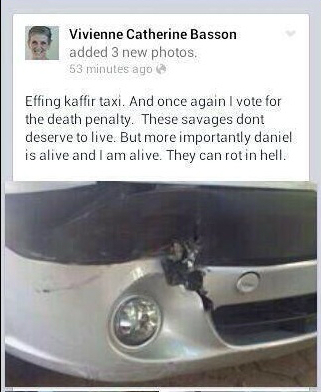
bassonTelecommunications firm Ericsson has fired a worker who used the word “kaffir” in a tweet.

The tweet from the account of Vivienne Basson used the word while expressing frustration over a taxi accident.

The Tweet went on to say, “These savages don’t deserve to live. They can rot in hell.”

Ericsson South Africa M.D Magnus Mchunguzi says Basson who was a sub-contractor, has breached their business ethics.

Social Networks may seem to many as lawless, but World Wide Worx Technology expert, Arthur Goldstuck says people may be prosecuted for hate speech posted online.

He also says the law on social networks applies as it would in other public spaces.

Social network leaves a pure trail of evidence as numerous people can copy it and save it for the whole world to see.

Goldstuck says once you put something up online, it can never be entirely deleted.

Basson explained on twitter what led to her offensive speech before apologising.

ericsson


Black students rally to keep racial privileges

What does it take to become equal?

Parliament should not “entertain” the memorandum by the youth wing of AfriForum, the Afrikaans rights lobby group, demanding universities should stop asking students to declare their race on application forms for placements and bursaries, said the Higher Education Transformation Network (HETN) on Monday.

“We urge Parliament to reject the proposals of AfriForum [Youth], as contained in their memorandum, on the grounds that the reasons for [declaring] race on forms and elsewhere in statutory bodies have not been addressed, let alone solved,” said Hendrick Makaneta, HETN’s spokesperson.

“It therefore remains inappropriate to even think of entertaining the memorandum from AfriForum,” he said.

AfriForum Youth delivered to Parliament on Heritage Day last week what they said was a memorandum against “racial profiling” by admission policies of the country’s universities. Charl Oberholzer, the organisation’s chairperson, told the Mail & Guardian on Monday it wants university admission policies to favour “all poor people, not just black people”.

“If we use socioeconomic conditions as a yardstick, instead of race, we’d all be better off. This would help all South Africans,” said Oberholzer.

“We shouldn’t have pro-race policies, but pro-poor policies. We can’t say all blacks are poor and all whites are rich.”

Race-based admissions
But HETN reminded AfriForum that race-based admissions are key to help empower disadvantaged communities and redress inequalities in the country.

“It is necessary for students to enter their race on admission and bursary forms in order to enable the institutions to keep track of whether or not they are doing enough to reverse more than three centuries of oppression and academic exclusion of black students, particularly in historically white institutions,” Makaneta said.

“The call from AfriForum is misplaced as it lacks the necessary will to take into cognisance more than 350 years of colonialism and oppression, which affected Africans in particular and black people in general.”

A lobby group that is already challenging institutions such as the University of Pretoria to transform, HETN claims to have up to 3 000 alumni members – most of whom are black. But Oberholzer dismissed it as an “organisation that has no support, [and] speaks for a few individuals”.

Oberholzer said AfriForum Youth’s proposal is designed to ensure the “black elite don’t benefit” from admission policies. “For example, it’s not fair that Tokyo Sexwale’s son benefits from affirmative action or gets into medical school based on his race. He’s already a billionaire,” he said.

He said there are many poor whites that are denied access. Whether one was poor could be determined in the same way candidates are granted study loans by the National Student Financial Aid Scheme of South Africa (NSFAS).

“When you apply for NSFAS, they know your parents’ income and where you come from. The same would apply for admissions.”

Afrikaans students
The AfriForum Youth student members who delivered the memorandum came from the University of Stellenbosch, the University of the Free State, the University of Pretoria and the North-West University, the organisation said. These are universities with sizeable number of Afrikaans students.

Moeketsi Letseka, senior researcher at the University of South Africa, said AfriForum Youth’s argument “doesn’t gel, not in this country”.

“Within 20 years of democracy we can’t just act like we’re a race-free country,” said Letseka.

“We can’t dispute that blacks have endured 350 years of unfairness.”

The white South Africans who usually “get paraded on TV as poor” are “not even a fraction of whites”, the majority of whom are wealthy, said Letseka.

There was still pressure on the country’s universities to ensure empowerment of the majority, he said. The declaration of a potential student’s race and supply of pertinent circumstantial information on application forms help universities establish the background of applicants, said Letseka. – M&G

WalMart shooter picked white victims

Lakim Faust
Lakim Faust

A black American who shot four people near a Greenville, NC, Wal-Mart in June picked out his victims because they were white, according to several indictments handed down against him.

Lakim Faust had more than 100 rounds of ammunition when he started shooting at people who were standing outside at a law firm and a shopping center in June, authorities said.

A grand jury indicted Faust on 14 charges Monday, including four counts of attempted first-degree murder.

Faust, who is black, picked out his victims based on their race, according to the indictments. The documents didn’t specify why Faust wanted to shoot white people, and police have not talked about why he picked out his targets. Earlier reports had indicated that Faust was  shooting “indiscriminately.”

Police said Faust’s first victim on June 21 was an insurance adjustor in the parking lot of a law firm. He then crossed a five-lane highway and shot three more people in the parking lot of a Wal-Mart, investigators said.

Three of the four people wounded in the shooting suffered permanent and debilitating injuries, according to the indictments. Details of those injuries were not specified.

Faust, 23, was shot by police. He recovered and is now in jail.

Police seized computers and documents from Faust’s home that showed he had a plan for the attack and wanted to shoot a large number of people, investigators said. – AP/CBS Radio

Black Management Forum to launch Gender Desk

Koko Khumalo
Koko Khumalo

The Deputy President of Black Management Forum Koko Khumalo says a Gender Desk will be launched on Saturday, August 24 in Polokwane. She says the theme for the day is “Planning Beyond Lifetime”. Khumalo says the rationale for this theme is to address that women are the centre of families.

She says the Black Management Forum Gender Desk will ask members why they don’t see themselves going beyond their current level at the workplace. Khumalo further says that they are also going to do their own survey so that their members can talk about their experiences and relevant actions can be taken.

According to Khumalo, women must not only be empowered in the boardroom because the Black Management Forum stands for the development of Black Managerial Leadership. She adds that the reason it’s called Gender Desk and not women empowerment is because gender issues are not only related to women. “For women to get the equation right they need men to play a significant role.”

Women are said to play an essential role in the society. Khumalo says if a woman do not come from a supportive background it is equally hard for her to get escalated at work and produce results. “When I walk into the boardroom, I play as an equal not as a woman,” she says. – SABC

Drunk suspect threatens police with voodoo curse

BH-2013-08-07-A001A Cadillac-driving OUI (common acronym for drunk driving) suspect — charged with running a Boston Globe delivery truck off Interstate 93 and onto the Leverett Connector — was carrying three EBT cards, mocked a cop “for paying for food when she gets it for free” and threatened to put a voodoo curse on him, according to a police report. [Recipients with food stamp benefits can use their EBT Card for eligible food purchases at most grocery stores and some other retailers for free]

“I questioned her as to why she had other peoples (sic) EBT cards and she 
began screaming that I was a ‘dumb (expletive)’ for paying for food when she gets it for free,” trooper William Koko­cinski wrote of Vivencia 
Bellegarde, 25, of Everett, noting she had her own electronic benefits transfer card and also the cards of two other people.

“She repeatedly called me a racist and told me she was from Haiti and she was gonna ‘put voodoo on my white (expletive),’” Kokocinski wrote. “(She) told me to Google her name and find out who I was ‘(expletive) with’. She further explained that her name translated means ‘give life take life’ and she emphasized ‘TAKE LIFE’. She then shouted that she was ‘coming for all you white (expletives).’”

A spokesman for the state Department of Transitional Assistance, which administers welfare, said in a statement the agency has been notified of Bellegarde’s EBT cards “and will take appropriate action.”

“DTA investigates every
tip that it receives from members of the public or law enforcement, and refers cases to the auditor’s Bureau of Special Investigations for further action, which has the power to investigate potential criminal matters,” the statement said.

Bellegarde, who is listed as unemployed in court 
papers, is being held on $10,000 bail on charges of drunken driving causing serious injury. Surveillance video of the 3:13 a.m. Monday crash shows a car slamming into the Globe truck, forcing it off the roadway and into a frightening 40-foot free fall. The truck came apart on impact with the Leverett Connector 
on-ramp below.

The truck driver, Paul Healy Jr., 35, of Brockton, was taken to Massachusetts General Hospital, where he was in fair condition yesterday. He declined to comment yesterday through a family member.

Bellegarde told cops she’d left a party prior to the crash, and “didn’t care about the guy she hit because he isn’t dead and that all she cares about is smoking a cigarette,” the report says. Her mood fluctuated greatly during booking, the report says, and at one point she began crying about her 5-year-old child.

Bellegarde at first denied driving the heavily damaged 2006 Cadillac DTS sedan, which Kokocinski spotted while on his way to the Globe truck crash, police said. Bellegarde’s attorney, Hassan Willians, said his client “has no comment. She’s looking forward to her day in court.”

Bellegarde’s driving record 
includes 10 suspensions, many for failing to pay citations. Last year, her license was suspended for 30 days in connection with a first-offense drunken-driving charge in Lincoln from September 2011. Her license will be suspended for three years because she refused a Breathalyzer test in Monday’s crash, according to the Registry of Motor Vehicles.

The Lincoln arrest report says Bellegarde reeked of booze and had front-end damage on her car when she called cops to ask them for help with her tires on a 5 a.m. trek home from a Boston club. She failed sobriety tests but was “polite and 
cooperative,” the reporting officer wrote. – Boston Herald

‘I kill all the whites. How great is that?’

Jamie Foxx in a South African ad

Two weeks ago, Oscar-winning actor Jamie Foxx made national headlines when he called President Obama “Our lord and savior.”

While hosting NBC’s Saturday Night Live this weekend, Foxx joked about how in his new film “Django Unchained,” “I kill all the white people in the movie. How great is that?” (video follows with transcript and commentary):

JAMIE FOXX: My name is Jamie Foxx. Give it up, give it up, New York City, Saturday Night Live. Come on, make some noise, man. New York City, New York City, Brooklyn, Staten Island, Queens, it’s crazy. I’m black, and I’m dressed all black cause it’s good to be black. Black is the new white. I’m telling you, how black is this right here? Nice fly, I’m saying. You know how I know black is in right now? Cause the Nets moved to Brooklyn. How black is that? They got black jerseys, black court. I mean, how black is that? And Jay-z is the owner, a rapper. How black is that? And Jay-z only own about this much of the team. But he act like he own all of New York. How black is that?

And I got a movie coming out, “Django,” check it out. Leonardo DiCaprio, Samuel L. Jackson. “Django Unchained” I play a slave. How black is that? And in the movie I had to wear chains. How whack is that? But don’t be worried about it because I get out the chains, I get free, I save my wife, and I kill all the white people in the movie. How great is that? And how black is that?

But I’m going to tell you right now, speaking of blackness, my President, President Obama is back up in the White House four more years. How black is that? And not only that, he’s so black, he was playing basketball during the Election Day. How black is that? But he was also late for his acceptance speech. Okay, all the white people, this is your turn – how black is that?

But he going to be extra black this next four years. He going to get everything black, and white people, don’t get nervous about that because he is mixed. Now the first four years was the white side of him, because I don’t know if you saw him on Ellen when he was dancing and everything. I don’t know what this is. That wasn’t President Obama, that was President Barry Gibb Obama. But the next four years he’s even changing his name from to President Barack Dikembe Mutombo Tupac Mandela Hussein Obama X. How black is that? And the next time you see him dancing on Ellen, he gonna be dancing like this. – newsbusters.org

Racism worse for whites, study shows

American Freedom Fighters

The study polled roughly 200 white people and 200 black people drawn at random from a national census and asked them to rate racist attitudes against blacks and whites in each decade from 1950 to 2000.

Both groups felt racism against black people was substantial in the 1950s and both groups agreed the situation had markedly improved.

However, white respondents to the survey indicated that racism is now on the rise against white people. Eleven per cent of people responding to the survey even gave anti-white racism a maximum rating of ten points.

The authors said the research showed America has not yet reached a “post-racial” era, despite the election of Barack Obama as the country’s first black president.

Instead, they said there are still “several legal and social controversies” highlighting “reverse racism” against white people, and that the white respondents to the survey felt that racism is now a “zero-sum game” – the less racism that is directed against black Americans has been accompanied by a rise in perceived biases against white Americans.

“Whites believe the pendulum has now swung way beyond equality in the direction of discrimination,” it added.

“It is a pretty surprising finding when you think of the wide range of disparities that still exist in society, most of which show black Americans with worse outcomes than whites in areas such as income, home ownership, health and employment,” said Samuel Somers, an associate professor of psychology at Tufts who co-authored the study.

David E. Berstein, a professor of law at George Mason university, told the New York Times that the US policy of affirmative action, which sees universities and employers overtly favour black candidates over whites, had led many whites to complain about the unfairness of the system.

“It is not terribly surprising that whites subjectively perceive discrimination against members of their own group as an especially significant and growing problem, even though, objectively speaking, bias against blacks is far more pervasive, problematic and ill-intentioned,” he said. – The Telegraph


Black racists at school ‘sickening’

Hindu traditions maintained

A report that pupils were being racially abused at a Boksburg school is disturbing, the Inkatha Freedom Party in Gauteng said on Thursday

“We are sickened by the reported racial discrimination doing the rounds at schools in Gauteng,” provincial leader Bonginkosi Dhlamini said in a statement.

The Star reported on Thursday that several parents of pupils at the Parkdene Primary School in Boksburg claimed the children suffered racial abuse and discrimination.

This was apparently because they wore red strings around their wrists as part of the Hindu faith.

A Grade 3 pupil was reportedly discriminated against by his music teacher, who is the principal’s wife, for wearing red strings on his wrists.

His parents claimed he was called a “coolie” several times in front of his classmates and told to take the string off.

After complaining, the parents were told the pupil had to wear a red jersey to hide the string.

The principal refused to comment, saying the department was dealing with the matter.

Dhlamini said the teacher’s alleged behaviour “demonstrates the dwindling humanistic culture in our society”.

“This unendurable action by the teacher is a regressive sign of racial battles still protruding in our society, and strict measures needs to be taken against those who… blatantly attack innocent children because of their race and religion.”

Education spokesperson Charles Phahlane was not immediately available for comment. – Sapa