 South Africa may not experience tsunamis, hurricanes or devastating earthquakes, but we do experience other life-shattering tragedies such as fires, HIV/AIDS and…. violent crime! “It always happens to others!” people are wont to say … until it happens to you! A victim of a hijacking writes about his terrible ordeal.
It happened to me three years ago, on the night of 17 September 2003. I was returning home after presenting a late lecture to engineering students. I was tired. It had been raining. I was looking forward to relaxing at home with my wife and son. I stopped my car outside the gate at home and was opening the gate, when I heard a voice behind me saying: “Get back inside your car”.
I turned slowly to see a black man standing there pointing his gun at me. I looked quickly towards my house but nobody was in sight. I had no option but to obey. With that, two accomplices emerged from the shadows and forced me into the back of the car, one on either side of me.
The gun toting attacker got behind the wheel and we drove away. I had no idea where I was being taken at that time of night. I was swiftly relieved of my belongings – my wallet (with R70.00 cash in it), my gold watch, my cell phone, my wedding band,…all the while I was being sworn at, cursed at. I remained calm, knowing that God had His hand on me.
I told them to drop me on the side of the road telling them they could have my car. In reply I was told they did not want my car, only money! As we drove on they forced me to lie down on the seat so that I could not be seen and put a dirty cap over my face so I could not see where I was being taken. I just prayed: “God confound them.” This happened, as they soon lost their way and had to stop and ask directions; but I was not afforded an opportunity for escape. I did manage to see some lights as we drove along and I recognised the route they were taking. I had no idea what to expect next.
After another ten kilometers or so, they turned into a smaller road and finally down a steep, rough track into a clearing and there I was accosted by the gun-wielding man who demanded to know where my laptop was. I had been doing research for an M.Sc. in Electrical Engineering and had left some discs on the back seat. They were now in disarray as I had been forced to lie down on them during the highjacking journey. While trying to explain that I did not possess one, the man punched me in the face and repeated his demand. He then threw me down onto the ground outside the car and tried to kick me in the face with his boot. I caught his foot and protected my face but he then started shooting, pumping four bullets into my left leg and two into my right thigh. He pulled the trigger once more but the gun just went “click”. As he walked away from the car, I decided to try and escape. I could not use my legs – they were simply not responding – so I decided to roll away. I rolled off the edge of the clearing and down the steep slope for about 30 meters through long weeds and muddy ground full of stones and roots. I decide to lie there with my head down so that blood would stay in my head. There was a street lamp nearby. In the dim light I could see the bullet wounds in my legs and the blood oozing from them. I lay on my back looking up at the stars thinking, “Nobody even knows where I am – Am I going to die like this?” I prayed to God saying I was totally in His hands. It was now up to Him.
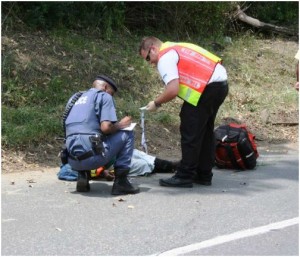
After lying there for about ten minutes, I spotted a young African boy walking along a nearby path. I called out to him in Zulu asking him to phone the police, get an ambulance and phone my wife to let her know what had happened to me. He said he would call his mother to help me – it turned out that she was a qualified home nurse! She arrived soon after, equipped with rubber gloves and a first aid kit. She took off my shoes and asked permission to remove my long pants, quite blood-stained by now. There was no time to feel embarrassed so I said, “Go ahead”. She cleaned my wounds and slowed the bleeding. With that an African man appeared and said: “Do not be afraid. I am here to help you.” By now my legs were shaking uncontrollably. He then left and returned with a sleeping bag which he placed over me to keep me warm. He placed his jacket under my head then returned home to phone the local police.
They were reluctant to come and investigate so he became angry and phoned his white boss, whom he knew “would make a plan”. His boss (who did not even know me) threatened the police and demanded that I be attended to. Within fifteen minutes there were four police vehicles at the scene. One of the policemen phoned my wife telling her I had been shot several times and that I would be taken to Crompton Hospital. My wife made two phone calls and by the time I arrived there were thirty family, friends and church members waiting. Even in the state I was in, I was emotionally moved and touched by this overwhelming support.
I was wheeled into Emergency, given an x-ray and, not needing surgery, was taken to a ward where my blood was tested. My veins had collapsed and they had to take arterial blood to establish my blood type. I needed two and a half pints of replacement blood. I overheard the nurses talking and saying that I probably would not live – then the doctor commenting that I was strong and would pull through. A day later I was well enough to move to a normal ward – one of the many miracles to follow. My left leg was in plaster from top to toe with a small window cut in the plaster to enable the dressing of my wound to be changed regularly. Two days later I was visited by Nickolas Ntanjana (who covered me with the sleeping bag) and his boss, Bruce Dickson, and that is when I heard their side of the story (about the calls to the police).
I was back home and recuperating in the company of my loving and very supportive family. I was off work for the rest of the year. This led to some serious financial losses as I received no compensation from either the Road Accident Fund nor from Workman’s Compensation.
I lost tens of thousands of rands due to not being able to give extra lectures. There is no fund to cover one in the event of a highjacking. A case of attempted murder was opened by the local police but to date no arrests have been reported. It is sad that criminals and the syndicates supporting them, can just force themselves into your life, violently ruin it and get away with it. Governments who pride themselves on removing the death penalty will have to answer to God as to why they have subjected their law-abiding citizens to the death penalty instead! Not only do you and your immediate family suffer but also the community that you serve – there are vast, rippling (negative) effects. Medical expenses, counselling (by psychologists or psychiatrists), protracted battles with insurance companies or debtors, security measures to be upgraded, etc. I have lost my ability to concentrate for extended periods on technical type work and hence have had to give up my research. I was determined not to become a victim and was elected as chairman of the South African Institute of Electrical Engineers, KwaZulu Natal Branch, last year. Nevertheless my reserves of energy have become limited. I suppose being over the age of fifty also contributes to this.
I would like to emphasise that having been through a traumatic, near death experience, it gives one a new set of values. One of these is the importance of communicating appreciation and love to those around you. Say it and say it often. Love is the only thing I know that grows as you give it away! Life is really very temporal and fragile. Live it by loving those close to you.
HOW TO AVOID A HIJACK SITUATION
- 80% of hijackings take place in home driveways. Check your driveway and street before you leave or enter your premises. Be on the look out for suspicious vehicles/persons.
- Always be cautious and aware of surrounding obstructions and shrubbery that may conceal a hijacker.
- At road junctions, leave enough space between your car and the one ahead of you to allow you to escape.
- If a car has driven into the rear of your car, and the impact is fairly light, wave to the driver to follow you to somewhere safe to trade necessary information.
- When approaching your vehicle, always have your keys ready but not visible. Be aware of your surroundings & if you notice any suspicious behaviour immediately walk away from your car towards a safe area.
- When approaching a red traffic light at night, slow down so that you only reach it when it turns green.
- Do not stand by your car if you are waiting for somebody & never sit in your parked vehicle without being aware of your surroundings.
- Once in the car, lock all your doors & leave your window only partially open. Keep any valuables, briefcase, handbag & cell phone out of sight.
- If you suspect you are being followed, take a different route home. If you still think you are being followed, drive to the nearest police station. Do not stop your car for any reason as this will give your pursuer the ideal opportunity to hijack your vehicle.
- Avoid driving through high crime or unfamiliar areas as well as late at night/early hours of the morning when the roads are quiet.
- Drive in the centre lane away from pedestrians where possible.
- When you are a victim of a car-hijacking, don’t put up a fight. Do exactly as told by the hijackers. Do not reach for your purse or valuables.
- Gather as much information as possible without posing a threat.