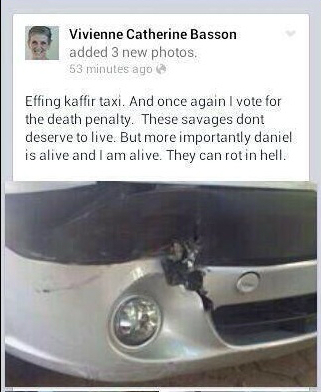
Telecommunications firm Ericsson has fired a worker who used the word “kaffir” in a tweet.
The tweet from the account of Vivienne Basson used the word while expressing frustration over a taxi accident.
The Tweet went on to say, “These savages don’t deserve to live. They can rot in hell.”
Ericsson South Africa M.D Magnus Mchunguzi says Basson who was a sub-contractor, has breached their business ethics.
Social Networks may seem to many as lawless, but World Wide Worx Technology expert, Arthur Goldstuck says people may be prosecuted for hate speech posted online.
He also says the law on social networks applies as it would in other public spaces.
Social network leaves a pure trail of evidence as numerous people can copy it and save it for the whole world to see.
Goldstuck says once you put something up online, it can never be entirely deleted.
Basson explained on twitter what led to her offensive speech before apologising.
The FW de Klerk Foundation on Thursday formally accepted the apology of a man who allegedly posted a racist tweet.
The foundation said spiritual leader Kemo Waters had apologised for the tweet.
In January last year, the foundation laid a complaint with the SA Human Rights Commission (SAHRC) about the Twitter post.
Waters allegedly tweeted on January 7, 2012: “The only way to end racism is to kill a material number of whites @hellenzille your indifferent and patrionizing stance in a double dare”.
Waters recently released an apology statement: “I… hereby tender my summary and unequivocal apology to the public, the Commission, the FW de Klerk Foundation.”
He undertook to refrain from “conducting myself in a manner associated with hate speech or racism in the form complained about”.
On Thursday, the FW de Klerk Foundation said that while the Bill of Rights provided for freedom of expression, it prohibited advocacy of hatred based on race, ethnicity, gender or religion, and incitement to cause harm.
“It is imperative that all South Africans should bear in mind the constitutional prohibition against hate speech when they are participating in the national debate.”
It was also important for the public to complain about language that incited hatred or violence.
The foundation thanked the SAHRC for its work on the matter and the way it was handled.
In a statement last week SAHRC spokesman Isaac Mangena said that during mediation the commission was satisfied that the comments could be interpreted as hate speech.
However, it felt that this needed to be seen in the context of Waters’s experiences and perceptions.
During the mediation, Waters said he had experienced racial prejudice himself since moving to the Western Cape.
The SAHRC also took into consideration that Waters already apologised publicly, on a radio show and on Twitter, for his comment before the commission received the complaint.
The commission advised him to release a formal written apology to all South Africans.
“The FW de Klerk Foundation accepted Mr Waters’ apology and a mediation agreement was signed between Mr Waters and the complainant in April 2013,” Mangena said. – Sapa
This website uses cookies to improve your experience. We'll assume you're ok with this, but you can opt-out if you wish. Cookie settingsACCEPT
Privacy & Cookies Policy
Privacy Overview
This website uses cookies to improve your experience while you navigate through the website. Out of these cookies, the cookies that are categorized as necessary are stored on your browser as they are essential for the working of basic functionalities of the website. We also use third-party cookies that help us analyze and understand how you use this website. These cookies will be stored in your browser only with your consent. You also have the option to opt-out of these cookies. But opting out of some of these cookies may have an effect on your browsing experience.
Necessary cookies are absolutely essential for the website to function properly. This category only includes cookies that ensures basic functionalities and security features of the website. These cookies do not store any personal information.
Any cookies that may not be particularly necessary for the website to function and is used specifically to collect user personal data via analytics, ads, other embedded contents are termed as non-necessary cookies. It is mandatory to procure user consent prior to running these cookies on your website.

 Telecommunications firm Ericsson has fired a worker who used the word “kaffir” in a tweet.


