
Here’s how tech giants profit from invading our privacy, and how we can start taking it back

Katharine Kemp, UNSW

Australia’s consumer watchdog has recommended major changes to our consumer protection and privacy laws. If these reforms are adopted, consumers will have much more say about how we deal with Google, Facebook, and other businesses.

The proposals include a right to request erasure of our information; choices about whether we are tracked online and offline; potential penalties of A$10 million or more for companies that misuse our information or impose unfair privacy terms; and default settings that favour privacy.


Read more:
Consumer watchdog calls for new measures to combat Facebook and Google’s digital dominance


The report from the Australian Competition and Consumer Commission (ACCC) says consumers have growing concerns about the often invisible ways companies track us and disclose our information to third parties. At the same time, many consumers find privacy policies almost impossible to understand and feel they have no choice but to accept.

My latest research paper details how companies that trade in our personal data have incentives to conceal their true practices, so they can use vast quantities of data about us for profit without pushback from consumers. This can preserve companies’ market power, cause harm to consumers, and make it harder for other companies to compete on improved privacy.
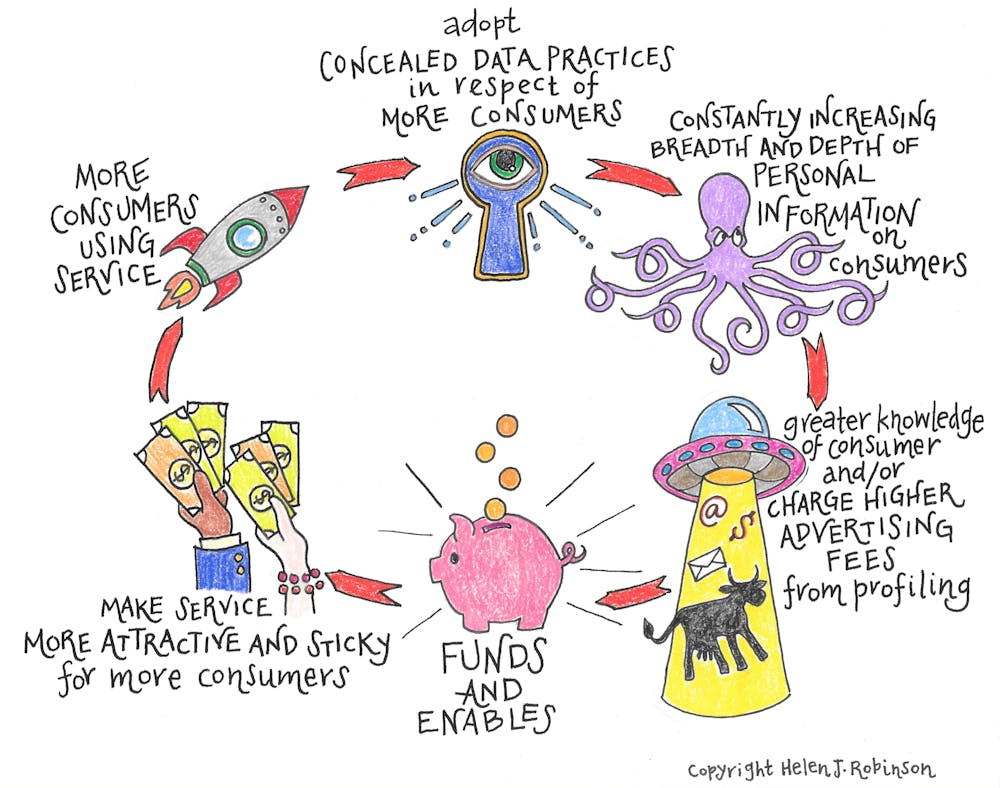
The vicious cycle of privacy abuse.
Helen J. Robinson, Author provided

Privacy policies are broken

The ACCC report points out that privacy policies tend to be long, complex, hard to navigate, and often create obstacles to opting out of intrusive practices. Many of them are not informing consumers about what actually happens to their information or providing real choices.

Many consumers are unaware, for example, that Facebook can track their activity online when they are logged out, or even if they are not a Facebook user.


Read more:
Shadow profiles – Facebook knows about you, even if you’re not on Facebook


Some privacy policies are outright misleading. Last month, the US Federal Trade Commission settled with Facebook on a US$5 billion fine as a penalty for repeatedly misleading users about the fact that personal information could be accessed by third-party apps without the user’s consent, if a user’s Facebook “friend” gave consent.

If this fine sounds large, bear in mind that Facebook’s share price went up after the FTC approved the settlement.

The ACCC is now investigating privacy representations by Google and Facebook under the Australian Consumer Law, and has taken action against the medical appointment booking app Health Engine for allegedly misleading patients while it was selling their information to insurance brokers.

Nothing to hide…?

Consumers generally have very little idea about what information about them is actually collected online or disclosed to other companies, and how that can work to their disadvantage.

A recent report by the Consumer Policy Research Centre explained how companies most of us have never heard of – data aggregators, data brokers, data analysts, and so on – are trading in our personal information. These companies often collect thousands of data points on individuals from various companies we deal with, and use them to provide information about us to companies and political parties.

Data companies have sorted consumers into lists on the basis of sensitive details about their lifestyles, personal politics and even medical conditions, as revealed by reports by the ACCC and the US Federal Trade Commission. Say you’re a keen jogger, worried about your cholesterol, with broadly progressive political views and a particular interest in climate change – data companies know all this about you and much more besides.

So what, you might ask. If you’ve nothing to hide, you’ve nothing to lose, right? Not so. The more our personal information is collected, stored and disclosed to new parties, the more our risk of harm increases.

Potential harms include fraud and identity theft (suffered by 1 in 10 Australians); being charged higher retail prices, insurance premiums or interest rates on the basis of our online behaviour; and having our information combined with information from other sources to reveal intimate details about our health, financial status, relationships, political views, and even sexual activity.


Read more:
Why you might be paying more for your airfare than the person seated next to you


In written testimony to the US House of Representatives, legal scholar Frank Pasquale explained that data brokers have created lists of sexual assault victims, people with sexually transmitted diseases, Alzheimer’s, dementia, AIDS, sexual impotence or depression. There are also lists of “impulse buyers”, and lists of people who are known to be susceptible to particular types of advertising.

Major upgrades to Australian privacy laws

According to the ACCC, Australia’s privacy law is not protecting us from these harms, and falls well behind privacy protections consumers enjoy in comparable countries in the European Union, for example. This is bad for business too, because weak privacy protection undermines consumer trust.

Importantly, the ACCC’s proposed changes wouldn’t just apply to Google and Facebook, but to all companies governed by the Privacy Act, including retail and airline loyalty rewards schemes, media companies, and online marketplaces such as Amazon and eBay.

Australia’s privacy legislation (and most privacy policies) only protect our “personal information”. The ACCC says the definition of “personal information” needs to be clarified to include technical data like our IP addresses and device identifiers, which can be far more accurate in identifying us than our names or contact details.


Read more:
Explainer: what is surveillance capitalism and how does it shape our economy?


Whereas some companies currently keep our information for long periods, the ACCC says we should have a right to request erasure to limit the risks of harm, including from major data breaches and reidentification of anonymised data.

Companies should stop pre-ticking boxes in favour of intrusive practices such as location tracking and profiling. Default settings should favour privacy.

Currently, there is no law against “serious invasions of privacy” in Australia, and the Privacy Act gives individuals no direct right of action. According to the ACCC, this should change. It also supports plans to increase maximum corporate penalties under the Privacy Act from A$2.1 million to A$10 million (or 10% of turnover or three times the benefit, whichever is larger).

Increased deterrence from consumer protection laws

Our unfair contract terms law could be used to attack unfair terms imposed by privacy policies. The problem is, currently, this only means we can draw a line through unfair terms. The law should be amended to make unfair terms illegal and impose potential fines of A$10 million or more.

The ACCC also recommends Australia adopt a new law against “unfair trading practices”, similar to those used in other countries to tackle corporate wrongdoing including inadequate data security and exploitative terms of use.

So far, the government has acknowledged that reforms are needed but has not committed to making the recommended changes. The government’s 12-week consultation period on the recommendations ends on October 24, with submissions due by September 12.The Conversation

Katharine Kemp, Senior Lecturer, Faculty of Law, UNSW, and Co-Leader, ‘Data as a Source of Market Power’ Research Stream of The Allens Hub for Technology, Law and Innovation, UNSW

This article is republished from The Conversation under a Creative Commons license. Read the original article.
How Apple’s FaceTime could be used for eavesdropping

Apple Inc said on Monday it will issue a software patch later this week for a bug that lets iPhone users hear audio from users who have not yet accepted a video call.

The bug, which Reuters was able to replicate, allows an iPhone user placing a call using Apple’s FaceTime video-calling feature to hear audio from the recipient’s phone even if the recipient has not yet picked up the call. The bug appears to rely on Apple’s group video-calling feature.

In certain situations, the bug also broadcast both video and audio from the recipient’s phone, the technology news website the Verge noted.

“We’re aware of this issue and have identified a fix that will be released in a software update later this week,” an Apple spokesperson said.

Apple’s group FaceTime was temporarily made unavailable due to an ongoing issue, according to Apple’s system status webpage. apple.co/2Sars1k

The Cupertino, California-based company was not immediately available to comment on the update on its system status page.

Users took to Twitter to tweet jokes and comments about the bug affecting Apple’s group FaceTime service.

“Disable FaceTime for now until Apple fixes,” Twitter Inc CEO Jack Dorsey tweeted.

Apple announced the feature last summer, but then removed it from early test versions of its iOS 12 operating system. The company launched the feature in October.

Who is twitter-luring refugees to Germany?

Content-analysis of a great number of tweets that triggered the ongoing wave of migration from Turkey to Germany since August this year suggests that these human streams were inspired and channeled from outside of the continental Europe.

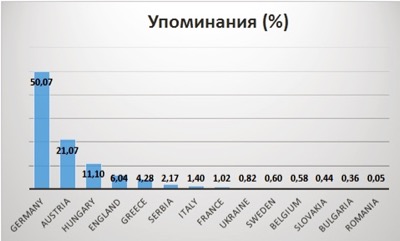
According to Vladimir Shalak from the Russian Academy of Science who developed the Internet Content-Analysis System for Twitter (Scai4Twi), his study of over 19000 refugees-related original tweets (retweets discounted) demonstrates that the vast majority of them mention Germany and Austria as the most refugee-welcoming countries in Europe:

Importantly, 93% of all tweets dedicated to Germany contained positive references to German hospitality and its refugee policy:

• Germany Yes! Leftists spray a graffiti on a train sayin “Welcome, refugees” in Arabic
• Lovely people – video of Germans welcoming Syrian refugees to their community
• Respect! Football fans saying “Welcome Refugees” across stadiums in Germany. _ • This Arabic Graffiti train is running in Dresden welcoming refugees: (ahlan wa sahlan – a warm welcome).
• ‘We love Germany!,’ cry relieved refugees at Munich railway station
• Thousands welcome refugees to Germany – Sky News Australia
• Wherever this German town is that welcomed a coach of Syrian refugees with welcome signs and flowers.

Analysis of 5704 original tweets containing #RefugeesWelcome” hashtag and a country name lead to even larger gap between Germany and the rest of Europe.

Only 6,4% of all tweets with “#RefugeesWelcome”+Germany came from Germany itself. Almost half of them were originated from UK, USA and Australia! Remote planetmates are thus inviting guests to visit your home without inquiring your opinion beforehand!

On Aug 27 forty automatic netbots @changing_news, @changing_news1,…, @changing_news39 from the United States simultaneously issued the following tweet at 8:00:33AM:

«A new welcome: Activists launch home placement service for refugees in Germany and Austria #News #Change #Help»

On Sept 1 the same group of netbots releases same tweets with caps on at 22:30:37:

«A New Welcome: Activists Launch Home Placement Service For Refugees In Germany And Austria #News #Change #Help»

On August 29 at 11.02PMa group of 80 netbots posts the following:

«Thousands Welcome Refugees to Germany at Dresden Rally: Thousands of people took to the streets of the German city of Dresden on Satu…»

Another group of fifty netbots from Australia (all created on Feb 14, 2014 between 06:02:00 до 06:24:00AM) publish a post on Aug 31 at 17:26:08:

«#hot Football Fans in Germany Unite with ‘Refugees Welcome’ Message #prebreak #best»

On Sept 1 at 07:29AM 95 netbots owned by Media for Social and Cultural Impact, Dallas, Texas, USA publish the following tweets:

«German Soccer Fans Welcome Refugees Amid Ongoing Crisis: As Europe faces the challenge of a wave of migration…»

Needless to say that every original tweet was multiplied in dozens of copies and spreaded Twitter-wide.

Andrey Fomin

Source: Oriental Review (Russia)

Social media storm after German minister says ‘negro’

A German state minister sparked a social media storm on Tuesday after calling a beloved German pop singer a “wonderful Negro” during a TV debate on Europe’s migrant crisis.

The Twitter hashtag #Neger (Negro) topped trending topics in Germany the morning after Bavarian Interior Minister Joachim Herrmann used the term for Roberto Blanco, who is of Afro-Cuban origin.

“Roberto Blanco was always a wonderful Negro, who most Germans thought was wonderful,” Herrmann had said in a TV talk show Monday evening on public broadcaster ZDF.

Continuing on the topic of immigrant “success stories” in Germany, he added that football powerhouse Bayern Munich also has many star players “with black skin”.

The debate centred on Blanco — a household name whose career as a singer peaked in the late 1960s and early 70s — comes as Europe faces its biggest migrant influx since World War II, with Germany the top destination.

On social media, people poured outrage and scorn on the comment from the minister of the conservative southern state of Bavaria.

Twitter user @Herzistvoll wrote: “A ‘Negro’ is only wonderful when he amuses white people with singing, dancing and football”.

User @TheGoodOldGamer commented that Herrmann “also has nothing against #Negroes who do the housework and work in the fields”.

Another Twitter user wrote that “whether Joachim Herrmann also finds #Obama wonderful remains unclear”.

An online comment from Berlin daily Tagesspiegel sneered that “little Joachim would like to be picked up from the 1950s”.

Herrmann on Monday morning was back on the airwaves to justify his comment, saying he had replied to a caller who had first used the term by saying he “did not want to have Negroes at all”.

The minister said this comment was “completely unacceptable”, adding that “I usually don’t use the word Negro at all”.

Source: AFP

Donald Trump rips into SA

American business magnate and television personality, Donald Trump, has called South Africa a very dangerous mess.

He expressed his opinion, which he said he has held for a while, via a tweet to his followers on Monday night.

“As I have long been saying, South Africa is a total – and very dangerous – mess. Just watch the evening news (when not talking weather)”

The South African Twittersphere did not take too kindly to Trump’s opinions and he’s since received enough flack for his name to trend.

It is not the first time Trump has criticised South Africa.

In 2013, he posted a tweet saying South Africa was a crime-ridden mess “just waiting to explode”.

Source: eNCA

‘Nigga’ used 500 000 times daily on Twitter

This season, the US National Football League is attempting the impossible: banning the n-word within the chalk-lined borders of its purview.

As with the previous attempts, the NFL’s “zero tolerance” policy — which gives referees leeway to issue a 15-yard penalty for a first offense and ejection for a second — comes with good intentions: to establish a field of play free of the most racially charged word in American history.

The policy, though, was widely criticized as being heavy-handed and out of touch. As the league wrestled with the issue, a team of Washington Post journalists examined the history of this singular American word, its spread through popular culture and its place in the vernacular today.

But like the others, it is almost certainly doomed to fail; to be ignored, at best — or mocked and flouted, at worst.

If there is one thing certain about the modern n-word, it is that it defies black-and-white interpretations and hard-and-fast rules.

The word is too essential as an urban slang term to be placed in a casket and buried, as NAACP delegates attempted to do in a 2007 mock “funeral” for the word.

It is too ingrained in youth culture to be eliminated from city streets, as the New York City Council attempted with a symbolic resolution banning the word the same year. And more than likely, it will prove too complex and nuanced to be policed by football referees wielding yellow flags and penalties. Never mind the troublesome optics of a group of mostly white NFL executives dictating the language rules of a majority-black player pool.

If anything, in 2014, it is the very notion of banning the n-word that appears dead and fit for burial. It was a long and noble fight, waged largely — but not exclusively — by an older generation for which the word is inseparable from the brutality into which it was born. If there is still a meaningful n-word debate left to have, it is over context, ownership and the degree to which it should be tethered to its awful history — or set free from it.

A word that is used 500,000 times a day on Twitter — as “nigga” is, according to search data on the social media analytics Web site Topsy.com — is almost by definition beyond banning. By comparison, “bro” and “dude” — two of the terms with which the n-word is synonymous to many people younger than 35 — are used 300,000 and 200,000 times, respectively. For many of this generation, the word is tossed around unthinkingly, no more impactful than a comma.

“It’s such a regular part of my vernacular. It’s a word I use every day,” said comedian/actor Tehran Von Ghasri, a 34-year-old D.C. native of African American and Iranian American heritage. “I’m a ‘nigga’ addict.”

But any larger exploration of this subject leads to the inevitable conclusion that it isn’t just the NFL that has an n-word problem. It’s all of America.

Source: Washington Post

Twitter: White, male and Asian

Succumbing to growing public pressure, Twitter released the gender and ethnic breakdown of its work force Wednesday, showing that it looks like most other major technology companies: overwhelming male, white and Asian.

In the U.S., nearly 90% of Twitter’s workers are white or Asian. And more than 90% of technology jobs in the U.S. are held by whites or Asians.

Men make up 70% of all staff but 90% of technology staff, according to figures released by the company’s vice president for diversity and inclusion, Janet Van Huysse.

Twitter pledged to take steps to diversify its staff.

“We want to be more than a good business; we want to be a business that we are proud of,” Huysse said.

Diversity has become a hotly debated issue as some of Silicon Valley’s most powerful companies have begun revealing the makeup of their work forces.

These companies say they are intent on diversifying their ranks to stay in touch and in tune with their customers around the world.

Over the past two months, Yahoo, Google, Facebook and LinkedIn have reported that their staffs are between 62% and 70% male. Whites and Asians make up between 88% and 91%.

Britain’s Prince Harry meanwhile has spoken of his hatred for Twitter due to its role in the “invasion of his privacy”, according to media report.

Harry was speaking to students at a seperate event promoting a Paralympics-style multi-sports event for British service personnel wounded in Iraq.

The dull prince, fourth in line to the throne, belongs to a class of people who live it up on taxpayers money while promoting racial mixing and “diversity” for the rest of humanity but not themselves.

“I really quite hate Twitter (due to) the invasion of privacy. I think you all know what I’m talking about.”

Harry, who proudly took part in the invasion and destruction of Iraq, was later pictured frolicking naked with hired entertainment at a party in Las Vegas.

British police work round the clock to patrol social media

Complaints arising from behaviour on Facebook, Twitter or other social media make up “at least half” of calls passed on to police officers in Britain.

Alex Marshall, head of the College of Policing, said the number of calls relating to social media represented “a real problem for people working on the frontline of policing”.

“Police officers can’t deal with every bit of nonsense or disagreement that occurs on social media,” he told BBC Radio.

Antisocial behaviour and threats of assault are among the most common allegations, said Marshall.

He claimed police training and enforcement by social media companies was needed to combat the problem. About 6000 officers are being trained to deal with online offences and identify when a pattern of behaviour requires further investigation.

“It won’t be long before pretty much every investigation that the police conduct will have an online element to it,” he said.

The director of public prosecutions has issued guidance to prosecutors to determine which cases should be treated as potentially criminal.

They are also advised to look out for messages that constitute a “credible threat of violence “. – Daily Telegraph

The Dark Web

This is a Twitter network for a political hashtag in the US, produced by Truthy. We see two clearly separated clusters, corresponding to conservative and liberal communities. Retweets, which tend to stay in the same community, are shown in blue. Mentions, shown in orange, connect the two communities. Image © Truthy.

Cybercriminals are settling into a comfortable place in the “Dark Web” where they test, refine and distribute malware for online crimes.

It sounds sinister, and it is. Big Brother is breaching your privacy, and terrorists and criminals are busy with a practice called astroturfing — creating the false impression that there’s huge grassroots support for some cause or person using false user accounts. It’s a big problem in elections and other types of political conflicts.

Automated tools to collect and analyse terrorist content from the Internet have been developed. like Truthy, a free tool for analysing how information spreads on Twitter that has been useful in spotting astroturfing.

McAfee, the US Internet security specialist, also noted that a huge data breach that affected as many as 110 million customers of the US retailer Target may also be just the tip of the iceberg.

In its quarterly threat assessment released Monday, McAfee Labs noted the relative ease with which this type of malware is bought and sold in “Dark Web” marketplaces.

McAfee researchers concluded that the malware for the Target attacks used “relatively unsophisticated technologies likely purchased ‘off the shelf’ from the Cybercrime-as-a-Service community, and customized specifically for these attacks,” the security firm said.

The report pointed out that the attackers who stole the data have also found a market — offering some of the 40 million credit card numbers reported stolen in batches of between one million and four million at a time.

“The fourth quarter of 2013 will be remembered as the period when cybercrime became ‘real’ for more people than ever before,” said Vincent Weafer, senior vice president for McAfee Labs.

“These cyber thefts occurred at a time when most people were focused on their holiday shopping and when the industry wanted people to feel secure and confident in their purchases. The impact of these attacks will be felt both at the kitchen table as well as the boardroom table.”

Weafer added that the attacks “represent a coming of age for both Cybercrime-as-a-Service and the ‘Dark Web’ overall.”

The “Dark Web” actors appear to be operating with ease, like other kinds of online businesses, McAfee said.

“But the big lesson is that we face a healthy and growing cybercrime industry which played a key role in enabling and monetizing the results of these attacks.”

Source: rawstory.com

Most popular Twitter insult is ‘white boy’

mhoax
This got attention on Twitter

10,000 racist tweets are sent ever day, a major new study into racism on social networks has discovered.
Research by the think tank Demos found the biggest insult was ‘white boy’.

Researchers analysed 126,975 English-language tweets from across the globe over a 9-day period in the biggest ever study of Twitter racism.

The Demos researchers claim 10,000 racist slurs are tweeted every day.

The study found that slurs were employed in six distinct ways: negative stereotype; casual use of slurs; targeted abuse; appropriated; non-derogatory; and offline action/ideologically driven.

The most common type of slurs were actually meant in a non-offensive, non-abusive manner, or to express in-group solidarity.
This group represented between 47.5-70 percent of tweets, depending on whether human or computer analysis were employed.

Researchers revealed the most common racial slurs used on the micro-blogging site included ‘whitey’ and ‘pikey’.

However, as many as 70% of tweets using such language were deemed to be using slurs in non-derogatory fashion.
‘This sparks the debate about the extent to which Twitter truly is a platform for racism and abusive language,’ the report claims.

Jamie Bartlett, Director of CASM at Demos and author of the report, said: ‘Twitter provides us with a remarkable window into how people talk, argue, debate, and discuss issues of the day.

‘While there are a lot of racial slurs being used on Twitter, the overwhelming majority of them are not used in an obviously prejudicial or hateful way.

Of the 126,975 English-language tweets from across the globe, further analysis suggests only 1% of tweets used a racial slur in an ideological context within a political statement or in a call to action in the real world.

Analysis found that as few as 500 tweets a day were directed at an individual and appeared on first sight to be abusive.

Source: Daily Mail

Winnie joins Twitter

Winnie Mandela
Winnie Mandela

Winnie Madikizela-Mandela joined Twitter in October tweeting that she “understood the value of social media”.

Madikizela-Mandela, who was married to former South African president Nelson Mandela and was a prominent voice in the struggle for the liberation of SA, is seen as an inspiration for women in the country.

Twitter users have welcomed her to the social media platform with word of thanks and heart felt massages which praised “the mother of the nation” for her grasp of black youth issues.

TV presenter Chriselda Lewis gushed in a tweet: “The founder of Twitter must send a special message to @winniemandela thanking her for joining. This is historic!”

Earlier this year she released a book titled 491 Days, Prisoner number 1323/69: a diary she wrote while in solitary confinement in 1969, having been charged under the Terrorism Act.

Winnie has been also implicated in a number of scandals including involvement in the murder of a young activist called Stompie Sepei, stemming back to her days with the Mandela United Football Club.

More recently upon the discovery of two bodies of young men, said to have been part of uMkhonto we Sizwe, again her involvement with the case was questioned.

However she has remained an inspiration to many South Africans and her presence on Twitter has been received warmly. – eNCA


#RedOctober hashtag trends on Twitter

redoctoberA backlash from white liberals erupted on Twitter as marches were held in a number of cities on Thursday by a grouping that gathered in protest against the oppression and slaughter of whites.

In Cape Town, Red October protesters marched from Keizersgracht to Parliament, where they released red balloons.

Red October, which is supported by musician Steve Hofmeyr, was slammed as “racist” on social media, with messages of disbelief and anger.

The #RedOctober hashtag trended on Twitter across South Africa.

By late afternoon, an online petition had been started “To all South Africans: Let’s shut down Red October!”, in an effort to have its Facebook page removed. It went nowhere.

According to the Red October website, the marches had been organised to let everyone know “that we have had enough”.

Whites protesting against their oppression marched to the Union Buildings under the theme Red October. After delivering a memorandum of their concerns, they released red balloons in remembrance of murdered white farmers.

“No longer will we be silent about the oppression of the White South African Ethnic Minority! No longer will we silently endure the killing of our people on our farms and in our towns and cities,” read its petition.

Their grievances included “destruction of our infrastructure; our filthy government hospitals; our pathetic educational system; dangerous neighbourhoods; and a disintegrating road network”.

As an ethnic minority, said Red October, white people were entitled to protection of their rights as enshrined in the constitution.


Twitter hosting terror feeds and suggesting terrorists to follow

bridgetjohnsonBy Bridget Johnson.

Twitter has increasingly come under criticism for hosting terror feeds. Al-Shabaab is on it sixth account after getting suspended in the past for tweeting photos of a dead French special ops soldier, and most recently the Somali terror outlet blazed through a few accounts after suspensions for gloating about the Westgate mall massacre.

Their latest account has remained active for many days now and has racked up 59 tweets. During the attack and its aftermath, journalists were checking the Shabaab feed for its latest claims and links to statements.

So when al-Qaeda announced it had launched its first official Twitter account, I, like other journalists who cover terrorism, hit the follow button. The account was suspended Sunday by Twitter after being allowed to remain open since Tuesday, posting nearly 50 tweets.

On Saturday, I received one of those occasional emails from Twitter offering suggestions based on a recent follow — suggesting that I follow other terrorists.

The first suggested account, “Islam Workshop,” is connected to an al-Qaeda web forum to “rouse the believers”. On Saturday the feed posted a video removed by YouTube for violence, showing Qaeda- and Muslim Brotherhood-backed jihadists Ansar Beit al-Maqdes fighting Egyptian forces in the Sinai.

The second appears to be linked to the Al-Battar training camp, al-Qaeda’s program that has offered DIY as well as hands-on terrorist advice. These days Muaskar Al-Battar (Camp of the Sword) concentrates largely on bringing together groups with the same goal in a loosely connected network. The feed even has a nice camp photo as its backdrop, with more than a few Tsarnaev look-a-likes in the wooded hills.

The third suggested Twitter account appears linked to a Kurdistan-based affiliate of al-Qaeda.

The fourth claims to be “one of the foot soldiers” of Al-Shabaab, and posted several press photo from the Westgate attack while gloating about Shabaab’s gruesome accomplishments.

The last account, posing with the girl, is former Guantanamo Bay detainee Abdulaziz Sayer Owain al Shammari, who was arrested by Pakistan in 2001 and transferred to his home country Kuwait in 2005.

“Based on detainee’s deception history, it is assessed that he has received training on advanced counter-terrorism techniques, as well as above average terrorist training typically taught by Al-Qaida,” reads a 2004 Defense Department memo. “…Detainee is assessed to have connections to high-ranking Al-Qaida members.”

Twitter has said it can’t comment on users when asked to explain why terrorist accounts remain up. The only reason Al-Shabaab’s account fell a couple of times after the horrific Westgate attack was because of intense pressure from angry Twitter users.