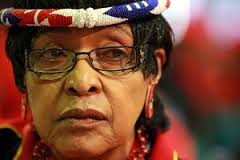
Winnie Madikizela-Mandela joined Twitter in October tweeting that she “understood the value of social media”.
Madikizela-Mandela, who was married to former South African president Nelson Mandela and was a prominent voice in the struggle for the liberation of SA, is seen as an inspiration for women in the country.
Twitter users have welcomed her to the social media platform with word of thanks and heart felt massages which praised “the mother of the nation” for her grasp of black youth issues.
TV presenter Chriselda Lewis gushed in a tweet: “The founder of Twitter must send a special message to @winniemandela thanking her for joining. This is historic!”
Earlier this year she released a book titled 491 Days, Prisoner number 1323/69: a diary she wrote while in solitary confinement in 1969, having been charged under the Terrorism Act.
Winnie has been also implicated in a number of scandals including involvement in the murder of a young activist called Stompie Sepei, stemming back to her days with the Mandela United Football Club.
More recently upon the discovery of two bodies of young men, said to have been part of uMkhonto we Sizwe, again her involvement with the case was questioned.
However she has remained an inspiration to many South Africans and her presence on Twitter has been received warmly. – eNCA
Winnie Madikizela-Mandela — she changed her last name from simply Mandela after her divorce from Mr. Mandela in 1996 — is very ostentatiously trying to re-enter politics.
Madikizela-Mandela is eager to claim part of the Mandela legacy. “Nobody knows him better than I do,” she told Britain’s ITN network.
And this move comes after years of political eclipse and a long slide, beginning in the 1980s, from her previous status as the most famous of South Africa’s female freedom fighters after her involvement in the murder of a follower.
“She has always wanted to be close to the action in the Mandela household,” said Justice Malala, a political commentator and former publisher of The Sowetan newspaper. He said a recent Soweto news conference and her subsequent interview with British television “showed that, once again, she is trying to do that. The question is whether there is any legitimacy to that, or whether she is a spent force.”
Of all the major figures who came to global prominence during the South African liberation struggle, Ms. Madikizela-Mandela was also the most outspoken revolutionary and anti-white, which explains her fall from grace.
For many of the years just before Nelson Mandela’s release from 27 years in prison, she was his public face, bringing word of his thoughts and his state of mind.
Rumors however circulated even back then of thuggish behavior by a club she had formed for young Soweto men — the Mandela United Football Club — and these whispered accusations came back to haunt her shortly after her husband’s release in 1990.
The following year she was convicted of kidnapping and assaulting a minor, a 14-year-old, James Seipei, who went by the name Stompie Moeketsi. The authorities said he had been fatally beaten by members of her football club, on her orders, because he was suspected of being an informant. She received a six-year sentence that was later reduced to a fine.
The next year, though, she and Mr. Mandela separated.
While she was given a role in the Mandela government, after Mr. Mandela was named president in 1994, she had little power. She was deputy minister of arts, culture, science and technology, but was later fired by Mr. Mandela after a series of incendiary comments and accusations of financial mismanagement.
She has retained her popularity, especially among some young and radical township residents.
“She has, over the past 19 years, attached herself to a sort of radical fringe in the ANC,” Mr. Malala said, referring to the governing African National Congress. “She always attached herself to whatever seemed to be the radical idea of the day, but nothing ever came of it.”
Her public troubles did not end with the Stompie Moeketsi case, though.
In 2003, she was convicted of theft and fraud for her role in a bank swindle in which ANC stationery was used to obtain loans for nonexistent employees. That sentence, too, was suspended.
In March, the police exhumed what they believe might be the bodies of two young Soweto activists who disappeared in 1989, shortly after the father of one of the activists saw them in a vehicle with Ms. Madikizela-Mandela and members of her football club. The father said she had told him that his son was “an apartheid spy.” That case is still under investigation.
Not long after the exhumations, the police showed up on her doorstep in Soweto — trailed by local journalists — to confiscate some of her artwork and possessions to pay a debt of about $5,000 to a private school that had admitted her grandniece. No one answered the door, and the debt was quickly paid by her lawyer.
In recent weeks, though, she gingerly reasserted herself on the public stage, showing up several times to visit her ailing former husband in the hospital in the capital, Pretoria, where he had been clinging to life. That recent Soweto news conference was widely seen as a declaration that she intended to claim her share of the Mandela legacy, as did the interview with ITN.
“When it suits the media, I am a murderer,” she told the British interviewer, while insisting that all the charges against her were “manufactured by the system I was fighting against.”
There is much skepticism here about whether she will be able to pull off yet another political resurrection after her ex-husband’s death.
“She has always felt that she played a major role in the Mandela story,” said William Gumede, a professor of public management at the University of Witwatersrand in Johannesburg.
“Winnie has argued that she played 80 percent of the role in elevating his status while he was in prison,” Mr. Gumede said. “What she wants now is not so much political power as a place in the Mandela family. But then, they all want a slice of Mandela now.”
This website uses cookies to improve your experience. We'll assume you're ok with this, but you can opt-out if you wish. Cookie settingsACCEPT
Privacy & Cookies Policy
Privacy Overview
This website uses cookies to improve your experience while you navigate through the website. Out of these cookies, the cookies that are categorized as necessary are stored on your browser as they are essential for the working of basic functionalities of the website. We also use third-party cookies that help us analyze and understand how you use this website. These cookies will be stored in your browser only with your consent. You also have the option to opt-out of these cookies. But opting out of some of these cookies may have an effect on your browsing experience.
Necessary cookies are absolutely essential for the website to function properly. This category only includes cookies that ensures basic functionalities and security features of the website. These cookies do not store any personal information.
Any cookies that may not be particularly necessary for the website to function and is used specifically to collect user personal data via analytics, ads, other embedded contents are termed as non-necessary cookies. It is mandatory to procure user consent prior to running these cookies on your website.