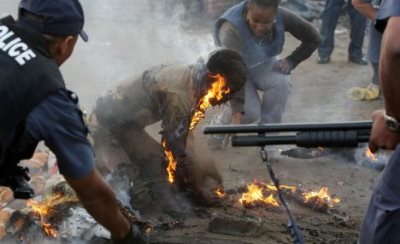
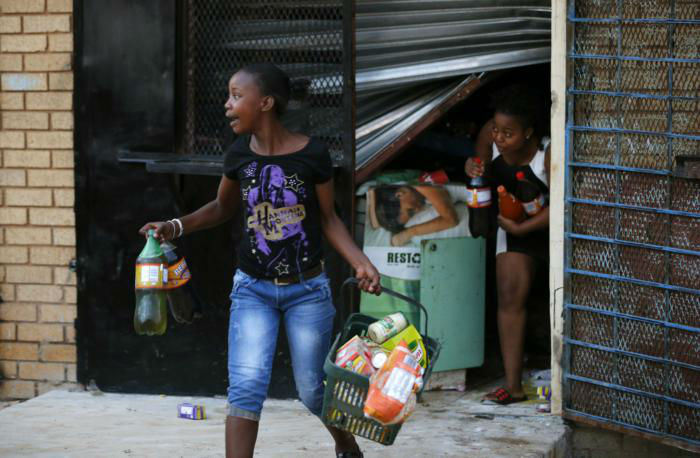
A 34-year-old foreign businessman was shot dead at the Tseki shopping complex in QwaQwa in the Free State.
Police spokesperson Thandi Mbambo said the incident occurred on Wednesday evening.
She said at around 17:50 police received a report that a man had been shot at the shopping complex. On arrival there they found a foreign national businessman lying on the ground near his shop.
The man had bullet wounds to his upper left eye and upper body. Paramedics certified him dead at the scene. Mbambo said it was later discovered that the businessman had been robbed of an undisclosed amount of money.
A case of murder has been registered for further investigation.
Immigration lawyers have noticed a spike in inquiries from South African residents interested in emigrating from one or two a week last year to about 10 a week now.
Even the NGO Homecoming Revolution, which encourages expats to return to South Africa, admits there is a spike of “negative sentiment” in the country.
Homecoming Revolution CEO Angel Jones puts the feelings of despair down to load-shedding, xenophobic attacks, weak leaders, crime, the Omar al-Bashir saga and South Africa’s alleged involvement in the Fifa corruption scandal.
Sadly Jones’organisation saw no benefits from attacking Afrikaans-language schools.
“The main destinations people plan to go to are the US, UK, Canada, Australia and New Zealand in that order,” immigration lawyer Chris Watters said.
Jennifer Vickerman, of Kramer Villion Norris Attorneys, said people who approached her about relocation cited crime, Eskom, investing abroad and better employment opportunities as the reasons behind their immigration plans.
White English-speaking South Africans worry the most about the state of government hospitals and their children’s long-term career prospects in South Africa, but one family admitted that they had had to return to the country about a year ago after living in Israel proved too expensive.
Althea Appolis, a coloured Cape Town resident, is also emigrating to Australia with her family in a few months.
“We have had enough of this place. No amount of beauty, culture or spirit can right the wrongs of the government,” she said.
“Along with at least six other families we have lodged applications for Australia via an immigration attorney, who confirmed the sudden influx of applications citing people who have decided now is the best time to leave.”
Damon Chadwick, who will graduate this year with a business degree, is planning to head to Berlin in December.
The trial of three blacks and a minor alleged to have murdered Mozambican national Emmanuel Sithole was set to start in the Johannesburg Magistrate’s Court on Monday.
The murder of the Mozambican national made world headlines when the attack was captured by a Sunday Times photographer at the height of the xenophobic violence that swept through South Africa two months ago.
According to the report, three South African men stalked Sithole, cornered him, stabbed him and left him for dead.
The photographer who captured the event as it was unfolding in Alexandra, in the north of Johannesburg, rushed Sithole to a nearby hospital but he was declared dead on arrival.
All of the accused have pleaded not guilty to the murder charges.
One of the accused is a 17-year-old who will be tried behind closed doors, under the Child Justice Act.
Their last appearance at the Alexandra Magistrate’s Court was held in camera because of the presence of the minor.
Mthinta Bhengu, Sizwe Mngomezulu, Sifundi Mzimzela and the minor were alleged to have stabbed Sithole in the streets of Alexandra on April 18.
It was believed that they had taken cigarettes from the street vendor without paying.
They allegedly attacked and killed Sithole when he demanded payment.
Bhengu had earlier indicated through his lawyer that he wanted to enter into a plea bargain.
Zimbabwean President Robert Mugabe laid the blame for xenophobic violence in South Africa on whites, because he said they still owned most of the land and had most of the opportunities.
“It is a matter of the whites keeping things to themselves and the political dispensation brought in by Mandela, (that) did not address the question of disparities between whites and blacks, and this is what must be addressed,” he said at a press conference after visiting the headquarters of the Southern African Development Community (SADC) secretariat here. Mugabe is the current chairperson of SADC.
Mugabe said he was satisfied with the South African government’s response to the attacks. But he added that unemployment in South Africa and white dominance of land ownership made the xenophobic attacks understandable.
“Most of the land is in the hands of the whites who are in a minority…They are not talking in their country of whites being unemployed. It is blacks who are unemployed, this is what they must address first and foremost,” said Mugabe, calling for a second liberation to redress these inequalities.
South Africa should be helped to overcome the problem that former oppressors were still occupying the old positions and the advantages that they allocated to themselves during colonialism.
Countries like Zimbabwe had overcome oppression and inequalities of land ownership.
“But if you go to SA it is a different story, we need to help them, they need another liberation,” he said.
Mugabe and SADC executive secretary Stergomena Tax, dismissed suggestions that his reception in Botswana was inadequate. Some local media put this down to the chilly relations between Mugabe and Botswana President Ian Khama, the deputy chairperson of SADC, who has in the past criticised the lack of democracy in Zimbabwe and differed from SADC when it declared the 2013 elections free and fair.
But Mugabe said he had not come on a state visit and so did not expect to be welcomed with much formal ceremony. He did have a private meeting with Khama over lunch and said relations between the two were friendly and that it was journalists who had created the idea that they were not friendly.
And he shrugged off Botswana’s opinion of the Zimbabwe elections, saying perhaps Botswana had seen certain incidents that others had not seen.
Mugabe had a dig at South Africa’s economic dominance of the region, and suggested Khama shared his view.
“Right now some of us are complaining about the bigness of SA, a giant establishing itself. That is what we discussed at the meeting, that if we are trying to establish our industries they are blocked.”
“For example, pharmaceuticals. We produce some drugs, and they are in demand. We want to send them to SA then those officials in trade say we will only receive them if they come by air. We say no it is much more costly to send them to SA by air, we have planes, yes, but the planes are expensive, we can send them by road, they say no. You see, that is contrary to our free trade principles, there are lots of things we still have to discuss amongst us.”
He also noted that there was a one-way trade of South African beer into other SADC countries.
Officials at the Central Methodist Church in the Joburg city centre believe that the fire at the building was the work of disgruntled members.
The church’s superintendent minister, Reverend Ndumiso Ncombo, said residents had set a room alight to spite church officials who gave them notice to move out.
“I wasn’t surprised when the fire started because the residents threatened to burn the building down when we gave them notice to move out,” he said. “We have opened a case of arson with the police.”
The fire last week Wednesday was started in one of the rooms, just a floor down from the church hall.
The small room where the fire was believed to have started lies in ruins, with clothes, groceries and broken glass from the shattered windows spread across the wet floor. Several large buckets, bottles and fire extinguishers lie outside the room.
After the fire was put out, residents were forced to evacuate the building.
The building, situated in the city centre, has acted as a haven for foreigners and destitute people who are desperate for a place to stay.
Since it opened its doors to the public almost 50 years ago, it has housed thousands of people at a time, especially during xenophobic flare-ups.
But now, the depilated building is a shadow of its former self. A strong stench of urine fills the graffiti-filled corridors and litter is spread across the broken floorboards. Makeshift housing structures are erected throughout the building, including on the staircases, in storage rooms and in the church hall where the thousands of residents once slept.
Ncombo said that although the sole reason for the mass evacuation was to renovate because the building was not safe to live in, the residents’ behaviour had also been a point of contention.
“We’ve found many of them selling and keeping large amounts of dagga and nyaope. They also used to vandalise the building; anything with steel or copper was stolen.”
Operation Fiela by the SA Police Service was meant to eliminate criminal activities and was not a form of harassment or xenophobia, African National Congress secretary Gwede Mantashe said on Sunday.
“Operation Fiela strives to apprehend and disarm those with illegal firearms in society, it is meant to discover and disarm everybody, foreign and national in the country,” Mantashe told journalists in Johannesburg following a three-day ANC national executive committee meeting.
“The operation is not harassment at all. This is an effort to regulate everyone in the country.”
The operation was started after xenophobic attacks on foreign nationals that started in Isipingo, Durban in March, before spreading to Gauteng.
The massive operation, which saw police, backed by the army, raid hostels and informal settlements, especially in townships, has come under fire from human rights activists who accused government of targeting the poor.
Hundreds of undocumented foreign nationals were also arrested and illegal weapons seized during the raids.
Mantashe said human rights organisations should realise that illegal firearms in communities was an attack on other people’s rights.
“I don’t know how human rights organisations can be opposed to that, one you have illegal firearms in communities, other people’s rights in those communities are infringed upon. Every persons’ human right includes the safety of others.”
Society would suffer from extremism if people were untouchable as far as the rule of law was concerned, he added.
A man was arrested in Mentz village near Mankweng in Polokwane on Monday for alleged human trafficking, Limpopo police said.
The man, 27, who was not from South Africa, allegedly brought 19 men, all foreign nationals, across the border into South Africa and locked them in a storeroom in Mentz village, spokesperson Lieutenant Colonel Malesela Ledwaba said.
“The police swiftly went to the spaza shop store room, acting on a tip off and managed to find the 19 foreigners, who were locked in,” he said.
“The country of origin of the suspect together with that of the 19 men is still to be confirmed.”
The 27-year-old was expected to appear in the Mankweng Magistrates Court soon.
In April, at least seven people, including three South Africans, were killed in xenophobic violence that occurred in parts of KwaZulu-Natal and Gauteng.
A UK law society has stepped up its pursuit of the Sun and its ‘Nazi propaganda’ spouting columnist Katie Hopkins over alleged anti-migrant hate speech, referring both to a powerful international court usually reserved for war criminals.
The Society of Black Lawyers, which originally reported the column written by Hopkins and published by the Sun just hours before 800 migrants drowned in the Mediterranean, has referred the case to the International Criminal Court (ICC).
The SBL’s efforts come after UN human rights chief Zeid Ra’ad Al Hussein said the column – in which Hopkins referred to migrants as “cockroaches” – recalled Europe’s darkest days of fascist hate speech and “Nazi propaganda.”
“The case is an exceptionally strong one as the incitement of racial hatred in Hopkins’ unfounded rant illustrated her xenophobic views on the issue surrounding migrants in general,” SBL committee member Shireen Khan told RT.
“This is further portrayed from the numerous articles that are published by the Sun newspaper that are anti-immigrant and majority of the time simply untrue.”
Khan is confident the ICC, which is best known for investigating atrocities in the Balkans and Africa, will take SBL’s referral very seriously.
“I believe that the ICC will take up this case fully as they have a duty to investigate such matters especially the seriousness of this case, which is further emphasized by the UN High Commissioner for Human Rights’ endorsement of our report.
“There is also a strong evidential basis on which SBL have brought this claim. It is quite a sad reality that [the] majority of the time racist abuse is unreported as a crime and secondly is hidden behind the ideas surrounding freedom of speech.”
Khan said the legitimization of anti-immigrant rhetoric under the banner of free speech was a scourge that had become all too common.
She pointed out that Hopkins’ controversial views proved infectious in some quarters, saying they were almost immediately echoed on LBC radio.
“Katie Hopkins’ column was published in the paper but it was then echoed in a viscous, xenophobic and racist tirade on radio, which led to exposure to further parts of society who may be disillusioned in thinking that immigrants are the cause of all destruction our country is facing.
“This has led to some of the most vulnerable people in the world being turned away from the support that they are entitled to under international law. These migrants trying to come to the EU are fleeing persecution, war and death.”
“Immigrants do not deserve to be the scapegoat of this country’s problems and it’s about time we stopped making them it.”
She blasted reactionary anti-immigrant elements within UK politics, arguing they were to blame for creating the political space in which such views could be aired without due criticism.
South African police have arrested 198 illegal immigrants in a raid in Johannesburg, according to officials.
The arrests came after a spate of xenophobic attacks by local mobs which targeted immigrant workers from Zimbabwe, Malawi and other African countries.
The unrest has left at least seven people dead in the past month. Police and soldiers arrested 212 people in Lenasia township south of Johannesburg on Thursday, including 14 South African citizens.
Unlicensed firearms, other weapons and marijuana were seized in the raid.
Millions of African migrants work in South Africa, many of them illegally.
The Limpopo provincial government has ruled out xenophobia in an incident where shops belonging to foreign nationals were looted and set alight on Wednesday.
This came after members of the public in Thabazimbi looted four Pakistani shops on Monday before midnight and again on Tuesday, resulting in the arrest of 13 people.
“As the provincial government of Limpopo we do not believe the looting and burning of the shops belonging to foreign nationals were part of xenophobic attacks,” said spokesperson Phuti Seloba on Wednesday.
“We know and believe that these are just criminal elements. We have since called the police to act and have sent the MEC for Community Safety and Security Mapula Mokaba-Phukwana to talk to the public. They are now calm.”
Other African nations should stop their citizens from migrating to South Africa to prevent violence against foreigners, Zimbabwean President Robert Mugabe on Wednesday
A wave of anti-immigrant violence in South Africa has claimed seven lives in Durban and Johannesburg over the past four weeks. The South African government has deployed troops to stop the fighting.
After a summit of the Southern African Development Community (SADC) called to discuss industrialisation in southern Africa, Mugabe told reporters that South African President Jacob Zuma had briefed regional leaders on the violence.
Zuma told the meeting that his government would educate its citizens to be tolerant of foreigners and would keep its security forces on alert to prevent future attacks.
“I was suggesting that we, the neighbours, must do what we can to prevent more people going into South Africa. If we can do it, we can then try to get those in South Africa home,” said Mugabe, the current SADC chairman.
“So people should get back to their own countries. It’s not just one for South Africa to resolve but for us, we the neighbouring countries, to resolve. Our people should not have the instinct of rushing into South Africa.”
An estimated one million Zimbabweans live in South Africa, after fleeing economic crisis and political violence at home over the last 15 years.
Mugabe said his government had brought 800 of its citizens back from Durban, but most of them had indicated they planned to return to South Africa, Zimbabwe’s biggest trading partner.
“The people who are described as influx into South Africa are not pushed by governments,” said Mugabe, who has ruled the former British colony since independence in 1980.
“They are people who voluntarily go to South Africa. They think South Africa is the heaven, our heaven in southern Africa.”
Periodic outbreaks of anti-immigrant violence have been blamed on high unemployment in South Africa. The official jobless rate is around 25 percent although economists say is much higher.
Mugabe concurred, saying the living standards of black South Africans were low and that the migrants “who think there is heaven in South Africa and decide to go to South Africa, they make the situation of the Africans there worse.”
Science and Technology Minister Naledi Pandor recently launched the “We are Africa mobile app” which is an online platform in which the public can pledge their support against xenophobia.
The application’s creators embody the very message of the anti-xenophobia campaign that is unity amongst Africans, as the application was a collaborative effort between three South Africans along with Angolan and Congolese team members.
The application allows people to pledge their support against xenophobia as well as alert officials on any looming cases of xenophobia.
Pandor believes that this is an innovative way to fight a challenge which is facing South Africa.
She has praised the inventiveness and committed support of young people to fight this challenge and believes that the application is an accessible way for everyone to join the fight against xenophobia.
The first version of the application can be accessed through any device capable of Internet connection – such as. PCs, laptops, tablets, cellphones – by visiting www.weareafrica.mobi.
The app will be available through Android, Apple and Windows stores within the next five days.
The Herald can confirm that what is believed to be the body of a white teacher, Jayde Panayiotou was found on Wednesday morning.
Panayiotou disappeared without a trace from outside her Port Elizabeth home just minutes after talking to a close friend at about 6.30am on Tuesday.
A massive search for her continued throughout the night and on Wednesday morning.
Panayiotou‚ a Grade 7 teacher at Riebeek College Girls’ High School in Uitenhage‚ was last seen at the gates to her residential complex‚ Stellen Glen‚ in Deacon Road by one of the residents.
She was just minutes away from being picked up by her close friend and colleague at Riebeek‚ Cherise Swanepoel‚ with whom she carpooled.
Police called in additional manpower on Tuesday night‚ including members of the dog unit‚ to help with the search‚ which was concentrated on bushy areas between Port Elizabeth and the black area of KwaNnobuhle.
A police helicopter was also dispatched to help the search as new leads came in.
Money was withdrawn from her bank account about one and a half hours after she went missing.
American business magnate and television personality, Donald Trump, has called South Africa a very dangerous mess.
He expressed his opinion, which he said he has held for a while, via a tweet to his followers on Monday night.
“As I have long been saying, South Africa is a total – and very dangerous – mess. Just watch the evening news (when not talking weather)”
The South African Twittersphere did not take too kindly to Trump’s opinions and he’s since received enough flack for his name to trend.
It is not the first time Trump has criticised South Africa.
In 2013, he posted a tweet saying South Africa was a crime-ridden mess “just waiting to explode”.
Source: eNCA
This website uses cookies to improve your experience. We'll assume you're ok with this, but you can opt-out if you wish. Cookie settingsACCEPT
Privacy & Cookies Policy
Privacy Overview
This website uses cookies to improve your experience while you navigate through the website. Out of these cookies, the cookies that are categorized as necessary are stored on your browser as they are essential for the working of basic functionalities of the website. We also use third-party cookies that help us analyze and understand how you use this website. These cookies will be stored in your browser only with your consent. You also have the option to opt-out of these cookies. But opting out of some of these cookies may have an effect on your browsing experience.
Necessary cookies are absolutely essential for the website to function properly. This category only includes cookies that ensures basic functionalities and security features of the website. These cookies do not store any personal information.
Any cookies that may not be particularly necessary for the website to function and is used specifically to collect user personal data via analytics, ads, other embedded contents are termed as non-necessary cookies. It is mandatory to procure user consent prior to running these cookies on your website.