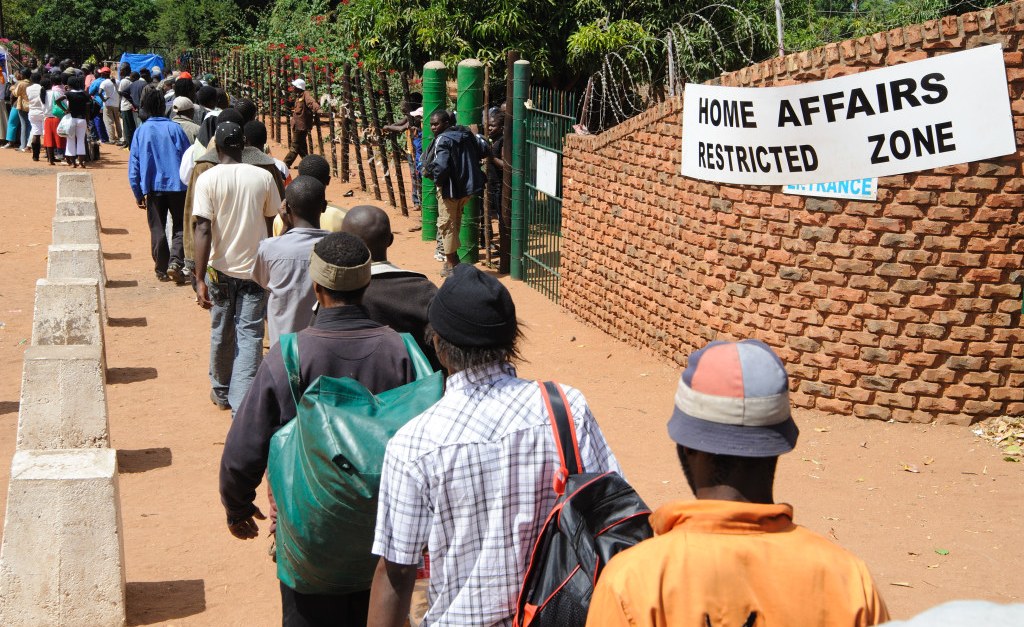
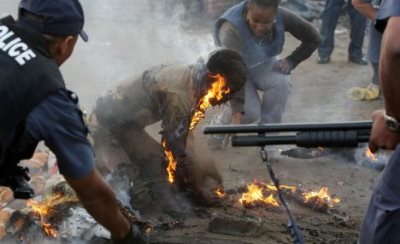
Zimbabweans don’t want to be here. South Africans don’t get that. We have voted and voted against the ruling party (and Mugabe) and each time we had the opportunity to be rid of those murderers guess who came to their rescue? Mbeki, ANC, Zuma, SADC.
While I am not wholesale blaming SA for Zim’s problems the country is complicit in keeping us in the shackles of the ANC’s “liberation friends”.
We are treated like cow dung here and live transitory lives where we cannot establish any meaningful sense of a long term view which makes being in SA the very last option.
I, myself, am a Zimbabwean… been here since 2004 working my black bottom off as a software engineer contributing to the tax that pays 11 million South African free loaders monthly in grants… or free cash.
This idea that Zimbabweans are freeloaders is perpetuated by those who wish for xenophobia to reign. The bulk of Zimbabweans are here are the very same ones you see in restaurants working double shifts and making South Africa look good to tourists with their friendly, easy-going, nature. The jobs they “steal” are there for the taking but South africans don’t want them because they are beneath them. This is not fiction.
Right now, looking at how much I pay in taxes and doing a quick calculation, I am looking after at least 15 South African grant recipients each month…. but if I want a house,
a). I can’t get an RDP house,
b). if i qualify for a bond I must pay 50% upfront… what’s 50% of R1.5million again?
c). if I buy a car… for which I must pay a hefty deposit I must get comprehensive cover for it for which… while a South African may pay R400/month… I invariably get to pay R1000-R2000!
d). Because I don’t have an ID I pay more, and in full for getting my kids educated.
e). I pay for all my medical care… nothing’s free.
I’m not unique in the above… most of us foreigners live this life. SA is a hostile, violent, place that, had we a choice, we’d only read about back home… but here we are.
If white South Africans accuse us of being parasites, I totally understand; you probably think since the local blacks are bunch of lazy entitled whiners the rest of us are the same. If you are black, you are grossly misguided and need to travel to at least 2 SADC countries to see how your black brothers’ work ethic lends them well towards being constructive members of society.
Zimbabawe’s President Robert Mugabe on Monday used his farewell speech, as outgoing chairperson of the Southern African Development Community (SADC), to rant against white liberals.
He used the podium at the opening of the annual SADC summit here on Monday, to take another stab at South Africa’s “non-racial” white population.
Speaking at the International Convention Centre in Gabarone, Mugabe recalled how Botswana helped him travel to the founding summit of the Organisation of African Unity (OAU), now the African Union, in Ethiopia in 1963.
Mugabe, who was handing over the SADC chairpersonship to Khama, even elicited a smile from his usually stern-looking successor, when he recalled the history of his father, Seretse Khama, the first president of Botswana.
Relations between Mugabe and Khama have been strained by the latter’s occasional criticism of developments in the neighbouring country. He was the only SADC leader to question the credibility of Zimbabwe’s 2013 elections which Mugabe and his Zanu-PF won outright, ending the four-year-old dysfunctional unity government between Zanu PF and the two Movement for Democratic Change (MDC) parties.
Mugabe said Seretse Khama, together with Tanzania’s Julius Nyerere, Zambia’s Kenneth Kaunda, Mozambique’s Samora Machel, were some of the founders of the so-called “Frontline States”, the countries, now in SADC, which led the fight against apartheid and colonialism in the 1970s and 1980s.
“Many founders are now dearly departed, but I am glad that Seretse Khama, the father, could see Zimbabwe become independent,” he said.
Mugabe recalled how Khama senior lost his chieftainship because “like all young men, he fell in love”. His “sin”, however, was that it was with a white woman (Englishwoman Ruth Williams), which meant apartheid South Africa exerted pressure on Botswana.
Mugabe said things had changed for the better now, thanks to those who had fought for freedom.
“Look at us now. Look at South Africa. I think they were the most vehement, the whites there, against the marriage. But today it is as if, oh oh, they always were non-racial,” he said in a mock English accent to laughter from the audience.
“Nonsense. Don’t accept that. You see their treacherous behaviour. But I don’t say revenge, no.
“We are a free people, a free people, a loving people, humanitarian. Full of joy, the Africans are, laughing and dancing all the time. But let them not play the fool with us, then the devil in us will emerge.”
In his speech accepting the chairpersonship, Khama joked that over the last year when he was deputy SADC chair, the people in Botswana referred to him as “Mugabe’s deputy”.
He thanked Mugabe for his tenure and praised him for seeing that the region’s industrialisation strategy was adopted under his tenure – at a SADC summit in Harare in April.
The industrialisation strategy is expected to dominate talks at the summit about development in SADC, which reportedly has to find $500-million (R 6,4-billion) over the next five years to implement it.
Mauritius appointed Ameenah Firdaus Gurib-Fakim as its first woman president on Thursday after her predecessor stepped down from the the ceremonial position last week.
“It is the first time in the history of Mauritius that a woman has acceded to this post,” parliament speaker Santi Bai Hanoomanjee said after lawmakers approved Prime Minister Anerood Jugnauth’s motion proposing Gurib-Fakim.
Jugnauth’s ruling coalition said during last December’s electoral campaign it would nominate Gurib-Fakim (55) a chemistry professor.
“I take it with humility. I feel there is a consensus among members of parliament and also among the population,” she was quoted as saying in L’Express, the leading daily on the Indian Ocean island.
Rajkeswar Purryag stepped down on May 29, saying he had agreed with Jugnauth to resign in May.
Zimbabwean President Robert Mugabe laid the blame for xenophobic violence in South Africa on whites, because he said they still owned most of the land and had most of the opportunities.
“It is a matter of the whites keeping things to themselves and the political dispensation brought in by Mandela, (that) did not address the question of disparities between whites and blacks, and this is what must be addressed,” he said at a press conference after visiting the headquarters of the Southern African Development Community (SADC) secretariat here. Mugabe is the current chairperson of SADC.
Mugabe said he was satisfied with the South African government’s response to the attacks. But he added that unemployment in South Africa and white dominance of land ownership made the xenophobic attacks understandable.
“Most of the land is in the hands of the whites who are in a minority…They are not talking in their country of whites being unemployed. It is blacks who are unemployed, this is what they must address first and foremost,” said Mugabe, calling for a second liberation to redress these inequalities.
South Africa should be helped to overcome the problem that former oppressors were still occupying the old positions and the advantages that they allocated to themselves during colonialism.
Countries like Zimbabwe had overcome oppression and inequalities of land ownership.
“But if you go to SA it is a different story, we need to help them, they need another liberation,” he said.
Mugabe and SADC executive secretary Stergomena Tax, dismissed suggestions that his reception in Botswana was inadequate. Some local media put this down to the chilly relations between Mugabe and Botswana President Ian Khama, the deputy chairperson of SADC, who has in the past criticised the lack of democracy in Zimbabwe and differed from SADC when it declared the 2013 elections free and fair.
But Mugabe said he had not come on a state visit and so did not expect to be welcomed with much formal ceremony. He did have a private meeting with Khama over lunch and said relations between the two were friendly and that it was journalists who had created the idea that they were not friendly.
And he shrugged off Botswana’s opinion of the Zimbabwe elections, saying perhaps Botswana had seen certain incidents that others had not seen.
Mugabe had a dig at South Africa’s economic dominance of the region, and suggested Khama shared his view.
“Right now some of us are complaining about the bigness of SA, a giant establishing itself. That is what we discussed at the meeting, that if we are trying to establish our industries they are blocked.”
“For example, pharmaceuticals. We produce some drugs, and they are in demand. We want to send them to SA then those officials in trade say we will only receive them if they come by air. We say no it is much more costly to send them to SA by air, we have planes, yes, but the planes are expensive, we can send them by road, they say no. You see, that is contrary to our free trade principles, there are lots of things we still have to discuss amongst us.”
He also noted that there was a one-way trade of South African beer into other SADC countries.
Lesotho’s opposition leader has fled the country for the second time in a year, claiming that he was at risk of assassination after being voted out of power.
Thomas Thabane, the former prime minister, travelled to Botswana on Tuesday night in the latest twist to a year of political turmoil for the mountainous country that is entirely surrounded by South Africa.
“I ordered an investigation which confirmed that there were indeed plans to kill me,” he told AFP by telephone.
“Soon after I was given this report, I fled the country fearing for my life. I am still in Botswana.”
The Lesotho police said they could not confirm the threat against Thabane, but that they would investigate.
Thabane suspended parliament in June last year to avoid a motion that would have seen him ousted from power after the previous fragile coalition government fell apart.
In August, soldiers attacked police headquarters, looting weapons and killing one officer.
Thabane described the violence as an opposition-backed coup attempt and fled to South Africa, though both his political opponents and the military denied any bid to seize power.
A regionally-brokered snap election in February brought a new coalition government to power, headed by Thabane’s predecessor, Pakalitha Mosisili.
Lesotho is seen as strategically important to South Africa as it provides 90 percent of the water to Johannesburg city.
Other African nations should stop their citizens from migrating to South Africa to prevent violence against foreigners, Zimbabwean President Robert Mugabe on Wednesday
A wave of anti-immigrant violence in South Africa has claimed seven lives in Durban and Johannesburg over the past four weeks. The South African government has deployed troops to stop the fighting.
After a summit of the Southern African Development Community (SADC) called to discuss industrialisation in southern Africa, Mugabe told reporters that South African President Jacob Zuma had briefed regional leaders on the violence.
Zuma told the meeting that his government would educate its citizens to be tolerant of foreigners and would keep its security forces on alert to prevent future attacks.
“I was suggesting that we, the neighbours, must do what we can to prevent more people going into South Africa. If we can do it, we can then try to get those in South Africa home,” said Mugabe, the current SADC chairman.
“So people should get back to their own countries. It’s not just one for South Africa to resolve but for us, we the neighbouring countries, to resolve. Our people should not have the instinct of rushing into South Africa.”
An estimated one million Zimbabweans live in South Africa, after fleeing economic crisis and political violence at home over the last 15 years.
Mugabe said his government had brought 800 of its citizens back from Durban, but most of them had indicated they planned to return to South Africa, Zimbabwe’s biggest trading partner.
“The people who are described as influx into South Africa are not pushed by governments,” said Mugabe, who has ruled the former British colony since independence in 1980.
“They are people who voluntarily go to South Africa. They think South Africa is the heaven, our heaven in southern Africa.”
Periodic outbreaks of anti-immigrant violence have been blamed on high unemployment in South Africa. The official jobless rate is around 25 percent although economists say is much higher.
Mugabe concurred, saying the living standards of black South Africans were low and that the migrants “who think there is heaven in South Africa and decide to go to South Africa, they make the situation of the Africans there worse.”
The Democratic Forces for the Liberation of Rwanda (FDLR) have missed the deadline set by the Southern African Development Community to voluntarily disarm themselves, it said on Saturday.
In spite of the presence of 20,000 UN peacekeepers, around 50 Congolese and foreign armed groups are still active in the region.
SADC chairman President Jacob Zuma urged the FDLR to come forward and disarm themselves unconditionally.
“The deadline set by the heads of state and government of SADC… for the FDLR to disarm voluntarily or face military action expired yesterday, 2 January 2015,” Zuma said in a statement.
A joint summit by the SADC heads of states would be held in Luanda, Angola to decide on measures to be taken.
“SADC remains committed to the internationally mandated objective of neutralising all negative forces operating in the Democratic Republic of the Congo, including the FDLR, and remains ready to play its fullest part in this regard,” Zuma said.
The east of the DRC has been a conflict area for two decades, French news agency Agence France-Presse reported last month.
Two major wars between 1996 and 2003, were fought with neighbouring countries including Uganda and Rwanda intervening directly or using militias to do their bidding.
Lesotho’s prime minister has asked southern African states to send peacekeepers into his mountain kingdom to restore order after an apparent coup over the weekend, his aide said on Monday.
Thomas Thabane fled to South Africa, whose territory surrounds Lesotho, early on Saturday, hours before the army surrounded his residence and overran police stations in the capital, Maseru, in what the prime minister called a coup.
Lesotho’s army said it had not tried to oust Thabane but had moved against police suspected of planning to arm a political faction. One policeman was shot dead and four others wounded.
The unrest stems from a power struggle between Thabane, who is supported by the police, and Deputy Prime Minister Mothetjoa Metsing, who has the loyalty of the army, diplomats said.
Tension has risen since Thabane, who has accused Metsing of orchestrating the coup, suspended parliament in June amid feuding in the two-year-old governing coalition.
The Southern African Development Community (SADC) defence and security troika, which includes foreign ministers from South Africa, Namibia and Zimbabwe, met through the night with Thabane and Metsing to try to find a peaceful settlement to the crisis.
Thabane asked the SADC, a co-operative group of 15 southern African states, for military support, said officials.
“On top of the table was a need for intervention based on the situation. We called on the SADC peace force to intervene,” said Thabane’s aide, Samonyane Ntsekele.
On Monday, Thabane and Metsing met South African President Jacob Zuma, who chairs SADC’s defence and security body, with the regional group agreeing to send a facilitator to help resolve the crisis.
“SADC further agreed to deploy an observer team on politics, defence and security as a matter of urgency,” a statement issued after the meeting in South Africa’s capital, Pretoria, said.
Thabane was now on his way back to Lesotho, Ntsekele said.
In Maseru, the atmosphere was quiet but tense on Monday. The police commissioner said soldiers had carried out further raids on police installations and even officers’ homes, taking away weapons and uniforms.
Commissioner Khothatso Ts’ooana told Public Choice FM radio station that this meant police would not be able to carry out their normal duties. Police stations were deserted and some officers had fled over the border into South Africa.
In Washington, the US State Department said in a statement it was “deeply concerned by uncertainty over the political process and the state of public security” in Lesotho’s capital. It has ordered non-employed family members of US mission personnel out of the country.
The SADC summit in Malawi has called on the international community to lift sanctions against Zimbabwe. The regional summit in Lilongwe says the July 31 elections in Zimbabwe were free and peaceful. SADC Chair Joyce Banda has commended Zimbabwe for what she says were free and peaceful elections and urged the United States and European Union to ease restrictions against Harare.
The SADC has welcomed the election process in Zimbabwe. After a two day summit the regional body also called on all stake holders to continue working together.
” We urge all stake holders to continue to work together and that the sanctions must be lifted. Zimbabweans have suffered enough,” said SADC Chair Joyce Banda.
The summit commended president Jacob Zuma for his role in Zimbabwe and his mediation efforts that led to the country’s elections. In turn President Zuma said South Africa has carried out its mandate to the full.
Zimbabwe was elected as the next host of the regional body summit to be held in August next year. – SABC
Southern African leaders opened an annual summit Saturday endorsing disputed elections in Zimbabwe that extended President Robert Mugabe’s 33-year rule by another five years.
“Congratulations to comrade Robert Mugabe for conducting peaceful elections,” said the incoming head of the Southern African Development Community (SADC), President Joyce Banda of Malawi.
“We wish to offer you continued support as a member of the family,” Banda said, to wild cheers from the audience at the start of the 15-nation summit.
A smiling Mugabe acknowledged the endorsement with his traditional clenched-fist salute.
Zimbabwean opposition leader Morgan Tsvangirai’s MDC party said Friday he had withdrawn a legal challenge to the elections, claiming the courts would not be fair.
This removed the last hurdle to 89-year-old leader Mugabe’s inauguration for a seventh term.
The SADC’s observer mission for the July 31 elections judged the vote was free, but have not yet commented on its fairness.
The SADC will publish its report on Zimbabwe’s polls during this weekend’s summit, according to South African President Jacob Zuma.
Banda took over the rotational one-year chairmanship of the SADC from Mozambican leader Armando Guebuza, becoming the first woman to head the bloc since its inception 33 years ago.
The two-day summit is expected to be dominated by the political stand-off in Madagascar and the conflict in eastern Democratic Republic of Congo, according to a Malawian official.
Madagascar has been suspended from the regional grouping since strongman Andry Rajoelina toppled Marc Ravalomanana in 2009.
The SADC has been pushing the rivals to follow through on a roadmap meant to steer the island nation toward elections, which Banda hinted could be due this year.
The vote has repeatedly been put on hold amid controversy over the candidacies of the three front-runners, including Rajoelina.
Regional mediators have called for Rajoelina, Ravalomanana’s wife Lalao and former leader Didier Ratsiraka to stand aside, but all three have refused.
In the DR Congo, a quarter-million people have fled their homes since last year when a rebel group calling itself the M23 took up arms against government troops in the mineral-rich but chronically unstable east. – AFP
Cabinet has congratulated the Zimbabwean government for their successful parliamentary and local elections, but would not make any early pronouncements on whether the elections were free and fair.
Zanu-PF’s long standing leader, Robert Mugabe, won the presidential poll with 61% while his party obtained a two-thirds majority in parliamentary elections.
Defeated Movement for Democratic Change (MDC) leader, Morgan Tsvangirai, cried foul and has taken the matter to court.
The Cabinet has commended President Jacob Zuma as the Southern African Development Community (SADC) facilitator on the Zimbabwe dialogue for ensuring that all political parties were committed to peaceful elections.
However, Agriculture, Forestry and Fisheries Minister Tina Joemat was cautious in stating that the Cabinet is not commenting on the state of elections before the next SADC meeting.
Botswana, a SADC member, has expressed doubts about the fairness of the elections.
She was speaking during the post Cabinet briefing in Pretoria.
“We’re in no way making a pronouncement on the elections, we’re congratulating them that the elections ran smoothly without violence and without incidents of severe violence”.
International unease mounted Sunday over the re-election of Africa’s oldest leader Robert Mugabe in polls denounced by Zimbabwe’s opposition as “stolen”.
Mugabe, 89, in power since 1980, trounced his long-standing rival Morgan Tsvangirai in Wednesday’s polls with 61 percent of the presidential vote while his party swept to a crushing parliamentary majority.
But 61-year-old Tsvangirai, leader of the Movement for Democratic Change (MDC) who has unsuccessfully tried to unseat Mugabe three times, condemned the vote as “fraudulent and stolen” and has vowed to challenge it.
Western powers, barred from sending full observer teams, voiced serious doubts about the polls following concerns over irregularities.
On Sunday, Germany said the election “casts a big shadow on the political and economic future of Zimbabwe”, while Australia called for new polls.
“Given our doubts about the results, Australia calls for a re-run of the elections based on a verified and agreed voters roll,” Foreign Minister Bob Carr said in a statement.
US Secretary of State John Kerry had Saturday described the election as “deeply flawed” and said Washington “does not believe that the results …today represent a credible expression of the will of the Zimbabwean people.”
British Foreign Secretary William Hague added his own “grave concerns” over the conduct of the vote in the former colony.
African and local observers raised concerns over the voters roll, the printing of extra ballot papers, and the turning away of voters at polling stations.
But with gentler assessments from the continent despite noting the flaws, President Jacob Zuma of powerful neighbour South Africa offered his “profound congratulations” to Mugabe on Sunday.
“President Zuma urges all political parties in Zimbabwe to accept the outcome of the elections as election observers reported it to be an expression of the will of the people,” a foreign ministry statement said.
The reaction in Zimbabwe’s Sunday press was starkly divided, with state-controlled newspaper The Herald proclaiming “President Mugabe romps to victory”, while the independent Daily News headlined, “It’s a Crisis”.
The vote marks the end of Mugabe and Tsvangirai’s tense compromise government, forced by bloodstained 2008 polls, that helped steer the isolated nation out of a protracted crisis.
In Harare’s oldest township Mbare on Sunday, several hundred Mugabe supporters carried a white coffin draped in an MDC flag, with a red knotted scarf placed on top with the inscription “RIP Morgan”.
“People are elated,” said one of the marchers, Tatenda Savanhu, 26, an economist.
“It’s really a moment of joy that the GNU (coalition government) is now gone that we are going into an era of ZANU-PF”.
— Finding a smoking gun may prove difficult —
Tsvangirai vowed to challenge the result in court and said the MDC would boycott government institutions.
“The fraudulent and stolen election has plunged Zimbabwe into a constitutional, political and economic crisis.”
Tsvangirai defended his 2008 decision to enter the uneasy pact with Mugabe, who has had him arrested, beaten and charged with treason, saying it had “rescued” Zimbabwe after years of meltdown.
But Mugabe’s ZANU-PF party says there is no need for the MDC in the new government.
“We have received over 60 percent of the vote, we have two-thirds majority, why would we want to bring someone else on board?” State Security Minister Sydney Sekeramayi told AFP.
The MDC now has until Saturday to present evidence of fraud to the constitutional court, but finding a smoking gun may prove difficult. The inauguration is expected within 48 hours of the court’s decision.
Tsvangirai said he would submit a dossier of “all irregularities and all the illegalities” to the influential 15-member Southern African Development Community (SADC) and called for an urgent summit.
The European Union, which had been moving toward easing long-standing sanctions, has also expressed concern.
But Emmerson Mnangagwa, defence minister and a key Mugabe lieutenant, argued that the result was a game-changer.
“The West will now have to climb down, they must find a ladder and climb down… A democratic election has taken place in Zimbabwe,” he told AFP.
The SADC, which engineered the power-sharing government, said the vote was “free and peaceful”.
But top SADC election observer Bernard Membe noted: “We did not say it was fair … we didn’t want to jump to a conclusion.”
The poll’s credibility was further tarnished by the resignation of one of the nine official electoral commissioners over “the manner” in which the polls “were proclaimed and conducted”.
But Harare based political analyst Blessing Vava said Western concerns meant little with African guarantors having given the polls the nod.
“The issue of Zimbabwe is over and done with,” Vava said.
The criticism will also be of little concern to Mugabe, he said.
“He will not care much with what the West will say, this is the reason why they were not invited to observe elections in the first place.” – AFP
Vote counting was underway in Zimbabwe’s tightly fought election Wednesday, amid high turnout and accusations of rigging by President Robert Mugabe’s allies who wish to extend his 33-year rule.
The 89-year-old Mugabe is Africa’s oldest leader and is running for office for the seventh and perhaps final time.
His rival Morgan Tsvangirai hopes the election will usher in a new era for the troubled southern African nation.
Organisers reported high turnout across the country for the first election since the violent polls of 2008, that led to an uneasy power-sharing government between the two men.
There were no reports of widespread violence this time round, despite the fierce rhetoric of the campaign.
Police said officers in Harare fired warning shots in the air and arrested 10 soldiers who tried to jump the queue to vote.
At many stations voters started queueing before sunrise in the winter cold hours before polls opened. The lines continued well into the evening, with many marking their ballots by candle light.
Mugabe voted before lunchtime in a Harare suburb, where he insisted the poll would reflect the will of the people.
“I am sure people will vote freely and fairly, there is no pressure being exerted on anyone,” he said.
The one-time teacher came to prominence as a hero of Africa’s liberation movement, guiding Zimbabwe to independence from Britain and white minority rule.
But his military-backed rule has been marked by a series of violent crackdowns, economic crises and suspect elections that have brought international sanctions and made him a pariah in the West.
On Tuesday Mugabe vowed to step down if Tsvangirai was the victor. “If you lose you must surrender,” he said.
Tsvangirai, the current prime minister, said that promise should be taken “with a pinch of salt”.
Tsvangirai won the first round of voting in 2008, but was forced out of the race after 200 of his supporters were killed and thousands more injured in suspected state-backed attacks.
But the 61-year-old former union boss has repeatedly voiced concerns that the election is being rigged.
Tsvangirai’s party on Wednesday listed a battery of alleged irregularities.
Finance Minister Tendai Biti, a senior member of Tsvangirai’s Movement for Democratic Change, said the names of thousands of voters were missing from the electoral roll.
Biti, speaking after a meeting with the electoral commission, added: “They are admitting that there’s still two million people who are dead on the voters’ roll, but they said ‘because they’re dead, they can’t vote’.”
The MDC has handed its evidence to observers from the Southern African Development Community (SADC).
Since no Western groups were allowed to cover the presidential and parliamentary poll, the SADC’s account will be closely watched.
The African Union, which has been accused of whitewashing problems in the run up to the vote, said initial reports indicated it was “peaceful, orderly, free and fair”.
In Washington, US State Department spokeswoman Marie Harf also said that early signs indicated a “peaceful environment” — but that it was too soon to say if the election had been fair.
“We’ve made clear to the government of Zimbabwe and the region that further reductions in our sanctions will only occur if these next elections are credible, transparent and reflect the will of the Zimbabwean people,” she told reporters.
Tsvangirai cut a confident figure as he cast his own ballot, predicting his MDC would win “quite resoundingly”.
“This is a very historic moment for all of us,” he said. It is the time to “complete the change”.
Turnout appeared to be particularly brisk in the urban areas where Tsvangirai has enjoyed his strongest support, and which he must retain to stand any chance of victory.
But some analysts cautioned against interpreting the high urban turnout as a sign Tsvangirai would sweep the election.
“This election is going to be decided in the rural areas,” where two thirds of Zimbabweans live and where Mugabe enjoys strong support, said Michael Bratton, founder of polling organisation Afrobarometer.
Police warned on Wednesday that anyone trying to release unofficial results ahead of the official figures risked being arrested.
Already Sunday, Mugabe had threatened to arrest Tsvangirai if he tried to declare an early victory.
Some 6.4 million people, around half of the population, are eligible to vote. A candidate needs 50 percent of the vote to avoid a run-off.
The sharp-tongued Mugabe has focused his campaign on attacking homosexuals and on promises to widen the redistribution of wealth to poor black Zimbabweans.
As the economy recovers from a crisis that saw mass unemployment and galloping inflation, Mugabe loyalists insist their hero is “tried and tested”.
Tsvangirai hopes his plans to lure back foreign investors, create a million jobs in five years and improve public services will deliver a long-awaited victory.
The final results are expected within five days. – AFP
This website uses cookies to improve your experience. We'll assume you're ok with this, but you can opt-out if you wish. Cookie settingsACCEPT
Privacy & Cookies Policy
Privacy Overview
This website uses cookies to improve your experience while you navigate through the website. Out of these cookies, the cookies that are categorized as necessary are stored on your browser as they are essential for the working of basic functionalities of the website. We also use third-party cookies that help us analyze and understand how you use this website. These cookies will be stored in your browser only with your consent. You also have the option to opt-out of these cookies. But opting out of some of these cookies may have an effect on your browsing experience.
Necessary cookies are absolutely essential for the website to function properly. This category only includes cookies that ensures basic functionalities and security features of the website. These cookies do not store any personal information.
Any cookies that may not be particularly necessary for the website to function and is used specifically to collect user personal data via analytics, ads, other embedded contents are termed as non-necessary cookies. It is mandatory to procure user consent prior to running these cookies on your website.