Mugabe rants againts white ‘non-racial’ liberals

Zimbabawe’s President Robert Mugabe on Monday used his farewell speech, as outgoing chairperson of the Southern African Development Community (SADC), to rant against white liberals.

He used the podium at the opening of the annual SADC summit here on Monday, to take another stab at South Africa’s “non-racial” white population.

Speaking at the International Convention Centre in Gabarone, Mugabe recalled how Botswana helped him travel to the founding summit of the Organisation of African Unity (OAU), now the African Union, in Ethiopia in 1963.

Mugabe, who was handing over the SADC chairpersonship to Khama, even elicited a smile from his usually stern-looking successor, when he recalled the history of his father, Seretse Khama, the first president of Botswana.

Relations between Mugabe and Khama have been strained by the latter’s occasional criticism of developments in the neighbouring country. He was the only SADC leader to question the credibility of Zimbabwe’s 2013 elections which Mugabe and his Zanu-PF won outright, ending the four-year-old dysfunctional unity government between Zanu PF and the two Movement for Democratic Change (MDC) parties.

Mugabe said Seretse Khama, together with Tanzania’s Julius Nyerere, Zambia’s Kenneth Kaunda, Mozambique’s Samora Machel, were some of the founders of the so-called “Frontline States”, the countries, now in SADC, which led the fight against apartheid and colonialism in the 1970s and 1980s.

“Many founders are now dearly departed, but I am glad that Seretse Khama, the father, could see Zimbabwe become independent,” he said.

Mugabe recalled how Khama senior lost his chieftainship because “like all young men, he fell in love”. His “sin”, however, was that it was with a white woman (Englishwoman Ruth Williams), which meant apartheid South Africa exerted pressure on Botswana.

Mugabe said things had changed for the better now, thanks to those who had fought for freedom.

“Look at us now. Look at South Africa. I think they were the most vehement, the whites there, against the marriage. But today it is as if, oh oh, they always were non-racial,” he said in a mock English accent to laughter from the audience.

“Nonsense. Don’t accept that. You see their treacherous behaviour. But I don’t say revenge, no.

“We are a free people, a free people, a loving people, humanitarian. Full of joy, the Africans are, laughing and dancing all the time. But let them not play the fool with us, then the devil in us will emerge.”

In his speech accepting the chairpersonship, Khama joked that over the last year when he was deputy SADC chair, the people in Botswana referred to him as “Mugabe’s deputy”.

He thanked Mugabe for his tenure and praised him for seeing that the region’s industrialisation strategy was adopted under his tenure – at a SADC summit in Harare in April.

The industrialisation strategy is expected to dominate talks at the summit about development in SADC, which reportedly has to find $500-million (R 6,4-billion) over the next five years to implement it.

SADC’s annual budget is about US$80 million.

Source: ANA
Mugabe blames xenophobic violence on whites

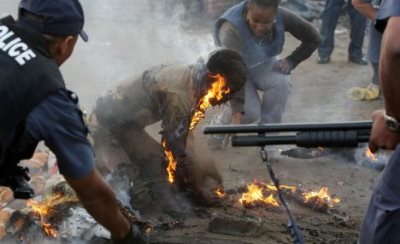
Zimbabwean President Robert Mugabe laid the blame for xenophobic violence in South Africa on whites, because he said they still owned most of the land and had most of the opportunities.

“It is a matter of the whites keeping things to themselves and the political dispensation brought in by Mandela, (that) did not address the question of disparities between whites and blacks, and this is what must be addressed,” he said at a press conference after visiting the headquarters of the Southern African Development Community (SADC) secretariat here. Mugabe is the current chairperson of SADC.

Mugabe said he was satisfied with the South African government’s response to the attacks. But he added that unemployment in South Africa and white dominance of land ownership made the xenophobic attacks understandable.

“Most of the land is in the hands of the whites who are in a minority…They are not talking in their country of whites being unemployed. It is blacks who are unemployed, this is what they must address first and foremost,” said Mugabe, calling for a second liberation to redress these inequalities.

South Africa should be helped to overcome the problem that former oppressors were still occupying the old positions and the advantages that they allocated to themselves during colonialism.

Countries like Zimbabwe had overcome oppression and inequalities of land ownership.

“But if you go to SA it is a different story, we need to help them, they need another liberation,” he said.

Mugabe and SADC executive secretary Stergomena Tax, dismissed suggestions that his reception in Botswana was inadequate. Some local media put this down to the chilly relations between Mugabe and Botswana President Ian Khama, the deputy chairperson of SADC, who has in the past criticised the lack of democracy in Zimbabwe and differed from SADC when it declared the 2013 elections free and fair.

But Mugabe said he had not come on a state visit and so did not expect to be welcomed with much formal ceremony. He did have a private meeting with Khama over lunch and said relations between the two were friendly and that it was journalists who had created the idea that they were not friendly.

And he shrugged off Botswana’s opinion of the Zimbabwe elections, saying perhaps Botswana had seen certain incidents that others had not seen.

Mugabe had a dig at South Africa’s economic dominance of the region, and suggested Khama shared his view.

“Right now some of us are complaining about the bigness of SA, a giant establishing itself. That is what we discussed at the meeting, that if we are trying to establish our industries they are blocked.”

“For example, pharmaceuticals. We produce some drugs, and they are in demand. We want to send them to SA then those officials in trade say we will only receive them if they come by air. We say no it is much more costly to send them to SA by air, we have planes, yes, but the planes are expensive, we can send them by road, they say no. You see, that is contrary to our free trade principles, there are lots of things we still have to discuss amongst us.”

He also noted that there was a one-way trade of South African beer into other SADC countries.

Source: ANA

Khama’s attempt to appoint brother as deputy fails

President Ian Khama’s bid to appoint his brother, Tshekedi Khama, as deputy-president has been thwarted as Botswana’s government says it will accept a court ruling to counter the move.

Khama, re-elected for a second term last month, wanted lawmakers to vote by a show of hands for his deputy, instead of through a secret ballot.

A show of hands would have exposed any who opposed his choice.

Khama had faced a backlash from within his own party over the prospect of Tshekedi as deputy-president, with parliamentarians accusing the president of trying to create a dynasty.

Botswana’s High Court on Friday that deemed only a secret parliamentary ballot constitutional. “A secret ballot is a hallmark of a free and fair election within our representative democracy,” said Justice Michael Leburu in the Gaborone High Court.

The executive issued a statement late on Tuesday, saying: “Government accepts that the matter has been resolved and wishes to assure the public that it will respect and fully implement the decision of the court.”

Opposition party lawyers say that the same voting process had been in place unchallenged for years, and was used to endorse Khama as deputy-president in 1999 and 2004.

Botswana went to the polls last month in elections that saw the BDP winning with less than 50% of the vote for the first time since it came to power in 1966.

Though the country is routinely held up as a paragon of good governance on the continent, its ruling party has been criticised recently for attempts to stifle dissent.

Botswana president wins second term

Botswana President Ian Khama yesterday saw off the biggest challenge posed by the opposition since independence, winning a second term in power as his ruling party secured a majority at the polls.

His Botswana Democratic Party won at least 34 of the 57 parliamentary seats, AFP reported.

With counting continuing for seven seats, it was unclear if the ruling party would match its previous tally of 41 seats.

An opposition coalition called the Umbrella for Democratic Change won 14 seats, while another opposition group, the Botswana Congress Party, secured two.

Khama, 61, the son of the country’s first president, Seretse Khama, will be inaugurated today.

Friday’s general elections had been billed as the most challenging for the ruling party since Botswana gained independence from Britain in 1966.

Opposition parties had made inroads in urban areas after the formation of a breakaway party, the Botswana Movement for Democracy, in 2010. It is now part of Umbrella for Democratic Change, led by Duma Boko, which won seats in districts that were once strongholds of the ruling party, including in the capital, Gaborone.

“The UDC did well for a new party ,” said party representative Seakamela Motsoaledi.