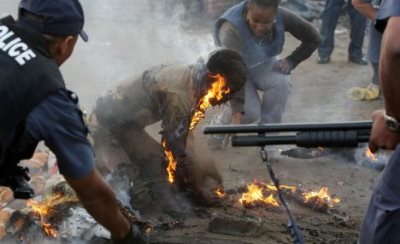
Mugabe blames xenophobic violence on whites

Zimbabwean President Robert Mugabe laid the blame for xenophobic violence in South Africa on whites, because he said they still owned most of the land and had most of the opportunities.

“It is a matter of the whites keeping things to themselves and the political dispensation brought in by Mandela, (that) did not address the question of disparities between whites and blacks, and this is what must be addressed,” he said at a press conference after visiting the headquarters of the Southern African Development Community (SADC) secretariat here. Mugabe is the current chairperson of SADC.

Mugabe said he was satisfied with the South African government’s response to the attacks. But he added that unemployment in South Africa and white dominance of land ownership made the xenophobic attacks understandable.

“Most of the land is in the hands of the whites who are in a minority…They are not talking in their country of whites being unemployed. It is blacks who are unemployed, this is what they must address first and foremost,” said Mugabe, calling for a second liberation to redress these inequalities.

South Africa should be helped to overcome the problem that former oppressors were still occupying the old positions and the advantages that they allocated to themselves during colonialism.

Countries like Zimbabwe had overcome oppression and inequalities of land ownership.

“But if you go to SA it is a different story, we need to help them, they need another liberation,” he said.

Mugabe and SADC executive secretary Stergomena Tax, dismissed suggestions that his reception in Botswana was inadequate. Some local media put this down to the chilly relations between Mugabe and Botswana President Ian Khama, the deputy chairperson of SADC, who has in the past criticised the lack of democracy in Zimbabwe and differed from SADC when it declared the 2013 elections free and fair.

But Mugabe said he had not come on a state visit and so did not expect to be welcomed with much formal ceremony. He did have a private meeting with Khama over lunch and said relations between the two were friendly and that it was journalists who had created the idea that they were not friendly.

And he shrugged off Botswana’s opinion of the Zimbabwe elections, saying perhaps Botswana had seen certain incidents that others had not seen.

Mugabe had a dig at South Africa’s economic dominance of the region, and suggested Khama shared his view.

“Right now some of us are complaining about the bigness of SA, a giant establishing itself. That is what we discussed at the meeting, that if we are trying to establish our industries they are blocked.”

“For example, pharmaceuticals. We produce some drugs, and they are in demand. We want to send them to SA then those officials in trade say we will only receive them if they come by air. We say no it is much more costly to send them to SA by air, we have planes, yes, but the planes are expensive, we can send them by road, they say no. You see, that is contrary to our free trade principles, there are lots of things we still have to discuss amongst us.”

He also noted that there was a one-way trade of South African beer into other SADC countries.

Source: ANA

Diepsloot calm yesterday after reports of xenophobic violence

Diepsloot
Diepsloot, a black township north of Johannesburg.

The situation in Diepsloot, north of Johannesburg was calm on Saturday following reports of shop lootings and public violence during the last week, police said.

“It has been quiet, there were no incidents reported,” said Lt-Col Lungelo Dlamini said.

On Monday police arrested 45 people for public violence, housebreaking, and possession of unlicensed firearms.

The unrest started on Sunday evening after Somali businessman, Bishar Isaack, was arrested for allegedly shooting dead two men, believed to be Zimbabweans, outside his shop.

Issack appeared in the Pretoria Magistrate’s Court on Tuesday.

Dlamini said Isaack, 39, appeared on charges of murder.

The case was postponed to June 4, when he was expected to bring a formal bail application.

After the shooting on Sunday, local residents gathered in front of Isaack’s shop, threw stones, and looted his business.

Police dispersed the crowd, but other shops were then looted. Several local businessmen then removed their goods and locked their shops.

Nine people were arrested for public violence and possession of suspected stolen goods. They appeared in the Pretoria Magistrate’s Court on Tuesday and the case was withdrawn, Dlamini said.

In the Vaal, police received around 100 complaints about looting at both local and foreign-owned shops, following service delivery protests last week.

On Tuesday, political parties bemoaned the violence.

The African National Congress said the attacks had tarnished the country’s image.

“South Africa is a country of integrity and honour internationally, but the recent attacks on our brothers and sisters have put a dent in our image as a peaceful nation,” said ANC Gauteng spokesman Dumisa Ntuli.

The Democratic Alliance said the unrest could be blamed on a lack of employment and poverty.

“As resources become scarcer, so the competition for jobs, housing, and basic services increases. This, in turn, fuels feelings of deprivation on the part of South Africans,” said DA spokesman Mmusi Maimane.

The Inkatha Freedom Party said the attacks were sickening.

“We view the attacks… as sickening and ridiculous, especially when one remembers that 50 years ago all Africans committed themselves to building a new continent of hope, with the concept of ubuntu as a key hallmark,” said IFP Gauteng chairman Nhlanhla Msimango.

Cope spokesman Mluleki George also condemned the violence.

“The attacks are nothing but a cowardly and criminal act which only takes society backwards,” he said.

The SA Communist Party said it was shocked at the violence.

“We call upon our communities, activists and leaders of fraternal and revolutionary movements to intervene decisively in the affected communities, and work in partnership with law enforcement agencies to ensure that these barbaric, extremely backward and inhuman acts are brought to an immediate end,” said SACP spokesman Lucian Segami.

The Gauteng provincial government added its voice to the condemnation.

“These are clear acts of opportunistic crimes on a vulnerable group of Gauteng residents by a minority of hooligans living in our communities,” said premier Nomvula Mokonyane.

“We call upon all our people across the province to refrain from taking part in (the) attacks that we have seen. We must all ensure that a repeat of 2008 does not happen,” she said.

She was referring to a string of xenophobic attacks which erupted in the country five years ago. – Sapa