Who will succeed Mugabe?

Emmerson Mnangagwa
Emmerson Mnangagwa

When Zimbabwe’s veteran President Robert Mugabe suavely hosted journalists at State House on the eve of last month’s election, there was only one question that caught him off guard.

Asked if the presence of Defence Minister Emmerson Mnangagwa by his side meant he was his chosen successor, Mugabe paused awkwardly amid laughter and then replied unconvincingly that Mnangagwa had just dropped by to see him.

Three weeks after Mugabe’s re-election in a disputed vote called a fraud by his main rival but accepted by his African neighbours, there are no doubts Africa’s oldest leader is holding firmly on to the presidency after 33 years in power.

But the question of whether, at 89, he can serve out all of his new five-year term – and who will succeed him if he steps down or dies – would have hung uncomfortably over his re-installation as Zimbabwe’s head of state last Thursday.

It will also be crucial for the future of the nation, which is rich in minerals but still emerging from a decade-long recession brought on by political violence and government-backed land seizures.

Mugabe faces few immediate threats. Rival Morgan Tsvangirai has been stunned by the enormity of his defeat in an election he says was rigged from start to finish; last week he dropped a challenge to Mugabe’s re-election that his Movement for Democratic Change had filed in the Constitutional Court. The court confirmed Mugabe’s win was “free, fair and credible” and had reflected the “will of the people”.

Faced with broad endorsement of the result by regional and continental bodies, Western governments must now decide whether to shun the man they have reviled as a ruthless dictator for years, or attempt a rapprochement in the interests of practical diplomacy.

Mugabe’s non-committal answer on the succession is typical of a wily and inscrutable guerrilla politician who fought a liberation war leading to independence in 1980, crushed a revolt once in power and has outfoxed rivals in and outside his fractious Zanu-PF.

“Mugabe and Tsvangirai have fought their last elections… one way or another. Whether it was stolen or not, this was a historic election that prefigures change,” Stephen Chan, professor of international relations at London’s School of Oriental and African Studies, said.

Adding to Zimbabwe’s uncertain outlook is the perception that another Mugabe term will intensify a succession battle within the ruling party. Zanu-PF has a history of feuds and splits dating back to its bush war against white minority rule in what was then Rhodesia.

Defence Minister Mnangagwa, 66, a guerrilla war veteran and Mugabe’s main security enforcer, is widely seen as a succession contender, along with vice-president Joice Mujuru and State Security Minister Sydney Sekeramayi.

Mnangagwa, earned a hardline reputation as security minister in the 1980s for his role in suppressing rebels in Matabeleland.

Mnangagwa, Mujuru and Sekeramayi have been members of Mugabe’s cabinet since 1980, and played a major role in Zanu-PF’s re-election machine.

During campaigning, Mujuru addressed rallies, Mnangagwa acted as Mugabe’s presidential election agent and Sekeramayi was the ruling party’s point man for the legislative elections in which Zanu-PF was declared the winner.

On the face of it, Mujuru, 58, another liberation war veteran whose nom de guerre was Teurai Ropa (“Spill the Blood”) appears to hold an advantage in the succession stakes because as first party vice-president she acts for Mugabe when he is away.

But under a new constitution adopted earlier this year, Zanu-PF would choose a new president if Mugabe stepped down or were to die before the end of his term. Many fear this could lead to a scramble for power among ambitious aspirants.

This week Mujuru attacked party rivals and presented herself as the moderate leader Zanu-PF needs after Mugabe, local media reported.

“We know that the president will soon be 90 and God might decide to call him … I am best placed to succeed Mugabe if he departs whether by natural wastage or voluntary retirement,” she said.

Far from mellowing his rhetoric, Mugabe has told his post-election critics to “go hang” and promised to increase the pace of “indigenisation” policies forcing foreign-owned firms to sell majority stakes to black Zimbabweans. – Reuters

‘Congratulations to comrade Robert Mugabe’: SADC leaders

Robert Mugabe
Robert Mugabe

Southern African leaders opened an annual summit Saturday endorsing disputed elections in Zimbabwe that extended President Robert Mugabe’s 33-year rule by another five years.

“Congratulations to comrade Robert Mugabe for conducting peaceful elections,” said the incoming head of the Southern African Development Community (SADC), President Joyce Banda of Malawi.

“We wish to offer you continued support as a member of the family,” Banda said, to wild cheers from the audience at the start of the 15-nation summit.

A smiling Mugabe acknowledged the endorsement with his traditional clenched-fist salute.

Zimbabwean opposition leader Morgan Tsvangirai’s MDC party said Friday he had withdrawn a legal challenge to the elections, claiming the courts would not be fair.

This removed the last hurdle to 89-year-old leader Mugabe’s inauguration for a seventh term.

The SADC’s observer mission for the July 31 elections judged the vote was free, but have not yet commented on its fairness.

The SADC will publish its report on Zimbabwe’s polls during this weekend’s summit, according to South African President Jacob Zuma.

Banda took over the rotational one-year chairmanship of the SADC from Mozambican leader Armando Guebuza, becoming the first woman to head the bloc since its inception 33 years ago.

The two-day summit is expected to be dominated by the political stand-off in Madagascar and the conflict in eastern Democratic Republic of Congo, according to a Malawian official.

Madagascar has been suspended from the regional grouping since strongman Andry Rajoelina toppled Marc Ravalomanana in 2009.

The SADC has been pushing the rivals to follow through on a roadmap meant to steer the island nation toward elections, which Banda hinted could be due this year.

The vote has repeatedly been put on hold amid controversy over the candidacies of the three front-runners, including Rajoelina.

Regional mediators have called for Rajoelina, Ravalomanana’s wife Lalao and former leader Didier Ratsiraka to stand aside, but all three have refused.

In the DR Congo, a quarter-million people have fled their homes since last year when a rebel group calling itself the M23 took up arms against government troops in the mineral-rich but chronically unstable east. – AFP

Morgan Tsvangirai finds Zim election ‘not credible’

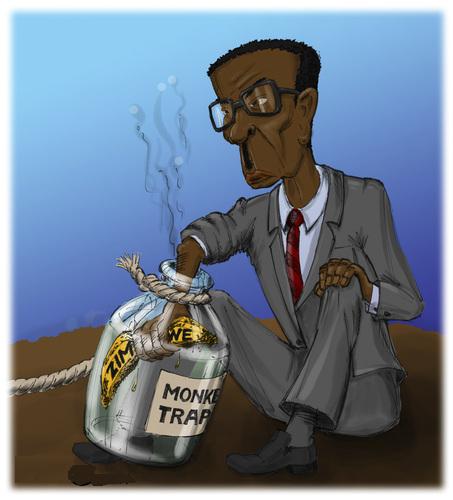
monkeytrapThe “outcome of this election is illegitimate,” Prime Minister Morgan Tsvangirai said Thursday, and “does not reflect the will of the people of Zimbabwe.”

“The shoddy manner in which it has been conducted and the consequent illegitimacy of the result will plunge this country in a crisis,” he said in Harare.

Tsvangirai said he had conveyed his concerns to the African Union and the Southern African Development Community.

“The message we have given is that this is not a credible election.” – sapa

Counting underway in knife-edge Zimbabwe election

Zimbabwe ballot paper

Vote counting was underway in Zimbabwe’s tightly fought election Wednesday, amid high turnout and accusations of rigging by President Robert Mugabe’s allies who wish to extend his 33-year rule.

The 89-year-old Mugabe is Africa’s oldest leader and is running for office for the seventh and perhaps final time.

His rival Morgan Tsvangirai hopes the election will usher in a new era for the troubled southern African nation.

Organisers reported high turnout across the country for the first election since the violent polls of 2008, that led to an uneasy power-sharing government between the two men.

There were no reports of widespread violence this time round, despite the fierce rhetoric of the campaign.

Police said officers in Harare fired warning shots in the air and arrested 10 soldiers who tried to jump the queue to vote.

At many stations voters started queueing before sunrise in the winter cold hours before polls opened. The lines continued well into the evening, with many marking their ballots by candle light.

Mugabe voted before lunchtime in a Harare suburb, where he insisted the poll would reflect the will of the people.

“I am sure people will vote freely and fairly, there is no pressure being exerted on anyone,” he said.

The one-time teacher came to prominence as a hero of Africa’s liberation movement, guiding Zimbabwe to independence from Britain and white minority rule.

But his military-backed rule has been marked by a series of violent crackdowns, economic crises and suspect elections that have brought international sanctions and made him a pariah in the West.

On Tuesday Mugabe vowed to step down if Tsvangirai was the victor. “If you lose you must surrender,” he said.

Tsvangirai, the current prime minister, said that promise should be taken “with a pinch of salt”.

Tsvangirai won the first round of voting in 2008, but was forced out of the race after 200 of his supporters were killed and thousands more injured in suspected state-backed attacks.

But the 61-year-old former union boss has repeatedly voiced concerns that the election is being rigged.

Tsvangirai’s party on Wednesday listed a battery of alleged irregularities.

Finance Minister Tendai Biti, a senior member of Tsvangirai’s Movement for Democratic Change, said the names of thousands of voters were missing from the electoral roll.

Biti, speaking after a meeting with the electoral commission, added: “They are admitting that there’s still two million people who are dead on the voters’ roll, but they said ‘because they’re dead, they can’t vote’.”

The MDC has handed its evidence to observers from the Southern African Development Community (SADC).

Since no Western groups were allowed to cover the presidential and parliamentary poll, the SADC’s account will be closely watched.

The African Union, which has been accused of whitewashing problems in the run up to the vote, said initial reports indicated it was “peaceful, orderly, free and fair”.

In Washington, US State Department spokeswoman Marie Harf also said that early signs indicated a “peaceful environment” — but that it was too soon to say if the election had been fair.

“We’ve made clear to the government of Zimbabwe and the region that further reductions in our sanctions will only occur if these next elections are credible, transparent and reflect the will of the Zimbabwean people,” she told reporters.

Tsvangirai cut a confident figure as he cast his own ballot, predicting his MDC would win “quite resoundingly”.

“This is a very historic moment for all of us,” he said. It is the time to “complete the change”.

Turnout appeared to be particularly brisk in the urban areas where Tsvangirai has enjoyed his strongest support, and which he must retain to stand any chance of victory.

But some analysts cautioned against interpreting the high urban turnout as a sign Tsvangirai would sweep the election.

“This election is going to be decided in the rural areas,” where two thirds of Zimbabweans live and where Mugabe enjoys strong support, said Michael Bratton, founder of polling organisation Afrobarometer.

Police warned on Wednesday that anyone trying to release unofficial results ahead of the official figures risked being arrested.

Already Sunday, Mugabe had threatened to arrest Tsvangirai if he tried to declare an early victory.

Some 6.4 million people, around half of the population, are eligible to vote. A candidate needs 50 percent of the vote to avoid a run-off.

The sharp-tongued Mugabe has focused his campaign on attacking homosexuals and on promises to widen the redistribution of wealth to poor black Zimbabweans.

As the economy recovers from a crisis that saw mass unemployment and galloping inflation, Mugabe loyalists insist their hero is “tried and tested”.

Tsvangirai hopes his plans to lure back foreign investors, create a million jobs in five years and improve public services will deliver a long-awaited victory.

The final results are expected within five days. – AFP

Zimbabwe’s power-sharing government comes to an end

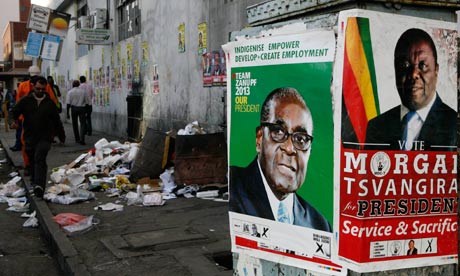
Election posters in Zimbabwe

by Susan Njanji

Whatever the result of Zimbabwe’s election Wednesday one thing is for sure: four years of uneasy power-sharing between President Robert Mugabe and Prime Minister Morgan Tsvangirai will end.

As Zimbabweans streamed to the polls, the unity government partners sighed with relief at the close of their “painful”, “disappointing” union.

The forced marriage was arranged by the international community to avoid further violence in the wake of suspect and blood-soaked 2008 elections.

Tsvangirai won the first round, but was forced to drop out of the second round amid the killing of 200 of his supporters.

He then became prime minister as a reluctant partner in the unity government alongside Mugabe, the former guerrilla who has ruled since independence from Britain.

While the power-sharing deal which took effect in 2009 prevented full-scale conflict, critics today deplore its failure to achieve much-needed democratic reforms and kickstart the economy.

“It has been a major disappointment,” Rugare Gumbo, spokesman for Mugabe’s ZANU-PF party, told AFP.

But communications minister Nelson Chamisa, spokesman for Tzvangirai’s Movement for Democratic Change (MDC), said the government had achieved some victories.

“It has been difficult, difficult, painful but useful for the people of Zimbabwe. People’s lives have improved,” he said. “We are excited that we are coming out of the blast furnace.”

The arrangement was aimed at creating a “genuine, viable, permanent, sustainable” solution to the crisis.

But in its early days, Mugabe could not hide his discomfort.

“I feel awkward in a thing like that, absolutely awkward,” he told mediator President Jacob Zuma of South Africa at the time.

Ex-finance minister Simba Makoni, who was not part of the unity deal, branded the Mugabe-Tsvangirai government “pathetic” and “dismal”.

And analysts said the deal had failed to set a democratic framework for fresh elections.

Days before Wednesday vote, the country was “still grappling with issues of reforms, the timing of elections, issues of sporadic violence and intimidation,” said Trevor Maisiri, a researcher with the International Crisis Group.

“It has not fully served its primary purpose because the idea was to create a transitional mechanism that would lead to a credible election,” he said.

Initially the unity government was to last just two years but it had to be extended as delays plagued the formulation of a new constitution that would lay the basis for credible polls this time around.

The MDC “regrets, definitely that quite a number of reforms did not move as we had wanted,” said Chamisa, highlighting a lack of revisions of the media and security sector.

Civic rights coalition Sokwanele, which kept an eye on the government’s performance, traced 22,482 violations of the agreement — 90 percent by ZANU-PF.

The rivals still strongly disagree on the economy, and bitterly blame each other for Zimbabwe’s slow recovery.

Unemployment still hovers on the wrong side of 50 percent while millions of people are still economic refugees in neighbouring countries.

Once a net food exporter known as Africa’s breadbasket, Zimbabwe’s reformed agricultural sector is yet to produce enough to feed the country.

“There were many programmes that we were going to carry out, but our colleagues acted like they were an opposition party instead of carrying themselves as part of the government,” the ZANU-PF’s Gumbo claimed.

The MDC said it opposed “ill-conceived” black economic empowerment schemes that forced foreign companies to cede a majority of their shares, saying it drove away investors.

But some say the power-sharing agreement was not all bad.

The government rescued the moribund economy by abandoning the Zimbabwean dollar, ending rampant inflation that peaked at 231 million percent.

Politicians who previously had not seen eye-to-eye suddenly were forced to run the country together, which may explain the peaceful run-up to Wednesday’s polls.

Just being able to talk to each other in parliament or in cabinet “has really been helpful,” said Gumbo.

The coalition “brought about some sanity, peace and stability. We are not fighting as we used to. Even campaigning is being done in a peaceful, orderly manner,” he said.

Chamisa also said the unity government was a healthy exercise.

“The past four years showed that another Zimbabwe is possible. A Zimbabwe where we can realise, appreciate and celebrate the cross-pollination of ideas,” he said.