Yemeni leader flees while Saudi Arabia continues with air strikes

Yemen’s President Abd-Rabbu Mansour Hadi left his refuge in Aden for Saudi Arabia on Thursday as Houthi rebels battled with his forces on the outskirts of the southern port city.

Throughout the day, warplanes from Saudi Arabia and Arab allies struck at the Shi’ite Houthis and allied army units, who have taken over much of the country and seek to oust Hadi.

Warplanes resumed bombing the Houthi-held capital Sanaa on Thursday evening, shaking whole neighborhoods and terrifying residents. Several civilians have been reported killed in Sanaa.

“My whole family and I are preparing to sleep in the basement, as it’s the safest part of the house,” said resident Fawzia Nedras.

“The windows are rattling and we think they may break. We live near the airport, where we think a lot of the Houthi leaders are living and many of the air strikes are.”

Houthi leader Abdel-Malek al-Houthi said in a televised speech Yemenis would confront the “criminal, unjust and unjustified aggression” by Saudi Arabia.

Residents and security officials said the second night of air strikes throughout Yemen targeted air and ground force bases loyal to ex-president Ali Abdullah Saleh, whose forces have bolstered the Houthi advance.

The Saudi-led military intervention marked a major escalation of the Yemen crisis, in which Iran supports the Shi’ite Muslim Houthis, and Sunni Muslim monarchies in the Gulf back Hadi and his fellow Sunnis in Yemen’s south.

Iran denounced the surprise assault on the Houthis and demanded an immediate halt to Saudi-led military operations.

Tehran also made clear Saudi Arabia’s deployment of a coalition of Sunni states against its Shi’ite enemies would inflame the sectarian hatreds already fuelling wars around the Middle East.

Hadi’s departure under Saudi protection from Aden, his embattled base since fleeing Sanaa in February, could be a turning point.

Saudi state news showed pictures of Hadi smiling and holding hands with the Saudi defense minister receiving him at an airport in the capital Riyadh and said he would go on to Egypt to attend an Arab summit on Saturday.

Mohammed Marem, the director of Hadi’s office, confirmed he would attend the meeting in person, dropping his original plan to address it via video link.

Hadi would seek a “Marshall Plan” from Arab leaders to aid his war-torn country, his foreign minister Riyadh Yaseen told pan-Arab Al Jazeera TV, referring to a major economic stimulus for Europe after World War Two.

It was far from certain whether Hadi would be able to return to Aden.

On the city’s northern outskirts, Houthis and allied troops fought gun battles with militiamen loyal to Hadi. Thirteen pro-Houthi fighters and three militiamen were killed and several others were killed in running street fights in nearby towns.

Pro-Hadi fighters retook Aden airport, a day after it was captured by Houthi forces. The facility remained closed.

Major gamble

The Saudi move was a major gamble by the world’s top oil exporter to check Iranian influence in its backyard without direct military backing from Washington.

“We will do whatever it takes in order to protect the legitimate government of Yemen from falling,” Saudi Arabia’s ambassador to the United States, Adel al-Jubeir, told a news conference in Washington.

In Sanaa, which the Houthis seized in September, warplanes earlier bombed the main airport and al Dulaimi military air base, residents said.

A Reuters witness said four or five houses had been damaged. Rescue workers put the death toll at 13, including a doctor pulled from the rubble of his clinic.

Warplanes also struck Houthi fighters near Yemen’s border with Saudi Arabia, tribal and Houthi sources said. There was heavy street fighting in Houta, north of Aden, in which five pro-Houthi fighters and four militiamen were killed.

Thousands of Houthi supporters gathered to condemn the air strikes at the gate to Sanaa’s old city, waving Houthi banners and chanting “Death to America!”

Al-Arabiya said Saudi Arabia was contributing 100 warplanes to operation “Storm of Resolve” and more than 85 were being provided by the United Arab Emirates, Qatar, Bahrain, Kuwait, Jordan, Morocco and Sudan.

Egyptian air forces were participating and four naval ships headed to secure the Gulf of Aden. Turkey said it might provide logistical support.

Turkish President Tayyip Erdogan said later Iran had been trying to dominate the Middle East.

“It is really not possible to tolerate this. Iran has to understand,” he said, adding Tehran should withdraw any forces it had in Yemen as well as from Syria and Iraq.

Pakistan’s Prime Minister Nawaz Sharif said any threat to Saudi Arabia would “evoke a strong response” from Islamabad.

Pakistan, which borders eastern Iran, said it was considering a Saudi request that it send troops to Yemen.

Saudi Brigadier General Ahmed Asseri, spokesman for the operation, told a news conference:

“There are no plans at this stage for ground forces operations, but if the need arises, the Saudi ground forces and those of the friends and sisterly forces are ready and will repel any aggression.”

Arab foreign ministers agreed in Egypt on Thursday on a draft resolution to form a unified Arab military force.

“The task of the force will be rapid military intervention to deal with security threats to Arab nations,” Arab League Secretary General Nabil Elaraby said.

Russia’s President Vladimir Putin called for an immediate cessation of military activities in Yemen in phone conversations with Iran’s President Hassan Rouhani, the Kremlin said.

U.S. Secretary of State John Kerry raised Yemen on Thursday with his Iranian counterpart before turning to nuclear negotiations in Switzerland.

Iran’s Foreign Ministry demanded an immediate halt to the “aggression and air strikes” in Yemen.

“Military actions in Yemen … will further complicate the situation,” ministry spokeswoman Marzieh Afkham said, quoted by Fars news agency.

A senior Iranian official told Reuters: “Iran will use all possible political ways to allay tension in Yemen. Military intervention is not an option for Tehran.”

Riyadh accuses Iran of stirring up sectarian strife throughout the region and in Yemen with its support for the Houthis. Iran denies funding and training the Houthis.

Ambassador Jubeir said the assaults were in response to a request by Hadi. Washington said it supported the operation and had authorized U.S. logistical and intelligence support.

A widening Yemen conflict could disrupt the narrow Bab el-Mandeb strait, through which nearly 4 million barrels of oil are shipped daily to Europe, the United States and Asia. Oil prices surged as much as 6 percent on Thursday.

Yemen closed its main ports. The U.S. military said it would help ensure the strait at the tip of the Red Sea remains open. -Reuters

Kerry calls for an Apartheid state in Israel

mandela_israeli_apartheidThe US Secretary of State said that if Israel doesn’t make peace soon, it could become “an apartheid state”, like the old South Africa. Many are fuming over the ill-informed comparison.

Kerry is clearly confused about apartheid, since the two-state solution implies apartheid rather than a single state containing both Jews and Arabs.

Kerry warned that if there was no “two-state solution” to the Israeli-Palestinian conflict soon, Israel risks becoming “an apartheid state”.

Secretary of State Kerry confused a room of influential world leaders in a closed-door meeting Friday about seperate development, ethnic selfrule and notions of Jewishness.

Senior American officials have rarely, if ever, used the term “apartheid” in reference to Israel, and President Obama has previously rejected the idea that the word should apply to the Jewish state.

Kerry’s use of the loaded term is already rankling Jewish leaders in America because it is bound to attract unwanted attention to Israel.

Kerry also repeated his warning that a failure of Middle East peace talks could lead to a resumption of Palestinian violence against Israeli citizens. He suggested that a change in either the Israeli or Palestinian leadership could make achieving a peace deal more feasible. He lashed out against Israeli settlement-building.

Kerry told his audience that a unitary state “winds up either being an apartheid state with second-class citizens, or it ends up being a state that destroys the capacity of Israel to be a Jewish state”.

The US nevertheless imposed a unitary state solution on South Africa, strangely, to “end apartheid”. They have now changed course 180 degrees on the matter it seems.

According to the 1998 Rome Statute, the “crime of apartheid” is defined as “inhumane acts… committed in the context of an institutionalized regime of systematic oppression and domination by one racial group over any other racial group or groups and committed with the intention of maintaining that regime.” The term is most often used in reference to the system of racial segregation and oppression that governed South Africa from 1948 until 1994.

A two-state solution and claims of Jewishness imply racial segregation however.

Former president Jimmy Carter came under fire in 2007 for titling his book on Middle East peace Palestine: Peace or Apartheid.

Carter explained after publishing the book that he was referring to apartheid-type policies in the West Bank.

“Apartheid is a word that is an accurate description of what has been going on in the West Bank, and it’s based on the desire or avarice of a minority of Israelis for Palestinian land,” Carter said.

Israel’s leaders have employed the term as well. In 2010 former Prime Minister and Defense Minister Ehud Barak used language very similar to Kerry’s. “If this bloc of millions of ­Palestinians cannot vote, that will be an apartheid state.”

Kerry suggested in March that if peace talks fail, it would bolster the boycott, divestment and sanctions (BDS) movement against Israel.

Time and demographics are on the Palestinian side, and Israel has to confront notions of the Jewishness of the state, Kerry implied, further strengthening the notion that the US would like to see apartheid being applied to Israel sooner rather than later.

Selling war with Russia

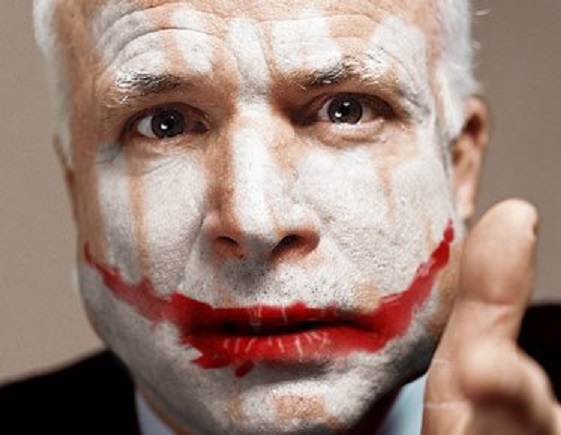
McCain kissing up to black Republican Mia Love

American senator, Republican John McCain, who is currently on a visit to Estonia, has urged to “provide weapons to Ukraine” speaking at a live show of one of the local TV channels.

“We should provide weapons to Ukraine so that it could defend itself,” the 77-year-old senator from Arizona said.

John McCain, the ex-presidential candidate from the Republicans on 2008 elections, believes that Russia threatens its neighbor. “Russia is provoking the West by staging actions in Ukraine’s East. Maybe, it wants to increase its influence on the South as well,” the senator suggested.

An advisor to Secretary of State John Kerry said Monday that the United States may decide to send arms to eastern Ukraine as tensions continue to worsen there between pro-Russian protesters and supporters of the country’s interim government.

Reuters reported on Monday that US State Department Counselor Thomas Shannon — a senior diplomat and member of Sec. Kerry’s inner circle — said the possibility of providing arms to Ukrainian forces is indeed currently on the table.

Oleksandr Turchynov, the acting president of Ukraine, has since asked for the UN to conduct a joint “anti-terrorist operation” in that region as activity intensifies.

Seven weeks after the right-wing coup in Ukraine, evidence is mounting that the Western-backed opposition at the time was responsible for the lethal shootings in Independence Square on February 20. This was suggested by a report on the German public television programme “Monitor” last Thursday evening, and which is available online in German.

“According to research it appears unlikely that the shots on demonstrators came exclusively from the side of the old regime,” stated a press release made available prior to the program. In its report, “Monitor” raised the question, “Did radical oppositionists end up shooting in order to produce chaos and place the blame on Yanukovitch?” The presented videos, interviews and sound recordings suggest precisely this!

“Monitor” presented an extract of radio traffic from alleged sharp-shooters of the Yanukovitch regime, who were positioned on various rooftops in the centre of Kiev on February 20. The discussion was picked up by a Ukrainian radio amateur. One of the snipers can be heard asking his colleagues, “Hey guys, they are over there, on the right of the hotel Ukrayina. Who is shooting? Our people don’t shoot at unarmed civilians.” Then he calls, “Guys, there is a sniper who is aiming at me. Who is he aiming at from the corner? Look out.” A short time later someone else says, “Someone shot him. But not us. Are there more snipers over there? And who are they?”

On other videos, activists who marched along Institutska Street on February 20, can be seen being shot not only from the front, that is, from the direction of government buildings, but also from behind. Nikola, an eyewitness who is visible on several videos, confirmed, “Yes, on the 20th [February] we were shot from behind, from the Hotel Ukrayina, from the eighth or ninth floor. People were standing up there and shooting at us and we were also shot from the other direction.”

Responding to the question as to who had shot them from the Hotel Ukrayina, he answered, “I don’t know. They were soldiers, certainly professionals.”

On the day of the shootings, the Hotel Ukrayina was firmly under the control of the opposition and was heavily guarded. Numerous witnesses, journalists and oppositionists confirmed this to “Monitor”. On the morning of February 20, the opposition even introduced entry controls. Only those with a room key or identification were allowed into the hotel. The “Monitor” reporters come to the conclusion, “Therefore it would have been very difficult for a sniper to sneak in.”

In addition, the reporters reviewed pictures from Russian television, which allegedly show armed oppositionists firing at demonstrators. “Precisely who is shooting at whom is not possible to confirm,” However, it was determined that “the recording was definitely made in the Hotel Ukrayina.” It was also confirmed that “not only oppositionists, but also the government militias were shot at. And perhaps this was also by the same people.”

A doctor, who treated victims on both sides, confirmed this in an interview. “The injured who we treated had the same type of bullet wounds. I’m speaking about the type of bullets we took out of the bodies in operations. They were identical. I can’t say any more”, he stated.

The explosive report concurs with the intercepted telephone call between Estonian foreign minister Urmas Paet and the foreign policy head of the EU, Catherine Ashton, at the beginning of March. Paet also based himself on information from doctors and stated that “the same snipers shot people on both sides.” He warned that “the conclusion that not Yanukovitch, but members of the new coalition were behind the shootings is increasingly reinforced.”

Since then, the transitional government in Kiev and its Western allies have desperately sought to cover up the true course of events. Only last week, Ukrainian general state prosecutor Oleg Machnizki of the fascist Svoboda, arrested 12 members of the now dissolved special Berkut unit and presented them as the main suspects in the shootings.

“Monitor” cites a high-ranking member of the investigative committee, who calls the version of events from the state prosecutor into doubt. “My investigation results do not agree with those presented by the state prosecutor at the press conference,” said the investigator, who wished to remain anonymous, in an interview.

A lawyer for the victims suggested that the entire investigation was a deliberate ploy by the transitional government to bury their own crimes. “None of us are getting any information on the investigation”, he complained. “And if you ask me, there is one simple reason for this: it is not being investigated properly. As a lawyer of the victims I am saying to you that the state prosecutor is not investigating properly. They are covering for their own people. They are as partisan as before.”

NATO is creating a naval battle group outside Russian borders, a Russian military source told Interfax news agency.

On April, 3, Foreign Minister Sergey Lavrov accused NATO of violating the Montreux Convention, which regulates the number ships that can enter the Black Sea, saying that “US warships have extended their deployment beyond the set terms a couple of times lately.”

According to the treaty, warships from non-Black Sea states can only stay in the basin for up to 21 days consecutively. USS Taylor spent 11 more than that in the region in February and March.

Russia’s Foreign Ministry expressed “bemusement” over the move.

“Turkey [which administers the treaty] did not inform us about the overstay. We have expressed our concern to the Turkish and US side in a verbal note,” said a statement on the ministry website.

A Russian fighter jet made multiple, close-range passes near an American warship in the Black Sea for more than 90 minutes Saturday.

Officials said the Russian Fencer made 12 passes, and flew within 1,000 yards of the USS Donald Cook, a Navy destroyer, at about 500 feet above sea level.

The U.S. warship, equipped with the powerful Aegis missile defense system and carrying helicopters, issued several radio queries using international emergency circuits. A Russian Navy ship, a frigate, has been shadowing the U.S. warship, remaining within visual distance.

U.S. military officials have said the deployment is part of an effort to “reassure” allies and partners in the region. A second U.S. Navy warship – a frigate from the Navy’s Sixth Fleet in the Mediterranean Sea – is also heading to the Black Sea.

It appears however that no official communication or protests by the U.S. to the Russians about incident have been made. It is also not clear how an American military build-up in the region could be reassuring, as it increases the likelyhood of conflict.

Paul Craig Roberts recently wrote that democracy and freedom require an independent and aggressive media, an independent and aggressive judiciary, and an independent and aggressive Congress. He said the US had none of the above.

The US media consistently lies for the government. Reuters continues to report, falsely, that Russia invaded and annexed Crimea. The Washington Post ran an obviously false story planted on the paper by the Obama regime that the massive protests in former Russian territories of Ukraine are “rent-a-mobs” instigated by the Russian government.

The CIA director has been sent to Kiev to launch a military suppression of the Russian separatists in the eastern and southern portions of Ukraine.

Washington’s plan to grab Ukraine overlooked that the Russian and Russian-speaking parts of Ukraine were not likely to go along with their insertion into the EU and NATO while submitting to the persecution of Russian speaking peoples, Roberts said.

Self-determination will not be recognized by the UN as the UN is essentially a Washington-financed organization, and will follow Washington’s orders. Roberts warned that money is more important to European politicians than humanity’s survival, and Washington pays them well.

Where’s America’s right to referendum, secession?

mercer_ilanaby Ilana Mercer

[followbutton username=’IlanaMercer’ count=’true’ lang=’en’ theme=’light’]

Like Ilana Mercer’s Facebook page

From a node in the neoconservative network, a Fox News studio, Charles Krauthammer has complained about the eviction of the Ukrainian Navy from the city of Sevastopol, where it was headquartered. Not a word did the commentator say about the city’s location: Sevastopol is on the Crimean Peninsula. It would appear that the city now falls within Crimean jurisdiction – starting March 16, the day the people of Crimea voted to secede from Ukraine.

By most estimates, between 97 and 93 percent of Crimean voters said yes to a reunion with Russia. High too was voter turnout. McClatchy pegs it at 83 percent of registered voters in Crimea. BBC News was agreed, also reporting a ballot of “more than 80 percent.” Zerohedge.com counted a “paltry” 73 percent turnout, still “higher than every U.S. presidential election since 1900.”

As rocker Ted Nugent might say, the Russians and Crimeans are blood brothers. Nugent got into trouble for using this perfectly proper appellation to describe his affinity for a politician, of all people: Texas Republican gubernatorial hopeful Greg Abbott. Notwithstanding that in the land of the terminally stupid, linguistic flourish can land one in hot water – blood brother is a good, if colorful, turn of phrase that denotes fealty between like-minded people. Steeped in state-enforced multiculturalism, America’s deracinated, self-anointed cognoscenti have a hard time grasping the blood-brother connections between the people of Russia and Crimea.

For no apparent reason other than that it is pro-Russian, Americans have reflexively aligned themselves against the swell for secession in southern Ukraine. Separatist referenda in Kosovo, Catalonia, South Sudan and Scotland have been accepted without demur by a political and media establishment unprepared to countenance a similar referendum in Crimea.

Guided by the pack animals of politics and punditry who seldom fail to shed darkness on whatever topic they tackle, a nation that struggles to locate the disputed territories on the map has been convinced of the menace posed by Russia. According to a CNN poll, 69 percent of Americans say they see Russia as a threat. A Rasmussen Report poll indicated that “52 percent support U.S. diplomatic action against Russia over Crimea.”

Helping to drive American Russophobia is the implacable logic exemplified by Bill O’Reilly of “The Factor,” yet another node in the network mentioned. At the suggestion that there are similarities between Russian and American military bellicosity, the TV host foams at the mouth. Fulmination is followed not by argument, but by a form of ad hominem or psychologizing.

Into the Cannibal's Pot

It is absolutely verboten on this popular and powerful show to compare Russia’s “excursion” into Ukraine to America’s naturally illicit and illegal occupations of Iraq, Afghanistan and Libya. In defense of their reflexive rejection of the reasonable, if inaccurate, comparison – for decades the U.S. has been far more aggressive than Russia in its forays abroad – Bill and his gang “argued” (on March 3) as follows:

President Vladimir Putin is a thug. That’s why his actions can’t be contrasted with the actions of “a good country” like the U.S. By “logical” extension, George Bush and Barack Obama are never to be fingered as thugs.

Why, Billy, some of you will inquire? Is it because these thugs are American? Precisely.

Next, Bill O’Reilly’s mind-reading gifts were galvanized to negate the juxtaposition of the actions on the ground of the Russian and American governments. Putin, it would appear, seeks the recrudescence of the Russian empire. On the other hand, the U.S., with a military presence in 148 countries and 900 bases worldwide, has neither sought nor achieved empire status.

Why, Billy, some of you will ask? Is it because the U.S. is a good country? You got it!

Be it in Belgium, Germany, Italy, Spain, Turkey, the United Kingdom, Japan, Bahrain, Djibouti, South Korea, Iraq, Kyrgyzstan, Afghanistan and Kuwait – even Aruba, Iceland, Indonesia, Kenya, Norway and Peru – wherever it plants its military boot, a “good country” is never an empire, only a force for good.

Me, O’Reilly would dismiss as “anti-American.” But what of former secretary of state Henry Kissinger? While Kissinger has condemned Russia’s annexation of Crimea, he excoriated “the demonization of Vladimir Putin.” This antipathy “is not a policy; it is an alibi for the absence of one.” “The United States needs to avoid treating Russia as an aberrant to be patiently taught rules of conduct established by Washington,” wrote the statesman in the Washington Post.

Is Henry Kissinger anti-American or simply smarter than some Americans?

At least Secretary of State John Kerry hung on to his sense of humor. “Unless you are the United States of America, you just don’t invade another country on phony pretext in order to assert your interests,” Kerry lectured the congenitally incurious David Gregory, of “Meet the Press.”

I ad-libbed. Except for the first eight words in quotation marks, Secretary Kerry did indeed say the foregoing. Given America’s military record, the missing words are implied.

The O’Reilly school of “thought” could – and does – counteract that Crimea’s vote to join Russia was tainted by fraud. This is certainly possible. Nevertheless, it is none of our business. Americans have their own tyrants to dethrone.

We’re supposed to be the freest people in the world, aren’t we? Is this claim not the moral basis for America’s we-know-best global meddling? But if we Americans are the freest people in the world, where’s our right to a referendum on, say, that “little” legislative “blip” called Obamacare? And if we’re so bleeding free, where’s our right to secede from D.C.?

© 2014 by Ilana Mercer

[followbutton username=’IlanaMercer’ count=’true’ lang=’en’ theme=’light’]

Like Ilana Mercer’s Facebook page

John Kerry, Zampolit for gay rights

Getting on the gay life boat?

Secretary of State John Kerry on Wednesday sounded like the Zampolit for Africa when he likened new anti-gay legislation in Uganda that imposes harsh penalties for homosexuality to anti-Semitic laws in Nazi Germany or apartheid South Africa.

The Zampolit is the Communist political commissar charged with taking “active measures” to ensure thought control. The politruk (Russian term) committed to the civilian control of the military, appeared during the October Revolution. Political commissars were part of the the Red Army that remained in the Soviet Army.

The United States spends millions on military training in Uganda.

“You could change the focus of this legislation to black or Jewish and you could be in 1930s Germany or you could be in 1950s-1960s apartheid South Africa,” Kerry told a group of reporters. “It was wrong there egregiously in both places and it is wrong here,” he added.

Strangely, Kerry forgot to mention that racial segregation in the US, lasted well beyond the 1960’s to the 1970’s.

Most Americans believe segregation leads to negative outcomes across American communities with higher rates of violent crimes, and lower levels of wellbeing. Across American communities, some argue, segregation is a key determinant of inequality.

Bankrupt black cities in the US like Detroit have borne this out. Clearly racial mixing and desegregation have thus been promoted to disguise black crime rates in the country.

The American experiment in South Africa is a complete disaster, however. Crime rates have soared since the ANC took over in 1994 with the assistance of Britain and the US.

Kerry said the legislation signed by President Yoweri Museveni on Monday was “atrocious” and expressed concern at mounting discrimination against gays in 78 countries around the world.

Discrimination against gays dim in comparison to child rape and farm murders in South Africa, despite efforts by certain foreign-funded NGO’s and the SAPS to camouflage the scourges. The American Secretary of State either is not aware of this, or does not care.

Homosexuality is a taboo in almost all African countries and illegal in 37, including in Uganda where it has been criminalized since British colonial rule by popular demand.

Yet Kerry denied that it was an “African problem”. “This anti-gay movement is obviously bubbling up in various places around the world; it is not just an African problem, it’s a global problem, and we are wrestling with it and we are going to as we go forward.”

The term “going foward” is a much used expression of the Zampolit.

Uganda launched a public awareness campaign earlier that led to a sharp reduction in the AIDS rate.

“What is happening in Uganda is atrocious and it presents all of us with an enormous challenge because LGBT rights are human rights and the signing of this anti-homosexuality law is flat out morally wrong,” Kerry said.

The State Department’s annual global human rights report will highlight the issue when it is released on Thursday and Kerry said a gathering of U.S. ambassadors in Washington would discuss ways to deal with rising prejudice against homosexuals.

The gay theme is very popular amongst Anglo-American elites. A former French prime minister Edith Cresson suggested that one in four British men may be gay.

“It’s a question of education, and I consider it something of a weakness,” Cresson said at the time.

She passed similarly harsh judgments on American and German men.


Central African Republic ‘on brink of genocide’

The United States is calling for deeper international involvement to halt violence in Central African Republic, amid growing alarm that the impoverished nation is on the brink of a possible genocide.

US Secretary of State John Kerry on Wednesday unveiled $40 million in new funding to help the country, with the bulk of the aid going to support the African Union-led peacekeeping mission known as MISCA.

“It’s a very, very serious situation right now,” a top State Department official told AFP, asking not to be named.

“It will require extensive, continued and deepened international commitment working with the CAR government to address the humanitarian crisis, to strength MISCA so that it can carry out its security mission, civil protection mission and lay the ground work for” elections set to take place in February 2015, the official added.

In the latest in a long line of rebellions and coups, the Seleka rebel coalition ousted president Francois Bozize in March and put the CAR’s first Muslim leader, President Michel Djotodia, in power.

But the move has unleashed unprecedented sectarian bloodshed, with fighting between the mainly Muslim former rebels who seized power in March and militia groups set up to protect Christian communities, which make up about 80 percent of the population.

The unrest has displaced almost 400,000 of the country’s estimated 4.6 million people, left 2.3 million in need of assistance and some 1.1 million scrambling to find food, according to the latest UN figures.

central-african-republicFrance’s Foreign Minister Laurent Fabius said Thursday that the country was “on the verge of genocide,” while a Kerry deputy told US lawmakers this week that it was in a “pre-genocidal” phase.

“The needs are so extensive, it’s really hard to say one is greater than the others,” the US official said in an interview.

“One area there’s going to be a serious need in over the coming year is in food aid, and that’s because the population has been so terrorized and traumatized by what’s happening in the country, that it’s had a serious impact on the planting season and necessarily that’s going to cause greater food insecurity in the months ahead.”

The US is supporting moves at the United Nations to boost an AU-led force to some 3,652 troops made up of soldiers from Chad, Cameroon, Gabon, Congo-Brazzaville and Equatorial Guinea with a contribution also expected from Burundi.

“The mandate is excessively broad given the very extensive challenge in front of them,” the official said, stressing that it was felt the AU force would be better placed to restore order and stability than a UN peacekeeping mission.

Apart from being quicker to set up and equip, “often the UN missions are more peacekeeping and this is not a peacekeeping situation, this is more enforcement,” he said.

The UN Security Council plans to vote in early December on a resolution to allow CAR’s neighbors, the African Union and France to intervene in the sprawling nation.

French President Francois Hollande said Paris was planning to “significantly increase” its contingent in the country, where it already has 400 soldiers in place to help protect the airport in Bangui and French nationals. – AFP

US spying causes new anger in France, Mexico

LogoLeMondeby Marianne Barriaux and Michael Mainville BARRIAUX, Michael MAINVILLE

The United States has become embroiled in a new row over its controversial spying programme as allies France and Mexico condemned revelations Washington tapped millions of phonecalls and hacked into leaders’ emails.

French President Francois Hollande on Monday expressed his “deep disapproval” of reports of US spying in a phone call with President Barack Obama.

France’s Le Monde newspaper reported that the US National Security Agency had secretly monitored 70.3 million phone communications in France over 30 days from December 10, 2012, to January 8 this year.

The allegations, the latest from leaks by former NSA contractor Edward Snowden, also marred a visit to Paris by US Secretary of State John Kerry, where he discussed moves to try to end the war in Syria.

At the same time, German weekly Der Spiegel reported the NSA had also hacked into former Mexican president Felipe Calderon’s email account.

Calderon, on Twitter, described the revelations as an “affront to the institutions of the country, given that it took place when I was president”.

Hollande told Obama that the alleged practices were “unacceptable between friends and allies because they infringe on the privacy of French citizens”, the French leader’s office said in a statement.

The allegations come on top of previous revelations by Snowden — who has sought safety in Russia as US authorities pursue him for leaking classified information — that the United States had a vast, secret programme called PRISM to monitor Internet users.

French prosecutors are already investigating the programme, and French Prime Minister Jean-Marc Ayrault said he was “deeply shocked” by the new revelations.

“It’s incredible that an allied country like the United States at this point goes as far as spying on private communications that have no strategic justification, no justification on the basis of national defence,” he told journalists.

French Foreign Minister Laurent Fabius, on a visit to Luxembourg, said US ambassador Charles Rivkin was summoned to his ministry early Monday.

“These kinds of practices between partners that harm privacy are totally unacceptable,” he told reporters, adding France needed assurances that the United States was no longer monitoring its communications.

His comments were relayed to the US ambassador during the meeting, a ministry spokesman said — the second time in less than four months that America’s top representative in France has been hauled in over revelations about US snooping.

Kerry refused to comment on the specific accusations, but noted that Washington was reviewing its intelligence gathering operations following protests from allied governments.

He also sought to defend the US position.

“Protecting the security of our citizens in today’s world is a very complicated, very challenging task… because there are lots of people out there seeking to do harm to other people,” Kerry said at a press conference after meeting Arab League officials.

“Lots of countries are engaged in the activity of trying to protect their citizens in the world,” he said. “Our goal is always to try to find the right balance between protecting the privacy and security of our citizens.”

According to Le Monde, the spy agency automatically picked up communications from certain phone numbers in France and recorded certain text messages under a programme code-named “US-985D”.

The French daily said the documents gave grounds to believe that the NSA targeted not only people suspected of being involved in terrorism but also high-profile individuals in business and politics.

Hollande’s office said the French president and Obama had agreed “to work together to determine the facts and the exact scope of surveillance activities” revealed by Le Monde.

Der Spiegel also revealed that US agents had hacked into the Mexican presidency’s network, gaining access to Calderon’s account.

According to the report, the NSA said this contained “diplomatic, economic and leadership communications which continue to provide insight into Mexico’s political system and internal stability”.

The agency reportedly said the president’s office was now “a lucrative source”.

Mexican authorities said they would be seeking answers from US officials “as soon as possible”.

“This practice is unacceptable, illegitimate and contrary to Mexican law and international law,” the foreign ministry said.

Glenn Greenwald, an American journalist now living in Brazil who has broken many of the recent stories about secret US surveillance programmes, says Washington has spied on all Latin American countries.

Speaking to a press association in Miami, Greenwald said he would report about each case in the region and warned that more spying within the United States would also be revealed.

He also said the disclosures published by Le Monde Monday had been in the hands of the French daily for some time.

This is not the first time there have been reports that France and Mexico have been targeted in relation to NSA spying allegations since information leaked by Snowden first emerged in June.

Mexico’s current President Enrique Pena Nieto has already complained to Obama over reports US spies have gone through his emails.

And Der Spiegel reported last month that in 2010 the NSA monitored the internal computer network of France’s diplomats and that of the foreign ministry.

But France itself has also been accused of spying. Le Monde reported in recent months that intelligence services intercepted all communications in the country, stocking telephone and computer data for years –accusations denied by the government. – AFP

Kerry talks tough in Syria meeting with Russia

John Kerry
John Kerry

by Matthew Lee and Nancy Benac

Striking a tough tone, U.S. Secretary of State John Kerry opened swiftly convened talks with Russia on Syria’s chemical weapons Thursday by bluntly rejecting a Syrian pledge to begin a “standard process” by turning over information rather than weapons – and nothing immediately.

That won’t do, Kerry declared at an opening news conference, a stone-faced Russian Foreign Minister Sergey Lavrov at his side. “The words of the Syrian regime in our judgment are simply not enough.”

“This is not a game,” Kerry said of the latest developments in a series that has rapidly gone from deadly chemical attacks to threats of retaliatory U.S. air strikes to Syrian agreement with a Russian plan to turn over the weapons and, finally, to the crucial matter of working out the difficult details.

“We believe there is nothing standard about this process at this moment because of the way the regime has behaved,” Kerry declared. And he kept alive the threat of U.S. military action, saying the turnover of weapons must be complete, verifiable and timely – “and finally, there ought to consequences if it doesn’t take place.”

Adding to the drama, Russian President Vladimir Putin weighed in from afar, raising eyebrows with an opinion piece in The New York Times that chided Americans for seeing themselves as “exceptional.” That was an apparent reference to a comment President Barack Obama made in his Syria speech Tuesday night, explaining why he felt the U.S. needed to take action. Congress has shown little inclination to authorize military action, and a vote on that has been put off.

Putin also warned that a U.S. strike against Syria because of chemical weapons use could unleash new terrorist attacks. And he still maintained there is “every reason to believe” the weapons were used by rebels and not by Assad’s military. In Washington, Obama’s spokesman said Russia was “isolated and alone” in that view.

Obama, for his part, said simply that he was hoping for “a concrete result” from the talks.

The back-and-forth was a stark indication of the challenging work ahead as Kerry, Lavrov and their teams of chemical weapons experts plunge into talks aimed at finding agreement on how to dismantle the chemical weapons amid the confusion and danger of Syria’s civil war.

Lavrov seemed to contradict Kerry’s negative view of Syrian President Bashar Assad’s offer to provide details on his country’s chemical arsenal beginning 30 days after it signs an international convention banning such weapons. Syria’s ambassador to the United Nations said that as of Thursday his country had become a full member of the treaty, which requires destruction of all chemical weapons. However, the United Nations said it will take at least another 30 days.

The Russian said the initiative must proceed “in strict compliance with the rules that are established by the Organization for the Prohibition of Chemical Weapons.” That suggests Russia does not agree with the U.S. that this is an exceptional case and that Syria should face tougher standards than other countries.

“We proceed from the fact that the solution to this problem will make unnecessary any strike on the Syrian Arab Republic, and I am convinced that our American colleagues, as President Obama stated, are firmly convinced that we should follow a peaceful way of resolution to the conflict in Syria.” Lavrov said.

The distrust in U.S.-Russia relations was on display even in an off-hand parting exchange at the news conference.

Just before it ended, Kerry asked the Russian translator to repeat part of Lavrov’s concluding remarks.

When it was clear that Kerry wasn’t going to get an immediate re-translation, Lavrov apparently tried to assure him that he hadn’t said anything controversial. “It was OK, John, don’t worry,” he said.

“You want me to take your word for it?” Kerry asked Lavrov. “It’s a little early for that.”

They were smiling at that point.

Shortly after making their opening statements, the two went into a private dinner. Talks were to resume Friday.

The meetings in Geneva got underway as Assad, in an interview with Russia’s Rossiya-24 TV, said his government would start submitting data on its chemical weapons stockpile a month after signing the convention. He also said the Russian proposal for securing the weapons could work only if the U.S. halted threats of military action.

But Kerry, who met earlier Thursday with Lakhdar Brahimi, the U.N.-Arab League envoy for Syria, made clear the threat remains.

“President Obama has been clear that should diplomacy fail, force might be necessary to deter and degrade Assad’s capacity to deliver these weapons,” he said. “It won’t get rid of them, but it could change his willingness to use them.”

Even as diplomacy took center stage, word surfaced that the CIA has been delivering light machine guns and other small arms to Syrian rebels for several weeks, following Obama’s statement in June that he would provide lethal aid to the rebels.

The U.S. is hoping that an acceptable agreement with the Russians can be part of a binding new U.N. Security Council resolution being negotiated that demands that Syria’s chemical weapons be put under international control and dismantled and condemns the Aug. 21 attack that led to the current crisis. Russia has long opposed U.N. action on Syria, has vetoed three earlier resolutions and has not indicated it is willing to go along with one now.

As for arming the Syrian rebels, White House National Security Council spokeswoman Bernadette Meehan said the administration could not “detail every single type of support that we are providing to the opposition or discuss timelines for delivery, but it’s important to note that both the political and the military opposition are and will be receiving this assistance.”

Current and former U.S. intelligence officials said the CIA has arranged for the Syrian opposition to receive anti-tank weaponry such as rocket-propelled grenades through a third party, presumably one of the Gulf countries that have been arming the rebels. They spoke on condition of anonymity because they were not authorized to discuss the classified program publicly.

Loay al-Mikdad, a spokesman for the Free Syrian Army, told The Associated Press that his group expected to receive weapons in the near future.

“We are cooperating with the American administration and have been receiving some logistical and technical assistance and there are commitments by the administration to arm us but until now we have not received any weapons,” al-Mikdad said by telephone.

The U.S. officials said the aid has been arriving for more than a month.

The U.S. team with Kerry in Geneva includes officials who worked on inspection and removal of unconventional weapons from Libya after 2003 and in Iraq after the first Gulf War. Officials with Kerry said the teams that eventually go into Syria would have to be an international mix.

The meetings are taking place in the same hotel where former Secretary of State Hillary Clinton in 2009 gave Lavrov a symbolic “reset button” as a goodwill gesture and a reminder of the Obama administration’s efforts to improve U.S.-Russian relations. – AP

In Syria (and all else), it’s ‘Us’ against ‘Them’

mercer_ilanaby Ilana Mercer

[followbutton username=’IlanaMercer’ count=’true’ lang=’en’ theme=’light’]

Like Ilana Mercer’s Facebook page

The “Us” of this column’s title needs no explaining. The “Them,” however, does. We the American people are up against an entity far more sinister than the traditional, inchoate enemy – terrorism – around which we are instructed to unite in purpose.

The debate over whether to strafe Syria or to stay out of that country pits us against the military-congressional-industrial complex, whose interests run counter to ours.

According to a Washington Post-ABC News poll, “Nearly six in 10 [of ‘us’] oppose missile strikes in light of the U.S. government’s determination that Syria used chemical weapons against its own people. Democrats and Republicans alike oppose strikes by double digit margins, and there is deep opposition among every political and demographic group in the survey. Political independents are among the most clearly opposed, with 66 percent saying they are against military action.”

Yet at the behest of Mr. Obama, who had drawn that red line in the sand – ran his mouth off and needed to save presidential face – Secretary of State John Kerry, Secretary of Defense Chuck Hagel and Joint Chiefs of Staff Chairman Gen. Martin Dempsey convened on Capitol Hill to argue against the wishes of Americans and for a “strategic” strike on Syria, a country that poses no imminent danger to “us.”

Offering near-meaningless opposition to the power of the president were our representatives in both Houses – Houses that, to paraphrase Edmund Burke, were “designed as a control for the people,” but have become a control “upon the people.” The latter failed to speak on behalf of the Great Unwashed – which is how they look upon us – delivering self-aggrandizing disquisitions instead.

How seriously do these dangerous war-gamers take “us”?

Sen. Ron Johnson, the Republican from Wisconsin, who, so far, has done the right thing in voting against the lobbing of Tomahawk cruise missiles at Syria, in the Senate Foreign Relations Committee, nevertheless told Fox News’ Greta Van Susteren that if his constituents came out against the strike, he would vote his conscience and merely consider their wishes.

How considerate of him! You elect a representative believing he’s aligned with certain principles, only to discover that so vast are the powers he’s been granted, that you cannot hope to sway him once he arrives on Mount Olympus. Johnson’s attitude also encapsulates the theatre of the absurd alluded to by Sen. Rand Paul, whereby, after the puppets in the Houses get to say their piece, the presidential veto puts paid to all delusions of a democratic decision-making process.

Into the Cannibal's Pot

Prominent among a new breed of military man turned lawmaker to stalk the people’s House is Illinois Republican Rep. Adam Kinzinger. A “veteran of the military” who still serves as a military pilot in the National Guard is how Kinzinger bills himself. War weary though he purports to be, Kinzinger is not. The verbally flatulent representative from Illinois loved it when his ilk flew sorties over the Old Stable Iraq and seeks a repeat performance over Syria. He appears to see no limits to the role the U.S. should play in rolling back evil around the world, out of “the goodness of our heart.” Yes, the constitutional principle Rep. Kinzinger invokes to justify war against the wishes and interests of the American people is “The Goodness of Our Heart” Clause.

But then, a “Global Force for Good” is how the Navy promises to fulfill “The Goodness of Our Heart” Clause of the U.S. Constitution, on its frightful, promotional website. You see, members of the U.S. military do not regard themselves as defenders of the realm – unless by “realm” one means empire. They’ve been brainwashed to be foot soldiers for the federal government, whenever, wherever.

Imagine what America’s Founding Fathers would think of a military that straddles the planet, having assumed the unauthorized role of a “global force for good.” Those sages opposed the idea of a standing army. They understood that “a standing military force, with an overgrown Executive will not long be safe companions to liberty.”

The magnificent Robert E. Lee, on the other hand, had it right. To this American hero, local was beautiful. Gen. Lee saw himself as a Virginian first. Rep. Kinzinger is a Syrian first.

Baseless too is the idea that someone who’s seen war will be especially judicious in sending others to war. John McCain had suffered in war and has not stopped advocating for it ever since. John Kerry voted to go into Iraq. Ditto Chuck Hagel. Both are veterans. Both are itching to “send a message” to Syria, despite Kerry’s earlier admission, in his “remarks on the alleged Syria chemical attack,” that Ban Ki-moon and assorted sources were clueless as to who was doing what in Syria.

“There is no clear indication that there is an imminent threat to the United States from Syria,” stressed Republican Rep. Jeff Duncan, pointing out that no other signatory to the convention against the use of chemical weapons has joined the U.S. in banging the tom-tom for war.

Indeed, a refrain repeated during this week’s hearing was that Assad’s alleged chemical-weapon use posed a threat to our troops. Only if they continue globetrotting!

What Duncan said next is especially poignant. Unlike Sen. Johnson, Duncan had consulted his constituents in South Carolina. Of the hundreds of emails his office had received, not one was in support of Uncle Sam killing more Syrians just because the factions in that country are killing one another. To a letter, Duncan’s South Carolinian bosses, down to the eighth-graders among them, told Duncan, “No! Don’t get involved in the civil war in Syria.”

Three minutes into his address to the House Foreign Affairs Committee’s hearing on Syria, Rep. Duncan made another pivotal point: An administration so eager to mire the U.S. in Syria had refused to galvanize the same resources to rescue four brave Americans who fought for their lives in Benghazi.

And here’s the rub. Here’s what American patriots must understand. The “estimable” men arguing for war in both Houses and before them are not on the people’s side. Never will be. For they do not accept that a just government’s duty is to its own citizens first.

Assuming for the sake of argument that lobbing long-range, air-to-surface missiles at Syria will enhance Syrian liberties – the Deciders stateside do not accept that distinguish we must between the right of the people the world over to be free and our obligation to free them.

We have a solemn [negative] duty not to violate the rights of foreigners everywhere to life, liberty and property. But we have no duty to uphold their rights. Why? Because the ostensible upholding of the negative rights of the world’s citizens involves compromising the negative liberties of Americans – our lives, our liberties and our livelihoods.

By this imperative, Kerry, Hagel, Dempsey, Kinzinger, the senior Republican flake from Arizona, the junior Jeff Flake from the same state, will never abide. This is why it is “us” against “them” on Syria and all else.

[followbutton username=’IlanaMercer’ count=’true’ lang=’en’ theme=’light’]

Like Ilana Mercer’s Facebook page

©2013 By ILANA MERCER

For syndication rights to http://BarelyABlog.com or http://IlanaMercer.com, contact ilana@ilanamercer.com. Read more.

Syria: Another Western war crime in the making

Dr Paul Craig Roberts

by Paul Craig Roberts

Update:

The war criminals in Washington and other Western capitals are determined to maintain their lie that the Syrian government used chemical weapons. Having failed in efforts to intimidate the UN chemical inspectors in Syria, Washington has demanded that UN Secretary General Ban Ki-moon withdraw the chemical weapons inspectors before they can assess the evidence and make their report. The UN Secretary General stood up to the Washington war criminals and rejected their demand. However, as with Iraq, Washington’s decision to commit aggression against Syria is not based on any facts.

The US and UK governments have revealed none of the “conclusive evidence” they claim to have that the Syrian government used chemical weapons. Listening to their voices, observing their body language, and looking into their eyes, it is completely obvious that John Kerry and his British and German puppets are lying through their teeth. This is a far more shameful situation than the massive lies that former Secretary of State Colin Powell told the UN about Iraqi weapons of mass destruction. Colin Powell claims that he was deceived by the White House and did not know that he was lying. Kerry and the British, French, and German puppets know full well that they are lying.

The face that the West presents to the world is the brazen face of a liar.

Washington and its British and French puppet governments are poised to yet again reveal their criminality. The image of the West as War Criminal is not a propaganda image created by the West’s enemies, but the portrait that the West has painted of itself.

The UK Independent reports that over this past week-end Obama, Cameron, and Hollande agreed to launch cruise missile attacks against the Syrian government within two weeks despite the lack of any authorization from the UN and despite the absence of any evidence in behalf of Washington’s claim that the Syrian government has used chemical weapons against the Washington-backed “rebels”, largely US supported external forces, seeking to overthrow the Syrian government.

Indeed, one reason for the rush to war is to prevent the UN inspection that Washington knows would disprove its claim and possibly implicate Washington in the false flag attack by the “rebels,” who assembled a large number of children into one area to be chemically murdered with the blame pinned by Washington on the Syrian government.

Another reason for the rush to war is that Cameron, the UK prime minister, wants to get the war going before the British parliament can block him for providing cover for Obama’s war crimes the way that Tony Blair provided cover for George W. Bush, for which Blair was duly rewarded. What does Cameron care about Syrian lives when he can leave office into the waiting arms of a $50 million fortune.

The Syrian government, knowing that it is not responsible for the chemical weapons incident, has agreed for the UN to send in chemical inspectors to determine the substance used and the method of delivery. However, Washington has declared that it is “too late” for UN inspectors and that Washington accepts the self-serving claim of the al Qaeda affiliated “rebels” that the Syrian government attacked civilians with chemical weapons.  See also Syria Accepts UN Inspectors, US Spurns Call as ‘Too Late’.

In an attempt to prevent the UN chemical inspectors who arrived on the scene from doing their work, the inspectors were fired upon by snipers in “rebel” held territory and forced off site, although a later report from RT says the inspectors have returned to the site to conduct their inspection.

The corrupt British government has declared that Syria can be attacked without UN authorization, just as Serbia and Libya were militarily attacked without UN authorization. In other words, the Western democracies have already established precedents for violating international law. “International law? We don’t need no stinking international law!” The West knows only one rule: Might is Right. As long as the West has the Might, the West has the Right.

In a response to the news report that the US, UK, and France are preparing to attack Syria, the Russian Foreign Minister, Lavrov, said that such unilateral action is a “severe violation of international law,” and that the violation was not only a legal one but also an ethical and moral violation. Lavrov referred to the lies and deception used by the West to justify its grave violations of international law in military attacks on Serbia, Iraq, and Libya and how the US government used preemptive moves to undermine every hope for peaceful settlements in Iraq, Libya, and Syria.

Once again Washington has preempted any hope of peaceful settlement. By announcing the forthcoming attack, the US destroyed any incentive for the “rebels” to participate in the peace talks with the Syrian government. On the verge of these talks taking place, the “rebels” now have no incentive to participate as the West’s military is coming to their aid.

In his press conference Lavrov spoke of how the ruling parties in the US, UK, and France stir up emotions among poorly informed people that, once aroused, have to be satisfied by war. This, of course, is the way the US manipulated the public in order to attack Afghanistan and Iraq. But the American public is tired of the wars, the goal of which is never made clear, and has grown suspicious of the government’s justifications for more wars.

A Reuters/Ipsos poll finds that “Americans strongly oppose U.S. intervention in Syria’s civil war and believe Washington should stay out of the conflict even if reports that Syria’s government used deadly chemicals to attack civilians are confirmed.”  However, Obama could not care less that only 9 percent of the public supports his warmongering. As former president Jimmy Carter recently stated, “America has no functioning democracy.” It has a police state in which the executive branch has placed itself above all law and the Constitution.

This police state is now going to commit yet another Nazi-style war crime of unprovoked aggression. At Nuremberg the Nazis were sentenced to death for precisely the identical actions being committed by Obama, Cameron, and Hollande. The West is banking on might, not right, to keep it out of the criminal dock.

The US, UK, and French governments have not explained why it matters whether people in the wars initiated by the West are killed by explosives made of depleted uranium or with chemical agents or any other weapon. It was obvious from the beginning that Obama was setting up the Syrian government for attack. Obama demonized chemical weapons–but not nuclear “bunker busters” that the US might use on Iran. Then Obama drew a red line, saying that the use of chemical weapons by the Syrians was such a great crime that the West would be obliged to attack Syria. Washington’s UK puppets, William Hague and Cameron, have just repeated this nonsensical claim. The final step in the frame-up was to orchestrate a chemical incident and blame the Syrian government.

What is the West’s real agenda? This is the unasked and unanswered question. Clearly, the US, UK, and French governments, which have displayed continuously their support for dictatorial regimes that serve their purposes, are not the least disturbed by dictatorships. They brand Assad a dictator as a means of demonizing him for the ill-informed Western masses. But Washington, UK, and France support any number of dictatorial regimes, such as the ones in Bahrain, Saudi Arabia, and now the military dictatorship in Egypt that is ruthlessly killing Egyptians without any Western government speaking of invading Egypt for “killing its own people.”

Clearly also, the forthcoming Western attack on Syria has nothing whatsoever to do with bringing “freedom and democracy” to Syria any more than freedom and democracy were reasons for the attacks on Iraq and Libya, neither of which gained any “freedom and democracy.”

The Western attack on Syria is unrelated to human rights, justice or any of the high sounding causes with which the West cloaks its criminality.

The Western media, and least of all the American presstitutes, never ask Obama, Cameron, or Hollande what the real agenda is. It is difficult to believe than any reporter is sufficiently stupid or gullible to believe that the agenda is bringing “freedom and democracy” to Syria or punishing Assad for allegedly using chemical weapons against murderous thugs trying to overthrow the Syrian government.

Of course, the question wouldn’t be answered if asked. But the act of asking it would help make the public aware that more is afoot than meets the eye. Originally, the excuse for Washington’s wars was to keep Americans safe from terrorists. Now Washington is endeavoring to turn Syria over to jihad terrorists by helping them to overthrow the secular, non-terrorist Assad government. What is the agenda behind Washington’s support of terrorism?

Perhaps the purpose of the wars is to radicalize Muslims and, thereby, destabilize Russia and even China. Russia has large populations of Muslims and is bordered by Muslim countries. Even China has some Muslim population. As radicalization spreads strife into the only two countries capable of being an obstacle to Washington’s world hegemony, Western media propaganda and the large number of US financed NGOs, posing as “human rights” organizations, can be counted on by Washington to demonize the Russian and Chinese governments for harsh measures against “rebels.”

Another advantage of the radicalization of Muslims is that it leaves former Muslim countries in long-term turmoil or civil wars, as is currently the case in Iraq and Libya, thus removing any organized state power from obstructing Israeli purposes.

Secretary of State John Kerry is working the phones using bribes and threats to build acceptance, if not support, for Washington’s war crime-in-the-making against Syria.

Washington is driving the world closer to nuclear war than it ever was even in the most dangerous periods of the Cold War. When Washington finishes with Syria, the next target is Iran. Russia and China will no longer be able to fool themselves that there is any system of international law or restraint on Western criminality. Western aggression is already forcing both countries to develop their strategic nuclear forces and to curtail the Western-financed NGOs that pose as “human rights organizations,” but in reality comprise a fifth column that Washington can use to destroy the legitimacy of the Russian and Chinese governments.

Russia and China have been extremely careless in their dealings with the United States. Essentially, the Russian political opposition is financed by Washington. Even the Chinese government is being undermined. When a US corporation opens a company in China, it creates a Chinese board on which are put relatives of the local political authorities. These boards create a conduit for payments that influence the decisions and loyalties of local and regional party members. The US has penetrated Chinese universities and intellectual attitudes. The Rockefeller University is active in China as is Rockefeller philanthropy. Dissenting voices are being created that are arrayed against the Chinese government. Demands for “liberalization” can resurrect regional and ethnic differences and undermine the cohesiveness of the national government.

Once Russia and China realize that they are riven with American fifth columns, isolated diplomatically, and outgunned militarily, nuclear weapons become the only guarantor of their sovereignty. This suggests that nuclear war is likely to terminate humanity well before humanity succumbs to global warming or rising national debts.

Dr. Paul Craig Roberts was Assistant Secretary of the Treasury for Economic Policy and associate editor of the Wall Street Journal. He was columnist for Business Week, Scripps Howard News Service, and Creators Syndicate. He has had many university appointments. His internet columns have attracted a worldwide following. His latest book, The Failure of Laissez Faire Capitalism and Economic Dissolution of the West is now available.

Copyright © Paul Craig Roberts 2013.

Originally published on Paul Craig Roberts – Institute for Political Economy. Reproduced with the author’s permission. Contact information for syndication rights.

US unlikely to lift Zim sanctions

Ban Ki Moon, John Kerry

The United States (US) has reiterated its long held position that any easing or lifting of sanctions against Zimbabwe would happen only in the context of a credible election.

At the weekend, Secretary of State John Kerry issued a statement that in light of substantial irregularities they did not consider the election to be a credible expression of the will of Zimbabweans.

While at the United Nations (UN) in New York, there were no words of congratulations, only to say they are watching developments closely. There has been no ringing endorsement of President Robert Mugabe’s electoral victory, not from the US or UN.

UN Secretary General Ban Ki-moon’s spokesperson, Martin Nesirky says: “Obviously the SG continues to follow this closely and as we said at the time and it still holds true, and concerns that have been raised about certain aspects of the electoral process should be pursued through established channels and these concerns should then be considered transparently and fairly.”

The US State Department hinted that lifting of sanctions were unlikely. Spokesperson Marie Harf says: “We do not believe the results announced represent a credible expression of the will of the Zimbabwean people in light of the substantive electoral irregularities reported by domestic and regional observers.”

She says voter rolls had some irregularities in them that were not credible as stated by preliminary reports from the African Union and Southern African Development Community. Harf says: “Domestic observer missions also noted some serious concerns, so we’ve been clear that any easing of sanctions will only occur in the context of credible, transparent and peaceful elections.”

“So I don’t want to get ahead of the process here but the Secretary made clear that we do not believe that these were a credible expression of the will of the Zimbabwean people,” she says.

While the UN is waiting and watching to see how opposition concerns are handled by the ‘established channels’, the US has been absolutely frank that it does not accept the poll results placing it at odds with President Jacob Zuma who endorsed the process and has long held that sanctions be lifted against Zimbabwe, something that now seems increasingly unlikely.

Mugabe does not care about Western criticism over elections

Robert Mugabe
Robert Mugabe

by Susan Njanji

International unease mounted Sunday over the re-election of Africa’s oldest leader Robert Mugabe in polls denounced by Zimbabwe’s opposition as “stolen”.

Mugabe, 89, in power since 1980, trounced his long-standing rival Morgan Tsvangirai in Wednesday’s polls with 61 percent of the presidential vote while his party swept to a crushing parliamentary majority.

But 61-year-old Tsvangirai, leader of the Movement for Democratic Change (MDC) who has unsuccessfully tried to unseat Mugabe three times, condemned the vote as “fraudulent and stolen” and has vowed to challenge it.

Western powers, barred from sending full observer teams, voiced serious doubts about the polls following concerns over irregularities.

On Sunday, Germany said the election “casts a big shadow on the political and economic future of Zimbabwe”, while Australia called for new polls.

“Given our doubts about the results, Australia calls for a re-run of the elections based on a verified and agreed voters roll,” Foreign Minister Bob Carr said in a statement.

US Secretary of State John Kerry had Saturday described the election as “deeply flawed” and said Washington “does not believe that the results …today represent a credible expression of the will of the Zimbabwean people.”

British Foreign Secretary William Hague added his own “grave concerns” over the conduct of the vote in the former colony.

African and local observers raised concerns over the voters roll, the printing of extra ballot papers, and the turning away of voters at polling stations.

But with gentler assessments from the continent despite noting the flaws, President Jacob Zuma of powerful neighbour South Africa offered his “profound congratulations” to Mugabe on Sunday.

“President Zuma urges all political parties in Zimbabwe to accept the outcome of the elections as election observers reported it to be an expression of the will of the people,” a foreign ministry statement said.

The reaction in Zimbabwe’s Sunday press was starkly divided, with state-controlled newspaper The Herald proclaiming “President Mugabe romps to victory”, while the independent Daily News headlined, “It’s a Crisis”.

The vote marks the end of Mugabe and Tsvangirai’s tense compromise government, forced by bloodstained 2008 polls, that helped steer the isolated nation out of a protracted crisis.

In Harare’s oldest township Mbare on Sunday, several hundred Mugabe supporters carried a white coffin draped in an MDC flag, with a red knotted scarf placed on top with the inscription “RIP Morgan”.

“People are elated,” said one of the marchers, Tatenda Savanhu, 26, an economist.

“It’s really a moment of joy that the GNU (coalition government) is now gone that we are going into an era of ZANU-PF”.

— Finding a smoking gun may prove difficult —

Tsvangirai vowed to challenge the result in court and said the MDC would boycott government institutions.

“The fraudulent and stolen election has plunged Zimbabwe into a constitutional, political and economic crisis.”

Tsvangirai defended his 2008 decision to enter the uneasy pact with Mugabe, who has had him arrested, beaten and charged with treason, saying it had “rescued” Zimbabwe after years of meltdown.

But Mugabe’s ZANU-PF party says there is no need for the MDC in the new government.

“We have received over 60 percent of the vote, we have two-thirds majority, why would we want to bring someone else on board?” State Security Minister Sydney Sekeramayi told AFP.

The MDC now has until Saturday to present evidence of fraud to the constitutional court, but finding a smoking gun may prove difficult. The inauguration is expected within 48 hours of the court’s decision.

Tsvangirai said he would submit a dossier of “all irregularities and all the illegalities” to the influential 15-member Southern African Development Community (SADC) and called for an urgent summit.

The European Union, which had been moving toward easing long-standing sanctions, has also expressed concern.

But Emmerson Mnangagwa, defence minister and a key Mugabe lieutenant, argued that the result was a game-changer.

“The West will now have to climb down, they must find a ladder and climb down… A democratic election has taken place in Zimbabwe,” he told AFP.

The SADC, which engineered the power-sharing government, said the vote was “free and peaceful”.

But top SADC election observer Bernard Membe noted: “We did not say it was fair … we didn’t want to jump to a conclusion.”

The poll’s credibility was further tarnished by the resignation of one of the nine official electoral commissioners over “the manner” in which the polls “were proclaimed and conducted”.

But Harare based political analyst Blessing Vava said Western concerns meant little with African guarantors having given the polls the nod.

“The issue of Zimbabwe is over and done with,” Vava said.

The criticism will also be of little concern to Mugabe, he said.

“He will not care much with what the West will say, this is the reason why they were not invited to observe elections in the first place.” – AFP

Wife of top US diplomat falls critically ill

Teresa Heinz Kerry
Teresa Heinz Kerry

Teresa Heinz Kerry, a leading philanthropist and wife of US Secretary of State John F. Kerry, was in critical but stable condition Sunday after being flown to Massachusetts General Hospital from Nantucket, where she had been rushed to the hospital for an undisclosed ailment, according to aides to the secretary.

Heinz Kerry, 74, was stricken while at the family’s vacation home, according to State Department spokesman Glen Johnson.

“Late Sunday afternoon, Mrs. Teresa Heinz Kerry was taken by ambulance to Nantucket Cottage Hospital, accompanied by her husband,” Johnson said in a prepared statement. “Once doctors had stabilized her condition, she was transferred to Massachusetts General Hospital in Boston, again accompanied by the Secretary.”

Johnson did not provide further details of her condition, saying “the family is grateful for the outpouring of support it has received and aware of the interest in her condition, but they ask for privacy at this time.”

Shortly after 5:30 p.m., Noah Brown, public information officer for Nantucket Cottage Hospital, confirmed in a brief phone interview that Heinz Kerry had arrived at the hospital that afternoon.

“She was brought in, in critical but stable condition, and that is currently how . . . . her condition still remains,” Brown said. “At this point, we are determining the next phase of her care, be that either in our facility on the island, or on the mainland.”

Heinz Kerry has overcome serious health problems in recent years. She was diagnosed with breast cancer in September 2009 and underwent surgery and radiation treatments. She has publicly encouraged other women to get regular mammograms to help enable early detection of the disease.

The Kerry family’s holiday weekend on Nantucket was designed as a much-needed respite for the nation’s top diplomat following a frenetic pace of foreign travel, but it garnered unwanted headlines before Heinz Kerry’s hospitalization. On Friday, a State Department spokeswoman was forced to retract an earlier denial that Kerry had been on his yacht, Isabel, during the military coup in Egypt Wednesday. – The Boston Globe

UK, US and allies will provide ‘urgent military support to Syrian rebels’

Syrian rebel ammunition

Substantial military support for opposition Syrian forces remains necessary, urged advocates Saturday during a meeting of the Friends of Syria group, a day after rebels disclosed receipt of advanced weapons they said could change the course of the war.

In the meantime, the BBC has reported that “Foreign ministers of the Friends of Syria group, who are meeting in Qatar, have agreed to provide urgent support to rebels who are fighting President Bashar al-Assad.”

The British broadcaster quoted Qatar’s Prime Minister Sheikh Hamad bin Jassim bin Jaber al-Thani as saying that “providing arms may be the only means of achieving peace”.

US Secretary of State John Kerry told a meeting of the 11-country grouping in the Qatari capital Doha that support for Syrian rebels was not aimed at ensuring a military victory for them, but to strengthen them at proposed peace talks with Damascus.

He added that the Friends of Syria believe the talks, expected to be in Geneva this summer, represents an opportunity to negotiate an end to Syria’s 27-month conflict.

Kerry accused Syrian President Bashar al-Assad’s regime of “internationalizing” the conflict by seeking assistance from Iran and the Lebanese Shiite movement Hezbollah.

“The United States and other countries here … will increase the scope and scale of assistance to the political and military opposition.”

Qatar, a staunch backer of the Syrian opposition, called on other countries represented in the Doha gathering to offer military aid to rebels fighting to oust al-Assad.

“Moral backing is not enough. We have to offer support to help Syrians face the regime troops,” said Qatari Prime Minister and Foreign Minister Hamd bin Jassim.

“A balance must be achieved on the ground so that the regime can accept negotiations.”

Al-Assad’s troops have, in recent weeks, regained several rebel-held areas, raising concerns among the opposition’s allies.

The rebel Free Syrian Army (FSA) has said it would demand more sophisticated weapons at the Doha meeting.

“From our part, the meeting will highlight the importance of sending more weapons and ammunition to the revolutionaries to help them confront attacks by the Syrian regime and their Hezbollah allies,” Samir al-Nashar, a member of the Syrian opposition, told dpa.

Earlier this month, the US, citing the use of chemical weapons by the al-Assad regime, announced it would give arms directly to the opposition forces.

The European Union’s arms embargo on Syria is to be lifted, but not until August.

Russia, Syria’s key arms supplier, this week warned the West that arms to Syrian rebels could end up in extremists’ hands.

The Friends of Syria group comprises Britain, France, the US, Germany, Italy, Jordan, Qatar, Saudi Arabia, Turkey, Egypt and the United Arab Emirates.

Jordanian military officials, meanwhile, confirmed Saturday that Amman and Washington have expanded a year-old training programme for Syrian rebels.

The programme, once restricted to the detection and securing of chemical weapons, has been broadened to include the use of anti-aircraft and anti-tank missiles – the very arms the rebels say are needed to turn the tide of the conflict.

Washington dispatched some 2,000 additional military trainers and advisors to Jordan last week, military officials said, to train 5,000 FSA commanders and officers over the next month.

“Due to changes on the battlefield, a decision has been made on both sides to train more fighters, faster before it is too late,” a Jordanian military officer involved in the training said on condition of anonymity.

Abu Mohammed al-Darawi, an FSA commander, who sent 100 of his 800-strong battalion to take part in the training in the eastern Jordanian desert, claims the revamped drills included, for the first time, the use of heavy artillery such as anti-aircraft and anti-tank missiles.

“For the first time we are using the very weapons that can defend ourselves against the regime’s arsenal,” al-Darawi told dpa. In Syria, opposition activists said government forces Saturday intensified attacks on pro-rebel areas around the capital Damascus.

The Britain-based Syrian Observatory for Human Rights said several buildings were damaged or gutted in a shelling attack by regime troops on the area of al-Qaboon north-east of Damascus.

The Observatory added that four government soldiers were killed when a shell landed in the district of al-Qadam south of Damascus.

At least 93,000 people have been killed in Syria since March 2011, according to the United Nations.Authors: Weedah Hamzah, Taylor Luck, Ramadan Al-Fatash – dpa