Berlusconi visits Putin in Crimea

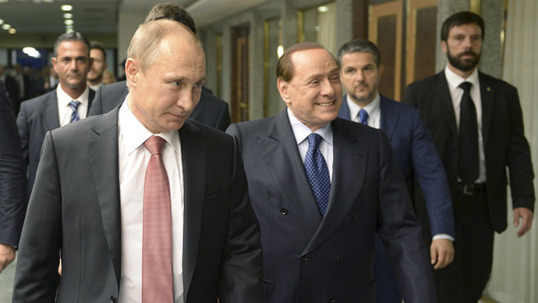
Former Italian prime minister Silvio Berlusconi became the most prominent Western politician to visit Russian-annexed Crimea when he strolled beside the Black Sea on Friday with Russian President Vladimir Putin.

Western visitors have been rare since Russia seized Crimea from Ukraine in March 2014. The takeover drove relations between Moscow and the West to their lowest point since the Cold War era, and prompted the United States and European Union to slap economic sanctions on Russia.

Putin and Berlusconi, known for their warm rapport going back more than a decade, laid flowers at a monument commemorating soldiers who fell in a 19th century war over Crimea. They included troops of the Kingdom of Sardinia, part of modern-day Italy.

Short footage run by Russia’s state TV broadcaster showed Putin telling Berlusconi he wanted to find out the names of the Italian soldiers and imprint them on the memorial.

As part of a joint two-day tour of Crimea, the two men then sat down in an open-air restaurant for a meeting with local residents of Italian origin.

A crowd of several hundred along the way cheered Berlusconi and Putin, who at one point took a small girl in his arms. Both took pictures with residents.

Source: Reuters

Putin on rise of right-wing in Europe

President Vladimir Putin said it was not Russia’s business to analyze the foreign policy of European countries, but discussing inter-European affairs with European partners in Washington “is not very interesting”.

The Russian president spoke to the Swiss RTS TV channel.

Asked to comment on the “ironic” turn in European politics, which has seen right-wing political parties gain public support, and seemingly speak out in favor of Putin’s statements as opposed to politicians on the left, the President said the underlying reason was Washington’s troublesome interference into the domestic affairs of other nations.

Putin has received support from Marine Le Pen of France’s National Front or Swiss Democratic Union of the Centre (UDC). He described it as a “tectonic shift in Europeans’ public conscience” in the direction of protecting national interests, including from foreign political interventions.

According to Putin, a number of issues Europe is facing now, including the influx of migrants from places such as war-torn Libya, have to do with “decisions taken over the [Atlantic] ocean.” In fact, Europe is now paying for decisions it did not make, he stressed.

He also mentioned that the US has been “pursuing an imperial policy for a long time.” In addition, he cited the opinion of some American political analysts who “believe that this imperial angle hurts the US.”

After several questions from Swiss media on the FIFA corruption scandal, Putin said he doesn’t believe it had anything to do with actions of the organization’s head, President Sepp Blatter, hinting that he views the allegations as politically motivated.

He questioned whether the efforts to pursue the investigation stemmed from failed attempts of the US and its key ally, the UK, to secure bids to host the 2022 and 2018 World Cups: “The way this fight against corruption looks makes me wonder if it isn’t a continuation of the bids for 2018 and 2022.”

He said European countries should be less beholden to military blocks and the US when considering issues concerning their own national interests.

“It would be great to see Europe show more independence and sovereignty, and the ability to stand up for its national interests – the interests of its peoples and countries,” Putin said in an interview with RTS published on Monday.

He added that he “hopes” another war in Europe is not in the cards.

The Russian leader added that a certain level of sovereignty is undoubtedly lost when joining any “any military-political organization [or] military-political bloc.” Putin noted that “France withdrew from NATO in order to preserve its sovereignty to a greater extent than would have been possible had it been part of the organization,” referring to the French withdrawal from NATO in the 1960s. France fully returned to the military bloc only in 2009.

Putin explained that Russia’s stance on US foreign policy “has nothing to do with anti-Americanism,” adding that Russians “have respect and great love for the USA, and especially for the American people.”

When answering a question about Russia’s earlier efforts to fight terrorism and the lack of Western support at the time, Putin said that European governments had ignored abundant evidence of terrorist activity, such as Al-Qaeda affiliates fighting in the Russian North Caucasus.

“When I asked my colleagues, including Europeans: ‘You see what is happening?’ they used to respond: ‘Yes, we do, but due to various domestic, international circumstances, we cannot support you.’ I would tell them then: ‘If you cannot support us – at least don’t hinder our efforts.’”

Putin criticized the US government’s self-perceived right to pressure other countries around the world, acting from a policy of “who is not with us, is against us.” Still, with enough patience it is possible and necessary to work with the American side on solving global issues, Putin said, praising international efforts that have led to a recent deal on Iran’s nuclear program.

Ilana Mercer: A Candidate To ‘Kick The Crap Out Of All The Politicians’

Since he announced for president, real-estate tycoon Donald Trump has distinguished himself from the pack of Republican presidential hopefuls.

Trump claims he opposed the invasion of Iraq. If this is true, it would make him better than almost all his Republican competitors, who mulishly continue to justify the most disastrous military campaign in American history (besides the War Between The States).

Decisive and to the point was Trump about liberalizing ties with Cuba: “It’s time!” he stated. The man who wrote “The Art of The Deal,” however, would rather a “deal” with Cuba favored ordinary Americans and Cubans, and would know how to “deliver the goods.”

We inhabit a world of managed, not free, trade. Trump is no rent-seeking political rat like every other Republican competing for the throne (besides Ben Carson, who is similarly motivated). Better than any self-interested politician, Trump can probably negotiate winning deals on all Treaties in Force, to the benefit of Americans.

“I’m really rich,” Trump swanked disarmingly. Being independently and stupendously wealthy means that this American individualist can continue to march to his own drumbeat; be as blunt and bold as he wants and pander to nobody.

“His fellow GOP presidential candidates,” explained Trump, are “totally controlled by their donors, by the lobbyists and by the special interests. If we have another politician, this country’s going down. … I’ve watched the politicians, I’ve dealt with them all my life. They will never make America great again. They don’t even have a chance.”

In the productive, non-parasitical economy, Trump has been enormously successful. Career politicians have created the hot mess that is America. The Founding Fathers wanted regular citizens to serve the public, not live off it as a vocation. Such upstanding Americans were to return to their careers after serving.

The consummate homo economicus, Trump is a rational actor in the market place. Unlike the rest of the GOP contenders who’re guided by political calculations; Trump speaks like a man to whom rational economic choices are second nature. And so he gets that the “stock market is bloated”; that the Stock Exchange is a laughing stock, and that soaring stock prices are a consequence of centrally planned, monetary stimulus.

The business mogul surprised Bill O’Reilly with the revelation that he’d “have a great relationship with Vladimir Putin.” This is a good thing. Whereas in the past, Trump was motivated by the sense that the nimbus of great power that surrounds the U.S. was dissipating—he now seems prepared to search closer to home for the causes of America’s economic inertia.

Also to O’Reilly, Trump “promised to build a wall along the southern border and make Mexico pay for it. ‘The Factor’ host stated that there’s no way they will pay for it.”

Although Bill is likelier than Dana Perino to comprehend the workings of tax and trade policy, Trump opted to calm the host down: “You have to let me handle that. They will pay for the wall, and the wall will go up.” D.C. insider Perino hit the roof: “On what planet is that actually true? Do you think you can make Mexico pay for a permanent wall between Mexico and the United States?” You can do that?”

A guide to the perpetually perplexed: Trump must be thinking of taking the populist path advocated by Pat Buchanan, whose patriotism is unimpeachable: tariffs. Levying a tariff on Mexico could indeed pay for a wall. Trade tariffs are not this libertarian’s bag. But walling off the deluge of Democrats crossing the southwest border is.

Finally, Trump is annoying the right people—from the liberal media to regimist neoconservatives like Perino and Charles Krauthammer, to noise making socialist Neil Young. In particular is the MSM furious about Trump’s matter-of-fact, informed assertion as to the quality of America’s largest immigrant population.

Donald Trump: “When Mexico sends its people, they’re not sending their best. They’re not sending you. … They’re sending people that have lots of problems and they’re bringing those problems with [them]. They’re bringing drugs. They’re bringing crime. They’re rapists. And some, I assume, are good people. But I speak to border guards, and they tell us what they’re getting.”

Brooke Baldwin, CNN: “… The notion of calling Mexicans rapists, people lose their jobs over words like those. And this is a man running for the president of the United States.”

Barbie, Trump created his job. He owns it.

And The Donald has certainly apprised himself of the facts. Perhaps he is reading Ann Coulter’s data-driven “Adios America!” in which she writes: “The U.S. government admits that at least 351,000 criminal immigrants were incarcerated [by] the United States as of 2011—the vast majority of them Mexican.” (Report to Congressional Requesters, 7 and 10.)

By the General Accountability Office’s “extremely conservative figures, Mexicans alone—forget other immigrants—have murdered a minimum of 23,000 Americans in the last few decades,” as compared to the Jihadis’ 4000 for the same time-frame.

I know, stick to rape; murder doesn’t matter. Cited in “Adios” is a report from the Inter-American Children’s Institute. It seconds what the media-political-complex has submerged. “Latin America is second only to Asia in the sexual exploitation of women and children because sex abuse is ‘ingrained [in] the minds of the people.’ Women and children are ‘seen as objects instead of human beings with rights and freedoms.’” (p. 168)

Ann’s “Adios” provides a critical-mass of evidence for Trumps impolitic statement. A few of Latin America’s proud sons are:

• Ariel Castro (kidnapper, sexual sadist, operated out of Cleveland)
• Elias Acevedo (173 counts of rape, 115 of kidnapping, Castro’s neighbor)
• Ingmar Cuandique (killer of Chandra Levy)
• Matias Reyes (contributor, Central Park rape)
• Conrado Juarez and family accomplices (Baby Hope’s rape and murder)

“Adios” cites well-concealed official records to uncover a preponderance of “Hispanic child rapists,” rounded up (and often released again), in “Nebraska, Indiana, even Hawaii.” When rates of child pregnancies and births are factored-in as proxies for rape; Latin America’s rape culture on American soil becomes even scarier.

Trump is on to something elusive: the truth.

Red State’s Erick Erickson concurs (kind of). “Trump’s campaign,” he writes,” “makes a hell of a lot of sense in an age when people no longer think their vote matters, but they sure want the crap kicked out of all the politicians they blame for making their vote meaningless.”

Get cracking, Donald.

Berlusconi’s party urge lifting of anti-Russian sanctions

The members of the Forza Italia party plan to come forth with the initiative that envisages the lifting of sanctions imposed on Russia by Italy, party leader Silvio Berlusconi said

Silvio Berlusconi’s party, Forza Italia, will urge the government to lift anti-Russian sanctions, which are crippling bilateral ties and harming Italy’s national interests, the former Prime Minister said after his meeting with President Vladimir Putin.

“Tomorrow we will present a motion calling on [the] government not to continue the sanctions against Russia, sanctions which harm our interests, causing significant financial losses,” Silvio Berlusconi said after his meeting with Putin at Fiumicino airport in Rome.

Berlusconi also said his Forza Italia party was planning to urge the Italian government to “commit itself” in convincing other European countries to follow its lead in lifting sanctions and “convince our American friends that the return to the atmosphere of the Cold War is inadmissible.”

The issue of Western sanctions and bilateral trade ties took center stage of Putin’s short visit to Italy.

While meeting with the current Italian Prime Minister Matteo Renzi in Milan, Putin was quick to point out that Italian companies had lost more than $1 billion due to the restrictive measures, while the trading volume shrank by one quarter in the first three months of 2015. The Russian president said that the sanctions also affected Russian-Italian military cooperation.

In Rome, meeting with Italian President Sergio Mattarella, the leaders discussed the necessity of maintaining strategic bilateral relations in “all spheres” and not allowing them to “become hostage” of current difficulties, Kremlin spokesman Dmitry Peskov said. He added both Mattarella and Putin agreed “all countries in Europe are paying too high a price for the ongoing internal Ukrainian conflict.”

Mattarella’s stance seems to echo statements by the Italian Foreign Minister Paolo Gentiloni who recently said that “Italy can’t afford to close the doors to Russia” and “can’t cut ties” with Moscow.

Berlusconi got a chance to meet Putin right before his departure to Moscow, and reminisce about the good old days of positive NATO-Russia relations.

The 78-year-old Italian said he remembers the times when world peace was fragile between the two nuclear superpowers. Berlusconi and Putin recalled the 2002 dialogue and cooperation, which established the NATO-Russia Council (NRC), which the former Italian Prime Minister said had put an end to the nuclear “nightmare.”

Berlusconi stressed the need to normalize relations between the West and Russia, insisting that is vital for cooperation on a global scale.

The 78 year-old said he is happy that Putin found time to visit Italy and even meet him personally, announcing that he will soon return the favor and come to Moscow. Berlusconi and Putin share a long personal connection over the years, and according to the Russian President, the bond of friendship they share doesn’t depend on political necessities.

Putins awards parents with seven or more kids

This is a wonderful event promoting family values. You don’t get to have dinner with the President every day, but these families deserved it!

The Order of Parental Glory is awarded to parents (including adoptive parents), who have raised seven or more children and pay great care to the next generation’s health, education, and physical, spiritual and moral development.

The decoration was instituted by a presidential executive order in May 2008, and was first awarded on January 13, 2009.

‘West still treats Africa as former vassals’

Western “colonial” states are not interested in South Africa’s development, but rather want to take its natural resources and never give anything back, pres. Jacob Zuma, told RT. It’s China’s investment that Zuma sees as a way to prosperity.

“The Western world or the European countries, in particular, came to Africa [in the 19th century] to colonize and they had been taking the resources of Africa,” Zuma said.

But even after the continent decolonized itself in the mid-20th century, its relationship with the US, UK, France and other Western countries “remained the same,” he stressed.

“They still regard us as the Third World, as a kind of people, who must be related to as the former subject [state], etc. That talks also to the economics… Their intention has never been to make the former colonial countries develop,” the president explained.

Zuma believes things “would never be the same” with China, which has been heavily investing in Africa since the early 2000s, as it came to the continent “as equals.”

“The Chinese come differently. They come to do business with us. They are ready to help… The results would be that African countries will be empowered,” he said.

China is educating African students and building highways in many countries, while the Western states “only built roads from mining areas to harbors,” the president added.

China is currently South Africa’s top trading partner, and Zuma expressed confidence that recent attacks on foreigners, in which Chinese citizens were affected, won’t lead to a cool down in relations between Pretoria and Beijing.

“The issue of xenophobia was exaggerated in South Africa,” he said, adding that the true reasons for the attacks lay outside racial issues.

The South African leader pointed out that thousands across the country had taken to the streets to protest xenophobia after five people died in violence in Durban in mid-April.

Despite “some things here and there,” South Africa was one of only two African nations approved as one of the 57 founding members of the Chinese-led Asian Infrastructure Investment Bank (AIIB).

Beijing and Pretoria will also join efforts to establish the BRICS bank (New Development Bank), with South Africa set to host the new financial institution’s regional center. The countries comprising the BRICS group are Brazil, Russia, India, China and South Africa.

Zuma criticized existing international financial institutions, such as the International Monetary Fund and the International Bank for Reconstruction and Development, saying that “it’s very difficult to pinpoint the real exemplary kind of delivery by these institutions,” and that African countries “got into more difficulties” by relying on their assistance.

The idea of the New Development Bank has “brought the fresh breath in the system,” he said.

“BRICS has brought the bank, which is a developer; which is going to operate differently… It’s focusing on the Third World, not just on the Third World, but whomever else. And it’s actually aimed at helping to uplift countries that need help,” the president said.

Meeting with Zuma, Russian President Vladimir Putin advocated BRICS development as a vehicle for improving the economies of Russia and South Africa.

Zuma arrived in Moscow on Vladimir Putin’s invitation as guest at the May 9 military parade dedicated to the 70th anniversary of Victory over Nazi Germany.

He stressed the importance of the occasion as “at times, people have got short memories. They might be forgetting that we came from a very serious situation, which led to many deaths.”

The South African president observed that the Soviet Union had “suffered a great deal” during World War II, noting that “the turning point of the defeat of fascism was done by the Russians.”

Source: RT

Senior rabbi warns against Putin’s ouster

A senior Russian rabbi warned of grave danger to Jews if Russian President Vladimir Putin is swept from power.

Alexander Boroda, head of the Chabad-affiliated Federation of Jewish Communities of Russia, made the warning Friday during a talk at Moscow’s 9th annual Jewish learning event organized by Limmud FSU.

“The Jews of Russia must realize the dangers inherent in the possible collapse of the Putin government, understand the rules of the game and be aware of the limitations,” Boroda said at a sessions, according to a translation provided by Limmud FSU.

The Moscow conference, which drew 1,400 participants, opened Friday at the state-owned Klyasma resort just outside the Russian capital.

Boroda’s Federation is among several Russian Jewish organizations that credit Putin for facilitating efforts to re-consolidate Russia’s Jewish community of 350,000 after decades of communist repression.

Under Putin, dozens of synagogues have been renovated with government support and a massive Jewish museum was opened in Moscow with state funding.

“In Russia, there is virtually unlimited freedom of religion and the Jewish community must ensure this situation continues,” Boroda said. “The support for religious institutions is wider than in the United States and defense of Jews against manifestations of anti-Semitism is greater than in other European countries. We do not have the privilege of losing what we have achieved and the support of the government for the community.”

All Russian Jews and especially those considering action against the Putin administration, Boroda said, “must understand the grave dangers that they take upon themselves and the potential consequences.”

Source: Haaretz

Moscow and Athens forge new alliance

The Greek prime minister’s visit to Moscow aimed at improving relations with Russia angers many in Europe – this is what reports in Greek media, covering the visit, boil down to.

Greek Prime Minister Alexis Tsipras is on a two-day visit to Moscow, making headlines in Greek media.”Alexis Tsipras’ upcoming visit to Moscow and meeting with Putin has generated much talk, analysis and warnings,” iefimerida.gr wrote in a piece titled Tsipras-Putin: Smiles in Moscow, Annoyance in Brussels. “Both sides underline that Moscow and Athens will discuss many issues and there is no shortage of speculations on what Tsipras will ask and what Putin will offer.

“The visit could help return Greek produce to the Russian market, according to the media outlet. “Exports are worth 125 million Euros and are of primary importance to the agriculture in northern Greece,” iefimerida.gr said.

EU sanctions and the Russian food ban, investments, privatization, energy cooperation and the Turkish Stream gas pipeline, tourism, the Ukrainian crisis and Greece-Turkey relations are the main topics on the agenda.

“Putin is preparing a ‘gift’ for Tsipras,” newsit.gr said, adding that it is the first visit of a Greek prime minister to Moscow in five years. According to the media outlet, Tsipras’ visit “caused outrage in Brussels” that “thinks the Russian president is trying to undermine the European stance on sanctions against Moscow.”

The visit sent partners and creditors, especially in Berlin, into turmoil. Some “on the other side of the Atlantic Ocean also worry that Greece would throw itself into Russia’s arms to come up with ‘alternative plans’ to solve the Greek problem,” the Crete media outlet pointed out.

“Tsipras and Putin are forging a new alliance,” according to protothema.gr. “All eyes in Europe are on Tsipras and Putin. ‘The spring’ in Greek-Russian relations gets on Europe’s nerves. The visit has created an atmosphere of enthusiasm in Moscow. … It is seen as a breakthrough in the bilateral relations that would revive and strengthen cooperation in a number of areas,” the media outlet said.”

The visit also sends important political signals: both countries are discontent with the West. In this context Tsipras wants to develop a diverse foreign policy and alliances, while Putin wants to show that he has power and influence to attract the attention of European leaders and countries,” protothema.gr said.

Source: Sputniknews

Britain warns it will expose Putin’s financial secrets

Britain may broadcast the financial secrets of Russia’s ruling elite as part of the information war against the Putin regime, the Foreign Secretary has indicated.

Philip Hammond said he was interested by the idea of publicising the wealth of the Russian president’s inner circle in order to embarrass them in front of their people, as part of the response to the ongoing incursion into eastern Ukraine.

The Foreign Secretary warned that Putin is rapidly modernising his armed forces, and warned Russia’s bid to destabilise eastern Europe poses “the greatest single threat” to British national security.

Mr Hammond said that Britain must now “accept” that efforts to offer Russia its “rightful place” in the post-Cold War order had been “rebuffed”.

It marks a change in tone from the British government: David Cameron has repeated said that the door is open to Russia to normalise relations.

He warned that Russia’s rapid rearmament is a “significant cause for concern,” and confirmed that British intelligence agencies are now recruiting Russian speakers.

The wealth of Putin’s court is opaque, but undoubtedly runs into tens of billions of dollars held in offshore accounts and property in London and New York.

Official statements of Putin’s wealth – a £96,000 a year salary, a flat and three cars – are frequently met with derision.

Asked if there was a case for the “interesting” financial arrangements of members of Putin’s inner circle to be published by the British government, Mr Hammond replied: “There might be.”

“When we talk about having further steps that we can take, increasing the pressure on Russia, one the headings that we regularly review is strategic communication.

“It is an interesting thought and I will make sure the Strat Comms people are thinking precisely about that.”

Mr Cameron has suggested the BBC budget should be increased to help its Russian and Ukrainian language services counter Russian television propaganda.

Source: The Telegraph

Putin heads for Hungary

Vladimir Putin has chosen Hungary for his first state visit to an EU state since the beginning of the Ukrainian crisis a year ago. Energy issues are expected to top the agenda, yet the Russian leader usually has an ace up his sleeve.

The Russian president’s visit to Hungary is keeping EU officials in Brussels guessing about what sort of deals exactly are going to be signed in Budapest.

Putin is visiting Prime Minister Viktor Orban at a time of unprecedented confrontation between the western world and Russia over the bloody conflict in Ukraine.

The EU has broadened its anti-Russian sanctions on Monday, expanding the blacklist with 19 more people and nine new companies. The EU blacklist now includes 151 citizens of Russia and Ukraine’s self-proclaimed eastern republics, as well as 37 Russian companies.

The Kremlin press service said that talks of the Russian and Hungarian leaders will focus on bilateral economic and trade relations, and in particular the nuclear energy deal signed in December.

Under a deal worth up to €10 billion, Russia’s Rosatom will build a 2,000 megawatt addition to Hungary’s state-owned nuclear power plant MVM Paksi Atomeromu.

Orban is famous for his skeptical attitude towards many European Union’s policies, particularly Brussels’ siding with the US in the sanctions against Russia, a campaign that damages ailing European economies.

Despite all the accusations, Orban’s Fidesz party won last year’s general election with a landslide victory, receiving practically 45 percent of votes and securing Orban’s third term as the Hungarian prime minister.

Prime Minister’s supporters view his action as defending Hungary’s national interests against agendas of international corporations and foreign governments. Among the biggest successes of the Orban government was the law that forced conversion of mortgages denominated in Swiss francs, which saved Hungarian borrowers from suffering a debt cost hike after Switzerland unpegged their currency from the euro, which resulted in sharp 20 percent gain in value.

Sleep-deprived Merkel at centre of Ukraine peace deal

When she arrived at the Brussels summit on Thursday, German chancellor Angela Merkel’s face bore the signs of the sleepless nights she has endured in the past week in a prodigious quest for a settlement of the Ukraine crisis.

But despite the deep rings around her eyes, there was no rest in sight for Europe’s most powerful leader. Just hours after the all-night Ukraine negotiations in Minsk, she was preparing for talks with her 27 fellow EU leaders — not least the radical new Greek prime minister Alexis Tsipras, with whom Germany is clashing over the country’s bailout.

“I have a certain camel-like quality,” Ms Merkel, 60, once said, explaining her capacity to keep going when others would have collapsed with tiredness. She has needed every ounce of it this week covering about 20,000 kilometres on an itinerary of Berlin-Kiev-Berlin-Moscow-Munich-Berlin-Washington-Ottawa-Berlin-Minsk-Brussels.

For all the effort, the ceasefire deal struck on Thursday morning is little different from a previous one reached in Minsk last September but never implemented.

Upon arrival in Brussels, Ms Merkel was more sober than triumphant, saying: “This is a glimmer of hope. Deeds must now follow words.”

It is her political style to tackle difficult problems step by step. With the Ukraine crisis, the first aim has long been to stop the fighting — and then hope that a ceasefire can create a little breathing space.

German officials concede that full implementation of the latest Minsk agreement might be a long shot — but believe even a “frozen conflict” in which the two sides did nothing more than stop fighting, would be worth the huge diplomatic effort.

The latest initiative sprang from a letter Mr Putin sent a month ago to Ukrainian president Petro Poroshenko offering peace talks. With the support of French president François Hollande, Ms Merkel decided it was worth engaging the Russian leader, especially with the fighting intensifying around the strategic town of Debaltseve and growing calls in the US for the west to arm Kiev.

The US was not invited to the peace talks. Thus Merkel’s shuttle diplomacy finally brought the Minsk meeting — and buckets of praise at home for the dogged chancellor.

“Merkel: the world chancellor” ran a headline in Bild, the tabloid.

Even Gregor Gysi, leader of the far-left Linke party and who has fought Ms Merkel for years, allowed himself to say: “If the chancellor succeeds, I will find the words to praise her.”

Host Belarusian president Aleksandr Lukashenko did not sleep much either and later joked that his task was “to provide supplies.” He later told the media that the leaders had the finest Russian and Belarusian “eggs, cheeses and dairy products, as well as buckets of coffee,” which helped them stay up “without so much as a nap,” pointing out that no one touched a single drop of alcohol, unlike the journalists.

Source: FT

Pentagon says Putin has Asperger’s

A study from a Pentagon think tank theorizes that Russian President Vladimir Putin has Asperger’s syndrome, “an autistic disorder which affects all of his decisions,” according to the 2008 report obtained by USA TODAY.

The 2008 report cites Dr. Stephen Porges, who is now a University of North Carolina psychiatry professor, as concluding that “Putin carries a form of autism.” However, Porges said Wednesday he had never seen the finished report and “would back off saying he has Asperger’s.”

Putin’s “neurological development was significantly interrupted in infancy,” wrote Brenda Connors, an expert in movement pattern analysis at the U.S. Naval War College in Newport, R.I. Studies of his movement, Connors wrote, reveal “that the Russian President carries a neurological abnormality.”

The 2008 study was one of many by Connors and her colleagues, who are contractors for the Office of Net Assessment (ONA), an internal Pentagon think tank that helps devise long-term military strategy. The 2008 report and a 2011 study were provided to USA TODAY as part of a Freedom of Information Act request.

Researchers can’t prove their theory about Putin and Asperger’s, the report said, because they were not able to perform a brain scan on the Russian president. The report cites work by autism specialists as backing their findings. It is not known whether the research has been acted on by Pentagon or administration officials.

USA TODAY reported in March 2014 about the Office of Net Assessment’s support for the research, but the Pentagon did not release the details of its studies. At the time, Pentagon officials said the research did not reach Defense Secretary Chuck Hagel or his predecessors. That is still true, said Lt. Col. Valerie Henderson, a Pentagon spokeswoman.

The Office of Net Assessment provides long-range plans for the Pentagon and helps shape future strategy. It has been particularly active in developing the military’s “pivot to Asia,” which has emphasized strategies to deal with China.

Connors’ team has done several studies on Putin for ONA beyond those from 2008 and 2011, Henderson said.

Connors’ program is called Body Leads. Military contract records show the Pentagon has paid at least $365,000 on outside experts to work with her since 2009. The two reports mention other work she and associates have done since Putin’s rise to power, including a 2005 study called “An Act of Trust to Move Ahead” and studies in 2004-05 and 2008 by movement pattern analysis pioneer Warren Lamb.

Source: USA Today

Putin’s favorite white philosopher

A rundown of beliefs espoused by Ivan Ilyin, Russia philosopher who most influenced the current Russia president

By Paul Robinson

In his speech to the Russian parliament on 4 December, Vladimir Putin quoted philosopher Ivan Ilyin, who died 60 years ago. Putin supervised the repatriation and reburial of Ilyin’s body in 2005, and has laid flowers on Ilyin’s grave.

He has quoted him several times before. Ilyin’s Our Tasks (Nashi Zadachi) was one of three books distributed by the Kremlin as recommended reading to regional governors and senior members of the United Russia party in early 2014.

And on December 22nd of this year, members of the Duma, Federation Council, and Presidential Administration will meet in Moscow for a round-table discussion of his work.

If Putin has a favourite philosopher, Ilyin seems to be the man. So who was he and what did he believe in?

Born in 1883, Ilyin studied law at Moscow State University and completed his thesis The philosophy of Hegel as a doctrine of the concreteness of God and humanity in 1916.

Resolutely anti-communist, he was expelled from Soviet Russia in 1922 along with some 200 other intellectuals on the infamous ‘philosophers’ steamboat’.

He then took up residence in Berlin, where he made contact with members of the exiled White army of General P.N. Wrangel, who nicknamed him Belyi (White) on account of the pure belizna (whiteness) of his opinions.

Ilyin became the unofficial ideologist of the White Army in exile, and much of his work thereafter was as much political as it was philosophical, and was aimed at a wider audience than other philosophers.

Ilyin’s work covered a large variety of subjects, including the philosophy of Hegel, law, politics, the ethics of violence, the nature of the Russian nation, and the tasks incumbent on Russian émigrés.

He was in many respects a religious philosopher, in that he regarded spiritual matters as more important than material ones. He believed that the Russian revolution was a product of the spiritual failings of the Russian people.

Russia’s resurrection depended on the revival of the correct spirit, including a love of God, a love of Russia, respect for the law, a sense of duty and honour, and devotion to the state and the common weal rather than personal or party interests.

It is difficult to reduce the writings of such a complex thinker to a few lines, but three themes stand out: gosudarstvennost’ (statehood); pravosoznanie (legal consciousness); and natsionalizm (nationalism).

Gosudarstvennost’. Ilyin was a firm believer in a strong state. Gosudarstvennost’ can be viewed in purely descriptive terms as meaning the system of government, but it is also a value-laden term.

It implies a belief that the interests of the state should come first. In this sense it can be contrasted with obshchestvennost’, which is often translated as ‘public opinion’ but more accurately describes the liberal stratum of Russian society and its beliefs, and it can be contrasted also with partiinost’, the ideology of the Communist Party, which placed the interests of the party first.

Ilyin believed that to view the state as a balance of competing material interests was profoundly mistaken. The state should work for the general good. To this end, it must be strong.

In Russia, a weak state would result in anarchy. ‘Russian state power will be strong, or it won’t exist at all’, he wrote. Ilyin rejected federalism and demanded a unitary state, ‘dictatorial in the scope of its powers.’ He favoured autocracy, but one filled with ‘creative spirit … a dictatorial-aristocratic-democracy.’

The state should be absolute in those areas in which it had competence. But it should not have competence over everything. ‘At the head of the state must stand a single will,’ he wrote, ‘It cannot and should not regulate everything. The totalitarian state is godless.’ The state had to be bound by law and accountable to the people.

Pravosoznanie: A lawyer by training, Ilyin was a firm believer in the importance of law. One of Imperial Russia’s greatest failings was its undeveloped ‘legal consciousness’, that is to say its people’s sense of what was right and wrong and whether they should obey the law.

One of the most important tasks of the autocratic state would be to develop the people’s legal consciousness until eventually it reached a level at which the people would become capable of self-government.

Until then, however, attempts to impose liberal democratic forms of government would be disastrous. Thus, in The essence of legal consciousness, Ilyin wrote:

‘The political structure and legal consciousness form a living, inseparable unity insofar as not a single reform is possible until a definite improvement in legal consciousness takes place, and any reform that is disproportionate to the state of popular legal consciousness will turn out to be absurd and ruinous for the state. The single true path to any reform is a gradual education in legal consciousness … in its idea the state can be reduced to self-government of the people. However, the sole and objective end of the state is so high and requires from the citizenry such mature legal consciousness that historically the people turn out to be incapable of self government. … Political philosophy must uncover the root of this divergence; state power must find the path to healing it.’

Natsionalizm: Ilyin was a nationalist. Love of country was a central part of his philosophy. Russians he felt, should put Russian interests first. This contrasted with the internationalist philosophy of the communists.

Furthermore, every nation, Ilyin said, should develop in its own way. Thus the West had no right to tell Russians how to run their own country; conditions in Russia weren’t the same as in the West. ‘Western Europe, which doesn’t know Russia, has not the slightest basis for imposing any political forms whatsoever on us,’ Ilyin declared.

At the same time, Ilyin’s vision of Russia was as a multi-national empire. He did not believe that every small nation had a right to self-determination. Ukrainian independence was anathema to him.

But, precisely because Russia was a multi-national country, and precisely because each nation should develop in its own way, Russians should not seek to assimilate the minorities within the country but leave them to develop their own culture.

In 1938 he fled Germany for Switzerland, where he lived the rest of his life, dying there in December 1954.

This article originally appeared here. 

Russia may build 24 nuclear power stations in India

A new road map on cooperation in the nuclear industry planned as Russian President Vladimir Putin visits Delhi on Thursday

Russia may build 20-24 nuclear power units in India against 14-16 units agreed previously, the Times of India reported Monday, citing Russia’s ambassador Alexander Kadakin.

The new road map on the countries’ cooperation in the nuclear industry can be formed during Russian President Vladimir Putin’s visit to Delhi on Thursday.

“We have big plans for nuclear energy cooperation,” Kadakin said, addressing a news conference ahead of Putin’s visit. “Russia had agreed to help India build 14-16 nuclear units. Now it seems that demand of India is much bigger and this may rise to 20-24 units.”

The countries plan to start negotiations for the construction of a fifth and sixth units at the Kudankulam nuclear plant soon, he also said. An agreement on the construction of the plant’s third and fourth units will be signed during Putin’s visit, he also said.

Russian nuclear power corporation Rosatom’s unit Atomstroyexport is building the Kudankulam plant in India’s southern state of Tamil Nadu under a contract signed in 1988. The plant’s first unit was launched in July 2013, while the construction of the second unit is currently at the final stage.

Source: Itar-TASS