Berlusconi’s party urge lifting of anti-Russian sanctions

The members of the Forza Italia party plan to come forth with the initiative that envisages the lifting of sanctions imposed on Russia by Italy, party leader Silvio Berlusconi said

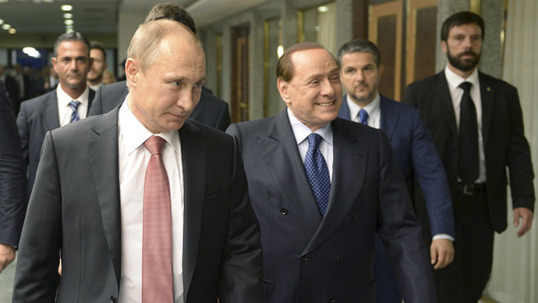
Silvio Berlusconi’s party, Forza Italia, will urge the government to lift anti-Russian sanctions, which are crippling bilateral ties and harming Italy’s national interests, the former Prime Minister said after his meeting with President Vladimir Putin.

“Tomorrow we will present a motion calling on [the] government not to continue the sanctions against Russia, sanctions which harm our interests, causing significant financial losses,” Silvio Berlusconi said after his meeting with Putin at Fiumicino airport in Rome.

Berlusconi also said his Forza Italia party was planning to urge the Italian government to “commit itself” in convincing other European countries to follow its lead in lifting sanctions and “convince our American friends that the return to the atmosphere of the Cold War is inadmissible.”

The issue of Western sanctions and bilateral trade ties took center stage of Putin’s short visit to Italy.

While meeting with the current Italian Prime Minister Matteo Renzi in Milan, Putin was quick to point out that Italian companies had lost more than $1 billion due to the restrictive measures, while the trading volume shrank by one quarter in the first three months of 2015. The Russian president said that the sanctions also affected Russian-Italian military cooperation.

In Rome, meeting with Italian President Sergio Mattarella, the leaders discussed the necessity of maintaining strategic bilateral relations in “all spheres” and not allowing them to “become hostage” of current difficulties, Kremlin spokesman Dmitry Peskov said. He added both Mattarella and Putin agreed “all countries in Europe are paying too high a price for the ongoing internal Ukrainian conflict.”

Mattarella’s stance seems to echo statements by the Italian Foreign Minister Paolo Gentiloni who recently said that “Italy can’t afford to close the doors to Russia” and “can’t cut ties” with Moscow.

Berlusconi got a chance to meet Putin right before his departure to Moscow, and reminisce about the good old days of positive NATO-Russia relations.

The 78-year-old Italian said he remembers the times when world peace was fragile between the two nuclear superpowers. Berlusconi and Putin recalled the 2002 dialogue and cooperation, which established the NATO-Russia Council (NRC), which the former Italian Prime Minister said had put an end to the nuclear “nightmare.”

Berlusconi stressed the need to normalize relations between the West and Russia, insisting that is vital for cooperation on a global scale.

The 78 year-old said he is happy that Putin found time to visit Italy and even meet him personally, announcing that he will soon return the favor and come to Moscow. Berlusconi and Putin share a long personal connection over the years, and according to the Russian President, the bond of friendship they share doesn’t depend on political necessities.

Putin visits Berlusconi

Russian President Vladimir Putin perhaps couldn’t resist an invite from his Italian chum, former Premier Silvio Berlusconi, in the early hours of Friday to his mansion in Milan, according to the WSJ.

A Russian presidential spokesman said Mr. Putin visited “his old friend” Mr. Berlusconi following an invite from the Italian politician. Mr. Berlusconi heads Italy’s biggest opposition party.

President Putin, 62, must have felt the need to relax after his meeting with Ms. Merkel at 1.36 a.m. CET on Friday. He drove off with a large police escort, which included dark limousines, to Mr. Berlusconi’s house and stayed there until roughly 3 a.m.

Putin is in Italy for peace talks with European Union leaders after Ukraine threatened the flow of natural gas. The government in Kiev wants to divert fuel for domestic use as it cannot pay for gas, Bloomberg reported.

“There are big transit risks,” Putin said yesterday in Belgrade, Serbia. If Russia sees its Ukrainian partners “are starting to siphon off our gas from the export pipeline network, we will respond by reducing flows by the amount stolen.”

Italy is the major terminal for South Stream.

The Italian EU presidency is in favour of the Russian pipeline, South Stream, which would circumvent Ukraine to bring gas to south-east Europe.

“We think South Stream should go ahead, as it would improve the diversification of gas routes to Europe,” Italy’s state secretary for EU affairs Sandro Gozi said in July during a press event in Brussels.

He echoed statements made by Italian foreign minister Federica Mogherini who visited Moscow in the same month and met with her Russian counterpart.

South Stream would deprive Ukraine of transit revenues from the gas pipelines that cross its territory and bring about 80 percent of Russian gas exports to EU countries.

It would also enable it to cut off supplies to Ukraine to exert political pressure, without affecting its EU gas clients.

Michael Gonchar, a former executive at Ukraine’s gas distribution firm, Naftogaz, told EUobserver, that, together with Nord Stream, Russia’s recently-built pipeline to Germany, South Stream would give Moscow “a 100 percent monopoly on shipments of gas to Europe from the east”.

He added that it would make it less likely that the EU will ever build a gas pipeline to the Caspian Sea, the so-called Southern Corridor, to diversify supplies.

Berlusconi calls EU leaders irresponsible towards Russia

Italy’s former Prime Minister and leader of the right-wing opposition party Forza Italia Silvio Berlusconi on Sunday accused NATO and Western leaders of irresponsible attitudes towards Russia.

“We are strangled by a most profound economic crisis, the situation is only worsening and it the situation is being aggravated by the international situation and the decisions of European leaders, heads of Western countries, the United States and NATO, who were irresponsible and unthinking to make null and void of the enormous work done after the signing of the Pratica di Mare agreement [on the establishment of the Russia-NATO Council] that ended the 50-year-long Cold War,” he said.

He said that the recent development around the Ukrainian crisis, the United States’ and the European Union’s policy of sanctions against Russia were irresponsible decision of the world leaders. “Russia cannot but defend Ukrainian citizens of the Russian origin who are like brothers for Russians,” he noted.

At the NATO summit Kiev has reached an agreement on sending Western military advisers to Ukraine and on the delivery of modern weapons from five countries, including Italy.

Yuri Lutsenko, an adviser to Ukrainian President Pyotr Poroshenko and leader of the Pyotr Poroshenko Bloc party, said on Sunday agreements were reached at the NATO summit.

“Agreements were reached at the NATO summit on Western military advisers and the delivery of modern weapons from the United States, France, Italy, Poland and Norway,” Lutsenko wrote on his Facebook page.

The Ukrainian president said last Friday on the results of the NATO summit in Wales that some countries were ready to supply weapons to Ukraine. Poroshenko declined then to specify the counties, offering Kiev these “newest types of weapons,” for confidentiality reasons.

‘Racist outbursts’ becoming common in Italy

Black footballer Balotelli on the cover of the Italian VanityFair

by Michele Leridon, Davide Lerner

From monkey chants in football stadiums to threats against the first black minister, racial outbursts in Italy reflect the profound social change taking place in a country relatively new to immigration.

Shocking episodes of racism have multiplied over the past few months, from hooligans taunting star striker Mario Balotelli with inflatable bananas to crude and vicious insults against the country’s Immigration Minister Cecile Kyenge, an Italian citizen born in the Democratic Republic of Congo.

Kyenge, who refuses to write Italy off as racist, has taken the brunt of the abuse since her election in April, shrugging off derogatory nicknames or photograph montages online in which her head is superimposed onto the bodies of indigenous African women.

“Why does no one rape her, so she can understand what the victims of atrocious crime feel?” a party official with Italy’s anti-immigrant Northern League party wrote of her last month in a Facebook post, while last week the vice-president of the Senate compared her to an orangutan.

The former was given a 13-month suspended sentence and was banned from public office for three years, while senator Roberto Calderoli is being investigated for inciting racial hatred — though he refuses to resign, insisting he has done enough by apologising to Kyenge with a bunch of flowers.

Bizarrely, the probe against him was only opened after a consumers association, Condacons, launched a complaint. And despite a petition signed by 200,000 people calling for Calderoli’s removal, the League member has so far managed to hold on to his prestigious Senate post.

“Italy is no more racist than other European countries, but sensitivity to the issue is not as developed here,” Italian historian Marco Fossati told AFP.

Michela Marzano, a philosopher and deputy from the centre-left Democratic Party (PD), said: “there is an extreme tolerance towards intolerance.”

“Italy has not had many opportunities to enter into contact with ‘the Other’, because it has always been a country of emigration rather than immigration,” she said.

While millions of Italian fleeing poverty emigrated to the United States, Latin America and other parts of Europe throughout the Twentieth century, the Mediterranean country has only had to absorb large numbers of immigrants over the past 20 years or so.

“We have remained very provincial, and the Calderoli affair has sparked a lot of indignation but no concrete action,” said Fossati, adding: “anyone who reacts with indignance is seen as a moralist, someone who is infected with the ‘politically correct’ virus.”

Luigi Manconi, head of the civil rights commission in the Senate, dates the ‘legitimisation’ of racial abuse back to an episode in 2007, when an Italian woman was raped by a Romanian man ahead of municipal elections, kicking off a fear-based campaign equating Romanians to rapists.

From that point, Manconi says, the Northern League — and Calderoli in particular — have felt increasingly free to be racist and “have played a fundamental role in the legitimation of xenophobia.”

Adriano Prosperi, modern history professor at Pisa University, compares Italians’ apathy in the face of racism today with the introduction of racial laws in 1938 which were “passively absorbed by Italian society” under dictator Benito Mussolini’s Fascist regime.

Centre-right former premier Silvio Berlusconi, renowned for off-colour comments, sparked a backlash in January when he stated during the inauguration of a Holocaust museum that the regime “in many ways did good things” for Italy — before retracting his comment.

Despite such incidents, Prosperi said he does not think Italy is “profoundly racist at heart”. While the League may generate shock headlines — its former leader Umberto Bossi once said immigrants arriving by boat should be shot at with cannons — it won just four percent in the last elections.

The real reason Calderoli has not been forced out, Prosperi says, is that the current government “has sacrificed values for the sake of realpolitik.” – AFP