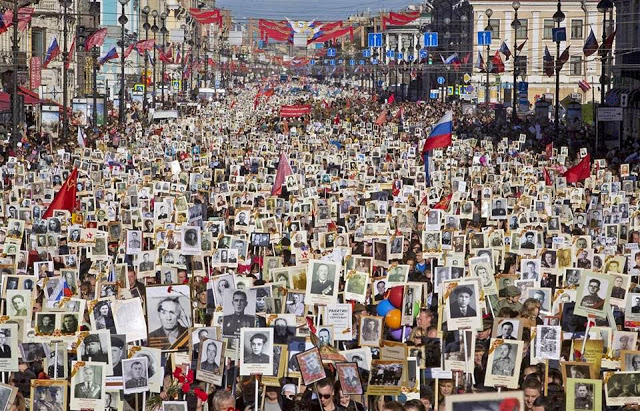
Ukraine’s settlement and possibilities for the restoration of cooperation between Russia and Germany will be high on the agenda of talks in the Kremlin on Sunday between Russian President Vladimir Putin and German Chancellor Angela Merkel, who is arriving in Moscow to attend celebrations in honour of the 70th anniversary of the World War II Victory.
Before the talks, the two leaders together will lay wreaths at the Tomb of the Unknown Soldier near the Kremlin wall.
Putin also spoke of the ‘Immortal Regiment‘ initiative’s importance earlier, while marching with over 300,000 people in Moscow’s Red Square, Saturday. “It was born not in cabinets, nor in administrative structures, but in the hearts of our people,” Putin told the interviewer.
“The sides will discuss, in particular, measures to boost trade and economic relations,” he said. In 2014, for the first time in recent years, a 6.5% decline in the Russian-German trade turnover volume was recorded, to $70.1 billion, compared to the previous year.
At the same time, the Russian economy has accumulated more than $21 billion of German investment. There are more than 6,000 companies with German participation operating in Russia, including about 800 – with 100% German capital. The volume of Russian investment in Germany is about $850 million.
The Kremlin also says the two countries have the traditionally intense cultural and humanitarian contacts and inter-regional cooperation.
The meeting with Merkel will complete the four-day “marathon” of international meetings that Putin has held on the sidelines of the Victory Day celebrations.
Since May 7, he has held talks with the leaders of the CIS (Commonwealth of Independent States) countries and the Eurasian Economic Union (EAEU), as well as with the leaders of Cuba, Mongolia, China, India, Vietnam, the Czech Republic, South Africa, as well as with the UN Secretary-General.
The South African president arrived in Moscow on Friday to join in commemorations of the 70th anniversary of the Allied victory.
Zuma urged on Saturday to endorse a “meaningful” reform of the United Nations to build a more just world order, the presidency said in a statement.
Meanwhile Martin Charmoy, head of Prosperity Capital Management fund in London, predicted that trade between Russia and China will reach $200 billion in the next several years.
Russia and China are quickly becoming close friends, a growing threat to European markets, Martin Charmoy, head of Prosperity Capital Management fund in London, said.
The analyst also predicted that trade between Russia and China will reach $200 billion in the next several years.
“Russia and China are becoming best friends,” Charmoy concluded.
Meanwhile, the analysts said European companies that once were very successful in the Russian market are losing their positions due to sanctions and the geopolitical situation.
This week during the Chinese President Xi Jinping’s visit to Moscow, a wide range of agreements in the trade, economic and energy fields were inked. The main issue on the agenda was an agreement to couple the Eurasian Economic Union and the Silk Road projects.
Last year, Russia’s gas-producing giant Gazprom and Chinese CNPC signed a deal to supply China with 38 billion cubic meters of gas per year over the next 30 years.
The total sum of the contract is estimated to be $400 billion, the largest Gazprom contract ever. The gas price is attached to the oil price. The supplies are planned to start in four to six years.
Russia may offer Greece a discount on gas deliveries and new loans when Greek Prime Minister Alexis Tsipras visits Moscow this week, the Kommersant business daily reported on Tuesday, citing one source in the Russian government.
A Kremlin spokesman said last week that Russian President Vladimir Putin and Tsipras planned to discuss economic ties and EU sanctions on Moscow when they meet for talks, which Kommersant said would take place on Thursday.
“We are ready to consider the issue of a gas price discount for Greece,” the newspaper said quoting an unnamed Russian government source.
Russia’s state-controlled producer Gazprom declined to comment. The Energy Ministry also declined to comment.
The source said that in exchange for the discount and some unspecified loans, Russia would want access to Greek assets. The source did not name any specific assets.
In recent weeks, the gas price charged by Gazprom has fallen, tracking lower oil prices. Gazprom said it wanted to acquire DEPA in 2013 but dropped its bid after failing to receive enough guarantees over DEPA’s financial position.
Vladimir Putin ordered the Russian state energy giant Gazprom to cut supplies to and through Ukraine amid accusations, according to The Daily Mail, that its neighbor has been siphoning off and stealing Russian gas.
Due to these “transit risks for European consumers in the territory of Ukraine,” Gazprom cut gas exports to Europe by 60%.
The EU raged that the sudden cut-off to some of its member countries was “completely unacceptable,” but Gazprom CEO Alexey Miller later added that Russia plans to shift all its natural gas flows crossing Ukraine to a route via Turkey; and Russian Energy Minister Alexander Novak stated unequivocally, “the decision has been made.”
Russia’s decision plunged the continent into an energy crisis ‘within hours’ as a dispute with Ukraine escalated.
Six countries reported a complete shut-off of Russian gas shipped via Ukraine today, in a sharp escalation of a struggle over energy that threatens Europe as winter sets in.
Bulgaria, Greece, Macedonia, Romania, Croatia and Turkey all reported a halt in gas shipments from Russia through Ukraine.
Russia’s President Vladimir Putin and China’s President Xi Jinping have discussed the possibility of using the yuan in mutual transactions in different fields of cooperation, Kremlin spokesman Dmitry Peskov said on Sunday.
“Much attention has been paid to the topic of mutual payments in diverse fields … in yuans which will help to strengthen the yuan as the region’s reserve currency,” Peskov said commenting on the meeting held between Putin and Xi on the sidelines of the Asia-Pacific Economic Cooperation (APEC) summit in Beijing, RIANovosti reported.
On October 13, Russian Economic Development Minister Alexei Ulyukayev announced that Russia was considering Chinese market to partially substitute access to the financial resources of the European Union and the United States.
The European Union and the United States have imposed several rounds of economic sanctions on Russia over its alleged involvement in the Ukrainian crisis, a claim Moscow has repeatedly denied. The restrictions prohibit major Russian companies from seeking financing on western capital markets.
Since the deterioration of Russia’s relations with the West, Moscow has increased its economic cooperation with the BRICS, Asia-Pacific and Latin America.
During the Asia-Pacific Economic Cooperation forum taking place this weekend in Beijing, Russia and China signed 17 documents on Sunday, greenlighting a second “mega” Russian natural gas to China via the so-called “western” or “Altay” route, which as previously reported, would supply 30 billion cubic meters (bcm) of gas a year to China.
Among the documents signed between Russian President Vladimir Putin and Chinese leader Xi Jinping were the memorandum on the delivery of Russian natural gas to China via the western route, the framework agreement on gas supplies between Russia’s Gazprom and China’s CNPC and the memorandum of understanding between the Russian energy giant and the Chinese state-owned oil and gas corporation.
“We have reached an understanding in principle concerning the opening of the western route,” Putin said. “We have already agreed on many technical and commercial aspects of this project, laying a good basis for reaching final arrangements.”
With the increase of deliveries via the western route, the total volume of Russian gas deliveries to China may exceed the current levels of export to Europe in the medium-term perspective.
China has now eclipsed Europe as Russia’s biggest, and most strategic natural gas client.
Russia launched a new and independent natural gas exchange that will reside in St. Petersburg, and will make the facility the largest market for natural gas trading in all of Europe.
Known as the St. Petersburg International Mercantile Exchange (SPIMEX), this trade facility will allow for international and domestic gas operations to sell their products in Russia and in a centralized location, and will become part of the growing Eurasian Economic Zone that is emerging in the East as global trade moves away from the dollar and away from U.S. hegemony.
The importance of this independent market exchange is that natural gas can work towards a complete separation from oil, which under the current system tends to price both commodities on similar scales and in dollar denominations. It will also open up the market for new buyers who are solely interested in natural gas, and help facilitate a new pricing structure that will allow Russia and other gas producers to eventually remove the energy source from the petro-dollar and from U.S. control over the monetary component in gas trading.
“Russia, the world’s second-largest producer of natural gas, has launched its first auction of natural gas on Friday at the St. Petersburg International Mercantile Exchange (SPIMEX). It will be Europe’s largest natural gas trading post.
The project is intended to create a more competitive market for natural gas prices, which at present are more-or-less tied to oil. Now, independent producers will have access to a broader range of buyers.
The exchange will facilitate up to 35 billion cubic meters of gas annually, with Gazprom, Russia’s largest producer, maintaining the right to sell a half of that, and independent producers the remaining 17.5 billion cubic meters.” – RT
It is interesting to note that the SPIMEX is beginning operations just two days after the tragic and highly suspect death of Total CEO Christophe de Margerie, who was in Russia to discuss energy topics with government and oil industry leaders. And with de Margerie being a staunch advocate of taking oil and energy off the antiquated petro-dollar system, it is very likely Total will be intrinsically involved in this new exchange.
With economic sanctions, and secret oil deals with Middle Eastern producers causing dire financial consequences to Russia’s currency and energy industries, the best way to circumvent external attacks is to simply bypass the recognized market structures and create your own platforms of trade, and in currencies that are beneficial to the well being of your economy. And while it may take some time before natural gas is completely segregated from oil and the petro-dollar, the introduction of the largest natural gas exchange in Europe will eventually allow Russia to establish price discovery for the commodity, and change the way customers are allowed to purchase this crucial form of energy for their natons and industries.
Russian President Vladimir Putin perhaps couldn’t resist an invite from his Italian chum, former Premier Silvio Berlusconi, in the early hours of Friday to his mansion in Milan, according to the WSJ.
A Russian presidential spokesman said Mr. Putin visited “his old friend” Mr. Berlusconi following an invite from the Italian politician. Mr. Berlusconi heads Italy’s biggest opposition party.
President Putin, 62, must have felt the need to relax after his meeting with Ms. Merkel at 1.36 a.m. CET on Friday. He drove off with a large police escort, which included dark limousines, to Mr. Berlusconi’s house and stayed there until roughly 3 a.m.
Putin is in Italy for peace talks with European Union leaders after Ukraine threatened the flow of natural gas. The government in Kiev wants to divert fuel for domestic use as it cannot pay for gas, Bloomberg reported.
“There are big transit risks,” Putin said yesterday in Belgrade, Serbia. If Russia sees its Ukrainian partners “are starting to siphon off our gas from the export pipeline network, we will respond by reducing flows by the amount stolen.”
Italy is the major terminal for South Stream.
The Italian EU presidency is in favour of the Russian pipeline, South Stream, which would circumvent Ukraine to bring gas to south-east Europe.
“We think South Stream should go ahead, as it would improve the diversification of gas routes to Europe,” Italy’s state secretary for EU affairs Sandro Gozi said in July during a press event in Brussels.
He echoed statements made by Italian foreign minister Federica Mogherini who visited Moscow in the same month and met with her Russian counterpart.
South Stream would deprive Ukraine of transit revenues from the gas pipelines that cross its territory and bring about 80 percent of Russian gas exports to EU countries.
It would also enable it to cut off supplies to Ukraine to exert political pressure, without affecting its EU gas clients.
Michael Gonchar, a former executive at Ukraine’s gas distribution firm, Naftogaz, told EUobserver, that, together with Nord Stream, Russia’s recently-built pipeline to Germany, South Stream would give Moscow “a 100 percent monopoly on shipments of gas to Europe from the east”.
He added that it would make it less likely that the EU will ever build a gas pipeline to the Caspian Sea, the so-called Southern Corridor, to diversify supplies.
Russia plans to sign a 30-year gas supply contract with China via the western route, Russian energy giant Gazprom’s CEO Alexei Miller told President Vladimir Putin on Wednesday. The route to supply gas to China via western Siberia may be implemented faster than the eastern route, through which Moscow has agreed to ship the fuel to its Asian neighbor in May.
“Gazprom plans to sign a contract to supply China with 30 billion cubic meters of natural gas via western route over thirty years,” Miller said.
The China-Russia West Route natural gas pipeline project connects gas deposits in Western Siberia and the northwestern part of China via Russia’s Altai region, securing the world’s top energy user a major source of cleaner fuel.
The potential of this route is “enormous”, the Gazprom CEO told the Russian President.
“It is even greater than in Eastern Siberia and, without a doubt, we can increase the volume of gas supplies very quickly via the western route, depending on the growth in demand in the Chinese market,” said Miller.
Gazprom is to sign the 30-year contract with China National Petroleum Corporation (CNPC) in November. The deal will directly link Russia’s huge gas fields to Asia’s booming market for the first time.
Miller also said Gazprom might consider more than doubling the volume of supply.
“We plan to sign a contract for a volume of 30 billion cubic metres for 30 years, though the talks have also looked at other figures for new contracts concluded for the western route. We are looking at the possibilities for supplying 60 billion cubic metres or up to 100 billion cubic metres of gas to China,” Miller told Putin in Moscow.
China and Russia signed a $400-billion gas supply deal in May this year, opening up a new market for Moscow as it risks losing European customers over the Ukraine crisis.
The Russian part of the joint venture pipeline, officially dubbed “Power of Siberia”, will be built by Gazprom with a total investment of $55 billion.
Construction of the China- Russia East Route natural gas pipeline started this month in this eastern Siberian city of Yakutsk.
BP Plc (BP/), Siemens AG (SIE) and Renault SA (RNO) are among European companies preparing for a downward turn in their Russian business following the European Union’s decision to impose its widest-ranging sanctions yet over President Vladimir Putin’s involvement in eastern Ukraine.
EU leaders announced plans yesterday to restrict the export to Russia of equipment to modernize the oil industry and forbid the sale of machinery, electronics and other civilian products with potential military uses. New arms contracts with Russia are also not allowed.
The sanctions will have a direct impact on companies like Siemens, which may no longer be able to sell oil equipment to Russia, and an indirect effect on many others like Renault, which expects the country’s auto market to contract more than 10 percent in 2014 as consumers hold back purchases. BP, owner of 20 percent of state-backed OAO Rosneft (ROSN), yesterday warned of risks to its profit and production due to the crisis.
“In Europe, for some companies this is becoming a major problem, and they can see it becoming an even bigger one,” said Andrew Kenningham, an economist at research firm Capital Economics. “The long-term impact of a standoff, if it continues, is clearly very bad for business confidence and future investment in Russia.”
Despite targeting oil production, the EU sanctions have steered clear of the natural-gas sector — leaving unscathed so far companies like BASF SE, the world’s biggest chemical producer, which gets about half its natural gas from state-controlled Gazprom, and other utilities like E.ON AG (TAG1Y) and RWE AG. On average, EU countries get 24 percent of their gas from Russia, according to Deutsche Bank — meaning that confronting Gazprom could result in supply cut-offs.
Vladimir Putin has scored a massive political victory in the heart of the Eurozone, after Austria openly defied NATO and sided with Russia.
Russia has an alternative pathway for its gas, one which bypasses Ukraine entirely and as the current South Stream framework is set up, crosses the Black Sea and enters Bulgaria before passing Serbia and Hungary on the way to the Central European energy hub located in Baumgarten, Austria.
The latest development comes only one short month after Putin concluded a game-changing deal with Beijing.
As Itar-Tass reports, citing Gazprom CEO Alexei Miller, “Russia’s gas giant Gazprom does not rule out gas transit via Ukraine may be stopped completely.”
“What happened once is a tendency, nothing happens incidentally. In 2009, gas supplies were stopped completely — so, we know precedents,” Miller told a briefing on Friday.
Clearly, this is bad news for Ukraine: Gazprom is no longer interested in participation in Ukraine’s gas transportation system (GTS).
“That train has departed”, the CEO said.
“It seems it departed yesterday,” Miller said. “It belongs to no one. The GTS has no owner,” he said. “The GTS of Ukraine does not belong to Naftogaz but to the Ukrainian government. Before discussing things with someone regarding modernization and cooperation, it should appear on the balance sheet of this or that economic entity.”
“Property and legal issues should be resolved first,” Miller said.
In fact, the civil war torn country may soon lose all leverage it had with both Europe and Russia as a transit hub for natural gas, which also means that it is quite likely that Ukraine is about to be abandoned by its western allies who will no longer have any practical use for it.
The Gazprom chief added that “a dozen Ukrainian laws need to be changed to be able to do something with the GTS.”
Confirming that Ukraine’s leverage at least with Russia is now effectively zero, Gazprom’s CEO also said that “As for the continuation of negotiations with Ukraine, today there is no subject for talks. First, they must repay their debts.”
“The gas price for Ukraine is fair – this price is fixed in the contract,” he stressed.
There have been no requests on the part of Ukraine’s national oil and gas company Naftogaz Ukrainy on a change of the transit deal with Russia, Alexei Miller said.
NATO will now turn its attention to the countries which the South Stream pipeline passes through.
Bulgaria, has just suffered its worst bank run in 17 years, and one which has paved the way to early elections.
This may provide the US with a government which will be more focused on their interests, instead of the current regime, whose allegiance to the Kremlin is said to take precedence.
The South Stream countries – starting with Bulgaria, and going through Serbia, Hungary, Slovenia, Italy and of course, Austria – will suffer scrutiny.
Finally, and perhaps most notably, is last week’s announcement by Gazprom CEO Miller that Gazprom is interested in discussing buying a stake in the Baumgarten gas hub.
“They do everything to disrupt this contract. There is nothing unusual here. This is an ordinary competitive struggle. In the course of this competition, political tools are also being used,” the Russian president said after holding talks with his Austrian counterpart, President Heinz Fischer, in Vienna.
Fischer defended the South Stream project, saying: “No one can explain to me – and I can’t explain to the Austrian people – why a pipeline that crosses EU and NATO countries can’t go 50 km into Austria.”
The mood turned jovial during Putin’s recent visit when the head of Austria’s chamber of commerce reminded Putin that part of Ukraine had belonged to Austria in 1914.
“What is that supposed to mean? What are you proposing?” Putin quipped, eliciting laughter from the business elite.
The one place which now matters most for Europe’s energy future is Austria.
Gazprom chief Alexei Miller said earlier he was in weekly if not daily contact with European Energy Commissioner Guenther Oettinger about winning approval for the South Stream project.
Russia’s Gazprom and Austria’s OMV oil and gas companies on Tuesday signed an agreement on the creation of a joint-stock company, South Stream Austria, outlining the principles for the construction and exploitation of the Austrian stretch of the South Stream gas pipeline.
The agreement was signed during Russian President Vladimir Putin’s visit to Vienna.
Gazprom and OMV will own a 50 percent stake each in the joint venture.
The agreement specifies the duties and responsibilities of the shareholders as well as the funding and profit-sharing principles.
In April, the sides sealed a memorandum on the construction of South Stream in Austria with annual gas supplies to that country through the future pipeline estimated at 32 billion cubic meters. Construction permit is expected to be issued in 2015 and the first supplies were initially set for 2017. The pipeline is due to reach its full operational capacity by 2018.
However, OMV hopes that Austria may get its first gas through South Stream earlier than planned – in late 2016.
Austria’s FM voices support for South Stream gas pipeline project
The pipeline with a total annual capacity of 63 billion cbm will connect the Russian port of Novorossiisk and the Bulgarian coast through the Black Sea and branch out towards Austria’s Baumgarten via Serbia and Hungary.
The agreement defines their specific rights and obligations and lays out the principles for financing and distribution of earnings among the shareholders.
The agreement signing was accompanied by approval of the final investment decision on construction of the Austrian segment of the pipeline under the previously agreed criteria, Gazprom said in a statement.
Gazprom considers Ukraine’s position a form of blackmail and a method to negotiate an ultra-low price, Aleksey Miller, head of Russia’s Gazprom, said on Monday.
“These absurd and unreasonable actions will ultimately hurt the Ukrainian economy, but after the Minister of Foreign Affairs comment last week, I am surprised by very little,” Prime Minister Dmitry Medvedev said after holding talks with Gazprom head Aleksey Miller and Russia’s Energy Minister Aleksandr Novak.
“Russia is ready to continue gas talks with Ukraine, but only on the condition of debt repayment,” Medvedev said at the meeting, noting Ukraine’s outstanding debt of $4.5 billion.
On Monday Gazprom introduced a prepayment system for Ukraine, who is months behind on its gas bills, and in the future will only get natural gas it pays for in advance.
Russia has offered Ukraine a final gas price of $385 per 1,000 cubic meters, but Ukraine has requested an interim price of $326, which was suggested by the EU.
“The terms offered to Kiev on gas were better than those that were given to the Yanukovich government,” Miller said. Under Yanukovich’s tenure, Ukraine scored a major discount and imported natural gas for $268.50 per 1,000 cubic meters, which was cancelled after his overthrow and the establishment of a coup-appointed government in Kiev.
“The system for prepaid gas is the result of the Ukrainian government’s unconstructive stance,” Gazprom head added.
Ukraine’s energy minister Yuriy Prodan in turn has confirmed that gas supplies from Moscow to Kiev have been reduced to zero, but insists that deliveries to Europe are safe.
Only 185 million cubic meters of natural gas per day will be transported through Ukraine to European markets, Prodan said.
Ukraine has more than 14 billion cubic meters of gas in underground storage, enough to meet its needs until December, the chief executive of state gas company Naftogaz said on Monday.
Prodan’s comments echo the earlier statements from Gazprom’s spokesperson, who said that as of Monday, Naftogaz, Ukraine’s state-owned gas and oil company, will receive gas only for which prepayment has been made, and since it has paid for nothing, it will receive nothing.
“Volumes of gas for European customers will be fully met in compliance with their contracts. Naftogaz must ensure transportation to the delivery points,” Kupriyanov said earlier. – RT.COM
The idea of a single European body that would be in charge of purchasing gas for the whole union is simply foolish and irrational, Gazprom Deputy Chairman Alexander Medvedev said, suggesting the Polish PM must’ve been out of his mind proposing it.
Speaking at the “Export and reliability of gas supplies to Europe” conference in Moscow, Gazprom Deputy CEO Aleksander Medvedev said that earlier calls by the Polish Prime Minister Donald Tusk to create a type of EU Gas Union for centralization of purchases of gas in Europe is irrational.
“Mr. Tusk is a politician who did quite a lot for the development of our relations,” Medvedev said. “And suddenly, as they say, he just falls out of an oak tree and says: ‘Why don’t we introduce the purchase of gas based on the example of some kind of atomic agency, where Europe at some point purchased enriched uranium?’”
Even the EU Energy Commissioner Guenther Oettinger believes that Tusk’s approach has no economic rationale behind it, Medvedev added.
“Gas is a special essence,” he said. “And even Mr. Oettinger agreed that the idea is far from being economically rational. I can say a lot about why this idea is foolish,” Gazprom executive added.
In the Financial Times editorial dated April 21, Tusk called for measures to tackle Russia’s monopoly in gas supplies to EU.
“Europe should confront Russia’s monopolistic position with a single European body charged with buying its gas,” Tusk wrote, adding, “I therefore propose an energy union.”
Russia is set to provide roughly 30 percent of growing European natural-gas demand by 2020. Even by conservative estimates, Europe by 2025 will require an additional 170 billion cubic meters of gas, and by 2035, Medvedev said that figure might constitute 225 billion cubic meters, creating an urgency for the investors to address the growing European demand for Russian gas.
Medvedev said Gazprom is willing to expand its supplies to Europe, but the process is being hindered by European partners.
“The problem with OPAL is still not solved, which, of course, is very, very strange,” said Medvedev, noting that agreements have already been signed. Under EU regulations Gazprom is only allowed to use 50 percent of capacity of the pipelines connecting the Nord Stream pipeline with the pipeline grid in Middle and Western Europe. Yet despite this, the European partners have repeatedly postponed a decision on the allocation of the remaining 50 percent capacity load.
“Calling this a policy would be a compliment to the politicians. This politicking, I can openly say,” said Medvedev .
Gas giant’s executive said that the same is true for the ‘Yamal – Europe-2’ gas pipeline which will allow increasing transit capacities of gas to central Europe.
“There is no doubt that the project is economically efficient. But then again, based on some political issues, we have not moved forward. They do not know what they are doing. But we’ll find another way to provide for our needs. You can’t win love by force,” he told reporters.
As far as the EU calls for the South Stream project to be halted, Gazprom says it is ready for the worst case scenario and can complete the project without outside investment.
“If you ask me if I’m ready for the worst case scenario, I’d say ‘Yes, we are ready,” Medvedev told journalists in Moscow.
Medvedev also said that US efforts to stop Russian energy supplies to Europe to increase American market share in the region are “impossible.”
“We understand that the US, sitting high on a hill and independent of economic cooperation with us, is pushing Europe to take wild steps,” Medvedev said. “I think that logic of European business cooperation won’t allow dementia to set in. Russian export restrictions are impossible.”
Cooperation of Russia’s and China’s defense ministries is an important factor for security in the region and the whole world, Russian President Vladimir Putin said after talks with China’s President Xi Jinping. “As far as military-technical cooperation contacts and contacts between defense ministries are concerned, such cooperation is a major factor for stability and security in the region and around the world,” Putin said. He noted joint projects in civil aircraft building.
“We have good prospects and good projects for creating a wide-body plane and heavy civilian helicopter,” Putin said.
Cooperation in the automobile industry was developing well, too, he said.
“We are working along all lines and there is progress everywhere,” Putin said.
“We shall be expanding financial infrastructures. Active work is underway to expand mutual settlements in the national currencies. We shall give thought to new instruments in the financial sphere,” he added, TASS reports.
Russia and China intend to raise their trade and business ties to a qualitatively new level as the two countries continue to boost their bilateral trade, Russian President Vladimir Putin said at negotiations with his Chinese counterpart Xi Jinping in Shanghai on Tuesday. According to Putin, he and the Chinese leader discussed bilateral issues and key international topics before they were joined by their countries’ delegations.
“Our countries have accomplished an enormous amount of joint work to reach this new historic landmark – a comprehensive partnership and strategic cooperation. China has gained a firm foothold as our main trade partner,” the Russian president said. Mutual trade between Russia and China grew by 2% to $90 billion in 2013 year-on-year, he said.
“Russian-Chinese cooperation has become a crucial factor of international stability. Our cooperation on the platform of the UN and other international organizations is becoming increasingly important. And we will continue to contribute to the development of regional ties, including within the SCO [Shanghai Cooperation Organization],” the Russian leader said.
Russia and China are resolved to resist the interference in internal affairs of other states urging to give up the language of unilateral sanctions, Russian President Vladimir Putin and Chinese leader Xi Jinping said in a joint statement following their talks in Shanghai. Russia and China also called for giving up funding or encouraging the activity aimed at changing the Constitutional order of other states.
“The parties underscore the necessity to respect the historical heritage of countries, their cultural traditions, the independently chosen social and political system, the system of values and ways of development, and resist the interference in internal affairs of other states, giving up the language of unilateral sanctions, the organization of assistance, funding or encouraging the activity aimed at changing the constitutional order of another state or its involvement in any multi-party association or union,” the document said.
The Russian and Chinese leaders call for “keeping the stability of international relations, peace and security at the regional and global levels, settling crises and disputes, fighting terrorism and cross border crime and resisting the proliferation of weapons of mass destruction.”
The parties agree that countries and peoples are increasingly dependent on each other in the modern world amid the convergence of the economies and cultures of different states, according to the joint statement, TASS reports.
Putin’s two-day visit to China may give momentum to restoring multipolar world
During the visit Putin will also hold separate bilateral meetings with some summit participants, in particular, Mongolian President Tsakhiagiin Elbegdorj, President of Afghanistan Hamid Karzai and Iranian President Hassan Rouhani.
A separate meeting of Putin with UN Secretary-General Ban Ki-moon is also planned. “The sides intend to exchange views on all important international issues, including on the situation in Ukraine,” Russian presidential aide Yuri Ushakov told TASS.
In addition, Putin will talk to the former President of the People’s Republic of China Jiang Zemin, “whom Vladimir Vladimirovich knows very well,” Ushakov added.
The current meeting between the heads of Russia and China is the second this year. They had previously met at the opening of the Sochi Olympics in February. According to Ushakov, the two heads of state plan to discuss important issues of the development of relations in various spheres, including interaction in the international arena. The side will pay major attention, in particular, to the work within the framework of the United Nations, BRICS group (bringing together Brazil, Russia, India, China and South Africa) and a number of regional structures, he said. On the talks’ results, the sides are expected to adopt a statement on a new stage in Russian-Chinese relations of comprehensive partnership and strategic interaction.
A package of documents that is planned to be signed in Shanghai would break a record in terms of the volume. “The package consists of 40 – 43 documents. The package that we have now is perhaps a record-breaking,” Ushakov said. He noted, in particular, that the sides continued the preparation of the contract between Russia’s natural gas monopoly Gazprom and China National Petroleum Corporation (CNPC).
China is Russia’s main trade partner. In 2013, the bilateral trade reached a record high level of 88.8 billion US dollars (1.7-percent increase from the 2012 level). In the first quarter of 2014, the growth of this indicator continued and reached 2.2%.
In the view of Ushakov, if this trend persists, the sides may reach by 2015 the level of 100 billion US dollars, and by 2020 – 200 billion US dollars.
The joint design of a long-haul wide-body aircraft and the production of Mil Mi-26 heavy helicopters in China will be the top priority military-technological cooperation areas discussed during the Chinese visit of Russian President Vladimir Putin, newspaper Kommersant said on Monday.
The newspaper quoted sources in the Russian delegation and said Russia’s United Aircraft Corporation (UAC) had drawn up a sketch project and a feasibility study of the prospective long-haul wide-body jet.
“This project is supposed to be a rival for US and European aircraft, and China is interested in building at least 1,000 jets. If the project is successful we may set up a joint venture at some point to compete full-scale against Airbus and Boeing. We are prepared to buy these aircraft for domestic needs, as well,” a source told Kommersant.
The second project will yield a heavy helicopter for Chinese military and civilian structures. “We offered them to buy Mil Mi-26 helicopters but our partners declined that option. They wished to design a helicopter capable of transporting up to 15 tonnes of cargo, so we suggested a concept of profound modernization of the Mi-26 and expressed readiness to start from scratch and to provide exclusive customization,” the source continued.
Putin said he believes the contract for the supply of gas to China will enable Russia to diversify its pipeline routes and will help China reduce its energy deficit. “We are consistently moving towards the formation of a strategic energy alliance,” Putin said. Simultaneously, “active work is being done to reduce the dependence of bilateral trade on external economic factors.”
Putin has said he is always glad to visit hospitable China. The expansion of ties with China is Russia’s indisputable foreign policy priority, Putin said in an interview for the Chinese media ahead of his visit to China. Bilateral cooperation has reached a higher level of comprehensive strategic partnership, he said.
He pointed out that the bilateral cooperation potential was far from exhausted.
Like government leaders everywhere, Russia’s Vladimir Putin often lies. But when he tells an uncomfortable truth, few people in the US or Europe bother to listen. Take what he said about Ukraine back in 2007, when Time magazine interviewed him as their “Person of the Year.”
The Russians subsidize Ukraine, Putin explained. They sell it natural gas and other energy resources at $3 billion to $5 billion a year below international market prices. At the same time, the US “somehow decided that part of the political elite in Ukraine is pro-American and part is pro-Russian, and they decided to support the ones they consider pro-American, the so-called orange coalition.”
Why, Putin asked, should Russia continue to subsidize Ukraine? “If you want to support someone, you pay for it. Nobody wants to pay.”
Putin had it right. In their proposed economic agreement with Ukrainian president Viktor Yanukovych, the Europeans offered very little money. In their negotiations with him during the Euromaidan protests, they and their allies in Washington continued to offer far less than the estimated $20 billion to $35 billion that the country needed.
In February, about a week before Yanukovych ran away, the Christian Science Monitor summed up the situation. Ukraine’s international currency reserves were falling at a vertiginous rate. The national currency, the hryvnia, had lost value, and the international credit rating agency Fitch had downgraded the country’s sovereign debt. How would Ukraine pay what it owed – primarily to Western banks and Russia’s Gasprom? How would it pay salaries, pensions, and social benefits?
The EU agreement looked to a major infusion of capital from the International Monetary Fund. But that would come only after the Ukrainians agreed to what IMF managing director Christiane Lagarde later called a “profound transformation,” especially of its fiscal policy, monetary policy, and policies on energy.
“Nobody is willing to give economic support, from the United States or from the IMF or from Europe, to an unreformed Ukraine,” US State Department’s Victoria Nuland said in Kiev on February 7.
The Westerners had good reason for being tight-fisted. They knew that the incredibly corrupt Yanukovych and the Ukrainian oligarchs would take the money and stay put. That is how the country’s oligarchic system works, with or without Yanukovych. Most of the new billionaires – including the leading candidate to become the new president, Petro Poroshenko – made their first big money by “privatizing” formerly state-owned enterprises.
“Ukraine’s oligarchs got rich during the privatization sales of former Soviet-owned industries and factories shortly after independence in 1991,” explained the Monitor. “The country’s main industries of mining, metals, chemical production, and energy distribution were snatched up by individuals, who then reaped millions in profits.”
The Monitor did not mention one significant fact. Privatization only came about the way it did with what one academic study called “the support and cajoling of Western donors.” Will foreign meddlers never learn?
Nor did the Western-backed rip-off stop with the original sin. Several analysts tell the same story, none more succinctly than the Monitor. “Many of the oligarchs’ businesses – particularly in the mining, heavy industry, and energy distribution industries – operate in dilapidated, Soviet-era facilities that are extremely energy-inefficient, and heavily dependent on government subsidies.”
In other words, when would-be reformers talk about Ukraine’s corruption, they mean the oligarchic system. Not necessarily personal corruption, but a pervasive systemic corruption.
“Corruption and politics have always had a close relationship in Ukraine,” explains the Monitor. “The oligarchs have benefitted for two decades from close relations with government officials, who have at times turned a blind eye to the activities in exchange for support. At other times, politicians have enabled their oligarch supporters to get richer through key government appointments and a lack of transparency in government contracts.”
Systemic corruption also gobbled up foreign assistance. Ukraine has gotten far more aid than any county in the former Soviet Union, energy specialist Emily Holland told Bloomberg Businessweek. And where has it gone? “Into the pockets of an incredibly corrupt political elite and oligarchs.”
The Russians, with their own oligarchic system, continued to subsidize Ukraine’s energy imports. They also agreed in December to buy $15 billion in Ukrainian Eurobonds, and actually laid out the first $3 billion.
“The economy of Ukraine was going into the wall and was heading for disaster,” the IMF’s Lagarde told PBS Newshour. “Without the support that they were getting from this lifeline that Russian had extended a few months ago, Ukraine was heading nowhere.”
Mounting violence from the protesters, continuing refusal of Brussels and Washington to come up with serious money, and increasing loss of support from the oligarchs convinced Yanukovych to jump ship. Putin responded by stopping the subsidies, which meant raising the price Ukraine had to pay for its energy imports.
Brussels and Washington were left holding the bag, as Putin had suggested they should. So, at warp speed, the IMF and Ukraine’s Western-backed interim government came to terms. The Ukrainians would agree to “profound transformation.” The IMF would give them something between $14 billion and $18 billion over time.
Having worked as a private banker, central banker, and Minister of Economy, Prime Minister Yatsenyuk knew from the start what lay ahead. “To be in this government is to commit political suicide,” he predicted even before the Russians moved into Crimea.
The biggest challenge, he told an investor’s conference in Kiev last week, will be to sell Ukrainians on the need for “painful economic reforms.” Unpegging the hryvnia from the dollar will likely cause a 3% drop in GDP, he explained. Cutting the public sector by 10% will put a lot of people out of work. Losing the Russian subsidy on energy and simultaneously cutting domestic fuel subsidies will greatly increase the cost of living, though the government would provide “some sort of subsidy” to the poorest five to eight million households.
Yats understood how this would breed discontent, especially in the east and south, where people lean more toward Russia. He knew Moscow was telling them that they would enjoy higher living standards in Russia, with higher wages and better pensions and without the austerity that the Kiev government was now offering. “They’re saying: if you go to Russia, you’ll be happy, smiling, and not living in a Western hell.”
That is Russian propaganda, no doubt. But the message rings true, doesn’t it?
Yats has a much bigger problem. He and his Western-backed interim government have gone to great lengths to give the oligarchs even greater power – far more than to the Svoboda Party or followers of Stepan Bandera in Yatsenyuk’s Fatherland Party. In one of their first acts in office, they appointed oligarchs like Ihor Kolomoisky and Serhiy Taruta as governors in Eastern Ukraine, and are already working closely with the country’s likely new president, Petro Poroshenko.
Many in the West welcome “the Chocolate King’s” presence, especially since he was the highest-profile oligarch to support the Euromaidan protest. Western “deciders” have looked kindly on him for years, as journalist Andriy Skumin wrote in March 2012, just after Yanukovych appointed Poroshenko Minister of Trade and Economic Development.
“European circles, blindly searching for any adequate Western-thinking individuals within Ukraine’s establishment, have a favorable opinion of Poroshenko as a person who is reliable, can be charged with introducing changes in Ukraine and ending the deadlock in EU–Ukraine relations” Skumin wrote. But “the preservation of the monopolistic oligarchy will not allow for any European integration or even domestic transformations using European patterns. The only thing that could be done is perhaps only an outward European appearance.”
“Profound transformation” requires killing the oligarchic system, which no one in the game – least of all Poroshenko – has come close to suggesting. This is the IMF’s big lie. Lagarde talks of changing Ukraine, but the people she has entrusted to make those changes are the precisely the ones whose power the country most needs to curtail.
To crib from Vladimir Putin, Poroshenko and his fellow oligarchs are neither pro-American, pro-European, nor pro-Russian. They are not even necessarily pro-Ukrainian, though a bit of patriotic fervor may help them shove austerity down the throats of their underlings. Ukrainian oligarchs, like American plutocrats, are simply pro-themselves.
A veteran of the Berkeley Free Speech Movement and the New Left monthly Ramparts, Steve Weissman lived for many years in London, working as a magazine writer and television producer. He now lives and works in France, where he is researching a new book, “Big Money and the Corporate State: How Global Banks, Corporations, and Speculators Rule and How to Nonviolently Break Their Hold.”
This website uses cookies to improve your experience. We'll assume you're ok with this, but you can opt-out if you wish. Cookie settingsACCEPT
Privacy & Cookies Policy
Privacy Overview
This website uses cookies to improve your experience while you navigate through the website. Out of these cookies, the cookies that are categorized as necessary are stored on your browser as they are essential for the working of basic functionalities of the website. We also use third-party cookies that help us analyze and understand how you use this website. These cookies will be stored in your browser only with your consent. You also have the option to opt-out of these cookies. But opting out of some of these cookies may have an effect on your browsing experience.
Necessary cookies are absolutely essential for the website to function properly. This category only includes cookies that ensures basic functionalities and security features of the website. These cookies do not store any personal information.
Any cookies that may not be particularly necessary for the website to function and is used specifically to collect user personal data via analytics, ads, other embedded contents are termed as non-necessary cookies. It is mandatory to procure user consent prior to running these cookies on your website.