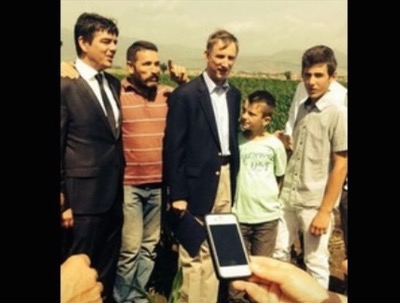
Failure of the US coup d’État in Macedonia

Macedonia has just neutralised an armed group whose sponsors had been under surveillance for at least eight months writes Thierry Meyssan.

By doing so, it has prevented a new attempt at a coup d’État, planned by Washington for the 17th of May. The aim was to spread the chaos already infecting Ukraine into Macedonia in order to stall the passage of a Russian gas pipeline to the European Union.

On the 9th of May, 2015, the Macedonian police launched a dawn operation to arrest an armed group which had infiltrated the country and which was suspected of preparing a number of attacks.

The police evacuated the civilian population before launching the assault.

The suspects opened fire, which led to a bitter firefight, leaving 14 terrorists and 8 members of the police forces dead. 30 people were taken prisoner. There were a large number of wounded

The Macedonian police were clearly well-informed before they launched their operation. According to the Minister for the Interior, Ivo Kotevski, the group was preparing a very important operation for the 17th May, the date of the demonstration organised by the Albanophone opposition in Skopje.

The identification of the suspects has made it possible to determine that they were almost all ex-members of the Kosovo Liberation Army).

The principal leaders of this operation, including Fadil Fejzullahu killed during the assault, are all close to the United States ambassador in Skopje, Paul Wohlers.

Paul Wohlers is the son of US diplomat Lester Wohlers, who played an important part in Atlantist propaganda, and directed the cinematographic service of the U.S. Information Agency. Paul’s brother, Laurence Wohlers, is presently an ambassador in the Central African Republic.

Paul Wohlers himself is a specialist in counter-espionage. He was the assistant director of the United States Department of State Operations Center, in other words, the service for the surveillance and protection of diplomats.

Although Macedonia is not a member of NATO, Jens Stoltenberg was « following » the police operation in Kumanovo.

To eliminate any doubt about the identity of the operation’s sponsors, the General Secretary of NATO Stoltenberg, intervened even before the assault was over – not to declare his condemnation of terrorism and his support for the constitutional government of Macedonia, but to paint a picture of the terrorist group as a legitimate ethnic opposition.

In January 2015, Macedonia foiled an attempted coup d’état organised for the head of the opposition, the social-democrat Zoran Zaev. Four peole were arrested, and Mr. Zaev had his passport confiscated, while the Atlantist press began its denunciation of an “authoritarian drift by the régime”.

Zoran Zaev is publicly supported by the embassies of the United States, the United Kingdom, Germany and Holland. But the only trace left of this attempted coup d’état indicates the responsibility of the US because this coup was coordinated by Mile Zechevich, an employee of one of George Soros’ foundations.

In order to understand Washington’s urgency to overthrow the Macedonian government, we have to go back and look at the gas pipeline war. Because international politics is a huge chess-board on which every move by any piece causes consequences for all the others.

The gas pipieline Turkish Stream was intended to pass through Turkey, Greece, Macedonia and Serbia in order to supply the European Union with Russian gas. On the initiative of Hungarian President Viktor Orbán, the Ministers for Foreign Affairs of each of the countries concerned met on the 7th April in Budapest to coordinate their position facing the United States and the European Union.

The United States have been attempting to sever communications between Russia and the European Union since 2007.

They managed to sabotage the projet South Stream by obliging Bulgaria to cancel its participation, but on the 1st December 2014, to everyone’s surprise, Russian President Vladimir Putin launched a new project when he succeeded in convincing his Turkish opposite number, Recep Tayyip Erdoğan, to sign an agreement with him, despite the fact that Turkey is a member of NATO.

It was agreed that Moscow would deliver gas to Ankara, and that in return, Ankara would deliver gas to the European Union, thus bypassing the anti-Russian embargo by Brussels. On the 18th of April 2015, the new Greek Prime Minister, Alexis Tsípras, gave his agreement that the pipeline could cross his country.

As for Macedonian Prime Minister Nikola Gruevski, he had already conluded discrete negotiations last March.

Finally, Serbia, which had been a partner in the South Stream project, indicated to the Russian Minister for Energy Aleksandar Novak, during his reception in Belgrade in April, that Serbia was ready to switch to the Turkish Stream project.

To halt the Russian project, Washington has multiplied its initiatives in Turkey, Greece, Macedonia and Serbia.

Last comment, but not the least: Turkish Stream will also supply Hungary and Austria, thus ending the alternative project negotiated by the United States with President Hassan Rohani – against the advice of the Revolutionary Guards – for supplying them with Iranian gas.

Thierry Meyssan French intellectual, founder and chairman of Voltaire Network. His columns specializing in international relations feature in daily newspapers and weekly magazines in Arabic, Spanish and Russian. His last two books published in English : 9/11 the Big Lie and Pentagate.

Putin visits Berlusconi

Russian President Vladimir Putin perhaps couldn’t resist an invite from his Italian chum, former Premier Silvio Berlusconi, in the early hours of Friday to his mansion in Milan, according to the WSJ.

A Russian presidential spokesman said Mr. Putin visited “his old friend” Mr. Berlusconi following an invite from the Italian politician. Mr. Berlusconi heads Italy’s biggest opposition party.

President Putin, 62, must have felt the need to relax after his meeting with Ms. Merkel at 1.36 a.m. CET on Friday. He drove off with a large police escort, which included dark limousines, to Mr. Berlusconi’s house and stayed there until roughly 3 a.m.

Putin is in Italy for peace talks with European Union leaders after Ukraine threatened the flow of natural gas. The government in Kiev wants to divert fuel for domestic use as it cannot pay for gas, Bloomberg reported.

“There are big transit risks,” Putin said yesterday in Belgrade, Serbia. If Russia sees its Ukrainian partners “are starting to siphon off our gas from the export pipeline network, we will respond by reducing flows by the amount stolen.”

Italy is the major terminal for South Stream.

The Italian EU presidency is in favour of the Russian pipeline, South Stream, which would circumvent Ukraine to bring gas to south-east Europe.

“We think South Stream should go ahead, as it would improve the diversification of gas routes to Europe,” Italy’s state secretary for EU affairs Sandro Gozi said in July during a press event in Brussels.

He echoed statements made by Italian foreign minister Federica Mogherini who visited Moscow in the same month and met with her Russian counterpart.

South Stream would deprive Ukraine of transit revenues from the gas pipelines that cross its territory and bring about 80 percent of Russian gas exports to EU countries.

It would also enable it to cut off supplies to Ukraine to exert political pressure, without affecting its EU gas clients.

Michael Gonchar, a former executive at Ukraine’s gas distribution firm, Naftogaz, told EUobserver, that, together with Nord Stream, Russia’s recently-built pipeline to Germany, South Stream would give Moscow “a 100 percent monopoly on shipments of gas to Europe from the east”.

He added that it would make it less likely that the EU will ever build a gas pipeline to the Caspian Sea, the so-called Southern Corridor, to diversify supplies.

Putin stresses importance of unblocking South Stream

It is important to unblock the situation around the South Stream gas pipeline that will make a weighty contribution to Europe’s energy security, Vladimir Putin said on Wednesday in an interview with the Serbian newspaper Politika.

“I feel confident this project will contribute considerably to the comprehensive energy security of Europe,” he said. “Everyone stands to gain from it – Russia and the European consumers including Serbia as well.

The problem of gas transit via Ukraine is still in place and its obvious solution is to diversify gas supply routes, Putin said.

“If we speak about further prospects of Russian gas exports to Europe, obviously, the problem of transit via the Ukrainian territory still exists,” he said. “One of the evident solutions is to diversify supplies routes.”

He stressed that Russia was ready to “continue constructive talks on those subjects”.

Also Putin hopes the European Commission (EC) will soon settle the issue of using the OPAL gas pipeline to full capacity.

“We hope that the European Commission will finally settle the issue of the full-capacity use of the OPAL gas pipeline,” he said in an interview with newspaper Politika.

South Stream gas pipeline project is expected to bring new investment to Serbia and to beef up its energy security, believes Russian President Vladimir Putin.

He said it on Wednesday in an interview with the Serbian daily Politika on the eve of his official visit to Belgrade.

“Implementation of the South Stream project should bring in no less than 2 billion to Serbia in the form of new investment and to beef up its energy security considerably,” Putin said.

South Stream is a global infrastructural project steered by Russia’s major producer and exporter of natural gas, OAO Gazprom. The pipeline that is destined to have a throughput capacity of 63 billion cubic meters /bcm/ will stretch across the floor of the Black Sea to reach the countries of Southern and Central Europe.

Its land-surface part will cross the territories of Bulgaria, Serbia, Hungary, Slovenia, and Austria.

In autumn 2013, the European Commission launched what it called an antitrust investigation targeting the South Stream, which it said stood at variance with the norms of the EU’s “third energy package”.

Earlier on Wednesday, Putin’s aide Yuri Ushakov said the South Stream project would come under discussion at the talks in Belgrade and preparations for building the Serbian section of the future pipeline were underway.

“The Serbs are making it clear that implementation of the project without consent from Brussels will be impossible in principle although they are fully ready for this /implementation/ and the project is of big interest for them,” Ushakov said.

Russian President Vladimir Putin hopes that Russian-Serbian trade will reach 2 billion dollars this year.

He said that a free trade regime existing between the two countries was contributing to steady development of Russian-Serbian economic ties.
“Our reciprocal trade turnover grew by 15% to reach 1.97 billion dollars in 2013. It grew by another 16.5% to reach 1.2 billion dollars in the first half of 2014. We hope to reach the figure of 2 billion dollars this year” Putin stressed.

Positive dynamics can be seen in the sphere of investments. The total volume of Russian capital investments in Serbia has exceeded 3 billion dollars, the bulk of which was channeled into the strategically important energy sector, Putin told Politika.

“The Naftna Industrija Srbije (NIS) oil company is a graphic example of our successful cooperation. It was a loss-making company that has turned into the main donor to the Serbian state budget,” Putin stressed.

The Russian head of state also said that the Russian Railways Company and the Russian credit support were enabling Serbia to modernize its railway infrastructure.

“I am glad that Serbian businessmen are active conquering the Russian market. For example, they are supplying quality agrarian and industrial products,” Putin stressed.

Earlier this month, Serbia suggested introducing a free trade regime for food products. According to Serbian Foreign Minister Ivica Dacic, Russia is thinking of lifting import duties for sugar, cigarettes, alcohol and poultry meat. The Russian Agriculture Ministry is considering a possibility of granting preferences to agricultural imports from Serbia.

Russia continues to regard Europeans as partners despite statements from Brussels, Russian foreign minister Sergei Lavrov said.

Source: ItarTASS

European parliament calls for cancellation of South Stream

In a resolution adopted Thursday, the European Parliament called on the EU leadership to cancel agreements with Russia, including on the construction of the South Stream gas pipeline.

The European Parliament “calls… on the Member States to cancel planned agreements with Russia in the energy sector, including the South Stream gas pipeline,” the resolution reads.

Aiming to diversify export routes from Russia to Central and Southern Europe, Russia began construction of the South Stream gas pipeline across the Black Sea in 2012. The pipeline, which will allow gas transfers to travel to Europe without crossing Ukraine, is expected to become fully operational by 2018. The first gas supplies are scheduled for late 2015.

Intergovernmental agreements were signed with Bulgaria, Serbia, Hungary, Greece, Slovenia, Austria and Croatia in order to implement the construction of onshore pipeline sections. However, in August, Bulgaria suspended operations saying that they did not meet the requirements of the European Commission.

The commission has long been trying to hamper the project saying it violates the EU’s Third Energy Package, which stipulates that pipelines in the European Union cannot belong to natural gas extractors. Moscow insists that the construction of the pipeline does not contradict the regulations in any way.

Source: RIA Novosti

Ukraine’s leverage evaporates

Vladimir Putin has scored a massive political victory in the heart of the Eurozone, after Austria openly defied NATO and sided with Russia.

Russia has an alternative pathway for its gas, one which bypasses Ukraine entirely and as the current South Stream framework is set up, crosses the Black Sea and enters Bulgaria before passing Serbia and Hungary on the way to the Central European energy hub located in Baumgarten, Austria.

The latest development comes only one short month after Putin concluded a game-changing deal with Beijing.

As Itar-Tass reports, citing Gazprom CEO Alexei Miller, “Russia’s gas giant Gazprom does not rule out gas transit via Ukraine may be stopped completely.”

“What happened once is a tendency, nothing happens incidentally. In 2009, gas supplies were stopped completely — so, we know precedents,” Miller told a briefing on Friday.

Clearly, this is bad news for Ukraine: Gazprom is no longer interested in participation in Ukraine’s gas transportation system (GTS).

“That train has departed”, the CEO said.

“It seems it departed yesterday,” Miller said. “It belongs to no one. The GTS has no owner,” he said. “The GTS of Ukraine does not belong to Naftogaz but to the Ukrainian government. Before discussing things with someone regarding modernization and cooperation, it should appear on the balance sheet of this or that economic entity.”

“Property and legal issues should be resolved first,” Miller said.

In fact, the civil war torn country may soon lose all leverage it had with both Europe and Russia as a transit hub for natural gas, which also means that it is quite likely that Ukraine is about to be abandoned by its western allies who will no longer have any practical use for it.

The Gazprom chief added that “a dozen Ukrainian laws need to be changed to be able to do something with the GTS.”

Confirming that Ukraine’s leverage at least with Russia is now effectively zero, Gazprom’s CEO also said that “As for the continuation of negotiations with Ukraine, today there is no subject for talks. First, they must repay their debts.”

“The gas price for Ukraine is fair – this price is fixed in the contract,” he stressed.

There have been no requests on the part of Ukraine’s national oil and gas company Naftogaz Ukrainy on a change of the transit deal with Russia, Alexei Miller said.

NATO will now turn its attention to the countries which the South Stream pipeline passes through.

Bulgaria, has just suffered its worst bank run in 17 years, and one which has paved the way to early elections.

This may provide the US with a government which will be more focused on their interests, instead of the current regime, whose allegiance to the Kremlin is said to take precedence.

The South Stream countries – starting with Bulgaria, and going through Serbia, Hungary,  Slovenia, Italy and of course, Austria – will suffer scrutiny.

Finally, and perhaps most notably, is last week’s announcement by Gazprom CEO Miller that Gazprom is interested in discussing buying a stake in the Baumgarten gas hub.

“They do everything to disrupt this contract. There is nothing unusual here. This is an ordinary competitive struggle. In the course of this competition, political tools are also being used,” the Russian president said after holding talks with his Austrian counterpart, President Heinz Fischer, in Vienna.

Fischer defended the South Stream project, saying: “No one can explain to me – and I can’t explain to the Austrian people – why a pipeline that crosses EU and NATO countries can’t go 50 km into Austria.”

The mood turned jovial during Putin’s recent visit when the head of Austria’s chamber of commerce reminded Putin that part of Ukraine had belonged to Austria in 1914.

“What is that supposed to mean? What are you proposing?” Putin quipped, eliciting laughter from the business elite.

The one place which now matters most for Europe’s energy future is Austria.

Gazprom chief Alexei Miller said earlier he was in weekly if not daily contact with European Energy Commissioner Guenther Oettinger about winning approval for the South Stream project.

Gazprom, Austria sign gas agreement

Russia’s Gazprom and Austria’s OMV oil and gas companies on Tuesday signed an agreement on the creation of a joint-stock company, South Stream Austria, outlining the principles for the construction and exploitation of the Austrian stretch of the South Stream gas pipeline.

The agreement was signed during Russian President Vladimir Putin’s visit to Vienna.

Gazprom and OMV will own a 50 percent stake each in the joint venture.

The agreement specifies the duties and responsibilities of the shareholders as well as the funding and profit-sharing principles.

In April, the sides sealed a memorandum on the construction of South Stream in Austria with annual gas supplies to that country through the future pipeline estimated at 32 billion cubic meters. Construction permit is expected to be issued in 2015 and the first supplies were initially set for 2017. The pipeline is due to reach its full operational capacity by 2018.

However, OMV hopes that Austria may get its first gas through South Stream earlier than planned – in late 2016.

Austria’s FM voices support for South Stream gas pipeline project
The pipeline with a total annual capacity of 63 billion cbm will connect the Russian port of Novorossiisk and the Bulgarian coast through the Black Sea and branch out towards Austria’s Baumgarten via Serbia and Hungary.

The agreement defines their specific rights and obligations and lays out the principles for financing and distribution of earnings among the shareholders.

The agreement signing was accompanied by approval of the final investment decision on construction of the Austrian segment of the pipeline under the previously agreed criteria, Gazprom said in a statement.

Source: Voice of Russia