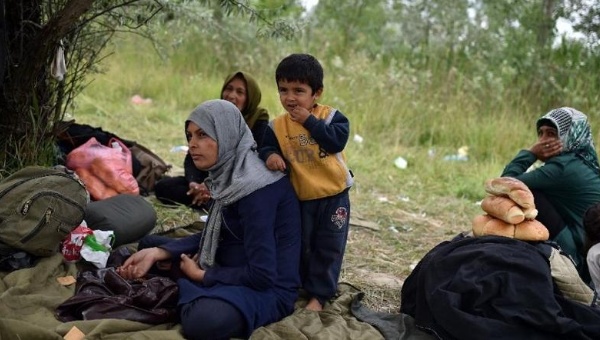
Hungary’s plans to build a wall that will prevent immigrants from entering the country.
The wall will run the entire length of the 109-mile border between the two countries, but Aleksandar Vucic, the Serbian prime minister, has said the four-metre (13ft) fence is “not the solution” to migrants entering Hungary from Serbia.
“Building walls is not the solution,” Vucic said today. “Serbia can’t be responsible for the situation created by the migrants, we are just a transit country. Is Serbia responsible for the crisis in Syria?”
Hungary, a landlocked country in central Europe, is also in the EU’s visa-free Schengen zone. It is therefore an attractive destination for migrants entering Europe through the Balkans from the Middle East and Africa, but Hungary has taken an increasingly hard-line approach to the issue of immigration in recent months.
The Hungarian Office of Immigration and Nationality says 57,000 irregular migrants have crossed into the country so far this year, a huge increase from the 43,000 that entered in the whole 2014.
Hungarian Prime Minister Viktor Orban’s government is under pressure from the far-right Jobbik party, which has been described by its critics as a neo-nazi movement and describes itself as a “principled, conservative and radically patriotic Christian party”. The party won its first ever individual constituency seat in parliament earlier this year.
“We should not look at economic immigration as if it had any use, because it only brings trouble and threats to European people,” he told state television in January, shortly after the Charlie Hebdo terror attacks in Paris. “Therefore, immigration must be stopped. That’s the Hungarian stance.”
The Hungarian government’s anti-immigration poster campaign earlier this month prompted fierce national debate. The posters displayed captions such as: “If you come to Hungary you mustn’t take away the work of Hungarians”, and were part of a national consultation on “immigration and terrorism” which included a survey sent to eight million Hungarian voters which appeared to link the two and drew widespread condemnation.
Several activists were arrested earlier this month for defacing the billboards, and others have begun a crowdfunding counter-campaign, designing their own posters to make fun of the government’s anti-immigration stance.
Earlier this year, there were reports that Bulgaria was building a wall along its Turkish border with the similar aim of keeping migrants out, as fears emerge that Bulgaria, Europe’s poorest country, will become the next frontier in Europe’s migrant crisis.
Moscow believes the events in Macedonia are being orchestrated from outside, Russian Foreign Minister Sergei Lavrov said Wednesday.
Lavrov said that outside pressure is being put on current Macedonian Prime Minister Nikola Gruevski for not agreeing to follow Western-backed sanctions against Russia and is being blamed for incompetency.
Moscow is concerned over the situation in Macedonia, Lavrov said during a speech before the Russian upper house of parliament.
Late in April, a group of some 40 Albanian-speaking gunmen briefly seized a police station in the northern Macedonian village of Gosince calling for the establishment of an Albanian state.
Less than three weeks after the incident, on May 9, Macedonia witnessed deadly clashes between police and an armed group of Albanians in Kumanovo, a city bordering Serbia and Kosovo.
Following the deadly clashes, the country was hit by a wave of protests staged by the Social Democratic Union of Macedonia (SDSM) that accuses the country’s government of corruption and demands its resignation.
Gruevski said that the opposition is trying to exploit the tragedy in Kumanovo to gain power.
According to the European Union Special Investigative Task Force’s (SITF) chief prosecutor, Clint Williamson some KLA senior officials committed crimes against humanity and war crimes following the end of the Kosovo War in 1999.
In a statement made recently, SITF announced its findings on the alleged crimes committed by members of ethnic-Albanian rebel organization Kosovo Liberation Army (KLA), which sought Kosovo’s separation from Serb territories in the 1990s.
The SITF says it found evidence “that certain elements of the KLA intentionally targeted the minority populations with acts of persecution that included unlawful killings, abductions, enforced disappearances, illegal detentions in camps in Kosovo and Albania, sexual violence, other forms of inhumane treatment, forced displacements of individuals from their homes and communities, and desecration and destruction of churches and other religious sites.”
Williamson underlined that the victims of these crimes were mainly Serbs, Roma and other minorities, but also Kosovo Albanians who were labeled as either collaborators with the Serbs or political opponents of the KLA leadership.
The SITF was set up by the European Union in September 2011 to conduct a full-scale criminal investigation into the allegations contained in the report of Council of Europe Rapporteur Dick Marty, who claimed he had information about former KLA officials harvesting and trafficking human organs.
Many people were mistreated by members of the Kosovo Liberation Army, the SITF found
“Over the past two and a half years, the SITF has conducted an intense, detailed investigation into the allegations in the Marty Report,” wrote Williamson the statement. “This investigation has involved interviews of hundreds of witnesses in countries throughout Europe and elsewhere. It has involved the review of thousands of pages of documents compiled by numerous organizations and individuals that were engaged in Kosovo during and after the period of our investigative focus.”
He added that the investigation has been a “challenging exercise” but was nevertheless convinced that it has been “the most comprehensive investigation ever done of crimes perpetrated in the period after the war ended in Kosovo in June 1999.”
In its press release, the SITF claims it can file an indictment against KLA individuals once “an appropriate judicial mechanism is established to host a fully independent, impartial and transparent trial that ensures the highest standards of security for witnesses and for criminal proceedings.”
Williamson thanked the European Union, its member states and international partners for their ongoing efforts in setting up a court for the proceedings.
It is important to unblock the situation around the South Stream gas pipeline that will make a weighty contribution to Europe’s energy security, Vladimir Putin said on Wednesday in an interview with the Serbian newspaper Politika.
“I feel confident this project will contribute considerably to the comprehensive energy security of Europe,” he said. “Everyone stands to gain from it – Russia and the European consumers including Serbia as well.
The problem of gas transit via Ukraine is still in place and its obvious solution is to diversify gas supply routes, Putin said.
“If we speak about further prospects of Russian gas exports to Europe, obviously, the problem of transit via the Ukrainian territory still exists,” he said. “One of the evident solutions is to diversify supplies routes.”
He stressed that Russia was ready to “continue constructive talks on those subjects”.
Also Putin hopes the European Commission (EC) will soon settle the issue of using the OPAL gas pipeline to full capacity.
“We hope that the European Commission will finally settle the issue of the full-capacity use of the OPAL gas pipeline,” he said in an interview with newspaper Politika.
South Stream gas pipeline project is expected to bring new investment to Serbia and to beef up its energy security, believes Russian President Vladimir Putin.
He said it on Wednesday in an interview with the Serbian daily Politika on the eve of his official visit to Belgrade.
“Implementation of the South Stream project should bring in no less than 2 billion to Serbia in the form of new investment and to beef up its energy security considerably,” Putin said.
South Stream is a global infrastructural project steered by Russia’s major producer and exporter of natural gas, OAO Gazprom. The pipeline that is destined to have a throughput capacity of 63 billion cubic meters /bcm/ will stretch across the floor of the Black Sea to reach the countries of Southern and Central Europe.
Its land-surface part will cross the territories of Bulgaria, Serbia, Hungary, Slovenia, and Austria.
In autumn 2013, the European Commission launched what it called an antitrust investigation targeting the South Stream, which it said stood at variance with the norms of the EU’s “third energy package”.
Earlier on Wednesday, Putin’s aide Yuri Ushakov said the South Stream project would come under discussion at the talks in Belgrade and preparations for building the Serbian section of the future pipeline were underway.
“The Serbs are making it clear that implementation of the project without consent from Brussels will be impossible in principle although they are fully ready for this /implementation/ and the project is of big interest for them,” Ushakov said.
Russian President Vladimir Putin hopes that Russian-Serbian trade will reach 2 billion dollars this year.
He said that a free trade regime existing between the two countries was contributing to steady development of Russian-Serbian economic ties.
“Our reciprocal trade turnover grew by 15% to reach 1.97 billion dollars in 2013. It grew by another 16.5% to reach 1.2 billion dollars in the first half of 2014. We hope to reach the figure of 2 billion dollars this year” Putin stressed.
Positive dynamics can be seen in the sphere of investments. The total volume of Russian capital investments in Serbia has exceeded 3 billion dollars, the bulk of which was channeled into the strategically important energy sector, Putin told Politika.
“The Naftna Industrija Srbije (NIS) oil company is a graphic example of our successful cooperation. It was a loss-making company that has turned into the main donor to the Serbian state budget,” Putin stressed.
The Russian head of state also said that the Russian Railways Company and the Russian credit support were enabling Serbia to modernize its railway infrastructure.
“I am glad that Serbian businessmen are active conquering the Russian market. For example, they are supplying quality agrarian and industrial products,” Putin stressed.
Earlier this month, Serbia suggested introducing a free trade regime for food products. According to Serbian Foreign Minister Ivica Dacic, Russia is thinking of lifting import duties for sugar, cigarettes, alcohol and poultry meat. The Russian Agriculture Ministry is considering a possibility of granting preferences to agricultural imports from Serbia.
Russia continues to regard Europeans as partners despite statements from Brussels, Russian foreign minister Sergei Lavrov said.
Top intelligence officers rarely reveal secret strings, pulling the nation’s political mechanism. Publication of a book like The German card. The obscure game of secret services, authored by Gerd-Helmut Komossa (Gerd-Helmut Komossa. DIE DEUTSCHE KARTE. Das verdeckte Spiel der geheimen Dienste. Ares-Verlag, Graz 2007. – 230 S.), is an exceptional occurrence. Raising very sensitive issues, the author appeals to the core of German identity that had been deliberately suppressed for decades by the United States and its allies.
The book is focused on contradictions between the United States and Germany, sometimes very strong but not supposed to be discussed in public. It was published in Austria, and its distribution in Germany may encounter certain difficulties today. Still, the very fact of its appearance indicates that the German intelligence community is increasingly dissatisfied with the role of a vassal of the United States (the definition applied to Europe by Zbigniew Brzezinski), imposed on Western Germany after World War II.
Gerd-Helmut Komossa reveals the uncomfortable truth about the post-war conditions, dictated by the US and its allies. The state treaty, dated May 21, 1949 and classified by BND as top secret, suggests restrictions of state sovereignty of the Federal Republic of Germany, introduced for a period until 2099. These restrictions include the provision that the winning coalition exercise complete control over Germany’s mass media and communications; that every Federal Chancellor is to sign the so-called Chancellor Act; that the gold reserve of Germany is kept under arrest.
In fact, all the German Chancellors, including the incumbent Chancellor Angela Merkel, pay their first foreign visit necessarily to the United States. The whole spectrum of German political parties is supervised by a special Washington-based controlling body, while local US-licensed media serve as a more sophisticated means of brainwashing than the Nazi propagandist machine. Meanwhile, Germany’s territory is still occupied by US troops.
This astonishing picture is not a fancy concoction of a political leftist. It is drawn by a military man whose mind has accumulated the experience of several crucial stages of development of the European civilization and Germany in particular. Gen. (Ret.) Gerd-Helmut Komossa took part in World War II and later in the Cold War. Possessing huge amounts of information, he analyzes the existing mechanisms of global policy with strong criticism.
Joining the Wehrmacht in 1943 as a volunteer, Komossa served at the Eastern front. Between May 1945 and April 1949, he was a prisoner of war. In the USSR, he got acquainted with many Russians who appeared to be quite different from the image imposed by the official Nazi propaganda.
Since 1956, he served in the German Bundeswehr, re-established under certain conditions. The abovementioned secret treaty admitted that the German sovereignty is sufficient for the right to build up military forces. According to the Constitution, the troops of the Federal Republic of Germany are carrying out exceptionally defensive functions. However, the Western coalition was pursuing different goals. It needed an army in new uniforms but with the same skills as the Nazi soldiers, perfectly fighting on land, on sea and in the air, and irrecusably abiding orders. Such a type of soldier was essential not only for the occasion of possible military collision with the Soviet bloc but also for fulfilling global missions. The coalition required at least 500,000 German soldiers. In addition, the newly-built army was supposed to purchase weapons and materiel solely from the United States.
During the last two decades, Washington has been trying to force Germany into military partnership in globalistic control. However, the massive effort to get Germany involved in US operations in Somalia and Bosnia, as well as in campaigns in Serbia, Iraq and Afghanistan, has brought about a reverse result, sparking a shift in approach in German strategic circles. The implicit discontent with American policy and essential difference in views on the role of the German people in current history eventually reached a critical dimension.
Since mid-1990s, the attitude of many German military to the United States, and significantly also towards NATO, has essentially changed. Though most of the German officers were not originally inclined against America, a lot of them being educated in the United States, they are now experiencing disappointment and even disgust with Washington’s policies. These officers realize that the hegemonistic policy is destined for destruction of socioeconomic systems of particular nations and whole regions, while the so-called order Washington is trying to impose is just a synonym for chaos.
Gerd-Helmut Komossa, in his former capacity of MAD (Military Counterintelligence) Director, was frequently called “a soldier with political thinking”. Today, he openly denounces the Bundeswehr’s involvement in foreign interventions, referring to the army’s constitutional duties.
Meanwhile, Washington urges Germans to go fighting. Conceding to the pressure, Berlin deployed a contingent of troops to Afghanistan. But even this was not sufficient for NATO bosses. Recently, NATO General Secretary Jaap de Hoop Scheffer accused the Bundeswehr of idleness in military operations in the region, and insisted that Germany “increase flexibility” and expand its military mission to the southern regions of Afghanistan.
In his book, Komossa inquires whether the state of affairs when young Germans are recruited in the national army for fulfilling overseas goals for other nations, could be acceptable. The map of operations, supposed to involve German troops, far exceeds the European continent, and has nothing to do with German national interests. “Do Germans expect this from the Bundeswehr? Would they like their soldiers to be called assassins again?” he asks.
However, the United States and its allies don’t care much for moral problems. As the secret treaty is valid until 2099, Germans are supposed to go and fight where they are told to.
The German audience will require certain time to digest the shocking information disclosed by General Komossa. But eventually, the nation with a great cultural and historical tradition will hardly agree to continue tolerating the American loop on its throat for decades more.
The publication of Komossa’s “German Card” is one more proof of the world’s transformation into a multipolar system. It indicates that Germany is likely to achieve complete sovereignty without waiting for eighty years.
Vladimir Putin has scored a massive political victory in the heart of the Eurozone, after Austria openly defied NATO and sided with Russia.
Russia has an alternative pathway for its gas, one which bypasses Ukraine entirely and as the current South Stream framework is set up, crosses the Black Sea and enters Bulgaria before passing Serbia and Hungary on the way to the Central European energy hub located in Baumgarten, Austria.
The latest development comes only one short month after Putin concluded a game-changing deal with Beijing.
As Itar-Tass reports, citing Gazprom CEO Alexei Miller, “Russia’s gas giant Gazprom does not rule out gas transit via Ukraine may be stopped completely.”
“What happened once is a tendency, nothing happens incidentally. In 2009, gas supplies were stopped completely — so, we know precedents,” Miller told a briefing on Friday.
Clearly, this is bad news for Ukraine: Gazprom is no longer interested in participation in Ukraine’s gas transportation system (GTS).
“That train has departed”, the CEO said.
“It seems it departed yesterday,” Miller said. “It belongs to no one. The GTS has no owner,” he said. “The GTS of Ukraine does not belong to Naftogaz but to the Ukrainian government. Before discussing things with someone regarding modernization and cooperation, it should appear on the balance sheet of this or that economic entity.”
“Property and legal issues should be resolved first,” Miller said.
In fact, the civil war torn country may soon lose all leverage it had with both Europe and Russia as a transit hub for natural gas, which also means that it is quite likely that Ukraine is about to be abandoned by its western allies who will no longer have any practical use for it.
The Gazprom chief added that “a dozen Ukrainian laws need to be changed to be able to do something with the GTS.”
Confirming that Ukraine’s leverage at least with Russia is now effectively zero, Gazprom’s CEO also said that “As for the continuation of negotiations with Ukraine, today there is no subject for talks. First, they must repay their debts.”
“The gas price for Ukraine is fair – this price is fixed in the contract,” he stressed.
There have been no requests on the part of Ukraine’s national oil and gas company Naftogaz Ukrainy on a change of the transit deal with Russia, Alexei Miller said.
NATO will now turn its attention to the countries which the South Stream pipeline passes through.
Bulgaria, has just suffered its worst bank run in 17 years, and one which has paved the way to early elections.
This may provide the US with a government which will be more focused on their interests, instead of the current regime, whose allegiance to the Kremlin is said to take precedence.
The South Stream countries – starting with Bulgaria, and going through Serbia, Hungary, Slovenia, Italy and of course, Austria – will suffer scrutiny.
Finally, and perhaps most notably, is last week’s announcement by Gazprom CEO Miller that Gazprom is interested in discussing buying a stake in the Baumgarten gas hub.
“They do everything to disrupt this contract. There is nothing unusual here. This is an ordinary competitive struggle. In the course of this competition, political tools are also being used,” the Russian president said after holding talks with his Austrian counterpart, President Heinz Fischer, in Vienna.
Fischer defended the South Stream project, saying: “No one can explain to me – and I can’t explain to the Austrian people – why a pipeline that crosses EU and NATO countries can’t go 50 km into Austria.”
The mood turned jovial during Putin’s recent visit when the head of Austria’s chamber of commerce reminded Putin that part of Ukraine had belonged to Austria in 1914.
“What is that supposed to mean? What are you proposing?” Putin quipped, eliciting laughter from the business elite.
The one place which now matters most for Europe’s energy future is Austria.
Gazprom chief Alexei Miller said earlier he was in weekly if not daily contact with European Energy Commissioner Guenther Oettinger about winning approval for the South Stream project.
Exactly 15 years ago, on March 24, NATO began its 78-day bombing of Yugoslavia. The alliance bypassed the UN under a “humanitarian” pretext, launching aggression that claimed hundreds of civilian lives and caused a much larger catastrophe than it averted.
Years on, Serbia still bears deep scars of the NATO bombings which, as the alliance put it, were aimed at “preventing instability spreading” in Kosovo. Questions remain on the very legality of the offense, which caused casualties and mass destruction in the Balkan republic.
Codenamed ‘Operation Allied Force,’ it was the largest attack ever undertaken by the alliance. It was also the first time that NATO used military force without the approval of the UN Security Council and against a sovereign nation that did not pose a real threat to any member of the alliance.
NATO demonstrated in 1999 that it can do whatever it wants under the guise of “humanitarian intervention,” “war on terror,” or “preventive war” – something that everyone has witnessed in subsequent years in different parts of the globe.
Nineteen NATO member states participated to some degree in the military campaign against the Federal Republic of Yugoslavia (Serbia and Montenegro), which lasted for 11 weeks until June 10, 1999.
In the course of the campaign, NATO launched 2,300 missiles at 990 targets and dropped 14,000 bombs, including depleted uranium bombs and cluster munitions (unexploded cluster bombs continued to pose a threat to people long after the campaign was over.) Over 2,000 civilians were killed, including 88 children, and thousands more were injured. Over 200,000 ethnic Serbs were forced to leave their homeland in Kosovo.
In what the alliance described as “collateral damage,” its airstrikes destroyed more than 300 schools, libraries, and over 20 hospitals. At least 40,000 homes were either completely eliminated or damaged and about 90 historic and architectural monuments were ruined. That is not to mention the long-term harm caused to the region’s ecology and, therefore, people’s health. Economic damage is estimated at over US$120 billion, according to Serbian media.
News correspondents Anissa Naouai and Jelena Milincic, the authors of RT’s documentary ‘Zashto?’ – which means “Why?” in English –traveled through former Yugoslavia to Belgrade, Kosovo, and Montenegro and spoke to people who endured the atrocities and horrors of the war and lost their friends and relatives.
“There is a bridge near the city of Nis, which was bombed at the time when a passenger train was passing through it,” Milincic recalls.The tragedy on April 12, 1999 killed 15 people and wounded 44 others, while many passengers were never accounted for.
“We felt the blast and saw flames under the locomotive. The train was blown so powerfully, half a meter from the ground. I don’t know how we stayed on the rails,” recalled witness Boban Kostic.
“Our colleague got off the train when I did,” he said. “He was really scared. But another rocket hit and blew him to pieces,” added another witness, Goran Mikic.
“Why? Why civilians? Why a train?” said Dragan Ciric. “It still torments me, if the first rocket was a mistake, what were the next three for?” he told RT.
The Chinese embassy in the Yugoslav capital of Belgrade was also hit and set on fire by NATO airstrikes on May 7, 1999. Three citizens of the country were killed. The alliance called the attack “a mistake.” China is a permanent member of the UN Security Council and, along with Russia, did not support a military solution for the Kosovo crisis.
Prior to the military assault, the Milosevic regime was accused of “excessive and disproportionate use of force in Kosovo.” But was the force that NATO used when bombing the sovereign state’s territory proportionate and restrained? Rights organization Amnesty International accused the allied forces of committing war crimes.
“Indications are that NATO did not always meet its legal obligations in selecting targets and in choosing means and methods of attack, On the basis of available evidence, including NATO’s own statements and accounts of specific incidents, Amnesty International believes that – whatever their intentions – NATO forces did commit serious violations of the laws of war leading in a number of cases to the unlawful killings of civilians,” the rights watchdog said in a report published in June 2000.
The alliance dismissed the accusations, saying that cases involving civilian deaths were due to technological failure or were simply “accidents of conflict.” NATO failed to say that they were due to the alliance’s own failure to take all necessary precautions.
“We never said we would avoid casualties. It would be foolhardy to say that, as no military operation in history has been perfect,” said Jamie Shea, NATO’s chief spokesman, the Guardian reported at the time.
Former NATO Secretary General Javier Solana ordered military action against Yugoslavia following a failure in negotiations on the Kosovo crisis in France’s Rambouillet and Paris in February and March 1999.
NATO’s decision was officially announced after talks between international mediators – known as the Contact Group – the Yugoslav government, and the delegation of Kosovo Albanians ended in a deadlock. Belgrade refused to allow foreign military presence on its territory while Albanians accepted the proposal.
Back then, Slobodan Milosevic’s forces were engaged in armed conflict with an Albanian rebel group, the Kosovo Liberation Army (KLA), which sought the province’s separation from Yugoslavia. Former US President Bill Clinton’s special envoy to the Balkans, Robert Gelbard, had earlier described the KLA as “without any questions, a terrorist group.” (The KLA was later repeatedly accused of being involved in the organ trafficking of Serbs in the late 1990s.)
However, despite not announcing the link officially, NATO entered the conflict on the side of the KLA, accusing Serbian security forces of atrocities and “ethnic cleansing” against ethnic Albanians in Kosovo. The main objective of the campaign was to make Milosevic’s forces pull out of the province. The fact that there was violence on both sides of the confrontation was ignored both by allied governments and Western media – which stirred up public anger by focusing only on Serbs’ atrocities and being far less vocal regarding abuses by Albanians.
“All efforts to achieve a negotiated political solution to the Kosovo crisis having failed, no alternative is open but to take military action,” Solana said on March 23, 1999. “We must halt the violence and bring an end to the humanitarian catastrophe now unfolding in Kosovo.”
An incident involving the “mass killing” of Albanians in central Kosovo’s village of Racak – a KLA stronghold – became a major excuse and justification for NATO’s decision to start its operation. Serbs were blamed for the deaths of dozens of Albanian “civilians” on January 15, 1999. However, it was alleged that the accusations could have been false and the bodies actually belonged to KLA insurgents whose clothes had been changed.
A central role in labeling the events in Racak “a massacre” belonged to William Walker, who headed the OSCE Kosovo Verification Mission. He visited the site shortly after the incident and made his judgment.
“[Walker] arrived there having no powers to make conclusions regarding what had happened,” Russian Foreign Minister Sergey Lavrov said in an interview with Rossiyskaya Gazenta paper in November last year.
Yugoslav authorities accused Walker of going beyond his mission and proclaimed him persona non grata, while Western leaders were infuriated over the Racak incident.
“And some time later the bombing started,” Lavrov recalled, adding that the situation in Racak became the “trigger point.” Moscow insisted that an investigation should be carried out. The EU commissioned a group of Finnish forensic experts to prepare a report on the incident. Later, the European Union handed it over to the International Criminal Tribunal for the former Yugoslavia, Lavrov said. The full version of the document has never been made public, said the minister, who was Moscow’s permanent representative to the UN between 1994 and 2004.
“But parts of the report leaked and were quoted in the media saying that [the victims] were not civilians and that all the bodies found in Racak were in disguise and that bullet holes on clothes and bodies did not match. There was also no one who was killed at short range,” Lavrov said. “Even though I’ve repeatedly raised this issue, the report itself still has not been shown.”
NATO halted its air campaign with the signing of the Military Technical Agreement in Kumanovo on June 9, 1999, with the Yugoslav government agreeing to withdraw its forces from Kosovo. On June 10, 1999, the UN Security Council adopted resolution 1244 to establish the UN Interim Administration Mission in Kosovo (UNMIK).
In August 2013, Amnesty International accused the UNMIK of failing to properly investigate the abductions and murders of Kosovo Serbs in the aftermath of the 1998-1999 war.
“Years have passed and the fate of the majority of the missing on both sides of the conflict is still unresolved, with their families still waiting for justice,” the organization said.
Moscow’s former envoy to NATO (1997-2002), Viktor Zavarzin, believes the military alliance’s aggression was “a crime against humanity” and a “violation of international laws and norms.” The event that unfolded 15 years ago laid ground to a new era of the development of international relations – the era of “chaosization of international law and its arbitrary manipulation,” Zavarzin, an MP for the United Russia party said at the State Duma plenary session on Friday.
The White House Fool has repeatedly declared erroneously and foolishly that it is “against international law” for Crimea to exercise self-determination. Self-determination, as used by Washington, is a propaganda term that serves Washington’s empire but is not permissible for real people to exercise.
On March 6 Obama telephoned Putin to tell the Russian President again that only Washington has the right to interfere in Ukraine and to insist against all logic that only the “government” in Kiev installed by the Washington-organized coup is “legitimate” and “democratic.”
In other words, the elected government in Crimea pushed by the people in Crimea to give them a vote on their future is “undemocratic” and “illegitimate,” but a non-elected government in Kiev imposed by Washington is the voice of self-determination and legitimacy.
Washington is so arrogant that it never occurs to the hubris-infected fools what the world thinks of Washington’s blatant hypocrisy.
Since the Clinton regime, Washington has done nothing but violate international law–Serbia, Kosovo, Afghanistan, Iraq, Libya, Syria, Iran, Pakistan, Yemen, Somalia, Honduras, Venezuela, Ecuador, Bolivia.
Does Russia have an Africa Command? No, but Washington does.
Is Russia surrounding the US with military bases? No, but Washington has used the NATO organization, whose purpose disappeared 23 years ago, to organize western, eastern, and southern Europe into an empire army with forward bases on Russia’s borders. Washington is determined to extend the boundaries of a North Atlantic Treaty Organization to Georgia in central Asia and to Ukraine on the Black Sea. Both Georgia and Ukraine are former constituent parts of both Russia and the Soviet Union.
Washington is doing the same thing to China and Iran. Washington is working to establish new air and naval bases in Philippines, South Korea, Vietnam, Thailand, Australia, with which to block the flow of oil and other resources into China. Iran is surrounded by some 40 US military bases and has US fleets standing off its coastline.
In Washington’s propaganda, this rank militarism is presented as “defending democracy.”
The Russian government continues to act as though Washington’s thrusts at Russia’s independence and strategic interests can be defused with good sense and good will. But Washington has neither.
Since the Clinton regime, Washington has been in the hands of a collection of ideologues who are convinced that the US is “the exceptional indispensable country” with the right to world hegemony. Everything that Washington has done in the 21st century is in pursuit of this goal.
Washington intends to break up the Russian Federation itself. Washington funnels huge sums of money into NGOs inside Russia that serve as Washington Fifth Columns and work hand-in-hand with Washington to discredit Russian free elections, to demonize Putin and the Russian government, to spread anti-Russian propaganda and agitation. It is amazing how many Russians actually believe the Western propaganda.
Washington is also working to isolate China with the Trans-Pacific-Partnership, but at this time is primarily focused on destabilizing and isolating Russia. Washington is desperate to break up the BRICS, the emerging organization of Brazil, Russia, India, China, and South Africa. With the largest countries and half of the world’s population, the BRICS organization is emerging as a political and economic power, especially with the organization’s plan to cease using the US dollar as reserve currency. Ringing Russia with US missile bases on Russia’s borders impairs Russian sovereignty and independence and, thus, weakens the BRICS as a countervailing power to Washington.
Many have been deceived by Washington’s propaganda. The world is slowly waking up, but is it in time?
The US media and much of Europe’s speak with one voice parroting Washington’s propaganda, demonizing Washington’s targets, and preparing insouciant Western populations for more war. The Western media, like Western governments, is devoid of integrity. Liars and whores rule.
Paul Craig Roberts is an economist and a nationally syndicated columnist for Creators Syndicate. He served as an Assistant Secretary of the Treasury in the Reagan Administration earning fame as the “Father of Reaganomics”. He is a former editor and columnist for the Wall Street Journal, among others. He has recently published How the Economy Was Lost: The War of the Worlds and is coauthor with Lawrence Stratton of The New Color Line and The Tyranny of Good Intentions.
This website uses cookies to improve your experience. We'll assume you're ok with this, but you can opt-out if you wish. Cookie settingsACCEPT
Privacy & Cookies Policy
Privacy Overview
This website uses cookies to improve your experience while you navigate through the website. Out of these cookies, the cookies that are categorized as necessary are stored on your browser as they are essential for the working of basic functionalities of the website. We also use third-party cookies that help us analyze and understand how you use this website. These cookies will be stored in your browser only with your consent. You also have the option to opt-out of these cookies. But opting out of some of these cookies may have an effect on your browsing experience.
Necessary cookies are absolutely essential for the website to function properly. This category only includes cookies that ensures basic functionalities and security features of the website. These cookies do not store any personal information.
Any cookies that may not be particularly necessary for the website to function and is used specifically to collect user personal data via analytics, ads, other embedded contents are termed as non-necessary cookies. It is mandatory to procure user consent prior to running these cookies on your website.