Weaponizing Migrants

Europeans ought to be demanding Uncle Sam’s head on a silver platter, and those of their own leaders on pikes.

Thanks to 25 years of lunatic U.S. foreign policy initiatives and relentless military aggressions, the steady drip of illegal immigration into Europe from Africa and the Middle East has become a crisis of refugees.

Not only has the U.S. killed and maimed at least a million people and displaced millions more, it has destroyed the property – water, sanitation and transport systems – that support the networks of trade and commerce essential to the survival of developed human communities.

The U.S. has salted great swaths of the Middle East with the desiccated and irradiated debris of war. Disease and contagions lurk in shadows while the agents of violence march in the noonday sun.

On Thursday last, Nicolas Bonnal, writing for the French website Boulevard Voltaire, reported on an Austrian magazine’s scoop – courtesy of leaks from military intelligence stationed in Vienna – that the U.S. government is paying guides and middlemen who bring migrants to Europe across the Mediterranean Sea. The original Info-Direkt article reported that the guides are well-equipped with technology, and are old hands at working Facebook, Twitter and Skype, as were the agents who instigated the Arab Spring.

With the targets of “color revolutions” having caught on to the CIA’s game of sedition, has inducing mass migrations meant to re-jigger the world so as to better serve their global purposes become the very latest weapon in the U.S. neo-cons’ arsenal?

It’s hard to credit the idea that Hillary Clinton, then the U.S. Secretary of State, didn’t understand the consequences of the “responsibility to protect” attack on Libya she and her foreign policy gal pals cooked up around the boiling cauldron that is U.S. foreign policy.

Muammar Gaddafi himself loudly warned both Italy and France, who so unwisely joined in the U.S.-instigated Libyan melee, of the flood of refugees that would come from toppling his gatekeeper government.

But why would a flood of refugees into Europe interest U.S. policymakers?

Possibly because the U.S.’s many attempts to bait Russia into attacking Ukrainian armed forces and thereby scare up increased Nato funding from the alliance’s membership have proved a risible failure. Flooding Europe with “swarms” of refugees just might convince Europeans that there is a useful purpose an expanding Nato presence could fulfill immediately.

Those same U.S. policymakers are actively working to inundate the U.S. with millions of migrants from Mexico and Central America, another imperial playground, on the flimsy basis of a Barack Obama Executive Order. Eager for a youthful, docile, dependent and cheap population of worker bees, the U.S. federal government is now engaged in draining the last wealth of the American middle class for use in settling and supporting many millions of immigrants, whose children will become the future taxpayers and voters the grotesquely obese federal government requires for its own future survival.

At last then, the long-sought weapons of mass destruction have been located. We can see them clearly now: They are Africa’s and the Middle East’s desperate and dispossessed migrants, and Central America’s young and unwitting illegals, of “the free world’s” creation, and they are on the move.

Source: Anne Williamson lewrockwell.com

Report suggests Russia and NATO are preparing for war

Russia and NATO are actively preparing for war with one another amid the greatest build up of military tension in Europe since the end of the Cold War, a new report says.

Rival exercises by the Russian armed forces and Nato have led to several near-miss incidents that could result in confrontation between the two sides, and leaders need to consider a new arms control treaty to avert the possibility of heightened tensions spilling into war.

The report by the European Leadership Network, a think tank, comes amid the most intense fighting for six months in eastern Ukraine and as Michael Fallon, the defence minister, pledged to expand a British army training mission to Ukraine.

“We do not suggest that the leadership of either side has made a decision to go to war or that a military conflict between the two is inevitable, but that the changed profile of exercises is a fact and it does play a role in sustaining the current climate of tensions in Europe,” the authors write.

The report outlines how both Nato and Russia have primed their forces to respond to an escalation since the Ukraine crisis erupted in early 2014.

The preparations include major military exercises by both Russia and Nato that appear designed exclusively to respond to one another’s capabilities and potential war plans.

”Whilst spokespeople may maintain that these operations are targeted against only hypothetical opponents, the nature and scale of the operations indicate otherwise,” the report writers say.

In March 2015, Russian conducted “snap exercises” that saw 80,000 troops engaged in long-range deployments and simulate combat on a scale that made the United States or Nato the only possibly adversary.

Nato’s exercise “Allied Shield,” in June this year, saw 15,000 allied troops engaged in a series of mock operations including response to a Crimea-style infiltration of irregular forces.

In both cases, the report writers find, the exercises focused on what the two sides perceive to be their most vulnerable areas, with and Nato moving to defend the Baltic States and Russia rushing reinforcements to the Arctic, its Baltic enclave of Kaliningrad, occupied Crimea, and Sakhalin island in the far east.

Allied Shield also included the first deployment of the Very High Readiness Taskforce, a rapid-reaction unit established at the Nato summit in Wales in 2014 in response to the annexation of Crimea.

The exercise, called ‘Noble Jump’, deployed 2,100 troops in a simulated a response to ‘unattibutable infiltration by an ally by irregular or special forces’ – essentially the scenario seen in Crimea and Eastern Ukraine since Early 2014.

The report recommends improvements in Nato-Russian communication to avert near misses and suggests working on a new arms treaty to restrict the use of conventional forces in Europe.

“If Russia or NATO decides at some point that they want to reduce tensions, showing restraint in terms of size or scenarios used for the exercises might be a good place to start,” the report writers conclude.

Source: The Telegraph

US missiles stay in Poland despite Iran deal

US anti-missile systems will be placed in Poland despite world powers reaching an agreement on Iran’s nuclear program, John A. Heffern, US Deputy Secretary of State for Europe and Eurasia, said.

“The deal with Tehran doesn’t include missiles, therefore the threat remains,” Heffern told Polish Rzeczpospolita newspaper Tuesday, adding that he was speaking about Iranian rockets without nuclear warheads.

According to the US diplomat, the construction of AMD components in the village of Redzikowo near the northern Polish town of Slupsk starts next year – as scheduled – and will be completed in 2018.

Washington’s plans to install anti-missile systems in Eastern Europe have been one of the biggest stumbling blocks in US-Russia relations.

Moscow refused to believe American explanations that the shield is needed to counter a possible attack from nuclear-capable Iran, considering it a threat to Russia’s national security.

After Tehran agreed to curb its controversial nuclear program in exchange of easing of international sanction, Russia’s foreign minister, Sergey Lavrov, said that Washington’s AMD plans had no justification anymore.

“We all probably remember that in April 2009 in Prague [US] President [Barack] Obama said that if the Iran nuclear program issue is sorted out, then the task of creating the European segment of the missile defense system would disappear,” Lavrov stated at a press conference in Vienna.

Meanwhile rearmament of Russia’s Strategic Missile Forces (RVSN) with the newest Yars mobile missile system is planned to be completed by 2021. Russian Defense Ministry’s spokesman for RVSN Dmitry Andreyev told TASS on Thursday that a division of the Yoshkar-Ola RVSN formation will be transferred to the Yars system in 2016.

In the next few years, the Topol mobile missile systems will remain at the heart of Russia’s “nuclear shield.”

About a hundred mobile missile carriers are now on combat duty across the country. The Topol mobile missile system, which has no analogues in the foreign missile industry, is designed to engage all types of strategic targets. Ove the past 30 years, about 100 missile launches have been carried out without a single abortive launch.

Yars is the result of modernization of the Topol system to destroy enemy’s stationary strategic targets with the RS-24 missile. It has increased total power of multiple warheads, equivalent to 45 US atomic bombs dropped on Hiroshima.

Israeli missile may have downed MH17

With debris of Malaysia Airlines Boeing 777 still covering the crash site in eastern Ukraine, the investigation of the July 17, 2014 tragedy is surrounded by secrecy. RT talked to international experts and the victims’ families, still waiting for answers.

“We want the facts, we don’t want propaganda,” Malaysian engineer Azahar Zanudin told RTD. “I’d like to know the real things about the disaster of MH17, because in MH17 case there is something wrong about the investigation,” the engineer said. Blaming the local media for “following the western media” bias, Zanudin has created a Facebook page, where he collects the news about the crash from around the world “for the people to see.”

“You can study the whole world behind your laptop, but the best thing you can do is check the spot yourself,” Dutch blogger Max Van Der Werff told RTD. The blogger has visited the crash site in Ukraine, and said that in the one week he spent there, he had learned more about the crash “than in a whole year behind my laptop.”

“The Netherlands is the official head of the investigation… (but) we are part of NATO, we are part of anti-Russian alliance, so we are not independent investigators,” Van Der Werff said, adding that the MH17 crash should have been investigated by the UN, “not a biased country like the Netherlands.”

Another independent researcher from the West also changed his opinion on the possible cause of the tragedy after visiting the crash site. “I thought that the story of (another) plane taking the Boeing was a propaganda of Russia,” German independent journalist Billy Six shared with RTD. Then he visited the site in eastern Ukraine and spoke to witnesses who claimed they saw military jets flying in the area, but no BUK missile launcher vapor trail.

A report on Malaysian Airlines MH17 air disaster in Ukraine last year by a group of old-hand aviation security experts maintains that the Boeing might have been downed by an Israeli Python air-to-air missile.

The report was leaked via the private LiveJournal account of Albert Naryshkin (aka albert_lex) late on Tuesday and has already been widely discussed by social media communities in Russia.

The authors of the investigative report have calculated the possible detonation initiation point of the missile that hit the passenger aircraft and approximate number and weight of strike elements, which in turn designated the type and presumed manufacturer of the weapon.

The missile that attacked MH17 had a passive radar homing head, which explains why the missile exploded so close to the cockpit. Under the radar-transparent nosecone of a Boeing 777-200 there is a surveillance radar station operable during the flight, so most likely the missile homed on to this radar as the target.

Apart from a radar homing head, the missile could also be equipped with an advanced, matrix type, imaging IR seeker, which enables the missile to determine the size and the type of the target and choose for attack its most vital element. For a huge Boeing aircraft, that’s the cockpit.

A simulation of the missile attack has proved that missiles with that type of guidance choose to attack a big passenger plane from the front hemisphere.

There are four air-to-air missiles that fit the description established by the experts, namely: French Magis-2, Israeli Shafrir, American AIM-9 and Israeli Python – all short-range.

The first three have been struck off the list for various reasons, including type of warhead or guidance system specifications. The Python deserved a closer look.

German missiles taken over by hackers

German-owned Patriot missiles stationed in Turkey were briefly taken over by hackers, according to media reports on Tuesday.

The attack took place on anti-aircraft ‘Patriot’ missiles on the Syrian border. The American-made weapons had been stationed there by the Bundeswehr (German army) to protect Nato ally Turkey.

According to the civil service magazine, the missile system carried out “unexplained” orders. It was not immediately clear when these orders were carried out and what they were.

The magazine speculates about two weak spots in the missile system which could be exploited by hackers.

One such weakness is the Sensor-Shooter-Interoperability (SSI) which exchanges real time information between the missile launcher and its control system.

The second exposed point is a computer chip which controls the guidance of the weapon.

Attackers might have gained access in two different ways, one that takes over the operating of the missile system and one that steals data from it.

The patriot missile has been in service in the US army since 1984 and was first used in operation in the first Gulf war in 1991.

In 2012 Turkey asked that its Nato partners support it by stationing Patriot missile systems there, after the civil war in Syria drew closer to its southern border.

In June 2015 Germany announced that it would replace its Patriot missiles with MEADS, an air defence system designed in cooperation with the USA and Italy.

Source: thelocal.de

NATO is the root cause of EU migrant crisis

The scale of the migrant crisis Europe is facing today cannot be understated. It is truly unprecedented. What is habitually understated, however — and in fact almost completely ignored by mainstream media — are the real roots of the crisis, says Danielle Ryan.

The debate around migration into the EU is happening nearly entirely without reference to the causes of the recent influx of migrants from North Africa and the Middle East. The elephant in the room is NATO and nobody really wants to talk about it.

Hundreds of articles, laden down with numbers and proposals and predictions fail to make any direct link between cause and effect. News anchors sit seemingly baffled, mouths agape, at the apocalyptic-like pictures they are seeing land on their desks, and yet few are willing to draw the appropriate conclusions. But it is such a basic and logical connection that it’s hard to believe it is not being made very loudly and very persistently.

Maybe it’s just that these journalists are so conditioned to framing U.S. and NATO policy in a positive light that the links don’t even really occur to them. Or maybe they’re simply embarrassed and trying to shift focus from their long-recorded support for various military interventions in these countries.

Either way, the result is that the story is framed in such a way that it makes the timing of the crisis sound almost random. We’re witnessing a conversation about how to ‘deal’ with boats full of Libyans making their way across the Mediterranean — as if Libya was a country that had just self-imploded yesterday, and for no discernible reason.

A fierce debate is raging over ‘what to do’ about these migrants — and in a way that’s understandable because that is the more immediate problem — but the debate we really need to be having is about the policies, NATO’s policies, which were the catalyst.

Even if Europe unites in formulating a ‘solution’ to the problem, it will be nothing more than a bandaid fix because it will only deal with symptom. After all, what’s the point in covering your open wound with a bandaid when the guy who cut you is still wielding a knife in the same room? It doesn’t take a genius to work out how that story ends.

Whenever the cause is grudgingly mentioned by the media, it is mentioned briefly and abstractly where the author or anchor might refer to “conflict” or make mention of how violence has “reignited” in these countries in recent years and months.

The editors at the New York Times in particular, are big fans of loading all the blame squarely onto Europe’s shoulders. Here a Times piece argues that the migrant crisis “puts Europe’s policy missteps into focus”. Another piece, from the editorial board, lectures Europe on how to handle the situation.

In April, NATO head Jens Stoltenberg called for a “comprehensive response” to the crisis and promised that NATO would help to stabilize the situation. The alliance’s role in “stabilizing” Afghanistan was part of its broader approach to the refugee crisis in the Mediterranean, he said.

That is rich coming from the head of a ‘security’ and ‘defensive’ alliance which for years has pursued a policy of offensive destabilization in the very regions which people are fleeing from in their hundreds of thousands. But Stoltenberg’s comments and NATO’s actions are easily decoded by the employment of some basic common sense.

The NATO modus operandi is clear. The pattern, repeated over and over, involves the complete destabilization of a region, to be swiftly followed up with another NATO-led ‘solution’ to the problem. When you couple that with the use of spokespeople who are unashamed to feign ignorance and lie blatantly (Jen Psaki, Marie Harf etc.), and a compliant media that will regurgitate the line without question, this is what you get.

The 2011 NATO intervention in Libya was authorized by the United Nations on “humanitarian” grounds and resulted in the deaths of between 50,000 and 100,000 people and the displacement of 2 million. Very humanitarian.

Similarly, after the U.S.-led campaign to destabilize Syria in an effort to topple Bashar al-Assad, facilitating (and even supporting) the rise of ISIS in the region, a staggering 10 million have been displaced (according to Amnesty International) and European countries are left to help pick up the pieces. Germany, for example, has pledged to resettle 30,000 Syrian refugees. Sweden, a non-NATO nation, has taken in similar numbers.

It should be made clear however, that the numbers European countries have taken or pledged to take pale in comparison to the numbers being hosted in other Middle Eastern countries. Lebanon, for example, is hosting 1.1 million Syrian refugees. Jordan is hosting more than 600,000. Iraq hosts nearly a quarter of a million. Turkey hosts 1.6 million.

There is one country that’s getting off scot-free in all of this — at least on the Syrian front. That country is the United States. The U.S. has taken in less than 900 Syrian refugees after four years of war. American officials have cited “national security” in their explanations for not yet taking more, although they have said they would like to see the number increase.

Maybe this has something to do with it?
Debate not allowed

There is a second media crime flying under the radar here and it is this: In European countries where the massive influx of migrants from the Middle East and North Africa have caused serious societal divisions, where migrants have failed to assimilate (for a variety of reasons, including both government policies and often radical religious beliefs), Western media will allow no one to talk about it honestly — and woe betide the person who tries.

Take Sweden, where the disease of political correctness is at an even more advanced stage than it is in the rest of Europe. There, any attempt to debate the coherence of a ‘doors wide open’ immigration policy is branded as “racist”. A further irony in the Swedish context, is that the country is facing a housing crisis and has nowhere to put most of the people they are pledging to resettle. There’s some real forward-thinking, common sense policy for you.

This is a dangerous combination for Europe: An unsustainable influx of migrants, foreign policy which ensures its continuation, a docile media, and an epidemic of political correctness which has infected the entire continent.

Media 101 on the migrant crisis: Talk a lot about migrants, don’t mention why they fled and then call anyone who has a problem with it a “racist” — success! Oh, and you get an added bonus if you can somehow link it all to ‘Russian aggression’, Vladimir Putin and NATO as a ‘defensive’ alliance.

Some European countries are taking a more hardline approach and are getting slammed for it. Hungary, for example, is looking at building a barrier wall along its border with Serbia, similar to barriers along the Greek-Turkish and Bulgarian-Turkish borders. Again, this has sparked accusations of xenophobia and racism from media and political quarters.

But that’s part of the game, isn’t it? If NATO’s war supporters can focus the debate around the idea that anyone who wants to address or critically assess immigration policy is “racist” then we won’t have to talk about why the migrants are here in the first place or why they are facing such dire circumstances at home.

Russia Today’s Oksana Boyko tried recently, to broach this topic with Peter Sutherland, the UN’s special representative on international migration and development, but she got nowhere. She argued that the debate around migration into the EU can’t really be had without addressing the essence and heart of the problem, but found that NATO policy is apparently a topic not up for discussion.

Debating Europe’s migrant crisis without acknowledging the context in which it has been created it useless. It would be like asking Americans to debate police brutality without talking about race. The two are inescapably interlinked and any ‘solutions’ that come from an incomplete debate will ultimately fail.

For now though, it seems Europe will continue to debate this humanitarian crisis in terms of ‘what to do’ without addressing the ‘how to stop’ and we’ll keep running around in a vicious circle.

An easier solution, of course, would be for NATO to put an end to its campaign of destabilization in the Middle East and North Africa, but that would require the acceptance and acknowledgement of some very hard truths.

Danielle is an Irish journalist and blogger. She has a degree in Business and German from Trinity College Dublin and studied political reporting at the Washington Center for Politics and Journalism in Washington, DC. Special interests: American politics and foreign policy, US-Russia relations and media bias. Her blog can be found at journalitico.com.

Berlusconi’s party urge lifting of anti-Russian sanctions

The members of the Forza Italia party plan to come forth with the initiative that envisages the lifting of sanctions imposed on Russia by Italy, party leader Silvio Berlusconi said

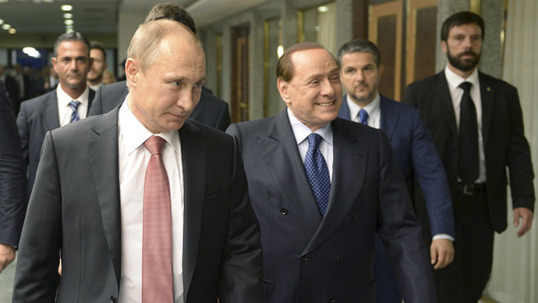
Silvio Berlusconi’s party, Forza Italia, will urge the government to lift anti-Russian sanctions, which are crippling bilateral ties and harming Italy’s national interests, the former Prime Minister said after his meeting with President Vladimir Putin.

“Tomorrow we will present a motion calling on [the] government not to continue the sanctions against Russia, sanctions which harm our interests, causing significant financial losses,” Silvio Berlusconi said after his meeting with Putin at Fiumicino airport in Rome.

Berlusconi also said his Forza Italia party was planning to urge the Italian government to “commit itself” in convincing other European countries to follow its lead in lifting sanctions and “convince our American friends that the return to the atmosphere of the Cold War is inadmissible.”

The issue of Western sanctions and bilateral trade ties took center stage of Putin’s short visit to Italy.

While meeting with the current Italian Prime Minister Matteo Renzi in Milan, Putin was quick to point out that Italian companies had lost more than $1 billion due to the restrictive measures, while the trading volume shrank by one quarter in the first three months of 2015. The Russian president said that the sanctions also affected Russian-Italian military cooperation.

In Rome, meeting with Italian President Sergio Mattarella, the leaders discussed the necessity of maintaining strategic bilateral relations in “all spheres” and not allowing them to “become hostage” of current difficulties, Kremlin spokesman Dmitry Peskov said. He added both Mattarella and Putin agreed “all countries in Europe are paying too high a price for the ongoing internal Ukrainian conflict.”

Mattarella’s stance seems to echo statements by the Italian Foreign Minister Paolo Gentiloni who recently said that “Italy can’t afford to close the doors to Russia” and “can’t cut ties” with Moscow.

Berlusconi got a chance to meet Putin right before his departure to Moscow, and reminisce about the good old days of positive NATO-Russia relations.

The 78-year-old Italian said he remembers the times when world peace was fragile between the two nuclear superpowers. Berlusconi and Putin recalled the 2002 dialogue and cooperation, which established the NATO-Russia Council (NRC), which the former Italian Prime Minister said had put an end to the nuclear “nightmare.”

Berlusconi stressed the need to normalize relations between the West and Russia, insisting that is vital for cooperation on a global scale.

The 78 year-old said he is happy that Putin found time to visit Italy and even meet him personally, announcing that he will soon return the favor and come to Moscow. Berlusconi and Putin share a long personal connection over the years, and according to the Russian President, the bond of friendship they share doesn’t depend on political necessities.

Bilderberg follows ANC in jamming signals

Cellphone signals were being jammed at South Africa’s Parliament ahead of the State of the Nation address, journalists and MPs reported. Now Bilderberg seems to have followed the move.

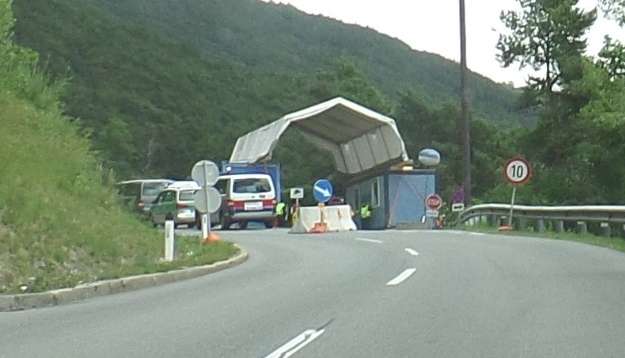
After visiting one of the closest spots to the InterAlpen hotel that is still accessible, Infowars filmed a communications truck owned by the Austrian Federal Ministry for Transport and Technology.

Large antennas are also visible on top of the hotel, as well as a giant newly erected mast in the forest near the hotel.

Infowars spoke to an informed local in the immediate vicinity who confirmed that cellphone coverage in the area around the hotel had died since the tower was erected. The individual had also met with police and security near the hotel.

Cellphone jammers work by preventing cellular phones from receiving signals from base stations. The jammers are technically illegal in European Union countries.

This triangulated jamming system would explain why Infowars reporters Rob Dew and Josh Owens have been unable to broadcast live via Skype anywhere near the InterAlpen hotel.

Apparently, Bilderberg is so afraid of media coverage, that police checkpoints miles away from the hotel are not enough, now they have resorted to installing expensive devices which shut down communications, presumably at taxpayer expense.

Media attending the State of the Nation address (SONA) at Parliament in Cape Town on 12 February 2015 reported that cellular phone signals (including mobile data) in the National Assembly had been jammed.

“Shocking: Parliament has scrambled all 3G and cell reception in the House,” tweeted Report editor Waldimar Pelser.

“Please help us Sanef, FXI, Right2Know. There’s a jamming device in the parly chamber next to media bay. We can’t work at SONA 2015,” an online editor posted to Twitter.

State Security Minister David Mahlobo said a ruling in the Western Cape High Court yesterday had clarified that the State Security Agency can own and operate cellphone jamming devices and use them at major events.

No fewer than three serving European prime ministers will be attending, from the Netherlands, Finland and Belgium. They will be discussing “European strategy” with the head of Nato, Jens Stoltenberg, and the president of Austria, Heinz Fischer. Two European finance ministers are on the list: one Dutch, the other from Britain.

Bilderberg 2015 has an extremely high-powered participant list, featuring a large number of senior politicians and public figures. With participants this powerful, and an agenda containing this many hot topics.

Bilderberg is actually where the big guns go, not the G7. They will be covering issues from Europe to terrorism and IT the policy conference.

Russian, Chinese warships enter Black Sea

For the first time in history, Chinese and Russian navies will begin a significant joint naval exercise in The Mediterranean Sea in mid-May.

Citied by RT, Chinese Defense Ministry spokesman Geng Yansheng said that “The aim is to deepen both countries’ friendly and practical cooperation, and increase our navies’ ability to jointly deal with maritime security threats,” but diplomatically added “these exercises are not aimed at any third party and have nothing to do with the regional situation.”

Against a background of this week’s “upgraded Japan-American military relationship” following Abe’s visit to Obama, as one analyst notes, “the geopolitical significance of its exercising alongside Russia will not be lost on the U.S. and NATO.”

While it was unclear if directly related to the upcoming “historic” drill, the Bosphorus Navy Blog reports that in what is a comparable “first” yesterday two warships from Peoples Republic of China were seen passing through the Bosphorus, and entering the Black Sea.

NATO promptly responded and hours ago AP reported that a top NATO commander said the alliance will briefly move its allied joint force command from Italy to Romania – which has a historic Black Sea port in the town of Constanta – as NATO continues to react to Russia’s moves in Ukraine.

Admiral Mark Ferguson, Commander of Allied Joint Force Command based in Naples, Italy, said the command will be based in Cincu, central Romania, for 12 days in June, to support a NATO exercise involving 1,000 troops from 21 NATO states.

Cincu is Romania’s largest military shooting range, some 180 kilometers (112 miles) northwest of Bucharest.

Source: Zerohedge

Hope on the horizon and it comes from Greece

Washington in its arrogance, seeing itself as “indispensable,” poses a continuing threat to the lives of hundreds of millions of people. The extraordinary number of dead that Washington has murdered in the 21st century–”The American Century”–is dismissed as “collateral damage” in the “war on terror.”

The war on terror is a hoax. It is a creation of the evil neoconservatives who intend Washington’s world hegemony and Israel’s hegemony from the Nile to the Euphrates. The rest of mankind has realized that Washington’s drive for world hegemony means the entire human race will be dismissed as “collateral damage” as Washington establishes itself as the “exceptional, indispensable country,” the country whose will is above the rule of law and whose morality is non-existent.

The stark reality is that America, which wore the White Hat during the Cold War, now wears the Black Hat, and Russia and China have traded the Black Hat for the White Hat. The hope for mankind no longer resides in the West, which has entered a militarized gestapo existence conducting war against its own citizens and the world at large.

Aggression is the hallmark of 21st century Washington and its captive European vassal states. There has not been a 21st century year without slaughter of innocents by “Western civilization.”

In this interview with Eric King– http://kingworldnews.com/dr-paul-craig-roberts-4-12-15/ –I speak of the hope that comes from revulsion at the looting of southern Europe by fellow EU members and the American hedge funds. If southern Europeans can find the intelligence to comprehend that the New York and German financial interests have decided to destroy the prospects of southern Europeans for the sake of the profits of American and northern European financial interests, European peoples, brainwashed into the grand glorious prospects of being an EU member, might realize the treachery to which they were subjected and leave the exploitative system known as the European Union, a system designed to destroy the sovereignty of European nations.

Powerful Russia stands there as an alternative. As does China. If the Greek government has the sense to default to those who are determined to exploit and to destroy Greece, Italy and Spain will follow. Russia and China are waiting with open arms, and unlike the Western governments, Russia and China are not bankrupt.

Without southern Europe NATO is a non-entity. The Brzezinski and neocon doctrines of Washington controlling Eurasia come to naught. Without NATO Washington’s pretense of speaking for “the world community,” that is, for the white people, rings hollow.

We have to pray for life. Unless Washington can be isolated life on earth has dim prospects.

Dr. Paul Craig Roberts was Assistant Secretary of the Treasury for Economic Policy and associate editor of the Wall Street Journal. He was columnist for Business Week, Scripps Howard News Service, and Creators Syndicate. He has had many university appointments. His internet columns have attracted a worldwide following. Roberts’ latest books are The Failure of Laissez Faire Capitalism and Economic Dissolution of the West and How America Was Lost.

French intel chief questions NATO claims

France’s intelligence chief has questioned NATO’s claims of Russia preparing to attack Ukraine as their agents failed to spot any activities signaling this – either before or after the crisis began.

A statement by the chief of France’s military intelligence, General Christophe Gomart, was published on the National Assembly’s website.

“NATO announced that the Russians were about to invade Ukraine. But, according to French intelligence, there is nothing to corroborate this hypothesis – we determined that the Russians were deploying neither command posts nor logistical facilities, including field hospitals, needed for a military incursion,” General Gomart told a parliamentary hearing.

NATO’s top brass has been incanting mantras about a “Russian invasion” ever since the crisis in Ukraine began a year ago. NATO Secretary-General Jens Stoltenberg, as well as his predecessor Anders Fogh Rasmussen, have lashed at Russia on numerous occasions, claiming that the Russian military is present on the ground in Ukraine, but failing to provide evidence supporting these claims.

“Our conclusion eventually proved correct because even if some Russian soldiers had indeed been seen on the Ukrainian side of the border, it was just a ploy, meant to bring pressure to bear on President Poroshenko, rather than an attempt to invade Ukraine,” General Gomart said.

The French intelligence chief’s remarks came in the context of France’s role in NATO. Gomart noted that at the moment the alliance is dominated by US intelligence, while France’s intelligence is taken not taken into consideration so much.

“France will not be fooled. France has its own sources of information and we are aware what the explanation for the crisis in Ukraine is,” Philippe Migault, expert on Ukraine from the University of International and Strategic Relations, said.

Meanwhile an American RC-135U reconnaissance aircraft was buzzed by a Russian Sukhoi Su-27 fighter jet over the Baltic Sea near Russia’s Kaliningrad Region, according to the Pentagon.

Major-General Igor Konashenkov, spokesman for the Russian Defense Ministry, said that the interception was launched after “Russian air defense radars spotted an unidentified air target over the Baltic Sea making steady progress toward the national border.” The aircraft had its transponder turned off, Konashenkov said.

The head of Russia’s Upper House Committee for Foreign Relations, Konstantin Kosachev, called on to NATO to stop their “hysterics” over flights by the Russian Air Force, “presenting them as aggression and demonizing Russia.”

“In connection with the incident over the Baltic one should keep in mind that Russia is a Baltic country, whereas the US is not,” Kosachev said.

Frants Klintsevich, of the United Russia party, said the report showed US intelligence has been working to fulfill a political order.

Meanwhile, on Friday five Northern European states, non-NATO Finland and Sweden included, signed a declaration on the expansion of military cooperation to counter “Russian aggression against Ukraine.”

Since Finland and Sweden intend to interact with NATO on a matching contribution basis, which might indicate a desire to join the alliance, Moscow will view this declaration as an act of aggression, Norwegian defense analyst Janne Haaland Matlary warned.

“Finland and Sweden have also decided to keep their exercises to NATO standards, which implies a step on the way toward NATO. Today, there are no political grounds for them to join NATO, public opinion is not frightened enough, and referendums will be required. But what is happening now still looks like a preparation for membership,” Matlary told Aftenposten newspaper on Friday.

US, UK and NATO up the infowar

Documents posted on the web reveal a high-level anti-Russian propaganda war being waged in south and eastern Ukraine by the US, the UK and NATO on behalf of the Kiev Government, using non-governmental organisations (NGOs) as agents.

According to the Drakula blog, the West is raising its game in its campaign against Russian President Vladimir Putin. While it is — on the one hand — pumping up the military volume by moving NATO and US hardware nearer to the Ukraine and Russian borders, it is also playing a hybrid war by pumping funds into an anti-Russian propaganda war.

NATO documents show that a “co-ordination meeting on StratCom training for Ukraine” was held in Riga, Latvia on February 19, 2015 as part of its “on-going capacity building programme”.

StratCom stands for Strategic Communication, which means dealing with the “inability of Ukrainian media to provide sufficient reach for the south/east of the country; vast reach of media originating from Russia; lack of strong Public Broadcaster; lack of success stories; [and] lack of trust of the population of the south/eastern regions in the central government”.

The NATO document reveals the Kiev Government has a “weak Public Affairs capacity” and sets out proposals to counter Russian influence and tackling what it describes as a lack of cross-government work and co-ordination as well as a lack of understanding of the importance of “national narrative”.

Further documents reveal a project run by the UK Foreign Office, the Department for International Development and the Ministry of Defence worth $360,500 with the purpose of: “National reconciliation in Ukraine through effective communication for restoring public trust and empowering of the participatory democracy mechanisms using regional media coverage, counteraction to Russian information influence”.

It outlines a pro-Kiev propaganda battle using Ukrainian agencies including the Ukrainian Institute for International Politics (UIIP); the Analytical Center for Geopolitical Studies ‘Borysfen Intel’ (BI); and the Department of the civil-military cooperation, HQ of the armed forces.

The program involves “resuming the communication and community dialog in Eastern and Southern regions of Ukraine using international experience shared by UIIP and BI foreign partners; informational support of national reconciliation ideas through broadcasting and media coverage of Eastern and Southern Ukraine regions by new alternative regional mass-media and Internet resources; and decreasing the Russian information influence in Ukraine, discredit of the Russian political and military leaders.”

The revelations will embarrass the US, NATO and UK who have been at pains to denounce Russia for promoting what they call a ‘hybrid war’ in Ukraine.

Source: Sputniknews

NATO’s empty promises

A speech given by NATO Secretary General Manfred Wörner on 17 May 1990 is still available on the NATO website here.

And so is its contradiction here.

NATO has to do a better job of pruning its site, I think. Some Winston Smith toiling away in the bowels of NATO’s Minitrue failed to spot Wörner’s unspeech and drop it down the Memory Hole. So, read it now, while it’s still there.

Here’s today’s version:

Claim: NATO leaders promised at the time of German reunification that the Alliance would not expand to the East

Fact: No such promise was ever made, and Russia has never produced any evidence to back up its claim.

Every formal decision which NATO takes is adopted by consensus and recorded in writing. There is no written record of any such decision having been taken by the Alliance.

Moreover, at the time of the alleged promise, the Warsaw Pact still existed. Its members did not agree on its dissolution until 1991. Therefore, it is not plausible to suggest that the idea of their accession to NATO was on the agenda in 1989.

So let’s see what Wörner, still I should imagine considered a “NATO leader” even in the new NATO of today, had to say in those far-off days of 1990.

The primary task of the next decade will be to build a new European security structure, to include the Soviet Union and the Warsaw Pact nations. The Soviet Union will have an important role to play in the construction of such a system. If you consider the current predicament of the Soviet Union, which has practically no allies left, then you can understand its justified wish not to be forced out of Europe.

We have to find solutions that respect the legitimate security interests of all the participants – including the Soviet Union. I emphasize: all participants; in other words not only the Soviet Union. That nation has a right to expect that German unification and Germany’s membership of the Atlantic Alliance will not prejudice its security.

But it is also clear that it cannot expect us to put NATO’s existence on the line and thus give it something that it never succeeded in obtaining in the past, even at the height of its power. The West cannot respond to the erosion of the Warsaw Pact with the weakening or even dissolution of the Atlantic Alliance; the only response is to establish a security framework that embraces both alliances : in other words one that draws the Soviet Union into a cooperative Europe.

This will also be true of a united Germany in NATO. The very fact that we are ready not to deploy NATO troops beyond the territory of the Federal Republic gives the Soviet Union firm security guarantees. Moreover we could conceive of a transitional period during which a reduced number of Soviet forces could remain stationed in the present-day GDR. This will meet Soviet concerns about not changing the overall East-West strategic balance. Soviet politicians are wrong to claim that German membership of NATO will lead to instability. The opposite is true. Europe including the Soviet Union would gain stability. It would also gain a genuine partner in the West ready to cooperate.

We have left behind us the old friend/foe mind-set and the confrontational outlook. We do not need enemies nor threat perceptions. We do not look upon the Soviet Union as the enemy. We want that nation to become our partner in ensuring security.

And finally,

At the same time, our Alliance is changing with the new times and through time. Already during the last two years it has begun to adjust to changed circumstances in the definition of its tasks, substance and policies. This adjustment will continue for some time yet. The centre of gravity of our Alliance is shifting

from confrontation to cooperation,
from a military to a political Alliance,
from deterrence to protection against risks and the guarantee of stability,
from peace-keeping to peace-building,
from a US-led Alliance to a genuine partnership with the Europeans now playing an equal leadership role.

The forthcoming NATO Summit will consecrate this new sharing of leadership roles within the Alliance, and it will produce a broad-ranging strategy for the changing Europe of the nineties.

Europe’s Alternatives

Europe has a basic choice: either it lapses back into the old power politics and balance of power diplomacy of past centuries or it moves ahead along the road leading to a new order of peace and freedom, whether this be based on multinational or supranational cooperation. Our choice is clear: we are going forward. Our Alliance together with the European Community is the most successful model of such multinational cooperation. It is and will remain our best guarantee for a future of security and freedom.

So, what do you say, folks? Is that a “promise by a NATO leader” or what? Certainly talking about something a lot different than what we got once NATO expansion started, wasn’t he?

However, we may be sure that the people in NATO won’t see fit to answer the question.

My next observation is that NATO, in its countering of Putin’s so-called propaganda war with things like NATO-Russia relations: the facts, they ought to do a better job of getting their facts right.

Source: FortRuss

Canada knew NATO would be aiding extremists in Libya

Canadian military intelligence knew that NATO’s March 2011 intervention in Libya would aid militant theocratic Islamists aligned with al-Qaeda and could create long-term chaos in the country, according to David Pugliese, a reporter with The Ottawa Citizen, who obtained Canadian intelligence documents.

At the time, NATO military leader, U.S. Admiral James Stavridis, denied that opposition to the secular leftist Libyan leader Muamar Gaddafi was dominated by fundamentalist Islamist theocrats, calling the bulk of the opposition forces “responsible men and women.”

But Canadian intelligence was clear-eyed about the nature of the Libyan opposition.

Pugliese revealed that “A Canadian intelligence report written in late 2009 described the anti-Gadhafi stronghold of eastern Libya,” from which the uprising against Gaddafi erupted, “as an epicentre of Islamist extremism.”

And Canadian pilots joked privately that they were part of al-Qaeda’s air force, “since their bombing runs helped to pave the way for rebels aligned with the terrorist group.”

Pugliese reports that just days before NATO’s intervention in Libya,

Canadian intelligence specialists sent a briefing report shared with senior officers. ‘There is the increasing possibility that the situation in Libya will transform into a long-term tribal/civil war,’ they wrote in their March 15, 2011 assessment. ‘This is particularly probable if opposition forces receive military assistance from foreign militaries.’

Canada’s Prime Minister Stephen Harper later denied that NATO’s intervention created the chaos that has paralyzed Libya, despite his own military’s warning that there was a good chance it would.

This reveals a dishonest attempt to manipulate public opinion through outright deception.