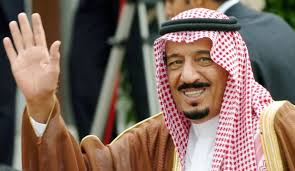
Saudi king blames Mossad for 9/11

The former ambassador to Saudi Arabia said in an interview this week that following 9/11, Saudi King Salman had insisted to him that the Mossad was responsible for the attacks.

“One of my first calls was with then-governor of Riyadh… Prince Salman, who is now the king. His response was very emphatic [that] this could not have been Saudis, we couldn’t possibly have done this,” former envoy Robert Jordan said on CNN’s Fareed Zakaria GPS.

“This had to have been an Israeli plot. The Mossad must have done this,” he cited Salman as saying at the time.

“I got the same thing from the minister of interior, Prince [Mohammed bin] Nayef,” Jordan continued. “I finally had to bring a CIA briefer out and show some of these princes some compelling evidence that it, indeed, was Saudis who were the hijackers.”

Jordan went on to say that he saw the Saudis as being in denial about the fact that 15 of the 19 hijackers were from their country.

The Saudis eventually altered their position, he said, after al-Qaida bombed three Western housing compounds in May 2003.

“At that point, Crown Prince Abdullah said to me that he understood that they had a problem, that they would take immediate action to capture or kill the attackers and to treat just as harshly anyone who gave them comfort or aid or even tried to justify what they did,” said the former ambassador.

In his new book, Desert Diplomat: Inside Saudi Arabia Following 9/11, Jordan writes that the Palestinian issue was often a “source of Saudi anger directed at me.”

“America should be able to resolve this, they told me.

After all, the United States was omnipotent. All Washington had to do was snap its fingers and Israel would come to heel, do whatever we commanded it to do,” he says in the book.

Source: Jerusalem Post

Hope on the horizon and it comes from Greece

Washington in its arrogance, seeing itself as “indispensable,” poses a continuing threat to the lives of hundreds of millions of people. The extraordinary number of dead that Washington has murdered in the 21st century–”The American Century”–is dismissed as “collateral damage” in the “war on terror.”

The war on terror is a hoax. It is a creation of the evil neoconservatives who intend Washington’s world hegemony and Israel’s hegemony from the Nile to the Euphrates. The rest of mankind has realized that Washington’s drive for world hegemony means the entire human race will be dismissed as “collateral damage” as Washington establishes itself as the “exceptional, indispensable country,” the country whose will is above the rule of law and whose morality is non-existent.

The stark reality is that America, which wore the White Hat during the Cold War, now wears the Black Hat, and Russia and China have traded the Black Hat for the White Hat. The hope for mankind no longer resides in the West, which has entered a militarized gestapo existence conducting war against its own citizens and the world at large.

Aggression is the hallmark of 21st century Washington and its captive European vassal states. There has not been a 21st century year without slaughter of innocents by “Western civilization.”

In this interview with Eric King– http://kingworldnews.com/dr-paul-craig-roberts-4-12-15/ –I speak of the hope that comes from revulsion at the looting of southern Europe by fellow EU members and the American hedge funds. If southern Europeans can find the intelligence to comprehend that the New York and German financial interests have decided to destroy the prospects of southern Europeans for the sake of the profits of American and northern European financial interests, European peoples, brainwashed into the grand glorious prospects of being an EU member, might realize the treachery to which they were subjected and leave the exploitative system known as the European Union, a system designed to destroy the sovereignty of European nations.

Powerful Russia stands there as an alternative. As does China. If the Greek government has the sense to default to those who are determined to exploit and to destroy Greece, Italy and Spain will follow. Russia and China are waiting with open arms, and unlike the Western governments, Russia and China are not bankrupt.

Without southern Europe NATO is a non-entity. The Brzezinski and neocon doctrines of Washington controlling Eurasia come to naught. Without NATO Washington’s pretense of speaking for “the world community,” that is, for the white people, rings hollow.

We have to pray for life. Unless Washington can be isolated life on earth has dim prospects.

Dr. Paul Craig Roberts was Assistant Secretary of the Treasury for Economic Policy and associate editor of the Wall Street Journal. He was columnist for Business Week, Scripps Howard News Service, and Creators Syndicate. He has had many university appointments. His internet columns have attracted a worldwide following. Roberts’ latest books are The Failure of Laissez Faire Capitalism and Economic Dissolution of the West and How America Was Lost.

How the US Government and US Military became Murder, Inc.

Andrew Cockburn has written a must-read book. The title is Kill Chain: The Rise Of The High-Tech Assassins. The title could just as well be: How the US Government and US Military Became Murder, Inc.

The US military no longer does war. It does assassinations, usually of the wrong people. The main victims of the US assassination policy are women, children, village elders, weddings, funerals, and occasionally US soldiers mistaken for Taliban by US surveillance operating with the visual acuity of the definition of legal blindness.

Cockburn tells the story of how the human element has been displaced by remote control killing guided by misinterpretation of unclear images on screens collected by surveillance drones and sensors thousands of miles away. Cockburn shows that the “all-seeing” drone surveillance system is an operational failure but is supported by defense contractors because of its high profitability and by the military brass because general officers, with the exception of General Paul Van Ripper, are brainwashed in the belief that the revolution in military affairs means that high-tech devices replace the human element. Cockburn demonstrates that this belief is immune to all evidence to the contrary. The US military has now reached the point that Secretary of Defense Hagel deactivated both the A-10 close support fighter and the U-2 spy plane in favor of the operationally failed unmanned Global Hawk System. With the A-10 and U-2 went the last platforms for providing a human eye on what is happening on the ground.

The surveillance/sensor technology cannot see human footprints in the snow. Consequently, the drone technology concluded that a mountain top was free of enemy and sent a detachment of unsuspecting SEALS to be shot up. Still insisting no enemy present, a second group of SEALS were sent to be shot up, and then a detachment of Army Rangers. Finally, an A-10 pilot flew over the scene and reported the enemy’s presence in force.

By 2012 even the US Air Force, which had been blindly committed to the unmanned drone system, had experienced more failure than could any longer be explained away. The Air Force admitted that the 50-year old U-2 could fly higher and in bad weather and take better pictures than the expensive Global Hawk System and declared the Global Hawk system scrapped.

The decision was supported by the 2011 report from the Pentagon’s test office that the drone system was “not operationally effective.” Among its numerous drawbacks was its inability to carry out assigned missions 75% of the time. The Chairman of the Joint Chiefs of Staff told Congress that in addition to the system’s unacceptable failure rate, the drone system “has fundamentally priced itself out of our ability to afford it.”

As Cockburn reports: “It made no difference. Congress, led by House Armed Services Committee Chairman Buck McKeon and Democratic Congressman Jim Moran (whose northern Virginia district hosts the headquarters of both Northrop and Raytheon) effortless brushed aside these pleas, forcing the Air Force to keep buying the unwanted drone.”

Cockburn provides numerous examples of the utter failure of the unmanned revolution ushered in by unrealistic dreamers, such as Andrew Marshall, John Foster, William Perry, and David Deptula, who have done much harm to the US military and American taxpayers. The failure stories are legion and sad. Almost always the victims are the innocent going about their everyday affairs.

The book opens with the story of three vehicles crammed with people from the same village heading to Kabul. Some were students returning to school in Kabul, some were shopkeepers heading to the capital to buy supplies, others were unemployed men on their way to Iran seeking work, and some were women bringing gifts for relatives. This collection of ordinary people, represented on screens by vague images, was willfully mistaken, as the reproduced conversations between drone operators and assassins show, for a senior Taliban commander leading forces to attack a US Special Forces patrol. The innocent civilians were blown to smithereens.

The second chapter tells of the So Tri, an indigenous people in the remote wilderness of southeastern Laos who were bombed for nine years because the stupid American military sowed their environment with sensors that called down bombs when human presence was detected. High-tech warfare misidentified the villagers with Viet Cong moving through jungle routes.

One heartbreaking story follows another. If surveillance suspects the presence of a High Value Target in a restaurant, regardless of nominal restrictions on the number of innocents who can be murdered as the “collateral damage” part of the strike, the entire restaurant and all within are destroyed by a hellfire missile. Remember that the Israelis denounce terrorists for exploding suicide vests inside Israeli restaurants. What the US military does is even worse.

On other occasions the US assassinates an underling of a High Value Target on the assumption that the Target will attend the funeral which is obliterated from the air whether the Target is present or not.

As the murders are indiscriminate, the US military defines all males killed to be valid targets. Generally, the US will not admit the deaths of non-Targets, and some US officials have declared there to be no such deaths. Blatant and obvious lies issue without shame in order to protect the “operationally ineffective” and very expensive high-tech production runs that mean billions of taxpayer dollars for the military/security complex and comfortable 7-figure employment salaries with contractors after retirement for the military brass.

When you read this book you will weep for your country ruled as it is by completely immoral and inhumane monsters. But Cockburn’s book is not without humor. He tells the story of Marine Lt. General Paul Van Riper, the scourge of the Unmanned Revolution in Military affairs, who repeatedly expressed contempt for the scientifically unsupported theories of unmanned war. To humiliate Gen. Ripper with a defeat in a massive war game as leader of the enemy Red force against the high-tech American Blue force, he was called out of retirement to participate in a war game stacked against him.

The Blue force armored with a massive database (Operational Net Assessment) and overflowing with acronyms was almost instantly wiped out by General Ripper. He sank the entire aircraft carrier fleet and the entire Blue force army went down with it. The war was over. The 21st century US high-tech, effects-based military was locked into a preset vision and was beaten hands down by a maverick Marine general with inferior forces.

The Joint Forces Command turned purple with rage. Gen. Ripper was informed that the outcome of the war game was unacceptable and would not stand. The sunken fleet magically re-floated, the dead army was resurrected, and the war was again on, only this time restriction after restriction was placed on the Red force. Ripper was not allowed to shoot down the Blue force’s troop transports. Ripper was ordered to turn on all of the Red force’s radars so that the Red forces could be easily located and destroyed. Umpires ruled, despite the facts, that all of Ripper’s missile strikes were intercepted. Victory was declared for high-tech war. Ripper’s report on the total defeat of the Blue force, its unwarranted resurrection, and the rigged outcome was promptly classified so that no one could read it.

The highly profitable Revolution in Military Affairs had to be protected at all costs along with the reputations of the incompetent generals that comprise today’s high command.

The infantile behavior of the US military compelled to create a victory for its high-tech, but legally blind, surveillance warfare demonstrates how far removed from the ability to conduct real warfare the US military is. What the US military has done in Afghanistan and Iraq is to create far more enemies than it has killed. Every time high-tech killing murders a village gathering, a wedding or funeral, or villagers on the way to the capital, which is often, the US creates hundreds more enemies. This is why after 14 years of killing in Afghanistan, the Taliban now control most of the country. This is why Islamist warriors have carved a new country out of Syria and Iraq despite eight years of American sacrifice in Iraq estimated by Joseph Stiglitz and Linda Bilmes to have cost Americans a minimum of $3 trillion. The total failure of the American way of war is obvious to all, but the system rolls on autonomously.

The Revolution in Military Affairs has decapitated the US military, which no longer has the knowledge or ability or human tools to conduct war. If the crazed Russophobic US generals get their way and end up in confrontation with Russia, the American forces will be destroyed. The humiliation of this defeat will cause Washington to take the war nuclear.

Interview with Paul Craig Roberts

The Saker interviews Paul Craig Roberts

I had been wanting to interview Paul Craig Roberts for a long time already. For many years I have been following his writings and interviews and every time I read what he had to say I was hoping that one day I would have the privilege to interview him about the nature of the US deep state and the Empire. Recently, I emailed him and asked for such an interview, and he very kindly agreed. I am very grateful to him for this opportunity.

The Saker

——-

The Saker: It has become rather obvious to many, if not most, people that the USA is not a democracy or a republic, but rather a plutocracy run by a small elite which some call “the 1%”. Others speak of the “deep state”. So my first question to you is the following. Could you please take the time to assess the influence and power of each of the following entities one by one. In particular, can you specify for each of the following whether it has a decision-making “top” position, or a decision-implementing “middle” position in the real structure of power (listed in no specific order)

Federal Reserve
Big Banking
Bilderberg
Council on Foreign Relations
Skull & Bones
CIA
Goldman Sachs and top banks
“Top 100 families” (Rothschild, Rockefeller, Dutch Royal Family, British Royal Family, etc.)
Israel Lobby
Freemasons and their lodges
Big Business: Big Oil, Military Industrial Complex, etc.
Other people or organizations not listed above?
Who, which group, what entity would you consider is really at the apex of power in the current US polity?

Paul Craig Roberts: The US is ruled by private interest groups and by the neoconservative ideology that History has chosen the US as the “exceptional and indispensable” country with the right and responsibility to impose its will on the world.

In my opinion the most powerful of the private interest groups are:
The Military/security Complex
The 4 or 5 mega-sized “banks too big to fail” and Wall Street
The Israel Lobby
Agribusiness
The Extractive industries (oil, mining, timber).

The interests of these interest groups coincide with those of the neoconservatives. The neoconservative ideology supports American financial and military-political imperialism or hegemony.

There is no independent American print or TV media. In the last years of the Clinton regime, 90% of the print and TV media was concentrated in 6 mega-companies. During the Bush regime, National Public Radio lost its independence. So the media functions as a Ministry of Propaganda.

Both political parties, Republicans and Democrats, are dependent on the same private interest groups for campaign funds, so both parties dance to the same masters. Jobs offshoring destroyed the manufacturing and industrial unions and deprived the Democrats of Labor Union political contributions. In those days, Democrats represented the working people and Republicans represented business.

The Federal Reserve is there for the banks, mainly the large ones.The Federal Reserve was created as lender of last resort to prevent banks from failing because of runs on the bank or withdrawal of deposits. The New York Fed, which conducts the financial interventions, has a board that consists of the executives of the big banks. The last three Federal Reserve chairmen have been Jews, and the current vice chairman is the former head of the Israeli central bank. Jews are prominent in the financial sector, for example, Goldman Sachs. In recent years, the US Treasury Secretaries and heads of the financial regulatory agencies have mainly been the bank executives responsible for the fraud and excessive debt leverage that set off the last financial crisis.

In the 21st century, the Federal Reserve and Treasury have served only the interests of the large banks. This has been at the expense of the economy and the population. For example, retired people have had no interest income for eight years in order that the financial institutions can borrow at zero costs and make money.

No matter how rich some families are, they cannot compete with powerful interest groups such as the military/security complex or Wall Street and the banks. Long established wealth can look after its interests, and some, such as the Rockefellers, have activist foundations that most likely work hand in hand with the National Endowment for Democracy to fund and encourage various pro-American non-governmental organizations (NGOs) in countries that the US wants to influence or overthrow, such as occurred in Ukraine. The NGOs are essentially US Fifth Columns and operate under such names as “human rights,” “democracy,” etc. A Chinese professor told me that the Rockefeller Foundation had created an American University in China and is used to organize various anti-regime Chinese. At one time, and perhaps still, there were hundreds of US and German financed NGOs in Russia, possibly as many as 1,000.

I don’t know if the Bilderbergs do the same. Possibly they are just very rich people and have their proteges in governments who try to protect their interests. I have never seen any signs of Bilderbergs or Masons or Rothchilds affecting congressional or executive branch decisions.

On the other hand, the Council for Foreign Relations is influential. The council consists of former government policy officials and academics involved in foreign policy and international relations. The council’s publication, Foreign Affairs, is the premier foreign policy forum. Some journalists are also members. When I was proposed for membership in the 1980s, I was blackballed.

Skull & Bones is a Yale University secret fraternity. A number of universities have such secret fraternities. For example, the University of Virginia has one, and the University of Georgia. These fraternities do not have secret governmental plots or ruling powers. Their influence would be limited to the personal influence of the members, who tend to be sons of elite families. In my opinion, these fraternities exist to convey elite status to members. They have no operational functions.

The Saker: What about individuals? Who are, in your opinion, the most powerful people in the USA today? Who takes the final, top level, strategic decision?

Paul Craig Roberts: There really are no people powerful in themselves. Powerful people are ones that powerful interest groups are behind. Ever since Secretary of Defense William Perry privatized so much of the military in 1991, the military/security complex has been extremely powerful, and its power is further amplified by its ability to finance political campaigns and by the fact that it is a source of employment in many states. Essentially Pentagon expenditures are controlled by defense contractors.

The Saker: I have always believed that in international terms, organizations such as NATO, the EU or all the others are only a front, and that the real alliance which controls the planet are the ECHELON countries: US, UK, Canada, Australia and New Zealand aka “AUSCANNZUKUS” (they are also referred to as the “Anglosphere” or the “Five Eyes”) with the US and the UK are the senior partners while Canada, Australia and New Zealand are the junior partners here. Is this model correct?

Paul Craig Roberts: NATO was a US creation allegedly to protect Europe from a Soviet invasion. Its purpose expired in 1991. Today NATO provides cover for US aggression and provides mercenary forces for the American Empire. Britain, Canada, Australia, are simply US vassal states just as are Germany, France, Italy, Japan and the rest. There are no partners; just vassals. It is Washington’s empire, no one else’s.

The US favors the EU, because it is easier to control than the individual countries.

The Saker: It is often said that Israel controls the USA. Chomsky, and others, say that it is the USA which controls Israel. How would you characterize the relationship between Israel and the USA – does the dog wag the tail or does the tail wag the dog? Would you say that the Israel Lobby is in total control of the USA or are there still other forces capable of saying “no” to the Israel Lobby and impose their own agenda?

Paul Craig Roberts: I have never seen any evidence that the US controls Israel. All the evidence is that Israel controls the US, but only its MidEast policy. In recent years, Israel or the Israel Lobby, has been able to control or block academic appointments in the US and tenure for professors considered to be critics of Israel. Israel has successfully reached into both Catholic and State universities to block tenure and appointments. Israel can also block some presidential appointments and has vast influence over the print and TV media. The Israel Lobby also has plenty of money for political campaign funds and never fails to unseat US Representatives and Senators considered critical of Israel. The Israel lobby was able to reach into the black congressional district of Cynthia McKinney, a black woman, and defeat her reelection. As Admiral Tom Moorer, Chief of Naval Operations and Chairman of the Joint Chiefs of Staff, said: “No American President can stand up to Israel.” Adm. Moorer could not even get an official investigation of Israel’s deadly attack on the USS Liberty in 1967.

Anyone who criticizes Israeli policies even in a helpful way is labeled an “anti-Semite.”

In American politics, media, and universities, this is a death-dealing blow. You might as well get hit with a hellfire missile.

The Saker: Which of the 12 entities of power which I listed above have, in your opinion, played a key role in the planning and execution of the 9/11 “false flag” operation? After all, it is hard to imagine that this was planned and prepared between the inauguration of GW Bush and September 11th – it must have been prepared during the years of the Clinton Administration. Is it not true that the Oklahoma City bombing was a rehearsal for 9/11?

Paul Craig Roberts: In my opinion 9/11 was the product of the neoconservatives, many of whom are Jewish allied with Israel, Dick Cheney, and Israel. Its purpose was to provide “the new Pearl Harbor” that the neoconservatives said was necessary to launch their wars of conquest in the Middle East. I don’t know how far back it was planned, but Silverstein was obviously part of it and he had not had the WTC for very long before 9/11.

As for the bombing of the Murrah Federal Building in Oklahoma City, US Air Force General Partin, the Air Force’s munitions expert, prepared an expert report proving beyond all doubt that the building blew up from the inside out and that the truck bomb was cover. Congress and the media ignored his report. The patsy, McVeigh, was already set up, and that was the only story allowed.

The Saker: Do you think that the people who run the USA today realize that they are on a collision course with Russia which could lead to thermonuclear war? If yes, why would they take such a risk? Do they really believe that at the last moment Russian will “blink” and back down, or do they actually believe that they can win a nuclear war? Are they not afraid that in a nuclear conflagration with Russia they will lose everything they have, including their power and even their lives?

Paul Craig Roberts: I am as puzzled as much as you. I think Washington is lost in hubris and arrogance and is more or less insane. Also, there is belief that the US can win a nuclear war with Russia. There was an article in Foreign Affairs around 2005 or 2006 in which this conclusion was reached. The belief in the winnability of nuclear war has been boosted by faith in ABM defenses. The argument is that the US can hit Russia so hard in a preemptive first strike that Russia would not retaliate in fear of a second blow.

The Saker: How do you assess the current health of the Empire? For many years we have seen clear signs of decline, but there is still not visible collapse. Do you believe that such a collapse is inevitable and, if not, how could it be prevented? Will we see the day when the US Dollar suddenly become worthless or will another mechanism precipitate the collapse of this Empire?

Paul Craig Roberts: The US economy is hollowed out. There has been no real median family income growth for decades. Alan Greenspan as Fed Chairman used an expansion of consumer credit to take the place of the missing growth in consumer income, but the population is now too indebted to take on more. So there is nothing to drive the economy. So many manufacturing and tradable professional service jobs such as software engineering have been moved offshore that the middle class has shrunk. University graduates cannot get jobs that support an independent existence. So they can’t form households, buy houses, appliances and home furnishings. The government produces low inflation measures by not measuring inflation and low unemployment rates by not measuring unemployment. The financial markets are rigged, and gold is driven down despite rising demand by selling uncovered shorts in the futures market. It is a house of cards that has stood longer than I thought possible. Apparently, the house of cards can stand until the rest of the world ceases to hold the US dollar as reserves.

Possibly the empire has put too much stress on Europe by involving Europe in a conflict with Russia. If Germany, for example, were to pull out of NATO, the empire would collapse, or if Russia can find the wits to finance Greece, Italy, and Spain in exchange for them leaving the Euro and EU, the empire would suffer a fatal blow.

Alternatively, Russia might tell Europe that Russia has no alternative but to target European capitals with nuclear weapons now that Europe has joined the US in conducting war against Russia.

The Saker: Russia and China have done something unique in history and they have gone beyond the traditional model of forming an alliance: they have agreed to become interdependent – one could say that they have agreed to a symbiotic relationship. Do you believe that those in charge of the Empire have understood the tectonic change which has just happen or are they simply going into deep denial because reality scares them too much?

Paul Craig Roberts: Stephen Cohen says that there is simply no foreign policy discussion. There is no debate. I think the empire thinks that it can destabilize Russia and China and that is one reason Washington has color revolutions working in Armenia, Kyrgyzstan, and Uzbekistan. As Washington is determined to prevent the rise of other powers and is lost in hubris and arrogance, Washington probably believes that it will succeed. After all, History chose Washington.

The Saker: In your opinion, do presidential elections still matter and, if yes, what is your best hope for 2016? I am personally very afraid of Hillary Clinton whom I see as an exceptionally dangerous and outright evil person, but with the current Neocon influence inside the Republican, can we really hope for a non-Neocon candidate to win the GOP nomination?

Paul Craig Roberts: The only way a presidential election could matter would be if the elected president had behind him a strong movement. Without a movement, the president has no independent power and no one to appoint who will do his bidding. Presidents are captives. Reagan had something of a movement, just enough that we were able to cure stagflation despite Wall Street’s opposition and we were able to end the cold war despite the opposition of the CIA and the military/security complex. Plus Reagan was very old and came from a long time ago. He assumed the office of the president was powerful and acted that way.

The Saker: What about the armed forces? Can you imagine a Chairman of the JCS saying “no, Mr President, that is crazy, we will not do this” or do you expect the generals to obey any order, including one starting a nuclear war against Russia? Do you have any hope that the US military could step in and stop the “crazies” currently in power in the White House and Congress?

Paul Craig Roberts: The US military is a creature of the armaments industries. The whole purpose of making general is to be qualified to be a consultant to the “defense” industry, or to become an executive or on the board of a “defense” contractor. The military serves as the source of retirement careers when the generals make the big money. The US military is totally corrupt. Read Andrew Cockburn’s book, Kill Chain.

The Saker: If the USA is really deliberately going down the path towards war with Russia – what should Russia do? Should Russia back down and accept to be subjugated as a preferable option to a thermonuclear war, or should Russia resist and thereby accept the possibility of a thermonuclear war? Do you believe that a very deliberate and strong show of strength on the part of Russia could deter a US attack?

Paul Craig Roberts: I have often wondered about this. I can’t say that I know. I think Putin is humane enough to surrender rather than to be part of the destruction of the world, but Putin has to answer to others inside Russia and I doubt the nationalists would stand for surrender.

In my opinion, I think Putin should focus on Europe and make Europe aware that Russia expects an American attack and will have no choice except to wipe out Europe in response. Putin should encourage Europe to break off from NATO in order to prevent World War 3.

Putin should also make sure China understands that China represents the same perceived threat to the US as Russia and that the two countries need to stand together. Perhaps if Russia and China were to maintain their forces on a nuclear alert, not the top one, but an elevated one that conveyed recognition of the American threat and conveyed this threat to the world, the US could be isolated.

Perhaps if the Indian press, the Japanese Press, the French and German press, the UK press, the Chinese and Russian press began reporting that Russia and China wonder if they will receive a pre-emptive nuclear attack from Washington the result would be to prevent the attack.

As far as I can tell from my many media interviews with the Russian media, there is no Russian awareness of the Wolfowitz Doctrine. Russians think that there is some kind of misunderstanding about Russian intentions. The Russian media does not understand that Russia is unacceptable, because Russia is not a US vassal. Russians believe all the Western bullshit about “freedom and democracy” and believe that they are short on both but making progress. In other words, Russians have no idea that they are targeted for destruction.

The Saker: What are, in your opinion, the roots of the hatred of so many members of the US elites for Russia? Is that just a leftover from the Cold War, or is there another reason for the almost universal russophobia amongst US elites? Even during the Cold War, it was unclear whether the US was anti-Communist or anti-Russian? Is there something in the Russian culture, nation or civilization which triggers that hostility and, if yes, what is it?

Paul Craig Roberts: The hostility toward Russia goes back to the Wolfowttz Doctrine:

“Our first objective is to prevent the re-emergence of a new rival, either on the territory of the former Soviet Union or elsewhere, that poses a threat on the order of that posed formerly by the Soviet Union. This is a dominant consideration underlying the new regional defense strategy and requires that we endeavor to prevent any hostile power from dominating a region whose resources would, under consolidated control, be sufficient to generate global power.”

While the US was focused on its MidEast wars, Putin restored Russia and blocked Washington’s planned invasion of Syria and bombing of Iran. The “first objective” of the neocon doctrine was breached. Russia had to be brought into line. That is the origin of Washington’s attack on Russia. The dependent and captive US and European media simply repeats “the Russian Threat” to the public, which is insouciant and otherwise uninformed.

The offense of Russian culture is also there–Christian morals, respect for law and humanity, diplomacy in place of coercion, traditional social mores–but these are in the background. Russia is hated because Russia (and China) is a check on Washington’s unilateral uni-power. This check is what will lead to war.

If the Russians and Chinese do not expect a pre-emptive nuclear attack from Washington, they will be destroyed.

Cracks in Washington’s empire

Washington’s EU vassals might be finding their backbone. Britain, Germany, France, and Italy are reported to have defied Washington’s orders and applied to join the Chinese-led Asian Investment Bank. Australia, Japan, South Korea, Switzerland and Luxembourg might also join.

Washington uses its development banks such as the Asian Development Bank, the World Bank, along with the IMF, in order to exercise financial and political hegemony. These banks are crucial elements of American economic and political imperialism.

The Chinese-led bank will, of course, be much more effective. The Chinese will use the bank to actually help countries and thereby make friends and grow trust, whereas Washington uses its banks for domination by force.

This new bank, together with the BRICS Bank, will provide countries with escape routes from Washington’s domination.

The Evil Empire is beginning to crack. It will crack more as the Russian-Chinese alliance unfolds its potentials and when European capitals understand that hegemonic Washington has put their existence at risk in order to try to prevent Russia’s rise. The crazed American and British neocon nazis, and their dupes among the populations, comprise the greatest human threat that the world has ever known. The sooner the Evil Empire collapses, the safer the world will be.

Here is the report.

Dr. Paul Craig Roberts was Assistant Secretary of the Treasury for Economic Policy and associate editor of the Wall Street Journal. He was columnist for Business Week, Scripps Howard News Service, and Creators Syndicate. He has had many university appointments. His internet columns have attracted a worldwide following. Roberts’ latest books are The Failure of Laissez Faire Capitalism and Economic Dissolution of the West and How America Was Lost.

The real Angela Merkel

The amazing career of a communist propagandist in the former German Democratic Republic

Angela Merkel was born in Hamburg in 1954 (Federal Republic of Germany). Shortly after her birth, her family made the unusual choice of moving to the East. Her father, a pastor in the Lutheran church, then founded a seminary in the German Democratic Republic and became director of a home for handicapped persons. He refrained from making any public criticism of the regime and enjoyed a privileged social status, having two cars and making frequent trips to the West.

Angela Merkel was a brilliant student, graduating as a doctor of physics. She married a physician, Ulrich Merkel, whom she soon divorced. She then moved in with Professor Joachim Sauer, divorced like herself but already the father of two children. Angela Merkel obtained a research post in quantum physics at the Academy of Sciences.

At the same time, she became politically involved in the Freie Deutsche Jugend (Free German Youth), the state organisation for young people. She rose within the organisation to the post of Secretary of the Agitprop department, becoming one of the main experts in political communication in the communist dictatorship. For professional and political reasons, she often travelled within the Soviet bloc, above all to Moscow, particularly since she spoke Russian fluently.

Although for many years hoped and prepared for, the fall of the Berlin Wall in November 1989 nevertheless took all governments by surprise. The CIA attempted to take over by recruiting senior individuals under the old system who were willing to serve the USA like they had previously served the USSR.

One month later, Merkel changed sides from one day to the next and joined the Demokratischer Aufbruch (Democratic Revival), a new movement inspired by the West German Christian Democrat party. She immediately took over the same functions that she had held before, except that the position was now, in West German terminology, “Press spokesperson”.

However, it soon became known that the president of Demokratischer Aufbruch, Wolfgang Schnur, had been a collaborator of the Stasi, the political police under the communist dictatorship. Merkel herself informed the press of this painful news, obliging Schnur to resign and enabling herself to be appointed in his stead as president of the movement.

Following the last parliamentary elections in the GDR, she joined the government of Lothar de Maizière, becoming the latter’s spokesperson, although Demokratischer Aufbruch only picked up 0.9% of the votes. During this period of transition, she was actively involved in the “2+4” negotiations that ended Berlin’s quadripartite status and the allied occupation, as well as in the negotiations aimed at reunifying Germany. In order, as she said, to avoid a mass exodus from the East to the West, she argued strongly in favour of getting the GDR to join the market economy and the Deutschmark zone.

Her partner, Joachim Sauer, was recruited by the US company Biosym Technology, spending a year at San Diego (California) at the laboratory of this Pentagon contractor. He then joined Accelrys, another San Diego company carrying out contracts for the Pentagon. For her part, Angela Merkel was perfecting her English, which she soon spoke fluently.

Once the GDR had been reunified with the Federal Republic and the Demokratischer Aufbruch had become part of the Christian Democratic Union (CDU), Angela Merkel was elected member of the Bundestag, the German federal parliament, and joined Helmut Kohl’s government. Although strict in matters of morals, he selected this young childless divorcee from the East living with a partner as Minister for Family, Youth and Women.

Within 14 months, the communist Agitprop leader of the DDR youth movement had become a Christian Democrat minister of Youth in the Federal Republic. Incidentally, she achieved very little in her first period as minister.

Continuing her career within the CDU, Angela Merkel launched an unsuccessful bid to get herself elected president of the Brandenburg regional party. However, Lothar de Maizière, who had become deputy president of the national party, was convicted of having distant relationships with the East German political police and was obliged to resign, to be replaced by Merkel.

In 1994, Klaus Töpfer, the Minister of the Environment, the Protection of Nature and Nuclear Security, was appointed director of the UN environment programme, following a series of clashes with the German Chamber of Industry and Commerce, which accused him of underestimating economic reality. Helmut Kohl then ended the crisis by appointing his protégée Merkel as Töpfer’s replacement. Immediately after assuming office, Merkel sacked all the senior officials of her ministry who had remained loyal to her predecessor. It was during this period that she formed a friendship with her French counterpart at the time, Dominique Voynet.

In 1998, Chancellor Kohl informed the USA of his opposition to an international intervention in Kosovo, while the Social Democrats under Gerhard Schröder and the Greens under Joschka Fischer compared Slobodan Milosevic to Adolf Hitler and were calling for a humanitarian war.

The pro-US press then thundered against the Chancellor, accusing him of the economic difficulties that the country was suffering from as a result of reunification. In the September 1998 elections, the Christian Democrats were swept out of power by a wave of red and green, Schröder becoming Chancellor and appointing Fischer his Foreign Minister.

However, Helmut Kohl and his closest associates had apparently accepted money from obscure sources for the CDU, but refused to reveal the names of the donors, arguing that they had given their word. Angela Merkel then published a courageous article in the Foreign Frankfurter Allgemeine Zeitung in which she distanced herself from her mentor. In this way, she forced him to withdraw from the party, with Wolfgang Schäuble, CDU party president, resigning shortly afterwards. Thus, in the name of public morality she grabbed the presidency of the party.

From then on, Angela Merkel was publicly supported by two press groups. Firstly, she was able to count on the support of Friede Springer, who had inherited the Axel Springer group (180 newspapers and magazines, including Bild and Die Welt). The group’s journalists are required to sign an editorial agreement laying down that they must work towards developing transatlantic links and defending the state of Israel.

Angela Merkel can also rely on her friend Liz Mohn, director of the Bertelsmann group, the number 1 in the European media world (RTL group, Prisma group, Random House group, etc.). Ms. Mohn is also vice-president of the Bertelsmann Foundation, an intellectual pillar of Europe-American relationships.

Angela Merkel relies on the advice of Jeffrey Gedmin, specially dispatched to Berlin to assist her by the Bush clan. This lobbyist first worked at the American Enterprise Institute (AEI) under Richard Perle and Mrs. Dick Cheney. He enthusiastically encouraged the creation of a Euro with Dollar parity exchange rate. Within the AEI, he led the New Atlantic Initiative (NAI), which brought together all the America-friendly generals and politicians in Europe. He was then involved in the Project for a New American Century (PNAC) and wrote the chapter on Europe in the neocon programme. He argued that the European Union should remain under NATO authority and that this would only be possible by “discouraging European calls for emancipation.” Finally he became the administrator of the Council of the Community of Democracies (CCD), which argues in favour of a two-speed UN, and became director of the Aspen Institute in Berlin. Subsequently he turned down the offer from his friend John Bolton of the post of deputy US ambassador to the UN so as to be able to devote himself exclusively to Angela Merkel.

In 2003, the State Department entrusted Jeffrey Gedmin and Craig Kennedy with a huge programme of “public diplomacy”, in other words propaganda, including the clandestine funding of journalist and opinion formers in Western Europe.

In 2003, Chancellor Gerhard Schröder opposed the Anglo-American intervention in Iraq. Angela Merkel then published a courageous article in the Washington Post in which she rejected the Chirac-Schröder doctrine of European independence, affirmed her gratitude and friendship for “America” and supported the war.

In May 2004, she established a new situation by pushing through the election as President of the Federal Republic of the banker Horst Köhler, main author of the Maastricht Treaty and creator of the Euro, later president of the European Bank for Reconstruction and Development (EBRD) and director of the IMF. She then began a “patriotic” campaign against radical Islamism.

Throughout the 2005 electoral campaign she criticised the increase in unemployment figures and the Social Democrats inability to deal with it, gaining for the CDU a lead of 21 percentage points in public opinion polls. It was then that her mysterious adviser, Jeffrey Gedmin, published an open letter to her in Die Welt. After criticising the German economic model, he wrote: “Before advancing the country, you need to defeat intellectually those nostalgic individuals who are dragging their feet. If Sarkozy succeeds Chirac, France might experience an upswing. It would be regrettable if Germany continued to decline.” In reply to this invitation, Merkel finally revealed her solutions. She promoted one of her advisers, the former Constitutional Court judge Paul Kirchhof, and entrusted him with the Initiative Neue Soziale Marktwirtschaft (Initiative for the New Social Market Economy). She announced the abolition of graduated income tax, proposing that the rate should be the same for those who only just have what is necessary and those who live in luxury. The outgoing Chancellor, Gerhard Schröder, severely criticised this proposal in a televised debate. The CDU’s lead was decimated, and in the actual election, the CDU polled 35% of the votes and the SPD 34%, the remainder being spread amongst a number of small parties. The Germans didn’t want Schröder any longer, but nor did they want Merkel. Following long and laborious negotiations, a Grand Coalition was agreed, with Merkel, although Chancellor, obliged to surrender half of the minister posts to her opponents.

She pushed through the participation of a German contingent in the multinational force under US command in Afghanistan. Then, when Israel intervened in Lebanon, she successfully achieved the involvement of the German navy in the FINUL, arguing that “if Germany’s raison d’être is to guarantee Israel’s right to exist, we cannot say, now that this existence is threatened, that we will do nothing.”

As of 1 January 2007, Angela Merkel is the president of the European Union. She has never made any secret of her intention to force France and the Netherlands to accept the equivalent of the Constitutional Treaty project that they both rejected in referendums, nor of her intention to relaunch the proposed merger of the North American Free Trade Area and the European Free Trade Area, thereby creating a “great transatlantic market” to use the words once pronounced by Sir Leon Brittan.

Source: Voltairenet

Delusional America

Robert Parry is one of my favorite columnists. He is truthful, has a sense of justice, and delivers a firm punch. He used to be a “mainstream journalist,” like me, but we were too truthful for them. They kicked us out.

I can’t say Parry has always been one of my favorite journalists. During the 1980s he spent a lot of time on Reagan’s case. Having been on corporate boards, I know that CEOs seldom know everything that is going on in the company. There are just too many people and too many programs representing too many agendas. For presidents of countries with governments as large as the US government, there is far more going on than a president has time to learn about even if he could get accurate information.

In my day Assistant Secretaries and chiefs of staff were the most important people, because they controlled the flow of information. Presidents have to focus on fund raising for their reelection and for their party. More time and energy is used up with formalities and meetings with dignitaries and media events. At the most there are two or three issues on which a president can attempt leadership. If an organized clique such as the neoconservatives get into varied positions of authority, they can actually “create the reality” and take the government away from the president.

As I have reported on many occasions, my experience with Reagan left me with the conclusion that he was interested in two big issues. He wanted to stop the stagflation for which only the supply-side economists had a solution, and he wanted to end, not win, the cold war.

Both of these agendas put Reagan at odds with two of the most powerful of the private interest groups: Wall Street and the military/security complex.

Wall Street for the most part opposed Reagan’s economic program. They opposed it because they understood it as Keynesian deficit pump-priming that would cause an already high inflation rate to explode, which would drive down bond and stock prices.

The CIA and the military opposed any ending of the Cold War because of the obvious impact on their power and budget.

Left-wing journalists never picked up on this, and neither did right-wing journalists.

The left could not get beyond Reagan’s rhetoric. For the left, Reagan was trickle-down economics, Iran/Contra, and the fired air traffic controllers.

The right-wing liked Reagan’s rhetoric and blamed him for not delivering on it.

For the left, the Reagan years were a traumatic time. Robert Parry has never recovered from them. He can scarcely write a column about events today, which are horrific in comparison, without dragging Reagan into it. Parry doesn’t realize it, but if it is all Reagan’s fault, little wonder it has been impossible to hold Clinton, Bush 1 and 2, and Obama accountable.

Having written these lines, I already detect the denunciations coming my way for again attempting to “rehabilitate Ronald Ray-Gun.” Reagan does not need rehabilitating. This column is not about Reagan, and it is not a criticism of Parry. It is praise for Parry’s column, “‘Group-thinking’ the World into a New War.” Read it.

The pattern since Milosevic (and before) has been to demonize a foreign head of state and to take the US to war to get rid of him. That way the secret agenda is achieved under the cover of the necessity of deposing a bad or dangerous ruler.

Parry describes this well. Group-Think plays the important role of preventing any dissent, any suspicion of the case against the demonized person, and any examination of the real agenda that is being pursued.

Now it is Russian President Vladimir Putin who is being demonized. As Parry and I and Stephen F. Cohen, the most knowledgeable of the Russian experts, appreciate, Putin is not Saddam Hussein and Russia is not Iraq, Libya, Syria, Serbia, or Iran. To foment conflict with Russia that could lead to war is worse than irresponsible. Yet, as Parry writes, “from the start of the Ukraine crisis in fall 2013, the New York Times, the Washington Post and virtually every mainstream U.S. news outlet have behaved as dishonestly as they did during the run-up to war with Iraq.”

When Professor Cohen pointed out, correctly, that the lies about Russia, Ukraine, and Putin were hot and heavy, the propagandists had to get rid of the man with the facts. The New Republic, a hang-out for low IQ fools, called America’s leading Russian expert “Putin’s American toady.”

From Parry’s reporting, it appears that Group-Think has spread from the media and foreign policy community into the Association for Slavic, East European and Eurasian Studies, which has decided that academic careers require adherence to the government’s propaganda line, which means the neoconservatives’ line.

As I have written on a number of occasions, facts no longer play a role in American political life. Fact-based analysis is also disappearing from academic life and no longer plays a role in official economic reporting. A matrix has been created, an artificial reality that channels the energies and resources of the country into secret agendas that serve the interests of the ruling private interest groups and neoconservative ideology.

The United States government and the American people cannot contend with reality, because they do not know what the reality is.

In America’s make-believe world, neoconservative toadies such as New York Times columnist Thomas Friedman, set the Group-Think tone, while knowledgeable experts such as Stephen Cohen are tuned out.

In effect, America is both blind and deaf. It lives in delusions. Consequently, it will destroy itself and perhaps the world.

Dr. Paul Craig Roberts was Assistant Secretary of the Treasury for Economic Policy and associate editor of the Wall Street Journal. He was columnist for Business Week, Scripps Howard News Service, and Creators Syndicate. He has had many university appointments. His internet columns have attracted a worldwide following. Roberts’ latest books are The Failure of Laissez Faire Capitalism and Economic Dissolution of the West and How America Was Lost.

Pat Buchanan questions ‘endless war’

Pat Buchanan, a former US Presidential candidate, is a leading voice of American Conservatism.  In excerpt from an article that appeared on his website on Tuesday, he is less than flattering about the Republican Party:

“How do you like the Journal’s war?”

So boasted the headline of William Randolph Hearst’s New York flagship that week in 1898 that the United States declared war on Spain.

While Hearst’s Journal, in a circulation battle with Joe Pulitzer’s World, was a warmongering sheet, it did not start the war.

Yet the headline comes to mind reading the Wall Street Journal, whose editorial pages seem to have concluded that on Nov. 4 America voted for new wars in the Middle East, and beyond.

On Nov. 15, its lead editorial declared that the great “question before President Obama and Europe is how to stop the Napoleon of the Kremlin.”

Putin is Napoleon? Has the Journal lost it?

Vladimir Putin is 62. By age 40, Napoleon’s empire encompassed nearly all of Europe. France had swallowed Belgium, Holland, parts of Germany and the Italian coast to Rome. The Emperor had alliances with Austria, Russia, Denmark, Sweden and a truncated Prussia. Virtually all the resources, industries and populations of Continental Europe were at the service of the French Empire.

Putin has reacquired Crimea, which belonged to Russia before the United States was a nation, and is about the size of Vermont.

Napoleon made it to Moscow. Does the Journal think Putin will make it to Paris, as Czar Alexander I did, or to Berlin, as Stalin did?

The Journal hails the Senate Foreign Relations Committee 18-0 vote to arm the Ukrainians, and urges Congress to do the same.

And what would be the result of U.S. heavy weapons arriving in Kiev?

Would Putin recoil in shock and awe and scurry out of Crimea?

Probably not, as the Journal itself concedes, “In 15 years running Russia, Mr. Putin has never stood down.”

And if Putin, seeing U.S. weapons arriving in Kiev, sent in the Russian army to annex Luhansk and Donetsk, took Mariupol on the Black Sea coast, established a land bridge to Crimea, and then offered to negotiate, what would Kiev do?

Even with U.S. weapons Ukraine cannot defeat Russia.

What would we do? Accept defeat? Send U.S. advisers or troops into Ukraine? Launch strikes on Russian forces? Blockade Crimea? Are we really prepared for war with Russia, over Donetsk?

Since Nov. 4, the Journal and its neocon allies have been cawing for U.S. troops to fight ISIL in Iraq and Syria, for U.S. air strikes on Assad’s regime, for bombing Iran, and for arming Ukraine to fight the Russians in a war that Kiev would surely lose.

Was this what America voted for on Nov. 4?

Is this what the Grand Old Party has on offer – endless war?

Hungary threatened by Maidan-style protest

Budapest has been shaken by several days of mass street demonstration against plans by Viktor Orban’s government to introduce a tax on the internet. According to the media, 100,000 Hungarians came out onto the streets of Hungary’s capital to tell the prime minister “no”.

In and of itself, the internet tax is a weak excuse for the organisation of 100,000-strong demonstrations. And, of course, demands to abolish the tax turned into demands for the resignation of Hungary’s ‘dictatorial’ and ‘corrupt’ government. Attacks were also launched on government buildings: as one, internet users pelted them with stones, notebooks and mobile phones.

Other signs of a ‘Hungarian Maidan’ were also evident: demonstrators defiantly jumped around chanting “He who does not jump pays the tax” (the Ukrainian version of this standard spectacle is “He who does not jump is a Moskal”). Local human rights defenders declared that introducing a tax on the internet is an assassination attempt on freedom of speech unacceptable for a democracy.

Among the demonstrators was the U.S. charge d’affaires in Hungary, Andre Goodfriend, who previously reported that the US authorities had banned six Hungarian nationals close to the Hungarian prime minister from entering the country.

It appears that Washington was protesting against the corrupt practices of these Hungarian nationals and expressed its displeasure to Viktor Orban in Brussels. On her Twitter page, the European Commissioner for Competition, Neelie Kroes, backed the street demonstrations and called for those who still had not done so to join them.

Western media write that Orban is under the influence of Putin. Orban himself has had to state more than once that he is not a pro-Russian but a pro-Hungarian politician, but he continues to be accused of yielding to pressure from Moscow. And no wonder: he has introduced restrictions on the work of foreign companies in the country, has too much power concentrated in his hands, and has approved Hungary’s neoliberal Constitution.

Orban is guilty before European democracy in a number of ways. As the father of five children, he resolutely opposes attempts to register the cohabitation of same-sex couples as ‘marriage’. He was also opposed to economic sanctions against Russia, calling them nonsensical, and saying they would do more harm to EU countries than to Russia. In addition, he is calling for compensation from Brussels for the losses incurred by Hungarian manufacturers as a result of curtailed cooperation with their Russian partners.

The head of the Hungarian government is not able to withstand all pressure, however. It was not long before Orban had to declare that Hungary stood with Germany in its assessment of events in Ukraine, and that the introduction of sanctions was a justified move.

It is easy to conclude that the change in the Hungarian prime minister’s initial position was a consequence of pressure from Berlin.

Thus, representatives of Deutsche Telekom’s subsidiary Magyar Telekom, Hungary’s largest internet company, have expressed their outrage at Orban’s plans to introduce a tax on the internet. Berlin is also putting pressure on Orban in other ways. Following German Minister of State for Europe Michael Roth’s visit to Budapest during the street demonstrations, the Hungarian prime minister declared that the government had listened to the people and the tax would not be introduced.

Yet the battle formations of a Maidan-style protest movement in Hungary remain ready to go. The leader of the protests, liberal Balazs Nemes, has reported that the protesters are in touch with each other and are ready to go back out onto the streets the instant that the authorities decide to launch an offensive on their civil rights. Balazs Nemes has referred to Viktor Orban’s leadership style as “the most appalling tyranny”.

The Hungarian prime minister’s independence, including with regard to Russia, has long irritated both Brussels and Washington.

Viktor Orban’s statements regarding his intention of finding allies in Europe capable of opposing the introduction of new sanctions against Russia together have not gone unnoticed.

Western capitals have been particularly outraged by the fact that on 4 November 2014, the Hungarian parliament passed a law allowing the construction of the South Stream pipeline to take place in Hungary, despite the position of the European Commission. Thanks to this law, Hungary now has a legal basis for refusing to comply with the requirements of the EU’s Third Energy Package.

Protests in Budapest against “the most appalling tyranny” are a warning to Viktor Orban, and a reminder of the fate of another Viktor – Viktor Yanukovych.

The street protests organised in the Hungarian capital should also be regarded as a warning to eastern European ‘Russophiles’ like Slovak Prime Minister Robert Fico or Czech President Miloš Zeman, since their attitude towards anti-Russian sanctions and events in Ukraine is much like that of Orban.

Source: Ron Paul Institute

Vladimir Putin is the leader of the moral world

Washington has declared Russia, China, India, Brazil and other parts of South America, Iran, and South Africa to be enemies

Dear Friends,

Vladimir Putin’s remarks at the 11th meeting of the Valdai International Discussion Club are worth more than a link in my latest column. These are the remarks of a humanitarian political leader, the like of which the world has not seen in my lifetime. Compare Putin to the corrupt war criminal in the White House or to his puppets in office in Germany, UK, France, Japan, Canada, Australia, and you will see the difference between a criminal clique and a leader striving for a humane and livable world in which the interests of all peoples are respected.

In a sane Western society, Putin’s statements would have been reproduced in full and discussions organized with remarks from experts such as Stephen F. Cohen. Choruses of approval would have been heard on television and read in the print media. But, of course, nothing like this is possible in a country whose rulers claim that it is the “exceptional” and “indispensable” country with an extra-legal right to hegemony over the world. As far as Washington and its prostitute media, named “presstitutes” by the trends specialist Gerald Celente, are concerned, no country counts except Washington. “You are with us or against us,” which means “you are our vassals or our enemies.” This means that Washington has declared Russia, China, India, Brazil and other parts of South America, Iran, and South Africa to be enemies.

This is a big chunk of the world for a bankrupt country, hated by its vassal populations and many of its own subjects, that has not won a war since it defeated tiny Japan in 1945 by using nuclear weapons, the only use of such terrible weapons in world history.

As an American, try to image any known American politician, or for that matter any professor at Harvard, Princeton, Yale, or Stanford capable of giving an address to an educated discussion group of the quality of Putin’s remarks. Try to find any American politician capable of responding precisely and directly to questions instead of employing evasion.

No one can read Putin’s remarks without concluding that Putin is the leader of the world.

In my opinion, Putin is such a towering figure that Washington has him marked for assassination. The CIA will use one of the Muslim terrorists that the CIA supports inside Russia. Unlike an American president, who dares not move among the people openly, Putin is not kept remote from the people. Putin is at ease with the Russian people and mingles among them. This makes him an easy target for the CIA to use a Chechnya terrorist, a Jihadist suicide bomber, or the traditional “lone nut” to assassinate Putin.

The immoral, wicked, and declining West is incapable of producing leadership of Putin’s quality. Having defamed Putin, assassinating him will cause little comment in the Western media.

Here are Putin’s remarkable remarks:

Meeting of the Valdai International Discussion Club
24 October 2014, Sochi

Vladimir Putin took part in the final plenary meeting of the Valdai International Discussion Club’s XI session. The meeting’s theme is The World Order: New Rules or a Game without Rules.
This year, 108 experts, historians and political analysts from 25 countries, including 62 foreign participants, took part in the club’s work.

The plenary meeting summed up the club’s work over the previous three days, which concentrated on analysing the factors eroding the current system of institutions and norms of international law.

PRESIDENT OF RUSSIA VLADIMIR PUTIN: Colleagues, ladies and gentlemen, friends, it is a pleasure to welcome you to the XI meeting of the Valdai International Discussion Club.

It was mentioned already that the club has new co-organisers this year. They include Russian non-governmental organisations, expert groups and leading universities. The idea was also raised of broadening the discussions to include not just issues related to Russia itself but also global politics and the economy.

n organisation and content will bolster the club’s influence as a leading discussion and expert forum. At the same time, I hope the ‘Valdai spirit’ will remain – this free and open atmosphere and chance to express all manner of very different and frank opinions.

Let me say in this respect that I will also not let you down and will speak directly and frankly. Some of what I say might seem a bit too harsh, but if we do not speak directly and honestly about what we really think, then there is little point in even meeting in this way. It would be better in that case just to keep to diplomatic get-togethers, where no one says anything of real sense and, recalling the words of one famous diplomat, you realise that diplomats have tongues so as not to speak the truth.

We get together for other reasons. We get together so as to talk frankly with each other. We need to be direct and blunt today not so as to trade barbs, but so as to attempt to get to the bottom of what is actually happening in the world, try to understand why the world is becoming less safe and more unpredictable, and why the risks are increasing everywhere around us.
Today’s discussion took place under the theme: New Rules or a Game without Rules. I think that this formula accurately describes the historic turning point we have reached today and the choice we all face. There is nothing new of course in the idea that the world is changing very fast. I know this is something you have spoken about at the discussions today. It is certainly hard not to notice the dramatic transformations in global politics and the economy, public life, and in industry, information and social technologies.

Let me ask you right now to forgive me if I end up repeating what some of the discussion’s participants have already said. It’s practically impossible to avoid. You have already held detailed discussions, but I will set out my point of view. It will coincide with other participants’ views on some points and differ on others.

As we analyse today’s situation, let us not forget history’s lessons. First of all, changes in the world order – and what we are seeing today are events on this scale – have usually been accompanied by if not global war and conflict, then by chains of intensive local-level conflicts. Second, global politics is above all about economic leadership, issues of war and peace, and the humanitarian dimension, including human rights.

The world is full of contradictions today. We need to be frank in asking each other if we have a reliable safety net in place. Sadly, there is no guarantee and no certainty that the current system of global and regional security is able to protect us from upheavals. This system has become seriously weakened, fragmented and deformed. The international and regional political, economic, and cultural cooperation organisations are also going through difficult times.

Yes, many of the mechanisms we have for ensuring the world order were created quite a long time ago now, including and above all in the period immediately following World War II. Let me stress that the solidity of the system created back then rested not only on the balance of power and the rights of the victor countries, but on the fact that this system’s ‘founding fathers’ had respect for each other, did not try to put the squeeze on others, but attempted to reach agreements.

The main thing is that this system needs to develop, and despite its various shortcomings, needs to at least be capable of keeping the world’s current problems within certain limits and regulating the intensity of the natural competition between countries.

It is my conviction that we could not take this mechanism of checks and balances that we built over the last decades, sometimes with such effort and difficulty, and simply tear it apart without building anything in its place. Otherwise we would be left with no instruments other than brute force.

What we needed to do was to carry out a rational reconstruction and adapt it the new realities in the system of international relations.

But the United States, having declared itself the winner of the Cold War, saw no need for this. Instead of establishing a new balance of power, essential for maintaining order and stability, they took steps that threw the system into sharp and deep imbalance.

The Cold War ended, but it did not end with the signing of a peace treaty with clear and transparent agreements on respecting existing rules or creating new rules and standards. This created the impression that the so-called ‘victors’ in the Cold War had decided to pressure events and reshape the world to suit their own needs and interests. If the existing system of international relations, international law and the checks and balances in place got in the way of these aims, this system was declared worthless, outdated and in need of immediate demolition.

Pardon the analogy, but this is the way nouveaux riches behave when they suddenly end up with a great fortune, in this case, in the shape of world leadership and domination. Instead of managing their wealth wisely, for their own benefit too of course, I think they have committed many follies.

We have entered a period of differing interpretations and deliberate silences in world politics. International law has been forced to retreat over and over by the onslaught of legal nihilism. Objectivity and justice have been sacrificed on the altar of political expediency. Arbitrary interpretations and biased assessments have replaced legal norms. At the same time, total control of the global mass media has made it possible when desired to portray white as black and black as white.

In a situation where you had domination by one country and its allies, or its satellites rather, the search for global solutions often turned into an attempt to impose their own universal recipes. This group’s ambitions grew so big that they started presenting the policies they put together in their corridors of power as the view of the entire international community. But this is not the case.

The very notion of ‘national sovereignty’ became a relative value for most countries. In essence, what was being proposed was the formula: the greater the loyalty towards the world’s sole power centre, the greater this or that ruling regime’s legitimacy.

We will have a free discussion afterwards and I will be happy to answer your questions and would also like to use my right to ask you questions. Let someone try to disprove the arguments that I just set out during the upcoming discussion.

The measures taken against those who refuse to submit are well-known and have been tried and tested many times. They include use of force, economic and propaganda pressure, meddling in domestic affairs, and appeals to a kind of ‘supra-legal’ legitimacy when they need to justify illegal intervention in this or that conflict or toppling inconvenient regimes. Of late, we have increasing evidence too that outright blackmail has been used with regard to a number of leaders. It is not for nothing that ‘big brother’ is spending billions of dollars on keeping the whole world, including its own closest allies, under surveillance.

Let’s ask ourselves, how comfortable are we with this, how safe are we, how happy living in this world, and how fair and rational has it become? Maybe, we have no real reasons to worry, argue and ask awkward questions? Maybe the United States’ exceptional position and the way they are carrying out their leadership really is a blessing for us all, and their meddling in events all around the world is bringing peace, prosperity, progress, growth and democracy, and we should maybe just relax and enjoy it all?

Let me say that this is not the case, absolutely not the case.

A unilateral diktat and imposing one’s own models produces the opposite result. Instead of settling conflicts it leads to their escalation, instead of sovereign and stable states we see the growing spread of chaos, and instead of democracy there is support for a very dubious public ranging from open neo-fascists to Islamic radicals.

Why do they support such people? They do this because they decide to use them as instruments along the way in achieving their goals but then burn their fingers and recoil. I never cease to be amazed by the way that our partners just keep stepping on the same rake, as we say here in Russia, that is to say, make the same mistake over and over.

They once sponsored Islamic extremist movements to fight the Soviet Union. Those groups got their battle experience in Afghanistan and later gave birth to the Taliban and Al-Qaeda. The West if not supported, at least closed its eyes, and, I would say, gave information, political and financial support to international terrorists’ invasion of Russia (we have not forgotten this) and the Central Asian region’s countries. Only after horrific terrorist attacks were committed on US soil itself did the United States wake up to the common threat of terrorism. Let me remind you that we were the first country to support the American people back then, the first to react as friends and partners to the terrible tragedy of September 11.

During my conversations with American and European leaders, I always spoke of the need to fight terrorism together, as a challenge on a global scale. We cannot resign ourselves to and accept this threat, cannot cut it into separate pieces using double standards. Our partners expressed agreement, but a little time passed and we ended up back where we started. First there was the military operation in Iraq, then in Libya, which got pushed to the brink of falling apart. Why was Libya pushed into this situation? Today it is a country in danger of breaking apart and has become a training ground for terrorists.

Only the current Egyptian leadership’s determination and wisdom saved this key Arab country from chaos and having extremists run rampant. In Syria, as in the past, the United States and its allies started directly financing and arming rebels and allowing them to fill their ranks with mercenaries from various countries. Let me ask where do these rebels get their money, arms and military specialists? Where does all this come from? How did the notorious ISIL manage to become such a powerful group, essentially a real armed force?

As for financing sources, today, the money is coming not just from drugs, production of which has increased not just by a few percentage points but many-fold, since the international coalition forces have been present in Afghanistan. You are aware of this. The terrorists are getting money from selling oil too. Oil is produced in territory controlled by the terrorists, who sell it at dumping prices, produce it and transport it. But someone buys this oil, resells it, and makes a profit from it, not thinking about the fact that they are thus financing terrorists who could come sooner or later to their own soil and sow destruction in their own countries.

Where do they get new recruits? In Iraq, after Saddam Hussein was toppled, the state’s institutions, including the army, were left in ruins. We said back then, be very, very careful. You are driving people out into the street, and what will they do there? Don’t forget (rightfully or not) that they were in the leadership of a large regional power, and what are you now turning them into?

What was the result? Tens of thousands of soldiers, officers and former Baath Party activists were turned out into the streets and today have joined the rebels’ ranks. Perhaps this is what explains why the Islamic State group has turned out so effective? In military terms, it is acting very effectively and has some very professional people. Russia warned repeatedly about the dangers of unilateral military actions, intervening in sovereign states’ affairs, and flirting with extremists and radicals. We insisted on having the groups fighting the central Syrian government, above all the Islamic State, included on the lists of terrorist organisations. But did we see any results? We appealed in vain.

We sometimes get the impression that our colleagues and friends are constantly fighting the consequences of their own policies, throw all their effort into addressing the risks they themselves have created, and pay an ever-greater price.

Colleagues, this period of unipolar domination has convincingly demonstrated that having only one power centre does not make global processes more manageable. On the contrary, this kind of unstable construction has shown its inability to fight the real threats such as regional conflicts, terrorism, drug trafficking, religious fanaticism, chauvinism and neo-Nazism. At the same time, it has opened the road wide for inflated national pride, manipulating public opinion and letting the strong bully and suppress the weak.

Essentially, the unipolar world is simply a means of justifying dictatorship over people and countries. The unipolar world turned out too uncomfortable, heavy and unmanageable a burden even for the self-proclaimed leader. Comments along this line were made here just before and I fully agree with this. This is why we see attempts at this new historic stage to recreate a semblance of a quasi-bipolar world as a convenient model for perpetuating American leadership. It does not matter who takes the place of the centre of evil in American propaganda, the USSR’s old place as the main adversary. It could be Iran, as a country seeking to acquire nuclear technology, China, as the world’s biggest economy, or Russia, as a nuclear superpower.

Today, we are seeing new efforts to fragment the world, draw new dividing lines, put together coalitions not built for something but directed against someone, anyone, create the image of an enemy as was the case during the Cold War years, and obtain the right to this leadership, or diktat if you wish. The situation was presented this way during the Cold War. We all understand this and know this. The United States always told its allies: “We have a common enemy, a terrible foe, the centre of evil, and we are defending you, our allies, from this foe, and so we have the right to order you around, force you to sacrifice your political and economic interests and pay your share of the costs for this collective defence, but we will be the ones in charge of it all of course.” In short, we see today attempts in a new and changing world to reproduce the familiar models of global management, and all this so as to guarantee their [the US’] exceptional position and reap political and economic dividends.

But these attempts are increasingly divorced from reality and are in contradiction with the world’s diversity. Steps of this kind inevitably create confrontation and countermeasures and have the opposite effect to the hoped-for goals. We see what happens when politics rashly starts meddling in the economy and the logic of rational decisions gives way to the logic of confrontation that only hurt one’s own economic positions and interests, including national business interests.

Joint economic projects and mutual investment objectively bring countries closer together and help to smooth out current problems in relations between states. But today, the global business community faces unprecedented pressure from Western governments. What business, economic expediency and pragmatism can we speak of when we hear slogans such as “the homeland is in danger”, “the free world is under threat”, and “democracy is in jeopardy”? And so everyone needs to mobilise. That is what a real mobilisation policy looks like.

Sanctions are already undermining the foundations of world trade, the WTO rules and the principle of inviolability of private property. They are dealing a blow to liberal model of globalisation based on markets, freedom and competition, which, let me note, is a model that has primarily benefited precisely the Western countries. And now they risk losing trust as the leaders of globalisation. We have to ask ourselves, why was this necessary? After all, the United States’ prosperity rests in large part on the trust of investors and foreign holders of dollars and US securities. This trust is clearly being undermined and signs of disappointment in the fruits of globalisation are visible now in many countries.

The well-known Cyprus precedent and the politically motivated sanctions have only strengthened the trend towards seeking to bolster economic and financial sovereignty and countries’ or their regional groups’ desire to find ways of protecting themselves from the risks of outside pressure. We already see that more and more countries are looking for ways to become less dependent on the dollar and are setting up alternative financial and payments systems and reserve currencies. I think that our American friends are quite simply cutting the branch they are sitting on. You cannot mix politics and the economy, but this is what is happening now. I have always thought and still think today that politically motivated sanctions were a mistake that will harm everyone, but I am sure that we will come back to this subject later.

We know how these decisions were taken and who was applying the pressure. But let me stress that Russia is not going to get all worked up, get offended or come begging at anyone’s door. Russia is a self-sufficient country. We will work within the foreign economic environment that has taken shape, develop domestic production and technology and act more decisively to carry out transformation. Pressure from outside, as has been the case on past occasions, will only consolidate our society, keep us alert and make us concentrate on our main development goals.

Of course the sanctions are a hindrance. They are trying to hurt us through these sanctions, block our development and push us into political, economic and cultural isolation, force us into backwardness in other words. But let me say yet again that the world is a very different place today. We have no intention of shutting ourselves off from anyone and choosing some kind of closed development road, trying to live in autarky. We are always open to dialogue, including on normalising our economic and political relations. We are counting here on the pragmatic approach and position of business communities in the leading countries.

Some are saying today that Russia is supposedly turning its back on Europe – such words were probably spoken already here too during the discussions – and is looking for new business partners, above all in Asia. Let me say that this is absolutely not the case. Our active policy in the Asian-Pacific region began not just yesterday and not in response to sanctions, but is a policy that we have been following for a good many years now. Like many other countries, including Western countries, we saw that Asia is playing an ever greater role in the world, in the economy and in politics, and there is simply no way we can afford to overlook these developments.

Let me say again that everyone is doing this, and we will do so to, all the more so as a large part of our country is geographically in Asia. Why should we not make use of our competitive advantages in this area? It would be extremely shortsighted not to do so.

Developing economic ties with these countries and carrying out joint integration projects also creates big incentives for our domestic development. Today’s demographic, economic and cultural trends all suggest that dependence on a sole superpower will objectively decrease. This is something that European and American experts have been talking and writing about too.
Perhaps developments in global politics will mirror the developments we are seeing in the global economy, namely, intensive competition for specific niches and frequent change of leaders in specific areas. This is entirely possible.

There is no doubt that humanitarian factors such as education, science, healthcare and culture are playing a greater role in global competition. This also has a big impact on international relations, including because this ‘soft power’ resource will depend to a great extent on real achievements in developing human capital rather than on sophisticated propaganda tricks.
At the same time, the formation of a so-called polycentric world (I would also like to draw attention to this, colleagues) in and of itself does not improve stability; in fact, it is more likely to be the opposite. The goal of reaching global equilibrium is turning into a fairly difficult puzzle, an equation with many unknowns.

So, what is in store for us if we choose not to live by the rules – even if they may be strict and inconvenient – but rather live without any rules at all? And that scenario is entirely possible; we cannot rule it out, given the tensions in the global situation. Many predictions can already be made, taking into account current trends, and unfortunately, they are not optimistic. If we do not create a clear system of mutual commitments and agreements, if we do not build the mechanisms for managing and resolving crisis situations, the symptoms of global anarchy will inevitably grow.
Today, we already see a sharp increase in the likelihood of a whole set of violent conflicts with either direct or indirect participation by the world’s major powers. And the risk factors include not just traditional multinational conflicts, but also the internal instability in separate states, especially when we talk about nations located at the intersections of major states’ geopolitical interests, or on the border of cultural, historical, and economic civilizational continents.

Ukraine, which I’m sure was discussed at length and which we will discuss some more, is one of the example of such sorts of conflicts that affect international power balance, and I think it will certainly not be the last. From here emanates the next real threat of destroying the current system of arms control agreements. And this dangerous process was launched by the United States of America when it unilaterally withdrew from the Anti-Ballistic Missile Treaty in 2002, and then set about and continues today to actively pursue the creation of its global missile defence system.

Colleagues, friends, I want to point out that we did not start this. Once again, we are sliding into the times when, instead of the balance of interests and mutual guarantees, it is fear and the balance of mutual destruction that prevent nations from engaging in direct conflict. In absence of legal and political instruments, arms are once again becoming the focal point of the global agenda; they are used wherever and however, without any UN Security Council sanctions. And if the Security Council refuses to produce such decisions, then it is immediately declared to be an outdated and ineffective instrument.

Many states do not see any other ways of ensuring their sovereignty but to obtain their own bombs. This is extremely dangerous. We insist on continuing talks; we are not only in favour of talks, but insist on continuing talks to reduce nuclear arsenals. The less nuclear weapons we have in the world, the better. And we are ready for the most serious, concrete discussions on nuclear disarmament – but only serious discussions without any double standards.

What do I mean? Today, many types of high-precision weaponry are already close to mass-destruction weapons in terms of their capabilities, and in the event of full renunciation of nuclear weapons or radical reduction of nuclear potential, nations that are leaders in creating and producing high-precision systems will have a clear military advantage. Strategic parity will be disrupted, and this is likely to bring destabilization. The use of a so-called first global pre-emptive strike may become tempting. In short, the risks do not decrease, but intensify.

The next obvious threat is the further escalation of ethnic, religious, and social conflicts. Such conflicts are dangerous not only as such, but also because they create zones of anarchy, lawlessness, and chaos around them, places that are comfortable for terrorists and criminals, where piracy, human trafficking, and drug trafficking flourish.

Incidentally, at the time, our colleagues tried to somehow manage these processes, use regional conflicts and design ‘colour revolutions’ to suit their interests, but the genie escaped the bottle. It looks like the controlled chaos theory fathers themselves do not know what to do with it; there is disarray in their ranks.

We closely follow the discussions by both the ruling elite and the expert community. It is enough to look at the headlines of the Western press over the last year. The same people are called fighters for democracy, and then Islamists; first they write about revolutions and then call them riots and upheavals. The result is obvious: the further expansion of global chaos.

Colleagues, given the global situation, it is time to start agreeing on fundamental things. This is incredibly important and necessary; this is much better than going back to our own corners. The more we all face common problems, the more we find ourselves in the same boat, so to speak. And the logical way out is in cooperation between nations, societies, in finding collective answers to increasing challenges, and in joint risk management. Granted, some of our partners, for some reason, remember this only when it suits their interests.

Practical experience shows that joint answers to challenges are not always a panacea; and we need to understand this. Moreover, in most cases, they are hard to reach; it is not easy to overcome the differences in national interests, the subjectivity of different approaches, particularly when it comes to nations with different cultural and historical traditions. But nevertheless, we have examples when, having common goals and acting based on the same criteria, together we achieved real success.

Let me remind you about solving the problem of chemical weapons in Syria, and the substantive dialogue on the Iranian nuclear programme, as well as our work on North Korean issues, which also has some positive results. Why can’t we use this experience in the future to solve local and global challenges?

What could be the legal, political, and economic basis for a new world order that would allow for stability and security, while encouraging healthy competition, not allowing the formation of new monopolies that hinder development? It is unlikely that someone could provide absolutely exhaustive, ready-made solutions right now. We will need extensive work with participation by a wide range of governments, global businesses, civil society, and such expert platforms as ours.

However, it is obvious that success and real results are only possible if key participants in international affairs can agree on harmonising basic interests, on reasonable self-restraint, and set the example of positive and responsible leadership. We must clearly identify where unilateral actions end and we need to apply multilateral mechanisms, and as part of improving the effectiveness of international law, we must resolve the dilemma between the actions by international community to ensure security and human rights and the principle of national sovereignty and non-interference in the internal affairs of any state.

Those very collisions increasingly lead to arbitrary external interference in complex internal processes, and time and again, they provoke dangerous conflicts between leading global players. The issue of maintaining sovereignty becomes almost paramount in maintaining and strengthening global stability.

Clearly, discussing the criteria for the use of external force is extremely difficult; it is practically impossible to separate it from the interests of particular nations. However, it is far more dangerous when there are no agreements that are clear to everyone, when no clear conditions are set for necessary and legal interference.

I will add that international relations must be based on international law, which itself should rest on moral principles such as justice, equality and truth. Perhaps most important is respect for one’s partners and their interests. This is an obvious formula, but simply following it could radically change the global situation.

I am certain that if there is a will, we can restore the effectiveness of the international and regional institutions system. We do not even need to build anything anew, from the scratch; this is not a “greenfield,” especially since the institutions created after World War II are quite universal and can be given modern substance, adequate to manage the current situation.

This is true of improving the work of the UN, whose central role is irreplaceable, as well as the OSCE, which, over the course of 40 years, has proven to be a necessary mechanism for ensuring security and cooperation in the Euro-Atlantic region. I must say that even now, in trying to resolve the crisis in southeast Ukraine, the OSCE is playing a very positive role.

In light of the fundamental changes in the international environment, the increase in uncontrollability and various threats, we need a new global consensus of responsible forces. It’s not about some local deals or a division of spheres of influence in the spirit of classic diplomacy, or somebody’s complete global domination. I think that we need a new version of interdependence. We should not be afraid of it. On the contrary, this is a good instrument for harmonising positions.

This is particularly relevant given the strengthening and growth of certain regions on the planet, which process objectively requires institutionalisation of such new poles, creating powerful regional organisations and developing rules for their interaction. Cooperation between these centres would seriously add to the stability of global security, policy and economy. But in order to establish such a dialogue, we need to proceed from the assumption that all regional centres and integration projects forming around them need to have equal rights to development, so that they can complement each other and nobody can force them into conflict or opposition artificially. Such destructive actions would break down ties between states, and the states themselves would be subjected to extreme hardship, or perhaps even total destruction.

I would like to remind you of the last year’s events. We have told our American and European partners that hasty backstage decisions, for example, on Ukraine’s association with the EU, are fraught with serious risks to the economy. We didn’t even say anything about politics; we spoke only about the economy, saying that such steps, made without any prior arrangements, touch on the interests of many other nations, including Russia as Ukraine’s main trade partner, and that a wide discussion of the issues is necessary. Incidentally, in this regard, I will remind you that, for example, the talks on Russia’s accession to the WTO lasted 19 years. This was very difficult work, and a certain consensus was reached.

Why am I bringing this up? Because in implementing Ukraine’s association project, our partners would come to us with their goods and services through the back gate, so to speak, and we did not agree to this, nobody asked us about this. We had discussions on all topics related to Ukraine’s association with the EU, persistent discussions, but I want to stress that this was done in an entirely civilised manner, indicating possible problems, showing the obvious reasoning and arguments. Nobody wanted to listen to us and nobody wanted to talk. They simply told us: this is none of your business, point, end of discussion. Instead of a comprehensive but – I stress – civilised dialogue, it all came down to a government overthrow; they plunged the country into chaos, into economic and social collapse, into a civil war with enormous casualties.

Why? When I ask my colleagues why, they no longer have an answer; nobody says anything. That’s it. Everyone’s at a loss, saying it just turned out that way. Those actions should not have been encouraged – it wouldn’t have worked. After all (I already spoke about this), former Ukrainian President Yanukovych signed everything, agreed with everything. Why do it? What was the point? What is this, a civilised way of solving problems? Apparently, those who constantly throw together new ‘colour revolutions’ consider themselves ‘brilliant artists’ and simply cannot stop.

I am certain that the work of integrated associations, the cooperation of regional structures, should be built on a transparent, clear basis; the Eurasian Economic Union’s formation process is a good example of such transparency. The states that are parties to this project informed their partners of their plans in advance, specifying the parameters of our association, the principles of its work, which fully correspond with the World Trade Organisation rules.

I will add that we would also have welcomed the start of a concrete dialogue between the Eurasian and European Union. Incidentally, they have almost completely refused us this as well, and it is also unclear why – what is so scary about it?

And, of course, with such joint work, we would think that we need to engage in dialogue (I spoke about this many times and heard agreement from many of our western partners, at least in Europe) on the need to create a common space for economic and humanitarian cooperation stretching all the way from the Atlantic to the Pacific Ocean.

Colleagues, Russia made its choice. Our priorities are further improving our democratic and open economy institutions, accelerated internal development, taking into account all the positive modern trends in the world, and consolidating society based on traditional values and patriotism.

We have an integration-oriented, positive, peaceful agenda; we are working actively with our colleagues in the Eurasian Economic Union, the Shanghai Cooperation Organisation, BRICS and other partners. This agenda is aimed at developing ties between governments, not dissociating. We are not planning to cobble together any blocs or get involved in an exchange of blows.

The allegations and statements that Russia is trying to establish some sort of empire, encroaching on the sovereignty of its neighbours, are groundless. Russia does not need any kind of special, exclusive place in the world – I want to emphasise this. While respecting the interests of others, we simply want for our own interests to be taken into account and for our position to be respected.
We are well aware that the world has entered an era of changes and global transformations, when we all need a particular degree of caution, the ability to avoid thoughtless steps. In the years after the Cold War, participants in global politics lost these qualities somewhat. Now, we need to remember them. Otherwise, hopes for a peaceful, stable development will be a dangerous illusion, while today’s turmoil will simply serve as a prelude to the collapse of world order.

Yes, of course, I have already said that building a more stable world order is a difficult task. We are talking about long and hard work. We were able to develop rules for interaction after World War II, and we were able to reach an agreement in Helsinki in the 1970s. Our common duty is to resolve this fundamental challenge at this new stage of development.

Thank you very much for your attention.

VLADIMIR PUTIN (commenting on statements by former Prime Minister of France Dominique de Villepin and former Federal Chancellor of Austria Wolfgang Schuessel): I would like to begin by saying that overall I agree with what both Wolfgang and Dominique have said. I fully support everything they said. However, there are a few things I would like to clarify.

I believe Dominique referred to the Ukrainian crisis as the reason for the deterioration in international relations. Naturally, this crisis is a cause, but this is not the principal cause. The crisis in Ukraine is itself a result of a misbalance in international relations.
I have already said in my address why this is happening, and my colleagues have already mentioned it. I can add to this, if necessary. However, primarily this is the outcome of the misbalance in international relations.

As for the issues mentioned by Wolfgang, we will get back to them: we will talk about the elections, if necessary, and about the supply of energy resources to Ukraine and Europe.
However, I would like to respond to the phrase “Wolfgang is an optimist, while life is harder for pessimists.” I already mentioned the old joke we have about a pessimist and an optimist, but I cannot help telling it again. We have this very old joke about a pessimist and an optimist: a pessimist drinks his cognac and says, “It smells of bedbugs,” while an optimist catches a bedbug, crushes it, then sniffs it and says, “A slight whiff of cognac.”

I would rather be the pessimist who drinks cognac than the optimist who sniffs bedbugs. (Laughter)
Though it does seem that optimists have a better time, our common goal is to live a decent life (without overindulging in alcohol). For this purpose, we need to avoid crises, together handle all challenges and threats and build such relations on the global arena that would help us reach these goals.

Later I will be ready to respond to some of the other things mentioned here. Thank you.
BRITISH JOURNALIST SEUMAS MILNE (retranslated from Russian): I would like to ask a two-in-one question.

First, Mr President, do you believe that the actions of Russia in Ukraine and Crimea over the past months were a reaction to rules being broken and are an example of state management without rules? And the other question is: does Russia see these global violations of rules as a signal for changing its position? It has been said here lately that Russia cannot lead in the existing global situation; however, it is demonstrating the qualities of a leader. How would you respond to this?
VLADIMIR PUTIN: I would like to ask you to reword the second part of your question, please. What exactly is your second question?

SEUMAS MILNE (retranslated from Russian): It has been said here that Russia cannot strive for leading positions in the world considering the outcomes of the Soviet Union’s collapse, however it can influence who the leader will be. Is it possible that Russia would alter its position, change its focus, as you mentioned, regarding the Middle East and the issues connected with Iran’s nuclear program me?

VLADIMIR PUTIN: Russia has never altered its position. We are a country with a traditional focus on cooperation and search for joint solutions. This is first.
Second. We do not have any claims to world leadership. The idea that Russia is seeking some sort of exclusivity is false; I said so in my address. We are not demanding a place under the sun; we are simply proceeding from the premise that all participants in international relations should respect each other’s interests. We are ready to respect the interests of our partners, but we expect the same respect for our interests.

We did not change our attitude to the situation in the Middle East, to the Iranian nuclear programme, to the North Korean conflict, to fighting terrorism and crime in general, as well as drug trafficking. We never changed any of our priorities even under the pressure of unfriendly actions on the part of our western partners, who are lead, very obviously in this case, by the United States. We did not even change the terms of the sanctions.

However, here too everything has its limits. I proceed from the idea that it might be possible that external circumstances can force us to alter some of our positions, but so far there have not been any extreme situations of this kind and we have no intention of changing anything. That is the first point.

The second point has to do with our actions in Crimea. I have spoken about this on numerous occasions, but if necessary, I can repeat it. This is Part 2 of Article 1 of the United Nations’ Charter – the right of nations to self-determination. It has all been written down, and not simply as the right to self-determination, but as the goal of the united nations. Read the article carefully.

I do not understand why people living in Crimea do not have this right, just like the people living in, say, Kosovo. This was also mentioned here. Why is it that in one case white is white, while in another the same is called black? We will never agree with this nonsense. That is one thing.
The other very important thing is something nobody mentions, so I would like to draw attention to it. What happened in Crimea? First, there was this anti-state overthrow in Kiev. Whatever anyone may say, I find this obvious – there was an armed seizure of power.

In many parts of the world, people welcomed this, not realising what this could lead to, while in some regions people were frightened that power was seized by extremists, by nationalists and right-wingers including neo-Nazis. People feared for their future and for their families and reacted accordingly. In Crimea, people held a referendum.

I would like to draw your attention to this. It was not by chance that we in Russia stated that there was a referendum. The decision to hold the referendum was made by the legitimate authority of Crimea – its Parliament, elected a few years ago under Ukrainian law prior to all these grave events. This legitimate body of authority declared a referendum, and then based on its results, they adopted a declaration of independence, just as Kosovo did, and turned to the Russian Federation with a request to accept Crimea into the Russian state.

You know, whatever anyone may say and no matter how hard they try to dig something up, this would be very difficult, considering the language of the United Nations court ruling, which clearly states (as applied to the Kosovo precedent) that the decision on self-determination does not require the approval of the supreme authority of a country.

In this connection I always recall what the sages of the past said. You may remember the wonderful saying: Whatever Jupiter is allowed, the Ox is not.

We cannot agree with such an approach. The ox may not be allowed something, but the bear will not even bother to ask permission. Here we consider it the master of the taiga, and I know for sure that it does not intend to move to any other climatic zones – it will not be comfortable there. However, it will not let anyone have its taiga either. I believe this is clear.

What are the problems of the present-day world order? Let us be frank about it, we are all experts here. We talk and talk, we are like diplomats. What happened in the world? There used to be a bipolar system. The Soviet Union collapsed, the power called the Soviet Union ceased to exist.
All the rules governing international relations after World War II were designed for a bipolar world. True, the Soviet Union was referred to as ‘the Upper Volta with missiles’. Maybe so, and there were loads of missiles. Besides, we had such brilliant politicians like Nikita Khrushchev, who hammered the desk with his shoe at the UN. And the whole world, primarily the United States, and NATO thought: this Nikita is best left alone, he might just go and fire a missile, they have lots of them, we should better show some respect for them.

Now that the Soviet Union is gone, what is the situation and what are the temptations? There is no need to take into account Russia’s views, it is very dependent, it has gone through transformation during the collapse of the Soviet Union, and we can do whatever we like, disregarding all rules and regulations.

This is exactly what is happening. Dominique here mentioned Iraq, Libya, Afghanistan and Yugoslavia before that. Was this really all handled within the framework of international law? Do not tell us those fairy-tales.

This means that some can ignore everything, while we cannot protect the interests of the Russian-speaking and Russian population of Crimea. This will not happen.

I would like everyone to understand this. We need to get rid of this temptation and attempts to arrange the world to one’s liking, and to create a balanced system of interests and relations that has long been prescribed in the world, we only have to show some respect.

As I have already said, we understand that the world has changed, and we are ready to take heed of it and adjust this system accordingly, but we will never allow anyone to completely ignore our interests.

Does Russia aim for any leading role? We don’t need to be a superpower; this would only be an extra load for us. I have already mentioned the taiga: it is immense, illimitable, and just to develop our territories we need plenty of time, energy and resources.

We have no need of getting involved in things, of ordering others around, but we want others to stay out of our affairs as well and to stop pretending they rule the world. That is all. If there is an area where Russia could be a leader – it is in asserting the norms of international law.
QUESTION: The peaceful process between the Palestinians and Israelis has completely collapsed. The United States never let the quartet work properly. At the same time, the growth of illegal Israeli settlements on the occupied territories renders impossible the creation of a Palestinian state. We have recently witnessed a very severe attack on the Gaza Strip. What is Russia’s attitude to this tense situation in the Middle East? And what do you think of the developments in Syria?

One remark for Mr Villepin as well. You spoke of humiliation. What can be more humiliating than the occupation that Palestine has been experiencing all these years?

VLADIMIR PUTIN: Regarding Palestine and the Israeli conflict. It is easy for me to speak about this because, first, I have to say and I believe everyone can see that our relations with Israel have transformed seriously in the past decade. I am referring to the fact that a large number of people from the former Soviet Union live in Israel and we cannot remain indifferent to their fate. At the same time, we have traditional relations with the Arab world, specifically with Palestine. Moreover, the Soviet Union, and Russia is its legal successor, has recognised Palestinian statehood. We are not changing anything here.

Finally, regarding the settlements. We share the views of the main participants in international relations. We consider this a mistake. I have already said this to our Israeli partners. I believe this is an obstacle to normal relations and I strongly expect that the practice itself will be stopped and the entire process of a peaceful settlement will return to its legal course based on agreement.

We proceed from the fact that that Middle East conflict is one of the primary causes of destabilisation not only in the region, but also in the world at large. Humiliation of any people living in the area, or anywhere else in the world is clearly a source of destabilisation and should be done away with. Naturally, this should be done using such means and measures that would be acceptable for all the participants in the process and for all those living in the area.
This is a very complicated process, but Russia is ready to use every means it has for this settlement, including its good relations with the parties to this conflict.

DIRECTOR, KIEV CENTER FOR POLITICAL AND CONFLICT STUDIES MIKHAIL POGREBINSKY: Mr President, I have come from Ukraine. For the first time in 70 years, it is going through very hard times. My question has to do with the possibility of a settlement. In this connection, I would like to go back in history. You mentioned that there was a moment when a trilateral format was under consideration: Russia-Ukraine-Europe. Back then, Europe did not agree to it, after which a series of tragic events took place, including the loss of Crimea, the death of thousands of people and so forth.

Recently, Europe together with Ukraine and Russia agreed that this format is possible after all; moreover, a corresponding resolution was passed. At that moment, there was hope that Russia together with Europe and Ukraine would manage to reach agreement and could become the restorer of peace in Ukraine. What happened next? What happened between Moscow and Brussels, Moscow and Berlin – because now the situation seems completely insane? It is unclear what this might lead to. What do you think happened to Europe?

VLADIMIR PUTIN: You know, what happened can be described as nothing happened. Agreements were reached, but neither side complied with them in full. However, full compliance by both sides might be impossible.

For instance, Ukrainian army units were supposed to leave certain locations where they were stationed prior to the Minsk agreements, while the militia army was supposed to leave certain settlements they were holding prior to these agreements. However, neither is the Ukrainian army withdrawing from the locations they should leave, nor is the militia army withdrawing from the settlements they have to move out of, referring, and I will be frank now – to the fact that their families remain there (I mean the militia) and they fear for their safety. Their families, their wives and children live there. This is a serious humanitarian factor.

We are ready to make every effort to ensure the implementation of the Minsk agreements. I would like to take advantage of your question to stress Russia’s position: we are in favour of complete compliance with the Minsk agreements by both sides.

What is the problem? In my view, the key problem is that we do not see the desire on the part of our partners in Kiev, primarily the authorities, to resolve the issue of relations with the country’s southeast peacefully, through negotiations. We keep seeing the same thing in various forms: suppression by force. It all began with Maidan, when they decided to suppress Yanukovych by force. They succeeded and raised this wave of nationalism and then it all transformed into some nationalistic battalions.

When people in southeast Ukraine did not like it, they tried to elect their own bodies of government and management and they were arrested and taken to prison in Kiev at night. Then, when people saw this happening and took to arms, instead of stopping and finally resorting to peaceful dialogue, they sent troops there, with tanks and aircraft.

Incidentally, the global community keeps silent, as if it does not see any of this, as if there is no such thing as ‘disproportionate use of force’. They suddenly forgot all about it. I remember all the frenzy around when we had a complicated situation in the Caucasus. I would hear one and the same thing every day. No more such words today, no more ‘disproportionate use of force’. And that’s while cluster bombs and even tactical weapons are being used.

You see, under the circumstances, it is very difficult for us in Russia to arrange work with people in southeast Ukraine in a way that would induce them to fully comply with all the agreements. They keep saying that the authorities in Kiev do not fully comply with the agreements either.
However, there is no other way. I would like to stress that we are for the full implementation of the agreements by both parties, and the most important thing I want to say – and I want everyone to hear that – if, God forbid, anyone is again tempted to use force for the final settlement of the situation in southeast Ukraine, this will bring the situation to a complete deadlock.

In my view, there is still a chance to reach agreement. Yes, Wolfgang spoke about this, I understood him. He spoke of the upcoming elections in Ukraine and in the southeast of the country. We know it and we are constantly discussing it. Just this morning I had another discussion with the Chancellor of Germany about it. The Minsk agreements do stipulate that elections in the southeast should be held in coordination with Ukrainian legislation, not under Ukrainian law, but in coordination with it.

This was done on purpose, because nobody in the southeast wants to hold elections in line with Ukrainian law. Why? How can this be done, when there is shooting every day, people get killed on both sides and they have to hold elections under Ukrainian law? The war should finally stop and the troops should be withdrawn. You see? Once this is achieved, we can start considering any kind of rapprochement or cooperation. Until this happens, it is hard to talk about anything else.

They spoke of the date of the elections in the southeast, but few know that there has been an agreement that elections in southeast Ukraine should be held by November 3. Later, the date was amended in the corresponding law, without consulting anyone, without consulting with the southeast. The elections were set for December 7, but nobody talked to them. Therefore, the people in the southeast say, “See, they cheated us again, and it will always be this way.”

You can argue over this any way you like. The most important thing is to immediately stop the war and move the troops away. If Ukraine wants to keep its territorial integrity, and this is something we want as well, they need to understand that there is no sense in holding on to some village or other – this is pointless. The idea is to stop the bloodshed and to start normal dialogue, to build relations based on this dialogue and restore at least some communication, primarily in the economy, and gradually other things will follow. I believe this is what should be achieved first and then we can move on.

PROFESSOR OF POLITICAL SCIENCE, DIRECTOR OF THE CENTER FOR GOVERNANCE AND PUBLIC POLICY AT CARLETON UNIVERSITY (OTTAWA) PIOTR DUTKIEWICZ: Mr President, if I may I would like to go back to the issue of Crimea, because it is of key importance for both the East and the West. I would like to ask you to give us your picture of the events that lead to it, specifically why you made this decision. Was it possible to do things differently? How did you do it? There are important details – how Russia did it inside Crimea. Finally, how do you see the consequences of this decision for Russia, for Ukraine, for Europe and for the normative world order? I am asking this because I believe millions of people would like to hear your personal reconstruction of those events and of the way you made the decision.

VLADIMIR PUTIN: I do not know how many times I spoke about this, but I will do it again.
On February 21, Viktor Yanukovych signed the well-known documents with the opposition. Foreign ministers of three European countries signed their names under this agreement as guarantors of its implementation.

In the evening of February 21, President Obama called me and we discussed these issues and how we would assist in the implementation of these agreements. Russia undertook certain obligations. I heard that my American colleague was also ready to undertake some obligations. This was the evening of the 21st. On the same day, President Yanukovych called me to say he signed the agreement, the situation had stabilized and he was going to a conference in Kharkov. I will not conceal the fact that I expressed my concern: how was it possible to leave the capital in this situation. He replied that he found it possible because there was the document signed with the opposition and guaranteed by foreign ministers of European countries.

I will tell you more, I told him I was not sure everything would be fine, but it was for him to decide. He was the president, he knew the situation, and he knew better what to do. “In any case, I do not think you should withdraw the law enforcement forces from Kiev,” I told him. He said he understood. Then he left and gave orders to withdraw all the law enforcement troops from Kiev. Nice move, of course.

We all know what happened in Kiev. On the following day, despite all our telephone conversations, despite the signatures of the foreign ministers, as soon as Yanukovych left Kiev his administration was taken over by force along with the government building. On the same day, they shot at the cortege of Ukraine’s Prosecutor General, wounding one of his security guards.

Yanukovych called me and said he would like us to meet to talk it over. I agreed. Eventually we agreed to meet in Rostov because it was closer and he did not want to go too far. I was ready to fly to Rostov. However, it turned out he could not go even there. They were beginning to use force against him already, holding him at gunpoint. They were not quite sure where to go.

I will not conceal it; we helped him move to Crimea, where he stayed for a few days. That was when Crimea was still part of Ukraine. However, the situation in Kiev was developing very rapidly and violently, we know what happened, though the broad public may not know – people were killed, they were burned alive there. They came into the office of the Party of Regions, seized the technical workers and killed them, burned them alive in the basement. Under those circumstances, there was no way he could return to Kiev. Everybody forgot about the agreements with the opposition signed by foreign ministers and about our telephone conversations. Yes, I will tell you frankly that he asked us to help him get to Russia, which we did. That was all.

Seeing these developments, people in Crimea almost immediately took to arms and asked us for help in arranging the events they intended to hold. I will be frank; we used our Armed Forces to block Ukrainian units stationed in Crimea, but not to force anyone to take part in the elections. This is impossible, you are all grown people, and you understand it. How could we do it? Lead people to polling stations at gunpoint?

People went to vote as if it were a celebration, everybody knows this, and they all voted, even the Crimean Tatars. There were fewer Crimean Tatars, but the overall vote was high. While the turnout in Crimea in general was about 96 or 94 percent, a smaller number of Crimean Tatars showed up. However 97 percent of them voted ‘yes’. Why? Because those who did not want it did not come to the polling stations, and those who did voted ‘yes’.

I already spoke of the legal side of the matter. The Crimean Parliament met and voted in favour of the referendum. Here again, how could anyone say that several dozen people were dragged to parliament to vote? This never happened and it was impossible: if anyone did not want to vote they would get on a train or plane, or their car and be gone.

They all came and voted for the referendum, and then the people came and voted in favour of joining Russia, that is all. How will this influence international relations? We can see what is happening; however if we refrain from using so-called double standards and accept that all people have equal rights, it would have no influence at all. We have to admit the right of those people to self-determination.

Link to this page: http://eng.news.kremlin.ru/news/23137

US definitely wants war in Ukraine

It’s about to get much worse

Dr. Paul Craig Roberts talks to Greg Hunter’s USAWatchdog.com

Former Assistant Treasury Secretary Dr. Paul Craig Roberts thinks the Neoconservatives in the U.S. government want war in Ukraine. Dr. Roberts says, “They definitely want war, of course. They’ve wanted it ever since Reagan was President. The Neocons were always saying we have to attack the Soviet Union, and Reagan said we are not going to win anything, we are going to end it. The Neocons got to where they really disliked Reagan because he wouldn’t take advantage of Soviet weakness to attack them. So, they are war minded. They produce documents that say nuclear war is winnable. So, they are basically crazy people; and, yet, they have determined the course of foreign policy since the Clinton Administration. Under George Bush, they controlled the show; and today, under Obama, the Neoconservatives control it.”

Some say the U.S. wants war so they have something to blame the fall of the U.S. economy. Not so, says Dr. Roberts, “They (Neocons) have been very clear about their ideology of American hegemony over the world. It’s like Adolf Hitler all over again. You know, the Germans are the chosen people and have the right to override others. Neoconservatives don’t use the Nazi language. Instead, we’re (Neocons) said to be the ‘exceptional’ people, the ‘indispensable country.’ They use these adjectives to elevate the United States above law, its own law and international law. So, it’s alright if we commit war crimes with naked aggression. It’s alright if we torture. It’s alright if we kidnap people in foreign countries and take them to other foreign countries. This is all just part of America achieving hegemony. Notice the way we achieve it is not by argument or reason or persuasion or anything like that. It’s by force.”

Roberts goes on to say, “So, why is Ukraine important? Well, there is the Black Sea naval base that Russia has there. They have a lease on it until 2042. You have Eastern Ukraine, which is former Soviet military industrial complex . . . for Washington, they say, look we can really bring a serious strategic threat to Russia here. We can devalue their nuclear deterrent by putting anti-nuclear bases in Ukraine on their border. So, when we put pressure on them, they have to think much harder when they stand up to us because we will have the upper hand. . . . So, that’s the real reason for what they are doing. There are other economic reasons. They want to get their hands on Ukraine. They want to loot it.”

On the economy, and if we are headed for another crash, Dr. Roberts says, “I think what we are headed for is continuous sinking. How fast it would be? I don’t know. Everyone’s running out of savings. People have been living off their savings for 5 years. For example, the elderly don’t get any interest income. So, what people are doing is spending down their capital to maintain their lives. As this capital is spent down, there is nothing left to spend. So, consumer spending and retail spending just gradually fall and fall. I don’t think there is going to be a sudden collapse, but there could be a sudden collapse because of all the money the Fed is pumping into the system. This is inconsistent with the dollar’s value and the dollar being the reserve currency.”

On gold, Dr. Roberts says, “To protect the dollar from Quantitative Easing (QE), the Fed is selling naked shorts in the gold market to keep the gold price from rising so rapidly that it exposes the worthlessness of the dollar. . . . The physical stock of gold in the West to meet delivery demand is diminishing rapidly. So, one day the Chinese will buy 100 tons of gold, and we won’t be able to make delivery. That would crash the system. It would just pop. So, there are things that could crash it suddenly. Regardless . . . the economy is going to gradually sink because there are no jobs, or no good jobs. . . So, there is not a recovery. The U.S. is a busted state. It’s completely busted.”

On the Federal Reserve money printing to prop up the economy, Dr. Roberts, who has a PhD in economics, contends, “I think they realize all the money printing does undermine the dollar, and if they lose the dollar, the game is over. So, they have to protect the dollar.” But what happens if the economy falls hard? Will they crank back up QE? Roberts says, “Suppose the economy does move down fairly fast, then all the pressure will be on them to support the economy. Given the stupidity of the media and stupidity of economists and the stupidity of Congress, supporting the economy will mean more QE. If it gets really bad, you could see the Fed cave in and start printing more money . . . at some point, it’s going to cost them the dollar.”

‘Left’ and ‘Right’ bamboozling you on Benghazi

mercer_ilanaby Ilana Mercer

[followbutton username=’IlanaMercer’ count=’true’ lang=’en’ theme=’light’]

Like Ilana Mercer’s Facebook page

“Us against al-Qaida”: This has been—still is—the narrowly conceived narrative among neoconservatives. As the politically provincial neoconservative foreign-policy paradigm has it, those were the forces that played out in the Benghazi affair, in which the American mission was left undefended, resulting in the slaughter of Ambassador Christopher Stevens and three other Americans (who, given the pecking order in the Empire, generally go unnamed).

Hillary Clinton, the woman who cracked the whip at Foggy Bottom at the time, had clearly resolved to run the U.S. embassy in Benghazi, Libya, as one would an open community center. This was meant to signal that her war on Libya had been a success, when in fact Hillary’s adventure there had as much “host-nation support” as George Bush’s faith-based forays into Iraq and Afghanistan.

Indeed, “a central figure in the attack,” reports David D. Kirkpatrick of the New York Times, “was an eccentric, malcontent militia leader, Ahmed Abu Khattala.” Once persecuted and imprisoned by Gadhafi, Abu Khattala is a Libyan Islamist from the el-Leithi region, who considers “the United States not far behind Col. Gadhafi on his list of infidel enemies.”

Understandably, Fox-News neocons have been fuming over “A Deadly Mix in Benghazi,” Kirkpatrick’s exposé in the Times. In their focused blindness, Republicans believe religiously that, to quote Kirkpatrick, “Mr. Stevens died in a carefully planned assault by al-Qaida to mark the anniversary of its strike on the United States 11 years before.” Accordingly, the Obama administration has been “covering up evidence of al-Qaida’s role to avoid undermining the president’s claim that the group has been decimated, in part because of the raid that killed Osama bin Laden.”

Uncovered by The Times’ investigation, however, was a very different reality in Benghazi—”murkier than either of those story lines suggests. Benghazi,” contends Kirkpatrick, “was not infiltrated by Al Qaeda, but nonetheless contained grave local threats to American interests. The attack does not appear to have been meticulously planned, but neither was it spontaneous or without warning signs.”

In particular are neoconservatives fulminating over the findings that “turned up no evidence that al-Qaida or other international terrorist groups had any role in the assault,” and that “the attack was led, instead, by fighters who had benefited directly from NATO’s extensive air power and logistics support during the uprising against Col. Gadhafi.”

How can that be? Easily: The history of Libya is festooned with similar ransacking and burning of consulates by angry local mobs. Alas, in the ignorance it cultivates about the past, America is Cicero’s perpetual child. By the definition of the great Roman statesman, “Not to know what happened before one was born is to be always a child.”

Into the Cannibal's Pot

Based on the annals of U.S. intervention in the region, it is fair to say that, to the extent the American-made video lampooning Islam triggered the hatred harbored by the invaded Libyans for the invading Americans—to that extent it is true that the YouTube clip, more so than the mythical al Qaida, was a catalyst for the attack on our embassy in Benghazi.

Still, the NYT has hardly been unsparingly honest. Rather, the Gray Eminence is as dishonest and politically provincial as the opposing faction.

Discounted in the Kirkpatrick essay is that al Qaida has devolved into many decentralized operations that mirror the aspirations of the indigenous population to be free of meddling Westerners—unless of course said militia and tribesmen (the Ansar al-Shariah, for example) can get us to bankroll their Baksheesh economy.

Predictably, the double-crossing neoconservative and neoliberal entities cross-pollinate each other.

So wrong was the Times on Iraq that the reporter who piped lies straight from the Bush White House to her Times readers was recruited to Fox News: She is Judith “Chalabi” Miller. (Ahmed Chalabi was the Iraqi exile who agitated for American intervention in Iraq. In the ramp-up to war, Chalabi fed Ms. Miller, the New York Times’ birdbrain now perched at Fox News, with the pro-invasion “intelligence” she then presented to the public.)

The facts in the Benghazi affair have likewise been unwoven and retied into two contradictory narratives to suit the respective sides.

Think of lab rats racing through a maze, as you watch the sub-intelligent, dual-panel “dialogue” conducted on the teli. Hosts Stephanie Cutter (left-wing, social-democratic rat) and S. E. Cupp (right-wing, social-democratic rat): Each rat runs with a designated, neatly bifurcated (Republican or Democratic) political orthodoxy. Each is a “maze-bright” rat, and not the possessor and giver of any truth.

“Left” and “right” are bamboozling you on Benghazi.

Neocons threaten life on earth with nuclear war

Dr Paul Craig Roberts

Amitai Etzioni has raised an important question: “Who authorized preparations for war with China?”  Etzioni says that the war plan is not the sort of contingency plan that might be on hand for an improbable event. Etzioni also reports that the Pentagon’s war plan was not ordered by, and has not been reviewed by, US civilian authorities. We are confronted with a neoconized US military out of control endangering Americans and the rest of the world.

Etzioni is correct that this is a momentous decision made by a neoconized military. China is obviously aware that Washington is preparing for war with China. If the Yale Journal knows it, China knows it. If the Chinese government is realistic, the government is aware that Washington is planning a pre-emptive nuclear attack against China. No other kind of war makes any sense from Washington’s standpoint. The “superpower” was never able to occupy Baghdad, and after 11 years of war has been defeated in Afghanistan by a few thousand lightly armed Taliban. It would be curtains for Washington to get into a conventional war with China.

When China was a primitive third world country, it fought the US military to a stalemate in Korea. Today China has the world’s second largest economy and is rapidly overtaking the failing US economy destroyed by jobs offshoring, bankster fraud, and corporate and congressional treason.

The Pentagon’s war plan for China is called “AirSea Battle.” The plan describes itself as “interoperable air and naval forces that can execute networked, integrated attacks-in-depth to disrupt, destroy, and defeat enemy anti-access area denial capabilities.”

Yes, what does that mean? It means many billions of dollars of more profits for the military/security complex while the 99 percent are ground under the boot. It is also clear that this nonsensical jargon cannot defeat a Chinese army. But this kind of saber-rattling can lead to war, and if the Washington morons get a war going, the only way Washington can prevail is with nuclear weapons. The radiation, of course, will kill Americans and most of the rest of the world as well.

Nuclear war is on Washington’s agenda. The rise of the Neocon Nazis has negated the nuclear disarmament agreements that Reagan and Gorbachev made. The extraordinary, mainly truthful 2012 book, The Untold History of the United States by Oliver Stone and Peter Kuznick, describes the post-Reagan breakout of preemptive nuclear attack as Washington’s first option.

During the Cold War nuclear weapons had a defensive purpose. The purpose was to prevent nuclear war by the US and USSR each having sufficient retaliatory power to ensure “mutually assured destruction.” MAD, as it was known, meant that nuclear weapons had no offensive advantage for either side.

The Soviet collapse and China’s focus on its economy instead of its military have resulted in Washington’s advantage in nuclear weaponry that, according to two US Dr. Strangeglove characters, Keir Lieber and Daryl Press, gives Washington first-strike capability. Lieber and Press write that the “precipitous decline of Russia’s arsenal, and the glacial pace of modernization of China’s nuclear forces,” have created a situation in which neither Russia nor China could retaliate to Washington’s first strike.

The Pentagon’s “AirSea Battle” and Lieber and Press’ article in Foreign Affairs have informed China and Russia that Washington is contemplating pre-emptive nuclear attack on both countries. To ensure Russia’s inability to retaliate, Washington is placing anti-ballistic missiles on Russia’s borders in violation of the US-USSR agreement.

Because the American press is a corrupt government propaganda ministry, the American people have no idea that neoconized Washington is planning nuclear war. Americans are no more aware of this than they are of former President Jimmy Carter’s recent statement, reported only in Germany, that the United States no longer has a functioning democracy.

The possibility that the United States would initiate nuclear war was given reality eleven years ago when President George W. Bush, at the urging of Dick Cheney and the neocons that dominated his regime, signed off on the 2002 Nuclear Posture Review.

This neocon document, signed off on by America’s most moronic president, resulted in consternation and condemnation from the rest of the world and launched a new arms race. Russian President Putin immediately announced that Russia would spend all necessary sums to maintain Russia’s retaliatory nuclear capability. The Chinese displayed their prowess by knocking a satellite out of space with a missile. The mayor of Hiroshima, recipient city of a vast American war crime, stated: “The nuclear Non-Proliferation Treaty, the central international agreement guiding the elimination of nuclear weapons, is on the verge of collapse. The chief cause is US nuclear policy that, by openly declaring the possibility of a pre-emptive nuclear first strike and calling for resumed research into mini-nukes and other so-called ‘useable nuclear weapons,’ appears to worship nuclear weapons as God.”

The Neocons do not accept any accountability whatsoever to international law, to human rights, to the Geneva Conventions, or to any statutory law.

The post World War II wars originate in the so-called “free world”. Other countries do not have imperial expansionary ambitions. The Chinese government has not seized Taiwan, which China could do at will. The Russian government has not seized former constituent parts of Russia, such as Georgia, which, provoked by Washington to launch an attack, was instantly overwhelmed by the Russian Army. Putin could have hung Washington’s Georgian puppet and reincorporated Georgia into Russia, where it resided for several centuries and where many believe it belongs.

For the past 68 years, most military aggression can be sourced to the “superpower”.Washington has drafted a war plan based on nuclear first strike, a direct threat to life on earth.

Paul Craig Roberts was Assistant Secretary of the Treasury for Economic Policy under Ronald Reagan and associate editor of the Wall Street Journal.