America’s infrastructure crisis: Israel, Iran and the growing pressure on Washington

America’s nationwide aviation shutdown has exposed serious weaknesses in its ageing infrastructure. Meanwhile, Israel’s Mossad chief has travelled to Washington as Benjamin Netanyahu presses Donald Trump to resume military action against Iran.

The nationwide grounding of US flights has exposed serious weaknesses in America’s ageing infrastructure, while a high-level visit by Israel’s Mossad chief to Washington has highlighted the growing pressure on Donald Trump to resume military action against Iran.

The United States experienced one of its most significant aviation disruptions in decades on Friday, November 13, when the Federal Aviation Administration (FAA) ordered a nationwide ground stop following a breakdown in its air traffic communications network.

The shutdown lasted almost five hours and affected more than 20,000 flights. Seventeen of the FAA’s 22 en-route air traffic control centres experienced communications problems, disrupting the systems used to coordinate aircraft movements and radar information.

Although flights subsequently resumed, the incident exposed the vulnerability of critical American infrastructure and raised fresh questions about the country’s ability to maintain and modernise essential technological systems.

An ageing system brought to a standstill

US Transportation Secretary Sean Duffy attributed the disruption to a technical failure during routine maintenance work carried out by L3Harris, a longstanding contractor responsible for operating the FAA’s telecommunications network.

The work involved replacing ageing copper telecommunications lines with fibre-optic connections. According to Duffy, a router associated with the upgrade began generating an extraordinary number of connection attempts, overwhelming other routers in the network.

Officials reported more than 1,000 connection attempts every four to five seconds.

The resulting instability affected communications between air traffic controllers and aircraft, as well as radar feeds. The FAA consequently decided to ground departing flights nationwide as a precautionary measure.

Duffy said investigators were examining whether the incident resulted from human error, faulty installation or defective equipment. No definitive technical cause had yet been established.

The administration also stated that there was no indication of a cyberattack or deliberate hostile action.

The incident nevertheless highlighted a wider problem: parts of America’s air traffic control infrastructure remain dependent on equipment and telecommunications systems that are decades old.

Congress has already approved substantial funding for modernisation, but the transition has been slow and technically complicated.

The episode raises questions about the resilience of infrastructure that is essential not only to commercial aviation but also to the functioning of the world’s largest economy.

Netanyahu presses Trump over Iran

While Washington was dealing with the aviation crisis, another development was unfolding in the relationship between the United States and Israel.

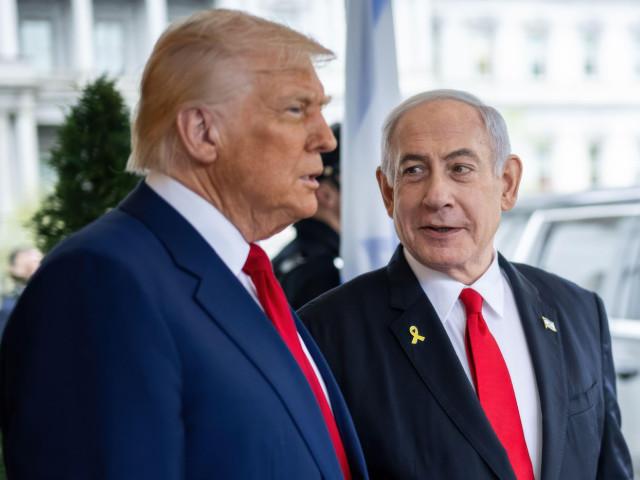
President Trump and Israeli prime minister Benjamin Netanyahu

According to a report by Axios on November 13, Mossad director Roman Gofman was in Washington for discussions with senior Trump administration officials concerning the war with Iran.

Gofman was reportedly scheduled to meet CIA director John Ratcliffe and was also expected to travel to Miami for discussions with White House envoy Steve Witkoff.

The visit coincided with renewed pressure from Israeli Prime Minister Benjamin Netanyahu for the United States to resume military operations against Iran.

Trump has so far resisted this pressure, although his position on the conflict has fluctuated. Reports have described disagreements over whether to continue diplomatic efforts or return to a more extensive military campaign.

The Israeli government considers Iran’s military and nuclear capabilities an existential security concern. Washington, meanwhile, must weigh the consequences of renewed hostilities, including the possibility of a wider regional conflict, disruption to energy markets and further American military commitments.

The presence of the Mossad director in Washington therefore illustrates the extent to which intelligence and military cooperation form part of the relationship between the two countries.

It also raises an important question about the degree of influence Israel exercises over American strategic decision-making.

Intelligence cooperation and political pressure

The relationship between American and Israeli intelligence agencies has traditionally been close. Cooperation between the CIA and Mossad covers a range of regional security issues, including Iran, counterterrorism and intelligence gathering.

However, cooperation does not necessarily imply agreement over every strategic decision.

The reported Washington visit comes at a particularly sensitive moment. Israel wants to prevent Iran from consolidating its regional military position, while the Trump administration faces the economic and political consequences of prolonging a costly conflict.

The question is whether American foreign policy is being determined primarily by Washington’s assessment of its own national interests or increasingly by the strategic priorities of a close regional ally.

This is a legitimate subject for public debate, particularly when decisions about war and peace are involved.

There have also been allegations and speculation in political circles about possible intelligence leverage, blackmail and pressure exerted on American political leaders. However, no independently verified evidence has established that Mossad is blackmailing Trump or that Israeli intelligence has been responsible for the recent American infrastructure disruptions.

Such allegations should not be confused with the documented diplomatic and political pressure surrounding the Iran conflict.

Is America becoming more vulnerable?

The FAA incident and the renewed diplomatic activity surrounding Iran are separate developments. There is currently no evidence connecting the aviation shutdown to Israel, Mossad or the conflict in the Middle East.

Nevertheless, both events illustrate different aspects of the challenges confronting the United States.

On the domestic front, an advanced industrial economy remains dependent on ageing infrastructure that can be disrupted by relatively isolated technical failures.

On the international front, Washington faces competing strategic priorities and pressure from allies whose regional objectives do not necessarily coincide with American interests.

The United States possesses enormous military, technological and economic resources. Yet the ability to project power abroad ultimately depends on the reliability of institutions and infrastructure at home.

The question facing Washington is therefore not simply whether it should resume military action against Iran. It is whether American foreign policy can remain independent, coherent and sustainable while the country struggles to modernise the systems upon which its own security and prosperity depend.

For a country that has long presented itself as the guarantor of international stability, these are questions that cannot easily be ignored.

PRAAG — November 15, 2026

Trump tells Jeb to speak the language of the majority

2016 Republican frontrunner Donald Trump told Breitbart News that former Florida Gov. Jeb Bush should be speaking the language of the majority.

Jeb Bush spoke Spanish, the migrant language, to attack Trump in Miami this week—on the campaign trail.

Trump had harsh words for Sen. Marco Rubio as well and lit into the donor class, all while saying that the “silent majority” in America is waking up and fighting to take back the country from the corrupt political class.

Trump also predicted that he will not only win the White House in 2016, but that he will be re-elected in 2020–predicting he will be a two-term president–and that at the end of his eventual eight years in the White House he will be known to all as a “great conservative” just like Ronald Reagan.

“I like Jeb,” Trump said. “He’s a nice man. But he should really set the example by speaking English while in the United States.”

“El hombre no es conservador,” Bush said in Spanish of Trump in Miami, according to the Tampa Bay Times. That means, according to that newspaper, that Bush is saying of Trump: “The man is not conservative.”

“Besides, he tries to personalize everything. If you’re not totally in agreement with him you’re an idiot, or stupid, or don’t have energy, or blah blah blah,” Bush continued in English, according to the Times.

Trump, in his exclusive with Breitbart News, ripped that argument—that somehow he’s not a conservative.

“You know, Ronald Reagan wasn’t a conservative,” Trump said. “He became a great conservative. By the time I’m finished, people will say I’m a great conservative. By the time I’m finished with the presidency, after eight years of the presidency, people will say I’m a great conservative—far greater than Jeb would ever have the ability to be.”

Trump also fired back at Rubio for aiming to undercut his campaign slogan, “Make America Great Again.” The campaign slogan was used by Ronald Reagan in the 1980 campaign for the White House alongside George H.W. Bush, Jeb’s father.

According to the New York Times, this week Rubio—while campaigning in Carson City, Nevada—said Trump’s campaign slogan isn’t an accurate assessment of the country. Rubio argued America is “great” now.

Trump, in response, told Breitbart News that this means Rubio is complacent with where America is now—and doesn’t believe there is room for improvement in the country. Trump also called Rubio “Jeb’s plebe.”

Rubio was trained by Bush in Florida politics before the two, along with 15 other Republicans including Trump, started competing against each other for the GOP nomination this cycle.

Rubio and Bush have nearly identical political viewpoints on immigration and trade, and as Bush and his campaign keep slipping more and more, it’s expected the donor class paymasters will get behind Rubio down the road, because he would give them everything they want if he’s elected president, just like Bush would.

Trump said that the donor class paymasters who he says are controlling the politicians like Bush and Rubio “are looking to benefit themselves or their company, whereas I’m looking only to benefit the people of the United States.”

When it comes to the border, Trump again noted that he’d build a wall if elected president.

“There is a great silent majority, and the silent majority is not so silent anymore,” Trump said. “They want to see America become great again.”

Meanwhile the war on Trump continued with Jon Stewart, formerly from the Daily Show, attacking the GOP-frontrunner under the usual guise of humor.

The public, roaring with laughter, is never shown, because there are no people in Stewart’s unfunny show.

Jon is alone in a studio with a camera man.

The canned laughter is edited in later, as a service to the dupes, to indicate when the humor starts, which is not always obvious from the context.

According to the Jerusalem Post, Trump’s chances for the White House may also “hinge on Hezbollah”.

Trump did not take kindly in a radio interview on Thursday to being asked to identify the affiliations of various militant leaders in the Middle East, saying the host was asking “a gotcha question” since these groups change constantly.

Discussing the “War on Terror”, talk-radio host Hugh Hewitt asked Trump who the leaders of militant groups were, and to name the heads of Islamic State, Hezbollah, al-Qaida and its Nusra Front wing in Syria.

Source: Breitbart/Jerusalem Post

Russia and Saudi Arabia sign nuclear deal

A number of cooperation documents were signed by Russia and Saudi Arabia on Thursday, after President Putin met with Saudi Prince Mohammed in what was one of the most anticipated meetings at the international economic forum in St. Petersburg.

The pair has signed six agreements in total, Al Arabiya News Channel reported. A cooperation agreement on a peaceful nuclear program was among the documents, the press service of Russia’s nuclear agency, Rosatom, said.

According to Rosatom, the document is the first in the history of Russia-Saudi relations to create a legal framework for cooperation between the nations in the field of nuclear energy. Future joint projects might include construction of nuclear power reactors, provision of services in nuclear fuel cycling, including those for nuclear power stations and research reactor facilities.

The Gulf kingdom has no industrial nuclear power plants, but has big plans for developing nuclear energy.

The two oil heavyweights have also agreed on the creation of a working group to develop joint energy projects, Russian Energy Minister Aleksandr Novak said on Thursday. Saudi Arabia is interested in energy projects in Russia, the minister said, adding that Russia doesn’t aim to replace existing partners in oil and gas cooperation, but rather wants to establish new ones.

The countries are ready to cooperate in a number of other spheres, the minister told journalists, mentioning pharmaceuticals and infrastructure development as prospective sectors.

“Our colleagues from Saudi Arabia have brought a lot of projects to the table. These projects will be introduced to our companies, including the ones involving the construction and upgrade of railways and building underground railway systems,” Novak said, adding that the Gulf kingdom plans to build metro systems in four cities in the near future.

Russia’s state space agency, Roscosmos, and Saudi national center for science and technology KACST signed papers including agendas for future cooperation in space exploration.

On meeting Putin, the 30-year old deputy crown prince Mohammed bin Salman, who is Saudi Arabia’s Defense Minister, announced that his father, King Salman, was inviting the Russian leader to visit the Gulf state.

“I have the honor to pass on an invitation to visit the kingdom of Saudi Arabia, as we regard Russia as one of the important states in the contemporary world, and our relations have roots in the past,” Prince Mohammed said, adding that Russia had been the first country to officially recognize the Gulf kingdom. “We will aim to develop bilateral relations in all sectors,” he added.

Expert warns Syria about to fall into ISIS hands

According to Doctor Natasha Underhill, an expert on terrorism in the Middle East from Nottingham Trent University in the UK, the Islamic State could be on the verge of a breakthrough in Syria.

The lecturer at Nottingham Trent University told Express.co.uk that ISIS militants seized huge phosphate mines depriving the Syrian regime of a desperately-needed revenue source. She added that the latest development puts Syria on the verge of disintegration.

It’s really a power play for Islamic State. The mines are one of the last things Syria could make money from. It will push the state closer towards failure which is now almost inevitable. Syria is at crisis point. It’s already seen as a crisis state. We are just one or two more key events away from failure as we know it. With the situation as it is we could wake up tomorrow and the whole state would have changed.

But Syria will only be the beginning. Dr Underhill said if Syria falls into hands of ISIS it will give the terrorists more legitimacy in the eyes of those in the region and encourage similar Islamic extremist groups to pledge their support, much as Boko Haram has in Africa.

Islamic State has a political strand to their organisation and when it moves into an area sets up local government-type institutions. […] Once ISIS takes over a significant piece of land – and we’ve seen this in Afghanistan where the Taliban took over 90 per cent of the country – then that gives them legitimacy – not in the wider world but in the direct area, which is their target audience. […] While ISIS has shown it is willing to focus on a core area rather than seek to expand at a vast rate, neighbouring Jordan should still be aware of the likelihood of an invasion.

Underhill has unwittingly also highlighted the complete failure of the Clean Break strategy.

Commonly known as the “Clean Break” report [A Clean Break: A New Strategy for Securing the Realm], is a policy document that was prepared in 1996 by a study group led by Richard Perle for Benjamin Netanyahu, Israeli premier.

The report explained a new approach to solving Israel’s security problems in the Middle East, advocating an aggressive new policy including the removal of Saddam Hussein from power in Iraq and the containment of Syria by engaging in proxy warfare and highlighting its possession of “weapons of mass destruction”.

Two major US newspapers openly advocate bombing

The New York Times continues its slide into becoming little more than a neocon propaganda sheet as it followed the Washington Post in publishing an op-ed advocating the unprovoked bombing of Iran, reports Robert Parry

If two major newspapers in, say, Russia published major articles openly advocating the unprovoked bombing of a country, say, Israel, the U.S. government and news media would be aflame with denunciations about “aggression,” “criminality,” “madness,” and “behavior not fitting the Twenty-first Century.”

But when the newspapers are American – the New York Times and the Washington Post – and the target country is Iran, no one in the U.S. government and media bats an eye. These inflammatory articles – these incitements to murder and violation of international law – are considered just normal discussion in the Land of Exceptionalism.

On Thursday, the New York Times printed an op-ed that urged the bombing of Iran as an alternative to reaching a diplomatic agreement that would sharply curtail Iran’s nuclear program and ensure that it was used only for peaceful purposes. The Post published a similar “we-must-bomb-Iran” op-ed two weeks ago.

The Times’ article by John Bolton, a neocon scholar from the American Enterprise Institute, was entitled “To Stop Iran’s Bomb, Bomb Iran.” It followed the Post’s op-ed by Joshua Muravchik, formerly at AEI and now a fellow at the neocon-dominated School of Advanced International Studies at Johns Hopkins.

Both articles called on the United States to mount a sustained bombing campaign against Iran to destroy its nuclear facilities and to promote “regime change” in Tehran. Ironically, these “scholars” rationalized their calls for unprovoked aggression against Iran under the theory that Iran is an aggressive state, although Iran has not invaded another country for centuries.

Bolton, who served as President George W. Bush’s ambassador to the United Nations, based his call for war on the possibility that if Iran did develop a nuclear bomb – which Iran denies seeking and which the U.S. intelligence community agrees Iran is not building – such a hypothetical event could touch off an arms race in the Middle East.

Curiously, Bolton acknowledged that Israel already has developed an undeclared nuclear weapons arsenal outside international controls, but he didn’t call for bombing Israel. He wrote blithely that “Ironically perhaps, Israel’s nuclear weapons have not triggered an arms race. Other states in the region understood — even if they couldn’t admit it publicly — that Israel’s nukes were intended as a deterrent, not as an offensive measure.”

How Bolton manages to read the minds of Israel’s neighbors who have been at the receiving end of Israeli invasions and other cross-border attacks is not explained. Nor does he address the possibility that Israel’s possession of some 200 nuclear bombs might be at the back of the minds of Iran’s leaders if they do press ahead for a nuclear weapon.

Nor does Bolton explain his assumption that if Iran were to build one or two bombs that it would use them aggressively, rather than hold them as a deterrent. He simply asserts: “Iran is a different story. Extensive progress in uranium enrichment and plutonium reprocessing reveal its ambitions.”

Pulling Back on Refinement

But is that correct? In its refinement of uranium, Iran has not progressed toward the level required for a nuclear weapon since its 2013 interim agreement with the global powers known as “the p-5 plus one” – for the permanent members of the UN Security Council plus Germany. Instead, Iran has dialed back the level of refinement to below 5 percent (what’s needed for generating electricity) from its earlier level of 20 percent (needed for medical research) — compared with the 90-plus percent purity to build a nuclear weapon.

In other words, rather than challenging the “red line” of uranium refinement that Israeli Prime Minister Benjamin Netanyahu drew during a United Nations speech in 2012, the Iranians have gone in the opposite direction – and they have agreed to continue those constraints if a permanent agreement is reached with the p-5-plus-1.

However, instead of supporting such an agreement, American neocons – echoing Israeli hardliners – are demanding war, followed by U.S. subversion of Iran’s government through the financing of an internal opposition for a coup or a “colored revolution.”

Bolton wrote: “An attack need not destroy all of Iran’s nuclear infrastructure, but by breaking key links in the nuclear-fuel cycle, it could set back its program by three to five years. The United States could do a thorough job of destruction, but Israel alone can do what’s necessary. Such action should be combined with vigorous American support for Iran’s opposition, aimed at regime change in Tehran.”

But one should remember that neocon schemes – drawn up at their think tanks and laid out on op-ed pages – don’t always unfold as planned. Since the 1990s, the neocons have maintained a list of countries considered troublesome for Israel and thus targeted for “regime change,” including Iraq, Syria and Iran. In 2003, the neocons got their chance to invade Iraq, but the easy victory that they predicted didn’t exactly pan out.

Still, the neocons never revise their hit list. They just keep coming up with more plans that, in total, have thrown much of the Middle East, northern Africa and now Ukraine into bloodshed and chaos. In effect, the neocons have joined Israel in its de facto alliance with Saudi Arabia for a Sunni sectarian conflict against the Shiites and their allies. Much like the Saudis, Israeli officials rant against the so-called “Shiite crescent” from Tehran through Baghdad and Damascus to Beirut.

Since Iran is considered the most powerful Shiite nation and is allied with Syria, which is governed by Alawites, an offshoot of Shiite Islam, both countries have remained in the neocons’ crosshairs. But the neocons don’t actually pull the trigger themselves. Their main role is to provide the emotional and political arguments to get the American people to hand over their tax money and their children to fight these wars.

The neocons are so confident in their skills at manipulating the U.S. decision-making process that some have gone so far as to suggest Americans should side with al-Qaeda’s Nusra Front in Syria or the even more brutal Islamic State, because those groups love killing Shiites and thus are considered the most effective fighters against Iran’s allies.

The New York Times’ star neocon columnist Thomas L. Friedman ventured to the edge of madness as he floated the idea of the U.S. arming the head-chopping Islamic State, writing this month: “Now I despise ISIS as much as anyone, but let me just toss out a different question: Should we be arming ISIS?”

I realize the New York Times and Washington Post are protected by the First Amendment and can theoretically publish whatever they want. But the truth is that the newspapers are extremely restrictive in what they print. Their op-ed pages are not just free-for-alls for all sorts of opinions.

For instance, neither newspaper would publish a story that urged the United States to launch a bombing campaign to destroy Israel’s actual nuclear arsenal as a step toward creating a nuclear-free Middle East. That would be considered outside responsible thought and reasonable debate.

However, when it comes to advocating a bombing campaign against Iran’s peaceful nuclear program, the two newspapers are quite happy to publish such advocacy. The Times doesn’t even blush when one of its most celebrated columnists mulls over the idea of sending weapons to the terrorists in ISIS – all presumably because Israel has identified “the Shiite crescent” as its current chief enemy and the Islamic State is on the other side.

But beyond the hypocrisy and, arguably, the criminality of these propaganda pieces, there is also the neocon record of miscalculation. Remember how the invasion of Iraq was supposed to end with Iraqis tossing rose petals at the American soldiers instead of planting “improvised explosive devices” – and how the new Iraq was to become a model pluralistic democracy?

Well, why does one assume that the same geniuses who were so wrong about Iraq will end up being right about Iran? What if the bombing and the subversion don’t lead to nirvana in Iran? Isn’t it just as likely, if not more so, that Iran would react to this aggression by deciding that it needed nuclear bombs to deter further aggression and to protect its sovereignty and its people?

In other words, might the scheming by Bolton and Muravchik — as published by the New York Times and the Washington Post — produce exactly the result that they say they want to prevent? But don’t worry. If the neocons’ new schemes don’t pan out, they’ll just come up with more.

Investigative reporter Robert Parry broke many of the Iran-Contra stories for The Associated Press and Newsweek in the 1980s. You can buy his latest book, America’s Stolen Narrative, either in print here or as an e-book (from Amazon and barnesandnoble.com). You also can order Robert Parry’s trilogy on the Bush Family. The trilogy includes America’s Stolen Narrative.

Source: Consortium News

Interview with Paul Craig Roberts

The Saker interviews Paul Craig Roberts

I had been wanting to interview Paul Craig Roberts for a long time already. For many years I have been following his writings and interviews and every time I read what he had to say I was hoping that one day I would have the privilege to interview him about the nature of the US deep state and the Empire. Recently, I emailed him and asked for such an interview, and he very kindly agreed. I am very grateful to him for this opportunity.

The Saker

——-

The Saker: It has become rather obvious to many, if not most, people that the USA is not a democracy or a republic, but rather a plutocracy run by a small elite which some call “the 1%”. Others speak of the “deep state”. So my first question to you is the following. Could you please take the time to assess the influence and power of each of the following entities one by one. In particular, can you specify for each of the following whether it has a decision-making “top” position, or a decision-implementing “middle” position in the real structure of power (listed in no specific order)

Federal Reserve
Big Banking
Bilderberg
Council on Foreign Relations
Skull & Bones
CIA
Goldman Sachs and top banks
“Top 100 families” (Rothschild, Rockefeller, Dutch Royal Family, British Royal Family, etc.)
Israel Lobby
Freemasons and their lodges
Big Business: Big Oil, Military Industrial Complex, etc.
Other people or organizations not listed above?
Who, which group, what entity would you consider is really at the apex of power in the current US polity?

Paul Craig Roberts: The US is ruled by private interest groups and by the neoconservative ideology that History has chosen the US as the “exceptional and indispensable” country with the right and responsibility to impose its will on the world.

In my opinion the most powerful of the private interest groups are:
The Military/security Complex
The 4 or 5 mega-sized “banks too big to fail” and Wall Street
The Israel Lobby
Agribusiness
The Extractive industries (oil, mining, timber).

The interests of these interest groups coincide with those of the neoconservatives. The neoconservative ideology supports American financial and military-political imperialism or hegemony.

There is no independent American print or TV media. In the last years of the Clinton regime, 90% of the print and TV media was concentrated in 6 mega-companies. During the Bush regime, National Public Radio lost its independence. So the media functions as a Ministry of Propaganda.

Both political parties, Republicans and Democrats, are dependent on the same private interest groups for campaign funds, so both parties dance to the same masters. Jobs offshoring destroyed the manufacturing and industrial unions and deprived the Democrats of Labor Union political contributions. In those days, Democrats represented the working people and Republicans represented business.

The Federal Reserve is there for the banks, mainly the large ones.The Federal Reserve was created as lender of last resort to prevent banks from failing because of runs on the bank or withdrawal of deposits. The New York Fed, which conducts the financial interventions, has a board that consists of the executives of the big banks. The last three Federal Reserve chairmen have been Jews, and the current vice chairman is the former head of the Israeli central bank. Jews are prominent in the financial sector, for example, Goldman Sachs. In recent years, the US Treasury Secretaries and heads of the financial regulatory agencies have mainly been the bank executives responsible for the fraud and excessive debt leverage that set off the last financial crisis.

In the 21st century, the Federal Reserve and Treasury have served only the interests of the large banks. This has been at the expense of the economy and the population. For example, retired people have had no interest income for eight years in order that the financial institutions can borrow at zero costs and make money.

No matter how rich some families are, they cannot compete with powerful interest groups such as the military/security complex or Wall Street and the banks. Long established wealth can look after its interests, and some, such as the Rockefellers, have activist foundations that most likely work hand in hand with the National Endowment for Democracy to fund and encourage various pro-American non-governmental organizations (NGOs) in countries that the US wants to influence or overthrow, such as occurred in Ukraine. The NGOs are essentially US Fifth Columns and operate under such names as “human rights,” “democracy,” etc. A Chinese professor told me that the Rockefeller Foundation had created an American University in China and is used to organize various anti-regime Chinese. At one time, and perhaps still, there were hundreds of US and German financed NGOs in Russia, possibly as many as 1,000.

I don’t know if the Bilderbergs do the same. Possibly they are just very rich people and have their proteges in governments who try to protect their interests. I have never seen any signs of Bilderbergs or Masons or Rothchilds affecting congressional or executive branch decisions.

On the other hand, the Council for Foreign Relations is influential. The council consists of former government policy officials and academics involved in foreign policy and international relations. The council’s publication, Foreign Affairs, is the premier foreign policy forum. Some journalists are also members. When I was proposed for membership in the 1980s, I was blackballed.

Skull & Bones is a Yale University secret fraternity. A number of universities have such secret fraternities. For example, the University of Virginia has one, and the University of Georgia. These fraternities do not have secret governmental plots or ruling powers. Their influence would be limited to the personal influence of the members, who tend to be sons of elite families. In my opinion, these fraternities exist to convey elite status to members. They have no operational functions.

The Saker: What about individuals? Who are, in your opinion, the most powerful people in the USA today? Who takes the final, top level, strategic decision?

Paul Craig Roberts: There really are no people powerful in themselves. Powerful people are ones that powerful interest groups are behind. Ever since Secretary of Defense William Perry privatized so much of the military in 1991, the military/security complex has been extremely powerful, and its power is further amplified by its ability to finance political campaigns and by the fact that it is a source of employment in many states. Essentially Pentagon expenditures are controlled by defense contractors.

The Saker: I have always believed that in international terms, organizations such as NATO, the EU or all the others are only a front, and that the real alliance which controls the planet are the ECHELON countries: US, UK, Canada, Australia and New Zealand aka “AUSCANNZUKUS” (they are also referred to as the “Anglosphere” or the “Five Eyes”) with the US and the UK are the senior partners while Canada, Australia and New Zealand are the junior partners here. Is this model correct?

Paul Craig Roberts: NATO was a US creation allegedly to protect Europe from a Soviet invasion. Its purpose expired in 1991. Today NATO provides cover for US aggression and provides mercenary forces for the American Empire. Britain, Canada, Australia, are simply US vassal states just as are Germany, France, Italy, Japan and the rest. There are no partners; just vassals. It is Washington’s empire, no one else’s.

The US favors the EU, because it is easier to control than the individual countries.

The Saker: It is often said that Israel controls the USA. Chomsky, and others, say that it is the USA which controls Israel. How would you characterize the relationship between Israel and the USA – does the dog wag the tail or does the tail wag the dog? Would you say that the Israel Lobby is in total control of the USA or are there still other forces capable of saying “no” to the Israel Lobby and impose their own agenda?

Paul Craig Roberts: I have never seen any evidence that the US controls Israel. All the evidence is that Israel controls the US, but only its MidEast policy. In recent years, Israel or the Israel Lobby, has been able to control or block academic appointments in the US and tenure for professors considered to be critics of Israel. Israel has successfully reached into both Catholic and State universities to block tenure and appointments. Israel can also block some presidential appointments and has vast influence over the print and TV media. The Israel Lobby also has plenty of money for political campaign funds and never fails to unseat US Representatives and Senators considered critical of Israel. The Israel lobby was able to reach into the black congressional district of Cynthia McKinney, a black woman, and defeat her reelection. As Admiral Tom Moorer, Chief of Naval Operations and Chairman of the Joint Chiefs of Staff, said: “No American President can stand up to Israel.” Adm. Moorer could not even get an official investigation of Israel’s deadly attack on the USS Liberty in 1967.

Anyone who criticizes Israeli policies even in a helpful way is labeled an “anti-Semite.”

In American politics, media, and universities, this is a death-dealing blow. You might as well get hit with a hellfire missile.

The Saker: Which of the 12 entities of power which I listed above have, in your opinion, played a key role in the planning and execution of the 9/11 “false flag” operation? After all, it is hard to imagine that this was planned and prepared between the inauguration of GW Bush and September 11th – it must have been prepared during the years of the Clinton Administration. Is it not true that the Oklahoma City bombing was a rehearsal for 9/11?

Paul Craig Roberts: In my opinion 9/11 was the product of the neoconservatives, many of whom are Jewish allied with Israel, Dick Cheney, and Israel. Its purpose was to provide “the new Pearl Harbor” that the neoconservatives said was necessary to launch their wars of conquest in the Middle East. I don’t know how far back it was planned, but Silverstein was obviously part of it and he had not had the WTC for very long before 9/11.

As for the bombing of the Murrah Federal Building in Oklahoma City, US Air Force General Partin, the Air Force’s munitions expert, prepared an expert report proving beyond all doubt that the building blew up from the inside out and that the truck bomb was cover. Congress and the media ignored his report. The patsy, McVeigh, was already set up, and that was the only story allowed.

The Saker: Do you think that the people who run the USA today realize that they are on a collision course with Russia which could lead to thermonuclear war? If yes, why would they take such a risk? Do they really believe that at the last moment Russian will “blink” and back down, or do they actually believe that they can win a nuclear war? Are they not afraid that in a nuclear conflagration with Russia they will lose everything they have, including their power and even their lives?

Paul Craig Roberts: I am as puzzled as much as you. I think Washington is lost in hubris and arrogance and is more or less insane. Also, there is belief that the US can win a nuclear war with Russia. There was an article in Foreign Affairs around 2005 or 2006 in which this conclusion was reached. The belief in the winnability of nuclear war has been boosted by faith in ABM defenses. The argument is that the US can hit Russia so hard in a preemptive first strike that Russia would not retaliate in fear of a second blow.

The Saker: How do you assess the current health of the Empire? For many years we have seen clear signs of decline, but there is still not visible collapse. Do you believe that such a collapse is inevitable and, if not, how could it be prevented? Will we see the day when the US Dollar suddenly become worthless or will another mechanism precipitate the collapse of this Empire?

Paul Craig Roberts: The US economy is hollowed out. There has been no real median family income growth for decades. Alan Greenspan as Fed Chairman used an expansion of consumer credit to take the place of the missing growth in consumer income, but the population is now too indebted to take on more. So there is nothing to drive the economy. So many manufacturing and tradable professional service jobs such as software engineering have been moved offshore that the middle class has shrunk. University graduates cannot get jobs that support an independent existence. So they can’t form households, buy houses, appliances and home furnishings. The government produces low inflation measures by not measuring inflation and low unemployment rates by not measuring unemployment. The financial markets are rigged, and gold is driven down despite rising demand by selling uncovered shorts in the futures market. It is a house of cards that has stood longer than I thought possible. Apparently, the house of cards can stand until the rest of the world ceases to hold the US dollar as reserves.

Possibly the empire has put too much stress on Europe by involving Europe in a conflict with Russia. If Germany, for example, were to pull out of NATO, the empire would collapse, or if Russia can find the wits to finance Greece, Italy, and Spain in exchange for them leaving the Euro and EU, the empire would suffer a fatal blow.

Alternatively, Russia might tell Europe that Russia has no alternative but to target European capitals with nuclear weapons now that Europe has joined the US in conducting war against Russia.

The Saker: Russia and China have done something unique in history and they have gone beyond the traditional model of forming an alliance: they have agreed to become interdependent – one could say that they have agreed to a symbiotic relationship. Do you believe that those in charge of the Empire have understood the tectonic change which has just happen or are they simply going into deep denial because reality scares them too much?

Paul Craig Roberts: Stephen Cohen says that there is simply no foreign policy discussion. There is no debate. I think the empire thinks that it can destabilize Russia and China and that is one reason Washington has color revolutions working in Armenia, Kyrgyzstan, and Uzbekistan. As Washington is determined to prevent the rise of other powers and is lost in hubris and arrogance, Washington probably believes that it will succeed. After all, History chose Washington.

The Saker: In your opinion, do presidential elections still matter and, if yes, what is your best hope for 2016? I am personally very afraid of Hillary Clinton whom I see as an exceptionally dangerous and outright evil person, but with the current Neocon influence inside the Republican, can we really hope for a non-Neocon candidate to win the GOP nomination?

Paul Craig Roberts: The only way a presidential election could matter would be if the elected president had behind him a strong movement. Without a movement, the president has no independent power and no one to appoint who will do his bidding. Presidents are captives. Reagan had something of a movement, just enough that we were able to cure stagflation despite Wall Street’s opposition and we were able to end the cold war despite the opposition of the CIA and the military/security complex. Plus Reagan was very old and came from a long time ago. He assumed the office of the president was powerful and acted that way.

The Saker: What about the armed forces? Can you imagine a Chairman of the JCS saying “no, Mr President, that is crazy, we will not do this” or do you expect the generals to obey any order, including one starting a nuclear war against Russia? Do you have any hope that the US military could step in and stop the “crazies” currently in power in the White House and Congress?

Paul Craig Roberts: The US military is a creature of the armaments industries. The whole purpose of making general is to be qualified to be a consultant to the “defense” industry, or to become an executive or on the board of a “defense” contractor. The military serves as the source of retirement careers when the generals make the big money. The US military is totally corrupt. Read Andrew Cockburn’s book, Kill Chain.

The Saker: If the USA is really deliberately going down the path towards war with Russia – what should Russia do? Should Russia back down and accept to be subjugated as a preferable option to a thermonuclear war, or should Russia resist and thereby accept the possibility of a thermonuclear war? Do you believe that a very deliberate and strong show of strength on the part of Russia could deter a US attack?

Paul Craig Roberts: I have often wondered about this. I can’t say that I know. I think Putin is humane enough to surrender rather than to be part of the destruction of the world, but Putin has to answer to others inside Russia and I doubt the nationalists would stand for surrender.

In my opinion, I think Putin should focus on Europe and make Europe aware that Russia expects an American attack and will have no choice except to wipe out Europe in response. Putin should encourage Europe to break off from NATO in order to prevent World War 3.

Putin should also make sure China understands that China represents the same perceived threat to the US as Russia and that the two countries need to stand together. Perhaps if Russia and China were to maintain their forces on a nuclear alert, not the top one, but an elevated one that conveyed recognition of the American threat and conveyed this threat to the world, the US could be isolated.

Perhaps if the Indian press, the Japanese Press, the French and German press, the UK press, the Chinese and Russian press began reporting that Russia and China wonder if they will receive a pre-emptive nuclear attack from Washington the result would be to prevent the attack.

As far as I can tell from my many media interviews with the Russian media, there is no Russian awareness of the Wolfowitz Doctrine. Russians think that there is some kind of misunderstanding about Russian intentions. The Russian media does not understand that Russia is unacceptable, because Russia is not a US vassal. Russians believe all the Western bullshit about “freedom and democracy” and believe that they are short on both but making progress. In other words, Russians have no idea that they are targeted for destruction.

The Saker: What are, in your opinion, the roots of the hatred of so many members of the US elites for Russia? Is that just a leftover from the Cold War, or is there another reason for the almost universal russophobia amongst US elites? Even during the Cold War, it was unclear whether the US was anti-Communist or anti-Russian? Is there something in the Russian culture, nation or civilization which triggers that hostility and, if yes, what is it?

Paul Craig Roberts: The hostility toward Russia goes back to the Wolfowttz Doctrine:

“Our first objective is to prevent the re-emergence of a new rival, either on the territory of the former Soviet Union or elsewhere, that poses a threat on the order of that posed formerly by the Soviet Union. This is a dominant consideration underlying the new regional defense strategy and requires that we endeavor to prevent any hostile power from dominating a region whose resources would, under consolidated control, be sufficient to generate global power.”

While the US was focused on its MidEast wars, Putin restored Russia and blocked Washington’s planned invasion of Syria and bombing of Iran. The “first objective” of the neocon doctrine was breached. Russia had to be brought into line. That is the origin of Washington’s attack on Russia. The dependent and captive US and European media simply repeats “the Russian Threat” to the public, which is insouciant and otherwise uninformed.

The offense of Russian culture is also there–Christian morals, respect for law and humanity, diplomacy in place of coercion, traditional social mores–but these are in the background. Russia is hated because Russia (and China) is a check on Washington’s unilateral uni-power. This check is what will lead to war.

If the Russians and Chinese do not expect a pre-emptive nuclear attack from Washington, they will be destroyed.


Obama says Islam has always been part of United States

We hear a lot about the United States’ Judeo-Christian heritage, but according to President Obama, “Islam has been woven into the fabric of our country since its founding.”

That’s what the president told a White House conference on “countering violent extremism” on Wednesday.

In his speech on Wednesday, Obama was making the point that Western nations must show that they “welcome people of all faiths,” at a time when “extremists” are saying that Western nations are “hostile to Muslims.”

However, America’s first dealings with Islam were tense and unpleasant.

According to a Heritage Foundation paper, shortly after America’s founding, the United States “was dragged into the affairs of the Islamic world by an escalating series of unprovoked attacks on Americans by Muslim pirates, the terrorists of the era,” who looted American ships and captured American sailors, holding them for ransom or selling them as slaves.

The paper notes that America’s struggle with Muslim pirates from the Barbary States (modern-day Morocco, Algeria, Tunisia, and Libya) began soon after the 13 colonies declared their independence from Britain in 1776 and continued for roughly four decades.

In his remarks on Wednesday, President Obama said Muslim Americans now serve as police officers, firefighters, soldiers, “and in our intelligence communities and in homeland security.”

He said Muslim American heroes are buried at Arlington National Cemetery, “having given their lives in defense of all of us.”

“And, of course, that’s the story extremists and terrorists don’t want the world to know — Muslims succeeding and thriving in America. Because when that truth is known, it exposes their propaganda as the lie that it is.

“It’s also a story that every American must never forget, because it reminds us all that hatred and bigotry and prejudice have no place in our country. It is not just counterproductive. It doesn’t just aid terrorists. It’s wrong. It’s contrary to who we are.”

So-called hate crimes against Muslims escalated in this country after the terror attacks of September 11, 2001 — attacks perpetrated by Islamic radicals — but they have never reached the level of hate crimes against Jews, according to the FBI’s annual Uniform Crime Reporting statistics.

In 2013, for example, 62.4 percent of hate crime victims were attacked because of anti-Jewish bias, while 11.6 percent were victims of anti-Islamic bias.

Compare that with the year before the 2001 terror attacks: In 2000, of the 1,699 victims of anti-religious hate crime, 74.6 percent were victims of an offender’s anti-Jewish bias; and only 2.1 percent were victims of an offender’s anti-Islamic bias.

President Obama on Wednesday stressed that U.S. is not at war with Islam:”We are at war with people who have perverted Islam,” he said.

He also said the West and Islam are not in conflict; and that Islam is not incompatible with modern life.

Source: CNS News

WIN/Gallup poll: US represents threat to world peace

Is the most dangerous country in the world the United States of America? According to a new poll from WIN and Gallup International, the U.S. represents the largest threat to world peace today.

In their annual End of Year poll, researchers for WIN and Gallup International surveyed more than 66,000 people across 65 nations and found that 24 percent of all respondents answered that the United States “is the greatest threat to peace in the world today.” Pakistan and China fell significantly behind the United States on the poll, with 8 and 6 percent, respectively. Afghanistan, Iran, Israel and North Korea all tied for fourth place with 4 percent.

Much of the animosity toward America comes from Muslim Middle Eastern and North African nations, all located in a region most likely to be affected by American military actions over the past decade. Forty-four percent of Pakistani respondents, for instance, voted America as the most dangerous nation, despite Pakistan’s acceptance of U.S. foreign aid. The Chinese and Russians rated the United States as dangerous even more than Pakistanis did, at 54 and 49 percent, respectively.

However, a plurality of people polled in several officially American-allied nations also rated the United States as dangerous. Thirty-seven percent of Mexicans and 17 percent of Canadians view their neighboring country with suspicion on the world stage. A surprising 13 percent of American respondents rated their own nation the biggest threat to world peace as well.

While poll respondents seem anxious about the United States’ role in world affairs, many of them would have no problems moving to America if they could. The United States topped WIN/Gallup’s list of top countries people would move to with 9 percent of the vote. Canada and Australia came in second with 7 percent apiece, while 38 percent said they were happy exactly where they are.

Overall, responders seemed remarkably optimistic about their own futures, despite any misgivings about the United States. Nearly 50 percent of responders say that 2014 will be better than 2013, the first time since 1990 that people thought a better year was on the way.

“Despite an unstable economic situation, our happiness index is extremely high all over the world except in Europe,” Jean-Marc Leger, President of WIN/Gallup International Association, said in a statement. “Moreover people think that 2014 will be better than 2013. Optimism is back in the world.”

British naval base in Bahrain a disaster waiting to happen

The British decision to establish a naval base at Mina Salman Port in Bahrain as an old colonial power strongly supporting the Sunni monarchy, is a questionable move.

Bahrain has been criticized by international organizations for human rights abuses, however, as the home of the US Fifth Fleet, it has faced little criticism from Western governments.

The monarchy mercilessly crushed demands for democracy and civil rights from the island’s Shia majority during the Arab Spring in 2011.

Their repression was excessive. Shia mosques and holy places were bulldozed. Doctors at the main hospital in Bahrain that treated injured protesters were tortured by being forced to stand without sleep for days on end. Other prisoners were told that unless they sang the praises of the king their interrogators would urinate into their mouths.

The hypocrisy in the claims of the US and Britain to support secular democracy and civil rights in countries such as Libya and Syria, are therefore outrageous.

They do so in alliance with Sunni theocratic repressive monarchies which understandably have no interest in spreading secular democracy anywhere.

In 2011, UAE said it would refuse to join the coalition against the Libyan leader Muammar Gaddafi if there was any criticism of Bahraini repression.

At the heart of the crisis convulsing this part of the Middle East is a struggle between Sunni and Shia, and Britain has openly taken the side of the former.

It may not necessarily be a good long-term investment, but the British are good at switching sides as Gaddafi found out too late.

The total population of states bordering on the Gulf is about 145 million of whom at least 110 million are Shia.

Nabeel Rajab, one of Bahrain’s leading human rights activists, was arrested on 1 October because he “offended national institutions” by his comments on social media. Rajab had criticised the government for using counterterrorism laws to prosecute human rights defenders.

He also pointed out that a former Bahraini interior ministry officer, Mohamed Isa al-Binali, had joined ISIS and was calling on other interior ministry employees to do likewise.

The opening of a large UK naval base in Bahrain is a reward to London for not speaking out against the royal family’s abuses against dissenters, human rights activist Nabeel Rajab said.

Hundreds of Bahrainis protested the announcement.

It is not at all clear why Britain needs to establish its first permanent naval base in the Middle East since 1970 in Bahrain.

The base in Bahrain will be used to support RAF operations against the Islamic State in Iraq, but these are on such a small scale that they will not do much to affect the outcome of the war with ISIS.

Most British disasters in the Middle East over the past century have stemmed from wishing to be a major player in the region, while underestimating the resources necessary to do so.

Bahrain will pay for the naval base, however.

Globalists scheming to end sovereign nations in ME

As if globalist scheming had not yet caused enough death and destruction in the Middle East, the global government-promoting Council on Foreign Relations and various outfits associated with the secretive Bilderberg group are now pushing a radical new plot for the region: a European Union-style regional regime to rule over the Arab, Turkish, Kurdish, and other peoples who live there. The sought-after “Middle Eastern Union” would put populations ranging from Turkey and Jordan to Libya and Egypt under a single authority.

If the plot moves forward, like in other areas, it would usurp from the peoples of the region their right to self-government and national sovereignty. It would also advance the longtime establishment goal of setting up regional regimes on the path to a more formal system of “global governance.” Already, the peoples of Europe, Africa, South America, Asia, and other regions have had self-styled regional “authorities” imposed on them against their will. In the Middle East, numerous similar efforts such as the Gulf Cooperation Council and the Arab League have been making progress, too.

A true “union” to rule over the broader Middle East and North Africa, though, would represent a major step forward in the ongoing regionalization of power around the world. Using a wide range of pretexts to advance the scheme, top globalist outfits and mouthpieces claim such a regional government would solve myriad real and imagined problems. However, with the plot being pushed hard by the CFR and various globalist propaganda organs such as the Financial Times, a U.K. newspaper that is always well represented at the shadowy Bilderberg summits, there is good reason to be skeptical at the very least.

“Just as a warring [European] continent found peace through unity by creating what became the EU, Arabs, Turks, Kurds and other groups in the region could find relative peace in ever closer union,” claimed Mohamed “Ed” Husain, an “adjunct senior fellow for Middle Eastern studies” at the CFR, in a piece published in the Financial Times and on the CFR website last month. “After all, most of its problems — terrorism, poverty, unemployment, sectarianism, refugee crises, water shortages — require regional answers. No country can solve its problems on its own.”

Of course, the notion that Europe “found peace through unity” — in reality it was globalists surreptitiously crushing national sovereignty and foisting an unaccountable regime on the peoples — is fashionable among establishment types. In truth, though, “peace” hardly requires giving up self-government. Plus, many of the wars in Europe over the last century were actually fomented by the very same forces that imposed the EU on the continent. Prince Bernhard of the Netherlands, for example, was a member of the National Socialist (Nazi) party before going on to create Bilderberg, which attendees openly boast has played a crucial role in imposing the Brussels-based super-state that now dominates Europe.

Plenty of actual examples also refute Husain’s claims about the supposed necessity of a regional regime to solve national problems. The Swiss, for instance, have had peace for centuries, yet they have consistently and overwhelmingly refused to surrender their sovereignty to the EU or any other outfit. Switzerland also has virtually no terrorism, poverty, unemployment, sectarianism, refugee crises, or water shortages, yet it never sought “regional answers.” In fact, contrary to Husain’s factually challenged argument, the Swiss have done better than virtually any other people in solving their problems on their own. Perhaps Husain views Middle Easterners as less capable, but more likely, he knows full well that a country could solve its problems on its own.

“Most in the Middle East no longer feel the dignity of their ancestors,” continued the CFR’s Husain without citing any data or surveys. “What Plato called thymos is desperately missing: the political desire for recognition and respect as dignified peoples. A Middle Eastern Union could recreate it.” How being ruled by an unaccountable and autocratic EU-style leviathan would give the peoples of the Middle East “dignity” or “thymos” was not immediately clear. Plato, of course, like bigwigs at the CFR and their fellow travelers, believed the masses should be lorded over by their superiors — Plato called them “philosopher kings.”

Source: The New American

Is World War III coming?

Nouriel Roubini, Kyle Bass, Hugo Salinas Price, Charles Nenner, James Dines, Jim Rogers, David Stockman, Marc Faber, Jim Rickards, Paul Craig Roberts, Martin Armstrong, Larry Edelson, Gerald Celente and others warn of wider war

Paul Craig Roberts – former Assistant Secretary of the Treasury under President Reagan, former editor of the Wall Street Journal, listed by Who’s Who in America as one of the 1,000 most influential political thinkers in the world, PhD economist – wrote an article yesterday about the build up of hostilities between the U.S. and Russia titled, simply: “War Is Coming”. In the article, Roberts notes:

As reported by Tyler Durden of Zero Hedge, the Russian response to the extra-legal ruling of a corrupt court in the Netherlands, which had no jurisdiction over the case on which it ruled, awarding $50 billion dollars from the Russian government to shareholders of Yukos, a corrupt entity that was looting Russia and evading taxes, is telling. Asked what Russia would do about the ruling, an advisor to President Putin replied, “There is a war coming in Europe.” Do you really think this ruling matters?”

In January, well-known economist Nouriel Roubini tweeted from the gathering of the rich and powerful at the World Economic Forum in Davos:

Many speakers compare 2014 to 1914 when WWI broke out & no one expected it. A black swan in the form of a war between China & Japan?

And:

Both Abe and an influential Chinese analyst don’t rule out a military confrontation between China and Japan. Memories of 1914?

Billionaire hedge fund manager Kyle Bass writes:

Trillions of dollars of debts will be restructured and millions of financially prudent savers will lose large percentages of their real purchasing power at exactly the wrong time in their lives. Again, the world will not end, but the social fabric of the profligate nations will be stretched and in some cases torn. Sadly, looking back through economic history, all too often war is the manifestation of simple economic entropy played to its logical conclusion. We believe that war is an inevitable consequence of the current global economic situation.

Reagan’s head of the Office of Management and Budget – David Stockman – is posting pieces warning of the dispute between the U.S. and Russia leading to World War 3.

Investment adviser Larry Edelson wrote an email to subscribers entitled “What the “Cycles of War” are saying for 2013″, which states:

Since the 1980s, I’ve been studying the so-called “cycles of war” — the natural rhythms that predispose societies to descend into chaos, into hatred, into civil and even international war.

I’m certainly not the first person to examine these very distinctive patterns in history. There have been many before me, notably, Raymond Wheeler, who published the most authoritative chronicle of war ever, covering a period of 2,600 years of data.

However, there are very few people who are willing to even discuss the issue right now. And based on what I’m seeing, the implications could be absolutely huge ….

Former Goldman Sachs technical analyst Charles Nenner – who has made some big accurate calls, and counts major hedge funds, banks, brokerage houses, and high net worth individuals as clients – says there will be “a major war”, which will drive the Dow to 5,000.

Veteran investor adviser James Dines forecast a war is epochal as World Wars I and II, starting in the Middle East.

Economist and investment manager Marc Faber says that the American government will start new wars in response to the economic crisis:

“The next thing the government will do to distract the attention of the people on bad economic conditions is they’ll start a war somewhere.”

Martin Armstrong – who has managed multi-billion dollar sovereign investment funds – wrote in August:

Our greatest problem is the bureaucracy wants a war. This will distract everyone from the NSA and justify what they have been doing. They need a distraction for the economic decline that is coming.

Source: Washington’s Blog

Ancient Christian communities are being destroyed

hilaryhysteria
Clueless and callous

The Arab Spring, and to a lesser extent the overthrow of Saddam Hussein, were touted as the catalysts for a major historic shift in the region. From Egypt to Syria to Iraq, the Middle East’s dictatorships would be succeeded by liberal, democratic regimes. Years later, however, there is very little liberality or democracy to show. Indeed, what these upheavals have bequeathed to history is a baleful, and barely noticed legacy: The near-annihilation of the world’s most ancient communities of Christians.

The persecution of Christians throughout the Middle East, as well as the silence with which it has been met in the West, are the subject of journalist Ed West’s Kindle Single “The Silence of Our Friends.” The booklet is a brisk and chilling litany of horrors: Discriminatory laws, mass graves, unofficial pogroms, and exile. The persecuted are not just Coptic and Nestorian Christians who have relatively few co-communicants in the West, but Catholics, Orthodox, and Protestants as well.

Throughout the Middle East the pattern is the same. Christians are murdered in mob violence or by militant groups. Their churches are bombed, their shops destroyed, and their homes looted. Laws are passed making them second-class citizens, and the majority of them eventually leave.

The world’s most ancient Christian communities are being destroyed.

In Egypt, a rumor that a Muslim girl was dating a Christian boy led to the burning of multiple churches, and the imposition of a curfew on a local Christian population. Illiterate children were held in police custody for urinating in a trash heap, because an imam claimed that pages quoting the Koran were in the pile and had been desecrated. Again, the persecution resulted in Christian families leaving their homes behind.

In Syria, the situation is even worse. In June 2013, a cluster of Christian villages was totally destroyed. Friar Pierbattista Pizzaballa reported that “of the 4,000 inhabitants of the village of Ghassanieh… no more than 10 people remain.”

Two Syrian bishops have been kidnapped by rebel groups. Militants expelled 90 percent of the Christians in the city of Homs. Patriarch Gregorios III of Antioch says that out of a population of 1.75 million, 450,000 Syrian Christians have simply fled their homes in fear.

In Iraq, the story is the same but more dramatic. According to West, between 2004 and 2011 the population of Chaldo-Assyrian Christians fell from over a million to as few as 150,000. In 2006, Isoh Majeed, who advocated the creation of a safe haven for Christians around Nineveh, was murdered in his home. The number of churches in Iraq has declined to just 57, from 300 before the invasion. The decline of Iraq’s Christian population since the first Gulf War is roughly 90 percent, with most of the drop occurring since the 2003 invasion.

The U.S. and the U.K. bear the responsibility in this catastrophe, since they oversaw the creation of Iraq’s postwar government and did little to protect minority faiths.

The clueless and callous behavior of Western governments in these episodes are obvious. U.S. reconstruction aid to Iraq is distributed according to Iraqi laws that discriminate against Christian Iraqis. The U.S. pours billions of foreign aid into Egypt, and yet the Christians in that country are not allowed to build churches (or even so much as repair toilets in them) without explicit permission from the head of state, almost never granted. Last September, the U.S and Britain attempted to make their support of Syrian rebel groups explicit and overt, but at the same time some of these militias were executing a pogrom against Christians.

A Christian shopkeeper in Ma’loula summed it up in a quote to the BBC: “Tell the EU and the Americans that we sent you Saint Paul 2,000 years ago to take you from the darkness, and you sent us terrorists to kill us.”

Source: The Week

West acting ‘like a monkey with a grenade’

Dmitri Rogozin
Dmitry Rogozin

Russia has begun to evacuate its citizens from Syria and its deputy prime minister, Dmitry Rogozin, has said the West is acting in the Islamic world like “a monkey with a grenade”.

Envoys from the US and its allies have told rebels fighting President Bashar al-Assad that Western powers might attack Syria within days.

US forces in the region are “ready to go”, US Defence Secretary Chuck Hagel said, as Washington and its European and Middle East partners honed their plans for punishing Assad for a major poison-gas attack last week that killed hundreds of civilians.

Several sources who attended a meeting in Istanbul on Monday between Syrian opposition leaders and diplomats said that the rebels were told to expect military action and get ready to negotiate a peace.

“The opposition was told in clear terms that action to deter further use of chemical weapons by the Assad regime could come as early as the next few days, and that they should prepare for peace talks in Geneva,” one of the sources said.

Ahmad Jarba, president of the Syrian National Coalition, met envoys from 11 states in the Friends of Syria group, including Robert Ford, the US ambassador to Syria, at an Istanbul hotel.

UN chemical weapons investigators, who finally crossed the frontline to take samples on Monday, put off a second trip to rebel-held suburbs of Damascus.

But Washington said it already held Assad responsible for a “moral obscenity”.

However, with Russian and Chinese opposition complicating efforts to satisfy international law – and Western voters wary of new, far-off wars – world leaders might not pull the trigger just yet. British Prime Minister David Cameron called parliament back from its summer recess for an emergency session on Syria tomorrow.

He and US President Barack Obama, as well as French President Francois Hollande, face tough questions about how an intervention, likely to be limited to air strikes, will end – and whether they risk handing power to anti-Western democracy Islamists if Assad is overthrown.

In an indication of support from Arab states that might help the Western powers argue the case for war against UN vetoes by Moscow and Beijing, the Arab League issued a statement holding Assad’s government fully responsible for the chemical-weapons attack.

Asked if US forces were ready to strike Syria just “like that”, Hagel told the BBC: “We are ready to go, like that. We have moved assets in place to be able to fulfil and comply with whatever option the president wants to take.”

Hagel said the US would have intelligence to present “very shortly” about last week’s mass poisoning. But he noted, after speaking to his British and French counterparts, that there was little doubt among US allies that “the most basic … international humanitarian standard was violated”.

Turkey, Syria’s neighbour and part of the US-led Nato military pact, called the Damascus deaths a “crime against humanity”.

The Syrian government, which denies using gas or obstructing the UN inspectors, said it would press on with its offensive against the rebels. Foreign Minister Walid al-Moualem said: “We have means of defending ourselves; we will surprise them.”

Russia has criticised Washington for cancelling bilateral talks on Syria that were set for today. A Russian aircraft is about to evacuate Russians and citizens of former Soviet states from Syria. The jet landed at the Latakia airport with 20t of humanitarian aid .

About 180 people who “have expressed a desire to leave Syria”, 100 of them Russian, are to be flown out. Russia evacuated its defence personnel from Syria in June.

US intelligence intercepts ‘point to big Al-Qaeda attack’

Al Qaeda fighters in Somalia

The unusual US decision to close its diplomatic missions en masse in the Middle East Sunday was prompted by intercepts of high-ranking Al-Qaeda operatives signaling a major attack, US lawmakers said Sunday.

Lawmakers briefed on the intelligence called the threat reporting among the most serious they’ve seen in recent years, reminiscent of the intelligence chatter that preceded the September 11, 2001, attacks.

“There is a significant threat stream and we’re reacting to it,” General Martin Dempsey, the chairman of the Joint Chiefs of Staff, said in an interview with ABC.

Dempsey said the specific locations and targets were not known but “the intent is to attack Western, not just US interests.”

At least 25 US embassies and consular offices were ordered closed Sunday, most of them in the Middle East and North Africa, in response to the threat.

Representative Dutch Ruppersberger, the ranking Democrat on the House Intelligence Committee, told ABC’s “This Week” that Al-Qaeda’s “operatives are in place.”

He said the United States knows this “because we’ve received information that high level people from Al-Qaeda in the Arabian Peninsula are talking about a major attack and these are people in the high level.”

ABC News cited an unnamed US official as saying there was concern that Al-Qaeda might deploy suicide attackers with surgically implanted bombs to evade security.

The chairman of the House Homeland Security Committee, Michael McCaul, said the United States was in a high state of alert, calling it “probably one of the most specific and credible threats I’ve seen, perhaps, since 9/11.”

He said an attack appeared to be “imminent,” possibly timed to coincide with the last night of Ramadan, the Muslim holy month.

The suspected plot comes against the backdrop of a series of recent prison breaks in Iraq, Libya and Pakistan in which thousands of inmates have escaped, he said, creating additional risks.

US sensitivity to embassy security also has been heightened by the Al-Qaeda attack on the US mission in Benghazi, Libya, last September 11 that claimed the life of the US ambassador and three other Americans.

It also dovetailed an intensifying US debate over electronic surveillance by the National Security Agency following bombshell leaks by fugitive former intelligence contractor Edward Snowden.

The NSA’s congressional supporters were quick to point to the role of electronic intercepts in obtaining the latest intelligence, while dismissing suggestions it also served to divert attention from the agency’s role in scooping up Americans’ phone and Internet data.

“If we did not have these programs, then we simply wouldn’t be able to listen in on the bad guys,” said Saxby Chambliss, the ranking Republican on the Senate Intelligence Committee.

However, he pointed out that the latest threat warnings did not stem from controversial domestic electronic surveillance programs, but from NSA’s monitoring operations outside the United States.

“And that’s where all the planning is taking place, we think that’s where the activities is planned for,” he said on NBC’s “Meet the Press.”

Representative Peter King, a Republican member of the House Intelligence Committee, said the intelligence was specific “as to how enormous it was going to be, and also there’s certain dates were given.”

“And, you know, the assumption is that it’s probably most likely to happen in the Middle East at or about one of the embassies, but there’s no guarantee of that at all,” he said on ABC.

“It could basically be in Europe, it could be in the United States, it could be a series of combined attacks,” he said.

Chambliss likened the stream of information to the intelligence chatter that preceded the 9/11 attacks in New York and Washington.

“What we have heard is some specifics on what’s intended to be done and some individuals who are making plans such as we saw before 9/11,” he said.

“Whether they’re going to be suicide deaths that are used or whether they’re planning on vehicle-born bombs being carried into an area, we don’t know,” he said. – AFP