Poland slams new Russian-German pipeline

Poland’s conservative president on Tuesday slammed a deal between Russia’s Gazprom energy giant and several leading Western firms to build a second gas pipeline under the Baltic Sea, saying it ignores Polish interests.

“Considering that an agreement was concluded on building Nord Stream-2, which completely ignores Polish interests, one must seriously question unity” in the 28-member European Union, President Andrzej Duda told delegates to an economic forum in the southern Polish mountain resort of Krynica, dubbed Central Europe’s “Davos”.

In June, Gazprom agreed with Anglo-Dutch Shell, Germany’s E.ON and Austria’s OMV to build the new gas pipeline – dubbed Nord Stream-2 – to Germany, bypassing conflict-torn Ukraine but also EU neighbour Poland.

The route under the Baltic Sea from Russia would have a capacity of 55 billion cubic metres per year and would double the flow of the existing Nord Stream pipeline currently linking the two countries.

No timeframe was given for the deal that will boost Germany as a distribution hub for Russian gas in Western Europe but undermines Poland’s role as a transit state.

Polish politicians from across the political spectrum have long opposed Nord Stream, claiming it undermines Poland’s energy security stemming from its role as a transit country for Russian gas via the Yamal-Europe pipeline.

The Nord Stream-2 announcement comes as Moscow seeks more gas delivery routes to the EU that bypass Ukraine, despite the EU’s insistence that it wants to cut its dependence on Russia.

Russia and the West are locked in a bitter standoff over the Kremlin’s role in Ukraine and a gas dispute between Kiev and Moscow has threatened energy supplies to the EU.

Source: AFP

Rosatom confident about SA nuclear deal

Russian State Atomic Energy Corporation Rosatom believes it is a strong candidate for getting its bid to build eight nuclear reactors for South Africa approved.

“Rosatom is a world leader in nuclear power provision, with its technology operating successfully in many developed and emerging markets,” said Viktor Polikarpov, Rosatom regional vice-president, Sub-Saharan Africa.

“We believe that this unmatched expertise sets us apart and makes us confident in the competitive capacity of our offer.”

This follows Rosatom’s signing of two ‘memoranda of understanding’ (MOU) documents with South Africa’s Department of Energy at the 7th BRICS summit in Ufa, Russia earlier this week.

The documents are a memorandum on cooperation in training personnel for the South African nuclear power industry and a memorandum on cooperation in Enhancement of Public Awareness of Nuclear Energy in South Africa.

Source: eNCA

SA, Russia sign energy pact

South Africa and Russia signed two memoranda of understanding on nuclear power co-operation on Wednesday, part of efforts by Africa’s most advanced economy to lessen its reliance on coal and overcome power shortages that threaten economic growth.

The agreements, signed at the summit of emerging Brics nations in Ufa, Russia, are between Russia’s state-run nuclear energy company Rosatom and South Africa’s Department of Energy. They call for joint projects to educate and encourage “public acceptance of nuclear power” in South Africa, the South African Department of Energy said in a statement.

They will also include programmes for training specialists in South Africa’s nuclear industry.

South Africa is considering using reactors from Russia’s Rosatom and Westinghouse for its planned 9 600 MW nuclear fleet expansion, an energy advisor to the government said in June.

The country plans to build six new nuclear power plants by 2030 at an estimated cost of between R400 billion and R1 trillion.

Critics contend South Africa cannot afford the price tag against the backdrop of rising debt and sluggish economic growth, which is constrained by power shortages that trigger periodic rolling blackouts.

The government has said South Africa needs to not only expand its capacity, but also diversify its power mix from coal, which provides over 85 percent of the country’s energy needs.

Source: Reuters

Russia and Saudi Arabia sign nuclear deal

A number of cooperation documents were signed by Russia and Saudi Arabia on Thursday, after President Putin met with Saudi Prince Mohammed in what was one of the most anticipated meetings at the international economic forum in St. Petersburg.

The pair has signed six agreements in total, Al Arabiya News Channel reported. A cooperation agreement on a peaceful nuclear program was among the documents, the press service of Russia’s nuclear agency, Rosatom, said.

According to Rosatom, the document is the first in the history of Russia-Saudi relations to create a legal framework for cooperation between the nations in the field of nuclear energy. Future joint projects might include construction of nuclear power reactors, provision of services in nuclear fuel cycling, including those for nuclear power stations and research reactor facilities.

The Gulf kingdom has no industrial nuclear power plants, but has big plans for developing nuclear energy.

The two oil heavyweights have also agreed on the creation of a working group to develop joint energy projects, Russian Energy Minister Aleksandr Novak said on Thursday. Saudi Arabia is interested in energy projects in Russia, the minister said, adding that Russia doesn’t aim to replace existing partners in oil and gas cooperation, but rather wants to establish new ones.

The countries are ready to cooperate in a number of other spheres, the minister told journalists, mentioning pharmaceuticals and infrastructure development as prospective sectors.

“Our colleagues from Saudi Arabia have brought a lot of projects to the table. These projects will be introduced to our companies, including the ones involving the construction and upgrade of railways and building underground railway systems,” Novak said, adding that the Gulf kingdom plans to build metro systems in four cities in the near future.

Russia’s state space agency, Roscosmos, and Saudi national center for science and technology KACST signed papers including agendas for future cooperation in space exploration.

On meeting Putin, the 30-year old deputy crown prince Mohammed bin Salman, who is Saudi Arabia’s Defense Minister, announced that his father, King Salman, was inviting the Russian leader to visit the Gulf state.

“I have the honor to pass on an invitation to visit the kingdom of Saudi Arabia, as we regard Russia as one of the important states in the contemporary world, and our relations have roots in the past,” Prince Mohammed said, adding that Russia had been the first country to officially recognize the Gulf kingdom. “We will aim to develop bilateral relations in all sectors,” he added.

Merkel, Zuma in Moscow for V-day celebrations

Ukraine’s settlement and possibilities for the restoration of cooperation between Russia and Germany will be high on the agenda of talks in the Kremlin on Sunday between Russian President Vladimir Putin and German Chancellor Angela Merkel, who is arriving in Moscow to attend celebrations in honour of the 70th anniversary of the World War II Victory.

Before the talks, the two leaders together will lay wreaths at the Tomb of the Unknown Soldier near the Kremlin wall.

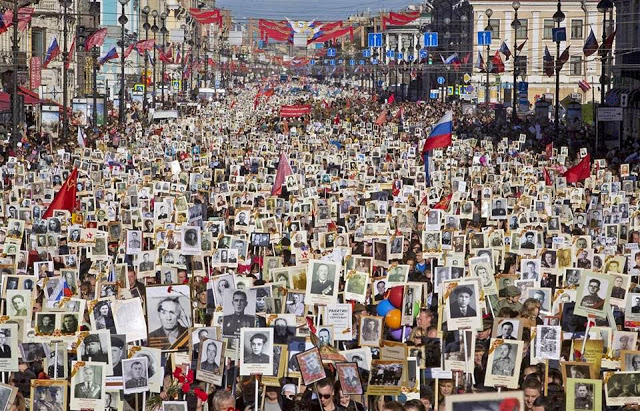
Putin also spoke of the ‘Immortal Regiment‘ initiative’s importance earlier, while marching with over 300,000 people in Moscow’s Red Square, Saturday. “It was born not in cabinets, nor in administrative structures, but in the hearts of our people,” Putin told the interviewer.

“The sides will discuss, in particular, measures to boost trade and economic relations,” he said. In 2014, for the first time in recent years, a 6.5% decline in the Russian-German trade turnover volume was recorded, to $70.1 billion, compared to the previous year.

At the same time, the Russian economy has accumulated more than $21 billion of German investment. There are more than 6,000 companies with German participation operating in Russia, including about 800 – with 100% German capital. The volume of Russian investment in Germany is about $850 million.

The Kremlin also says the two countries have the traditionally intense cultural and humanitarian contacts and inter-regional cooperation.

The meeting with Merkel will complete the four-day “marathon” of international meetings that Putin has held on the sidelines of the Victory Day celebrations.

Since May 7, he has held talks with the leaders of the CIS (Commonwealth of Independent States) countries and the Eurasian Economic Union (EAEU), as well as with the leaders of Cuba, Mongolia, China, India, Vietnam, the Czech Republic, South Africa, as well as with the UN Secretary-General.

The South African president arrived in Moscow on Friday to join in commemorations of the 70th anniversary of the Allied victory.

Zuma urged on Saturday to endorse a “meaningful” reform of the United Nations to build a more just world order, the presidency said in a statement.

Meanwhile Martin Charmoy, head of Prosperity Capital Management fund in London, predicted that trade between Russia and China will reach $200 billion in the next several years.

Russia and China are quickly becoming close friends, a growing threat to European markets, Martin Charmoy, head of Prosperity Capital Management fund in London, said.

The analyst also predicted that trade between Russia and China will reach $200 billion in the next several years.
“Russia and China are becoming best friends,” Charmoy concluded.

Meanwhile, the analysts said European companies that once were very successful in the Russian market are losing their positions due to sanctions and the geopolitical situation.

This week during the Chinese President Xi Jinping’s visit to Moscow, a wide range of agreements in the trade, economic and energy fields were inked. The main issue on the agenda was an agreement to couple the Eurasian Economic Union and the Silk Road projects.

Last year, Russia’s gas-producing giant Gazprom and Chinese CNPC signed a deal to supply China with 38 billion cubic meters of gas per year over the next 30 years.

The total sum of the contract is estimated to be $400 billion, the largest Gazprom contract ever. The gas price is attached to the oil price. The supplies are planned to start in four to six years.

Source: Sputnik News/Itar-TASS

Russia, Argentina sign energy deals worth billions

Russia and Argentina signed agreements which amounted to an “all-encompassing strategic partnership” during Argentine President Cristina Fernandez de Kirchner’s visit to Moscow.

Russia and Argentina signed a number of deals on developing hydroelectric, nuclear and fossil-based energy and announced intentions to use each other’s currencies in trade.

The memorandums are a massive breakthrough for economic relations between Russia and Argentina. Russian President Putin called the negotiations rich and fruitful.

“There were important long-term deals made in economic and political spheres. Russia and Argentina are entering a new stage of cooperation,” the head of Argentina’s Foreign Ministry Timerman Hector told Sputnik.

Argentine President Cristina Fernandez de Kirchner said the two sides agreed to conduct thorough consultations on using national currencies in trade calculations instead of US dollars.

Argentina’s New Power Sources

A $2 billion memorandum was signed to build a new hydroelectric dam and will consider switching to national currencies for mutual deals. Russia’s VEB bank will provide $1.2 billion of the total investments needed, 35 percent of which will be used to pay Argentine subcontractors.

In addition, Russia will provide Argentina with access to Russian nuclear power technology. The deal will be prepared by the end of the year. The head of Russian nuclear power plant company Rosatom declined to give an estimate to the deals, saying that one bloc costs “billions of dollars.”

“Rosatom has joined the project to build the sixth bloc of the Atucha nuclear power plant,” Putin said.

Russian energy giant Gazprom signed a memorandum to explore and develop gas fields with Argentine state gas company YPF. The deal may amount to $1 billion in investments according to Argentina’s Minister of Industry.

Russian company Uralmash will also construct a plant which will manufacture oil extraction equipment, which will amount to an additional $1.9 billion in Russian investments.

Putin also said that Russia and Argentina will cooperate in the military-technical sphere and pledged to accelerate the construction of GLONASS satellite navigation systems in Argentina.

In the mutual statement, Kirchner and Putin agreed that the situation in Ukraine can only be solved by peaceful means. Putin added that Russia supports Argentina in the Malvinas (Falkland) Islands dispute.

“Russia supports Argentina’s striving for direct talks with Britain to achieve prompt resolution to the Malvinas Islands dispute,” Putin added.

The Eurasian Economic Union and the Latin American MERCOSUR bloc also plan to sign a cooperation memorandum.

Source: Sputnik News

Oil sinks on hopes of Iran deal

Oil prices edged lower on Tuesday on high hopes for a deal on Iran’s nuclear program and increased Iranian crude-oil exports.

Light, sweet crude for May delivery settled down 0.48% at $47.37 a barrel on the New York Mercantile Exchange.
Brent, the global benchmark, slid 0.14%, to $56.13 a barrel on ICE Futures Europe.

Both benchmarks fell for the third straight quarter on expectations of a final deal on Iran’s nuclear program in exchange for lifting international sanctions on Tehran. Market analysts say additional oil supplies from Iran would flood an already-oversupplied market and push prices even lower.

Crude prices have dropped more than 50% from their mid-June high due to growing production and lackluster demand.
Talks between Iran and six world powers to settle a dispute around Tehran’s nuclear program extended beyond a Tuesday deadline, as the parties moved towards a deal but failed to agree to crucial details such as the lifting of UN sanctions.

Efforts to reach a framework deal were scheduled to continue on Wednesday in the Swiss city of Lausanne.
Russian Foreign Minister Sergei Lavrov said a general agreement had been reached on all key aspects of a future deal.

“If the flood gates to Iranian crude open, (prices) will probably test this year’s lows again,” Phillip Futures analyst Daniel Ang told Reuters.

Iran’s oil production is expected to rise by around 500,000 barrels per day within six months if sanctions are removed, and by a further 700,000bpd within another year.

Source: Sputnik News

EU reportedly moves to block Russia-Hungary nuclear deal

The European Union is opposing a multibillion deal under which Hungary is to buy nuclear fuel rods from Russia for its old Paks nuclear power plant. Some media claim the deal has been blocked, though Budapest denies the reports.

Russian nuclear engineers are to build two new reactors with combined capacity of 1,200 megawatts at Hungary’s only nuclear power plant, which currently has four reactors. The deal signed last year involves a €10-billion loan that Moscow offered to Budapest on condition that the money would pay for the equipment, RT reported.

The new reactors would have to be loaded with Russian-made fuel rods, which is a matter of safety for the new reactors. However EU’s nuclear fuel purchasing agency Euratom is opposing the exclusive deal. The Financial Times reported Thursday that the European Commission last week backed Euroatom’s decision to block the deal.

The blockage was not immediately confirmed by European or Russian officials. Hungarian government spokesman Zoltan Kovacs rejected the FT report and said Budapest would demand that the newspaper publish a retraction.

Hungary is among EU members opposing Brussels’ drive to break ties with Russia over the ongoing Ukrainian crisis. Hungarian Prime Minister Viktor Orbán is a vocal opponent of EU sanctions against Moscow, which have led to a trade war between Russia and Europe.

Orbán maintains his maverick position towards EU anti-Russian policies, which he views as harmful for Europe and imposed under pressure from Washington. Critics accuse him of authoritarian trends, with hawkish US Senator John McCain going as far as calling him a “neo-fascist dictator.”

Amid the criticism both at home and abroad, the PM’s Fidesz party won last year’s general election with a landslide victory, receiving almost 45 percent of votes.

However, Andras Giro-Szasz, Hungary’s state secretary responsible for government communications, has firmly denied the report of the EU veto or other prohibitive fines on its nuclear projects with Russia, in a statement to Hungarian state news agency MTI.

“It is not true that the EU has blocked the Paks II construction,” Giro-Szasz told the news agency AFP.

On Thursday, the Financial Times reported that EU has blocked the Hungary-Russia nuclear deal and its EU nuclear body, Euratom, has refused Hungary’s plans to import nuclear fuel from Russia.

Russia, China abandoning dollar

Russia and China plan to use more actively rubles and yuan in mutual settlements, Russian President Vladimir Putin said at an Asia-Pacific Economic Co-operation summit in the Chinese capital on Monday.

“Within cooperation with that country (China) we plan to use national currencies more actively in settlements,” the Russian leader said, recalling that first deals are already paid in rubles and yuan.

Putin recalled that settlements in national currency are particularly planned in oil trade. “Our experts are studying such possibilities,” the Russian president said.

Payments in national currencies of such countries as China and Russia will allow influencing financial and energy markets, Russian President Vladimir Putin said at the APEC summit.

“Payments in national currencies between such partners as China and Russia — a very promising direction of our cooperation. It will allow broadening our possibilities in mutual trade and substantially influencing world financial and energy markets,” the president said.
On Sunday, Putin and Chinese counterpart Xi Jinping particularly discussed possible settlements in national currency.

The presidents of the two countries “focused on mutual settlements in yuan in different spheres, including such sensitive spheres as military-technical co-operation that will strengthen yuan as a reserve regional currency,” Russian presidential spokesman Dmitry Peskov said after the meeting of the two leaders.

Russia to submit request to UN for new Arctic borders

A decade after its first application was turned down, Russia plans to submit another request to the United Nations (UN), seeking to expand its Arctic borders by over 1 million square km, a senior government official said Wednesday.

“If the request is approved, Russia will fix its sovereign right over an extra territory of 1.2 million square meters in the Arctic Ocean and will also have a chance to increase its forecasts for hydrocarbon resources by 5 billion tons of equivalent fuel,” Natural Resources Minister Sergei Donskoi told a meeting chaired by President Vladimir Putin.

He added that the approval of the Russian claim would support Moscow’s geopolitical interests in the Arctic and provide its control over seabed and covered waters.

Moscow initially submitted its claim to the UN Commission on the Limits of the Continental Shelf in 2001 but was asked in 2002 to revise the application by adding more trustworthy data. Russia could again submit the claim next spring.

“Now all the work has been done. Since 2002 rather a large volume of field and camera work has been carried out in ice conditions,” Interfax news agency quoted Donskoi as saying.

For the UN to recognize Moscow’s ownership of those areas, it must be scientifically proven that they are a continuation of the continental crust with the same general geological structure.

Russia, along with the United States, Canada, Denmark and Norway, exercises sovereignty of 200 nautical miles (370 km) exclusive economic zone from their respective Arctic shorelines.

All the five countries have reserved the right to demand expansion of their exclusive zones, which requires each country to demonstrate the seabed is a natural extension of its continental shelf.

Source: Xinhua

The Colder War

The conspiracy theories surrounding the death of Total SA’s chief executive, Christophe de Margerie, started the second the news broke of his death. Under mysterious circumstances in Moscow, his private jet collided with a snowplow just after midnight. De Margerie was the CEO of Total, France’s largest oil company.

He’d just attended a private meeting with Russian Prime Minister Medvedev, at a time when the West’s relationship with Russia is fraught, to say the least.

One has better odds of being struck by lightning at an airport then a snow plow, or any other ground support vehicles hitting a plane and killing all inside the plane, in my opinion. And I say that as someone who’s familiar with airports, having worked at Vancouver International Airport when I was in university; I was the one who would bring the plane into its parking bay.

If it weren’t for those short odds, a snowplow on the runway with an allegedly drunk driver would be the perfect crime. But who would benefit from his death?

De Margerie was one of the few business leaders who spoke out against the isolation of Russia. On this last trip to Moscow, he railed against sanctions and the obstacles to Russian companies obtaining credit.

He was also an outspoken supporter of Russia’s position in natural gas pricing and transportation disputes with Ukraine, telling Reuters in an interview in July that Europe should not cut its dependence on Russian gas but rather focus on making the supplies more secure.

But what could have made de Margerie a total liability is Total’s involvement in plans to build a plant to liquefy natural gas on the Yamal Peninsula of Russia in partnership with Novatek. Its most ambitious project in Russia to date, it would facilitate the shipping of 800 million barrels of oil equivalent of LNG to China via the Arctic.

Compounding this sin, Total had just announced that it’s seeking financing for a gas project in Russia in spite of the current sanctions against Russia. It planned to finance its share in the $27-billion Yamal project using euros, yuan, Russian rubles, and any other currency but US dollars.

Did this direct threat to the petrodollar make this “true friend of Russia”—as Putin called de Margerie—some very powerful and dangerous enemies amongst the power that be, whether in the French government, the EU, or the US?

In my book The Colder War, one chapter deals with “mysterious deaths” and how they are linked to being on the wrong side of the political equation. Whether it’s going against Putin or against the petrodollar, there are many who have fallen on both sides.

If Total doesn’t close the $27 billion financing it needs to move forward with the Yamal LNG project then we’ll know someone stepped in to prevent an attack on the petrodollar. The CEO of Total, before his death and his CFO were both strong supporters of Total raising the $27 billion in non US dollars and moving the project forward with the Russians. But, this could all change if the financing does not complete.

How many other Western executives who dare to help Russia bypass sanctions—and turn it into an energy powerhouse—will die under suspicious circumstances?

Marin Katusa, is author of The Colder War, manager of multiple global energy-exploration hedge funds, and co-founder of Copper Mountain Mining Corporation. 

Putin stresses importance of unblocking South Stream

It is important to unblock the situation around the South Stream gas pipeline that will make a weighty contribution to Europe’s energy security, Vladimir Putin said on Wednesday in an interview with the Serbian newspaper Politika.

“I feel confident this project will contribute considerably to the comprehensive energy security of Europe,” he said. “Everyone stands to gain from it – Russia and the European consumers including Serbia as well.

The problem of gas transit via Ukraine is still in place and its obvious solution is to diversify gas supply routes, Putin said.

“If we speak about further prospects of Russian gas exports to Europe, obviously, the problem of transit via the Ukrainian territory still exists,” he said. “One of the evident solutions is to diversify supplies routes.”

He stressed that Russia was ready to “continue constructive talks on those subjects”.

Also Putin hopes the European Commission (EC) will soon settle the issue of using the OPAL gas pipeline to full capacity.

“We hope that the European Commission will finally settle the issue of the full-capacity use of the OPAL gas pipeline,” he said in an interview with newspaper Politika.

South Stream gas pipeline project is expected to bring new investment to Serbia and to beef up its energy security, believes Russian President Vladimir Putin.

He said it on Wednesday in an interview with the Serbian daily Politika on the eve of his official visit to Belgrade.

“Implementation of the South Stream project should bring in no less than 2 billion to Serbia in the form of new investment and to beef up its energy security considerably,” Putin said.

South Stream is a global infrastructural project steered by Russia’s major producer and exporter of natural gas, OAO Gazprom. The pipeline that is destined to have a throughput capacity of 63 billion cubic meters /bcm/ will stretch across the floor of the Black Sea to reach the countries of Southern and Central Europe.

Its land-surface part will cross the territories of Bulgaria, Serbia, Hungary, Slovenia, and Austria.

In autumn 2013, the European Commission launched what it called an antitrust investigation targeting the South Stream, which it said stood at variance with the norms of the EU’s “third energy package”.

Earlier on Wednesday, Putin’s aide Yuri Ushakov said the South Stream project would come under discussion at the talks in Belgrade and preparations for building the Serbian section of the future pipeline were underway.

“The Serbs are making it clear that implementation of the project without consent from Brussels will be impossible in principle although they are fully ready for this /implementation/ and the project is of big interest for them,” Ushakov said.

Russian President Vladimir Putin hopes that Russian-Serbian trade will reach 2 billion dollars this year.

He said that a free trade regime existing between the two countries was contributing to steady development of Russian-Serbian economic ties.
“Our reciprocal trade turnover grew by 15% to reach 1.97 billion dollars in 2013. It grew by another 16.5% to reach 1.2 billion dollars in the first half of 2014. We hope to reach the figure of 2 billion dollars this year” Putin stressed.

Positive dynamics can be seen in the sphere of investments. The total volume of Russian capital investments in Serbia has exceeded 3 billion dollars, the bulk of which was channeled into the strategically important energy sector, Putin told Politika.

“The Naftna Industrija Srbije (NIS) oil company is a graphic example of our successful cooperation. It was a loss-making company that has turned into the main donor to the Serbian state budget,” Putin stressed.

The Russian head of state also said that the Russian Railways Company and the Russian credit support were enabling Serbia to modernize its railway infrastructure.

“I am glad that Serbian businessmen are active conquering the Russian market. For example, they are supplying quality agrarian and industrial products,” Putin stressed.

Earlier this month, Serbia suggested introducing a free trade regime for food products. According to Serbian Foreign Minister Ivica Dacic, Russia is thinking of lifting import duties for sugar, cigarettes, alcohol and poultry meat. The Russian Agriculture Ministry is considering a possibility of granting preferences to agricultural imports from Serbia.

Russia continues to regard Europeans as partners despite statements from Brussels, Russian foreign minister Sergei Lavrov said.

Source: ItarTASS

Whatever happened to shale gas?

In certain circumstances, no news is good news. Sometimes, though, it tells its own story, especially when it we are experiencing something akin to a news blackout on an issue which should be constantly in the public eye.

That issue is shale gas, the great white hope of the energy market which, supposedly, was going to rescue our economy with the promise of massive volumes of cheap energy. By now, we should be getting some idea of the scale of the bonanza in the UK, but there have been no public reports following early test drilling.

The most recent media report, however, might give some clue as to why we are hearing so little. This is from the South China Morning Post which tells of China’s shale gas ambition facing a “reality check”. Commercialisation of the mainland’s rich shale gas resources, the paper says, is proving difficult. Challenging geology, shortage of water near the drilling sites and high population densities are all conspiring to make drilling more expensive and less certain than predicted.

Last April, the BBC had already pre-empted the language of the South China Morning Post, proclaiming that the “shale industry faces global reality check”.

It told us that Poland was seen as the poster boy for European shale gas but, according to Stuart Elliott, managing editor at the industry information provider Platts, “the Polish experiment has been a failure to date”. Enticed by seemingly abundant reserves and a government keen to kick-start production, US energy majors moved in, hoping to replicate their domestic success on foreign shores.

Thirty to 40 wells were planned for 2013. To date, there is just one well producing enough gas to be economically viable. Earlier, we had news of companies deserting Poland. Exxon Mobil, Talisman and Marathon have all pulled out, while Chevron, Conoco Phillips and San Leon are persevering.

In the UK, alarm bells have been sounding for some time, and for some of the same reasons. Chatham House in December 2013 was telling us that knowledge of the geology of shale plays in the United Kingdom was in its infancy.

Not only are shale plays notoriously different, so too are wells on the same play, it said. Costs also change as the shale gas operations move along the learning curve. This uncertainty is compounded by the uncertainty over the externalities of environmental damage that may be associated with shale gas operations.

In March of this year, the Financial Times was also sounding less than enthusiastic, starting off by setting up John McGoldrick, chief executive of unconventional gas company Dart Energy, to say: “The shale gas potential is enormous here, even if we just get one percent of the in-place estimates”.

But just because gas is recoverable, it doesn’t mean it makes economic sense to do so, the paper said. Explorers must drill wells to discover natural gas flow rates. Cuadrilla was the only company to have fracked in the UK and no wells had been fracked since an 18-month moratorium had been lifted more than a year preciously.

Exploration is expensive and it is easy to spend more on drilling a well than the value of gas that comes out of the ground. Drilling costs are significantly higher in the UK than the US. The nascent supply chain and long licensing process were largely to blame.

“At the minute, the economic equation is negative”, said Alex Grant at investment bank Jefferies. “It’s costing [UK explorers] well over $10m to drill a well – compared to say $4m in the US – and the gas they can get out is worth a lot less than that. If this is the best they can do then the equation doesn’t work on a per well basis and it doesn’t matter that they have huge amounts of gas”, he said.

And seriously expensive it was turning out to be, with a report in April telling is that the investment needed to bring 4,000 wells into action would cost £33 billion. By then, though, Bill Powers in Forbes was “popping the shale gas bubble”. America’s shale gas resources and reserves have been grossly exaggerated and today’s level of shale gas production is unsustainable, he was saying.

In fact, he said, due the distortions of zero interest rates and other factors, an enormous shale gas bubble has developed. Like all bubbles, this one will pop sooner than expected and when it does, the aftermath will be very unpleasant.

From a standing start a dozen years ago, shale gas production had grown to account for nearly 50 percent of America’s gas production. However, the shale gas boom was rapidly maturing and it was quickly approaching a point where shale gas production was heading into decline. In fact, the majority of shale gas basins in America were already exhibiting declining production.

This had long been picked up by industry sources, and even Bloomberg had been warning of it earlier in the year. Freshly fracked wells had sent US oil production soaring 39 percent since 2011, it said. That had been the steepest climb in history, and if production had continued apace, the US had been set to become the world’s biggest source of oil by 2015. The problem, though, was that the production was declining faster than expected.

The average flow from a shale well drops by about 50 percent to 75 percent in the first year, and up to 78 percent for oil, we were told by Pete Stark, senior research director at IHS Inc. “The decline rate is a potential show stopper after a while,” said Stark. “You just can’t keep up with it”.

The industry has so far been able to live with the decline curve problem because operators have been able to scratch out better initial production in wells, Stark said. “If you don’t have that improvement, then you get stuck after a while and have to drill more and more wells just to stay even”, Stark said. As depletion rates increased, an FT correspondent described the problems as “crippling”.

Exactly the same problems are being found with gas production and the New York Times has been on the case for years – with caveats.

By May this year, though, the House of Lords select committee on economic affairs was saying that exploration and appraisal was urgently needed to establish the economic potential of the UK’s shale gas and oil resource. And there lies as neutral an assessment as you can get. There are currently no official reserve estimates. The UK reserves could be anywhere from zero to substantial. And without those estimates, the commercial scale of shale gas extraction cannot be forecast.

Still the questions on the US scenario abound. “The staying power of the American shale boom is limited by natural, macroeconomic, and microeconomic factors, none of which will disappear on the strength of unconstrained enthusiasm”, said Dajahi Wiley of Oilprice in June. And in September, the situation was once again being called this decade’s version of the dotcom bubble.

Already in July, the Telegraph had been warning that the British shale industry had a very long way to go, making any investment extremely high-risk. It may be impossible to get the shale gas out of the ground economically and there had been no well tests that had proven the resources was commercially viable, this paper said. Yet, in Poland, it is estimated that about 150-300 drills will be needed to produce enough data to estimate the size of shale gas deposits.

However, even if UK shale gas reserves are zero, or the industry fails to be economically viable, it may not matter. Another potential source is coming up fast – methane hydrate, which potentially exists in such quantities that it can keep the world supplied for 1,500 years.

For sure, it would be preferable to have indigenous supplies of gas, but the prospect of the world running out of gas any time soon is looking increasingly remote. What we cannot do, though – at this stage, at least – is rely on UK-produced shale gas as a policy option. The UK shale revolution may happen, but it may not.

Source: http://eureferendum.com/

Finland, Turkey get Russian VVER1200 NPP

These latest design VVER1200 NPP’s have 60 year life span, with 20% reduction in build cost and time, and 10% reduction in operating cost. Turkey ordered 4 of these NPPs. Same process as SA: State deal subsequently approved by parliament. Russia to finance, built, own, operate and transfer option after 15 years. Russia buys back … Continue reading “Finland, Turkey get Russian VVER1200 NPP”

These latest design VVER1200 NPP’s have 60 year life span, with 20% reduction in build cost and time, and 10% reduction in operating cost.

Turkey ordered 4 of these NPPs. Same process as SA: State deal subsequently approved by parliament. Russia to finance, built, own, operate and transfer option after 15 years. Russia buys back spent fuel for processing.

In Finland one Russian VVER 1200 NPP will be build near Tornio – Outokumpu has 12% share in the planned NPP.

During 2014 Outokumpu said its investment in Fennovoima VVER1200 NPP, to be paid over the next decade, would be around 210 million euros, compared with its earlier estimate of around 150 to 200 million euros. (Nearly 3 billion Rand for the 12% share.)

The company’s stainless steel plants in Tornio, including 540 000t/y of FeCr-production, are the single largest consumer of electricity in Finland.

“We want to ensure a stable, predictable and low-carbon energy source at production cost to our operations in Finland,” Chief Executive Mika Seitovirta said in a statement on Wednesday. (19 February 2014)

Eight VVER1200 NPP’s are planned for South-Africa, near Jeffreys Bay, Gansbaai and Koeberg in Cape Town. Currently transmission losses from Mpumalanga to coastal cities in the Cape run at around 12%.

The real controversy surrounding the Russian-SA NPP agreement, refers to SA’s intention to again enrich uranium at Pelindaba near Pretoria for local NPP fuel production. South-Africa and Namibia, governed as a former province of South-Africa, have large uranium reserves. Uranium enrichment and nuclear fuel production, although legal under the NPT, can supply a country with a break-out capability to produce bombs.

NECSA was also to produce the TRISO fuel for Eskom’s Pebble Bed Modular Reactor at Pelindaba.

During June 2014, the Indonesian government approached the South-African government for PBMR technology. After conducting a levelized evaluation of various NPP’s, Indonesia’s nuclear authority came to the conclusion that Eskom’s PBMR is the safest and lowest cost option for Indonesia.

The Eskom PBMR direct-cycle helium turbo-generator (from Mitsubishi) runs at 45% efficiency as compared to 34% of conventional NPPs. The Eskom PBMR was of 160MW capacity per module, and could also be build inland , for exmple in Middelburg, as unlike conventional NPPs, it does not require (sea) water cooling

During 2009 Eskom refused to become the anchor client for 60 of its own PBMR plants totaling 9 600MW. Thus during same year the construction of the first direct cycle (no water-steam circuit) PBMR in Cape Town by Murrey & Roberts and SNC Lavalin was halted. The R300m reactor pressure vessel had already been manufactured in Spain near the port of Santander. Currently this PBMR reactor vessel is lying at Saldanha Bay. The other major contracts with Mitsubishi and SGL Carbon were also cancelled.

During 2013 the then Minister of State-Owned-Enterprises and Eskom, Mr Melusi Gigaba was in Middelburg and answered a question about the possibility of the state reviving local technology and industry, in chosing PBMR instead of conventional NPP. The minister answered that only four PBMR engineers were still in state employment, and that their contracts were to expire during 2013. The minister then proceeded to announce that heads would roll if Medupi power station did not start-up end-2013.

Mr O’ Flaharty, then CFO of Eskom, is now CEO of Arcelor Mittal South-Africa. Mr Brian Dames left the employment of Eskom after a two decade career. Mr Gigaba, second on the ANC’s NEC-list and once mooted as South-Africa’s crown prince, is
now minister of Home Affairs.

During February 2014, the veteran financial reporter at Business Day, David Gleason passed away. Gleason predicted that Russia would win the South-African nuclear build contract, and that as a result prized Russian assets in South-Africa would then experience a change in ownership.

Norilsk Nickel has put up for sale its 50% share in the rich and highly profitable Nkomati Nickel mine not far from Middelburg, Mpumalanga. First option to refuse belongs to South-African ARM. It remains to be seen who will soon own this valuable asset.