Is China colonising Namibia and other African countries?

Every weekday before dawn, a morning migration takes place near the desert on Africa’s southwestern coast. At 5:30 in the Namibian enclave Swakopmund, whose century-old buildings still bear the imprint of German colonization, solitary men in khaki uniforms emerge from houses and apartment complexes, the white reflective strips on their pants flashing as they walk briskly through the darkness. They are not African but Chinese. No one else is stirring in the Atlantic Coast town as the men converge on a tidy house on Libertina Amathila Avenue, the only one in the neighborhood with its lights ablaze.

Dylan Teng, a boyish 29-year-old engineer with a brush cut and wire-rimmed glasses, is among the last to arrive. Just as he has done nearly every day since landing in Namibia three and a half years ago, Teng joins the others in wolfing down a breakfast of steamed buns and rice porridge. He picks up a packed lunch prepared by a company chef and at precisely 6 o’clock, with stars still glimmering overhead, he boards a bus emblazoned with the letters C.G.N. — China General Nuclear, a state-owned behemoth that owns the biggest Chinese project in all of Africa.

An hour later, as the sun clears the horizon, the bus winds through a craggy moonscape and descends to the Husab Uranium Mine, a $4.6 billion investment that is the second-largest uranium mine in the world. Teng has made this trip nearly a thousand times, but Husab always seems like a mirage: a virtual city stretching seven miles across the desert floor, from two vast open pits being gouged out of the rocky substratum to a processing plant that, on the last working day of 2016, produced its first drums of U₃O₈, the yellowcake that can be used to generate nuclear power (and also to make weapons). “We had a big ceremony that day,” Teng says.

One of the few university graduates from his village in China’s southwestern Sichuan Province, Teng is keenly aware of Husab’s significance. It is not simply a lifeline for Namibia’s struggling economy, one that the country estimates will increase its gross domestic product by 5 percent when the mine reaches full production next year. The uranium itself, almost all of which will go to China, will also help turn Teng’s homeland into a world leader in nuclear energy and reduce its dependence on coal. In Beijing, where he worked before coming here, Teng lived under the gray blanket of coal-generated pollution that hangs over much of eastern China. Now he is working for the future — his own and his country’s — under an endless African sky of cobalt blue. “I never imagined,” he says, “I would end up halfway around the world.”
China’s gravitational pull can be felt today in every nook of the globe. Few countries feel the tug more strongly than Namibia, a wind-swept nation with a population of 2.4 million — barely a tenth the size of Beijing’s — some 8,000 miles away from the Chinese capital. The desert where the Husab mine has materialized in recent years used to be known only for the presence of Welwitschia mirabilis, the short, droopy national plant that grows just two leaves — and can live for more than 1,000 years. Now, in little more than 1,000 days, China’s reach has spread far beyond the uranium mine.

Just north of Swakopmund, a Chinese telemetry station sprouts from the desert floor, its radar dishes pointing skyward to track satellites and space missions. Twenty-five miles south, in Walvis Bay, a state-owned Chinese company is building an artificial peninsula the size of 40 baseball fields as part of a vast port expansion. Other Chinese projects nearby include new highways, a shopping mall, a granite factory and a $400 million fuel depot. Chinese trade flows through the port: shipping containers filled with cement, clothing and machinery coming in; tiles, minerals and — in some cases — illegal timber and endangered wildlife heading out to China. The activity is so frenzied that rumors of a proposed naval base in Walvis Bay, though vehemently denied by Chinese officials, do not strike locals as implausible.

This small outpost offers a glimpse of what may be the largest global trade-and-investment spree in history. Driven by economics (a hunger for resources and new markets) and politics (a longing for strategic allies), Chinese companies and workers have rushed into all parts of the world. In 2000, only five countries counted China as their largest trading partner; today, more than 100 countries do, from Australia to the United States. The drumbeat of proposed projects never stops: a military operating base, China’s first overseas, in Djibouti; an $8 billion high-speed railway through Nigeria; an almost-fantastical canal across Nicaragua expected to cost $50 billion. Even as China’s boom slows down, its most ambitious scheme is still ramping up: With the “One Belt, One Road” initiative — its name a reference to trade routes — President Xi Jinping has spoken of putting $1.6 trillion over the next decade into infrastructure and development throughout Asia, Africa and the Middle East. The scheme would dwarf the United States’ post-World War II Marshall Plan for Europe.

China’s relationship with Africa goes back to the 1960s, when Chairman Mao Zedong promoted solidarity with the developing world — “Ya Fei La,” as he called it, using the first syllables for Asia, Africa and Latin America. Though it was poor and mired in the chaos of the Cultural Revolution, China won new allies in Africa by finishing, in 1976, a 1,156-mile railroad through the bush from Tanzania to Zambia. Aid continued to trickle in, but there were no other big projects for nearly 30 years, as China focused on building up its domestic economy, following its leader Deng Xiaoping’s prescription to “hide your strength and bide your time.” That ended in the 2000s, when Beijing, recognizing the need for foreign resources and allies to fuel its economic growth, exhorted the nation’s companies to “go out” into the world.

Today, if you take the red-eye flight from Shanghai to Addis Ababa, the Ethiopian capital, chances are you’ll be seated among Chinese workers heading to a construction site in oil-rich Equatorial Guinea, a cotton-processing plant in Mozambique, a telecom project in Nigeria. China’s trade with African nations has increased fortyfold in the past 20 years. The workers and migrants carrying out China’s global vision are now so ubiquitous in Africa — as many as a million of them, according to one estimate — that when my wife and I wandered into a Hunanese restaurant in Addis, the red-faced workers devouring twice-cooked pork blurted out: “Ah, laowai laile!” “Foreigners have come!” It seemed rude to point out that they were foreigners, too.

China’s advances have come as the West seems to be retreating. United States engagement in Asia, Africa and Latin America declined after the Cold War, when the regions served as proxies for superpower rivalries. China’s rise and the wars in the Middle East also pulled away resources and attention. And now, with Washington raising doubts about global agreements on issues like free trade and climate change, Beijing has more leverage to push its own initiatives and show its capacity for global leadership. President Trump’s disdain for the Trans-Pacific Partnership has already made Beijing’s trade proposals, which exclude the United States, more appealing. “In certain parts of the world, the relative inattention of the Trump administration is definitely creating an opening for China to fill,” says David Shambaugh, director of the China Policy Program at George Washington University and author of the 2013 book “China Goes Global.” But “China remains very much a partial power — and only offers other countries an economic relationship.”

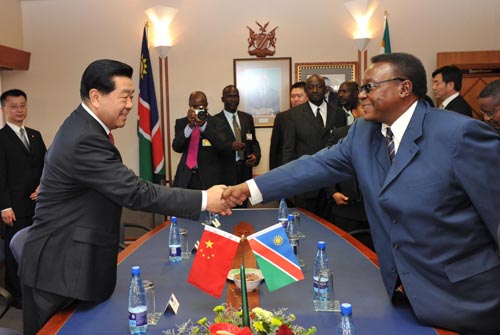
Still, for a nation like Namibia, China’s pitches can be irresistible partly because they’re rooted in historical solidarity. Beijing backed the black nationalist movement’s liberation struggle against apartheid and its white South African overlords. Sam Nujoma, the leader of the South West Africa People’s Organization (Swapo), visited Beijing in search of guns and funds in the early 1960s. When Namibia finally claimed independence in early 1990, with Nujoma as president, China became one of its first diplomatic allies, pronouncing the two countries “all-weather friends.” (Beijing was also desperate for allies to break its diplomatic isolation after its violent crackdown on the 1989 democracy movement.) – New York Times, fragment

Mossad contradicts Bibi’s bom

Israeli PM Benjamin Netanyahu’s 2012 statement at the UN, in which he warned the world of Iran being too close to making a nuclear bomb, allegedly contradicted his country’s intelligence assessments, according to leaked spy documents.

The Mossad shared the information with South Africa’s State Security Agency a few weeks after the prime minister’s UN speech.

Netanyahu famously declared to the United Nations General Assembly in September 2012 that Iran was 70 percent of the way to completing its “plans to build a nuclear weapon,” and drew another “red line” at 90 percent, claiming Tehran’s first bomb would be ready “by next spring, at most by next summer.”

However, leaked Mossad documents suggest the country was much further from such development.

According to Spy Cables – a cache of hundreds of leaked secret intelligence papers from all over the world, published by Al Jazeera’s Investigative Unit in collaboration with the Guardian newspaper – at the time of Netanyahu’s statement, Israel’s intelligence service concluded that Iran was “not performing the activity necessary to produce weapons,” estimating that Iran had 100 kilograms of uranium enriched to a level of 20 percent.

“Even though Iran has accumulated enough 5 percent enriched uranium for several bombs, and has enriched some of it to 20 percent, it does not appear to be ready to enrich it to higher levels. It is allocating some of it to produce nuclear fuel for the TRR [Tehran Research Reactor], and the amount of 20 percent enriched uranium is therefore not increasing,” said the secret report.

In an article by Press TV, an American foreign policy analyst said that US President Barack Obama is “under pressure” to reach an agreement with Iran over Tehran’s nuclear energy program.

“It’s quite obvious to everyone that Mr. Obama would like to have a deal with Iran,” said James George Jatras, a former US diplomat and adviser to the Senate Republican leadership.

“He’s under a lot of pressure to try to bring negotiations to a conclusion that he can defend domestically,” Jatras said Sunday during a phone interview with Press TV.

“I doubt very much that the United States would walk away from the negotiations because this is such a strong priority for Mr. Obama who otherwise has very little to show in the realm of foreign policy,” he added.

US Secretary of State John Kerry and Iranian Foreign Minister Mohammad Javad Zarif began a new round of talks in Geneva on Tehran’s nuclear program on Sunday.

Russia, Iran ink deal for 8 nuclear power units

Russia is to build eight nuclear power units in Iran, as a new partnership agreement, guaranteed by the IAEA, was signed in Moscow on Tuesday.

The head of the Rosatom, Sergey Kirienko, and the chief of the Atomic Energy Agency of Iran, Ali Akbar Salehi, signed a series of documents, promoting the links in the field of peaceful application of atomic energy between the countries, RIA Novosti reports.

According to the agreement, Russia is to construct eight units with pressurized water reactors “turn-key ready” in Iran. Four of them will be built at the Bushehr Nuclear Power Plant, also completed by Russia a year ago.

Besides, nuclear fuel for the future reactors will be provided by Russia during the whole life cycle of the new reactors. Spent fuel will be returned for processing and storage.

“It is the turning point in the relations between our countries,” Salehi said. “These friendly actions, taken by Russia will be well-remembered.” He added that now Russia and Iran “have become even closer to each other.”

The partners didn’t touch upon the subject of possible shipment of enriched uranium to Iran.

“We didn’t discuss this question today,” Kirienko told journalists after the signing of the protocol.

Iran is currently facing a November 24 deadline to reach an agreement on its nuclear program, within the frame of year-long diplomatic talks. On Monday, Iran’s Foreign Minister Mohammad Javad Zarif and US Secretary of State John Kerry tried to overcome the problems, and, according to the US State Department, the talks had proven “tough, direct and serious,” yet “there is still time” for progress, AFP reported.

Oz signs away nuclear material to India

Australia’s agreement to provide India with uranium could leave Canberra with no say on the use of nuclear material shipped to India, the former head of Australia’s nuclear watchdog said Friday.

“[Australian authorities] clearly left out a number of things that the Indians don’t like . . . Where Australia has given reprocessing consent in the past, it’s on the basis that we approve downstream facilities where the plutonium will be used. But under the India agreement, we’re just not doing that,” John Carlson, the former head of the Australian Safeguards and Non-Proliferation Office, was cited as saying by The Guardian.

Plutonium is created from uranium in nuclear reactors and may potentially be used in the creation of nuclear weapons.

According to Carlson, the “reprocessing consent” outlined in the sixth article of the bilateral nuclear cooperation agreement means Australia has no say in how India may choose to use byproducts from energy production.

The deal appeared to waive “standard provisions” relating to nuclear safeguards, Carlson told the newspaper, noting that Australia has been allowed to track the uranium it supplies, and well as its byproducts, under every similar agreement thus far.

An agreement on nuclear cooperation between India and Australia was signed on September 5 during Australian Prime Minister Tony Abbott’s trip to New Delhi. Australia, which holds the largest uranium deposits in the world, has previously refused to sign such an agreement because India is not party to the Nuclear Non-Proliferation Treaty.

Finland, Turkey get Russian VVER1200 NPP

These latest design VVER1200 NPP’s have 60 year life span, with 20% reduction in build cost and time, and 10% reduction in operating cost. Turkey ordered 4 of these NPPs. Same process as SA: State deal subsequently approved by parliament. Russia to finance, built, own, operate and transfer option after 15 years. Russia buys back … Continue reading “Finland, Turkey get Russian VVER1200 NPP”

These latest design VVER1200 NPP’s have 60 year life span, with 20% reduction in build cost and time, and 10% reduction in operating cost.

Turkey ordered 4 of these NPPs. Same process as SA: State deal subsequently approved by parliament. Russia to finance, built, own, operate and transfer option after 15 years. Russia buys back spent fuel for processing.

In Finland one Russian VVER 1200 NPP will be build near Tornio – Outokumpu has 12% share in the planned NPP.

During 2014 Outokumpu said its investment in Fennovoima VVER1200 NPP, to be paid over the next decade, would be around 210 million euros, compared with its earlier estimate of around 150 to 200 million euros. (Nearly 3 billion Rand for the 12% share.)

The company’s stainless steel plants in Tornio, including 540 000t/y of FeCr-production, are the single largest consumer of electricity in Finland.

“We want to ensure a stable, predictable and low-carbon energy source at production cost to our operations in Finland,” Chief Executive Mika Seitovirta said in a statement on Wednesday. (19 February 2014)

Eight VVER1200 NPP’s are planned for South-Africa, near Jeffreys Bay, Gansbaai and Koeberg in Cape Town. Currently transmission losses from Mpumalanga to coastal cities in the Cape run at around 12%.

The real controversy surrounding the Russian-SA NPP agreement, refers to SA’s intention to again enrich uranium at Pelindaba near Pretoria for local NPP fuel production. South-Africa and Namibia, governed as a former province of South-Africa, have large uranium reserves. Uranium enrichment and nuclear fuel production, although legal under the NPT, can supply a country with a break-out capability to produce bombs.

NECSA was also to produce the TRISO fuel for Eskom’s Pebble Bed Modular Reactor at Pelindaba.

During June 2014, the Indonesian government approached the South-African government for PBMR technology. After conducting a levelized evaluation of various NPP’s, Indonesia’s nuclear authority came to the conclusion that Eskom’s PBMR is the safest and lowest cost option for Indonesia.

The Eskom PBMR direct-cycle helium turbo-generator (from Mitsubishi) runs at 45% efficiency as compared to 34% of conventional NPPs. The Eskom PBMR was of 160MW capacity per module, and could also be build inland , for exmple in Middelburg, as unlike conventional NPPs, it does not require (sea) water cooling

During 2009 Eskom refused to become the anchor client for 60 of its own PBMR plants totaling 9 600MW. Thus during same year the construction of the first direct cycle (no water-steam circuit) PBMR in Cape Town by Murrey & Roberts and SNC Lavalin was halted. The R300m reactor pressure vessel had already been manufactured in Spain near the port of Santander. Currently this PBMR reactor vessel is lying at Saldanha Bay. The other major contracts with Mitsubishi and SGL Carbon were also cancelled.

During 2013 the then Minister of State-Owned-Enterprises and Eskom, Mr Melusi Gigaba was in Middelburg and answered a question about the possibility of the state reviving local technology and industry, in chosing PBMR instead of conventional NPP. The minister answered that only four PBMR engineers were still in state employment, and that their contracts were to expire during 2013. The minister then proceeded to announce that heads would roll if Medupi power station did not start-up end-2013.

Mr O’ Flaharty, then CFO of Eskom, is now CEO of Arcelor Mittal South-Africa. Mr Brian Dames left the employment of Eskom after a two decade career. Mr Gigaba, second on the ANC’s NEC-list and once mooted as South-Africa’s crown prince, is
now minister of Home Affairs.

During February 2014, the veteran financial reporter at Business Day, David Gleason passed away. Gleason predicted that Russia would win the South-African nuclear build contract, and that as a result prized Russian assets in South-Africa would then experience a change in ownership.

Norilsk Nickel has put up for sale its 50% share in the rich and highly profitable Nkomati Nickel mine not far from Middelburg, Mpumalanga. First option to refuse belongs to South-African ARM. It remains to be seen who will soon own this valuable asset.

Remember Chernobyl?

chernobyl09The 1986 Ukrainian nuclear disaster of Chernobyl was in nuclear weapons-equivalent terms a very large-sized nuclear device, probably releasing 130 kilograms of very highly enriched uranium and plutonium, as well as other long-lived deadly nuclides.

In very approximate terms this was equivalent to about 15 times the radiological inventory of the 1945 Hirsoshima A-bomb. Economic damage to date from the Chernobyl disaster which requires a 2827 square kilometer total exclusion zone, is variously estimated at $350 – $500 billion, with at least 30 000 fatalities to date across Europe.

Despite the Ukraine having known, proven and published natural gas reserves able to cover about 185 years of national gas consumption, for conventional gas reserves, and about 600 years when probable unconventional gas reserves are included, the country was designated by the Soviet Union as needing intensive development of nuclear power. From the late 1960s, nuclear power was developed on a massive basis.

As of 2009, according to the World Nuclear Association, total electricity production was about 50% nuclear and this nuclear supply amounted to about 87 billion kWh. Only 20% of Ukraine’s power supply was gas-based, with 4 billion kWh net exported. Ukraine’s hydropower resources, which have been treated like gas as “poor cousins”, but are large, contributed about 9.3% of electricity generation in 2009, according to the WNA.

All of Ukraine’s remaining 15 civil-type reactors still in service are Russian VVER types, two being 440 MW models, and the other 13 larger 1000 MW units. All of these reactors are potentially “dual use”, due to their original format – exactly like US Westinghouse industry standard 900 MW reactors – derived from Soviet nuclear submarine and nuclear ship reactor models, the design requirements of which demand very high power densities without consideration of plutonium production during their service lifetimes, or the reprocessing of “reactor core pollutants”. Being semi-military design, spunoff plutonium was regarded as a bonus rather than handicap.

The original Soviet design lifetime for VVER reactors was 30 years. The more-dangerous or “naked reactor” Soviet design format, called RBMK, as used at Chernobyl, have since 1997 all been closed down in the Ukraine, but not fully decommissioned.

As many as 15 new reactors of around 1000 MW capacity each with much higher safety standards were “proposed and part funded” in a 2006 Ukrainian energy plan, but none of these reactors were ever completed, although some are in part-completed condition. Significantly, reactor development strategies published by Ukraine’s Energoatom, the state semi-private atomic energy corporation, envisage the possible replacement of unfinished PWR-type reactors by Canadian CANDU heavy water reactors – the type utilized by both Pakistan and India to “brew” sufficient weapons grade plutonium to clandestinely produce their atomic weapons. Reasons for possibly using CANDU reactors notably included the ability of these reactors to operate on the low-clarke or low quality of uranium ore reserves in Ukraine.

Since independence from the USSR in 1991 attempts were made to “close the nuclear fuel cycle”, that is to fund, build and operate nuclear fuel reprocessing facilities and long-term nuclear waste disposal facilities, rather than continue simply storing used fuel rods and nuclear wastes on site – as at Fukushima. This failed civil-sector attempt to reduce the very large residual nuclear pollution resulting from the Chernobyl disaster (1986) and accumulated “temporary measures” for used fuel rod and waste disposal, has been joined by explicitly military-nuclear attempts at reducing the quantities of weapons-capable nuclear material in Ukraine.

In 2013, a four-year Ukraine-NATO project started with the aim of cleaning up radioactive waste at 9 military facilities in the country, with a 25 million euro budget.

Collected and regrouped wastes were scheduled to be buried in the Chernobyl total exclusion zone. Since 2011, very high-level military nuclear wastes originating in Ukraine are scheduled to be “repatriated” to Russia, for burial in Russia’s central dry storage facility. This program which was never funded is now evidently on hold, since late February 2014

A new facility for treatment solid radioactive waste is under construction at the site of Zaporozhe nuclear power plant, to be commissioned in 2015. It will be fitted with a state-of-the-art nuclear waste incinerator of Danish design but this program has suffered from lack of political commitment inside the country, and lack of funding from EU sources. The completion date is only “indicative” and the program is also now on hold.

The Nuclear Threat Initiative (NTI), and its linked World Institute for Nuclear Security (WINS) has tracked the heavily-funded but semi-secret US-Russian Cooperative Threat Reduction project started in 1991 and aimed at repatriating thousands of nuclear warheads and military-nuclear materials, both short-range and long-range, that the USSR had spread between Russia, Belarus, Ukraine and Kazakhstan. While Belarus and Kazakhstan agreed in short order to give up their nuclear weapons, Ukraine initially refused.

In 1992, however, the Ukrainian government recognized it lacked both the resources and the technical know-how to maintain its status as a nuclear-armed nation, and its “inherited” nuclear weapons were literally two-edged swords. It then engaged to repatriate its entire stock – but also demanded financial compensation terms that Russia refused. As cited in interview with Associated Press, former Ukrainian president Leonid Kravchuk said that Russia “….threatened us with all kinds of economic sanctions, they wanted to get this issue over with fast”.

The financial haggling with Ukraine has continued although it is denied or qualified as unimportant by both sides, and by US observers. The haggling led to Russian general Alexander Lebed, in 1997, stating that Ukraine’s military was unable to account for dozens of “compact” or small-sized short-range nuclear devices.

The general gave differing figures regarding the count of lost or stolen weapons, but the Kremlin dismissed his allegations. Leading US politicians cited by NTI claim that the simple absence of “no nuclear detonations by terrorists or organized crime” is the proof that Lebed was being too pessimistic and the program has worked.

Ukraine is therefore a deadly storehouse of dangerous reactors, including the crippled Chernobyl reactor which as yet, to date, does not have a final entombment sarcophage.

Nuclear wastes, in Ukraine, are widely dispersed and poorly accounted for. The country could or might have a certain number of operational or repairable smaller-sized nuclear warheads, the radioactive materials of which also makes them prime assets for the production of “dirty bombs”, that is non-explosive nuclear waste-dispersing weapons.

This is serious business, so Washington’s diplomatic suicide-run to derail nuclear cooperation with Russia through START should raise alarms for anyone genuinely concerned about moving the globe towards a peaceful future.

Source: 21stcenturywire.com

Stolen uranium prompts SA probe

uraniumoreSouth African police have launched an investigation into how two Mozambican men obtained a kilogramme of uranium which they tried to sell in Durban, a spokesman said Tuesday.

“We’re trying to establish which mine it came from and how it came into the hands of the culprits,” said police spokesman Colonel Jay Naicker, who described the uranium as a raw mined product.

The two men, both in their early 20s, were arrested last week with the uranium and 90 ecstasy tablets.

They appeared in court on Monday charged with being in possession of the drugs and the kilo (about two pounds) of uranium.

The case has heightened fears over the illicit trade in enriched materials that could be used in dirty bombs.

“We would have to establish whether it’s just a small batch that they got their hands on or whether they’ve got access to more of the stuff,” Naicker said.

The South African Nuclear Energy Corporation (NECSA) confirmed that the substance was uranium and is testing its isotopic identity and levels.

“In order to produce a dirty bomb, one would have to obtain certain amounts of enrichment on the uranium,” Elliot Mulane, NECSA spokesman, told AFP.

“These tests will reveal the enrichment levels of the material, and with that revelation we will be able to confirm whether it can be used in a dirty bomb or in other clandestine or illegal activities.”

However, he said it was unlikely that highly enriched — that is, weapons-grade — material would have been sold on the street.

“Highly enriched uranium worldwide is stored in very, very high-security areas, and the chances that anyone could lay their hands on these materials are almost nil,” he said.

“So I’m not very concerned about highly enriched uranium ending up in the wrong places.”

Uranium trafficking is rare, with only five such cases in the past 20 years, Mulane said.

But he admitted that the theft was “a concern”, citing the issue of safeguards at mines and fears over the possible toxicity of the substance.

The material is likely to have come from a mine, possibly not within South Africa.

South Africa has the continent’s only nuclear power plant, but several countries have significant uranium deposits and mining activities.

The results of the tests on the uranium are expected Thursday.

International atomic bodies have been informed of the seizure.

The men were remanded in custody until December 3 for a bail application. – Sapa/AFP

Zim reporter denies uranium story

zbclogoZimbabwean police are looking for two journalists from the British newspaper, The Times over a story about a secret uranium export deal between Zimbabwe and Iran, a state newspaper reported Sunday.

The two Times journalists, Jan Raath and Jerome Starkey, are wanted for “spreading falsehoods” after the uranium deal story was published in the London paper on Saturday, Zimbabwe’s Sunday Mail reported.

The Times quoting outgoing deputy minister of mines, Gift Chimanikire, wrote that Zimbabwe signed a deal with Iran to supply the Islamic republic with the raw materials needed to develop a nuclear weapon.

The United States and the European Union have imposed crippling sanctions on Iran over its nuclear programme, which Tehran insists is for peaceful energy uses but which the Western powers fear is intended to build an atomic bomb.

Zimbabwe is also subject to international sanctions over its human rights record and alleged election fraud.

President Robert Mugabe, who won another five-year term in disputed polls last month, has publicly backed Iran’s nuclear drive.

During a visit to Harare in 2010 by then Iranian president Mahmoud Ahmadinejad, Mugabe said his guest should be assured of “Zimbabwe’s continuous support of Iran’s just cause on the nuclear issue”.

Chimanikire could not be reached for comment but The Sunday Mail quoted him denying the story as “silly, speculative and dangerous”.

“No licence has been issued. I never said such a silly thing,” the paper quoted Chimanikire as saying.

When contacted by AFP, The Times newspaper said it was not aware of the story in the Zimbabwean press and would prepare a response.

However, one of the two reporters, Starkey, tweeted about the report of the “manhunt” by Zimbabwean police. When asked if he planned to add the event to his CV, he tweeted: “Let’s wait and see that it ends ok.”

National police spokesperson Charity Charamba said she was not aware of a search for the journalists.

“I have not heard about it. I only got a call from someone else who was inquiring,” she told AFP, saying she would have to look into it. – SABC

Zim to supply Iran with uranium

Mugabe greets Iranian counterpart
Mugabe greets Ahmadinejad

Zimbabwe has breached international sanctions with an agreement to supply Iran with uranium to fuel its nuclear programme.

Zimbabwean Deputy Mining Minister Gift Chimanikire said: “I have seen [a memorandum of understanding] to export uranium to the Iranians.”

The agreement, which was reportedly signed in 2012, is likely to cause alarm in western capitals.

The United States and the European Union have imposed crippling sanctions on Iran over its declared nuclear programme.

Zimbabwe is also subject to international sanctions over its human rights record and conduct of elections.

A report compiled by the United Nations’ nuclear watchdog more than two years ago detailed a visit from Iran’s then Foreign and Co-operative Ministers to Zimbabwe to strike a deal, with the Iranians also sending engineers to assess uranium deposits

President Robert Mugabe, who won another five-year term in disputed polls in July, has publicly backed Iran’s nuclear drive.

During a visit by Iran’s then president, Mahmoud Ahmadinejad, to Harare in April 2010, Mugabe said his guest should be assured of “Zimbabwe’s continuous support of Iran’s just cause on the nuclear issue”.

He said the uranium deal had been made without his knowledge, and was only known to a handful of people at the top of the government.

A Chinese company has been surveying yellow-cake deposits in the far northeast of the country and the Zimbabwe government has been actively looking for buyers, according to Chimanikire, who, as a member of Zimbabwe’s opposition is likely to be replaced now that the election has brought an end to the shaky coalition government.

Uranium ore, or yellow cake, can be converted to a uranium gas which is then processed into nuclear fuel or enriched to make nuclear weapons.

Iran has long maintained that it needs the uranium for peaceful nuclear aspirations, as a source of domestic energy.

Mugabe has begun his seventh term as Zimbabwe president following an election once again stained by accusations of widespread vote rigging

Despite the agreement, analysts have said it was likely to be a long time before Zimbabwe’s uranium reserves were ready for export. – Sapa