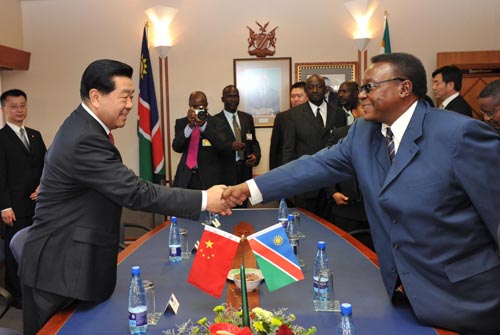
Is China colonising Namibia and other African countries?

Every weekday before dawn, a morning migration takes place near the desert on Africa’s southwestern coast. At 5:30 in the Namibian enclave Swakopmund, whose century-old buildings still bear the imprint of German colonization, solitary men in khaki uniforms emerge from houses and apartment complexes, the white reflective strips on their pants flashing as they walk briskly through the darkness. They are not African but Chinese. No one else is stirring in the Atlantic Coast town as the men converge on a tidy house on Libertina Amathila Avenue, the only one in the neighborhood with its lights ablaze.

Dylan Teng, a boyish 29-year-old engineer with a brush cut and wire-rimmed glasses, is among the last to arrive. Just as he has done nearly every day since landing in Namibia three and a half years ago, Teng joins the others in wolfing down a breakfast of steamed buns and rice porridge. He picks up a packed lunch prepared by a company chef and at precisely 6 o’clock, with stars still glimmering overhead, he boards a bus emblazoned with the letters C.G.N. — China General Nuclear, a state-owned behemoth that owns the biggest Chinese project in all of Africa.

An hour later, as the sun clears the horizon, the bus winds through a craggy moonscape and descends to the Husab Uranium Mine, a $4.6 billion investment that is the second-largest uranium mine in the world. Teng has made this trip nearly a thousand times, but Husab always seems like a mirage: a virtual city stretching seven miles across the desert floor, from two vast open pits being gouged out of the rocky substratum to a processing plant that, on the last working day of 2016, produced its first drums of U₃O₈, the yellowcake that can be used to generate nuclear power (and also to make weapons). “We had a big ceremony that day,” Teng says.

One of the few university graduates from his village in China’s southwestern Sichuan Province, Teng is keenly aware of Husab’s significance. It is not simply a lifeline for Namibia’s struggling economy, one that the country estimates will increase its gross domestic product by 5 percent when the mine reaches full production next year. The uranium itself, almost all of which will go to China, will also help turn Teng’s homeland into a world leader in nuclear energy and reduce its dependence on coal. In Beijing, where he worked before coming here, Teng lived under the gray blanket of coal-generated pollution that hangs over much of eastern China. Now he is working for the future — his own and his country’s — under an endless African sky of cobalt blue. “I never imagined,” he says, “I would end up halfway around the world.”
China’s gravitational pull can be felt today in every nook of the globe. Few countries feel the tug more strongly than Namibia, a wind-swept nation with a population of 2.4 million — barely a tenth the size of Beijing’s — some 8,000 miles away from the Chinese capital. The desert where the Husab mine has materialized in recent years used to be known only for the presence of Welwitschia mirabilis, the short, droopy national plant that grows just two leaves — and can live for more than 1,000 years. Now, in little more than 1,000 days, China’s reach has spread far beyond the uranium mine.

Just north of Swakopmund, a Chinese telemetry station sprouts from the desert floor, its radar dishes pointing skyward to track satellites and space missions. Twenty-five miles south, in Walvis Bay, a state-owned Chinese company is building an artificial peninsula the size of 40 baseball fields as part of a vast port expansion. Other Chinese projects nearby include new highways, a shopping mall, a granite factory and a $400 million fuel depot. Chinese trade flows through the port: shipping containers filled with cement, clothing and machinery coming in; tiles, minerals and — in some cases — illegal timber and endangered wildlife heading out to China. The activity is so frenzied that rumors of a proposed naval base in Walvis Bay, though vehemently denied by Chinese officials, do not strike locals as implausible.

This small outpost offers a glimpse of what may be the largest global trade-and-investment spree in history. Driven by economics (a hunger for resources and new markets) and politics (a longing for strategic allies), Chinese companies and workers have rushed into all parts of the world. In 2000, only five countries counted China as their largest trading partner; today, more than 100 countries do, from Australia to the United States. The drumbeat of proposed projects never stops: a military operating base, China’s first overseas, in Djibouti; an $8 billion high-speed railway through Nigeria; an almost-fantastical canal across Nicaragua expected to cost $50 billion. Even as China’s boom slows down, its most ambitious scheme is still ramping up: With the “One Belt, One Road” initiative — its name a reference to trade routes — President Xi Jinping has spoken of putting $1.6 trillion over the next decade into infrastructure and development throughout Asia, Africa and the Middle East. The scheme would dwarf the United States’ post-World War II Marshall Plan for Europe.

China’s relationship with Africa goes back to the 1960s, when Chairman Mao Zedong promoted solidarity with the developing world — “Ya Fei La,” as he called it, using the first syllables for Asia, Africa and Latin America. Though it was poor and mired in the chaos of the Cultural Revolution, China won new allies in Africa by finishing, in 1976, a 1,156-mile railroad through the bush from Tanzania to Zambia. Aid continued to trickle in, but there were no other big projects for nearly 30 years, as China focused on building up its domestic economy, following its leader Deng Xiaoping’s prescription to “hide your strength and bide your time.” That ended in the 2000s, when Beijing, recognizing the need for foreign resources and allies to fuel its economic growth, exhorted the nation’s companies to “go out” into the world.

Today, if you take the red-eye flight from Shanghai to Addis Ababa, the Ethiopian capital, chances are you’ll be seated among Chinese workers heading to a construction site in oil-rich Equatorial Guinea, a cotton-processing plant in Mozambique, a telecom project in Nigeria. China’s trade with African nations has increased fortyfold in the past 20 years. The workers and migrants carrying out China’s global vision are now so ubiquitous in Africa — as many as a million of them, according to one estimate — that when my wife and I wandered into a Hunanese restaurant in Addis, the red-faced workers devouring twice-cooked pork blurted out: “Ah, laowai laile!” “Foreigners have come!” It seemed rude to point out that they were foreigners, too.

China’s advances have come as the West seems to be retreating. United States engagement in Asia, Africa and Latin America declined after the Cold War, when the regions served as proxies for superpower rivalries. China’s rise and the wars in the Middle East also pulled away resources and attention. And now, with Washington raising doubts about global agreements on issues like free trade and climate change, Beijing has more leverage to push its own initiatives and show its capacity for global leadership. President Trump’s disdain for the Trans-Pacific Partnership has already made Beijing’s trade proposals, which exclude the United States, more appealing. “In certain parts of the world, the relative inattention of the Trump administration is definitely creating an opening for China to fill,” says David Shambaugh, director of the China Policy Program at George Washington University and author of the 2013 book “China Goes Global.” But “China remains very much a partial power — and only offers other countries an economic relationship.”

Still, for a nation like Namibia, China’s pitches can be irresistible partly because they’re rooted in historical solidarity. Beijing backed the black nationalist movement’s liberation struggle against apartheid and its white South African overlords. Sam Nujoma, the leader of the South West Africa People’s Organization (Swapo), visited Beijing in search of guns and funds in the early 1960s. When Namibia finally claimed independence in early 1990, with Nujoma as president, China became one of its first diplomatic allies, pronouncing the two countries “all-weather friends.” (Beijing was also desperate for allies to break its diplomatic isolation after its violent crackdown on the 1989 democracy movement.) – New York Times, fragment

Documentary on Herero massacre by Germany on SABC

The German parliament threw out an opposition motion calling on the government to acknowledge that a massacre committed by German troops in what is now Namibia more than 100 years ago was genocide in 2012.

The massacre was the subject of a documentary film shown on the SABC on Sunday.

An order, issued by General Lothar von Trotha on October 2, 1904, saw more 70,000 Herero and 10,000 Nama, most of the tribal populations, killed as an anti-colonial uprising was crushed.

Namibian victims’ groups and German NGOs have been saying for some time that these German colonial massacres should be recognized as genocide. Christian Kopp from Berlin Postkolonial says the term genocide is appropriate “because there was a clear intent to wipe out the Herero and the Hama.”

Niema Movassat is a deputy for the opposition Left Party in the German parliament. He says hundreds of thousands were shot or hanged, or deprived of water and left to die of thirst in the desert. Or put into camps for forced labour. “One has to take responsibility for this,” he told DW. At the end of February, the Left Party brought a motion before parliament calling for the murderous campaign in what was then German South West Africa to be declared as genocide. “There has never been an official apology,” said Movassat.

It wasn’t until 2006 that the Ovambo people, who formed the majority in the Namibian parliament, gave backing to Herero and Hama claims for restitution.

Little has happened on the German side, says Christian Kopp from Berlin Postkolonial, because the political elite is afraid of the legal and moral consequences that a clear definition of this crime might bring in its wake. “The state could be forced to pay reparations,” Kopp explains.

In 2004, Heidemarie Wieczorek-Zeul, the then Social Democrat minister for development, travelled to Namibia to mark the centenary of the Herero genocide. She delivered a moving speech which contained a clear reference to German guilt. “But it was later dismissed a purely personal remark, not representing government policy,” said the Left Party’s Niema Movassat.

Henning Melber also believes Germany does not wish to anger its European partners. “I can well imagine that France, Great Britain and Portugal are following very closely how Germany is tackling this issue. If Germany were to agree to hand over millions of euros, that could set a precedent which could trigger negotiations elsewhere. Germany’s European partners might well advise it behind closed doors to let matters rest.

At the end of 2011, a gesture of reconciliation between Germany and Namibia ended in a diplomatic incident. A Namibian delegation had travelled to Germany to collect a number of Namibian skulls which had been found in Berlin’s Charite hospital. They dated back to the time of the Herero massacre. But the occasion was ruined by a faux-pas in which German government representatives left the room while the African delegates were still speaking.

Source: Deutsche Welle

Finland, Turkey get Russian VVER1200 NPP

These latest design VVER1200 NPP’s have 60 year life span, with 20% reduction in build cost and time, and 10% reduction in operating cost. Turkey ordered 4 of these NPPs. Same process as SA: State deal subsequently approved by parliament. Russia to finance, built, own, operate and transfer option after 15 years. Russia buys back … Continue reading “Finland, Turkey get Russian VVER1200 NPP”

These latest design VVER1200 NPP’s have 60 year life span, with 20% reduction in build cost and time, and 10% reduction in operating cost.

Turkey ordered 4 of these NPPs. Same process as SA: State deal subsequently approved by parliament. Russia to finance, built, own, operate and transfer option after 15 years. Russia buys back spent fuel for processing.

In Finland one Russian VVER 1200 NPP will be build near Tornio – Outokumpu has 12% share in the planned NPP.

During 2014 Outokumpu said its investment in Fennovoima VVER1200 NPP, to be paid over the next decade, would be around 210 million euros, compared with its earlier estimate of around 150 to 200 million euros. (Nearly 3 billion Rand for the 12% share.)

The company’s stainless steel plants in Tornio, including 540 000t/y of FeCr-production, are the single largest consumer of electricity in Finland.

“We want to ensure a stable, predictable and low-carbon energy source at production cost to our operations in Finland,” Chief Executive Mika Seitovirta said in a statement on Wednesday. (19 February 2014)

Eight VVER1200 NPP’s are planned for South-Africa, near Jeffreys Bay, Gansbaai and Koeberg in Cape Town. Currently transmission losses from Mpumalanga to coastal cities in the Cape run at around 12%.

The real controversy surrounding the Russian-SA NPP agreement, refers to SA’s intention to again enrich uranium at Pelindaba near Pretoria for local NPP fuel production. South-Africa and Namibia, governed as a former province of South-Africa, have large uranium reserves. Uranium enrichment and nuclear fuel production, although legal under the NPT, can supply a country with a break-out capability to produce bombs.

NECSA was also to produce the TRISO fuel for Eskom’s Pebble Bed Modular Reactor at Pelindaba.

During June 2014, the Indonesian government approached the South-African government for PBMR technology. After conducting a levelized evaluation of various NPP’s, Indonesia’s nuclear authority came to the conclusion that Eskom’s PBMR is the safest and lowest cost option for Indonesia.

The Eskom PBMR direct-cycle helium turbo-generator (from Mitsubishi) runs at 45% efficiency as compared to 34% of conventional NPPs. The Eskom PBMR was of 160MW capacity per module, and could also be build inland , for exmple in Middelburg, as unlike conventional NPPs, it does not require (sea) water cooling

During 2009 Eskom refused to become the anchor client for 60 of its own PBMR plants totaling 9 600MW. Thus during same year the construction of the first direct cycle (no water-steam circuit) PBMR in Cape Town by Murrey & Roberts and SNC Lavalin was halted. The R300m reactor pressure vessel had already been manufactured in Spain near the port of Santander. Currently this PBMR reactor vessel is lying at Saldanha Bay. The other major contracts with Mitsubishi and SGL Carbon were also cancelled.

During 2013 the then Minister of State-Owned-Enterprises and Eskom, Mr Melusi Gigaba was in Middelburg and answered a question about the possibility of the state reviving local technology and industry, in chosing PBMR instead of conventional NPP. The minister answered that only four PBMR engineers were still in state employment, and that their contracts were to expire during 2013. The minister then proceeded to announce that heads would roll if Medupi power station did not start-up end-2013.

Mr O’ Flaharty, then CFO of Eskom, is now CEO of Arcelor Mittal South-Africa. Mr Brian Dames left the employment of Eskom after a two decade career. Mr Gigaba, second on the ANC’s NEC-list and once mooted as South-Africa’s crown prince, is
now minister of Home Affairs.

During February 2014, the veteran financial reporter at Business Day, David Gleason passed away. Gleason predicted that Russia would win the South-African nuclear build contract, and that as a result prized Russian assets in South-Africa would then experience a change in ownership.

Norilsk Nickel has put up for sale its 50% share in the rich and highly profitable Nkomati Nickel mine not far from Middelburg, Mpumalanga. First option to refuse belongs to South-African ARM. It remains to be seen who will soon own this valuable asset.

Nuclear trumps shale and gas

The signing in Vienna – at the margins of the 58th session of the International Atomic Energy Agency General Conference – of a strategic nuclear partnership between Russia and South Africa, has met with criticism from the mining sector.

The agreement lays the foundation for a large-scale nuclear power plant procurement and development programme of South Africa based on the construction of new nuclear power plants with Russian VVER reactors with a total installed capacity of up to 9,6 GW or 8 units.

These will be the first based on the Russian technology to be built on the African continent.

The signed agreement provides for comprehensive collaboration in other areas of nuclear power, including the construction of a Russian-technology based multipurpose research reactor, assistance in the development of South African nuclear infrastructure, and education of South African nuclear specialists.

The creation of new highly-skilled workplaces will also allow South African companies to further participate in Rosatom’s projects in third countries.

South Africa’s industry will become dependent on sources other than shale and coal, critics say. While industry and certain role players obsess about shale and gas, Mozambique’s gas resources will also need expensive infrastructure.

The questionable benefits that shale gas might offer, will be short-lived, unlike nuclear.

This agreement would naturally limit South Africa’s importation of energy from Namibia or Mozambique.

Also, this will probably mean an end to preferential electricity contracts that offer power at a rate far below the level other industrial users pay, to companies like BHP Billiton.

The R9,5bn lost in embedded derivatives, as reported by Eskom, is the cost of the remaining time on these preferential electricity contracts, some of which still have years to run.

Other energy sources will be hydroelectric power from the future Inga III dam in the Democratic Republic of Congo.

South Africa’s nuclear power ambitions had attracted several proposals.

French group Areva, which built South Africa’s only nuclear plant at Koeberg, had proposed to provide the country with its new generation of EPR reactors.

Government had also solicited an offer from the US-Japanese group Westinghouse.

SAS Spioenkop heads for west Africa on anti-piracy mission

SAS_Spioenkop1
SAS Spioenkop

An SA Navy frigate has set sail for the pirate-infested west coast of Africa.

SAS Spioenkop left Simon’s Town naval base yesterday morning with a crew of 180 .

It and three other frigates were purchased in the controversial arms deal.

Commander Greyling van den Berg, spokesman for the naval base, said pirate attacks had increased along the African west coast and were a threat to commercial vessels and international trade.

The frigate will stop in Namibia, Angola, Ghana, Nigeria and Senegal. The crew will train their foreign counterparts in anti-piracy action at some of the ports of call during the six-week voyage and will showcase South African defence industry products.

“Piracy has increased, especially off Nigeria, because there are a lot of offshore oil platforms there,” said Van den Berg.

“So we will be sailing through an area that is heavy with pirates. That is why our training involves specific training for anti-piracy.”

He said South Africa is a strategic choke-point for the continent. Because modern ships are too big to pass through the Suez Canal, which connects the Mediterranean with the Red Sea, they must sail around the west coast of Africa to get to Europe.

He said another South African warship was patrolling the Mozambique channel.

The frigate will reach Dakar, Senegal, next month in time for the four-day Sea Power for Africa Symposium, which attracts many of the continent’s naval leaders. Van den Berg said piracy would top the agenda this year. – timerslive.co.za

Five factors that will shape SA’s future: FW de Klerk

FW de Klerk
FW de Klerk

Former President says country continues to present an anomalous picture to the world

SPEECH BY FORMER PRESIDENT FW DE KLERK FOXHILLS RESORT, ENGLAND, September 13 2013

SOUTH AFRICA: PAST, PRESENT AND FUTURE

I should like to talk about South Africa: our past, our present and our future -­‐ about

  • where we have come from since the 1980s;
  • where we now find ourselves; and
  • where we are going.

It is especially appropriate to do so now -­‐  because I can recall no time since 1994 when so many South Africans have been so despondent.

We should remember 1994 -­‐ not only because it was the birth  of  our  new  society -­‐  but because it provides an important reminder  that  we  South  Africans  have  the  ability  to  solve even  the  most  intractable  problems.

It is easy to forget now how desperate our situation was in the mid-­1980s:

  • Our efforts to reform apartheid -­‐ including the scrapping of more than 100 apartheid laws and the introductions of the tricameral parliament had simply redoubled demands for “one-­‐man, one vote”;
  • We were beset with internal unrest and increasingly violent protests;
  • Scenes of chaos and  insurrection  in our streets dominated  TV  screens throughout the world;
  • After the Rubicon speech the rand had plummeted through the floor;
  • Unsure  of  the  government’s  ability  to  control  the  situation,  international  banks  had pulled the plug on us by refusing to roll over our short-­‐term debt;
  • Demands for comprehensive economic sanctions were reaching crescendo pitch;
  • Our armed forces were confronting increasing attacks on our borders and the borders of Namibia -­‐ attacks that were supported by 50 000 Cuban troops.

There were no signs of light on the dark and stormy horizon.

And yet -­‐  by 1990 -­‐  we had clawed our way back from the precipice.

The victory of our forces at the battle of the Lomba River in September 1987 had finally convinced the  Soviets, the Cubans  and the Angolans that there  was no  prospect of a military victory.

  • The  following  year  we  began  negotiations  on  the  withdrawal  of  Cuban  forces  from Angola and the parallel implementation of the UN independence process in Namibia;
  • Also by 1987 the ANC had accepted that there would not be a revolutionary outcome in South Africa and that the only path to the future lay through negotiations;
  • The successful independence process in Namibia in 1989 showed that it was possible to negotiate successful outcomes with enemies;
  • Finally,  the  collapse  of  the  Soviet  Union -­‐   symbolized  by  the  fall  of  the  Berlin  Wall  in November, 1989 -­‐  signaled the arrival of an entirely new global paradigm.

By the beginning of 1990 these events had opened a historic window of opportunity for a peaceful and negotiated settlement. We did not hesitate. We jumped through -­‐ and after almost four years of roller-­‐coaster negotiations we were able to reach a national accord on our future.

It was our proudest moment.

Our 1993 and 1996 constitutions were the outcome of the genuine give and take process inherent in all negotiations. The final agreement was at least as close to original negotiating positions of the non-­‐ANC parties as it was to that of the ANC.

It contains all the basic rights that we need to maintain a free and prosperous society.

It  articulates  the  values  of  human  dignity,  equality,  fundamental  rights  and  non-­‐ discrimination on which the new South Africa has been established.

It acknowledges the supremacy of the Constitution and the rule of law.

It  makes  provision  for  all  the  institutions  and  mechanisms  that  are  necessary  for multiparty democracy based on accountability, openness and responsiveness.

It has served us well for the past 19 years. Which brings me to the present.

It is important to remember the many, many successes that we have achieved since 1994 -­‐ many of them as a result of government action:

  • We have experienced 19 years of economic growth -­‐  interrupted only briefly by the global  economic  crisis  of  2008.
  • The regulation of our security exchanges and our reporting standards are the best in the world;
  • Our banks are the second soundest in the world and our corporate boards are the second most efficacious. Our financial services and protection of minority shareholders are third best in the world and our ability to finance local equity is the fourth best internationally.
  • We are one of the primary gateways to Africa -­‐  and are now the fifth largest investor in the   continent.

We have also made significant social progress:

  • The  percentage  of  the  population  living  in  absolute  poverty  has  declined  to  less  than 20% -­‐  largely because of social grants.
  • More than three million housing units have been built -­‐  enough to house almost a quarter of the population -­‐  with another million units in the pipeline;
  • More than three quarters of the population now have access to electricity, drinkable water and sanitation
  • We have experienced moments -­‐  like the 2010 Soccer World Cup -­‐  when we have lived up  to  Archbishop  Tutu’s  characterization  of us  as  the  Rainbow  Nation  of  God;
  • We have seen the rapid growth of new and self-­‐confident black middle class. Whites now comprise less than 40% of the top decile of income earners.

At the same time we are beset by serious problems. One can hardly disagree with  the diagnosis of the National Planning Commission regarding  the  nature  of  these  challenges. They include:

  • High unemployment -­‐  closer to 40% than the official figure of 25,6%;
  • Poor education -­‐  especially for black South Africans -­‐  who fare badly in comparative tests with  children  from  the  poorest  African  countries;
  • Poor public service delivery -­‐  which has led to virtually daily protests throughout the country;
  • rising levels of corruption; and
  • the fact that South Africa is still a divided society.

Another growing problem is the increasingly destructive role that is being played  by  our militant trade unions. It is one of the main causes of unemployment and of our failure to attract the foreign investment that we need for sustained economic growth:

  • South Africa has the worst labour relations in the world. According to the World Economic Forum’s Global Competitiveness Report it is the worst of 144 countries assessed in terms of co-­‐operation in labour-­‐employer relations;
  • COSATU has continuously raised labour costs without  commensurate  productivity increases -­‐ which has inevitably resulted in job losses. South Africa’s flexibility of wage determination is the fourth worst in the world.
  • Our labour legislation is amongst the most onerous anywhere. South Africa’s hiring and firing practices are the second worst in the world.
  • COSATU’s campaign to abolish labour brokers would lead to the loss of more than half a million jobs.
  • COSATU has steadfastly opposed proposals to open labour markets to the unemployed.
  • It   is   destroying   jobs   by   alienating   foreign   and   domestic   investors   through   its confrontational stance and open support for nationalisation.
  • On top of all this came the Marikana massacre of 16 August last year; the subsequent wave of violent and uncontrolled wildcat strikes and hopelessly unrealistic wage demands. All this has been compounded by the precipitate fall of the rand against the US dollar.

So South Africa continues to present an anomalous picture to the world:

  • on  the  one  hand  a  picture  of  failing  governance;  out  of  control  trade  unions;  rising corruption and daily service delivery protests -­‐ and
  • on  the   other  hand,  a  picture   of  economic   dynamism,  enormous  opportunities  and  a counter-­‐intuitive sense of optimism -­‐  particularly in bustling Johannesburg.

But what of the future?

Predicting the future is one of the most risky of all endeavours -­‐ since we live in such rapidly changing times. Nevertheless one can identify some of the  salient  factors  that  will undoubtedly influence the course of events:

  • Whatever happens in South Africa will take place within the framework of macro-­‐ developments on the global stage -­‐ just as they have always done in the past;
  • Secondly, current developments within the ANC’s ruling alliance will play a key role. The question is whether the leadership will be able to hold together an alliance which now encompasses the whole spectrum
    • from Stalinism to social democracy;
    • from exclusive black nationalism to inclusive non-­‐racialism;
    • from  genuine  commitment  to  sound  governance  to  pervasive  crony  capitalism and entrenched kleptocracy?
  • Will the ANC be able to continue to plaster over these increasing obvious cracks   -­‐  or will it  split?
  • Thirdly, will it be possible to moderate the behavior of our rampant and wildly irresponsible trade unions?
  • Fourthly, will the government break away from its race-­‐based ideology and accept the idea that the skills of all South Africans must be used to enable the country to address its problems and achieve its potential?
  • Finally, a critical factor will be our ability to maintain the excellent Constitution that we South Africans negotiated between 1990 and 1996 and the institutions that it mandates including
  • free and impartial courts;
  • an independent National Prosecuting Authority; and
  • government that is accountable, transparent and responsive.

So, these are the factors that will play significant roles in determining our future:

  • What will happen on the global stage?
  • What will happen within the ANC Alliance?
  • Will we be able to control the trade unions?
  • Will we be able to liberate ourselves from race-­‐based ideologies? And,
  • Will we be able to uphold our Constitution and achieve the vision that it articulates?

Personally,  I  remain  an  optimist -­‐  and  believe  that  we  shall  be  able  to  surmount  the challenges that confront us now -­‐ just as we were able to overcome the  much  greater problems that we  faced  25  years ago.

Issued by the FW de Klerk Foundation, September 16 2013

Namibia satisfies Cuba’s animal attraction

Etosha
Etosha

Namibia will airlift 10 rhinoceros and five elephants to Cuba in September, concluding a massive translocation project of 135 animals taken from its national parks, the environment ministry said Wednesday.

The 15 animals will be captured from the Etosha National Park in northern Namibia — one of the country’s major tourist attractions — plus a nearby smaller game reserve, the Waterberg Plateau, environment and tourism deputy-minister Pohamba Shifeta told AFP.

The ambitious project, dubbed Noah’s Ark II, has populated Cuba’s 342-hectare National Zoo outside Havana.

A total of 120 animals of 23 species — including endangered black and white rhinos, cheetahs, leopards and lions — were already transported to the Caribbean island nation in November.

Animal rights groups have protested the capture of wild animals.

But Shifeta defended the translocation as Namibia’s “token of appreciation” to Cuba for its support.

Cuba gave the southern African country political and military backing during its struggle for independence from South Africa in the 1970s and 1980s.

“Cuban people were not complaining when their government was supporting us,” Shifeta told AFP.

The donation is also aimed at helping Cuba establish a “proper wildlife programme”, he added.

Several other species including the warthog, waterbuck, wildebeest and zebra did however not make the cut for veterinary reasons, according to local media reports.

Authorities are now racing to complete the translocation by September 6.

Meanwhile, the Namibian government has ordered over 400 springboks, kudus — another kind of antelope — and other non-endangered animals to be culled from four national parks to feed people threatened with hunger from a severe drought.

Authorities estimate that at least 400,000 people are facing hunger while Unicef has said more than 778,000 people — including 109,000 children under the age of five — are at risk of malnutrition. – AFP


War of words errupt between SWAPO, SWATF

Russiese amfibiese brug, Angola
Russian pontoon, Angola

A war of words is heating up between those who served in the pre-independence South West Africa Territory Force (SWATF as it was known) and Namibia’s ruling party, SWAPO.

Reacting to an announcement that the group of former fighters, known as the Namibian War Veterans Trust, were planning to sue the government over the N$36 million that was paid over to SWAPO at independence in 1990 by the South African government, SWAPO Secretary General, Nangolo Mbumba, came out fighting – claiming that they should “pay the price for siding with the former colonial masters and killing their own people.”

Linus Tobias, the group’s coordinator in the northern Oshana region, hit back saying that Mbumba was trying to stir up antagonism between former members of SWATF, Koevoet and the People’s Liberation Army of Namibia (PLAN).

“His statement goes against national reconciliation and it further instils fear in the hearts of people who are already afraid of us because we fought for the South African government,” said Tobias, adding that the SWAPO government was “using a worse system of colonialism than the South African government did during apartheid.”

At the root of the group’s unhappiness is the fact that the Veterans Act excludes those who ‘fought on the other side’. In terms of this Act, war veterans are entitled to pay-outs, monthly pensions, assistance with school fees and various other benefits – but only for veterans who fought for the right side.

For some time, the SWATF group has been threatening legal action to force the government to amend the Act to include them. They, too, want to be recognised as veterans so that they can benefit from social grants. But their demands have been ignored by the government, which insists that the definition of war veteran does not apply to them.

However, the definition of ‘war veteran’ is very wide-reaching. In 2006, the government created a Veterans Ministry to deal with the registration of an estimated 40,000 war veterans. But it is not only former fighters who qualify. The Act talks about ‘former freedom fighters who were in exile and those who remained inside the country’. This has caused considerable controversy as has the fact that veterans have to register to get their benefits – a time-consuming and costly process.

On the other hand, the Namibia War Veterans Trust says it has registered about 20,000 former members of SWATF, with an estimated 5,000 still to come. And when these are registered, the Trust also plans to pressurise the South African Government for compensation and benefits – since the Namibian authorities seem bent on continuing to exclude them.

Last year Ndeunyama Jabulani, Executive Director of the Trust, said that the law in Namibia was discriminatory and a “far cry from what is happening in other countries such as Angola and South Africa” where ex-fighters from opposing sides were treated equally.

But it is not just former SWATF members who are growing increasingly irate. Recently, the Veterans Ministry decided to accord veteran status to a man, who was 13 years old when during the conflict. Described as a ‘PLAN messenger’ it was decided that he fit the criteria to get the cash and benefits.

However, when another man came forward soon afterwards claiming that he had been injured in a bombing in northern Namibia in the war years and should also be recompensed, the Ministry said he was not entitled, as he had been simply ‘caught in the crossfire’ and would need to prove he had been in the service of the liberation movement to get veteran status.

This decision is fuelling a great deal of unhappiness as there are many other people who suffered in one way or another for their pro-SWAPO affiliations prior to independence and who believe that they, too, should be recognised for their sacrifice – and given benefits. – Open Society Initiative for Southern Africa

Namibian PM wants to close down ‘racist outposts’ after interracial brawl

Dr. Hage Geingob, prime minister of Namibia (ex-South West Africa)

Windhoek — The days are numbered for Buffalo’s bar in Gobabis, the latest flashpoint in an alleged racist attack, warned Prime Minister Dr Hage Geingob.

He said “undesirable establishments like Buffalo’s bar and similar places which are scattered all over the country,” should be closed down for being racist outposts. Geingob made the remarks on Tuesday in the National Assembly when he launched a strong denunciation of the alleged act of racism in which Levi Katire was allegedly assaulted by Nico Kotze and Frederick ‘Boeta’ du Plessis who now face charges of assault and racial discrimination.

“The heinous actions of a group of racist criminals in the town of Gobabis took the entire nation back to a dark past from which we have all so dearly wanted to emerge. It seems there are some people living within our borders who are intent on continuing the sinister legacy of racial discrimination and brutal violence of the past,” said the Prime Minister who joined the growing chorus of voices condemning the barbaric attack.

Geingob went on to say the two suspects are amongst a large number of “so-called Namibian citizens” who look upon the country’s policy of national reconciliation as a “policy of weakness”. The policy of national reconciliation was adopted to heal a nation, which was emerging from a dark history of racial discrimination, and to mitigate acts of revenge following the attainment of independence, Geingob said.

He condemned in the strongest terms the attack on Katire and promised that no stone would be left unturned until “we uproot and expose each and every one of these racist elements, who participated in this act of barbarism.” According to Geingob there are people who still think they can establish “pseudo republics and homelands” on the territory of an independent Namibia that courageously fought and triumphed over a discriminatory system.

He said it is high time that the government awakens racially intolerant individuals from “their absurd dreams and remind them that the apartheid republic is now nothing but a relic of psychosis”. He further warned that Namibia is a free and sovereign state and any individual who cannot comprehend that after 23 years should do him or herself a favour to “pack and go”.

“If you cannot pack yourself fast enough we will assist you. Make no mistake. The days are numbered for undesirable establishments like Buffalo’s bar and similar places which are scattered all over the country.”

He said so-called private establishments should be outlawed in public areas and implored the Attorney-General to find ways of closing down such places and to conduct a thorough investigation into the Gobabis incident.

“We need to identify the nationality of these perpetrators and if they are not Namibians, they should be shipped off immediately. I am aware that there is a criminal investigation which is ongoing, but we must ensure that a place such as Buffalo’s bar is permanently shut down,” he urged the Attorney-General.

The two men were denied bail on Friday in the Gobabis Magistrate’s Court and their quest to secure bail resumed on Wednesday and continues today. – New Era