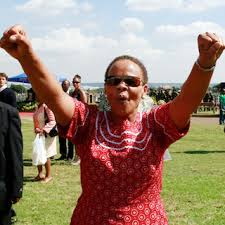
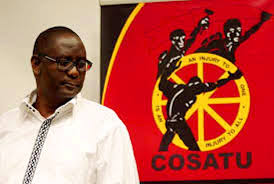
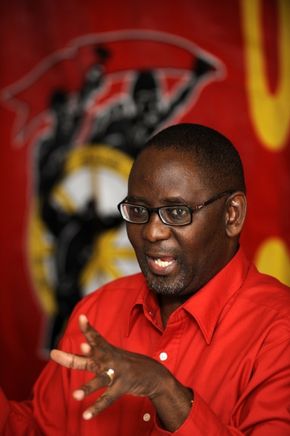
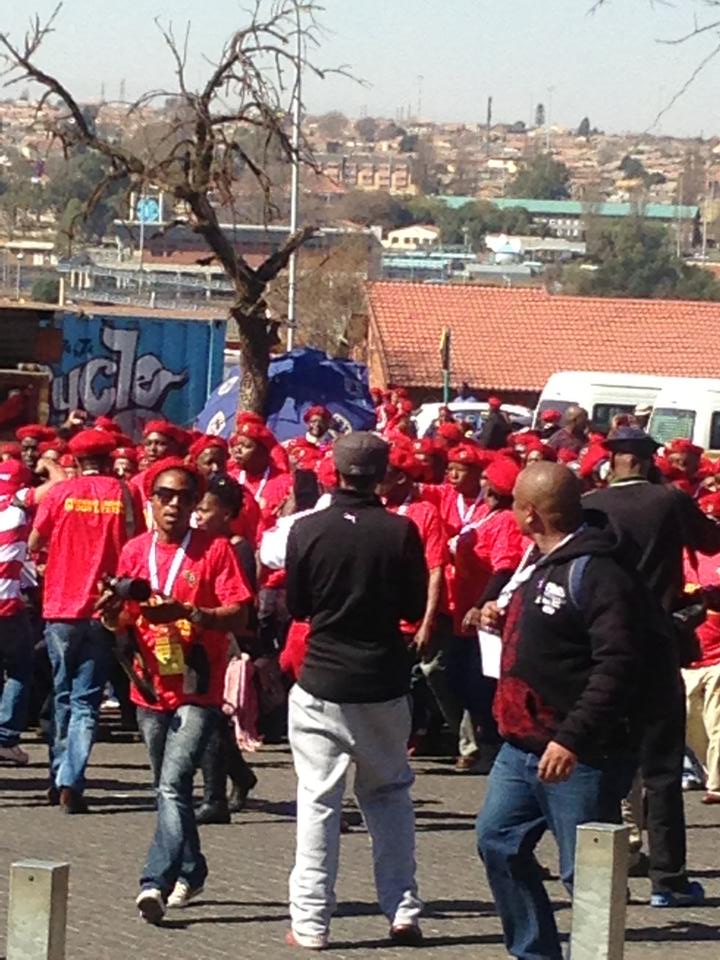
On Thursday, Cosatu public service unions vowed to bring the country to its knees, saying the government seemed to want to plunge the country into crisis.
Pretoria’s central business district was brought to a standstill on Thursday as 11 000 public servants took to the streets. But in a week’s time the country could be hit by rolling mass action, stay-aways and civil disobedience, should a settlement not be reached by the government and public sector unions, which are demanding a 10 percent pay rise.
A strike will mean schools, hospitals and government services would work on a skeletal to a no-staff complement.
During the march, major CBD intersections were gridlocked and frustrated motorists had to find “alternative routes”.
This situation was compounded by ongoing city council roadworks – in cases approaching two years – which have seen some streets narrowed to one lane; others have been closed off.
The pay talks at the Public Service Co-ordinating Bargaining Council stalled again this week.
The government says it cannot afford more than a 5.8 percent increase, but has offered to pay the lowest-paid state-employed workers a 14 percent wage increase.
But powerful police and teachers unions want a 10 percent increase across the board and a R1 500 monthly housing allowance.
Police have launched an investigation into the killing of SA Transport and Allied Workers Union (Satawu) Gauteng secretary general Chris Nkosi after he was shot dead in his car.
Spokesman Lt-Colonel Lungelo Dlamini said it was not clear how many people attacked Nkosi along the N17 on Monday while on his way home from work.
Nkosi was alone in the car.
Satawu spokesman Vincent Masoga said the union had believed Nkosi’s life was under threat and had hired bodyguards for him. Nkosi decided to leave them behind on Monday and drove home alone.
There were four bullet holes on Nkosi’s side of the car.
It is believed his attackers were driving a BMW.
Meanwhile, the union’s president, June Dube’s house was petrol-bombed after midnight on Tuesday, said Masoga.
“He and his family were sleeping when a petrol bomb was thrown into the house. The lounge was damaged, there were no injuries,” Masoga said.
A case of malicious damage to property was opened on Tuesday.
Cosatu general secretary Zwelinzima Vavi says the organisation’s influence has waned dramatically and it could become irrelevant.
Vavi and Sdumo Dlamini both have factions which have divided the trade union body.
Vavi is pushing for action against the ANC while Dlamini is inclined towards the ANC.
In his draft organisational report prepared for Cosatu’s central committee meeting in November, Vavi warns that the once powerful federation could become irrelevant if its leaders do not resolve divisions soon.
The party’s task team appears to have backtracked on its initial plans to offer Vavi and Cosatu president Sdumo Dlamini ambassadorial positions in an effort to bring about unity before November’s central committee meeting.
“Cosatu has through its work over the years built up critical political capital in terms of its image and reputation at home and abroad, and the trust which workers in particular have had in the organisation,” Vavi writes in his report.
Vavi said Cosatu’s reputational damage negatively affected the organisation among South African workers and the public, as well as the perceptions of Cosatu among key international players, including in the trade union movement.
“Equally important to this reputational damage is the fact that the broader political impact of Cosatu’s interventions on key issues is significantly undermined by the dilution of our organisational power.
The general secretary said that already there were also signs emerging that membership is declining.
“There was already evidence of this danger in relation to Cosatu’s minimal impact at the ANC’s national conference in Mangaung.” Vavi said.
“We were forced to launch a rearguard action after the Conference, for example in relation to the NDP, to minimise the damage caused by our lack of coherence in Mangaung.”
Cosatu has campaigned against the National Development Plan, or NDP.
Barely eight months after it was formed, the EFF will start their own union – the National Trade Union Congress.
The Economic Freedom Fighters said the Labour Department has officially given them the go-ahead.
The EFF union plans to target marginalised workers such as petrol attendants, domestic workers, farmworkers, security guards and workers in the retail sector.
An EFF spokesman said yesterday party members could not belong to Cosatu-affiliated unions.
According to an EFF insider, the party submitted registration forms to the Labour Department on May 27 and received its registration number yesterday.
The inside source said the EFF would travel to all nine provinces to recruit people into their union.
“We already have a huge number of registered members but we could not approach employers for recognition without registration,” he said.
The union could prove stiff competition to Cosatu, which is battling internal divisions. The biggest split has been with The National Union of Metalworkers of SA, which has just called for a strike.
The EFF won 6.35% of the votes in the national elections in May.
Eddie Mathiba, the union’s interim general secretary, said “the economic emancipation of the proletariat” has arrived.
“Gone are the days of capitalist vehicles driven by employers and Cosatu affiliates,” he said.
Clive Derby-Lewis, one of the men convicted of killing SACP secretary general Chris Hani, should be freed, the Front Nasionaal (FN) said on Saturday.
Derby-Lewis is South Africa’s most famous remaining political prisoner, said the group’s deputy leader Dan Roodt in Pretoria, where a march was being held by the convicted killer’s supporters.
In demanding his release, the Afrikaner FN emphasized that it did not mean this as a political statement.
“That might seem like a paradox. Clive is, after all, a consummate politician, a statesman and a leading figure of the conservative movement in South Africa,” said Roodt.
The FN believed freeing Derby-Lewis was the right thing to do.
They demanded his release in the name of “justice, in the name of God or Christian charity and in the name of civilised values”.
“For such an appeal to reason and reasonableness, they will call us right-wing. Or fascists. Or boorish Boers. But we reject all labels and slogans,” Roodt said.
Hani was shot dead in the driveway of his home on April 10 1993.
Derby-Lewis, who was sentenced to 25 years behind bars, has already served more than 20 years of his sentence.
The 78-year-old man, who has been diagnosed with cancer, has twice been denied medical parole.
The SA Communist Party in the Western Cape were due to hold Chris Hani memorial lectures on Saturday.
“…Twenty-one years ago, comrade Chris was assassinated by ignorant cowards outside his residence in Boksburg,” provincial spokesman Masonwabe Sokoyi said in a statement.
He did not comment on millions of “ignorant cowards”, Germans and Eastern Europeans who welcomed the end of communism.
“In the month of April all SACP structures commemorate and pay homage to a virtuous and humble leader of the working class.”
Both the “virtuous leader” Hani and his wife Limpho were having extra-marital affairs when Hani was shot, however.
The SACP supported virulent action against the adulterous comrade Zwelizima Vavi, head of Cosatu.
The 50-year-old Vavi has been fighting to keep his job over the past few months after a probe into whether he is still suitable to lead.
This is not the first time the married father of six – from both his current and previous marriages – has been accused of sexual misconduct.
In 2006, then Cosatu president Willie Madisha compiled a dossier in which he accused Vavi of sexually harassing a married female Cosatu employee. The charges did not stand then.
Around the same time, Vavi was also accused of using the federation’s credit card to bankroll an extra-marital affair, using it to splurge on his and his mistress’ foreign trips without the federation’s knowledge.
City Press reported on how her distraught former husband Bheki Ngema tried in vain to get Madisha to institute disciplinary proceedings against Vavi, and to force Vavi to fork out R700 000 “as compensation so my children would not suffer much”.
Vavi, who lives in Sandton, is thus not a paragon of virtue on matters sexual, and his 14-year career in the federation could come to an end.
The extramarital affair could force him out as Vavi is also swimming against the political tide.
Cosatu’s general secretary is also not the first local politician to be embroiled in a sex or rape scandal.
Here are some others:
» Jacob Zuma
In December 2005, Zuma was charged with the rape of an HIV-positive family friend in what was to become one of the country’s major sex scandals in recent history. He was acquitted in May 2006.
» John Steenhuisen
The DA’s KwaZulu-Natal leader was forced to resign in 2010 after an affair with the party’s provincial spin doctor Terry Kass-Beaumont became public.
» Narend Singh
News of the 2006 sex scandal followed the emergence of a DVD of a tryst between Singh and Roseanne Narandas, wife of jeweller Bob Narandas.
By then, the DVD had been sold around Durban for weeks.
Singh resigned his post as Kwazulu-Natal MEC for arts, culture and tourism, but remained a member of the provincial legislature for the IFP.
» Fikile Mbalula
In 2011, the sports minister had an affair with model Joyce Molamu, whom he paid R10 000 to have an abortion. They had sex twice, said Mbalula, who publicly apologised.
» Malusi Gigaba
The public enterprises minister was sued for R1.7 million in 2011 by a friend, Luka Sandhlane, for having an affair with his wife and ruining their marriage. Gigaba apologised to Sandhlane, who reconciled with his wife.
» Albert Mncwango
The former IFP national organiser had his rape conviction and 10-year sentence overturned by the Pietermaritzburg High Court in 2005. Mncwango – who spent 19 days in jail before successfully appealing – said the rape charge was trumped-up to destabilise the IFP’s elections campaign at the time.
» Mbulelo Goniwe
Goniwe was axed as ANC chief whip and MP in 2006 after being found guilty of sexual harassment. He asked ANC parliamentary administrative assistant Nomawele Njongo to have sex with him after she helped serve dinner to guests at his home.
» Jonas White
The Cederberg mayor was kicked out of the ANC last month for allegedly sending an image of his genitals “embellished with a strawberry and cream” to his deputy, Lorna Scheepers. He is also facing a criminal investigation for alleged sexual harassment.
But Chris Hani strangely has not been knocked off his perch.
It is alleged that Hani still enjoys the protection of advocate Gerrie Nel, the Oscar trial star, and advocate George Bizos.
President Jacob Zuma has signed into law the Transport Laws and Related Matters Amendment Bill — paving the way for e-tolling, the presidency said on Wednesday.
“The president… has, in terms of Section 84 (2) of the Constitution of the Republic of South Africa, 1996, signed the Transport Laws and Related Matters Amendment Bill into law,” said spokesman Mac Maharaj.
“In effect, the act will provide more effectively for the collection of toll; to amend the Cross-Border Road Transport Act, 1998 (Act No 4 of 1998), to empower the Cross-Border Road Transport Agency to collect toll on behalf of Sanral….”
The law in effect gives the SA National Roads Agency Limited (Sanral) the nod to put into effect e-tolling on Gauteng’s freeways.
The signing came on the same day that the Supreme Court of Appeal was hearing argument in an attempt by the Opposition to Urban Tolling Alliance (Outa) to stop e-tolling in Gauteng.
The court was told that legislation allowed Sanral to explore options other than tolling to fund Gauteng’s freeways.
It also heard that Sanral should, therefore, have kept an open mind about the matter, despite the Cabinet’s approval of electronic tolling.
“Even bound by the Cabinet decision, they still had to follow the procedures of the act,” said Mike Maritz, for Outa.
He argued that the Sanral Act allowed Sanral to explore other funding options. Sanral should have considered this and should not have been bound by Cabinet’s decision that the project be funded with public money through e-tolling.
The High Court in Pretoria had granted Outa leave to appeal against a previous judgment, handed down in December, dismissing its bid to have the e-tolls scrapped.
Judge Fritz Brand asked whether Sanral should have ignored Cabinet’s decision.
Maritz said Sanral should have kept an open mind and taken all options into consideration.
Last week, Transport Minister Dipuo Peters said the Gauteng Freeway Improvement Project would be implemented in 2013, but that a starting date had not been determined.
The e-tolls have been challenged by political parties and the Congress of SA Trade Unions (Cosatu).
In April 2012, the High Court in Pretoria granted Outa an interdict approving a full judicial review before electronic tolling could be put into effect.
The interdict prevented Sanral from levying or collecting e-tolls, pending the outcome of a review. Sanral and the National Treasury appealed the court order.
In September last year, the Constitutional Court set aside the interim order, and in December, the High Court in Pretoria dismissed the application.
The court granted Outa leave on January 25 this year to take the matter to the Supreme Court of Appeal in Bloemfontein. – Sapa
Former President says country continues to present an anomalous picture to the world
SPEECH BY FORMER PRESIDENT FW DE KLERK FOXHILLS RESORT, ENGLAND, September 13 2013
SOUTH AFRICA: PAST, PRESENT AND FUTURE
I should like to talk about South Africa: our past, our present and our future -‐ about
where we have come from since the 1980s;
where we now find ourselves; and
where we are going.
It is especially appropriate to do so now -‐ because I can recall no time since 1994 when so many South Africans have been so despondent.
We should remember 1994 -‐ not only because it was the birth of our new society -‐ but because it provides an important reminder that we South Africans have the ability to solve even the most intractable problems.
It is easy to forget now how desperate our situation was in the mid-1980s:
Our efforts to reform apartheid -‐ including the scrapping of more than 100 apartheid laws and the introductions of the tricameral parliament had simply redoubled demands for “one-‐man, one vote”;
We were beset with internal unrest and increasingly violent protests;
Scenes of chaos and insurrection in our streets dominated TV screens throughout the world;
After the Rubicon speech the rand had plummeted through the floor;
Unsure of the government’s ability to control the situation, international banks had pulled the plug on us by refusing to roll over our short-‐term debt;
Demands for comprehensive economic sanctions were reaching crescendo pitch;
Our armed forces were confronting increasing attacks on our borders and the borders of Namibia -‐ attacks that were supported by 50 000 Cuban troops.
There were no signs of light on the dark and stormy horizon.
And yet -‐ by 1990 -‐ we had clawed our way back from the precipice.
The victory of our forces at the battle of the Lomba River in September 1987 had finally convinced the Soviets, the Cubans and the Angolans that there was no prospect of a military victory.
The following year we began negotiations on the withdrawal of Cuban forces from Angola and the parallel implementation of the UN independence process in Namibia;
Also by 1987 the ANC had accepted that there would not be a revolutionary outcome in South Africa and that the only path to the future lay through negotiations;
The successful independence process in Namibia in 1989 showed that it was possible to negotiate successful outcomes with enemies;
Finally, the collapse of the Soviet Union -‐ symbolized by the fall of the Berlin Wall in November, 1989 -‐ signaled the arrival of an entirely new global paradigm.
By the beginning of 1990 these events had opened a historic window of opportunity for a peaceful and negotiated settlement. We did not hesitate. We jumped through -‐ and after almost four years of roller-‐coaster negotiations we were able to reach a national accord on our future.
It was our proudest moment.
Our 1993 and 1996 constitutions were the outcome of the genuine give and take process inherent in all negotiations. The final agreement was at least as close to original negotiating positions of the non-‐ANC parties as it was to that of the ANC.
It contains all the basic rights that we need to maintain a free and prosperous society.
It articulates the values of human dignity, equality, fundamental rights and non-‐ discrimination on which the new South Africa has been established.
It acknowledges the supremacy of the Constitution and the rule of law.
It makes provision for all the institutions and mechanisms that are necessary for multiparty democracy based on accountability, openness and responsiveness.
It has served us well for the past 19 years. Which brings me to the present.
It is important to remember the many, many successes that we have achieved since 1994 -‐ many of them as a result of government action:
We have experienced 19 years of economic growth -‐ interrupted only briefly by the global economic crisis of 2008.
The regulation of our security exchanges and our reporting standards are the best in the world;
Our banks are the second soundest in the world and our corporate boards are the second most efficacious. Our financial services and protection of minority shareholders are third best in the world and our ability to finance local equity is the fourth best internationally.
We are one of the primary gateways to Africa -‐ and are now the fifth largest investor in the continent.
We have also made significant social progress:
The percentage of the population living in absolute poverty has declined to less than 20% -‐ largely because of social grants.
More than three million housing units have been built -‐ enough to house almost a quarter of the population -‐ with another million units in the pipeline;
More than three quarters of the population now have access to electricity, drinkable water and sanitation
We have experienced moments -‐ like the 2010 Soccer World Cup -‐ when we have lived up to Archbishop Tutu’s characterization of us as the Rainbow Nation of God;
We have seen the rapid growth of new and self-‐confident black middle class. Whites now comprise less than 40% of the top decile of income earners.
At the same time we are beset by serious problems. One can hardly disagree with the diagnosis of the National Planning Commission regarding the nature of these challenges. They include:
High unemployment -‐ closer to 40% than the official figure of 25,6%;
Poor education -‐ especially for black South Africans -‐ who fare badly in comparative tests with children from the poorest African countries;
Poor public service delivery -‐ which has led to virtually daily protests throughout the country;
rising levels of corruption; and
the fact that South Africa is still a divided society.
Another growing problem is the increasingly destructive role that is being played by our militant trade unions. It is one of the main causes of unemployment and of our failure to attract the foreign investment that we need for sustained economic growth:
South Africa has the worst labour relations in the world. According to the World Economic Forum’s Global Competitiveness Report it is the worst of 144 countries assessed in terms of co-‐operation in labour-‐employer relations;
COSATU has continuously raised labour costs without commensurate productivity increases -‐ which has inevitably resulted in job losses. South Africa’s flexibility of wage determination is the fourth worst in the world.
Our labour legislation is amongst the most onerous anywhere. South Africa’s hiring and firing practices are the second worst in the world.
COSATU’s campaign to abolish labour brokers would lead to the loss of more than half a million jobs.
COSATU has steadfastly opposed proposals to open labour markets to the unemployed.
It is destroying jobs by alienating foreign and domestic investors through its confrontational stance and open support for nationalisation.
On top of all this came the Marikana massacre of 16 August last year; the subsequent wave of violent and uncontrolled wildcat strikes and hopelessly unrealistic wage demands. All this has been compounded by the precipitate fall of the rand against the US dollar.
So South Africa continues to present an anomalous picture to the world:
on the one hand a picture of failing governance; out of control trade unions; rising corruption and daily service delivery protests -‐ and
on the other hand, a picture of economic dynamism, enormous opportunities and a counter-‐intuitive sense of optimism -‐ particularly in bustling Johannesburg.
But what of the future?
Predicting the future is one of the most risky of all endeavours -‐ since we live in such rapidly changing times. Nevertheless one can identify some of the salient factors that will undoubtedly influence the course of events:
Whatever happens in South Africa will take place within the framework of macro-‐ developments on the global stage -‐ just as they have always done in the past;
Secondly, current developments within the ANC’s ruling alliance will play a key role. The question is whether the leadership will be able to hold together an alliance which now encompasses the whole spectrum
from Stalinism to social democracy;
from exclusive black nationalism to inclusive non-‐racialism;
from genuine commitment to sound governance to pervasive crony capitalism and entrenched kleptocracy?
Will the ANC be able to continue to plaster over these increasing obvious cracks -‐ or will it split?
Thirdly, will it be possible to moderate the behavior of our rampant and wildly irresponsible trade unions?
Fourthly, will the government break away from its race-‐based ideology and accept the idea that the skills of all South Africans must be used to enable the country to address its problems and achieve its potential?
Finally, a critical factor will be our ability to maintain the excellent Constitution that we South Africans negotiated between 1990 and 1996 and the institutions that it mandates including
free and impartial courts;
an independent National Prosecuting Authority; and
government that is accountable, transparent and responsive.
So, these are the factors that will play significant roles in determining our future:
What will happen on the global stage?
What will happen within the ANC Alliance?
Will we be able to control the trade unions?
Will we be able to liberate ourselves from race-‐based ideologies? And,
Will we be able to uphold our Constitution and achieve the vision that it articulates?
Personally, I remain an optimist -‐ and believe that we shall be able to surmount the challenges that confront us now -‐ just as we were able to overcome the much greater problems that we faced 25 years ago.
Issued by the FW de Klerk Foundation, September 16 2013
Cosatu’s central executive committee will hold a special meeting on Wednesday to discuss the conflict between supporters of the federation’s top two leaders.
The opposing factions are expected to use the meeting to dislodge and discredit general secretary Zwelinzima Vavi and president Sdumo Dlamini.
The trade union federation’s top brass called the special meeting after Vavi admitted to having had a sexual liaison with a junior staff member at the Cosatu head office, in Braamfontein, Johannesburg, earlier this year.
Vavi has apologised.
It is expected that Vavi’s detractors in Cosatu – comprising representatives of the National Union of Mineworkers, the Police and Prisons Civil Rights Union, the National Education, Health and Allied Workers’ Union and the SA Democratic Teachers’ Union – will call for his suspension tomorrow.
But Vavi’s supporters are expected to attack Dlamini in a strategy to crush attempts to topple their man. A vote of no-confidence in the Cosatu president might be called.
Expected to lead the charge against Dlamini is the National Union of Metalworkers of SA.
The union has accused Dlamini of failing to deal with what has been call ed the imminent implosion of the labour federation after attempts were reportedly made to force him to act .
Numsa has questioned the motive for convening a special sitting of the Cosatu leadership, which has the power to suspend or expel leaders of the federation.
The union claims that the meeting is part of a ploy to oust Vavi.
Numsa said it would argue tomorrow that the special meeting was unconstitutional and would call for it to be cancelled.
A letter to this effect has been sent to Cosatu officials, the union said yesterday.
Numsa president Cedric Gina – speaking to journalists yesterday in Johannesburg alongside other union leaders after Sunday’s special central committee meeting – said he had recently implored Dlamini to prevent Cosatu’s “imminent demise” but Dlamini was not moved by his pleas. – timeslive.co.za
A woman miner was shot dead at a residential area in Wonderkop, near Lonmin’s Marikana mine outside Rustenburg, on Monday, North West police said.
The 44-year-old was shot in the head while returning from a shop at Wonderkop around 12.30pm, Brigadier Thulani Ngubane said.
“This is a mine residential area that is not far from Rowland Shaft and in close proximity to the National Union of Mineworkers’ (NUM) and Association of Mineworkers and Construction Union’s offices at Lonmin.”
The woman, who worked at Four Belt Shaft, was off duty at the time.
The gunman fled the scene, shooting randomly. Six 9mm cartridges were found nearby.
A case of murder was opened. The motive was not immediately known.
Ngubane could not confirm NUM’s earlier assertion that the murdered woman was a NUM shop steward.
“That is up to the union to say.”
North West police commissioner Lt-Gen Zukiswa Mbombo appealed to local residents not to speculate on the motive for the killing.
“Let us wait and we will get information from those who are investigating the case, and we will pronounce unambiguously on the motive as soon as information is available,” she said.
Earlier, NUM spokesperson Lesiba Seshoka said in a statement that the woman was a union shop steward.
” We are disappointed that amid the increasing assassinations in Marikana and the broader Rustenburg area, there has not been any progress with regard to the arrest and prosecutions of the suspects,” he said.
“While many of the suspects are known to the police, none has been arrested or prosecuted.”
Seshoka said Lonmin had instructed shop stewards to return to work even though the NUM had cautioned that it was not safe.
“The union is concerned that the company’s pre-occupation with profits and the police incompetence may lead to a serious bloodbath in Rustenburg,” Seshoka said.
Comment from Lonmin was not immediately available.
The Congress of SA Trade Unions said it was tragic that the murder happened days before the August 16 Marikana shooting anniversary.
“We see yet more evidence that violence remains endemic in the Rustenburg area,” spokeperson Patrick Craven said in a statement.
“This latest atrocity demonstrates that the framework agreement for a sustainable mining industry, signed by organised labour… organised business, and government on 3 July 2013 is simply not being effectively implemented.”
On August 16 last year, 34 miners were shot dead and 78 wounded when police fired on them while trying to disperse a group gathered on a hill near Lonmin’s platinum mine in Marikana.
In the preceding week, 10 people, including two police officers and two security guards, were killed in strike-related violence.
The framework agreement was aimed at resolving issues like strikes and violence bedevilling the mining industry, especially in the Rustenburg platinum belt.
Cosatu secretary general Zwelinzima Vavi is happy that a grievance against him has been withdrawn by his accuser, he said on Monday.
“I am pleased that the grievance [hearing] has been finalised,” Vavi said in a statement.
“I hope that we all can put this saga behind us so that we all can concentrate on the real issues of the day — ensuring that we have a vibrant trade union federation that promotes South Africa and the interests of workers.”
Vavi admitted to having consensual sex with a married woman who was employed by the Congress of SA Trade Unions, and claimed she later tried to extort R2 million from him and alleged rape.
He denied raping her, and said the sex was consensual.
However, she brought a complaint of sexual harassment against him at work.
The hearing commenced on Monday morning.
Vavi said the woman withdrew the complaint two hours into the hearing.
He said he would consult with his lawyer to see if any further action could be taken regarding the complaint.
“In the light of the extreme damage that has been done to my reputation, I will consult with my lawyers to consider any further actions about this matter.” – Sapa
The National Union of Mineworkers (NUM) would not comment on rape allegations against Cosatu general secretary Zwelinzima Vavi until it heard from the trade union federation, it said on Monday.
“It will be irresponsible to make statements at this stage,” NUM general secretary Frans Baleni told reporters in Johannesburg after the union’s national executive committee meeting.
“We do not want to engage on details about this matter until it is formally brought to us,” he said.
Vavi has admitted to having an extramarital affair with a married woman who was employed by the Congress of SA Trade Unions (Cosatu) and claimed she later tried to extort R2 million from him.
He denied raping her, and said the sex was consensual.
However, she brought a complaint of sexual harassment against him. An internal grievance proceeding was being held on Monday morning
Baleni said the union would wait for internal processes regarding the matter to take place. – Sapa
A woman who apparently accused Cosatu general secretary Zwelinzima Vavi of raping her wrote an open letter to the Sunday Times about her encounter with him.
“Vavi…came down from the ninth floor…to see me in my office in a quiet area of the building. I was sitting at my desk and he came up behind me,” she said.
“He is a big man. When I got up, he grabbed me and then kissed me. Then he locked the door. I still have the dress I wore on that day, ” she said without giving more details about the incident.
Vavi on Saturday released documents to the media, including an internal complaint by the woman in which she accuses him of rape.
The police could not confirm that a charge of rape had been laid against him.
The mother of two said she first met Vavi at a check-in counter at OR Tambo International Airport in 2011. She helped him sort out a problem with his ticket and was allegedly told Cosatu could use “someone like me”. She said Vavi took her telephone number and later offered her a job.
She said she was hired without going through proper procedures.
“There wasn’t even an interview.”
Vavi admitted to having an extramarital affair with the woman, adding that she later attempted to extort R2 million from him.
He denied raping her, saying they had consensual sex. – Sapa
The Economic Freedom Fighters (EFF) have secured over 1000 new members, it said on Saturday.
“We received 1 100 new members on the first day of recruiting,” said party leader Julius Malema at a press briefing in Soweto.
“If this becomes a trend then we will be getting 1 000 member[s] every day. It is going to be bigger than what we expected.”
This exceeded their expectations, he said.
The EFF — which had gathered at the the Uncle Tom community hall for a two day national assembly — plans to contest next year’s general election.
Malema said the EFF would be officially registered with the Independent Electoral Commission (IEC) on Monday after a few amendments had been made, including changes to its logo.
The EFF logo depicted an arrow instead of a spear, and this was to be changed.
Malema said the party would register with double the required number of members needed to contest the election.
“I was told by the IEC that we should have 500 members to register but we are going register with 1 100 new members,” the former ANC Youth League leader said.
Malema is facing corruption charges in the Polokwane Magistrate’s Court. He is accused of making nearly R4-million from corrupt activities, and is out on bail of R10,000.
He faces charges of fraud, corruption, money-laundering, and racketeering.
On Saturday, Malema acknowledged that intimidation was part of politics, but expressed concern about the alleged intimidation of his members.
He said “people with pangas” had intimidated his members during an EFF meeting in the Vaal, but did not say when this happened. He noted that intimidation tactics were worse in Mpumalanga.
“I am more worried about Mpumalanga because they have the potential to kill,” he said.
Malema also encouraged Congress of SA Trade Unions (Cosatu) general secretary Zwelinzima Vavi and his wife to stay strong amid the rape allegations against him.
Vavi’s lawyer Dup de Bruyn said earlier that a case of extortion was opened against a woman who allegedly tried to blackmail Vavi. He said the case was opened at the Sandton police station on Thursday evening. Police spokeswoman Captain Kym Cloete verified this.
In a statement, Vavi denied the rape of a Cosatu colleague, saying he had been in a consensual extramarital affair with the woman.
Malema said he expected Vavi’s wife to stick by his side and not allow “his detractors any room for joy”. – sapa
Cosatu secretary general Zwelinzima Vavi fears for his life and has increased security to protect himself, he has told Eyewitness News.
The Cosatu secretary general said during the interview: “I am scared. This matter came to the public sphere three years ago, and it seems people who issued the threats then are still on a mission to attain that.”
Vavi told the radio station he started receiving death threats in 2010, when he received information that he would “go down” the same way as the former deputy minister of health, Dr Molefi Sefularo.
Sefularo died in a car accident in Pretoria in 2010.
Vavi reportedly said the accident was presumed to have been “engineered”.
The threat was reported to the police ministry, but nothing had come of it so far, he said.
Last year, immediately after the Cosatu held its elective congress, intelligence officials told him there was a plot by Iranians to poison him, he said.
“I was told that the plot originated from Iranian intelligence, and that someone from the non-government organisations that we, as Cosatu, work with has been hired by Iranians to poison me.”
When asked why the Iranians would want him killed, Vavi said he did not know because Cosatu and the country had good relations with Iranians.
“Months have gone by and intelligence officials have not come back to me regarding this,” he told Eyewitness News.
Vavi is facing an ongoing internal investigation into alleged corruption regarding the sale of Cosatu’s headquarters, in which he was implicated. – SAPA
This website uses cookies to improve your experience. We'll assume you're ok with this, but you can opt-out if you wish. Cookie settingsACCEPT
Privacy & Cookies Policy
Privacy Overview
This website uses cookies to improve your experience while you navigate through the website. Out of these cookies, the cookies that are categorized as necessary are stored on your browser as they are essential for the working of basic functionalities of the website. We also use third-party cookies that help us analyze and understand how you use this website. These cookies will be stored in your browser only with your consent. You also have the option to opt-out of these cookies. But opting out of some of these cookies may have an effect on your browsing experience.
Necessary cookies are absolutely essential for the website to function properly. This category only includes cookies that ensures basic functionalities and security features of the website. These cookies do not store any personal information.
Any cookies that may not be particularly necessary for the website to function and is used specifically to collect user personal data via analytics, ads, other embedded contents are termed as non-necessary cookies. It is mandatory to procure user consent prior to running these cookies on your website.