US middle class wages plummet with immigration

Wages of America’s middle class have dropped below 1970s levels as immigration has surged 325 percent, according to a new congressional report that questions claims that native Americans are economically helped by greater immigration.

The nonpartisan Congressional Research Service report studied immigration and middle class income from 1945-2013 and found that as immigration slowed between 1945 and 1970, American incomes increased.

But when immigration expanded, the incomes of the bottom 90 percent of Americans went flat and then dropped beginning in 2000.

In the report to the Senate Judiciary Committee, the CRS reported that the foreign-born population of the United States surged 324.5 percent, from 9,740,000 to 41,348,066, from 1970 to 2013.

Source: Washington Examiner

Cosatu vows to bring SA to its knees

On Thursday, Cosatu public service unions vowed to bring the country to its knees, saying the government seemed to want to plunge the country into crisis.

Pretoria’s central business district was brought to a standstill on Thursday as 11 000 public servants took to the streets. But in a week’s time the country could be hit by rolling mass action, stay-aways and civil disobedience, should a settlement not be reached by the government and public sector unions, which are demanding a 10 percent pay rise.

A strike will mean schools, hospitals and government services would work on a skeletal to a no-staff complement.

During the march, major CBD intersections were gridlocked and frustrated motorists had to find “alternative routes”.

This situation was compounded by ongoing city council roadworks – in cases approaching two years – which have seen some streets narrowed to one lane; others have been closed off.

The pay talks at the Public Service Co-ordinating Bargaining Council stalled again this week.

The government says it cannot afford more than a 5.8 percent increase, but has offered to pay the lowest-paid state-employed workers a 14 percent wage increase.

But powerful police and teachers unions want a 10 percent increase across the board and a R1 500 monthly housing allowance.

Source: IOL

US Fast food strike makes no impact on eaters

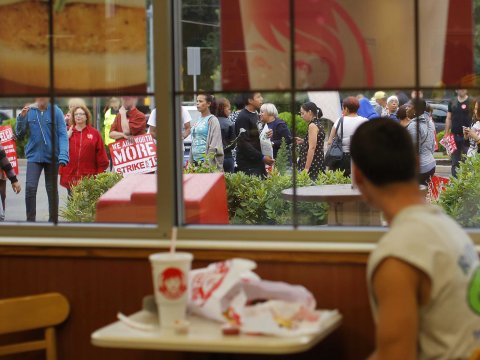
fast-food-strikeOn Friday thousands of fast food workers went on strike for higher wages.

The strike has been touted by organizers as the industry’s largest in history. The workers are seeking wages of $15 an hour.

But despite demonstrations in 58 cities, the strikes appeared to do little to rattle the industry today.

Judging by dozens of tweets and photos about the event, most protesters were outside. This left customers free to order inside.

While restaurants in some places temporarily shut down because they had too few employees, many targeted restaurants operated under normal conditions, according to the Associated Press.

In New York, things appeared to business as usual. The AP wrote:

In New York, City Council Speaker Christine Quinn joined about 300 to 400 workers and supporters Thursday in a march before the group flooded into a McDonald’s near the Empire State Building. Shortly after the demonstration, however, the restaurant seemed to be operating normally, and a few customers said they hadn’t heard of the movement. The same was true at a McDonald’s a few blocks away.

The AP noted that since the organizers had made their plans public in an effort to get workers to participate in the strike, managers had time to adjust their staffing levels prior to today’s events.

Despite the relatively low impact of the strikes, a protesting worker interviewed by Business Insider said he wasn’t deterred. 

“It’s something I’m doing for my coworkers and out of respect for myself,” Nick Williams, a 28-year-old McDonald’s worker from Indianapolis, said. “My voice will be heard no matter what.” – Business Insider