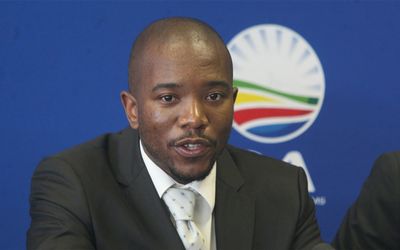
DA spokesman says ANC much better than ‘apartheid’

Mmusi Maimane
Mmusi Maimane

EFF leader Julius Malema was wrong to say that the ANC-led government is worse than the apartheid government, DA spokesman Mmusi Maimane said on Monday.

“You may have heard Julius Malema saying over the weekend that the ANC is worse than apartheid. It is wrong to create this impression among South Africans,” he said in a speech prepared for delivery.

“Apartheid was worse because it was a system of entrenched racism. Apartheid was worse because we couldn’t vote out apartheid. In fact, we couldn’t vote at all.”

The Economic Freedom Fighters’ leader said at the rally in Lethabong near Rustenburg, North West, on Saturday that black people would never own land under the African National Congress.

“Our struggle is about land. [Former president Nelson] Mandela was arrested for demanding land,” Malema said.

Maimane said “the sacrifice that so many made for our freedom” had to be remembered.

“Like so many others where I grew up, I used to be an ANC supporter. I believed that the ANC could bring about a better life for me and my family,” he said.

“Since then I have seen how that once proud movement has lost its way under the current leadership.”

He said apartheid was forced on the people against their will, while the ANC was “not compulsory”.

“The ANC is a political party in a democracy. We can vote for another party if we feel let down by the one in power.” – Sapa

Miner shot dead at Wonderkop

mynerA woman miner was shot dead at a residential area in Wonderkop, near Lonmin’s Marikana mine outside Rustenburg, on Monday, North West police said.

The 44-year-old was shot in the head while returning from a shop at Wonderkop around 12.30pm, Brigadier Thulani Ngubane said.

“This is a mine residential area that is not far from Rowland Shaft and in close proximity to the National Union of Mineworkers’ (NUM) and Association of Mineworkers and Construction Union’s offices at Lonmin.”

The woman, who worked at Four Belt Shaft, was off duty at the time.

The gunman fled the scene, shooting randomly. Six 9mm cartridges were found nearby.

A case of murder was opened. The motive was not immediately known.

Ngubane could not confirm NUM’s earlier assertion that the murdered woman was a NUM shop steward.

“That is up to the union to say.”

North West police commissioner Lt-Gen Zukiswa Mbombo appealed to local residents not to speculate on the motive for the killing.

“Let us wait and we will get information from those who are investigating the case, and we will pronounce unambiguously on the motive as soon as information is available,” she said.

Earlier, NUM spokesperson Lesiba Seshoka said in a statement that the woman was a union shop steward.

” We are disappointed that amid the increasing assassinations in Marikana and the broader Rustenburg area, there has not been any progress with regard to the arrest and prosecutions of the suspects,” he said.

“While many of the suspects are known to the police, none has been arrested or prosecuted.”

Seshoka said Lonmin had instructed shop stewards to return to work even though the NUM had cautioned that it was not safe.

“The union is concerned that the company’s pre-occupation with profits and the police incompetence may lead to a serious bloodbath in Rustenburg,” Seshoka said.

Comment from Lonmin was not immediately available.

The Congress of SA Trade Unions said it was tragic that the murder happened days before the August 16 Marikana shooting anniversary.

“We see yet more evidence that violence remains endemic in the Rustenburg area,” spokeperson Patrick Craven said in a statement.

“This latest atrocity demonstrates that the framework agreement for a sustainable mining industry, signed by organised labour… organised business, and government on 3 July 2013 is simply not being effectively implemented.”

On August 16 last year, 34 miners were shot dead and 78 wounded when police fired on them while trying to disperse a group gathered on a hill near Lonmin’s platinum mine in Marikana.

In the preceding week, 10 people, including two police officers and two security guards, were killed in strike-related violence.

The framework agreement was aimed at resolving issues like strikes and violence bedevilling the mining industry, especially in the Rustenburg platinum belt.

Mining deaths a joke to police chief

Riah Phiyega

National Police Commissioner Riah Phiyega reportedly laughed and joked as footage of the killing of 34 miners in a clash with police was screened at the Farlam Commission of Inquiry, The Times reported on Wednesday.

Phiyega reportedly joked with a state law adviser as a prelude to the killings was screened at the Rustenburg Civic Centre.

Surrounded by her senior officers, Phiyega smiled as she watched.

It was only after screams of horror echoed across the room, as the footage was played without any warning, that Phiyega’s “humorous demeanour changed to that of an ice queen, blatantly ignoring the wailing families”, the report continued.

“…Phiyega stared straight ahead, ignoring a widow screaming at her for answers about her husband’s death,” the newspaper reported.

“Why did they do this? Why did your policemen kill my husband? What did he do?” the woman screamed at her.

Later she was seen comforting one of the widows of the two policemen killed ahead of the August 16 shooting.

Asked repeatedly for comment on why she did not help those upset, and what she had been joking about, Phiyega said: “I am not here for that. I am here for the commission and the commission only.”

Bishop Jo Seroka, a talks facilitator for the miners, said: “She sat there laughing and did nothing. You would expect a sense of remorse and empathy which was non-existent.” – Sapa

Two more miners killed by police, one dragged by armoured car

Amplats strikers
Amplats strikers

RUSTENBURG, South Africa (AP) — Days after soldiers were deployed, South African President Jacob Zuma’s office announced Thursday he has ordered military forces to assist police trying to control labor unrest in the nation’s crucial mining sector. Despite resolution of the longest and bloodiest strike, two more deaths were reported.

Even as miners returned to work Thursday at the Lonmin PLC platinum mine in Marikana where police killed 34 miners on Aug. 16 labor advocates said police killed two more people: a ruling party municipal councilor who died of injuries from a rubber bullet and a miner who was run over by an armored car.

Zuma’s office said he was invoking the Constitution to use the military to support police “in the prevention and combating of crime as well as the maintenance of law and order in the Marikana Area … and other areas around the country where needed” until Jan. 31. The notice from the presidency referred to section 201 (2) of the Constitution, which states that “only the President, as head of the national executive, may authorize the employment of the defense force.”

Last weekend some 1,000 soldiers were trucked into the “platinum belt” northwest of Johannesburg.

Thursday morning, police in two water cannon trucks and several armored cars confronted striking Anglo American Platinum miners at a shantytown where residents set up barricades of rocks and burning tires and logs. Before long, the fires died down and most of the police pulled back. The people dispersed, leaving a herd of goats milling around the water cannons. Strike leader Evans Ramokga told The Associated Press that one miner was run over Wednesday by a police armored car and dragged several meters (feet) before it stopped. He said the man died overnight in the hospital.

Police spokesman Dennis Adriao said he was unaware of the incident which occurred at the scene where police fired rubber bullets, tear gas and stun grenades to break up a march by thousands of strikers. The mines near Rustenburg belong to Anglo American Platinum, the world’s largest platinum producer.

“The only thing we want is to sit down and have them hear our demands,” Ramokga said. He said authorities have refused to give permission for the thousands of strikers among Anglo’s 15,000 workers there to hold a protest march to back their demands for a gross monthly salary of 16,070 rand ($2,000).

Anglo issued an ultimatum for workers to report for duty by Thursday night or threatened to act on a court order declaring the strike illegal. That gives Anglo the power to fire strikers.

“Anglo American Platinum’s Rustenburg mining operations are already under considerable economic pressure, any further delays in returning to work will only increase the risk to the long-term viability of these mines,” it said in a statement late Wednesday.

The Marikana Solidarity Campaign meanwhile reported that African National Congress councilor Paulina Masutlhe was shopping Saturday at the Wonderkop shantytown where Lonmin platinum miners live when police firing from a speeding armored car hit several women. Masutlhe was hit in the abdomen and leg and rushed to the hospital, where she died Wednesday, a statement said.

Adriao said he is investigating the report of a death. He said police had reported to the Independent Police Investigative Directorate that several people were hit by rubber bullets in a raid to disarm strikers on Saturday, the day after the government ordered a crackdown.

The directorate already has opened 34 murder and 78 attempted murder charges against police in the Aug. 16 shootings, the worst state violence since the white minority apartheid regime was brought down in 1994. The government has said it is awaiting the outcome of a judicial commission of inquiry that is to report to the president in January.

The solidarity campaign condemned the brutality of police and called for “the immediate identification and suspension of the police officers involved in her (Masutlhe’s) murder. “

“We are also extremely unhappy that, to date, none of the police officers involved in the massacre on 16 August 2012 has been identified or suspended – this is totally unacceptable and unlawful,” said the campaign that includes the powerful Congress of South African Trade Unions that is part of a governing alliance with the African National Congress party and the South African Communist Party.

The deaths at the two mines, both northwest of Johannesburg, bring the strike-related death toll to 47.

Lonmin on Tuesday resolved its five-week strike by agreeing to pay raises of 16 to 22 percent.

The strike already has spread to several gold, platinum and chrome mines, damaging investor confidence in the country that produces 75 percent of world platinum and is the No. 4 chrome producer and in the top 10 of gold producers.

Amplats miners striking for R16 070 per month

Striking Anglo American Platinum (Amplats) mineworkers demanded pay of R16,070 a month at a meeting at the Blesbok stadium in Rustenburg on Thursday.

This was according to Gaddafi Ndoda, who described himself as a member of a newly formed workers’ committee.

“To us, R12,500 is just a basic salary,” he said, referring to the amount raised as a demand among many mineworkers over the past weeks.

“Anglo is the most-paying (sic) mine in the country, so our demand is different from other mineworkers,” said Ndoda.

He said they wanted “nothing to do” with AngloPlats’ Mageu beverage, and wanted their refreshment allowance to be R30 a day.

On Wednesday workers there complained about the quality of the Mageu, an energy drink made from fermented grains.

He said currently workers were not entitled to a safety and transport allowance.

“We want our transport allowance to be R60 daily and [our] safety allowance to be R1500.”

They also wanted the increase in their living-out allowance to be R2000 — up from R1700.

An “executive committee” of six members representing workers outside formal union forums had been formed and they were expected to take a memorandum to the mine’s management in Klipfontein near the stadium, he said.

While heading towards the nearby offices, about half the workers who had been in the stadium accompanied the committee, singing and dancing, amid tight security.

As in the past week, the police had Nyalas stationed in the area and a helicopter overhead. Amplats security vehicles and security guards were also on alert, and a Netcare911 ambulance was on standby.

Workers carried knobkerries, sticks and whips. Some also carried umbrellas.

It appeared that a group of striking workers from Lonmin Platinum did not join them as hoped.

Amplats said it suspended operations on Wednesday out of concern for the safety of its employees, and said there was no strike at the mine.

CEO Chris Griffith said the situation in the Rustenburg area was volatile, and that people who wanted to go to work could not because of threats of violence.

“Anglo American Platinum has decided to suspend its operations in the Rustenburg area with immediate effect,” he said in a statement.

“The suspension will continue until such time as operations can be safely resumed.”

Amplats’ chairwoman Cynthia Carroll said the company was in touch with authorities “at the highest level” to identify ways of working with government and the recognised labour unions to achieve a swift and peaceful resolution.

She said the company’s Rustenburg platinum operations were already under financial pressure, and the suspension of operations on Wednesday risked their long-term viability, the longer the situation lasted.

A strike at Lonmin entered its second month this week. Workers at Gold Fields’ KDC West mine were also on strike on Thursday. – Sapa

Did South African police kill at Marikana to help black billionaire Ramaphosa’s finances?

The scene at Marikana, north west of Johannesburg, last week

Over the past few days PRAAG obtained new information about the Marikana massacre that is currently still making frontpage news in South Africa. It appears as if the miners of the Association of Mineworkers and Construction Union (AMCU) were deliberately murdered by the police as part of a campaign to get rid of the bothersome union.

AMCU was busy replacing the NUM (National Union of Mineworkers) as the majority union at the mine. The NUM is affiliated with COSATU, which is a member of the ANC regime’s so-called “tripartite alliance”. Before the shooting started, police ordered the media to leave the area.

Lauren Clifford-Holmes, the multimedia editor for the Johannesburg Mail & Guardian, was prevented last Thursday night from speaking to injured mineworkers. However, she stumbled upon two workers at Lonmin who confirmed that strife between the two trade unions was responsible for the problems, as NUM representatives were not re-elected by dissatisfied miners.
Cyril Ramaphosa

Black businessman and high-ranking ANC politician, Cyril Ramaphosa, apparently owns a contract to supply labour to the Lonmin mine at Marikana via his company Shanduka. “Ramaphosa and the NUM is practising a form of slave labour at the mine,” a source said at Marikana. “He is supplying labour at about R12 000 ($1500) per worker per month, but only pay his workers R4000 ($500) per month, thereby pocketing the difference. As a former NUM chief, he is able to control the union leaders and sees to it that he maintains this grotesque form of exploitation.”

However, NUM’s rival, AMCU, demands that the R12 000 received by Shanduka as labour broker in terms of the contract, should be paid directly to workers. Particularly the rock drillers, who perform the most difficult and dangerous work, felt that they were entitled to this wage, given that this was the tariff already received by Cyril Ramaphosa’s company for work at the mine.

An ex-policeman that PRAAG spoke to, but who prefers to remain anonymous, said that judging from the photographs he had seen, the workers were not attacking the police, but were fleeing from an area where a second police contingent was throwing tear gas at them. “One could see how some of them were trying to protect their eyes and faces. They thought they were fleeing to a safe place, where the heavily armed policemen mowed them down with automatic weapons, however,” said the ex-policeman.

The motive for the mass murder at the Lonmin mine at Marikana was apparently the protection of Shanduka’s lucrative service contract for supplying labour to the mine. Shanduka has already annouced that it will donate R2 million for the funeral of the 34 workers.

The workers are mostly from Lesotho, an independent country, and areas in the Eastern Cape. It would therefore be difficult for them to defend their rights and lives against the ANC-controlled state, cooperating closely with the British-controlled mining company. Until now, the only questions abut the massacre have come from black politicians and activists from outside governing ANC circles.

A group known as the September National Imbizi did a local investitagion and talked to an eyewitness alleging that the mineworkers were “drawn into an ambush” and that they were first bombarded with a “blue substance”, after which they were shot dead during the confusion. Many were executed while trying to hide among rocks and under bushes. On the websit of September National Imbizo, the eyewitness is referred to as “our friend”:

“…our friend shows us how several people were shot while they were hiding between the rocks and under bushes. We see for ourselves splatters of blood that indicate the determination to dig workers out of their hiding holes and shoot them dead. All sorts of items of clothing and shoes, soiled with blood lie all around the scene.”

The website also claims:

“What is clear from what we are told is that this was an ambush. The video material in mainstream media showing workers charging at the police was in fact workers running away from bullets being hurled from behind. Why would workers, armed with knobkierries [African-style clubs – ed.] charge at armed police? The workers were completely surrounded and what we’ve been seeing in the media is only half the story. There was clearly a mission: shoot to kill, thus the deployment of the army.”

Other strange incidents took place.

The media were kept away from the scene for hours so that it would be difficult to reconstruct the exact events. A contact of The Star newspaper was shot dead during the massacre. The police also forced a photographer from the Johannesburg Mail & Guardian to delete his photographs. Why were the police so scared that particular evidence regarding the shooting would leak out?

A video shown in the Netherlands, contained a Vodafone ambulance on the scene. The same vido was later shown in South Africa on News24.com, but without the ambulance, indicating that the video must have been edited.
Beforehand SAPA reported the following statement by the leader of the AMCU:
“We are not safe. Our phones have been tapped,” the Association of Mineworkers and Construction Union president Joseph Mathenjwa told a crowd in the Wonderkop informal settlement at Lonmin.
“We have been democratically colonised – workers work under very harsh conditions.”
After the massacre Mathenjwa demanded a really independent investigation, but the ANC simply appointed one of its own ministers, Collins Chabane, to lead the commission of enquiry. Under the previous, so-called “apartheid government” judges were always appointed to commissions of enquiry.
What Mathenjwa is probably referring to when he talks of “democratic colonisation”, is that workers are paid R4000 per month while Cyril Ramphosa is receiving three times as much per worker.

A Johannesburg businessman PRAAG spoke to and who is also in the services sector, confirmed that the ANC’s cadres have virtually instituted a system of “slave labour” in the country. The former officers of their militia, Umkhonto we Sizwe, is currently providing labour to the mines by recruting foreigners. Few, if any, mines still employ workers directly.

“Everything which the ANC described as apartheid, including the system of migrant labour, now applies, except in a far worse degree,” said the businessman. “The ANC’s cadres control everything. They have dug themselves into all sectors of the economy. They do not rule, they are in business. The state is for them just another business, with resources that they may use to enrich themselves. That is what BEE stands for, Black Elite Enrichment.”

Among those state resources controlled by the ANC, is the police force. Was it used to punish the AMCU and “make an example” of the rival union? In the run-up to the 1994 elections the ANC committed necklace murders against so-called “sell-outs”. Where tens of millions of rand are at issue in the provision of labour to a mine, one may therefore expect that an organisation as ruthless as the ANC will use all means at its disposal to eliminate a rival.

During the shooting a journalist from The Star, Poloko Tau, tweeted from the scene:  “Auto guns creacking [sic] and cocked like 100 at a time, scary … warzone down here, 1st shot fired … journalist running, diving and hiding amid shots, water canon spewing water at the strikers … my contact has just been shot dead …”

After the Marikana massacre, some people simply “disappeared”. SAPA reported the following:

“Around 100 women arrived at the Ga-Rankuwa Magistrate’s Court outside Pretoria today where more than 250 protesters were expected to appear for public violence.

One woman, Nombulelo Jali, 37, wept hysterically. She said police did not know what happened to her husband Themba Khalo Jali, 40, who she says was arrested on Thursday.

‘I have come all the way from Harding in KwaZulu-Natal but we can’t find him. We have frantically searched everywhere and we can’t locate him. Police took him,’ said Jali.”

Julius Malema alleges that many of the striking workers are currently detained “irregularly in a private prison”. His friend and ex-colleague from the ANC Youth League, Floyd Shivambu, also said that many of the workers were shot in the back, which would indicate that they were running away from the police when they were shot.

This could not be verified, as a security blanket has been pulled over the area and journalists are not allowed at the mine hospital.

The narrow links between the British-controlled mining houses and the ANC may be traced back many decades. The first contact between the Afrikaner establishment and the exiled ANC was arranged by the mining company Consolidated Goldfields in England during the eighties. On that occasion Thabo Mbeki and Willie Esterhuyse met each other. Their relationship later played a crucial role in the capitulation of the Afrikaner government as Esterhuyse had persuaded several cabinet ministers that the ANC could be “trusted”.

The mining houses also played a leading role in portraying the ANC as the new government for South Africa and probably entered into private agreements with the so-called “liberation movement”.

Yesterday the chairman of Lonmin, Roger Phillimore, blamed “apartheid” for the poor conditions in which his mineworkers have to live, knowing that Shanduka and Lonmin are pocketing the greater share of the mine’s income for themselves.

Riah Phiyega

Julius Malema held Jacob Zuma and Cyril Ramaphosa responsible for the mass murder: “They presided over the massacre of our people… Not even the apartheid government killed as many.”

It is unclear whether the police’s actions will be investigated internally, as the executive director of South Africa’s Independent Police Investigative Directorate, Mr. Francois Beukman, has recently resigned “to pursue other interests”. He is leaving the service at the end of the month. His contract would only have expired in August 2014. At any rate, the new national police commissioner, Riah Phiyega, does not consider the shooting of 34 people “to be a massacre”.

‘Warning signs of a failing state’ at Marikana – Law society of South Africa

The legal fraternity has blamed a breakdown in conflict resolution in the mining industry for Thursday’s shooting near Lonmin’s Marikana mine, in North West.

“These workers have been the victims of an escalating breakdown in conflict resolution, particularly in the mining industry,” the Law Society of SA (LSSA) said on Friday.

It said in a statement this had been brought about by those who put vested interests before the lives of workers

“This breakdown is symptomatic of our society and body politic in South Africa.”

A total of 34 people were killed and 78 were injured when police tried to disperse striking workers who had encamped at the Wonderkop hilltop, near the mine, in Rustenburg.

Another 10 people had already been killed in violent protests at the mine in the past week.

The LSSA said there had been a failure to rely on the rule of law to resolve conflicts.

“Violence, vigilantism, corruption, xenophobia, disrespect for the law and law enforcement agencies, as well as greed for power, influence and wealth are all collectively destroying the values of nation building, patriotism and respect for law and order. These are the warning signs of a failing state.”

A fresh approach was needed by political parties, workers’ unions, NGOs, religious bodies, gender lobby groups, youth groups, community-based organisations, professional and business organisations.

Leaders in these fields and academics with socio-political and economic skills should to get together “to find common ground in order to reverse the growing damage to our society and country that we see around us”, the LSSA said. – Sapa

‘I understand miners’ frustration’ – farmer near Marikana

Families and friends continued to arrive at Lonmin’s Marikana mine on Friday in the hope of tracking down people who went missing, after 34 people were killed in a clash with police.

“I have been trying to call my brother since yesterday and his phone is off,” said Vuyani Feni outside the Andrew Saffy Memorial Hospital, on the grounds of the platinum mine.

“I don’t know whether he is alive or dead, or if he is in prison,” said Feni.

Thirty four people were killed, 78 injured, and 259 arrested after police fired on a group of protesters near the mine on Thursday afternoon, National Police Commissioner Riah Phiyega said at a media briefing at the mine.

Jacobeth Rapoo said she was at the hospital looking for her partner, who she has a child with.

She left the hospital disappointed because she hadn’t heard any news about him.

Feni said they were disappointed with the National Union of Mineworkers (NUM) for not securing higher wages for workers, and in the mine for always “preaching” safety but not protecting them.

He was also disappointed with the police, saying the Lonmin workers felt they were protected when they saw police were present.

Gcobani Tiya, also trying to find a relative since he had arrived at the Rustenburg mine from Bethal after not being able to make contact by phone, complained that he was being sent from pillar to post.

He had been sent to a police station where he saw a large group of people in a truck who had been arrested. Not seeing his relative there, he left as they were led into the police station.

“I wish they would release a statement or a list that has all the deceased’s names, or tell us which hospitals our relatives are in, because we are going from pillar to post,” said Tiya.

He complained that the mine and police appeared to be giving information to the media, but not to families.

A hospital official said some of the people who were wounded in the shooting on Thursday had been sent to hospitals in Johannesburg, central Rustenburg, and Pretoria.

She said she was not allowed to speak to the media and asked not to be named by journalists who had heard her speaking to the people gathered.

Meanwhile, Marthinus Barnard, who farms in the area, said land owners were “fed up” with the mine.

“People can’t approach the mine. The mine shuts them out. And they cannot approach government. Government has been called, [but] they never come,” he said.

“All I can say is that the miners have it hard. I understand their frustration.”

The people who died were among a group of protesters who went on strike last Friday.

Another 10 people, including police officers and security guards, have died in separate incidents since the unrest began.

18 dead in Lonmin shootout

An attempt by the police on Thursday to disperse striking workers at Marikana’s troubled Lonmin mine ended in a shootout between the two groups.

A Sapa reporter at the scene said he counted 18 bodies lying next to the nearby Wonderkop squatter camp. The shooting lasted about three minutes.

Police had tried to intercept a section of the strikers gathered on top of a hill.

The strikers were wielding pangas and chanting war songs. Police fired teargas and then used a water cannon to disperse the strikers, who retaliated by firing live ammunition at the police.

The area around the hill, which the strikers had turned into their base for the past few days, was cordoned off with barbed wire.

The strikers scattered towards the squatter camp and the nearby veld.

Police spokesman Captain Dennis Adriao told journalists at the scene police had been “tactical” in their approach and that the situation was tense. – Sapa

Afrikaner Church Rejects Apartheid, Confesses Role in Segregation – historical article

TOM COHEN , Associated Press, Nov. 9, 1990

RUSTENBURG, South Africa (AP) – The white Dutch Reformed Church joined other Christian denominations Friday in rejecting apartheid as a sin and confessed the church’s role in implementing it.

The main church of the Dutch-descended Afrikaners who dominate the government had argued for decades that the Bible supported the system of legalized segregation. The position isolated it from other denominations.

But at the end of a weeklong conference of 90 Christian churches, leaders of the white Dutch Reformed Church joined in supporting a statement – the Rustenberg Declaration – condemning church participation in apartheid.

”We confess our own sin and acknowledge our heretical part in the policy of apartheid which has led to such extreme suffering,” the joint statement said.

”We denounce apartheid in its intention, its implementation, and its consequences as an evil policy,” the statement added.

The conference in Rustenburg, 60 miles northwest of Johannesburg, was the largest ever gathering of Christian churches in South Africa.

The declaration also recommended the government remove all apartheid laws, set up a one-person, one-vote democracy, seek equitable wealth distribution, restore land to blacks and arrange an affirmative action program to advance blacks.

The Rev. Peter Potgieter, head of the Dutch Reformed Church, told an impromptu news conference during final debate on the document that his church disagreed with some elements. He said it objected specifically to the call for a one-person, one-vote electoral system and other political recommendations, but agreed with the condemnation and confession of apartheid.

Potgieter also said the document was not official church policy, which must be decided by the church’s synod.

For years, the white Dutch Reformed Church has been isolated from most other Christian churches because of its refusal to reject the apartheid system of racial segregation and white dominance.

It argued for decades that the Bible supported apartheid, citing biblical passages that referred to different people in different nations. The church also considered whites, and Afrikaners in particular, a ”chosen people” destined to rule South Africa as part of ”God’s will.”

In a major policy statement in 1960, the church said segregation could be justified. Twenty-six years later, it declared racial discrimination a sin, but withheld comment on apartheid.

The mere presence of white Dutch Reformed Church leaders at the conference marked a breakthrough in interchurch relations, organizers said.

The Rev. Frank Chikane, leader of the South African Council of Churches, praised the document but said he understood the Dutch Reformed Church’s hesitation to give it full support.

”I feel that we have started a process, and I’m just hoping the Dutch Reformed Church will be able to move ahead with us,” he said. ”I understand they’re constrained, they have to answer back to their own membership,” Chikane added.

Anglican Archbishop Desmond Tutu said he hoped the white church’s objections avoided critical sections of the declaration.

”Obviously, what we hear is political,” Tutu said. ”It is going to be up to them to demonstrate through action what they have said in words.”

The Rustenburg Declaration said all South African churches should have done more to resist apartheid.

”Some of us actively misused the Bible to justify apartheid, leading many to believe that it had the sanction of God,” it said.

Other churches, the document said, ignored apartheid by preaching the ”sufficiency of individual salvation without social transformation.”

”We adopted an allegedly neutral stance which in fact resulted in complicity with apartheid,” it said.

Some churches condemned apartheid but did little to resist, the statement added.

”Those of us who were the victims of apartheid acknowledge our own contribution to the failure of the church,” it said.

The white branch of the Dutch Reformed Church has about 1 million members, including President F.W. de Klerk and most of his Cabinet. There are separate branches for blacks and people of mixed-race, which have staunchly opposed apartheid.

The white branch of the Dutch Reformed Church said last month it wants to merge with its sister churches, but no action has been taken.