President Jacob Zuma has shown little sympathy for the victims and relatives of the Marikana massacre after he announced that the slain and wounded miners had themselves been killers.
The Tshwane University of Technology (TUT) south campus hall was packed to listen to Zuma’s address on Tuesday.
Some said the president had contravened presidential decorum by addressing the students on the deaths of the miners while families were still waiting for the Farlam Commission’s report into the Marikana massacre.
Zuma stunned his audience when he said the striking miners had been killers before they were shot on August 16, 2012, referring to the killing of 10 people ahead of the massacre.
He said the police had been forced to stop the violence that had been prevailing at the time.
“Even the Marikana miners were shot after killing people,” he said.
“We stabbed the man. I also took part in it. I used my panga to strike him,” the witness, identified only as “Mr X”, told the Farlam inquiry into the Marikana deaths. A worker was killed because he went to work during the 2012 platinum miners’ strike the inquiry heard in Pretoria on Tuesday. Mr X may not be identified to protect his identity. Mr X said they asked Julius Langa where he was going and he told them he was going to work. “We asked, ‘how can you go to work when there is a strike?’ and we killed him,” Mr X said. Langa was stabbed 18 times, his post-mortem showed. Before Langa was killed a meeting was held where it was decided people going to work should be killed. The strikers were armed with pangas, firearms, and spears. Police were apparently trying to disarm and disperse them. In the preceding week, 10 people, including two policemen and two security guards, were killed.
“We took some of the flesh of the security [officer]. It was to make our muti strong.”
This was one of the confessions made by Mr X during his first day of testifying at the Marikana commission on Thursday.
Mr X, who was one of the striking miners at Marikana in 2012, is under police witness protection and his long-awaited testimony is now being heard in-camera.
While his evidence was being led by Advocate Frank Mathibedi, who represents the South African Police Service (SAPS), Mr X told how they took pieces of flesh from one of the Lonmin security guards who was killed by the striking miners on August 12 2012. They did this on the instruction of inyangas (traditional healers) to make the muti, used during the rituals with the strikers, strong.
According to Mr X, the muti and rituals were to protect the strikers. “An inyanga would make people brave, who would lead the warriors,” he told the commission through an isiXhosa interpreter. “The inyanga was going to make us not subject to being shot [and] lock the fire arms if we’re being shot at.”
Upon being shown a photo of the inyangas’ rag with lions printed on it, Mr X slowly started singing a song the strikers made up while on the koppie taking part in the rituals. “The lion from Bezana, the lion that eats people,” he sang in his low, husky voice. The significance of this song has not yet emerged.
A “committee” of 15 people were chosen by the strikers to undergo these rituals. It was these 15 who were the leaders of the strikers, and responsible for conveying messages between the inyangas and other strikers.
March to NUM
When questioned by Mathibedi on why the mine workers marched to National Union of Mineworkers’ (NUM) offices on August 11 2012, Mr X insisted that “we had gone to kill [them]”.
Mathibedi referred to three instances where other mine workers testified to other reasons why they had marched to the NUM offices, namely to ask them why the union was preventing the mine workers from talking to Lonmin management; and to deal with allegations that strikers had been assaulted and forced to go to work by NUM officials while they were on strike.
But Mr X remained insistent that the reason they marched to the NUM offices was to kill the people inside. “We were armed, Mr Chairperson, with pangas and spears. We were going to kill [them] in the office,” he said.
Initial meetings
Mr X also spoke about the initial meetings held by the mine workers on August 9 and 10 2012 to discuss their wage demands and plan of action with each other.
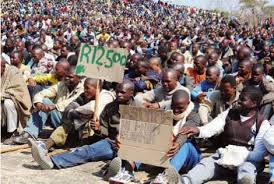
It was on August 10 that miners marched “peacefully” to the offices of Lonmin management to make their requests known, by writing their wage demands on a piece of cardboard.
Mr X told how after 15 minutes a “white man” – one of Lonmin’s management – emerged from the office. “He said the demands would be addressed by the union in 2013, and that is the agreement with the union. [He said] go back to work [and that] our strike is illegal.”
The miners then decided they would take action against those miners who returned to work and would also take steps against the refusal of Lonmin to address their wage demands.
Objection
The testimony of Mr X got off to a slow start, as technicians fine-tuned the video link through which he is testifying, but also due to a lengthy objection by Advocate Dali Mpofu, who represents the injured and arrested mine workers.
Mr X, a miner under police protection, has testified about removing “pieces of human flesh” from a murdered security guard to make their muti stronger.
While his evidence was being led by Advocate Frank Mathibedi, who represents the South African Police Service (SAPS), Mr X told how they took pieces of flesh from one of the Lonmin security guards who was killed by the striking miners on August 12 2012.
They did this on the instruction of inyangas (witchdocters) to make the muti, used during the rituals with the Amcu-strikers, strong.
According to Mr X, the muti and rituals were to protect the strikers. “An inyanga would make people brave, who would lead the warriors,” he told the commission through an isiXhosa interpreter. “The inyanga was going to make us not subject to being shot [and] lock the fire arms if we’re being shot at.”
Upon being shown a photo of the inyangas’ rag with lions printed on it, Mr X slowly started singing a song the strikers made up while on the koppie taking part in the rituals. “The lion from Bezana, the lion that eats people,” he sang in his low, husky voice.
The significance of this song has not yet emerged.
A “committee” of 15 people were chosen by the strikers to undergo these rituals. It was these 15 who were the leaders of the strikers, and responsible for conveying messages between the inyangas and other strikers.
When questioned by Mathibedi on why the mine workers marched to National Union of Mineworkers’ (NUM) offices on August 11 2012, Mr X insisted that “we had gone to kill [them]”.
Mathibedi referred to three instances where other mine workers testified to other reasons why they had marched to the NUM offices, namely to ask them why the union was preventing the mine workers from talking to Lonmin management; and to deal with allegations that strikers had been assaulted and forced to go to work by NUM officials while they were on strike.
But Mr X remained insistent that the reason they marched to the NUM offices was to kill the people inside. “We were armed, Mr Chairperson, with pangas and spears. We were going to kill [them] in the office,” he said.
Police crime intelligence gathered information that protesting Marikana mineworkers had performed muti rituals and believed they were invincible before the August 16 shootings last year.
Brigadier Adriaan Calitz told the Farlam Commission of Inquiry in Centurion on Tuesday that even though the strikers believed they were invincible police had to intervene to curb the violent strike.
“We had received intelligence that there was this story around the muti and these people believed that the police would not be able to do anything to them. They believed that their [police] weapons would not be able to do anything.
“The police are being subjected to such things on a daily basis, for example in the cash-in-transit robberies. People use muti and believe that nothing will happen to them. At the end of the day, we had to act,” he said.
Calitz was one of the police commanders assigned to the operation during the labour unrest at Lonmin’s platinum mining operations at Marikana, near Rustenburg in North West last year.
He said the police had been threatened and told to leave the Marikana koppie (hill), where the strikers had gathered, six times in the hours before the shooting.
Ishmael Semenya, for the police, asked Calitz to explain whether police were sure that methods like verbal orders, use of stun grenades, water cannon, rubber bullets, and the display of force would not have caused the protesters to disperse from the koppie.
Calitz said: “From my own experience based on around 20 years in charge of the POP (public order policing), it is not the first time I was giving instructions for dispersal. These methods [the water cannon, stun grenades, and verbal orders] always work correctly.
“People [protesters] take the easiest way out to avoid being shot or being arrested.”
He rubbished claims that the mineworkers “misunderstood” the purpose of barbed wired, which led to the chaotic confrontation.
“It [the rolling out of barbed wire] was not misunderstood. The purpose of the barbed wire had been explained to them. It [the confrontation] was a deliberate action by protesters,” said Calitz.
On Monday, Calitz told the commission he was unaware that mineworkers “lying around” after the encounter with police were dead.
In a sworn statement submitted to the commission, Calitz testified that due to the noise around the koppie, he had not heard the police tactical response team (TRT) firing live ammunition at the strikers.
“I contacted Lt-Col [Solomon] Vermaak on radio and inquired from him why the TRT was not following our dispersal action. He said he would go and check and later reported that the TRT were at the kraal and there were bodies lying around,” said Calitz.
“I thought, given my experience and the absence of such a report to me, that the bodies referred to people who were injured by the dispersion action or lying down to be arrested.”
Calitz detailed how he instructed officers to pursue protesters who were escaping in the northern and western directions. He urged the officers to arrest the fleeing protesters.
“I gave clear instructions over the radio to the dispersion group [police officers] ‘do not shoot unless the target engages you’. I repeated the instruction to ensure that members understood me clearly,” said Calitz.
“The shooting I was referring to [meant the use of] rubber rounds and not sharp ammunition. They were to use rubber only as a last resort if the armed strikers approached them with dangerous weapons.”
The three-member commission led by retired judge Ian Farlam is holding public hearings. The other commissioners are senior advocates Bantubonke Tokota and Pingla Hemraj.
Thirty-four people, mostly striking miners, were shot dead on August 16, 2012, and 78 were wounded when police fired on them while trying to disperse and disarm a group which had gathered on a hill near Lonmin’s platinum mining operations.
In the preceding week, 10 people, including two policeman and two security guards, were killed near the mine.
President Jacob Zuma appointed the commission in August last year.
Some families of deceased Marikana mineworkers were prejudiced at the Farlam Commission of Inquiry as they did not understand Afrikaans, a lawyer said on Friday.
Dumisa Ntsebeza SC, for the families, brought the complaint shortly after the inquiry resumed its public hearings on Friday.
It was prompted by the fact that police Brigadier Adriaan Calitz testified exclusively in Afrikaans.
“I did not have a problem with translation… I have been approached by the families from Lesotho, who are saying ‘because the Brigadier is insisting on speaking in Afrikaans, which apparently is his Constitutional right, Sesotho has been eliminated completely,” Ntsebeza said.
“There are three channels [of translation used at the commission] and the Brigadier is speaking in Afrikaans, then there is a translation to English and another translation from English to IsiXhosa.”
Some of the families had been prejudiced, contended Ntsebeza, saying five families had raised the complaint.
Commission chairman, retired judge Ian Farlam, then translated Calitz’s brief testimony.
“He was telling us about the experience he has had, which he referred to yesterday about a riotous incident. He particularly told us about an incident in May last year when there was a strike and there was disorder,” Farlam said.
“Police ran out of bullets in the incident.”
Farlam said perhaps arrangements would be made to cater for the Sotho-speaking families next week.
“We will see what we can do, if it’s possible to do something. [We may] provide for a third translation service just for those five people, I am not sure whether we can do that,” he said.
“We may have to resort to translating the transcript to them when it becomes available.”
Head of the evidence leaders, Geoff Budlender, said translators at the commission had complained that Calitz, apart from answering quickly to the questions, also spoke too quickly.
On Friday, some people in the auditorium were dressed in Julius Malema’s Economic Freedom Fighters party regalia.
In May, the commission heard that Calitz gave the order for police to “engage” the striking Marikana miners in August last year.
A video clip taken from a helicopter that Calitz was in during the police’s dispersal operation at Marikana was played for the commission.
“Get out there and engage,” Calitz is heard saying on the clip.
Calitz was one of the commanders assigned to the Marikana operation.
Another police officer, Maj-Gen Charl Annandale, who was under cross-examination at the time, confirmed Calitz’s voice was audible in the clip.
“That was Papa one, Brigadier Calitz,” said Annandale.
Annandale headed the police tactical response team during the wage-related unrest at Lonmin’s platinum mining operations at Marikana, near Rustenburg in North West last year. He said he was at the joint operations centre listening to the police radio when the instruction was given.
The three-member commission is holding public hearings in Centurion. The other commissioners are senior advocates Bantubonke Tokota and Pingla Hemraj.
Thirty-four people, mostly striking miners, were shot dead on August 16, 2012 and 78 were wounded when police fired on them while trying to disperse and disarm a group which had gathered on a hill near the mine.
In the preceding week, 10 people, including two policeman and two security guards, were hacked to death near the mine.
President Jacob Zuma appointed the commission in August last year. – Sapa
Hundreds of Economic Freedom Fighters braved the scorching sun for the launch of their party at the Nkaneng informal settlement in Marikana, North West on Sunday.
Members dressed in red berets and T-shirts sat on top of a hill while others sat on the grey clay soil around the stage.
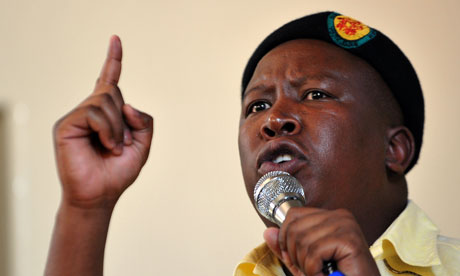
Speaking at the launch, EFF leader Julius Malema said a giant had been born.
“A different baby is born today, a giant… A child that walks immediately. The baby that fights for your living wage. You must be afraid of that child.”
He said the EFF was a home for orphans.
“This is the home for the hopeless,” he said to the applause of the crowd.
He said the EFF was not afraid of confronting white bosses for not paying workers and abusing them.
“You must fight these abuses whether Julius Malema is there or not… You must be a Malema at your workplace.”
He said the police should take off their uniform when instructed to kill innocent people.
“Give them their uniforms and weapons. Tell them you do not want a salary with blood on it.” He was referring to the shooting of 34 mineworkers in Marikana in August last year.
Malema called on teachers to teach pupils first and go on a strike after school.
“When you strike after school the children will join you,” he said.
He told the crowd that the land of South Africa belonged to the landless.
“This is your land. You (the landless) do not have to pay for the land. It has been already paid by the sweat of your fathers.”
He said white South Africans were still refusing to hand over the land they had “inherited through theft”.
“Till today they (whites) are not ashamed of killing our people. They want us to kneel before them.
“We are not going to do that. We are not going to beg for the land. Bring back the land.”
He told the crowd to vote for a real president and not a dancer.
“Refuse to vote for a singer and dancer. We want a thinker to drive the policy of our country.
“We do not want an old man who dances like a teenager. Everytime he dances older people look down with shame,” he said.
The crowd responded by waving their hand in a circle, indicating need for a change.
“We must restore the image of South Africa.”
Malema apologised to South Africans for having Jacob Zuma as president.
“I apologise for giving you a mediocre non-thinker and non-reader.
“We must vote for statesmen, we must vote for the restoration of the image of South Africa.”
Malema vowed to make the Gupta family pay for embarrassing the country, including with their controversial landing of a plane at the Waterkloof Air Force Base.
He said the day EFF took power they would “be punished” for all their “wrongs”.
He concluded his speech by singing the controversial “Shoot the boer” song.
The crowd shouted “Juju! Juju!” after he had spoken. – Sowetan
Hundreds of Economic Freedom Fighters braved the scorching sun for the launch of their party at the Nkaneng informal settlement in Marikana, North West on Sunday.
Members dressed in red berets and T-shirts sat on top of a hill while others sat on the grey clay soil around the stage.
Speaking at the launch, EFF leader Julius Malema said a giant had been born.
“A different baby is born today, a giant… A child that walks immediately. The baby that fights for your living wage. You must be afraid of that child.”
He said the EFF was a home for orphans.
“This is the home for the hopeless,” he said to the applause of the crowd.
He said the EFF was not afraid of confronting white bosses for not paying workers and abusing them.
“You must fight these abuses whether Julius Malema is there or not… You must be a Malema at your workplace.”
He said the police should take off their uniform when instructed to kill innocent people.
“Give them their uniforms and weapons. Tell them you do not want a salary with blood on it.” He was referring to the shooting of 34 mineworkers in Marikana in August last year.
Malema called on teachers to teach pupils first and go on a strike after school.
“When you strike after school the children will join you,” he said.
He told the crowd that the land of South Africa belonged to the landless.
“This is your land. You (the landless) do not have to pay for the land. It has been already paid by the sweat of your fathers.”
He said white South Africans were still refusing to hand over the land they had “inherited through theft”.
“Till today they (whites) are not ashamed of killing our people. They want us to kneel before them.
“We are not going to do that. We are not going to beg for the land. Bring back the land.”
He told the crowd to vote for a real president and not a dancer.
“Refuse to vote for a singer and dancer. We want a thinker to drive the policy of our country.
“We do not want an old man who dances like a teenager. Everytime he dances older people look down with shame,” he said.
The crowd responded by waving their hand in a circle, indicating need for a change.
“We must restore the image of South Africa.”
Malema apologised to South Africans for having Jacob Zuma as president.
“I apologise for giving you a mediocre non-thinker and non-reader.
“We must vote for statesmen, we must vote for the restoration of the image of South Africa.”
Malema vowed to make the Gupta family pay for embarrassing the country, including with their controversial landing of a plane at the Waterkloof Air Force Base.
He said the day EFF took power they would “be punished” for all their “wrongs”.
He concluded his speech by singing the controversial “Shoot the boer” song.
The crowd shouted “Juju! Juju!” after he had spoken. – Sapa
A trust is being set up for victims of strike-related violence in Marikana last year, a group calling itself Citizens4Marikana said on Tuesday.
“We are in the process of forming a trust for the benefit of the persons identified by the Farlam Commission [of Inquiry] as victims of the Marikana massacre, and their families,” it said in a statement.
“The aim of the trust will be to benefit the named beneficiaries in whatever way the trustees deem most appropriate… Right now that could be by providing finance for legal fees.”
In the long term, this could be used for education scholarships.
“Ultimately, how funds are spent will be determined by the trustees and we will be responsible only for raising those funds.”
The group was started on Twitter following comments about the August 16 shooting last year that left 44 people dead at Lonmin’s platinum mine in Marikana.
“Our mission is to ensure that the truth of the events at Marikana are revealed and that the victims, and their families, achieve justice,” it said.
“While we recognise the importance of the Farlam Commission, justice cannot be found… unless real recompense is made to the people most intimately affected.”
On June 21, Dali Mpofu, for the miners, told the commission that due to financial constraints, it could be his last day representing the miners. He brought an application in the High Court in Pretoria several weeks ago seeking funding, but this was dismissed. Mpofu then took the State to the Constitutional Court, asking that it pay for his legal team. The application was dismissed on Monday.
On its website, Citizens4Marikana state that Nkome Attorneys, based in Pretoria, were appointed to temporarily collect donations.
Citizens4Marikana is as a social media movement started by a group of people moved by the violence at Marikana. There was nothing political behind it, said representative Kay Sexwale, former radio presenter and niece of former human settlements minister Tokyo Sexwale.
“We are just outraged at the Marikana massacre and we feel that something has to be done,” she said.
“Nothing is cast in stone. We are not trying to steal anyone’s money. We are just collecting money for those families affected. It is about the 44 people who died in August last year.”
Citizens4Marikana was started by “random people” on social media network Twitter, including Sexwale, UN secretary general at the G8 and G20 Youth Summits in 2012 Erik De Ridder, photojournalist Greg Marinovich, and Nomboniso Gasa, who describes herself as a researcher, analyst, and public speaker. – Sapa
The Farlam Commission of Inquiry, which is investigating the deaths of 44 people during strike-related unrest at Lonmin’s platinum mine in Marikana last year, is expected to continue on Tuesday.
This follows the Constitutional Court ruling regarding funding for the legal teams representing the miners.
Thirty four people — almost all striking mineworkers — were killed on August 16 when police opened fire on them. Ten people, including two police officers, were killed in the preceding week.
On June 21 Dali Mpofu, for the miners, told the commission that due to financial constraints, it could be his last day representing the miners.
He brought an urgent court application in the High Court in Pretoria several weeks ago seeking funding, but this was dismissed.
Mpofu then took the State to the Constitutional Court, asking that it pay for his legal team.
The application was dismissed on Monday.
North West deputy police commissioner General William Mpembe on Monday told the Commission how his colleague was killed by striking miners.
“I couldn’t count how many [attackers] there were… There were plus minus five of them who attacked Monene,” testified Mpembe.
“They had pangas and knobkerries.”
Mpembe was being cross-examined by Takalani Masevhe, for the family of slain Warrant Officer Tsietsi Monene.
A second officer, Sello Lepaku, was also killed in the attack. – Sapa
African cleansing ceremony at the site of the Marikana killings
The first anniversary of the shooting at Lonmin’s Marikana mine, near Rustenburg in the North West, will be marked during a commemorative rally on Friday.
On August 10 last year, Lonmin rockdrillers embarked on an unprotected strike for a monthly salary of R12,500.
More workers joined the strike and the protesters gathered at a hill near Nkaneng informal settlement carrying weapons, such as pangas, spears, knobkerries, and iron rods.
On August 16 last year, police trying to disperse and disarm them opened fire on the mineworkers, killing 34 of them.
Ten people, including two policemen and two security guards, were killed in strike-related violence the preceding week.
Several violent deaths in the area following the Lonmin strike have been blamed on rivalry between the Association of Mineworkers and Construction Union (Amcu) and the National Union of Mineworkers (NUM).
The Congress of SA Trade Unions, to which NUM is affiliated, said that there had been “overwhelming concern” in the wake of the Marikana shooting that such killings should never again happen in democratic South Africa.
“Tragically however, one year later, we cannot say that there have been no further deaths,” spokesman Patrick Craven said in a statement on Thursday.
Social problems, poverty and lack of transformation still affected the lives of mining communities.
A framework agreement for a sustainable mining industry, signed by government, employers and most unions, needed to be fulfilled in order to prevent a repetition of the Marikana tragedy, Craven said.
He said the union federation was “bitterly disappointed” at the procedural arguments stalling the work of the Farlam Commission.
President Jacob Zuma appointed the commission to probe circumstances around the August 16 shooting.
On Friday, the Constitutional Court is expected to rule whether the State should pay the legal costs for the miners arrested and injured at Marikana.
In June Dali Mpofu, for the miners, told the commission that due to financial constraints his team could be forced to withdraw from the inquiry.
He previously brought an urgent court application in the High Court in Pretoria several weeks ago seeking funding, but this was dismissed.
The commission has been postponed several times while solutions to the funding problems were sought.
Amnesty International’s Africa spokesman Noel Kututwa said on Thursday that the organisation was concerned that the Farlam Commission was in crisis.
“The long-term consequences for the respect and protection of human rights in South Africa will be severe should the South African authorities fail in taking all necessary steps to achieve accountability for what happened in Marikana on 16 August 2012.”
The SA Communist Party called for the speedy conclusion of the Farlam Commission’s work.
“The SACP hopes that the commission will also attend to the broader systemic, underlying issues around the mining areas and the mining industry.”
The SA Human Rights Commission (SAHRC) said it was concerned about continuing violence and killings in the Marikana area.
“The SAHRC recognises the urgent need for an understanding of all of the causes and reasons for these deaths, and what can be done to improve the material conditions of the people of Marikana, and hold those responsible accountable.”
Agang SA leader Mamphela Ramphele said: “As we honour all those who died at Marikana, we must encourage a spirit of reconciliation backed by practical steps so that all concerned parties can work together to finally bring peace to Marikana”.
The CCMA said its offices would observe a minute of silence at noon on Friday as a mark of respect for those killed at Marikana.
The CCMA committed itself to working tirelessly in efforts to prevent a repetition of the events of August 16 last year. It also acknowledged the work of its members in relation to the Marikana labour disputes.
Council for the Advancement of the SA Constitution chairman Sipho Pityana said police needed to heed lessons learnt from the Marikana shooting.
“The continued brutality of the police, and their inadequacies in policing protests, shows how urgent it is that reforms are introduced to protect the human rights of everyone who lives in South Africa.”
National police commissioner Riah Phiyega called for peace at Friday’s commemorative events.
“We wish to appeal to everyone who will be in attendance to conduct themselves appropriately and to co-operate with the event organisers, marshals and the police,” she said on Thursday.
“Most importantly, we plead with them to not carry dangerous weapons including knives, knobkerries, firearms or any other dangerous weapons.”
NUM and the African National Congress in the North West signalled on Thursday that they would not be attending the commemorations.
NUM spokesman Lesiba Seshoka said the decision was based on the fact that the events were organised by the Marikana Support Group, rather than deputy president Kgalema Motlanthe’s office.
NUM initially welcomed Amcu’s invitation to its president Senzeni Zokwana to attend the commemoration. Zokwana had been asked to share the stage with Amcu president Joseph Mathunjwa in an attempt to ease tensions in the platinum belt.
Lonmin signed an agreement with Amcu this week, recognising it as the company’s majority trade union. The agreement set a threshold of a 30 percent membership for any trade union to be recognised by the company.
Membership of the NUM, which used to be the majority union, has dropped to 20 percent of Lonmin’s workforce.
ANC provincial spokesman Kenny Morolong said: “The commemoration is organised by an illegitimate team called ‘Marikana support group’ — a group which the ANC does not recognise”.
The ANC would only participate in a commemoration organised by government, as agreed with families, Lonmin Platinum and labour unions, he said. – Sapa
President Jacob Zuma called for reflection to restore peace in South Africa’s mining industry Wednesday, days before the first anniversary of police shooting dead strikers in the Marikana tragedy.
Friday marks a year after police opened fire on thousands of strikers at platinum producer Lonmin’s mine northwest of Johannesburg which killed 34 and injured 78 people.
Two days before the commemoration the firm recognised radical labour group AMCU, which led the wage strike, in an attempt to ease simmering inter-union tensions on the platinum belt.
“The incident of the 16th (of August) in particular shocked the whole country and caused untold pain and numbness amongst all South Africans,” Zuma said in a statement.
“It was a tragic and sad loss of life,” he added.
“We must all resolve to do everything possible to prevent a repeat of similar incidents.”
Demands for higher salaries sparked last year’s wildcat strikes.
Workers flocked to join the militant Association of Mineworkers and Construction Union (AMCU), abandoning the once-dominant National Union of Mineworkers (NUM) in droves because it was perceived to protect the mine management’s interests rather than that of labourers.
AMCU now represents 70 percent of Lonmin’s 27,000 employees, stealing the majority position from NUM, which is left with 20 percent of the membership.
The August shooting was described as the worst police brutality since the end of apartheid two decades ago.
But in the preceding week at least 10 people, including two policemen, were killed in clashes between the workers.
Following the massacre strikes spread quickly across the platinum industry and some gold mines, bringing an economic lifeblood to a standstill for months.
Mine stoppages in 2012 cost Africa’s largest economy 15.3 billion rand ($1.2 billion, 1.5 billion euro).
In the year since the bloodbath the union struggle for supremacy and ensuing benefits left a trail of bodies in its wake.
At least eight prominent members from both AMCU and NUM have been murdered, the latest victim a local NUM leader who was gunned down in front of her house on Monday.
Most victims were NUM members, and attackers periodically threatened the NUM to leave the mine.
“What is happening in Marikana does not only disrupt the community there, it disrupts economic growth,” said police commissioner Riah Phiyega launching a crime combating initiative in the town on Wednesday.
At least 13 murders occurred in the area in recent months, she added.
AMCU’s recognition as majority organisation seemed auspicious to calm hostilities in Marikana two days before the memorial of a massacre which has seen little retribution.
An inquiry Zuma set up to probe the killings is yet to conclude its work and lawyers representing wounded workers have pulled out over lack of funding.
The agreement “signals a new era”, according to Lonmin chief executive Ben Magara, who vowed that “we’ll put all we can to ensure peace and stability”.
AMCU president Joseph Mathunjwa urged a partnership to end acrimony between mine managers and labourers.
“We acknowledge that without cooperation we are all losers and that as leaders, we must find a way to ensure we can move forward together in peace and stability,” he said.
Labour analyst Daniel Silke believes that AMCU’s recognition will give it a sense of accomplishment, but won’t stop the NUM from reclaiming its position.
“In the short term, I think it’s positive on the mines,” said Silke.
Zuma urged unity in mining “so as to create an environment conducive to development”.
“Workers and managers must go to work without fear that anyone would harm them. Workers must be free to excercise their Constitutional right to join any trade union of their choice,” he added. – Sapa-AFP
A woman miner was shot dead at a residential area in Wonderkop, near Lonmin’s Marikana mine outside Rustenburg, on Monday, North West police said.
The 44-year-old was shot in the head while returning from a shop at Wonderkop around 12.30pm, Brigadier Thulani Ngubane said.
“This is a mine residential area that is not far from Rowland Shaft and in close proximity to the National Union of Mineworkers’ (NUM) and Association of Mineworkers and Construction Union’s offices at Lonmin.”
The woman, who worked at Four Belt Shaft, was off duty at the time.
The gunman fled the scene, shooting randomly. Six 9mm cartridges were found nearby.
A case of murder was opened. The motive was not immediately known.
Ngubane could not confirm NUM’s earlier assertion that the murdered woman was a NUM shop steward.
“That is up to the union to say.”
North West police commissioner Lt-Gen Zukiswa Mbombo appealed to local residents not to speculate on the motive for the killing.
“Let us wait and we will get information from those who are investigating the case, and we will pronounce unambiguously on the motive as soon as information is available,” she said.
Earlier, NUM spokesperson Lesiba Seshoka said in a statement that the woman was a union shop steward.
” We are disappointed that amid the increasing assassinations in Marikana and the broader Rustenburg area, there has not been any progress with regard to the arrest and prosecutions of the suspects,” he said.
“While many of the suspects are known to the police, none has been arrested or prosecuted.”
Seshoka said Lonmin had instructed shop stewards to return to work even though the NUM had cautioned that it was not safe.
“The union is concerned that the company’s pre-occupation with profits and the police incompetence may lead to a serious bloodbath in Rustenburg,” Seshoka said.
Comment from Lonmin was not immediately available.
The Congress of SA Trade Unions said it was tragic that the murder happened days before the August 16 Marikana shooting anniversary.
“We see yet more evidence that violence remains endemic in the Rustenburg area,” spokeperson Patrick Craven said in a statement.
“This latest atrocity demonstrates that the framework agreement for a sustainable mining industry, signed by organised labour… organised business, and government on 3 July 2013 is simply not being effectively implemented.”
On August 16 last year, 34 miners were shot dead and 78 wounded when police fired on them while trying to disperse a group gathered on a hill near Lonmin’s platinum mine in Marikana.
In the preceding week, 10 people, including two police officers and two security guards, were killed in strike-related violence.
The framework agreement was aimed at resolving issues like strikes and violence bedevilling the mining industry, especially in the Rustenburg platinum belt.
The Economic Freedom Fighters (EFF) scored a significant political victory at the weekend, when one of the worker leaders at the forefront of the labour strike in Marikana, outside Rustenburg, joined the organisation.
Xolani Nzuza was paraded as a prominent EFF member during the organisation’s national assembly at Uncle Tom’s Hall in Soweto at the weekend.
Nzuza was among Lonmin miners who presided over several mass meetings before and after the Marikana massacre, when the police gunned down 34 striking mineworkers on August 16 last year.
Strangely, Nzuza confused the mine bosses, mostly British passport holders, with the “Boers”, or Afrikaners however.
“The president of Nkandla decided to go and meet the Boers and not the workers who voted for him. Once he saw Juju (Julius Malema) was with us, he tried to come. Now, our lawyers have not been paid and are begging for (financial) assistance,” Nzuza said.
He is also a member of the Association of Mineworkers and Construction Union (Amcu), which recently eclipsed the rival ANC-aligned National Union of Mineworkers (NUM) as the majority union at Lonmin.
His decision to join EFF has raised the organisation’s hopes that it could make serious inroads at Marikana, and possibly around other mines in Rustenburg’s platinum belt.
Nzuza told of workers’ pain at how the government had “abandoned” them.
“We still haven’t received the R12 500 promised to us. Till on Monday, we are still waiting for (President Jacob) Zuma’s government.
It’s painful (because) our brothers died (for that pay rise),” Nzuza said.
He took a swipe at Zuma for siding with the mine bosses and for not paying the legal fees of the families of the slain and wounded miners at the Farlam Commission of Inquiry. – IOL
A poor showing by the ruling party at next year’s general election will likely cost President Jacob Zuma his job, political analyst Nic Borain said on Thursday.
Speaking at a Cape Town Press Club lunch, he said the signs were that “the ANC’s glue is coming unstuck” after the Marikana shootings last year.
“They [the ANC] are taking this 2014 election extremely seriously. They’re going to fight tooth and nail to [win it].
“They know that if they drop below 60%, they’re in trouble. Jacob Zuma will be in trouble… “
Responding to questions, Borain – a local independent analyst, who spoke on “the impact of the current mining troubles” in South Africa – suggested the rise of the Association of Mineworkers and Construction Union (Amcu) was a turning point for ANC supporters.
Support for it had been triggered by unhappiness with the ANC-aligned National Union of Mineworkers (NUM).
“There was a huge defection [from] the ANC support base in the platinum sector.”
This had later spread to the gold sector, where it had risen – according to some sources – to 30%.
“Jacob Zuma is now losing support among urban black people,” Borain said.
Prediction
Asked to predict the likely showing of the ANC at next year’s elections, he said a “worst-case scenario” was the ANC retained 65% of the vote.
He suggested a more-likely “best scenario” would see the ANC get 59% of the vote. This, he said, would lead to ANC leaders negotiating a “controlled exit” for Zuma, who would want to be assured he could leave with his wealth intact and not facing corruption charges.
“The ANC is not going to accept this kind of loss.”
Borain said a third scenario, involving the ANC garnering only 51% of the vote, was “very scary”.
“If that happens, all bets are off.”
Pushed to suggest how political parties might fare in the coming election, he estimated the ANC would take 58%, the DA 26%, a figure he later revised to 30%, and newly-formed Agang SA about 2%.
On the DA, Borain said the main opposition party would find it “difficult to overcome barriers to its growth”.
On the future prospects of Julius Malema’s Economic Freedom Fighters (EFF) – whose leadership he described as “the clowns and fools of our politics” – Borain said they could take up to 5% of the vote.
“But I can’t see them getting out to vote,” he added. – Sapa
This website uses cookies to improve your experience. We'll assume you're ok with this, but you can opt-out if you wish. Cookie settingsACCEPT
Privacy & Cookies Policy
Privacy Overview
This website uses cookies to improve your experience while you navigate through the website. Out of these cookies, the cookies that are categorized as necessary are stored on your browser as they are essential for the working of basic functionalities of the website. We also use third-party cookies that help us analyze and understand how you use this website. These cookies will be stored in your browser only with your consent. You also have the option to opt-out of these cookies. But opting out of some of these cookies may have an effect on your browsing experience.
Necessary cookies are absolutely essential for the website to function properly. This category only includes cookies that ensures basic functionalities and security features of the website. These cookies do not store any personal information.
Any cookies that may not be particularly necessary for the website to function and is used specifically to collect user personal data via analytics, ads, other embedded contents are termed as non-necessary cookies. It is mandatory to procure user consent prior to running these cookies on your website.