Soweto — the true story of 16 June 1976

June 16, 1976 was a normal working day. It was cold and cloudless sunny winter weather. At the time I was working as a social-worker supervisor for the West Rand Development Council in Soweto and my office was in Diepkloof, which is located near Baragwanath Hospital. The hospital is located on the outskirts of Soweto. There were quite a few white social workers working in Soweto at the time, as well as many black social workers under our supervision. They had offices in their respective areas in and around Soweto. Our direct head was Dr. Melville Edelstein who was also the first person and the first white person to be killed in Soweto on June 16.

There were quite a few black social workers under my supervision whose offices were in Klipspruit, Chiawelo, Dlamini, Pimville, Senoane, Orlando East and Orlando West, Dube, Jabulani, Morocco and Jabavu.

As usual, I was at my office in Diepkloof at eight am on June 16, 1976. After completing some administrative tasks, I drove to Jabulani around 10:30 am to deliver a cheque to that office. At that point, everything was quiet and everyone seemed to be going about their business normally. Around 11 am on my way back to my office in Diepkloof I drove through Jabavu. I noticed black children in their school uniforms (black dresses, grey long pants and white shirts) running along the roads and in between the houses. They did not carry posters or give any indication why they were running. Further on to my right I saw a small brown sedan with four white officers inside who looked like South African policemen in their blue uniforms. They were travelling in the same direction as me,  at a high speed. The situation seemed tense. Fortunately I wore a black leather jacket that stood high against my neck, with black leather gloves and dark glasses. Because I was driving against the sun, no one from outside could see that I was a white woman. We were always instructed not to stop anywhere. I was thus able to reach my office in Diepkloof in one piece through the unruly mass of school children.

After returning to my office, I immediately went to the Chief Village Management’s office and told the manager what I had seen. After a short while he told me to leave the area immediately. He asked another Village Manager to escort me out of Soweto. It was 12 noon and I went to my apartment in Hillbrow. Because there were no cell phones at that time, I had no idea what was going on in Soweto. I didn’t have a TV or a radio either. From then on I was never able to return to my office in Diepkloof. I subsequently reported to the salary office in Eloff Street Extension, Johannesburg.

At around 5 pm, a Soweto work colleague visited me and told me Soweto was burning and that there was total chaos everywhere. On that same morning this colleague who worked in Zola was also instructed to leave the area by midday. Needless to say, he could never return again to his Zola office. The orderly system where white village managers had successfully managed the city of Soweto for many years ceased to exist from 16 June 1976. If a Soweto resident wanted to see a white official who had been replaced by a black village manager, a fee would have to be paid to the new black official just to make an appointment! This fee went into the official’s pocket.

During the riots, the Zola office was completely destroyed. Roving black mobs came with chains, surrounded the buildings and the large built-in safe was removed in the plundering. In addition the mob carried away all the roofing sheets and bricks. Some years later we drove past what had been a large, well-maintained edifice, with a vegetable market and parking, and now there was just grass. They had removed everything.

The formerly neat Diepkloof offices and the complex remained standing, but the library building was occupied by blacks who made it their headquarters. The buildings had deteriorated. Other town offices in Soweto were also looted and destroyed. Before the riots, rumours among whites working in Soweto had circulated that one day there would be trouble, but we had no indication when it was expected and what form it would take.

Arrogance and insubordination increased. One black social worker whose office was also in Diepkloof proved this point. She was never on time at 8 am, and sometimes only arrived at 10 am. Her black clients, mostly elderly people,  had been patiently waiting in the sun outside for hours for her arrival. I spoke to her on numerous occasions about her tardiness and discussed the matter with Dr. Edelstein. He did nothing about it. One morning she informed me she didn’t have a car like me, so could not arrive on time. At that point, she was on the same salary scale as me, while no tax was deducted from her annual bonus. Tax was deducted from my bonus. When I asked why she didn’t buy a car, she replied because she was black and nobody would sell her a car. I told her this was nonsense — she was playing the race card. But she turned around and left the office.

Dr. Melville Edelstein, with his family

Until his death, the 56-year old Dr. Edelstein had worked for eighteen years firstly in Soweto as a social worker/philanthropist and later as Chief Social Worker at the West Rand Development Council. He obtained his doctor’s degree from the left-liberal University of the Witwatersrand studying and researching the black youth in Soweto. He devoted his life to the upliftment of Soweto’s black youth and he could see nothing wrong with them. His daughter later said that “he loved the people of Soweto almost like he did his own family”. He attended his synagogue every morning before going to his office in Jabavu. On the morning of his death, he opened a project / program at the Protected Workshop in Orlando East. When he heard that there were problems at the Jabavu office,  he rushed back there despite warnings and pleas from myself and his other colleagues not to return. At his office he was met by the riotous young blacks who caught him under his desk. Despite the pleas of a black lady social worker not to attack Dr. Edelstein, they shouted at him “bleddy white k..…r, today you are going to die”.  They dragged him from under his desk and brutally killed him, smashing his head to a pulp and assaulting him with knives.

Jou bleddie wit k*****, vandag vrek jy. You bloody white k***** [n*****], today you are going to die [like an animal]

To my knowledge, he was known to these black thugs as he had worked with them daily for many years. In the media it was reported that had they known who he was, they would not have killed him. A note left behind on Dr. Edelstein’s body read  “preserving Afrikaans is the most dangerous drug for our future”. The black youth who killed him knew that he was not Afrikaans.

The “forcing students to learn Afrikaans” story is totally untrue. Afrikaans as a subject in the black schools was voluntary and no student was forced to take Afrikaans as a subject. White Afrikaans teachers in the black schools offered their respective subjects in English. All reports, interviews and so forth conducted by Village Managers or Social Workers or any other official in Soweto were conducted in English.

Because of the shortage of qualified black teachers, white women teachers were sent to the schools. Most of them were Afrikaans speakers, but all of course spoke English. Many of them were already teaching in English. The story that was spread around the world that Afrikaans was “forced” on black pupils is absolute nonsense. No one was forced to learn anything other than what they chose to learn. Afrikaans as a subject was listed with other subjects from which to choose. If you didn’t want to learn Afrikaans, no one forced you to do so.

It should be remembered that before the National Party came to power in 1948, there was no formal education system for blacks. So those in South Africa and overseas who complain about “Bantu education” should remember that for thousands of years while they lived in Africa, none of the black tribes created an education system. It was the whites who brought modern education to South Africa. Firstly it was the British and German missionaries who opened a few schools, then white farmers set up schools on their farms for the children of their workers, but until the Verwoerd government came to power, there was no formal education whatsoever for blacks. So those black critics who complain about Bantu education, we ask: what education system did you create for your own people? The answer is none.

Protests against education in Afrikaans broke out at seven Soweto schools. In six of them however no subjects were taught in Afrikaans. Before long, 20 000 students went on a rampage through the streets, burning, destroying, killing and looting. Other whites working in Soweto, including women, were surrounded and assaulted. One white official (J.N.B. Esterhuizen) was stopped in his car and hacked to death! Police detachments were sent in to restore order but achieved little. They were attacked by stone-throwing crowds which also set police dogs alight.

At one of the riot scenes, a large group surrounded and closed in on a few policemen. The police opened fire and several hundred rioters, including rioting children, were shot in the mayhem which spread to the rest of the country and continued for months. (Die Burger, 16 June 2000).

This gratuitous violence gave the world the opportunity to brand South Africa as a “brutal police state” and a host of new international punishment measures were imposed on the country, which sanctions lasted until the late eighties. All of this is based on a false story, sent around the world by an antagonistic media. Will the truth of this day 16 June in South Africa ever prevail, and will the truth about the real George Floyd ever prevail as America’s racial hysteria sends out an inflamed message to the world?

—Salomé Oosthuizen

Black woman regards Afrikaans as ‘model of decolonisation’

Seeing the Afrikaans language as a decolonised language, speakers at the Breaking Down Borders Africa Youth Summit conference shared how central language is in decolonising education.

Dr Edith Phaswana, a senior lecturer at the University of South Africa (Unisa), said a model of decolonisation can be learnt from how Afrikaans developed.

“It’s because this language evolved in the twentieth century. Before 1914 there was no Afrikaans, but today we speak of Afrikaans as scientific language that is taught at university level, that has produced its own literature as well,” said Phaswana.

“Our languages – isiXhosa, seSotho and all of them – are older than Afrikaans, are more matured than Afrikaans and if Afrikaans can reach this level … it means there’s a possibility that we can form our own creole from the many Nguni and Sotho languages that we have in this country in order to form a formal scientific language at university level,” she added.

Extract from CityPress

Dan Roodt: Anglicising Afrikaans schools will speed up the country’s decline

It is astonishing that Mary Metcalfe, whose educational legacy in Gauteng was characterised by one foolish, abandoned experiment after the other, should pontificate on the issue of Afrikaans schools (“War talk won’t end language row”, June 5). The very prowess of those schools and their exceptional results depended for years on avoiding, sometimes even surreptitiously, the more disastrous policies and decisions emanating from the provincial education minister’s office.

Metcalfe is also blindly ethnocentric, judging from the zeal with which she argues the case for ramming even more English down our throats. What she calls a “legal war of attrition” over the Afrikaans schools is, more fundamentally, a prolongation of the Anglo-Boer wars and the quest for total English supremacy and monoculture.

In many societies, such attempts at cultural and political domination of one group over another have led not to legal bellicosity, but to more literal war and ethnic conflict. Metcalfe refers to “challenges of perception”, among which is the “perception” (of white liberals with children in ­private English schools?) “that language exclusion operates as a proxy for racial exclusion”.

Before we argue about perceptions, there is a reality that Afrikaners are, by and large, politically and culturally excluded from the current system that is run by ex-terrorists, ­former exiles and an Anglomaniac elite that takes its own colonial Anglo-American or even Afro-American culture as a given. McDonald’s and KFC are in; boerewors and biltong are out.

The operative term here, and which Metcalfe in her Anglomaniac self-righteousness uses quite freely, is “imposition”: “the imposition of English as a parallel medium of instruction in Afrikaans-medium schools”. By what right do Metcalfe, Barbara Creecy and their puppet, Panyaza Lesufi, want to “impose” their killer language on us? English enjoys unheard-of dominance, funding (also by the Afrikaans taxpayer, who is financing English imperialism) and exclusive privilege on all levels of government, yet this is apparently not enough. The Afrikaans school must be stifled, given its final solution – all in the name of “diversity”, that nauseatingly politically correct concept. There are ­thousands of all-black schools all over South Africa without any white children, yet no one is bemoaning their “lack of diversity”.

It follows that the assault on Afrikaans schools has nothing to do with improving education, but more with the ethnic hatred of Afrikaners in some Anglophone, cultural-Marxist circles whose covert objective is not only to eradicate the Afrikaans language but also to rid the country of Afrikaners. Either we will be made to feel so unwelcome and hated that we will simply emigrate or there will be some more violent solution to the “Afrikaner problem”.

If the remaining 124 Afrikaans schools in Gauteng succumb to English political fanaticism, the country will lose many young engineers and scientists, further hastening its current decline. But those schools have a wider function too: in a violent, decadent society that is hostile to cultural minorities, they care for our children.

Afrikaans schools manage to give children from single-parent, lower middle-class homes a chance in life. They also represent the last havens of Afrikaans culture menaced by an Anglocentric state and corporate behemoths constantly imposing their monoculture on everyone.

It is not true that “from 1994, many historically Afrikaans schools have opted to offer parallel streams of English and Afrikaans in one school”. In all the cases I know of, there was some degree of threat or coercion from the provincial education department concerned.

The notion that Afrikaans schools “belong” to the state and not to the community that created them must also be challenged. Metcalfe and education MEC Lesufi are the landlords of public schools, lording it over their hapless tenants as they see fit. Most Afrikaans schools in Gauteng were financed by Afrikaner taxes and are maintained as semi-private institutions by fee-paying parents, often grappling with financial problems.

Ever since the British took control of South Africa in 1806, there has been a Dutch and Afrikaans taalstryd (language struggle), perhaps interrupted by 40 years of National Party rule, during which an Afrikaner government did not dare to force English schools to become Afrikaans medium.

After two centuries of language struggle, the very existence of Afrikaans and Afrikaans schools is still under threat from a hostile, fundamentalist, Anglomaniac government that makes British colonialists look tame by comparison.

First pulblished on 11 June 2015 in the Mail & Guardian, Johannesburg.

Letter: By what right may government decide what language I should use?

I write in English to accomodate readers who aren’t bright enough to speak more than one language; those who do not understand Afrikaans.

I write anonymously as I am not pursuing a career in politics or in media. Further I don’t want to be tarred and feathered or championed by any group.

Also as I am not a politician or a pundit, so I will keep it brief, relying on the reader’s pre-existing knowledge of affairs to set the context and situation.

I refer to the current controversy on racial transformation in our society, specifically with regards to Stellenbosch University and the Open Stellenbosch movement.

It has been reported that Stellenbosch University has removed the memorial plague of the Villain Verwoerd and renamed the Malicious Malan hall.

I find this ironic. It’s ironic as the government and associated intellectuals and press still think that they are within their rights to socially engineer South Africans into their vision of society, curtailing the rights of individuals and free associations that don’t fit the plan.

Furthermore they won’t blink whilst classifying individuals into racial categories and deciding for themselves what the rights will be that these categories shall enjoy or forgo.

I find it very ironic that a movement such as Open Stellenbosch is fighting for language rights at Stellenbosch University (not Universiteit) when that institution is already a majority English university with almost all textbooks in English; the majority of classes are presented in English, not translated but presented in English.

All exams can be completed either in English or in Afrikaans.

Nobody is intuitionally/bureaucratically excluded from Stellenbosch on the basis of race and there have been major efforts to accommodate students who are not Afrikaans-speaking at undergraduate level, while all post-graduate studies are already in English.

Fighting for language rights at the only bilingual university in South Africa?

Are there any English universities who even make this concession to language preference? Stellenbosch is already a de facto English university and de jure a bilingual university.

Within all popular frames of reference it is not only allowed, but morally just and desirable for government to impede individual freedoms by disallowing the right to free association, language and cultural rights.

In this philosophy it is just for national government to interfere in the future of it citizens and decide no longer will this be an all-white team/university/company/person but it must now be 79.2% black.

By what right can government classify me according to race, and if this right exists for government what is the process, where do I appeal and when will the SA bureau of Standards(SABS) release the race specs?

By what right can the Communist Party tell me in what language I may receive instruction?

This is pure arrogance to interfere in my life and disturb my peace. Was it gained from Baas Verwoerd?

Koos Kleurvol
‘n Vryburger

Stellenbosch promises to ‘remove racists’

Rector and vice-chancellor Professor Wim de Villiers promised Parliament’s portfolio committee on higher education and training on Tuesday Stellenbosch University would root out “racists”.

Stefan Lang, the outgoing SRC chairman, having to rush through his address in order to provide committee members the chance to respond to the university’s presentation, reiterated that the SRC was focussed on “celebrating diversity”, a euphemism for black monoculture.

“Our vision is to create a welcoming ethos and anything that is against that must be removed,” he said.

“Our journey is imperfect, incomplete but we remain steadfast,” said De Villiers.

De Villiers, along with the rest of Stellenbosch University’s management were called before the Portfolio Committee to respond to allegations of racism made in an online documentary called “Luister” recently.

The 35-minute video has been trending on social media since its release last month.

“I watched ‘Luister’ with my wife… it was uncomfortable and upsetting,” said De Villiers. “I do not enjoy knowing that students – my students – are suffering. It is painful.”

The student movement, Open Stellenbosch, was first to post the film online. It documented 34 students and a staff member’s accounts of racism on campus. De Villiers said he would not “attempt to defend the indefensible”.

“It’s wrong. Racism, discrimination, human rights violations, exclusion and marginalisation are wrong,” he said.

However, De Villiers pointed out certain “nuances” omitted from “Luister” and in the dialogue that followed thereafter. Among these, De Villiers said clarification on off-campus incidents had not been made and that Elsenburg, a campus mentioned in the documentary, was in fact not part of Stellenbosch University.

The “activist group” Open Stellenbosch on Tuesday embarked on a protest march to coincide with university management appearing before MPs to account for the institution’s transformation policies.

The group has bemoaned the university’s use of Afrikaans as a medium of instruction, charging that this was devised to safeguard Afrikaner culture at the expense of black students.

Last week a documentary titled Luister, which captured black students’ plight at the university, caused ripples in Parliament and the government. Following its airing, the university’s management was ordered to appear before Parliament’s committee on higher education to explain themselves.

Source: IOL/ Business Day

Opinion: South Africa is sleepwalking into disaster

The worm has turned and virtually every South African political commentator whose legacy was to encourage a one man one vote ANC takeover in South Africa is now tearing into the government and its alliance partners. The country is on its economic knees and those in charge seem blithely unaware of the destruction they have wrought and are still wreaking, or else they couldn’t care less. What is surprising is that people are surprised. Why would ANC cadres not do what they are doing, given who they are and whence they came? A leopard never changes its spots.

In his startling and brutally critical book “How long will South Africa survive? The Looming Crisis”, former ANC supporter and self-described ex Marxist R.W. Johnson explains how effortlessly the ANC government has slipped into the lifestyle of so many other African ruling cliques, but with more to plunder and destroy. He has put to bed any notions that the ANC may still have something up its sleeve and the country will come right after all. The book should be required reading for all thinking South Africans.

TAU SA has watched the slide with the somber knowledge that it was inevitable. Warning after warning has been issued, to little avail. Agriculture was one of the first victims of government’s ludicrous socialistic policies (there are currently 16 pieces of legislation on the table designed to hobble SA’s commercial agriculture) but the country at large appeared disaffected because it wasn’t happening to other segments of society. It was only a matter of time before the other shoe dropped: affirmative action hit all levels of the country’s civil service; Black Economic Empowerment (BEE) has affected virtually all manufacturing and commercial enterprises; attempts to nationalize the mining industry (some of which endeavors became a reality) sent investors running for the hills; and the prohibition on foreign property ownership caused uncertainty across the board and businesses started moving their head offices overseas, while others sent out cash in an upsurge of foreign purchases. This economic shambles has sent even the most optimistic believers into a tailspin.

GWEDE MANTASHE

A particular object of resentment in business and agricultural circles is ANC Secretary General Gwede Mantashe. He is not an elected public representative yet his pronouncements and actions are directed at all and sundry, as if he were president. In a letter to Mantashe (to which there was no reply), TAUSA president Louis Meintjies asked Mantashe what gave him the right to organize a recent conference on Afrikaans and other matters which resulted in a shambles and where not even an agenda had been drawn up? Despite the country’s disarray in virtually every sector, Mantashe chose to emphasize the Freedom Charter over the constitution as the country’s first reference for governing. Meintjies put it to Mantashe that it is the SA Communist Party that is controlling the government, and emphasized that because of TAU SA’s close contact with Georgia in the Caucasus, “that country is presently licking its economic wounds after what it suffered under Soviet Communist rule”. Clearly these comments are like water off a duck’s back as far as Mantashe and others in the ruling clique are concerned.

Mantashe talks with forked tongue. Wrote Meintjies: “On the one hand you mentioned at the conference that you need farmers as agriculture is a key industry. Shortly thereafter you threaten us with land grabs and illegal land occupation. Are you creating a climate for further violence and unrest in the country and is it your hidden agenda that farmers must be driven from their farms? You are busy creating the right climate for this”.

Shortly afterwards, a KwaZulu/Natal farmer and his family were forced to flee for their lives when 400 neighboring squatters invaded his farm and killed his cattle. The farm was conservatively valued at R12 million and the destroyed cattle at R3 million. The farmer declared that if his farm was suitably ploughed and if he were left alone to plant pineapples, the property’s value would increase to R50 million. (Twenty five years ago, Zimbabwe’s land nationalization plan was unveiled where 5 million hectares of land was grabbed by the government and compensated for a fraction of its real value. Now Zimbabwe imports maize while the populace scratches in the dust for food.)

PANIC

Panic is creeping into the writings of commentators and newspaper editors about the country’s economic malaise and the ANC/SACP alliance’s bull-headedness and inability to acknowledge the dire consequences of their policies. A Business Day editorial (29.7.15) declares that the ANC is “sleepwalking into disaster” and points out the damage caused to the mining industry and the economy at large by the government. Strong words unheard of during Mandela’s rule are now being bandied about with impunity: “mulishness” is used to describe the ANC’s mindset over their introduction of travel restrictions now hurting the hospitality industry. They have a “Stalinist worldview” says another editor, while former Business Day editor Peter Bruce uses words like “drivel”, “pseudo Marxist claptrap” and “deranged” to describe various policies of the ruling clique. It’s a bit late for this type of vituperation from people of influence, many of whom lauded the coming to power of the ANC and who initially turned a blind eye to their corruption, incompetence and other sins in order to give the impression that “democracy” was flourishing in South Africa. At the same time, many lambasted those who warned of the perils of an ANC government as dinosaurs, rightwing fanatics and even Nazis!

Huge layoffs and retrenchments are planned by mining companies fed up to the back teeth with destructive government policies, strikes and union demands. Yet government cadres continue to threaten the mining industry. One of the world’s biggest mining groups Glencore has just had its licence suspended, with minister of Mineral Resources Ngoako Ramatlhodi deploring Glencore for creating “inhumane” job losses!

All along those in government have never viewed capitalism as a creator of jobs but rather as a supplier of jobs. Mining, manufacturing, agriculture –all of them are the ANC’s playthings, to be manipulated to fit their socialist agenda. These people have no idea of what drives an economy, and despite the abysmal failure of socialism and communism, they believe that somehow these failures can be turned into successes by declaring this to be so! Rhetoric beats logic every time.

Why this ANC behavior has suddenly shocked people whose forefathers have lived for centuries in Africa is a mystery. A perfect storm is brewing. R.W. Johnson predicts a possible implosion of SA’s economy where the government may have to go cap in hand to the International Monetary Fund (IMF) or the World Bank. But with these two organizations there’s no free lunch. Their funds are not as loose as the SA taxpayers’ money, to be spent willy nilly with no accountability. Foreign loans mean conditions, two of which will surely be a demand to cut the salaries of the bloated SA civil service, and the other will be instructions to prune welfare payments now distributed to more than 15 million recipients. Currently public sector pay is rising 7% translating into an 11,5% increase for the average worker when benefits are included. This three year wage deal will cost an extra R66 bn. Will the economy survive long enough for this increase to be met, or will the IMF pull the plug on it? What then for the ANC?

These recipient groups may turn on the ANC and the organization could disintegrate into infighting between factions trying to retain their places at the trough. Unemployment could soar to Zimbabwean levels , and millions could roam the streets looking for food. It’s not an unrealistic scenario. (In South Africa, the number of workers in agriculture fell 31% to 670 000 in 2014 from 969 000 in 2001. The current unofficial unemployment level is estimated to be 40%.)

SIXPENS

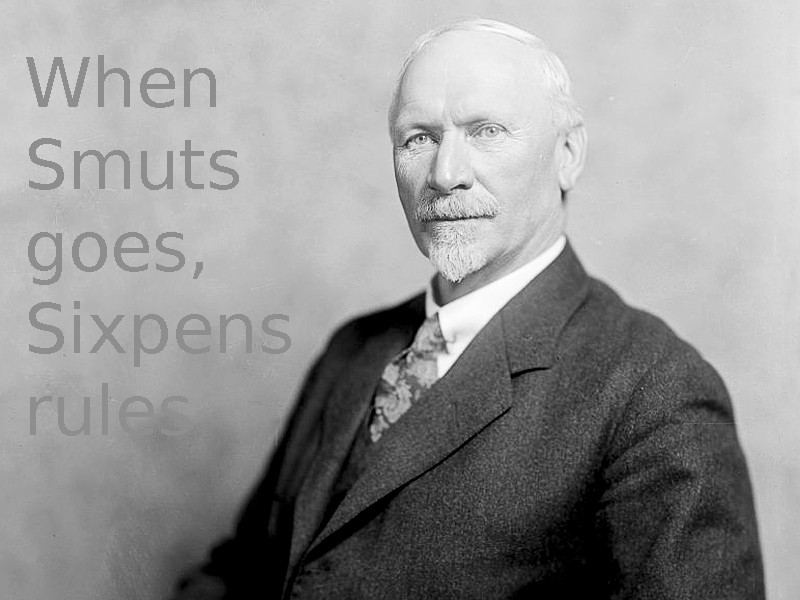
Says R W Johnson in his book: “In his celebrated dystopian novel written in 1947 ‘When Smuts goes: A history of South Africa from 1952 to 2010’, Arthur Keppel-Jones foresaw South Africa meeting its ruin at the hands of a primitive Zulu leader, Sixpens. There are many points of comparison between Zuma and Sixpens. Indeed, in many respects, Zuma has fulfilled the predictive vision of right-wing whites who resisted majority rule on the grounds that it would bring authoritarianism, corruption and incompetence sufficient to ruin the country. The surprise is how quickly the ANC in power regressed to this sort of rule and, even more, how it rallied behind Zuma, defending him against any criticism.”

In light of the country’s parlous situation and the fact that the government neither listens to advice nor acts rationally, the TAU SA president urged farmers to stick to their principles and to unify. A line must now be drawn in the sand. Farmers must declare that they did not steal land from anyone; they will not accept government propaganda without question; they will refuse to be drawn into participating in failed and failing government projects; and they will continue to produce food for South Africa while paying no attention to government’s socialist rhetoric. In a newspaper interview, Mr. Meintjies says that he doesn’t believe the government wants to get rid of commercial farmers. ”They want to control them. They want to control agriculture. If they can do that, they can control the food production, and if they control food, they control the masses”. The TAU SA president has been called a dinosaur by some critics but the dinosaurs knew what was coming.

Edmund Burke (1729 – 1797) said that ”the people never give up their liberties but under some delusion”. Why so many people of influence took so easily to ANC rule may never be explained. But Burke also said that “a state without the means of some change is without the means of its conservation”. Change may be on the way, and not a moment too soon. We must hold on until the ANC destroys itself. Perhaps then, after such trauma, the country can regenerate and realize once again its full potential.

Battle lines drawn for Gauteng Afrikaans schools

The Gauteng Education Department’s decision to change single-medium Afrikaans schools into parallel-medium schools will be challenged in the Johannesburg High Court.

The Federation of Governing Bodies of South African Schools are calling for the preservation of Afrikaans as a language of instruction.

But Gauteng Education MEC Panyaza Lesufi said he wants to address overcrowding in the province’s classrooms, which will affect over 124 schools.

Lesufi slammed resistance to the plan as “racially motivated”, because most English speakers are black.

Source: eNCA

PRAAG denounces interference by Panyaza Lesufi in Afrikaans schools as ‘linguistic genocide’

Commenting on the current conflict around Afrikaans-only schools in the Gauteng Province, Dr. Dan Roodt, leader of PRAAG, has called for seeing it in its historical context.

“Issues around culture, language, identity and education go to the heart of the South African problem,” Roodt said. “Throughout the nineteenth century, Britain tried to suppress Dutch and/or Afrikaans. It was only in the Boer republics and especially in the Transvaal that Afrikaners first attained the right to their own language and culture. This was followed by the genocidal war waged by Britain against Afrikaner women and children in 1900, which included Milner’s attempt at anglicising Afrikaner children in the concentration camps, to turn them into ‘Englishmen of the future’. After 1910 and especially after 1925 Afrikaans enjoyed official recognition and one saw the flowering of Afrikaans schools and universities.”

PRAAG is highly concerned about the current conditions of “near-genocidal levels of violence directed against Afrikaner farmers, but also against the Afrikaner minority in cities”. The organisation directs attention to the underlying Marxist, centralist and violent culture of the ANC and the South African Communist Party that currently rule South Africa.

“We all know that Marxism during the twentieth century was mostly synonymous with genocide, in dozens of countries. Not only does the ANC and its Communist partner not lift a finger to protect people from vicious physical attacks by members of the majority, but it has evidently set out to extirpate the Afrikaans language and culture completely by threatening to close down or fundamentally alter Afrikaans schools. Those schools represent the last vestiges of Afrikaner community life and islands of Afrikaans within an ambient anglocentric, violent and intolerant majority culture. The attack on them by Panayza Lesufi and the Gauteng Department of Education is tantamount to linguistic genocide,” said Roodt.

PRAAG has already collected more than 4 000 signatures in an online petition opposing the anglicisation of Afrikaans schools and is aiming for at least 10 000 signatures.

“The Schools Act does not provide enough protection for Afrikaans schools and the Constitution was so badly negotiated by the moronic NP traitors that the sections dealing with language are contradictory, if not nonsensical. We must look to the Constitution of the ZAR, as well as Act no. 10 of 1888, the South Africa Act of 1909 and International Law for a basis to argue in favour of Afrikaans-only, autonomous community schools that must not be subjected to any form of linguistic or majority-demographic pressure. On the contrary, the state should provide far more resources for the preservation and development of Afrikaans, as a minority culture under threat from the privileged majority culture, as well as two centuries of colonialist and Marxist genocide,” Roodt said.

Please support the Afrikaner struggle for survival in South Africa.

8 South African films to be screened at Cannes film festival

Music mockumentary Stone Cold Jane Austen will be one of eight South African films screening at the Cannes Film Festival later this month.

The films form part of the Marche Du Film programme which takes place from May 12 to 21, the film market business side of the Cannes Film Festival.

Writer/director Jon Savage is surprised that his film has made it onto the line-up. “It’s not a very traditional film. It’s a feature film in the style of a mockumentary. My film is going to Cannes, I’m going, too.”

Crowdfunded Stone Cold Jane Austen was shot over a three-and-half-year period and features Rob van Vuuren, Savage and Kurt Schoonraad as the only fictional characters in the story of an English rock band wanting to break into the lucrative Afrikaans rock market.

“All the Afrikaans stars from Fokofpolisiekar to Kurt Darren are in it, either as people supporting the idea, or not,” said Savage.

The film has been picked up by Nu Metro Theatre for local release on May 22.

Three of the films which will screen at the film market were produced by Cape Town production company ZenHQ Films.

Action crime thriller Dias Santana, is the country’s first South African-Angolan co-production between ZenHQ Films and Giant Sables Media Entertainment and was written and directed by Chris Roland and Maradona Dias Dos Santos.

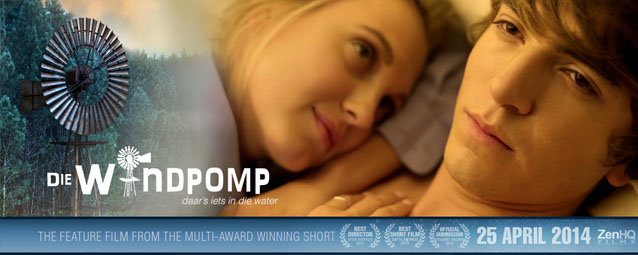
Critically acclaimed Afrikaans fantasy romance Die Windpomp and the politically incorrect action comedy Bordering on Bad Behaviour are their other two films. Die Windpomp will screen as The Windmill and is currently available online or on DVD while Bordering on Bad Behaviour is doing the international film festival rounds and will release locally later this year.

Here is the official trailer for Stone Cold Jane Austen.

Source: Cape Argus

SABC scraps Afrikaans for minority killer language

The SABC will do away with Afrikaans news bulletins on its 24 hour news channel on DStv.

Black indigenous South African language bulletins, including Zulu, Siswati, Tsonga, Xhosa, isiNdebele, Sotho and Venda will also be scrapped.

As from April 1, all bulletins will be done in English.

SABC spokesperson Kaizer Kganyago says the decision was informed by the fact that the channel has to compete with other international English language channels.

Kganyago maintains that the channel “lost viewers each time indigenous language news bulletins were aired”, but satellite competitors StarSat and OpenView HD don’t have any local news channels.

Some SABC TV news bulletins in other languages actually grab a larger slice of the audience than the flagship.

The news in isiZulu on SABC1 commands a staggering average of 3.6 million viewers, while the isiXhosa news, also on SABC1, pulls in 3.4 million people. The Afrikaans news has more than 1.5 million viewers.

The one-size-fits-all approach that South Africans are now stuck with, is really only for the benefit of the tiniest minority of English speakers, a clear indication of the killer language at work once more.

Meanwhile the wage bill of the SABC is set to soar by close to R100 million. The increase is a result of bigger board member fees, salaries and filled vacancies.

The increase comes in the wake of a strained economic climate, less advertising spending and a drop in viewers.

Why are we so ‘backward’, Allister Sparks?

Allister Sparks is one of those raving left-liberal journalists for whom nothing in South Africa will ever detract from the utopia of being ruled by the ANC and South African Communist Party. Together with his protégé, Helen Zille, current leader of South Africa’s ineffectual liberal opposition, he tirelessly calumnied Afrikaners until the hapless Mr. FW de Klerk finally capitulated to Communist Party chief Joe Slovo and his team in the early 1990s.

In 1987 Sparks made an even more sinister remark to one of his colleagues on a flight from Dakar to Johannesburg, overheard by Afrikaans journalist Chris Louw. He said: “It would have been better for South Africa if Britain had left all the Afrikaner women and children to die in the concentration camps in 1902.” It certainly evinces an extraordinary degree of anti-Afrikaans animus.

danr2The irony is that Sparks, after being fired as a columnist from his beloved Independent Group of newspapers, has now been appointed as a columnist for the Naspers group where his cultural-marxist musings will be published in… Afrikaans. Naspers seems to have a policy now that Afrikaner columnists should no longer be allowed to publish in their media as they have not embraced the new ideology as wholeheartedly as they should. Only the extremist kind of Afrikaner “askari”, such as Mad Max du Preez, will be allowed to write in the Naspers media, with the rest of us condemned to Soviet-style censorship, at least in print.

Sparks himself is somewhat amazed that the very people whom he would like to see disappear from South Africa, preferably genocided by Britain or English-speaking blacks, should accord him the courtesy of preaching to them from the hallowed pages of South Africa’s largest media group. To Sparks and many others, Afrikaans remains “the language of apartheid”, which heightens the irony. I suppose Beeld editor Adriaan Basson will have a bottle of Dettol disinfectant handy to sprinkle over Sparks’s freshly translated copy.

Writing in English recently, Allister Sparks tried to explain his strange new bedfellows by saying:

There must surely be something symbolic about a former editor of the Rand Daily Mail becoming a columnist for newspapers of Naspers (formerly Nasionale Pers), especially Die Burger, a paper so intimately associated with its first editor, DF Malan, the founding father of apartheid SA.

For that is where this, my first column of 2015, will be appearing, as well as in its sister papers, Beeld and The Witness of Pietermaritzburg.

For those who do not know, Nasionale Pers and Die Burger alone bore the torch for the Gesuiwerde Nasionale Party in the 1930s under the legendary Dr. Geyer and the cartoonist D.C. Boonzaier. Not only did the hated “Nats” capitulate, but they have also embraced the ideology of their arch-enemies, the Sappe, that Afrikaners should dissolve into a common South Africanism and accept reverse discrimination and wall-to-wall English under black rule.

No less extraordinary is the fact that I, as an Afrikaner, am censored by the same Naspers who would not even publish a letter from me, let alone a column, probably because I am still not able to acquiesce in Sap-ism, even though I quite like Jan Smuts’s philosophy of holism. The editor of Beeld, Adriaan Basson, has even blocked me on Twitter!

Buy Dan Roodt’s book on this site

According to Allister Sparks, “the differences of the past were profound and passionate, but now all that is over, having ended where the demographics of our country always indicated it was bound to end”. I a way then, “demographics” (the black population growth over the last century) has made the much-desired Afrikaner genocide superfluous, although in various ways we are experiencing extreme violence and ethnic killings in South Africa.

However, I came across another intriguing statement by Mr. Sparks, quoted by Hermann Giliomee in his volume on Afrikaner history, The Afrikaners. In that quotation from The Mind of South Africa, Sparks claims that Afrikaners or white South Africans in general represent “the simplest and most backward fragment of Western civilization in modern times”.

I am quite prepared to accept that we are backward, given the fact that we have so little to show for our presence numbering 360 years on this continent, in terms of assets or influence. A few volumes of poetry, perhaps, and a farm novel or two before our authors became politically correct. But that’s it.

On the other hand, what is the cause of this backwardness? one is tempted to ask. Is it nature or nurture? Does it have something to do with our protracted exposure to the African sun that cooked our brains or is it more hereditary, genetic in origin? Or maybe our Calvinism, which also blighted countries such as the Netherlands and Switzerland. Just look at how small those countries are: like us, the Dutch and the Swiss are real territorial losers!

Or is Mr. Sparks harking back to some late nineteenth-century British Herrenvolk idea, as formulated here and there by Rhodes and Milner? Were our forebears, the Dutch, the Germans and the French, simply not up to the high standards of the majestic island kingdom, Great Britain? It may sound sarcastic, but I am honestly just curious as to what – according to Mr. Sparks – the source of our South African backwardness could be.


Hofmeyr, Roodt vow to fight on for Afrikaans

A magistrate at the Randburg Magistrates Court, Naren Sewnarain, accepted the arguments put forward by Conrad Koch that there exists American-style freedom of speech in South Africa and everyone may insult everyone else in the grossest of manners, as well as wage open cyber war on social media. Harming your opponent in any way you see fit, apart from physically assaulting him, was given the imprimatur of the court.

According to Dr. Dan Roodt of the Pro-Afrikaans Action group said: “Although we lost the case, we succeeded in our strategic aim of safeguarding the popular Afrikaans is Groot concerts from disruption by leftist extremists over the past three weeks. That anyone would want to disrupt peaceful, non-political music concerts simply to score points in the media, shows to what extent conditions in South Africa have already degenerated into low-intensity ethnic conflict between language groups.”

The effect of the judgement, which essentially ignored the statute on harassment in favour of a vague appeal to the constitution, will be greater polarisation between groups in South Africa. Public discourse will deteriorate into invective, vituperation, calumny and other forms of what was euphemistically called “robust” speech.

In statements to the media outside the court, Dr. Dan Roodt of PRAAG said that he and Mr. Steve Hofmeyr were campaigning for a less violent and more decent society.

Evidently, decency is no longer a South African value and we may expect even greater degeneration into harmful campaigns, boycotts, race-baiting and other techniques in the cultural-Marxist arsenal.

Arguing before the magistrate, Mr. Steven Budlender, appearing for Conrad Koch, appeared to equate the previous dispensation in South Africa with Nazism, claiming that large numbers of people were wantonly killed. There was even question of it being forbidden to discuss such “facts” as it amounted to “apartheid denial”, which was akin to “Holocaust denial”.

According to both Hofmeyr and Roodt the day was “hardly a victory for free speech. Instead it was a victory for those who wish to curtail a rational and balanced debate about South African history and wish to drown it out with their hysterical exaggerations and intolerance toward dissenting viewpoints. Nonetheless we will continue to question the manufactured consent that every Afrikaner is a Nazi and that therefore our language, culture and history should simply be effaced from South Africa. We will continue to assert the right to write, sing and create in Afrikaans before our own people, regardless of how offensive a certain radical Nomenklatura might find what is after all a basic human right of all peoples and all cultures.”

BBC discovers Afrikaans is spoken in Orania!

‘We sleep with the doors unlocked. You can walk in the street at 3am without any fear’

In the sparsely populated Karoo desert in the heart of South Africa’s Northern Cape, the spirit of Afrikaner independence lives on.

I spent a few days in Orania, a town established in 1991 where no black people live.

I was part of a BBC crew, including Zimbabwean journalist Stanley Kwenda, who were accredited to visit.

And during that time, Stanley and I were the only black people in the town of 1,000 – an unusual experience in modern South Africa.

It is an Afrikaner-only town, where only Afrikaans is spoken, because of fears about “diluting culture”.

“We do not fit in easily in the new South Africa. It [Orania] was an answer to not dominating others and not being dominated by others,” says Carel Boshoff Jr, the community leader.

Mr Boshhoff inherited the town from his father Carel Boshoff Snr, an Afrikaner intellectual and son-in-law of the former South African prime minister, assassinated in 1966, Hendrik Verwoerd.

The town was founded by Mr Boshoff Snr as a registered company shortly before white-minority rule ended in the rest of the country.

Mr Verwoerd’s grandson tells me that his people were faced with a tough question about their future when the black government was elected in 1994.

“In terms of Afrikaners who had been standing very close to the state, when the policies such as black economic empowerment and affirmative action came into place, Afrikaners needed to seriously think about their future. It wouldn’t make sense not to,” he said.

Black Economic Empowerment (BEE) was introduced to encourage more black participation in business.

Orania has also proved to be the answer for those Afrikaners who felt displaced in the land their people had ruled for many decades.

“I see nothing wrong with apartheid,” says Martin Kemp, one of the older residents.

“Of course you get the petty apartheid: ‘You use this toilet I use that toilet’, I don’t think that was necessary but the real apartheid as Dr Verwoerd saw it, there was nothing wrong with it,” he said.

We were taken on a guided tour of the town’s facilities by John Strydom, a retired doctor.

The town’s leaders insist that Orania is misunderstood. “We are not against black people. We are for ourselves,” is their message.

However, black people cannot live here.

Prospective residents are screened by the town council using a strict criterion, which includes first and foremost being an ethnic Afrikaner.

It is not enough to simply speak Afrikaans, as is the case with many black and mixed-race South Africans.

Eerie place

As we sat down with Mr Boshoff for a cup of what the cafe described as “proper Boere [Afrikaner] tea… strong”, I took in some of the surroundings.

Near the entrance of the gated community was a statue of Mr Verwoerd, one of a few of the apartheid-era prime ministers, and the Orania flag – with similar colours to the old republic’s orange, white and blue horizontal stripes – which hung proudly.

The town was quiet; the sound of birds and rustling leaves interrupted by a few cars passing by. It is an eerie place for an outsider.

  • Afrikaners are descendants of Dutch, German and French settlers who arrived in the 17th Century
  • The Dutch, who arrived in 1652, took over land from local people and put them to work as farm workers
  • Afrikaners dominated South Africa for many decades and introduced the apartheid system which was based on racial segregation
  • Orania was established in 1991, by Afrikaner intellectual Carel Boshoff Snr
  • The town is built on 8,000 hectares of farmland along the Orange River

The town boasts amenities such as shops, hair salons, a library, a post office, a hotel, a couple of schools – and churches, a lot of churches.

But beneath the surface of this solitude lurks a fear that leads people to abandon high-paying jobs in the city for lowly jobs in this arid land.

“The levels of crime and violent crimes in South Africa are definitely pushing powers that bring people to Orania. Many of them have been victims of crimes,” says Mr Boshoff.

South Africa is considered to be one of the most violent societies in the world, with one of the highest murder rates.

Official statistics suggest that most crimes actually happen in poor communities between people known to each other, but this has not stopped the fear of crime in other communities.

‘Little giant’

As a result, Orania officials say the town has had an annual growth rate of nearly 10% since its inception.

The Afrikaner community’s totem is the “the little giant”, a man with rolled-up sleeves who features in the flag and the local money, the Ora which is pegged to the South African rand.

The people do their own work from gardening to plumbing, bricklaying and waste-collection – jobs usually done by black labourers in the rest of the country.

“We sleep with the doors unlocked. You can walk in the street at 3am without any fear” – Quinton Diedrichs Bar owner

“It takes some adjusting to. It is more difficult for some people because they are used to how things were done in South Africa, they are not used to manual labour,” says Mr Strydom.

The locals explain that one of the goals in Orania is to help create a generation of pure Afrikaners untouched by the “outside world”.

Bizarrely, the town’s existence is protected by South Africa’s constitution through a clause that ensures the right to self-determination – introduced to reassure those worried about the transition to democracy.

With its old Cape-Dutch styled houses it is like stepping back in time, but some families fear this place could eventually be too small for their children.

‘Respect’

George van Staden moved from Johannesburg recently after he was offered a job in Orania.

Mr Van Staden says his two children are enjoying life in the countryside but he and his wife are preparing them for a world where there is not just one race or culture.

“There is no tertiary institution here for example. They need to be equipped to handle the outside world,” says Mr Van Staden.

“I teach them that there is no difference in skin colour. I teach them if they respect the people in Orania they must also respect the people outside Orania,” his wife Tisha adds.

Another couple, Theunie and Annelize Kruger, say they are still adjusting to Orania’s rules, which include getting permission from the town council before receiving visitors.

“We understand it but it’s a bit frustrating at times,” Mr Kruger says.

‘Defend with our lives’

At the local bar, framed newspaper articles hang on the wall and Afrikaner memorabilia adorns the place.

The owner, Quintin Diedericks, is well-travelled but became disillusioned with South Africa and moved to Orania with his wife, a beauty therapist, about four years ago.

“It’s very safe here. We sleep with the doors unlocked. You can walk in the street at 3am without any fear. You don’t have that where you live,” he tells me.

He blames FW de Klerk, the last Afrikaner to rule South Africa, for the plight of his people.

“We can’t get jobs. It’s like we are being punished for the past” – Drinker in an Orania bar

“He gave away the country for nothing. We had the army,” he says and stops abruptly, beginning to shake his head.

Inside the dimly-lit pub, a game of rugby is on the TV, apart from a few odd glances, no-one seems to pay much attention to Stanley or me.

A few more locals do come over to our table and conversation is polite and largely politically correct, much like in the rest of South Africa.

The pernicious issue of jobs and pro-black policies rears its head.

One local explains it as “reverse racism”.

“We can’t get jobs. It’s like we are being punished for the past,” he says.

They seem oblivious to the oppression of black South Africans during apartheid. For them it was a system that gave order.

“It [apartheid] didn’t affect me. So many people get aggravated now for things they didn’t even witness. It’s over, move on,” says Yolandie Jonk, 29, a call centre agent.

As the sun sets, the bronze busts of Afrikaner leaders spanning over many decades – Paul Kruger, JBM Herzog, DF Malan, JG Stridom and, of course, Mr Verwoerd – look protectively over the town.

Held in disdain elsewhere, they are Orania’s heroes – yet it is difficult to see how the community will be able to remain so completely isolated in such an inter-connected world.

But as one pub drinker put it – being an Afrikaner in Orania is “something we will defend with our lives if we need to”. – By Pumza Fihlani, BBC News, Orania

You can hear a BBC World Service programme about Orania on Tuesday 7 October .

Excerpt from ‘Raiders of the lost Empire’ by Dan Roodt

The English proclivity for drink, getting drunk, even the pub culture, has taken root in South Africa.

From Vanuatu ‘our’ flag and penchant for imitation

South Africa, especially these days, is trying to decide whether we should emulate Idi Amin’s Uganda or some cargo cult on the island of Vanuatu. You could call the system here a “cargo-cult democracy” and as long as we spend about a billion dollars or so every five years on an election, in between elections it’s anything goes. Anarchy, or close to it.

Raidersblad2However, elections only serve to give the imprimatur of “democracy” to a system in which power changes hands elsewhere: in the ruling party’s headquarters or in dark deals cut with whomever benefits from the system financially.

Speaking of Vanuatu, I first became aware of the existence of this island in the early nineties when I noticed the remarkable resemblance between “our” flag and that of Vanuatu. If there were such a thing as plagiarism in flags, South Africa would be guilty of it. Yet, South Africanness, at least after the decline of Afrikaner influence, is proudly imitatory. The closer one gets in passing oneself off as British, the more “South African” one becomes. Plagiarism at university, at both under- and postgraduate level, is absolutely rife as students “copy and paste” the words and thoughts of others in order to obtain one of our increasingly worthless degrees.

Buy this book in printed or ebook form and pay via PayPal, credit card or other means in our Ebook shop.

In other societies a lack of authenticity, or ersatz, showing no originality, or being a copy of something else, a simulacrum, is frowned upon. Not so in South Africa. It is part of “our” colonial heritage. Paradoxically, those revolutionary blacks who fulminate against “colonialism and capitalist exploitation” are the first to adopt the outward trappings of what they imagine a British gentleman to be. They play golf and drive expensive cars. They also drink whisky, of the expensive so-called “single malt” kind, in copious amounts. The English proclivity for drink, getting drunk, even the pub culture, has taken root in South Africa. In fact, in its aspiration to become more and more English, the country has produced the second-biggest beer company in the world, SABMiller. This is a remarkable feat, given that our GDP is only about an eighth of that of Germany, another beer-drinking nation, who was no rival to us in the beer business. As we shall see, beer and being “a nation of one beer” is fundamental to what is called the “new South African identity”.

The English and American taste for drugs has also been adopted. The other day my 18-year old daughter visited the campus of the University of the Witwatersrand and spoke to some first-year students there. (Despite its Afrikaans name, “Wits”, as it is colloquially known, is a decidedly English institution.) According to her, all they could talk about was drugs, what different narcotics they had already tried and what others they still intended to experiment with. With her Afrikaans upbringing and schooling, my daughter takes a keen interest in literature, art and philosophy, and was looking forward to an intellectual exchange with people who may have different perspectives to hers. Yet, alas, all they could talk about was drugs. There is a kind of snobbery around drugs and the English look down upon others who do not use narcotics. I strongly suspect that a lot of the opinions that we encounter in English newspapers or in the media in South Africa, were also concocted while on some form of stupefying substance. The French word for drugs, stupéfiants, expresses it very succinctly, for in the act of drugging oneself one also succumbs to stupor or becomes stupid. South Africa has plumbed such levels of stupidity over the last few years that we are regressing back to primitive, early Stone Age, or even hominid levels. Very soon South African English, which is already considerably creolised and ugly, will consist of screeches and grunts. Like the vuvuzela, a monotonous plastic instrument habitually blown at soccer matches, all communication will eventually descend to a very basic level.

There is something tragic about English consciousness, which is fundamentally unhappy, hence the need to be drugged, inebriated or numbed. Perhaps this has some connection with the global multicultural project, which aspires to the destruction of all identity, including personal identity. Only when we achieve an undifferentiated herd consciousness, an atavistic “we”, are we to become “fully human” or whatever cliché it may be called. In South Africa’s business schools, they even teach courses in “ubuntu” as an ethical principle which translates into “I am a person through others”, another way of expressing the longing for a collective, hive consciousness.

Today in South Africa, it is part of the English creed that we should in no way be “divided”. This is almost a world-wide Anglo-Saxon principle. All progress towards becoming an undifferentiated human mass, a bit like the science-fiction concept of “the Borg” in the American Star Trek series, is applauded. Anyone relinquishing his language and culture in favour of English is seen as having taken a step towards becoming part of the “greater mass” which may even be seen as a global or planetary mass.

Being English in South Africa, and not quite British (yet), is a very painful experience. Like the person who does not quite pass his matric or does not quite make the team, he is forever devoured by “what could have been”. This explains the radicalism, hatred and extremism of many English people who have committed terrorism or espoused communism or Boerehaat (hatred of the Boers) as their motto and been prepared to kill or attack civilians in the name thereof. Why is South Africa so alien to the English mind? one may ask. Of course, there is the ordinary anglophone South African, not part of the academic, media or political elite, and who is probably not seething with Boerehaat and Marxist ideals. But he or she hardly plays any role in defining what it means to be English in South Africa.

At the risk of digressing somewhat, let us look for a moment at what George Orwell had to say about being English. Among Afrikaners, the French, Germans, Spanish and many other nations, reflecting on one’s national identity, style and character is done almost naturally. To Afrikaners, it is even more, a national obsession. The reason for the Afrikaner obsession with identity is not hard to find: it is because we have been forced to share a country with a peculiarly nihilistic, overbearing, colonialist group that is so destructive of identity and culture that we have had to constantly question ourselves.

Why do they hate us so much? Why do they want to prohibit our language, traditions and customs? Is there indeed something wrong with us? The Afrikaner, being given to guilt-ridden, Calvinist introspection and self-doubt, is always trying to locate the problem within himself instead of looking at his hostile, sneering compatriot and his pathological intolerance to any other culture besides his own. In fact, although thousands of novels, essays and theses have been written about what it means to be an Afrikaner, no Afrikaner has ever tried to understand the Englishman. I could have written this essay in Afrikaans, but probably people will only agree with what I have to say and it will not be seen for the unique piece of analysis that it is, an attempt to find out what it means to be English today, in South Africa, but perhaps even globally. I strongly suspect that much of what we experience here, is also felt by people in other non-English countries. The recent essays of Richard Millet (2012) on the decline of French literature in favour of global Anglo-Saxon bestsellers, come to mind.

George Orwell is normally associated with his two dystopian novels, 1984 and Animal Farm. However, he was also one of the few English authors who ventured to reflect on what it means to be English, in his essay “England your England”. Among other things, he has this to say:

“Here are a couple of generalizations about England that would be accepted by almost all observers. One is that the English are not gifted artistically. They are not as musical as the Germans or Italians, painting and sculpture have never flourished in England as they have in France. Another is that, as Europeans go, the English are not intellectual. They have a horror of abstract thought, they feel no need for any philosophy or systematic ‘world-view’. Nor is this because they are ‘practical’, as they are so fond of claiming for themselves. One has only to look at their methods of town planning and water supply, their obstinate clinging to everything that is out of date and a nuisance, a spelling system that defies analysis, and a system of weights and measures that is intelligible only to the compilers of arithmetic books, to see how little they care about mere efficiency. But they have a certain power of acting without taking thought. Their world-famed hypocrisy – their double-faced attitude towards the Empire, for instance – is bound up with this.” (Orwell 1946)

There is a kind of cliché that one may often find in Afrikaans newspapers and uttered by know-it-all Afrikaner academics: that “the Afrikaner feels inferior to the Englishman”. Of course, being an Afrikaner academic today means that you have actually accepted, not only the Anglo-American world-view, but also the ANC and Communist Party’s way of thinking, otherwise you would not have a job! So such opinions do not carry much weight. Here I am merely signalling that such a notion exists.

However, I have come across very few Afrikaners who actually feel that way, or who see themselves as inferior. Most of the time, it is the opposite. As Afrikaners dominate the English in most English sports and games that they actually play, there is rather a complacency in the Afrikaner mind that he is physically and mentally superior to the Englishman. The idea that the English are lazy and tend to concentrate on activities that are both lucrative and require little effort, is also widespread. As a farmer once explained to me, in the English-speaking province of Natal (now officially Kwazulu-Natal) sugar plantations became popular as the cane plant “grows like a weed and does not need any special attention, unlike most other agricultural crops”.

On the other hand, I would say that the liberal or communist Afrikaner has interiorised a sense of inferiority. That is because many of them have actually been to some extent anglicised, living and working in an English world, often associated with politics or the universities, where not subscribing to English stereotypes of Afrikaners would be detrimental to their careers. Frederik van Zyl Slabbert, the liberal politician, as well as author André Brink are two such people. Brink has even gone so far as to proclaim that “my people do not deserve to exist and should disappear”, thereby fully embracing Anglo-Saxon ideology. Bram Fischer, the communist leader who lived in Johannesburg, surrounded by mostly internationalist communists, is another case in point.

Regarding Orwell’s observations above, the lack of artistic talent among the English, especially out here in the colonies, is highly evident. Even people without any artistic training or talent, such as William Kentridge, to name but one, are eulogized as great artists by the English media. Wherever there is artistic endeavour in South Africa, there have always been Afrikaners. Even the Nobel prizewinner, Nadine Gordimer, was first introduced to writing and literature by an Afrikaner, Uys Krige.

This is the first cause of anglophone animosity towards Afrikaans and Afrikaners. One of the first things that the new English administration did after 1994, was to destroy all cultural institutions created by Afrikaners, such as the provincial arts councils, after which Afrikaans schools and universities were attacked. Recently, the minister of higher education and leader of the South African Communist Party, Blade Nzimande, announced that “there were no longer any Afrikaans universities”, by which he meant that the anglicisation process had been completed.

In many respects, white English people and blacks share a common rancour towards Afrikaners. “Why do you think you are so special, with your own culture?” they often ask. Having a culture and language of one’s own, a strong identity, is taboo and one should join the Borg. But underlying all of this is also envy and jealousy. There will never be another Voortrekker Monument in South Africa, or the Afrikaans Language Monument at Paarl. Until recently, ninety percent of all monuments in South Africa had been erected by Afrikaners! The efforts expended by Afrikaners in commemorating their history or in maintaining their language are seen as daunting, even intimidating. There is something “unnatural” or “fascistic” in wanting to construct one’s own culture and tradition when you could be out there on the golf course, or drinking in the pub and making jokes.

Recently, the English principal of the University of Pretoria decided to ban the study of European philosophy at that institution, ostensibly as it was suspected of leading to “racism”. Studying Kant, Descartes, Bergson, Nietzsche or Heidegger was not politically correct when one could peruse American feminism, multiculturalism, gender studies, black studies, as well as Anglo-American language philosophy. Not so long ago, a female member of staff with an interest in Nietzsche wrote an article critical of feminism on a website and she was immediately threatened with disciplinary action and eventually hounded out of the university. English “tolerance” has its limits! But the suspicion that in the dark corners of European thought, especially as read by Afrikaners, could lurk ideas challenging the Afro-Saxon and Anglo-Saxon hegemony in South Africa, led to this Soviet-style ban on Continental philosophy.

So the great European philosophers have been reduced to silence in South Africa, in our “becoming English”. But some of our English are even calling for the silence of the white race itself. A few years ago, an English professor of philosophy at Rhodes University, Samantha Vice (2010), caused a stir when she argued that whites or people of European descent should remain completely silent in relation to a black government. Even where that government engaged in corruption, mismanagement, cronyism, nepotism and abuse of power, we had “no moral right to criticise”. That must certainly be the height of English political correctness. Her essay was aptly entitled, “How Do I Live in This Strange Place?” What is even more odd, is that the title was derived from an Afrikaans song from an album by Bernoldus Niemand, but as Vice opines: “While I am not an Afrikaner and so have escaped the taint that identity brings with it, I am a white South African, undeniably a product of the Apartheid system and undeniably still benefiting from it.

While Vice wallows in her white guilt, aided by the American concept of “whiteness”, she cannot help but add as an aside that Afrikaner identity is “tainted”. But at least she refers to an Afrikaans song, just like many English people are irritated by the majestic sight of the Voortrekker Monument to the left of the highway as one enters Pretoria from Johannesburg. Some years ago, another would-be British movie critic and man-about-town, Barry Ronge, said that the Voortrekker Monument should be painted pink and turned into a gay disco, which expressed his particular appreciation for Afrikaans culture. He also repeated various anti-Afrikaans slurs such as “rock spider” and “rocks”, which led to complaints from no fewer than 26 Afrikaans organisations to the South African Broadcasting Complaints Commission (1999):

“Barry Ronge: ‘I have always looked at that old stupid monument to the past, called Voortrekkermonument and have decided that the only sensible thing to be done with is to paint it pink and turn it into an enormous gay disco at which they can have drug crazed raves. Now that would be exactly what it deserves. (instemmende gelag) They are not going to do that, BUT they’re going to make it rock. Now how the rocks (rocks =rock spiders, rock heads =neerhalende term vir Afrikaner, Boere) that built it will feel about it (lag van plesier) a rock concert being held at the Voortrekkermonument a du du … but the people that are doing that very thing are with me in the studio, Graham Scott who is the guy who came up with this idea and Claire Johnston who is going to be there Mango Grooving her way through the first ever rock concert at the Voortrekkermonument – amazing stuff, your wicked mind mister.’”

Needless to say, the Commission found Ronge’s comments to fall entirely within the ambit of free speech, whereas the opposite would have been the case if any Afrikaner had had to have insulted an English monument, let alone a black English one.

According to Orwell then, lack of artistic talent and suspicion towards ideology, or at least attempts to systematize one’s understanding of a culture or discipline, are two characteristics of the English. The third one, hypocrisy, or what he politely calls “the power of acting without taking thought”, we also have experience of. Whereas throughout our history, Afrikaners have mostly had to deal with blacks directly on farms or in the state administration, the Englishman has kept himself aloof, residing in all-white suburbs but at the same time fulminating about “racism”. This is a common complaint also levelled at liberal journalists and academics in the United States, that something like 96% of them live in majority-white neighbourhoods, send their children to majority-white schools, and so on. These same people will then intone endless jeremiads about “the lack of integration” and “rising inequality”. Most English people in the South African government, black or white, actually send their children to private schools, use private healthcare, apart from staying in the “formerly white suburbs”. It would be too much to expect of them that they should practise their anti-racism and move to Soweto or Diepsloot, places whose “vibrancy” and “warmth” they praise in articles and books.

Even on a personal level, one must be aware that English people rarely speak their minds and would falsely bring you under the impression that they agree with you. Only later would you find out that you have actually made a tremendous mistake and it was all a ruse. During the twentieth century, Afrikaners have not only suffered a devastating betrayal by their own leaders, but also by the entire Anglo-Saxon Empire. Here and there a figure like Ronald Reagan or Margaret Thatcher stands out, but for the most part it was one betrayal after the other, by the local and the overseas English. Many of our forebears had fought on the Allied side during the two world wars and in Korea, but eventually we were simply thrown to the dogs! That includes the patriotic English South Africans and Rhodesians. Ian Smith, the former leader of Rhodesia and an RAF fighter pilot who nearly died several times during World War II, suffered the same fate. It is simply mind-boggling that Anglo-Saxons can betray not only their friends but even their own people for the sake of currying favour with the likes of Robert Mugabe or the devious little East European communist, Joe Slovo, a former leader of the South African Communist Party.

There seems to be a fundamental duplicity at work in English thought and culture that is having devastating effects on the world. Some honest Americans feel the same way about their country and what it is doing to the planet. Paul Craig Roberts (2014)recently said the following about Washington:

“The fraud perpetuated on the world by the United States in the 21st century is extraordinary. Nothing comparable has ever been witnessed in history. Not only are there the frauds of the numerous wars (Afghanistan, Iraq, Somalia, Iraq, Syria, Ukraine, almost Iran and Washington’s illegal military actions within the borders of Pakistan and Yemen), but also the vast financial frauds perpetuated on the world. Among the costs of Wall Street’s frauds are the European debt crisis, the infringements of national sovereignty of European countries by the IMF bailouts of sovereign debt, and the impoverishment of ‘rescued’ Greece, Italy, Spain, Portugal, and Ireland, along with Eastern Europe.”

Often have I wondered: Do the Anglo-Saxons have no principles? It is fine to quote Lord Palmerston, “England has no eternal friends, England has no perpetual enemies, England has only eternal and perpetual interests”, but did our local English and the wider Anglo-Saxon world really serve their interests in betraying South Africa, which will in the long run lead to Chinese domination in South Africa, as well as in the rest of Africa? Perhaps due to their hostility towards systematic thought, they “act without thinking” in a piecemeal fashion.

Buy this book in printed or ebook form and pay via PayPal, credit card or other means in our Ebook shop.