Opinion: South Africa is sleepwalking into disaster

The worm has turned and virtually every South African political commentator whose legacy was to encourage a one man one vote ANC takeover in South Africa is now tearing into the government and its alliance partners. The country is on its economic knees and those in charge seem blithely unaware of the destruction they have wrought and are still wreaking, or else they couldn’t care less. What is surprising is that people are surprised. Why would ANC cadres not do what they are doing, given who they are and whence they came? A leopard never changes its spots.

In his startling and brutally critical book “How long will South Africa survive? The Looming Crisis”, former ANC supporter and self-described ex Marxist R.W. Johnson explains how effortlessly the ANC government has slipped into the lifestyle of so many other African ruling cliques, but with more to plunder and destroy. He has put to bed any notions that the ANC may still have something up its sleeve and the country will come right after all. The book should be required reading for all thinking South Africans.

TAU SA has watched the slide with the somber knowledge that it was inevitable. Warning after warning has been issued, to little avail. Agriculture was one of the first victims of government’s ludicrous socialistic policies (there are currently 16 pieces of legislation on the table designed to hobble SA’s commercial agriculture) but the country at large appeared disaffected because it wasn’t happening to other segments of society. It was only a matter of time before the other shoe dropped: affirmative action hit all levels of the country’s civil service; Black Economic Empowerment (BEE) has affected virtually all manufacturing and commercial enterprises; attempts to nationalize the mining industry (some of which endeavors became a reality) sent investors running for the hills; and the prohibition on foreign property ownership caused uncertainty across the board and businesses started moving their head offices overseas, while others sent out cash in an upsurge of foreign purchases. This economic shambles has sent even the most optimistic believers into a tailspin.

GWEDE MANTASHE

A particular object of resentment in business and agricultural circles is ANC Secretary General Gwede Mantashe. He is not an elected public representative yet his pronouncements and actions are directed at all and sundry, as if he were president. In a letter to Mantashe (to which there was no reply), TAUSA president Louis Meintjies asked Mantashe what gave him the right to organize a recent conference on Afrikaans and other matters which resulted in a shambles and where not even an agenda had been drawn up? Despite the country’s disarray in virtually every sector, Mantashe chose to emphasize the Freedom Charter over the constitution as the country’s first reference for governing. Meintjies put it to Mantashe that it is the SA Communist Party that is controlling the government, and emphasized that because of TAU SA’s close contact with Georgia in the Caucasus, “that country is presently licking its economic wounds after what it suffered under Soviet Communist rule”. Clearly these comments are like water off a duck’s back as far as Mantashe and others in the ruling clique are concerned.

Mantashe talks with forked tongue. Wrote Meintjies: “On the one hand you mentioned at the conference that you need farmers as agriculture is a key industry. Shortly thereafter you threaten us with land grabs and illegal land occupation. Are you creating a climate for further violence and unrest in the country and is it your hidden agenda that farmers must be driven from their farms? You are busy creating the right climate for this”.

Shortly afterwards, a KwaZulu/Natal farmer and his family were forced to flee for their lives when 400 neighboring squatters invaded his farm and killed his cattle. The farm was conservatively valued at R12 million and the destroyed cattle at R3 million. The farmer declared that if his farm was suitably ploughed and if he were left alone to plant pineapples, the property’s value would increase to R50 million. (Twenty five years ago, Zimbabwe’s land nationalization plan was unveiled where 5 million hectares of land was grabbed by the government and compensated for a fraction of its real value. Now Zimbabwe imports maize while the populace scratches in the dust for food.)

PANIC

Panic is creeping into the writings of commentators and newspaper editors about the country’s economic malaise and the ANC/SACP alliance’s bull-headedness and inability to acknowledge the dire consequences of their policies. A Business Day editorial (29.7.15) declares that the ANC is “sleepwalking into disaster” and points out the damage caused to the mining industry and the economy at large by the government. Strong words unheard of during Mandela’s rule are now being bandied about with impunity: “mulishness” is used to describe the ANC’s mindset over their introduction of travel restrictions now hurting the hospitality industry. They have a “Stalinist worldview” says another editor, while former Business Day editor Peter Bruce uses words like “drivel”, “pseudo Marxist claptrap” and “deranged” to describe various policies of the ruling clique. It’s a bit late for this type of vituperation from people of influence, many of whom lauded the coming to power of the ANC and who initially turned a blind eye to their corruption, incompetence and other sins in order to give the impression that “democracy” was flourishing in South Africa. At the same time, many lambasted those who warned of the perils of an ANC government as dinosaurs, rightwing fanatics and even Nazis!

Huge layoffs and retrenchments are planned by mining companies fed up to the back teeth with destructive government policies, strikes and union demands. Yet government cadres continue to threaten the mining industry. One of the world’s biggest mining groups Glencore has just had its licence suspended, with minister of Mineral Resources Ngoako Ramatlhodi deploring Glencore for creating “inhumane” job losses!

All along those in government have never viewed capitalism as a creator of jobs but rather as a supplier of jobs. Mining, manufacturing, agriculture –all of them are the ANC’s playthings, to be manipulated to fit their socialist agenda. These people have no idea of what drives an economy, and despite the abysmal failure of socialism and communism, they believe that somehow these failures can be turned into successes by declaring this to be so! Rhetoric beats logic every time.

Why this ANC behavior has suddenly shocked people whose forefathers have lived for centuries in Africa is a mystery. A perfect storm is brewing. R.W. Johnson predicts a possible implosion of SA’s economy where the government may have to go cap in hand to the International Monetary Fund (IMF) or the World Bank. But with these two organizations there’s no free lunch. Their funds are not as loose as the SA taxpayers’ money, to be spent willy nilly with no accountability. Foreign loans mean conditions, two of which will surely be a demand to cut the salaries of the bloated SA civil service, and the other will be instructions to prune welfare payments now distributed to more than 15 million recipients. Currently public sector pay is rising 7% translating into an 11,5% increase for the average worker when benefits are included. This three year wage deal will cost an extra R66 bn. Will the economy survive long enough for this increase to be met, or will the IMF pull the plug on it? What then for the ANC?

These recipient groups may turn on the ANC and the organization could disintegrate into infighting between factions trying to retain their places at the trough. Unemployment could soar to Zimbabwean levels , and millions could roam the streets looking for food. It’s not an unrealistic scenario. (In South Africa, the number of workers in agriculture fell 31% to 670 000 in 2014 from 969 000 in 2001. The current unofficial unemployment level is estimated to be 40%.)

SIXPENS

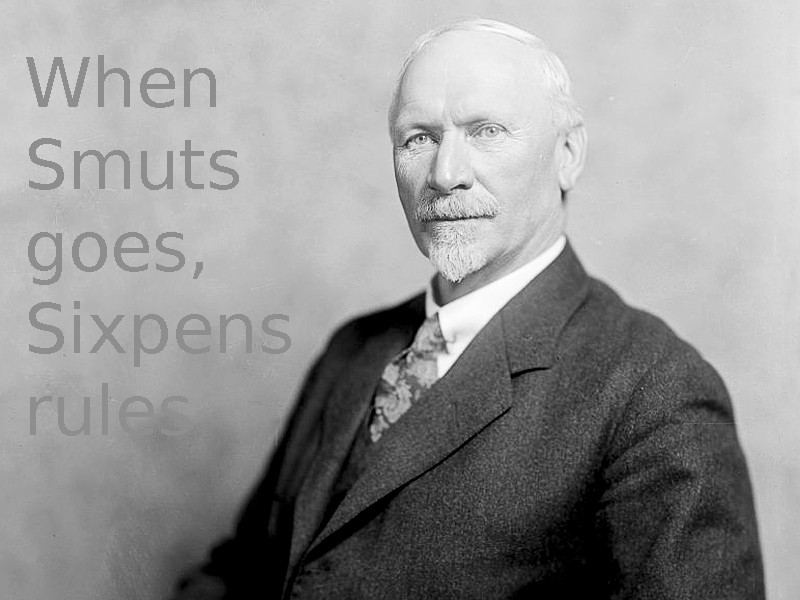
Says R W Johnson in his book: “In his celebrated dystopian novel written in 1947 ‘When Smuts goes: A history of South Africa from 1952 to 2010’, Arthur Keppel-Jones foresaw South Africa meeting its ruin at the hands of a primitive Zulu leader, Sixpens. There are many points of comparison between Zuma and Sixpens. Indeed, in many respects, Zuma has fulfilled the predictive vision of right-wing whites who resisted majority rule on the grounds that it would bring authoritarianism, corruption and incompetence sufficient to ruin the country. The surprise is how quickly the ANC in power regressed to this sort of rule and, even more, how it rallied behind Zuma, defending him against any criticism.”

In light of the country’s parlous situation and the fact that the government neither listens to advice nor acts rationally, the TAU SA president urged farmers to stick to their principles and to unify. A line must now be drawn in the sand. Farmers must declare that they did not steal land from anyone; they will not accept government propaganda without question; they will refuse to be drawn into participating in failed and failing government projects; and they will continue to produce food for South Africa while paying no attention to government’s socialist rhetoric. In a newspaper interview, Mr. Meintjies says that he doesn’t believe the government wants to get rid of commercial farmers. ”They want to control them. They want to control agriculture. If they can do that, they can control the food production, and if they control food, they control the masses”. The TAU SA president has been called a dinosaur by some critics but the dinosaurs knew what was coming.

Edmund Burke (1729 – 1797) said that ”the people never give up their liberties but under some delusion”. Why so many people of influence took so easily to ANC rule may never be explained. But Burke also said that “a state without the means of some change is without the means of its conservation”. Change may be on the way, and not a moment too soon. We must hold on until the ANC destroys itself. Perhaps then, after such trauma, the country can regenerate and realize once again its full potential.

Beware the Stockholm syndrome

Cyril and Roelf, laughing

by TAU Bulletin

“Adjusting” to the ANC and the consequences thereof.

Stockholm Syndrome: This syndrome refers to a group of psychological symptoms that occur in some persons or groups in a captive or hostage situation. It is sometimes referred to as a Survival  Identification Syndrome.

In early June of this year, a meeting was held between Afrikaner groups and the ANC. A former National Party minister Mr. Roelf Meyer facilitated the meeting which was attended, inter alia, by some commercial farmers and was designed to discuss the government’s land reform policy. In press pictures, Mr. Meyer was seen laughing and joking with ANC bigwigs including Mr. Gwede Mantashe, secretary general of the ANC, but it was the ANC which was laughing all the way to the bank. TAU SA’s public statement at the time explained why it would not attend – numerous TAU SA requests to see the country’s president, the Minister of Water Affairs and the Ministers of Transport and the Police were systematically ignored. All efforts to get appointments were fruitless.

So what was to be discussed under the sponsorship of Mr. Meyer? If the government is not prepared to meet representatives of organized agriculture, it can only be assumed the Meyer meeting was a public relations exercise for the ANC, with the hapless attendees along for the ride.

There is a growing trend in South Africa, particularly within the Afrikaans press and other organizations, that reconciliation (from one side only of course), a healthy guilt complex  and “live and let live” with the government is the way forward. Attitudes within the English language press seem to have hardened, although there are still sycophants who urge us not to be pessimistic:  that “false alarmism” is wrong.

But the University of Pretoria’s politics lecturer  Mzukisi Qobo says we must “face the truth”. (Business Day  29.6.2012).  He says “peddlers of good news” are trying to convince us that things are not so bad. “Anyone who dares point to the reality of a creaking public service or worsening leadership is likely to be reminded that there are many good stories happening elsewhere in the country”. They point to Zimbabwe, Nigeria and Iraq as being worse than South Africa.

“There is nothing as dangerous as unguarded optimism” says Qobo. “It is a convenient refuge for those who find reality too discomfiting and want to be left alone to wallow in their apathy. They think that to be discontented is a bad thing when in fact it is the absence of meaning and too much comfort in the face of crisis that gives succor to bad leadership. What our optimists don’t realize is that they are fostering idle indifference.  Action is a progeny of discontent.  It is when we are deeply dissatisfied with a political framework which lowers the benchmark for success and excellence that we are most likely to take action and insist on meaningful change.”

Mr. Qobo’s words should cause those who are succumbing to a group version of the Stockholm Syndrome to take stock of themselves. Now that we are enslaved by the ANC, let’s make the best of it. Let’s sit down and chat and try and get them to be “reasonable”.  After all, it’s all we’ve got left. They run the country, they have the power and if we’re nice to them, maybe they’ll leave us alone! For the sake of peace and quiet, we can overlook the ANC’s bad governance, its corruption, its venal theft and plunder of the country’s assets, its corrosive indifference to the needs of the people, its dismissive contempt of criticism and its wholesale destruction of a country that took 350 years of hard work to build. Let’s all be friends, even if the ANC treats us with disdain. They are our captors, but so what? We can’t do anything about it so let’s just get on with it and stop complaining!

Mr. Qobo quotes US admiral Jim Stockdale who survived torture in captivity during the Vietnam war.  He didn’t try and escape from reality by invoking a false sense of optimism. This “cripples human agency by leaving everything to fate”. Stockdale’s counsel is that “you must never confuse faith that you will prevail in the end… with the discipline to confront the most brutal facts of your current reality”. How many times have we heard that “it has to get worse before it will get better!”  Who says it will get better?

At the same time

At the Meyer group’s convivial get-together, the ANC’s Gwede Mantashe assured the meeting that land reform without compensation wasn’t the policy of the ANC. Soon after, at the ANC Midrand policy conference, delegates passed a motion where the “willing seller, willing buyer” principle regarding agricultural property ownership, was rejected.  In mid April, TAU SA’s legal representatives told the Equality Court in Johannesburg that it is more dangerous being a farmer in South Africa than being a member of the police. This evidence was proffered in the case against the ANC and its Youth League’s Julius Malema on the hate speech issue. The song “Shoot the Farmer” has been widely sung at ANC rallies, with no comment from the ANC’s hierarchy and no strong objections from others in civil society who should have been shouting from the rooftops about this exhortation to kill!

During the ANC’s centenary celebrations in KwaZulu/Natal in April and May of this year, President Jacob Zuma sang (in Zulu)  – “We will kill them with a canon (gun); They will flee, shoot them;  You are a Boer, we will kill you;  You will be killed, you will flee”.

(During this period, blacks occupied a farm in Komatipoort and ordered the farmer to leave. The levels of aggression displayed by the crowd were similar to the same type of behavior exhibited by land invaders in Zimbabwe.)

It was AFTER the President’s outburst that Mr. Meyer organized the meeting with the ANC. Did Mr. Meyer complain to the ANC about these obvious crimes, urging people to kill the farmers? Or is this to be cast aside in order to” get along” with the ANC and the President?

The government’s Green Paper on land reform and its Draft Land Tenure Security Bill have caused shockwaves not only within the farming community but throughout the country. Why bother talking to the ANC when they are at the same time undermining commercial agriculture? (Has Mr. Meyer read through these destructive Bills?)   At virtually the same time as Mr. Meyer’s affable June 6 meeting with the ANC, TAU SA declared in a press release that ANC Youth League threats to occupy farms and put farmers’ safety in jeopardy was being taken very seriously. “Is it meaningful to stay involved with government forums?” asked TAU SA. “We are being deceived and cajoled in official circles while being threatened and intimidated outside these circles.”

State president

The State President continues with his obfuscation about land ownership (the old 13% black/87% white  ownership fiction), and it’s time those who care should take action to counter this propaganda. South Africans who do not want to see their country descend into yet another African abyss should do all in their power to disseminate throughout the world the appalling failures of ANC rule. There are not enough “successes” to counteract the decline.

Are citizens really content to “go along” with the third world “values” of the ruling party? Where our hospitals are death traps, where doctors are raped and where a cake and a bottle of Coke will get the nurse out of her chair to attend to you? Where our municipalities don’t function, yet salary increases and bonuses are lavishly awarded? Where the civil service’s inertia, incompetence and corruption degrades us; where you can buy a passport on the street, forge your matriculation certificate and indeed your Ph.D. documentation;  where the government  cannot keep the country clean, where it pollutes the water and trashes school books? The ANC has turned South Africa into the world’s laughing stock, so why the obsequiousness towards them?

If there is no public discontent  and rebellion against certain media and groups who continue to urge us to reconcile with criminals, incompetents and thieves, then we deserve everything we get.

When farm murders figures cease to shock us so that we consider it “normal” that those who supply South Africa’s food are wiped out;  when we say Thank Heaven we were not killed when thugs rob and assault us, then it’s time to take stock. There was a time when the police WERE dependable, when the hospitals WERE the best in the world, when our fences WEREN’T bedecked with barbed wire, when our transport ran on time, our cities were clean, our civil service functioned efficiently, and our borders repelled transients, criminals and illegal entrants to what used to be a sovereign country.

It’s time to remind the ANC that if they don’t ship up, then they must ship out! It’s our constitutional right to do so.

Swedish firebrand Liv Shange ‘having problems re-entering South Africa’

Liv Shange and children

The husband of WASP member Liv Shange will take court action if his Swedish wife and their three children are not allowed back into South Africa.

“I’m thinking that I will be exploring legal steps if she is not allowed to return to the country,” a worried Xolani Shange told Sapa on Monday in a telephone interview.

“The home affairs department had been giving her problems in the past. When she came to South Africa they put a stamp for a tourist inside her visa.”

That stamp had been the cause of many problems.

Liv Shange and her three children are currently visiting her parents in Sweden. They went there for the school holiday, and were meant to return on July 14 so the children could return to school the following day.

The Swedish-born woman is a member of the Democratic Socialist Movement and the Workers’ and Socialist Party (WASP), and got married to South African Xolani Shange in December 2004.

Xolani said that after their marriage she had some problems applying for South African citizenship because of her visa.

She had eventually obtained a temporary visa but did not renew it.

“The problem was she did not apply for permanent citizenship because of the visa… it had a tourist stamp on it,” he said.

Xolani said he had not been contacted by the home affairs department about his wife not being able to return to the country.

“I haven’t had any discussion with them. What I know is what has been said in the newspaper.”

He had, however, spoken to Liv recently.

“Yes I spoke to her. She is in the process of re-applying for the visa. Basically that information [that she is unable to get into the country] is coming from the department of home affairs who spoke to the journalists,” said Xolani.

“She never told me that someone told her that. What we know is that there’s been a challenge with her visa. The whole issue is that the home affairs must rectify that problem.”

He said when she approached the South African embassy in Sweden, she was told to re-apply for the visa because “they say she is a tourist in South Africa”.

She is in the process of applying for a new visa.

Liv has been at the forefront of organising striking mineworkers in the North West and Gauteng, according to a report by IOL.

On August 16, 34 striking miners were shot dead by police near the Lonmin Platinum mine. An inquiry into the matter is pending.

Last month, ANC secretary general Gwede Mantashe blamed the anarchy in the platinum mines on foreign nationals, and particularly singled out the Swedes and the Irish, reported the IOL website.

“What is happening in Marikana… I can give you what comes out of that information. Anarchy, anarchy, anarchy driven by people who are from far away, Sweden, Irish,” Mantashe was quoted as saying.

“They are a force behind the anarchy that is happening in the platinum industry.”

According to the Business Report, there was also an Irish connection at the WASP launch, in the form of Joe Higgins, a Socialist Party member of the Irish parliament, who had connections with South Africa and with the local union movement.

Liv told the newspaper she had a spousal visa in her passport which got lost when she was mugged in 2010.

Attempts to get the visa re-issued proved fruitless because “they couldn’t find my file”.

She suspected she might be a victim of political persecution, but believed the loss of the file could also be a matter of bureaucratic bungling.

Home affairs spokesman Ronnie Mamoepa declined to comment directly about Liv Shange, but gave a broad comment on the matter.

“The department of home affairs has a responsibility to ensure everybody that comes into the country does so legally and in full compliance with the Immigration Act,” he said.

“Should it be found that an individual is inside the country in contravention of the act, our home affairs inspectorate unit will be expected to enforce the provisions of the law.” – Sapa

High Court to hear ANCYL liquidation case

The High Court in Johannesburg will hear a liquidation application against the ANC Youth League on Friday.

Phil Patlanski, a lawyer for Z2 Presentations CC, which brought the application, said on Thursday the matter was expected to be heard on Friday morning.

The close corporation trades as University Events Management (UEM).

The application came after the African National Congress Youth League failed to pay almost R15 million, including interest, to the contractor for its national congress in Mangaung in the Free State in 2008, when Julius Malema was elected leader.

The sheriff reportedly twice tried to seize youth league assets to pay off the debt, but there were no assets.

On Wednesday, in an answering affidavit filed at the court for the youth league, ANC secretary general Gwede Mantashe said it was a matter of record that the league’s affairs were “shambolic and chaotic”.

“The respondent at present has no disposable assets and its operations, which are currently limited to auditing its membership and restructuring the chaos, are being funded by the ANC,” Mantashe said.

In his affidavit Mantashe said the cost of collecting and administering the annual ANCYL membership fee of R12 exceeded that amount. He said the league was not a commercial business and did not operate for profit.

“The respondent, as set out in its constitution, is a voluntary association of persons with the object of pursuing and furthering the ideals of democracy, freedom, and peace through political processes.

“At present the only goodwill it has is of a political nature and not a commercial nature, and this cannot be sold for money,” Mantashe said.

He argued that the Companies Act would not apply to the ANCYL.

The ANC had made some payments to the contractor, but Mantashe said the party was a separate entity from the league,

The ANC had made the payments because its youth wing did not have the funds. However, the ANC had no obligation to take steps to pay the debt, he said.

UEM’s lawyers argue the Insolvency Act applies to the case. In their heads of argument the lawyers say the ANCYL’s affairs could be wound up in accordance with the act.

“The respondent has committed acts of insolvency and is unable to pay its debts as envisaged in section eight of the Insolvency Act,” they say.

A trustee needed to be appointed to establish where the ANCYL’s assets were, since it was an organisation with numerous members who paid annual fees, and it received donations.

Mantashe said appointing a liquidator or a trustee would not gain anything and only be a cost to creditors, as the ANCYL had no assets and no money in its bank account.

“Any investigation by a liquidator or trustee would be at the expense of creditors… As there is no business there is no suggestion of any hidden assets or profits which might be uncovered,” he said.

UEM’s lawyers said it was untenable that the league could be found to be “contracting with the world at large giving out the appearance of legitimacy” when it claimed it had no assets.

“A trustee will be able to investigate this and establish the correctness or falsity of the assertions made.”

They argued Mantashe was not authorised to speak on behalf of the ANCYL because he was not one of its office bearers. They would ask the court to dismiss Mantashe’s arguments in his answering affidavit.

Mantashe asked that the application be dismissed with costs. – Sapa

ANC tries to reassure ‘panicking’ international community about South Africa

ANC secretary general Gwede Mantashe has denied there was wide-spread panic over recent violent protests countrywide.

“I’m not sure what’s the difference between panic and caution. If they take cautionary measures to avoid the damage and deaths of people that have occurred now, I don’t think that can be called panic, it would be called cautionary,” Mantashe told SAfm on Thursday morning.

Asked for reaction to investors and the international community “panicking” about the situation, Mantashe said there were two “distinct problems” that needed to be dealt with.

“When there is lawlessness, the state must be capable to deal with that. When there is agitation and incitement, the state must be able to deal with that,” said Mantashe.

If the state becomes “flat-footed”, “everything can break loose”.

“I think that is where I am more worried than the panic you are talking about.”

He also expressed concern about threats to bring the mining industry to a standstill. Mantashe said it would be regrettable if bargaining councils no longer functioned properly.

A month ago, 34 people were shot dead by police at Lonmin platinum mine in Marikana, Rustenburg in the North West. Protests — apparently sparked by rivalry between two unions — had left 10 people dead the week before the shooting by police.

Another body was found at the mine this week, where talks to deal with a R12,500 monthly salary demand were yet to yield any results.

The mine has not been able operate for weeks, and protests by mineworkers seem to have spilled over to more mines — Anglo American Platinum in Rustenburg, and Goldfields’ KDC West mine in Carletonville.

Expelled African National Congress Youth League leader Julius Malema has addressed striking miners, urging them to go on work stoppages every month until their demands were met.

He also addressed disgruntled soldiers on Wednesday, causing the defence minister to accuse him of being counter-revolutionary and trying to incite members of the SA National Defence Force against the state.

Mantashe said the ANC national executive committee would meet to discuss “all these matters that are in the public domain”.

“It’s not an emergency [meeting], it’s a normal NEC meeting. It’s scheduled,” he said. – Sapa

Black business should stop charging double prices to government, says Deputy President Mantashe

Black business should deliver affordable, quality products and services if it wants government contracts, ANC secretary general Gwede Mantashe said on Tuesday.

“As we support black business, black business must bring a commitment of delivery, cost-competitive and quality of items that are procured,” he told analysts and business people in Soweto.

He asked why a government-built school cost a minimum of R20 million to construct, while a private sector-funded school only cost around R5m to R10m.

“Something is wrong with this system of creating layers and layers of business because the primary objective of building a school is made secondary… to creating business beneficiaries.”

He was addressing analysts as part of the African National Congress’s programme to speak to various sectors in South Africa.

Mantashe said the primary outcome of the ANC lekgotla in July was that the government needed to drop the system of tenders.

It needed to move away from giving business to black companies, and then afterwards arguing about quality and cost.

“Don’t undermine this question of people delivering bridges that get eroded with the first rainfall. It can’t continue. It just can’t continue. It is wrong. It is wrong.”

Mantashe suggested that black businesses look to SizweNtsalubaGobodo, South Africa’s largest black auditing firm, as an example of how to succeed.

The company started small, but now handled the entire audit account of parastatal Transnet because of the quality of its work, Mantashe said.

He said the ANC would meet the Black Business Council (BBC) to discuss the strengths and failures of black economic empowerment (BEE) and the role of state procurement in transformation of the economy.

A representative from the BBC had complained that the government’s procurement policy had gone wrong.

Various delegates raised questions about the effectiveness of BEE policies.

Mantashe responded that he had a problem with the idea of BEE.

“I have a serious grievance with BEE… focusing on shareholding with beneficiaries not being operational.”

He said if the beneficiaries of BEE deals were not part of operations, they were not gaining a deeper understanding of the business in order to grow.

“Operational exposure, to me, is more powerful than just ownership…”

Mantashe drew parallels with when the Afrikaners were in power from 1948 to 1994.

“Afrikaner capital, after 40 years in power,… they couldn’t produce a single CEO of mining, not one.”

All CEOs of mining companies up until 1994 were white and English.

“We should not wait for 40 years to produce genuine black CEOs who can run companies.”

He commended Xstrata’s South African CEO Sipho Nkosi for not being a “window-shopping CEO”.

“Sipho Nkosi is not a big shareholder, but he is very operational… he knows mining. To me, that is how we are going to transform the economy.”

When questioned about factions within the ANC, Mantashe said they had been around for years.

“I wish we can have an organisation that has no factions.”

He spoke of a Pan-Africanist faction splitting from the ANC amid “violent polemics” in 1959.

“It was then, it is today, it will be in future,” Mantashe said.

However, he said: “When there are confrontations in an organisation, we always exaggerate them as always a division about to see a split. I think that is a flawed analysis when there are politicians.”

He said the contradictions helped move the party forward.

“The fact that people have different views… actually it sharpens you.”

ANC must take ‘bold decisions’ on economy – Mantashe

Gwede Mantashe

JOHANNESBURG –  “If we have a weak resolution on the economy it would be flying in the face of what is intended in the second transition document, which is the second phase of our transition,” he said in an interview on SAFM.

“Then we will go strong… which means taking bold actions. [The] time has arrived for us to do something new and get in, [take] the plunge, take a decision, take a risk.”

The ANC policy conference in Midrand accepted a proposal on Thursday on a “second transition” for correcting economic imbalances after renaming it “the second phase of the transition”.

The conference ends on Friday with an address by Zuma.

Mantashe told SAFM the ANC had a long history of appreciating the importance of a balanced, mixed economy.

“We don’t give markets a free hand. We believe that the markets must have their role, but the state must [also] play a role,” he said.

“In this day and age, after this [economic] crisis, we are all convinced that the state must be more firm and provide the leadership in the economy.”

Mantashe said the state had the capacity to provide the leadership needed.

“Skills are never bought in any shop. You develop skills. You cannot develop skills unless you are involved,” he said.

Mantashe said the ANC would read all the documents from the policy conference together, for them to be finalised at the 53rd ANC national conference in Mangaung, in the Free State, in December.

If adopted, the policies will form the basis for the ANC government’s policies, new laws or amended laws.

On Friday, the commissions will report back on their discussions on gender, state intervention in the minerals sector, economic transformation, peace and stability, education and health, legislature and governance and land reform.

Asked about the ANC’s policy conference, political analyst Aubrey Matshiqi of the Helen Suzman Foundation told SAFM there had been many good decisions reported in the media briefings.

“I think the main challenge facing the ANC is that of aligning what it says… with state capacity, and its own capacity as a ruling party to deliver what it promises.” – Sapa

ANC must take land, Mantashe tells Young Communists

The ANC cannot be a liberation movement if it does not tackle the issue of land reform, ANC secretary general Gwede Mantashe said on Thursday.

“The land question is at the centre of the struggle. If we raise it in the ANC some are irritated. It can’t be a liberation movement that refuses to deal with the land question,” he said.

Mantashe, who is also the chairman of the SA Communist Party, was speaking at a Young Communist League meeting at the University of Witwatersrand in Johannesburg.

He said land could not just be claimed without compensation, as unskilled workers would not be able to successfully care for their land.

“When the people were dispossessed, they were also de-skilled. Land distribution must go together with a support mechanism for emerging farmers.”

He said historians needed to focus on the indigenous people of South Africa.

“The first war in the country [with colonialists] left what they call the ‘Khoisan Genocide’,” he said.

“This left [the Khoi and San] believing they are extinct, and they say now that they are the ‘coloured’ people. They are the first indigenous people in Africa… they are a part of the African identity.”

He said subsequent wars forced the Basuto nation into the mountains as a means of defence.

“We need to see history through the eyes of the lion. We cannot allow hunters to write the history of lions.”

He was talking in reference to the claim made by Freedom Front Plus leader Pieter Mulder in Parliament on Wednesday.

Mulder suggested that black “Bantu-speaking” people had no historical claim to 40 percent of the country. “Africans in particular never in the past lived in the whole of South Africa,” Mulder claimed during debate in the National Assembly on last week’s state-of-the-nation address.

Mantashe said the ANC and SACP were both fighting different sides of the same “monster”.

“We are fighting the monster at the same time. The ANC is fighting against racial exploitation and the SACP against economic exploitation.”

He said both parties needed to clear themselves of members with “negative tendencies”.

“It is like taking a mouse to a cheese factory, it will eat itself to death. We need to fight these tendencies wherever they are… things like corruption and the use of money to balance forces in conferences, or singing songs that are decisive.

“The ANC needs to reinforce that the only thing that is yours is your salary,” he said