
The worm has turned and virtually every South African political commentator whose legacy was to encourage a one man one vote ANC takeover in South Africa is now tearing into the government and its alliance partners. The country is on its economic knees and those in charge seem blithely unaware of the destruction they have wrought and are still wreaking, or else they couldn’t care less. What is surprising is that people are surprised. Why would ANC cadres not do what they are doing, given who they are and whence they came? A leopard never changes its spots.
In his startling and brutally critical book “How long will South Africa survive? The Looming Crisis”, former ANC supporter and self-described ex Marxist R.W. Johnson explains how effortlessly the ANC government has slipped into the lifestyle of so many other African ruling cliques, but with more to plunder and destroy. He has put to bed any notions that the ANC may still have something up its sleeve and the country will come right after all. The book should be required reading for all thinking South Africans.
TAU SA has watched the slide with the somber knowledge that it was inevitable. Warning after warning has been issued, to little avail. Agriculture was one of the first victims of government’s ludicrous socialistic policies (there are currently 16 pieces of legislation on the table designed to hobble SA’s commercial agriculture) but the country at large appeared disaffected because it wasn’t happening to other segments of society. It was only a matter of time before the other shoe dropped: affirmative action hit all levels of the country’s civil service; Black Economic Empowerment (BEE) has affected virtually all manufacturing and commercial enterprises; attempts to nationalize the mining industry (some of which endeavors became a reality) sent investors running for the hills; and the prohibition on foreign property ownership caused uncertainty across the board and businesses started moving their head offices overseas, while others sent out cash in an upsurge of foreign purchases. This economic shambles has sent even the most optimistic believers into a tailspin.
GWEDE MANTASHE
A particular object of resentment in business and agricultural circles is ANC Secretary General Gwede Mantashe. He is not an elected public representative yet his pronouncements and actions are directed at all and sundry, as if he were president. In a letter to Mantashe (to which there was no reply), TAUSA president Louis Meintjies asked Mantashe what gave him the right to organize a recent conference on Afrikaans and other matters which resulted in a shambles and where not even an agenda had been drawn up? Despite the country’s disarray in virtually every sector, Mantashe chose to emphasize the Freedom Charter over the constitution as the country’s first reference for governing. Meintjies put it to Mantashe that it is the SA Communist Party that is controlling the government, and emphasized that because of TAU SA’s close contact with Georgia in the Caucasus, “that country is presently licking its economic wounds after what it suffered under Soviet Communist rule”. Clearly these comments are like water off a duck’s back as far as Mantashe and others in the ruling clique are concerned.
Mantashe talks with forked tongue. Wrote Meintjies: “On the one hand you mentioned at the conference that you need farmers as agriculture is a key industry. Shortly thereafter you threaten us with land grabs and illegal land occupation. Are you creating a climate for further violence and unrest in the country and is it your hidden agenda that farmers must be driven from their farms? You are busy creating the right climate for this”.
Shortly afterwards, a KwaZulu/Natal farmer and his family were forced to flee for their lives when 400 neighboring squatters invaded his farm and killed his cattle. The farm was conservatively valued at R12 million and the destroyed cattle at R3 million. The farmer declared that if his farm was suitably ploughed and if he were left alone to plant pineapples, the property’s value would increase to R50 million. (Twenty five years ago, Zimbabwe’s land nationalization plan was unveiled where 5 million hectares of land was grabbed by the government and compensated for a fraction of its real value. Now Zimbabwe imports maize while the populace scratches in the dust for food.)
PANIC
Panic is creeping into the writings of commentators and newspaper editors about the country’s economic malaise and the ANC/SACP alliance’s bull-headedness and inability to acknowledge the dire consequences of their policies. A Business Day editorial (29.7.15) declares that the ANC is “sleepwalking into disaster” and points out the damage caused to the mining industry and the economy at large by the government. Strong words unheard of during Mandela’s rule are now being bandied about with impunity: “mulishness” is used to describe the ANC’s mindset over their introduction of travel restrictions now hurting the hospitality industry. They have a “Stalinist worldview” says another editor, while former Business Day editor Peter Bruce uses words like “drivel”, “pseudo Marxist claptrap” and “deranged” to describe various policies of the ruling clique. It’s a bit late for this type of vituperation from people of influence, many of whom lauded the coming to power of the ANC and who initially turned a blind eye to their corruption, incompetence and other sins in order to give the impression that “democracy” was flourishing in South Africa. At the same time, many lambasted those who warned of the perils of an ANC government as dinosaurs, rightwing fanatics and even Nazis!
Huge layoffs and retrenchments are planned by mining companies fed up to the back teeth with destructive government policies, strikes and union demands. Yet government cadres continue to threaten the mining industry. One of the world’s biggest mining groups Glencore has just had its licence suspended, with minister of Mineral Resources Ngoako Ramatlhodi deploring Glencore for creating “inhumane” job losses!
All along those in government have never viewed capitalism as a creator of jobs but rather as a supplier of jobs. Mining, manufacturing, agriculture –all of them are the ANC’s playthings, to be manipulated to fit their socialist agenda. These people have no idea of what drives an economy, and despite the abysmal failure of socialism and communism, they believe that somehow these failures can be turned into successes by declaring this to be so! Rhetoric beats logic every time.
Why this ANC behavior has suddenly shocked people whose forefathers have lived for centuries in Africa is a mystery. A perfect storm is brewing. R.W. Johnson predicts a possible implosion of SA’s economy where the government may have to go cap in hand to the International Monetary Fund (IMF) or the World Bank. But with these two organizations there’s no free lunch. Their funds are not as loose as the SA taxpayers’ money, to be spent willy nilly with no accountability. Foreign loans mean conditions, two of which will surely be a demand to cut the salaries of the bloated SA civil service, and the other will be instructions to prune welfare payments now distributed to more than 15 million recipients. Currently public sector pay is rising 7% translating into an 11,5% increase for the average worker when benefits are included. This three year wage deal will cost an extra R66 bn. Will the economy survive long enough for this increase to be met, or will the IMF pull the plug on it? What then for the ANC?
These recipient groups may turn on the ANC and the organization could disintegrate into infighting between factions trying to retain their places at the trough. Unemployment could soar to Zimbabwean levels , and millions could roam the streets looking for food. It’s not an unrealistic scenario. (In South Africa, the number of workers in agriculture fell 31% to 670 000 in 2014 from 969 000 in 2001. The current unofficial unemployment level is estimated to be 40%.)
SIXPENS
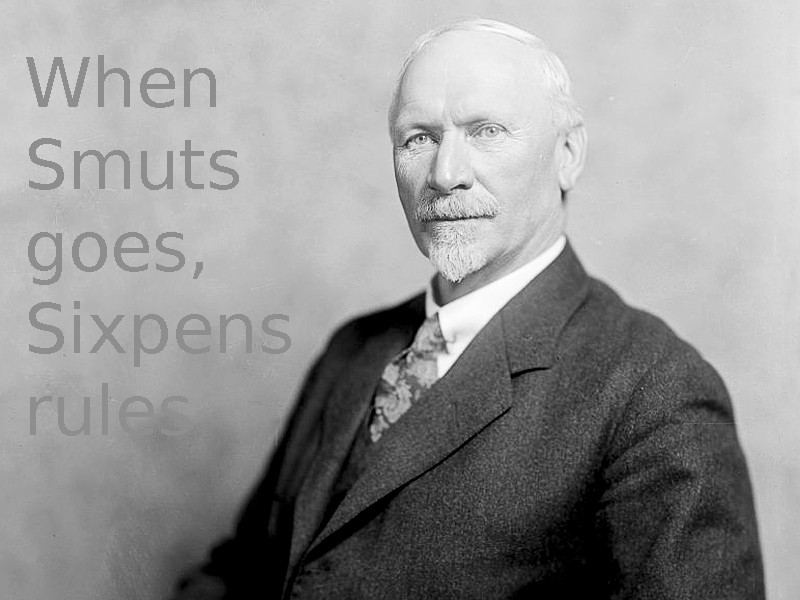
Says R W Johnson in his book: “In his celebrated dystopian novel written in 1947 ‘When Smuts goes: A history of South Africa from 1952 to 2010’, Arthur Keppel-Jones foresaw South Africa meeting its ruin at the hands of a primitive Zulu leader, Sixpens. There are many points of comparison between Zuma and Sixpens. Indeed, in many respects, Zuma has fulfilled the predictive vision of right-wing whites who resisted majority rule on the grounds that it would bring authoritarianism, corruption and incompetence sufficient to ruin the country. The surprise is how quickly the ANC in power regressed to this sort of rule and, even more, how it rallied behind Zuma, defending him against any criticism.”
In light of the country’s parlous situation and the fact that the government neither listens to advice nor acts rationally, the TAU SA president urged farmers to stick to their principles and to unify. A line must now be drawn in the sand. Farmers must declare that they did not steal land from anyone; they will not accept government propaganda without question; they will refuse to be drawn into participating in failed and failing government projects; and they will continue to produce food for South Africa while paying no attention to government’s socialist rhetoric. In a newspaper interview, Mr. Meintjies says that he doesn’t believe the government wants to get rid of commercial farmers. ”They want to control them. They want to control agriculture. If they can do that, they can control the food production, and if they control food, they control the masses”. The TAU SA president has been called a dinosaur by some critics but the dinosaurs knew what was coming.
Edmund Burke (1729 – 1797) said that ”the people never give up their liberties but under some delusion”. Why so many people of influence took so easily to ANC rule may never be explained. But Burke also said that “a state without the means of some change is without the means of its conservation”. Change may be on the way, and not a moment too soon. We must hold on until the ANC destroys itself. Perhaps then, after such trauma, the country can regenerate and realize once again its full potential.

