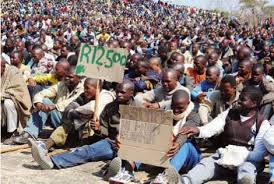
President Jacob Zuma has shown little sympathy for the victims and relatives of the Marikana massacre after he announced that the slain and wounded miners had themselves been killers.
The Tshwane University of Technology (TUT) south campus hall was packed to listen to Zuma’s address on Tuesday.
Some said the president had contravened presidential decorum by addressing the students on the deaths of the miners while families were still waiting for the Farlam Commission’s report into the Marikana massacre.
Zuma stunned his audience when he said the striking miners had been killers before they were shot on August 16, 2012, referring to the killing of 10 people ahead of the massacre.
He said the police had been forced to stop the violence that had been prevailing at the time.
“Even the Marikana miners were shot after killing people,” he said.
Two blacks are expected to appear in the Brits Magistrate’s Court today on charges of possession of explosives.
North West police spokesperson, Paul Ramoloko, says the suspects were arrested at a petrol station in Bapong village on Thursday with 40 explosives and 73 detonators in their possession. The suspects are aged 33 and 43.
Ramoloko says one of the suspects admitted to police that there were more explosives at his home. Upon further investigation, police found an additional 20 explosives and 53 detonators at the house.
The 43-year-old suspect is allegedly an employee at Lonmin mine.
“We stabbed the man. I also took part in it. I used my panga to strike him,” the witness, identified only as “Mr X”, told the Farlam inquiry into the Marikana deaths. A worker was killed because he went to work during the 2012 platinum miners’ strike the inquiry heard in Pretoria on Tuesday. Mr X may not be identified to protect his identity. Mr X said they asked Julius Langa where he was going and he told them he was going to work. “We asked, ‘how can you go to work when there is a strike?’ and we killed him,” Mr X said. Langa was stabbed 18 times, his post-mortem showed. Before Langa was killed a meeting was held where it was decided people going to work should be killed. The strikers were armed with pangas, firearms, and spears. Police were apparently trying to disarm and disperse them. In the preceding week, 10 people, including two policemen and two security guards, were killed.
Bloomberg reports that China’s Long March Capital Ltd., which partners with Citic Group Corp., is considering buying South African platinum assets after their value was depressed by strikes, the company’s Managing Partner Clement Kwong said.
The company is now reviewing a decision to hold off on purchasing South African platinum assets because of the labor issues, Kwong said in a Feb. 19 interview in Johannesburg. Long March last year partnered with Citic unit Baiyin Non-Ferrous Metal Group Co. Ltd. and China-Africa Development Fund to complete their buy-out of Perth-based Gold One International Ltd. and indirectly acquired a stake in Westonaria, South Africa-based Sibanye Gold Ltd.. (SGL)
“If the industry survives and makes a profit then that would be a good signal to look at investing,” said Kwong, who founded Long March Capital with a partner in 2008. “This last round has repriced these assets down so I think it would be as cheap as it gets.”
Anglo American Platinum Ltd. (AMS), Impala Platinum Holdings Ltd. (IMP) and Lonmin Plc (LMI) say they have lost 4.4 billion rand ($399 million) of revenue because of a four-week strike by about 70,000 workers. The companies, which together produce about three quarters of the world’s platinum, suffered losses from weeks of walk-outs in 2012 and 34 protesting miners were killed by police at Lonmin’s Marikana mine on Aug. 16 that year.
The platinum workers are demanding that monthly wages for the lowest-paid underground laborers be more than doubled to 12,500 rand a month. The Association of Mineworkers and Construction Union, which represents the employees, rejected a pay-increase offer of as much as 9 percent. South Africa’s annual inflation rate is 5.8 percent.
Share Decline
Anglo American Platinum declined 0.6 percent in Johannesburg yesterday to 450.37 rand, giving it a market value of 121.5 billion rand, a third of its value when it reached a record in 2008. Lonmin has declined by three quarters since its 2008 record while Impala has fallen 64 percent.
“There is a current situation that has not been resolved,” Kwong said. “But we think we are scraping the bottom now. I don’t see how much worse the demands can be.”
Long March Capital advises and manages the group of investors, which in December completed their purchase of Gold One. The mining company acquired a 17 percent stake in Sibanye in August.
Long March Capital remains “very positive” on the “phenomenal number” of investment opportunities in South Africa, although it’s wary of labor issues and discussion by the ruling African National Congress of additional taxes and nationalizing the nation’s mines, Kwong said.
‘Huge Opportunity’
The ANC in 2012 backed higher taxes for mines and rejected proposals to nationalize mines, an idea that the party’s youth wing had promoted for two years.
“Some of the challenges like organized labor, the somewhat unclear regulatory environment, these are discouraging to further investment,” Kwong said. “But the underlying economics, the underlying resources, still present huge opportunity for further investment.”
South Africa is the continent’s largest coal and gold producer and holds the world’s biggest reserves of platinum and chrome. Jinchuan Group Ltd. and the China Development Bank in 2011 bought a 45 percent stake in Wesizwe Platinum Ltd. (WEZ) State-owned China National Arts & Crafts Corp. Last month bought Aquarius Platinum Ltd.’s (AQP) Blue Ridge and Sheba Ridge mines for $37 million. Glencore Xstrata Plc (GLEN) said in November it would like to sell its 24.5 percent stake in Lonmin.
Congo, Zimbabwe
As Long March Capital seeks to expand into Africa, it is also doing due diligence on mine projects in Democratic Republic of Congo and will look at assets in Zimbabwe next week, Kwong said.
“The more de-risked a project, the easier it is to get funded today so something without even a pre-feasibility report is a little difficult to swallow,” Kwong said. “But if it is near production, but requires a substantial amount of capex to take it into production in order to unlock value, that is probably our favorite type of profile. We do have access to a reasonably priced source of capital in order to provide the capex to unlock the projects.” – Franz Wild, Bloomberg.com
Platinum producer Lonmin faces possible strike action from minority unions that were left out of a recognition agreement it signed last week with the Association of Mineworkers and Construction Union (Amcu).
Trade union Solidarity says it is considering staging a strike at the mine in a bid to have its recognition at the company restored.
The union has declared a dispute with Lonmin over the issue and has taken the matter to the government labour mediator, a step towards legal strike action.
Ironically, Lonmin, the world’s third-largest producer of platinum, signed the agreement with Amcu in part to avert a threatened strike.
Solidarity general-secretary Gideon du Plessis says they have no choice but to strike.
Amcu president Joseph Mthunjwa says the agreement accommodates other unions.
Mthunjwa says past agreements did not allow for any other minority unions to be recognised. – SABC
African cleansing ceremony at the site of the Marikana killings
The first anniversary of the shooting at Lonmin’s Marikana mine, near Rustenburg in the North West, will be marked during a commemorative rally on Friday.
On August 10 last year, Lonmin rockdrillers embarked on an unprotected strike for a monthly salary of R12,500.
More workers joined the strike and the protesters gathered at a hill near Nkaneng informal settlement carrying weapons, such as pangas, spears, knobkerries, and iron rods.
On August 16 last year, police trying to disperse and disarm them opened fire on the mineworkers, killing 34 of them.
Ten people, including two policemen and two security guards, were killed in strike-related violence the preceding week.
Several violent deaths in the area following the Lonmin strike have been blamed on rivalry between the Association of Mineworkers and Construction Union (Amcu) and the National Union of Mineworkers (NUM).
The Congress of SA Trade Unions, to which NUM is affiliated, said that there had been “overwhelming concern” in the wake of the Marikana shooting that such killings should never again happen in democratic South Africa.
“Tragically however, one year later, we cannot say that there have been no further deaths,” spokesman Patrick Craven said in a statement on Thursday.
Social problems, poverty and lack of transformation still affected the lives of mining communities.
A framework agreement for a sustainable mining industry, signed by government, employers and most unions, needed to be fulfilled in order to prevent a repetition of the Marikana tragedy, Craven said.
He said the union federation was “bitterly disappointed” at the procedural arguments stalling the work of the Farlam Commission.
President Jacob Zuma appointed the commission to probe circumstances around the August 16 shooting.
On Friday, the Constitutional Court is expected to rule whether the State should pay the legal costs for the miners arrested and injured at Marikana.
In June Dali Mpofu, for the miners, told the commission that due to financial constraints his team could be forced to withdraw from the inquiry.
He previously brought an urgent court application in the High Court in Pretoria several weeks ago seeking funding, but this was dismissed.
The commission has been postponed several times while solutions to the funding problems were sought.
Amnesty International’s Africa spokesman Noel Kututwa said on Thursday that the organisation was concerned that the Farlam Commission was in crisis.
“The long-term consequences for the respect and protection of human rights in South Africa will be severe should the South African authorities fail in taking all necessary steps to achieve accountability for what happened in Marikana on 16 August 2012.”
The SA Communist Party called for the speedy conclusion of the Farlam Commission’s work.
“The SACP hopes that the commission will also attend to the broader systemic, underlying issues around the mining areas and the mining industry.”
The SA Human Rights Commission (SAHRC) said it was concerned about continuing violence and killings in the Marikana area.
“The SAHRC recognises the urgent need for an understanding of all of the causes and reasons for these deaths, and what can be done to improve the material conditions of the people of Marikana, and hold those responsible accountable.”
Agang SA leader Mamphela Ramphele said: “As we honour all those who died at Marikana, we must encourage a spirit of reconciliation backed by practical steps so that all concerned parties can work together to finally bring peace to Marikana”.
The CCMA said its offices would observe a minute of silence at noon on Friday as a mark of respect for those killed at Marikana.
The CCMA committed itself to working tirelessly in efforts to prevent a repetition of the events of August 16 last year. It also acknowledged the work of its members in relation to the Marikana labour disputes.
Council for the Advancement of the SA Constitution chairman Sipho Pityana said police needed to heed lessons learnt from the Marikana shooting.
“The continued brutality of the police, and their inadequacies in policing protests, shows how urgent it is that reforms are introduced to protect the human rights of everyone who lives in South Africa.”
National police commissioner Riah Phiyega called for peace at Friday’s commemorative events.
“We wish to appeal to everyone who will be in attendance to conduct themselves appropriately and to co-operate with the event organisers, marshals and the police,” she said on Thursday.
“Most importantly, we plead with them to not carry dangerous weapons including knives, knobkerries, firearms or any other dangerous weapons.”
NUM and the African National Congress in the North West signalled on Thursday that they would not be attending the commemorations.
NUM spokesman Lesiba Seshoka said the decision was based on the fact that the events were organised by the Marikana Support Group, rather than deputy president Kgalema Motlanthe’s office.
NUM initially welcomed Amcu’s invitation to its president Senzeni Zokwana to attend the commemoration. Zokwana had been asked to share the stage with Amcu president Joseph Mathunjwa in an attempt to ease tensions in the platinum belt.
Lonmin signed an agreement with Amcu this week, recognising it as the company’s majority trade union. The agreement set a threshold of a 30 percent membership for any trade union to be recognised by the company.
Membership of the NUM, which used to be the majority union, has dropped to 20 percent of Lonmin’s workforce.
ANC provincial spokesman Kenny Morolong said: “The commemoration is organised by an illegitimate team called ‘Marikana support group’ — a group which the ANC does not recognise”.
The ANC would only participate in a commemoration organised by government, as agreed with families, Lonmin Platinum and labour unions, he said. – Sapa
President Jacob Zuma called for reflection to restore peace in South Africa’s mining industry Wednesday, days before the first anniversary of police shooting dead strikers in the Marikana tragedy.
Friday marks a year after police opened fire on thousands of strikers at platinum producer Lonmin’s mine northwest of Johannesburg which killed 34 and injured 78 people.
Two days before the commemoration the firm recognised radical labour group AMCU, which led the wage strike, in an attempt to ease simmering inter-union tensions on the platinum belt.
“The incident of the 16th (of August) in particular shocked the whole country and caused untold pain and numbness amongst all South Africans,” Zuma said in a statement.
“It was a tragic and sad loss of life,” he added.
“We must all resolve to do everything possible to prevent a repeat of similar incidents.”
Demands for higher salaries sparked last year’s wildcat strikes.
Workers flocked to join the militant Association of Mineworkers and Construction Union (AMCU), abandoning the once-dominant National Union of Mineworkers (NUM) in droves because it was perceived to protect the mine management’s interests rather than that of labourers.
AMCU now represents 70 percent of Lonmin’s 27,000 employees, stealing the majority position from NUM, which is left with 20 percent of the membership.
The August shooting was described as the worst police brutality since the end of apartheid two decades ago.
But in the preceding week at least 10 people, including two policemen, were killed in clashes between the workers.
Following the massacre strikes spread quickly across the platinum industry and some gold mines, bringing an economic lifeblood to a standstill for months.
Mine stoppages in 2012 cost Africa’s largest economy 15.3 billion rand ($1.2 billion, 1.5 billion euro).
In the year since the bloodbath the union struggle for supremacy and ensuing benefits left a trail of bodies in its wake.
At least eight prominent members from both AMCU and NUM have been murdered, the latest victim a local NUM leader who was gunned down in front of her house on Monday.
Most victims were NUM members, and attackers periodically threatened the NUM to leave the mine.
“What is happening in Marikana does not only disrupt the community there, it disrupts economic growth,” said police commissioner Riah Phiyega launching a crime combating initiative in the town on Wednesday.
At least 13 murders occurred in the area in recent months, she added.
AMCU’s recognition as majority organisation seemed auspicious to calm hostilities in Marikana two days before the memorial of a massacre which has seen little retribution.
An inquiry Zuma set up to probe the killings is yet to conclude its work and lawyers representing wounded workers have pulled out over lack of funding.
The agreement “signals a new era”, according to Lonmin chief executive Ben Magara, who vowed that “we’ll put all we can to ensure peace and stability”.
AMCU president Joseph Mathunjwa urged a partnership to end acrimony between mine managers and labourers.
“We acknowledge that without cooperation we are all losers and that as leaders, we must find a way to ensure we can move forward together in peace and stability,” he said.
Labour analyst Daniel Silke believes that AMCU’s recognition will give it a sense of accomplishment, but won’t stop the NUM from reclaiming its position.
“In the short term, I think it’s positive on the mines,” said Silke.
Zuma urged unity in mining “so as to create an environment conducive to development”.
“Workers and managers must go to work without fear that anyone would harm them. Workers must be free to excercise their Constitutional right to join any trade union of their choice,” he added. – Sapa-AFP
A woman miner was shot dead at a residential area in Wonderkop, near Lonmin’s Marikana mine outside Rustenburg, on Monday, North West police said.
The 44-year-old was shot in the head while returning from a shop at Wonderkop around 12.30pm, Brigadier Thulani Ngubane said.
“This is a mine residential area that is not far from Rowland Shaft and in close proximity to the National Union of Mineworkers’ (NUM) and Association of Mineworkers and Construction Union’s offices at Lonmin.”
The woman, who worked at Four Belt Shaft, was off duty at the time.
The gunman fled the scene, shooting randomly. Six 9mm cartridges were found nearby.
A case of murder was opened. The motive was not immediately known.
Ngubane could not confirm NUM’s earlier assertion that the murdered woman was a NUM shop steward.
“That is up to the union to say.”
North West police commissioner Lt-Gen Zukiswa Mbombo appealed to local residents not to speculate on the motive for the killing.
“Let us wait and we will get information from those who are investigating the case, and we will pronounce unambiguously on the motive as soon as information is available,” she said.
Earlier, NUM spokesperson Lesiba Seshoka said in a statement that the woman was a union shop steward.
” We are disappointed that amid the increasing assassinations in Marikana and the broader Rustenburg area, there has not been any progress with regard to the arrest and prosecutions of the suspects,” he said.
“While many of the suspects are known to the police, none has been arrested or prosecuted.”
Seshoka said Lonmin had instructed shop stewards to return to work even though the NUM had cautioned that it was not safe.
“The union is concerned that the company’s pre-occupation with profits and the police incompetence may lead to a serious bloodbath in Rustenburg,” Seshoka said.
Comment from Lonmin was not immediately available.
The Congress of SA Trade Unions said it was tragic that the murder happened days before the August 16 Marikana shooting anniversary.
“We see yet more evidence that violence remains endemic in the Rustenburg area,” spokeperson Patrick Craven said in a statement.
“This latest atrocity demonstrates that the framework agreement for a sustainable mining industry, signed by organised labour… organised business, and government on 3 July 2013 is simply not being effectively implemented.”
On August 16 last year, 34 miners were shot dead and 78 wounded when police fired on them while trying to disperse a group gathered on a hill near Lonmin’s platinum mine in Marikana.
In the preceding week, 10 people, including two police officers and two security guards, were killed in strike-related violence.
The framework agreement was aimed at resolving issues like strikes and violence bedevilling the mining industry, especially in the Rustenburg platinum belt.
The Economic Freedom Fighters (EFF) scored a significant political victory at the weekend, when one of the worker leaders at the forefront of the labour strike in Marikana, outside Rustenburg, joined the organisation.
Xolani Nzuza was paraded as a prominent EFF member during the organisation’s national assembly at Uncle Tom’s Hall in Soweto at the weekend.
Nzuza was among Lonmin miners who presided over several mass meetings before and after the Marikana massacre, when the police gunned down 34 striking mineworkers on August 16 last year.
Strangely, Nzuza confused the mine bosses, mostly British passport holders, with the “Boers”, or Afrikaners however.
“The president of Nkandla decided to go and meet the Boers and not the workers who voted for him. Once he saw Juju (Julius Malema) was with us, he tried to come. Now, our lawyers have not been paid and are begging for (financial) assistance,” Nzuza said.
He is also a member of the Association of Mineworkers and Construction Union (Amcu), which recently eclipsed the rival ANC-aligned National Union of Mineworkers (NUM) as the majority union at Lonmin.
His decision to join EFF has raised the organisation’s hopes that it could make serious inroads at Marikana, and possibly around other mines in Rustenburg’s platinum belt.
Nzuza told of workers’ pain at how the government had “abandoned” them.
“We still haven’t received the R12 500 promised to us. Till on Monday, we are still waiting for (President Jacob) Zuma’s government.
It’s painful (because) our brothers died (for that pay rise),” Nzuza said.
He took a swipe at Zuma for siding with the mine bosses and for not paying the legal fees of the families of the slain and wounded miners at the Farlam Commission of Inquiry. – IOL
Fourteen of the 34 Lonmin platinum miners killed by the police in August were shot in the back, a judicial inquiry into the Marikana shooting heard on Monday.
“All fatal projectile wounds were sustained from the back,” advocate Dumisa Ntsebeza told the Farlam commission at the Rustenburg Civic Centre, North West.
“Those who were killed were unlawfully killed by SAPS [the SA Police Service],” he said in his opening remarks.
On 16 August the police opened fire while trying to disperse a group of striking mineworkers encamped on a hill in Nkaneng, killing 34 and wounding 78.
The workers had been carrying knobkerries, pangas, sticks, and iron rods.
The miners went on strike on 10 August, demanding a monthly salary of R12 500. Within four days, 10 people had been killed, two of them policemen and two of them security guards.
Ntsebeza represents the Eastern Cape families of 20 of the men who died.
The family members, many of the women wearing black and blue mourning clothes, sat in the first two front rows of the auditorium at the hearing.
Ntsebeza said the police had claimed the mineworkers charged at officers because they had taken muti (traditional medicine) which made them feel invincible. This was the police’s justification for killing them.
“For us, the subtext of this justification… is that the miners, according to them [police], acted like possessed men, that they had to be destroyed like vermin and that they were destroyed like vermin,” he said.
“Whatever the truth of that tragic day, it cannot be that the SAPS could not have acted differently. [They] could and should have brought the gathering to an end peacefully and without loss of life,” Ntsebeza said.
He said his team would contend that every step the police took leading up to 16 August, and on the day itself, made the workers’ deaths foreseeable and inevitable.
Ntsebeza agreed it was the police’s job to disarm people and disperse gatherings, and that the way they had done so in Marikana was not legitimate.
“The manner and timing… invited injury and death as well.”
He said the police’s decision to send National Union of Mineworkers and Association of Mineworkers and Construction Union officials to discuss the striking workers’ demands was not the correct one.
“SAPS officers on the scene must have known workers were not under the control of the unions… This was a public order issue, not a labour issue,” said Ntsebeza.
It appeared the police had not given the mineworkers an official order to disperse, but rather an ultimatum, and had encircled and entrapped the protesters with barbed wire.
“Blocking the miners’ dispersal route to Nkaneng informal settlement… [they] had no choice but to move in numbers towards police with nowhere else to go,” he said.
“Some of these miners were shot in the back and the back of the head while trying to get away.”
Ntsebeza said the police’s response to the protest was aggressive, misguided, disproportionate, unreasonable, and unlawful. – Sapa
The judicial inquiry into the shooting at Lonmin’s Marikana mine will begin in Rustenburg in the North West on Monday.
The commission of inquiry would start with public hearings at 9am at the town’s civic centre.
On Monday, all parties involved would go to the area where 34 striking workers of the Lonmin Platinum mine in Marikana were shot dead by police on August 16.
The commission’s secretary said people would be allowed to point out places which they considered relevant to the inquiry. The descriptions of what happened at the site would be recorded.
Following the in loco inspection, formal sittings of the commission were expected to start at the civic centre on Wednesday.
In August, President Jacob Zuma announced a three-member judicial commission of inquiry to probe the mine violence.
[ad 1]
The commission, chaired by retired Judge Ian Farlam, has been mandated to determine the roles played by Lonmin, the police, the Association of Mineworkers and Construction Union, and the National Union of Mineworkers.
It will also determine the role played by the department of mineral resources or any other government department or agency, and the conduct of individuals and groupings in promoting a situation of conflict and confrontation which could have given rise to the shootings. – Sapa
South Africa’s president says the mining unrest that captured international attention following the police killing of 34 striking miners will be resolved through negotiation.
President Jacob Zuma told the Associated Press that the Aug. 16 killings at the Lonmin PLC platinum mine in Marikana should not be viewed as “the kind of incident that will be a common occurrence” or “that things have gone out of control in South Africa.”
He said the strikes which spread to other, mostly gold, mines were a direct consequence of the strike at Marikana and that they too would be resolved through negotiation.
Zuma denied that the strikes revealed startling inequalities in post-apartheid South Africa, saying it was not a problem that has “arisen now,” blaming the problem on the legacy of apartheid. – AP
Miners assembling on a hillside in Marikana to mourn their colleagues killed by police
The violent crisis that has shaken South Africa’s mines shows workers’ distrust for traditional trade unions, up to now the guardians of social peace despite the country’s deep inequality.
Miners this week clawed record salary increases of 22 percent from the Lonmin platinum mine operators after a near six-week wildcat strike that killed 46.
Having rejected major player the National Union of Mineworkers (NUM), miners appointed their own representatives at the negotiations.
The unprecedented agreement may upend the whole mining industry, a fifth of the GDP of Africa’s largest economy, analysts said, and bodes ill for the country’s powerful trade union federation COSATU, and NUM, its main member.
Wildcat strikes have already spread to other gold, platinum and chrome mines, including world number one Anglo American Platinum and Gold Fields.
“Marikana holds the potential for an era in South African labour relations where violent strike action forces the hand of weakened management as opposed to historical collective bargaining promoted by COSATU and its affiliate unions,” said independent analyst Daniel Silke.
The country’s labour movement has been formalised for decades, and representative unions have exclusive negotiation rights with employers in an extremely structured process.
Unions also formed a formidable opposition to the white minority regime during apartheid. Since its inception in 1985, COSATU was affiliated with the African National Congress.
This alliance helped to avoid major social unrest when the ANC took over government in 1994 after the first all-race elections, and COSATU only gained in power through the deal.
But now the partnership threatens to taint the federation.
“COSATU has moved away from its roots to become a political organisation, while its supposed to be a labour movement,” economist Dawie Roodt told AFP.
On the ground, mineworkers say they live in hell, pointing to shacks without electricity, water or sanitation.
“Because of the separation between the grassroots and leadership, the mine worker feels his interests are not being protected anymore. This guy from the union is more interested to become a mine shareholder, and has forgotten about the worker’s wages,” said Roodt.
But it has not all been bad. The Chamber of Mines has said workers have it good compared to others in South Africa amid a 40 percent unemployment rate.
“The National Union of Mineworkers has done too good a job for its members over the past 30 years, especially the past 10, getting its members double-digit, double-inflation wage increases with no increases in productivity,” Peter Major, mining and resources head at consulting company Cadiz Corporate Solutions, wrote in the weekly Mail & Guardian.
Now, the same workers are abandoning the old guilds in favour of new ones, like the Association for Mineworkers and Construction Union (AMCU), which has been blamed for inciting the violence at Lonmin.
Other miners go it alone. Wildcat strikes have increased since the start of the year. They often erupt into violence, with intimidation against non-strikers. Some clashes spill explode into deadly violence.
Police shot dead 34 people on August 16 at the Marikana mine, a week after clashes between workers left 10 dead. Two people died in subsequent violence.
“The key issue here is whether the trade union movement, whether COSATU itself, can keep a handle on the more militant workers who have smelled blood with management as a result of Marikana,” said Silke.
“The pressure will really be on COSATU to retain a level of organisation …to attempt to elicit a better deal for members or face the potential of political polarisation.”
Unions were losing membership “without a doubt”, added Roodt.
“The political outcome will be (that) we need a separation between labour and government. (The situation) is untenable.” – Sapa
RUSTENBURG, South Africa (AP) — Days after soldiers were deployed, South African President Jacob Zuma’s office announced Thursday he has ordered military forces to assist police trying to control labor unrest in the nation’s crucial mining sector. Despite resolution of the longest and bloodiest strike, two more deaths were reported.
Even as miners returned to work Thursday at the Lonmin PLC platinum mine in Marikana where police killed 34 miners on Aug. 16 labor advocates said police killed two more people: a ruling party municipal councilor who died of injuries from a rubber bullet and a miner who was run over by an armored car.
Zuma’s office said he was invoking the Constitution to use the military to support police “in the prevention and combating of crime as well as the maintenance of law and order in the Marikana Area … and other areas around the country where needed” until Jan. 31. The notice from the presidency referred to section 201 (2) of the Constitution, which states that “only the President, as head of the national executive, may authorize the employment of the defense force.”
Last weekend some 1,000 soldiers were trucked into the “platinum belt” northwest of Johannesburg.
Thursday morning, police in two water cannon trucks and several armored cars confronted striking Anglo American Platinum miners at a shantytown where residents set up barricades of rocks and burning tires and logs. Before long, the fires died down and most of the police pulled back. The people dispersed, leaving a herd of goats milling around the water cannons. Strike leader Evans Ramokga told The Associated Press that one miner was run over Wednesday by a police armored car and dragged several meters (feet) before it stopped. He said the man died overnight in the hospital.
Police spokesman Dennis Adriao said he was unaware of the incident which occurred at the scene where police fired rubber bullets, tear gas and stun grenades to break up a march by thousands of strikers. The mines near Rustenburg belong to Anglo American Platinum, the world’s largest platinum producer.
“The only thing we want is to sit down and have them hear our demands,” Ramokga said. He said authorities have refused to give permission for the thousands of strikers among Anglo’s 15,000 workers there to hold a protest march to back their demands for a gross monthly salary of 16,070 rand ($2,000).
Anglo issued an ultimatum for workers to report for duty by Thursday night or threatened to act on a court order declaring the strike illegal. That gives Anglo the power to fire strikers.
“Anglo American Platinum’s Rustenburg mining operations are already under considerable economic pressure, any further delays in returning to work will only increase the risk to the long-term viability of these mines,” it said in a statement late Wednesday.
The Marikana Solidarity Campaign meanwhile reported that African National Congress councilor Paulina Masutlhe was shopping Saturday at the Wonderkop shantytown where Lonmin platinum miners live when police firing from a speeding armored car hit several women. Masutlhe was hit in the abdomen and leg and rushed to the hospital, where she died Wednesday, a statement said.
Adriao said he is investigating the report of a death. He said police had reported to the Independent Police Investigative Directorate that several people were hit by rubber bullets in a raid to disarm strikers on Saturday, the day after the government ordered a crackdown.
The directorate already has opened 34 murder and 78 attempted murder charges against police in the Aug. 16 shootings, the worst state violence since the white minority apartheid regime was brought down in 1994. The government has said it is awaiting the outcome of a judicial commission of inquiry that is to report to the president in January.
The solidarity campaign condemned the brutality of police and called for “the immediate identification and suspension of the police officers involved in her (Masutlhe’s) murder. “
“We are also extremely unhappy that, to date, none of the police officers involved in the massacre on 16 August 2012 has been identified or suspended – this is totally unacceptable and unlawful,” said the campaign that includes the powerful Congress of South African Trade Unions that is part of a governing alliance with the African National Congress party and the South African Communist Party.
The deaths at the two mines, both northwest of Johannesburg, bring the strike-related death toll to 47.
Lonmin on Tuesday resolved its five-week strike by agreeing to pay raises of 16 to 22 percent.
The strike already has spread to several gold, platinum and chrome mines, damaging investor confidence in the country that produces 75 percent of world platinum and is the No. 4 chrome producer and in the top 10 of gold producers.
This website uses cookies to improve your experience. We'll assume you're ok with this, but you can opt-out if you wish. Cookie settingsACCEPT
Privacy & Cookies Policy
Privacy Overview
This website uses cookies to improve your experience while you navigate through the website. Out of these cookies, the cookies that are categorized as necessary are stored on your browser as they are essential for the working of basic functionalities of the website. We also use third-party cookies that help us analyze and understand how you use this website. These cookies will be stored in your browser only with your consent. You also have the option to opt-out of these cookies. But opting out of some of these cookies may have an effect on your browsing experience.
Necessary cookies are absolutely essential for the website to function properly. This category only includes cookies that ensures basic functionalities and security features of the website. These cookies do not store any personal information.
Any cookies that may not be particularly necessary for the website to function and is used specifically to collect user personal data via analytics, ads, other embedded contents are termed as non-necessary cookies. It is mandatory to procure user consent prior to running these cookies on your website.