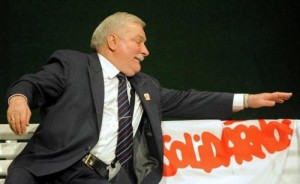
Former Solidarity leader warns that arming Ukraine is a bad idea

European military assistance to Ukraine could lead to a nuclear conflict between Russia and NATO, according to Poland’s iconic cold warrior and Nobel Peace Prize laureate Lech Walesa.

“It could lead to a nuclear war,” the anti-Communist legend told reporters when asked whether the EU should send weapons to Ukraine to help it fights off separatist rebels and Russian aggression.

“The EU is well aware that Russia has nuclear weapons. NATO has them too. Must we then destroy each other?” said the former Solidarity trade union leader famous for negotiating a bloodless end to communism in Poland in 1989.

“This is why the EU keeps on repeating: stop being silly (…) This is why it isn’t getting involved too much!” he added, at an annual regional economic in Krynica, southern Poland.

The EU on Saturday agreed to impose fresh sanctions on Russia should Moscow failed to change its behaviour in Ukraine, after Kiev said Russian soldiers were fighting along side pro-Moscow rebels.

Source: AFP

SA Police to defend anti-white policy in Constitutional Court

Renate Barnard... too white for promotion
Renate Barnard… too white for promotion

The South African Police Service (SAPS) now wants to refer the Renate Barnard affirmative action case to the Constitutional Court. Yesterday, court papers were served on Solidarity which is representing Barnard. Solidarity will oppose the SAPS’s application for leave to appeal.

‘Solidarity is shocked by the SAPS’s decision to defend its unlawful race practices all the way to the Constitutional Court,’ Dirk Hermann, Solidarity’s Executive Officer said in a statement. According to Hermann, the Supreme Court of Appeal in Bloemfontein passed an excellent judgment that balances the rights of all. ‘We get the impression that the SAPS believes that affirmative action annuls the constitutional rights to equality and dignity of white employees like Barnard. Should that be the case, then affirmative action would have a higher authority than the Constitution itself. This would imply that South Africa is an affirmative action state and not a constitutional state. We are of the opinion that an appeal to the Constitutional Court is inappropriate. The SAPS should abide by the Supreme Court of Appeal’s judgment.’

Hermann says the greatest injustice brought about by this is the time it is taking to get justice for Barnard. ‘She has been fighting for justice for the past 8 years, and a constitutional court application will simply delay this process even more. She exudes passion to serve the South African public, and surely something is patently wrong if the colour of her skin is the only stumbling block preventing her to live out her calling.’

Hermann added that although Solidarity believes that, for Barnard’s sake, it is inappropriate to refer this matter to the Constitutional Court, it will be advantageous for South Africa to obtain legal certainty about these burning issues in the highest court.

In November, the Supreme Court of Appeal in Bloemfontein ruled in favour of Solidarity and Barnard. The SAPS was ordered to pay the costs associated with the litigation in the Labour, Labour Appeal Courts as well as in the Supreme Court of Appeal, as well as Barnard’s backdated remuneration.

Barnard’s affirmative action struggle began as far back as 2005. Twice, she had applied for the same position. In both instances she was found to be the best candidate and the interviewing panel recommended her appointment. The position was, however, left vacant. The position was advertised a third time, but was scrapped after she had again applied for it.

Solidarity threatens strike at Lonmin

solidatityPlatinum producer Lonmin faces possible strike action from minority unions that were left out of a recognition agreement it signed last week with the Association of Mineworkers and Construction Union (Amcu).

Trade union Solidarity says it is considering staging a strike at the mine in a bid to have its recognition at the company restored.

The union has declared a dispute with Lonmin over the issue and has taken the matter to the government labour mediator, a step towards legal strike action.

Ironically, Lonmin, the world’s third-largest producer of platinum, signed the agreement with Amcu in part to avert a threatened strike.

Solidarity general-secretary Gideon du Plessis says they have no choice but to strike.

Amcu president Joseph Mthunjwa says the agreement accommodates other unions.

Mthunjwa says past agreements did not allow for any other minority unions to be recognised. – SABC

No white cadets for South African Airways

Solidarity intends campaigning against SA Airways after not a single white man was selected for its cadet programme, the trade union said on Tuesday.

“In August last year, the SAA lifted the ban on applications from white males for its cadet programme after Solidarity launched a major public protest campaign against the SAA,” deputy general secretary Dirk Hermann said.

“It is clear that the lifting of the ban was merely a smoke-screen for continued racial discrimination by the airline.”

The union said SAA announced on Monday that 40 candidates had been admitted to its cadet programme. They would undergo 14 months of theoretical and practical training to enable them to obtain their Airline Transport Pilot Licences.

This would be followed by about three years of internship. The group consisted of 10 black men, four black women, nine coloured men, one coloured woman, seven Indian men, two Indian women and seven white women, it said.

“SAA’s exclusion of white male candidates constitutes subsidised racism… .The taxpayer is forced to pay for the government’s obsession to apply national racial demographics at all levels, everywhere in South Africa,” said Hermann.

Solidarity called on white men who applied for the cadet programme, but were unsuccessful, to contact it so it could investigate taking legal action on their behalf, said Hermann.

SAA said in a statement that the final 40 candidates fell under the category of previously disadvantaged individuals as defined in the Employment Equity Act.

“It is important to note this in the context of the current reality and measures that need to be taken,” spokesman Tlali Tlali said.

“The cadet programme is the airline’s effort to transform not only its own but also the country’s flight deck community, which is nowhere close to reflecting the country’s demographics,” he said.

He said SAA’s transformation strategy was informed by the broad-based black economic empowerment aviation sector charter.

“In the case of this particular programme, when assessing all applications, SAA is obliged to give preference to previously disadvantaged groups,” said Tlali. – Sapa

Solidarity hero shocks world with anti-gay words

Lech Walesa, the Polish democracy icon from Solidarity and Nobel peace prize winner, has sparked outrage in Poland by saying that gays have no right to a prominent role in politics and that as a minority they need to “adjust to smaller things.”

Some commentators are now suggesting that Walesa, the leading figure in Poland’s successful democracy struggle against communism, has irreparably harmed his legacy.

Walesa said in a television interview on Friday that he believes gays have no right to sit on the front benches in Parliament and, if represented at all, should sit in the back, “and even behind a wall.”

“They have to know that they are a minority and must adjust to smaller things. And not rise to the greatest heights, the greatest hours, the greatest provocations, spoiling things for the others and taking (what they want) from the majority,” he told the private broadcaster TVN during a discussion of gay rights. “I don’t agree to this and I will never agree to it.”

“A minority should not impose itself on the majority,” Walesa said.

The words have enraged many.

“From a human point of view his language was appalling. It was the statement of a troglodyte,” said Jerzy Wenderlich, a deputy speaker of Parliament with the Democratic Left Alliance.

Walesa, Poland’s first democratic-era president, is a deeply conservative Roman Catholic and a father of eight. But, the democracy he helped create in 1989 from the turmoil of strikes and other protests has had a profound social transformation in recent years.

Poland is a traditionally conservative and Catholic society that long suppressed discussions of gay rights. The topic was essentially taboo under communism, and in the early years of democracy. The Polish church, which has a strong role in political life, still holds that homosexuality is deviant, while gays and lesbians say they face discrimination and even violence.

However, much has changed. A watershed moment came in 2011 when a new progressive and anti-clerical party – Palikot’s Movement – entered Parliament for the first time. Taking seats for the party were Anna Grodzka, a transsexual, and Robert Biedron, who is openly gay. These were all historic firsts.

Some predicted the consequences for Walesa could be serious.

“Now nobody in their right mind will invite Lech Walesa as a moral authority, knowing what he said,” Wenderlich said.

Monika Olejnik, a leading television journalist, said Walesa “disgraced the Nobel prize.”