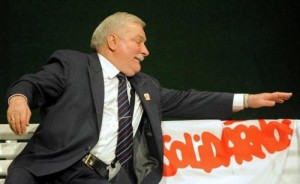
Former Solidarity leader warns that arming Ukraine is a bad idea

European military assistance to Ukraine could lead to a nuclear conflict between Russia and NATO, according to Poland’s iconic cold warrior and Nobel Peace Prize laureate Lech Walesa.

“It could lead to a nuclear war,” the anti-Communist legend told reporters when asked whether the EU should send weapons to Ukraine to help it fights off separatist rebels and Russian aggression.

“The EU is well aware that Russia has nuclear weapons. NATO has them too. Must we then destroy each other?” said the former Solidarity trade union leader famous for negotiating a bloodless end to communism in Poland in 1989.

“This is why the EU keeps on repeating: stop being silly (…) This is why it isn’t getting involved too much!” he added, at an annual regional economic in Krynica, southern Poland.

The EU on Saturday agreed to impose fresh sanctions on Russia should Moscow failed to change its behaviour in Ukraine, after Kiev said Russian soldiers were fighting along side pro-Moscow rebels.

Source: AFP

Former Polish president talks Anschluss

Lech Walesa
Lech Walesa

The Nobel Peace Prize winner and former Polish president, whose Solidarity trade union played a key role in bringing an end to the Cold War, said the world had changed and needed new ways of organising itself.

“We need to expand economic and defence co-operation and other structures to create one state from Poland and Germany in Europe,” he said.

Speaking to Russia’s Itar-Tass news agency, Lech Walesa, 69, said national boundaries were not as relevant as they once were.

“We have travelled so far in our technical advancements that we are no longer located in our own countries,” he said, adding that this required changes to geographical structures, the economy and democracy.

Although few Poles have forgotten Germany’s invasion and brutal occupation of Poland in 1939, history should not be an obstacle to unity, Walesa said. “After the war, Germany fully confessed to all its dirty tricks,” he said. “It’s necessary to is draw a line under the past, even if people did something evil. Until we do, wounds won’t heal.”

Walesa’s calls for Polish-German unity exceed his previous support for closer European solidarity.

“At the moment different ways of doing things and different systems hold us back but gradually everything will align and states will become like Lego blocks,” he said in the Itar-Tass interview.

He suggested that current international systems were now defunct, saying the United Nations and NATO were the “ideas of an old era” and “badly organised”.

The comments on German-Polish unification will further enhance the former Polish president’s reputation for making frank and sometimes unorthodox remarks.

While Walesa said Poland could bury the hatchet with Germany, the situation was different with Russia, the other great historical foe of the Poles. He urged Moscow to follow the German example and atone for its sins committed against Poland in order to lay the foundations of a good relationship.

“We are too slow in solving our problems and reaching an understanding,” he said. “We must aim to make our relations as smooth as possible, since we are fated to be neighbours.” – The Telegraph

Solidarity hero shocks world with anti-gay words

Lech Walesa, the Polish democracy icon from Solidarity and Nobel peace prize winner, has sparked outrage in Poland by saying that gays have no right to a prominent role in politics and that as a minority they need to “adjust to smaller things.”

Some commentators are now suggesting that Walesa, the leading figure in Poland’s successful democracy struggle against communism, has irreparably harmed his legacy.

Walesa said in a television interview on Friday that he believes gays have no right to sit on the front benches in Parliament and, if represented at all, should sit in the back, “and even behind a wall.”

“They have to know that they are a minority and must adjust to smaller things. And not rise to the greatest heights, the greatest hours, the greatest provocations, spoiling things for the others and taking (what they want) from the majority,” he told the private broadcaster TVN during a discussion of gay rights. “I don’t agree to this and I will never agree to it.”

“A minority should not impose itself on the majority,” Walesa said.

The words have enraged many.

“From a human point of view his language was appalling. It was the statement of a troglodyte,” said Jerzy Wenderlich, a deputy speaker of Parliament with the Democratic Left Alliance.

Walesa, Poland’s first democratic-era president, is a deeply conservative Roman Catholic and a father of eight. But, the democracy he helped create in 1989 from the turmoil of strikes and other protests has had a profound social transformation in recent years.

Poland is a traditionally conservative and Catholic society that long suppressed discussions of gay rights. The topic was essentially taboo under communism, and in the early years of democracy. The Polish church, which has a strong role in political life, still holds that homosexuality is deviant, while gays and lesbians say they face discrimination and even violence.

However, much has changed. A watershed moment came in 2011 when a new progressive and anti-clerical party – Palikot’s Movement – entered Parliament for the first time. Taking seats for the party were Anna Grodzka, a transsexual, and Robert Biedron, who is openly gay. These were all historic firsts.

Some predicted the consequences for Walesa could be serious.

“Now nobody in their right mind will invite Lech Walesa as a moral authority, knowing what he said,” Wenderlich said.

Monika Olejnik, a leading television journalist, said Walesa “disgraced the Nobel prize.”