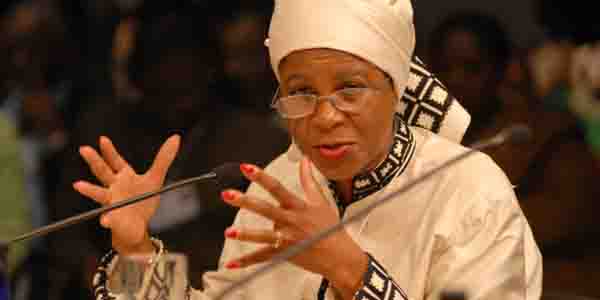
Mamphela Ramphele has been mentioned a fraud scandal involving the alleged disappearance of almost R13 million from AgangSA coffers.
Police yesterday confirmed that a fraud case was being investigated.
The investigation was launched after a mystery bank account was discovered by a party official.
Police spokesman Brigadier Neville Malila said a party member discovered the “irregularity” after trying to open an account at the Nedbank branch in Centurion, near Pretoria, on Friday.
“The official discovered an account had already been opened in his name and that of Dr Ramphele,” said Malila.
Neither Ramphele nor AgangSA spokesman responded to repeated calls or messages.
AgangSA’s national executive council is to hold a special meeting tomorrow , including provincial representatives, to discuss the matter.
Included in the money feared stolen is R65845 paid by the Independent Electoral Commission to AgangSA for the two parliamentary seats the party won in the May 7 election.
Also feared stolen is the R1.3-million the party owed the SA Revenue Service, and about R10-million it owes to service providers.
Other funds also appear to be missing, bringing the total amount not accounted for to nearly R13-million.
A party insider claimed someone in Cape Town had forged signatures.
“One would expect the national executive council to take a decision on whom the signatories on the account would be, but this never happened,” said Donald Tontsi, AgangSA’s Gauteng spokesman
“What is surprising is that, after announcing she was taking time off from politics following a gruelling election campaign, we now find Ramphele is a signatory on the account.
“‘Not only that, but one of the co-signer’s signature has apparently been forged.”
DA leader Helen Zille announced that Agang SA’s Mamphela Ramphele will be the DA’s presidential candidate in the general elections, hoping to lure ANC voters away from the governing party.
“Good people in the ANC have reached out to us but are scared. Good business leaders have reached out to us but are nervous,” Ramphele told reporters during the announcement of the merger.
The merger will not change the DA’s fortunes however, as Ramphele lacks a constituency and no ANC history because she has never been a member.
Agang was a non-starter, one analyst said, as Ramphele’s appeal lay with people who were already supporting the DA and she was unlikely to lure away ANC voters.
Ramphele promised to consign race, the main staple of South African politics, to the dustbin on Tuesday.
“We are taking away that race card and putting it in the dustbin,” Ramphele said.
“This is a historic moment. We are going to take away the excuse of race and challenge the ANC to be judged on its performance.
Ramphele has previously shown a disregard for sound analysis.
The ex-World Bank employee who is best known as the girlfriend of a dead Black Consciousness activist, the late Steve Biko, launched Agang SA after initially rejecting an offer of replacing Zille as DA leader.
Instead she blew millions on her own party despite surveys predicting very limited support for the venture.
She said she was “honoured” to accept the DA’s invitation to join, saying: “I believe that this decision is in the best interests of South Africa as we head into turbulent waters.”
A member of political party, AgangSA was murdered on last month. According to the party, Nyako Masenya was wearing his AgangSA T-shirt to attend the launch of a new branch in the town of Uitkyk in Limpopo. Masenya reportedly took a break from the party meeting to visit a nearby shop, where he was attacked, allegedly with rocks and a plank found at the scene of his murder.
“We hope this is not a reflection of how political intolerance is finding increasing expression in our society,” said AgangSA communications director, Thabo Leshilo. “We live in a constitutional democracy where citizens have the right to a choice of political allegiance and have a right to freedom of expression, have a right to dignity and to hold whatever views they hold without having to fear that such views may endanger their very lives.”
According to the statement by the party the assailant is well known in the area.
“We would also urge the IEC to pay attention to the increasing reports of violence stemming from political intolerance if we are to have free and fair elections. Citizens should feel they will be defended by the institutions of our constitutional democracy set up for that purpose,” added Mashilo.
Party leader Mamphela Ramphele appealed to the community of Uitkyk and AgangSA members in the area to respect the rule of law and let justice take its course.
The murder took place in the village of Ramphele’s family home. – Sapa
I was still pondering the implications of “black colonialism” as set out in a previous column when it struck me that some of South Africa’s ethnic categories are completely wrong.
Afrikaners were the first group in the country to refer to themselves as “Africans”, as long ago as 1707 when Hendrik Biebouw said: “Ik ben een Afrikaander.” However, today Afrikaners have been defined as an out-group by South African legislation that simply classes them as “whites”.
Most of our affirmative-action legislation has been imported from the USA and BEE is just an adapted form of what is called “minority procurement” over there. So there is nothing “African” about the current race-classification system!
In German, “Afrikaner” means simply “African”, yet the current laws define Afrikaners as Europeans. The ultimate irony is that ANC and especially SACP ideology has been constructed by recent immigrants from Lithuania (like Joe Slovo) and, of course, Britain.
Imposing racial quotas on everything from the medical schools at Afrikaans universities to the Blue Bulls rugby team is bad enough. But stripping us of our age-old Africanness by legislative fiat represents the ultimate insult, making us interlopers in our own country.
Searching for answers, I reread Thabo Mbeki’s “I am an African” speech, but it is simply a fanciful restatement of American multiculturalism, with echoes of (Swedish) Gunnar Myrdal’s “melting pot” idea. So nothing “African” there, either.
We urgently need to bring back the term “Bantu” and I have begun to recommend its use on social media and everywhere else. There seems to be a certain squeamishness about using this word, meaning “people”, which is unfathomable. Even the famous Xhosa definition of “ubuntu” contains it: “Ubuntu ungamntu ngabanye abantu.”
Anthropologists, linguists and other people in need of proper definitions have never stopped referring to the “Bantu peoples”, “Bantu languages”, etc. Even Bantu education has been rehabilitated by such leading authorities as Dr. Mamphela Ramphele and a lecturer at Wits Business School, Mr. Rabelani Dagada, both of whom consider it better than the current schooling system.
The first ANC-supporting newspaper in the 1920s was called Abanthu-Batho and today there is a clothing brand which is thus advertised: “Abantu is a ladies wear brand which creates timeless pieces which speak to the South African audience.”
The Bantu peoples inhabit East and Southern Africa. For them or their Lithuanian theorists to arrogate unto themselves the sole right to being called “Africans” is not only intellectually unsound, but also unfair. After all, there are 200 million North Africans, including Egyptians, Arabs, Berbers, Copts and so on, who are Africans, by definition. West Africa too, is given the cold shoulder by Bantu imperialism.
In the nineteen-twenties some leading German and French anthropologists claimed, upon the basis of very ancient mining activity in these parts, that whites may have inhabited both South Africa and Zimbabwe as long ago as 3500 B.C. They must have been the first Afrikaners and we should venerate them as our true founding fathers, together with the Khoi and San.
Either we must qualify for affirmative action like other “Africans” – and even the Chinese! – or the Bantu must clearly announce their pretensions to being a kind of continental nobility with special privileges.
Ramphele with the headgear that landed her the World Bank job
Agang SA leader and ex-World Bank co-chair Mamphela Ramphele called on President Jacob Zuma to disclose his personal finances.
“I call upon President Zuma to publish his accounts immediately. What is there to hide?” she asked reporters in Johannesburg. “South Africans deserve a president that sets a good example for the rest of the country to follow.”
With each passing day suspicion about his integrity mounts.
“President Zuma has used a convenient technicality to sidestep this requirement. From his inauguration… the president has dodged the issue for over 1,565 days to date. With each passing day suspicion about his integrity mounts,” Ramphele said.
She said she was disclosing her own financial affairs for the country to scrutinise, in line with the need for accountability, and to set an example for Zuma.
Ramphele said her net worth as of June 27 this year was R55,436,063.
She had shares worth R1.38 million with Anglo American, Gold Fields, Sibanye Gold, and the PTI Select Managers Fund. Her primary residence in Camps Bay, Cape Town, was valued at R10m. A total of R1,146,139 was in retirement annuity and R1,574,064 in a provident fund. Her family trust held R30m and her investment trust R10.9m.
“My income for the tax year ending 28 February 2013, was R346,000 – a sizeable drop from previous years due to my resignation from all board commitments… ahead of my entrance into politics.”
Ramphele said her wealth would not distance her from South Africa’s poor.
“I am one of many leaders of this country, as with [former] president [Nelson] Mandela, who was not poor,” she said. “Being comfortable or having a measure of wealth is not a barrier to linking with poor people. What is a barrier is the abuse of power and stealing from poor people as this government has done consistently.”
President Jacob Zuma has responded to Agang SA leader Mamphela Ramphele’s call for him to disclose his personal finances.
In a statement from The Presidency on Wednesday evening, Zuma said his financial status had been recorded by the Secretary of Cabinet, according to stipulations made in the constitution.
“The Constitution of 1996 and the Executive Members Ethics Act, 1998, prescribe the nature, content and form in which members of the Cabinet and the Executive Councils disclose their financial interests annually. Members of the National Executive of Government submit their disclosures to the Secretary of Cabinet who maintains a register. The President therefore submits his disclosure annually to the Secretary of Cabinet,” the statement said. – Sapa
African cleansing ceremony at the site of the Marikana killings
The first anniversary of the shooting at Lonmin’s Marikana mine, near Rustenburg in the North West, will be marked during a commemorative rally on Friday.
On August 10 last year, Lonmin rockdrillers embarked on an unprotected strike for a monthly salary of R12,500.
More workers joined the strike and the protesters gathered at a hill near Nkaneng informal settlement carrying weapons, such as pangas, spears, knobkerries, and iron rods.
On August 16 last year, police trying to disperse and disarm them opened fire on the mineworkers, killing 34 of them.
Ten people, including two policemen and two security guards, were killed in strike-related violence the preceding week.
Several violent deaths in the area following the Lonmin strike have been blamed on rivalry between the Association of Mineworkers and Construction Union (Amcu) and the National Union of Mineworkers (NUM).
The Congress of SA Trade Unions, to which NUM is affiliated, said that there had been “overwhelming concern” in the wake of the Marikana shooting that such killings should never again happen in democratic South Africa.
“Tragically however, one year later, we cannot say that there have been no further deaths,” spokesman Patrick Craven said in a statement on Thursday.
Social problems, poverty and lack of transformation still affected the lives of mining communities.
A framework agreement for a sustainable mining industry, signed by government, employers and most unions, needed to be fulfilled in order to prevent a repetition of the Marikana tragedy, Craven said.
He said the union federation was “bitterly disappointed” at the procedural arguments stalling the work of the Farlam Commission.
President Jacob Zuma appointed the commission to probe circumstances around the August 16 shooting.
On Friday, the Constitutional Court is expected to rule whether the State should pay the legal costs for the miners arrested and injured at Marikana.
In June Dali Mpofu, for the miners, told the commission that due to financial constraints his team could be forced to withdraw from the inquiry.
He previously brought an urgent court application in the High Court in Pretoria several weeks ago seeking funding, but this was dismissed.
The commission has been postponed several times while solutions to the funding problems were sought.
Amnesty International’s Africa spokesman Noel Kututwa said on Thursday that the organisation was concerned that the Farlam Commission was in crisis.
“The long-term consequences for the respect and protection of human rights in South Africa will be severe should the South African authorities fail in taking all necessary steps to achieve accountability for what happened in Marikana on 16 August 2012.”
The SA Communist Party called for the speedy conclusion of the Farlam Commission’s work.
“The SACP hopes that the commission will also attend to the broader systemic, underlying issues around the mining areas and the mining industry.”
The SA Human Rights Commission (SAHRC) said it was concerned about continuing violence and killings in the Marikana area.
“The SAHRC recognises the urgent need for an understanding of all of the causes and reasons for these deaths, and what can be done to improve the material conditions of the people of Marikana, and hold those responsible accountable.”
Agang SA leader Mamphela Ramphele said: “As we honour all those who died at Marikana, we must encourage a spirit of reconciliation backed by practical steps so that all concerned parties can work together to finally bring peace to Marikana”.
The CCMA said its offices would observe a minute of silence at noon on Friday as a mark of respect for those killed at Marikana.
The CCMA committed itself to working tirelessly in efforts to prevent a repetition of the events of August 16 last year. It also acknowledged the work of its members in relation to the Marikana labour disputes.
Council for the Advancement of the SA Constitution chairman Sipho Pityana said police needed to heed lessons learnt from the Marikana shooting.
“The continued brutality of the police, and their inadequacies in policing protests, shows how urgent it is that reforms are introduced to protect the human rights of everyone who lives in South Africa.”
National police commissioner Riah Phiyega called for peace at Friday’s commemorative events.
“We wish to appeal to everyone who will be in attendance to conduct themselves appropriately and to co-operate with the event organisers, marshals and the police,” she said on Thursday.
“Most importantly, we plead with them to not carry dangerous weapons including knives, knobkerries, firearms or any other dangerous weapons.”
NUM and the African National Congress in the North West signalled on Thursday that they would not be attending the commemorations.
NUM spokesman Lesiba Seshoka said the decision was based on the fact that the events were organised by the Marikana Support Group, rather than deputy president Kgalema Motlanthe’s office.
NUM initially welcomed Amcu’s invitation to its president Senzeni Zokwana to attend the commemoration. Zokwana had been asked to share the stage with Amcu president Joseph Mathunjwa in an attempt to ease tensions in the platinum belt.
Lonmin signed an agreement with Amcu this week, recognising it as the company’s majority trade union. The agreement set a threshold of a 30 percent membership for any trade union to be recognised by the company.
Membership of the NUM, which used to be the majority union, has dropped to 20 percent of Lonmin’s workforce.
ANC provincial spokesman Kenny Morolong said: “The commemoration is organised by an illegitimate team called ‘Marikana support group’ — a group which the ANC does not recognise”.
The ANC would only participate in a commemoration organised by government, as agreed with families, Lonmin Platinum and labour unions, he said. – Sapa
A possible coalition is on the cards for the United Democratic Movement, Agang SA and the Congress of the People (Cope) ahead of the 2014 general elections.
UDM leader Bantu Holomisa reportedly wants to team up with Agang SA’s Mamphela Ramphele in a bid to challenge the ANC’s dominance in the Eastern Cape.
But the UDM leader denied that an agreement had been reached.
Holomisa would only confirm he had been in talks with the two parties.
“We agreed we would let Agang SA launch themselves as a party and that Cope must find a way to sort through their disputes. We will be meeting again very soon,” said Holomisa.
He added that nothing was concrete.
“The positive thing is that all of us feel strongly that we need to close rank and unite in fighting for the people of South Africa from this maladministration we are witnessing on a daily basis.”
Agang SA members appear in Mahwelereng Magistrate Court, Mokopane, Limpopo on Wednesday as prosecution asks for more time to find evidence
Three Agang SA members who were arrested last Monday, 22nd July, after a meeting with residents in Limpopo was disrupted by an ANC councillor, appeared in Mahwelereng Magistrate Court this morning Wednesday, 31st July 2013.
The Magistrate postponed the hearing of the case until 6th September to allow the prosecution more time to investigate the charge of malicious damage to property.
The allegations stem from a community meeting held on 22nd July, organised by Agang SA members of the Mzombane community. This citizen action by our members has already forced a response from the municipality with road maintenance and cleaning and the provision of water trucks to the community appearing after the meeting.
Dr Mamphela Ramphele commented:
“The community of Mzombane, like many others across the country, is fed up with food parcel pay-offs when all these citizens were asking for was water, electricity, jobs, decent education and healthcare. After nearly 20 years of waiting, enough is enough.
“Agang SA and the community called for a meeting with the Mayor of Mogalakwena Local Municipality in Mokopane to address these issues but instead we ended up with a Councillor abusing public money and offering jobs for votes. Having attempted to disrupt our meeting, the Councillor then opened a case against the very Agang SA members who ensured that the proceedings were conducted with respect.
“Rather than engage on the real issues people face, it seems the ANC are going to try cheap tricks to disrupt our work with the threat of charges and the disturbance of our meetings.
“Agang SA will not be intimidated, as our members have shown in Mzombane again today, and will show again across the country. We categorically deny the allegations made against our members and are providing legal representation every step of the way as we trust in the legal system of our country to prove their innocence.”
The newly-launched political party Agang SA is hoping that the same team which helped US President Barack Obama win in 2008 will help it to do well in next year’s election, City Press reported on Sunday.
Agang policy director Mills Soko said the party had appointed the Benenson Strategy Group “to advise us on elections strategy”, because it was “the best we could find”.
Soko refused to talk about how much it was costing.
“They are costly because they are professionals. They are not doing it for free,” he was quoted as saying.
City Press reported that the group had also done political strategy consulting in Nigeria for former president Umaru Yar’Adua’s winning campaign, and in Jamaica, Romania and Croatia.
Its corporate clients included Tampax, Pfizer, Verizon and JPMorgan Chase.
On the group’s website Benenson was described “an industry leader, which has successfully taken on some of the most complicated political, corporate and advocacy challenges over the past decade”.
Agang SA, led by former activist and businesswoman Mamphela Ramphele, was officially launched as a political party in Pretoria on Saturday. – Sapa
South Africa needs to dig itself out of a 19th-century mining business model, academic Mamphela Ramphele said on Wednesday.
Speaking at a media briefing ahead of an international leadership education conference in Cape Town, she said a failure to change the nature of the industry was having devastating repercussions.
“We’ve just had this tragic Marikana debacle, and what was in evidence there is the consequence of South Africa failing to transform the mining industry from a 19th century business model, which relies on cheap migrant labour, very archaic mining technology and a… low-skilled, labour-intensive industrial base.”
She said change could come from leaders of business schools, leaders in the private mining sector and citizens putting their heads together.
“I want to make sure my three-year old grandson, in 30 years’ time, is in a country he can be proud of; and that will not happen, unless we deal with the legacy issues which are holding us back.”
Ramphele, who also chairs the Gold Fields board, said her recent visit to the mining house’s Australian operations showed the industries in the two countries were like chalk and cheese.
“Of course, they were established in different periods, but that doesn’t stop us, because one of the things South Africa is underplaying is technological innovation capacity,” Ramphele said.
She referred to the London Underground rail system, and said tunnelling technology developed in South Africa had contributed towards this.
Ramphele said the ability to innovate and change to a new mining model was not lacking in South Africa.
“We just have not applied our minds because there isn’t the political leadership and will to create a framework for a mining industry of the 21st century.”
She also took aim at industry bosses.
“The private sector, in the form of the mining industry, has also not exercised its mind about how do you leverage the huge endowment… in the form of mineral resources; leveraging that as a way of positioning South Africa as a globally competitive economy… .”
[ad 1]
Ramphele said South Africa had missed the benefits of the last mining boom, while other countries flourished.
“The other thing we do in South Africa — which is really inexplicable, that’s the polite way of putting it — is that we are exporting value to China, to India, to everywhere.
“We mined the riches the dear Lord gave us, gave it to others to process, which means we are exporting jobs, then we re-import (processed minerals) at huge costs for our own purposes, which is why we are de-industrialising.”
She said re-industrialisation in mining would depend on a rethink of the whole value chain.
Ramphele is also a businesswoman and medical doctor, and was an anti-apartheid activist. – Sapa
South Africa’s education system is worse today than the “gutter education” the country had under the apartheid government, said an academic and struggle heroine Mamphela Ramphele, The Star reported on Friday.
“Maths literacy… what is that? It’s worse than the arithmetic I did under Bantu education,” Ramphele was quoted saying.
She was addressing the sixth annual Solomon Mahlangu lecture at the University of Johannesburg.
Ramphele criticised the much praised matric pass rate saying it was deceptive, consigning thousands to a life that promised neither further education nor employment.
She lashed out at the 30 percent pass benchmark, saying it degraded education standards and was used for political purposes.
“Kader Asmal [former education minister] fell for micropolitics when, under his watch, a 40 percent pass rate suddenly became 70 percent.”
Ramphele also criticised the 70.2 percent pass rate achieved by last year’s matriculants.
“There was a great razzmatazz about the ‘historic’ 70.2 percent, but this performance was deceptive – less than 500,000 people showed up to write their matric exams; 539,102 students [who were in grade 1, 12 years prior] disappeared from the system. The department of education must tell us what happened to those children.”
– Sapa
This website uses cookies to improve your experience. We'll assume you're ok with this, but you can opt-out if you wish. Cookie settingsACCEPT
Privacy & Cookies Policy
Privacy Overview
This website uses cookies to improve your experience while you navigate through the website. Out of these cookies, the cookies that are categorized as necessary are stored on your browser as they are essential for the working of basic functionalities of the website. We also use third-party cookies that help us analyze and understand how you use this website. These cookies will be stored in your browser only with your consent. You also have the option to opt-out of these cookies. But opting out of some of these cookies may have an effect on your browsing experience.
Necessary cookies are absolutely essential for the website to function properly. This category only includes cookies that ensures basic functionalities and security features of the website. These cookies do not store any personal information.
Any cookies that may not be particularly necessary for the website to function and is used specifically to collect user personal data via analytics, ads, other embedded contents are termed as non-necessary cookies. It is mandatory to procure user consent prior to running these cookies on your website.