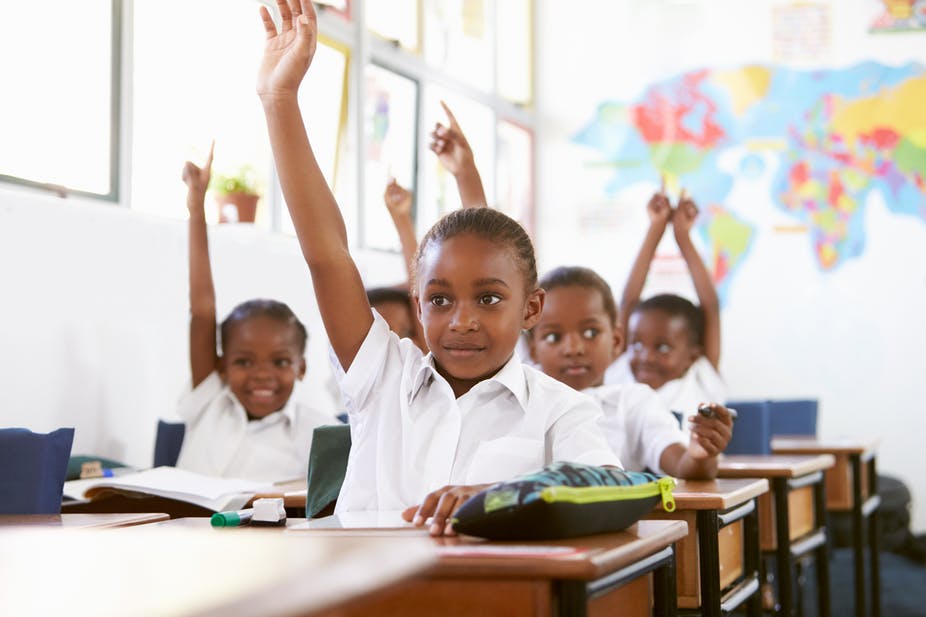
Except for Afrikaners, South Africans prefer their children to be taught in English

Steven Gordon, Human Sciences Research Council and Jaqueline Harvey, Human Sciences Research Council

English is only one of 11 official languages spoken in South Africa. It’s currently the preferred language of education and is used in many of the nation’s schools. But most children entering the education system are not native English speakers and many are still in the process of learning English by the time they arrive at school.

The main language of instruction in education influences academic and career progress. Oral language proficiency is a foundational skill that’s required to develop the ability to read which in turn is required, together with writing, for all types of learning.

Language use in schools has been a focus in both national and international research. It is largely agreed that learners should be taught in their home language. However, many countries continue to promote English instruction including Kenya, India, and South Africa. The conflict between what is being implemented in schools and what is recommended by the available research remains unresolved.

There is a strong body of work that shows that learning problems can develop if the language in which a child has oral proficiency is not the same as the language of instruction. As a result, policymakers in most countries now recommend home language instruction for the first years of education after which a gradual transition to another language can be made.

But the policy won’t succeed unless there is buy-in from the general public. In designing and implementing education language policy, it’s therefore necessary to understand peoples’ preferences.

We set out to find out what these are in South Africa. We examined public attitudes towards main language of instruction at different levels in the South African education system. Preferences for language of instruction at different stages of education was examined for the period 2003–2016 and this allowed us to map any changes in attitude.

We found that a majority of the population favoured English as the language of instruction at all levels of education. It is clear that people are unaware of the benefits of home language instruction and may resist efforts to promote the teaching of African languages in South African schools.

The research

We used data from the South African Social Attitudes Survey for this study. The survey series is nationally representative and is used to track public attitudes on important social and political issues. The series is administered by the Human Sciences Research Council and has been conducted annually since 2003.

In each round of the survey, people were asked: “What do you think should be the main language of instruction in: (1) grade 1–3; (2) grade 4–9; (3) grade 10–12; and (4) higher education?”

In 2003 about half (55%) of the population preferred English as the language of instruction against about two-fifths (41%) selected home language at the foundation phase (grades 1-3).

Thirteen years later popular support for English as the language of instruction during the foundational phase had gone up to 65% – the highest level since polling began. The most recent survey, the results of which have not yet been published, found little change in 2018.

The preference for English extended into later years of education too. In fact, we found that the number of people supporting English rose the higher up the education ladder went. In other words, the more advanced the phase of education the smaller the share of the public supporting options other than English.

There was remarkably little variation in attitudes for the last decade indicating the durability of these preferences. And over the ten years attitudes among South Africa’s population groups remained very similar.

The best way forward

A preference for English over home language may be motivated by economic concerns. Research has shown that English proficiency in South Africa is linked to socio-economic advancement.

Another reason for the popularity of English as a language of instruction could be the general lack of school resources and training required for educators to teach in many of the country’s African languages. When compared to other languages, greater resources are devoted to helping teachers educate learners in English.

The disparity in resources could, in turn, reinforce the view that English is superior to African languages.

What next

We believe that post-colonial education policies should nurture multilingualism and promote all languages. This will require a well-resourced programme to overcome common misconceptions about the alleged inferiority of African languages. The development of compelling teaching materials for African languages is required as well as educating teachers on how to use such materials. Although there may be opposition from some, learners will ultimately benefit from such a programme.

The government is moving in this direction. The Department of Basic Education recently launched the Incremental Implementation of African Languages programme which aims to strengthen the teaching of African languages in South African schools.

The goal is to reach 3,558 public schools across all grades by 2029.

But, as our research shows, South African policymakers must convince the public to support home languages as the main language of instruction if the programme is going to succeed.The Conversation

Steven Gordon, Senior research specialist, Human Sciences Research Council and Jaqueline Harvey, Researcher, Human Sciences Research Council

This article is republished from The Conversation under a Creative Commons license. Read the original article.
Huge grants to low-income students who never graduate

Billions of taxpayer dollars go to college students who never end up with a diploma in their hands, a new report found.

Pell grants–which are given to low-income families and, unlike student loans, do not need to be paid back–are the costliest education initiative in the nation. But little official data exists on whether they are a good investment, according to the education watchdog Hechinger Report.

Education Department Undersecretary Ted Mitchell last month lauded Pell grants as “one of the key levers that we have” to increase college completion rates. But an analysis published Monday by Hechinger revealed that Pell recipient graduation rates are often considerably lower than the overall graduation rate–even six years after a student starts college.

To make matters worse, the government keeps no official tally of what proportion of those who receive the grants end up getting degrees–despite the fact that money spent on Pell grants has quadrupled since 2000.

“There’s two scandals here. We have spent over the last decade one quarter of a trillion dollars on Pell grants, and if you ask the federal government what percentage of those kids graduate from college, they can’t tell you,” said Richard Vedder, director of the non-profit Center for College Affordability and Productivity. “The second scandal is as far as we can estimate, that graduation rate is embarrassingly low.”

Vedder has done research on Pell recipient graduation rates, which concluded that only about 40 percent Pell recipients graduate, significantly lower than the national average of about 60 percent.

Taxpayers paid $31.4 billion on Pell grants in fiscal year 2015, and since 2000, they have poured $300 billion into them, Hechinger reported.

Source: NBC News

Extent of black matric cheating exposed

Basic Education Minister Angie Motshekga has revealed the extent to which teachers helped matric pupils cheat in last year’s exams.

Motshekga yesterday disclosed some of the evidence given during hearings into group cheating at some KwaZulu-Natal and Eastern Cape matric exam centres, where only black schools are implicated.

She said teachers and principals who encouraged group copying, would be criminally charged.

The continuing investigation will now focus on teachers, principals and invigilators.

A KwaZulu-Natal pupil wrote on an exam answer sheet: “We can now continue.”

This, according to Motshekga, “clearly indicated . that someone was dictating answers to them”.

She said that in other instances teachers had simply walked into exam rooms and told invigilators to leave so that they could help their pupils.

“The papers are opened at the school, so teachers would not have had sight of the paper before. So, I think, as the teacher looked at the paper, she found there was a section she had not taught the class and quickly rushed to the exam room to dictate it to them.”

A KwaZulu-Natal pupil admitted during the hearings to cribbing.

Motshekga said the exam results of pupils found guilty of group copying would be nullified.

The department launched the investigation into cheating allegations involving 153 exam centres in Eastern Cape, KwaZulu-Natal and Gauteng earlier this year.

More than 3000 pupils implicated in group copying will sit for this year’ s exams in October and November.

Only one KwaZulu-Natal pupil, among a group of 2307, was cleared of cheating charges; 56 confessed.

Of the 720 implicated in Eastern Cape, 26 were cleared and 17 confessed.

Former acting director-general of the Department of Basic Education Paddy Padayachee said security would be improved.

Source: timeslive

Violence rocks PE

Violent protests rocked Port Elizabeth’s northern areas on Monday.

On Monday areas – including Gelvandale and Bethelsdorp – were ablaze over the closure of 33 schools due to a lack of teachers.

Talks between angry residents, principals, the Eastern Cape Education Department and other interested parties were expected to continue on Tuesday to avoid a repeat of Monday’s violence.

Protesters blocked roads with burning barricades, forcing the deployment of Public Order Policing and Tactical Response Teams to control the situation.

Photos and videos uploaded onto social media showed some protesters making petrol bombs. Others displayed spent bullet casings, claiming live ammunition had been fired into the crowd.

“It has calmed down a lot. The situation is slowly returning to normal. There are negotiations taking place at the moment,” she said on Monday evening.

Parents, pupils and even taxi drivers reportedly took part in the protests that erupted on Monday morning, with protesters also complaining about a lack of infrastructure at the schools, apart from the closures and a lack of teachers.

Police said: “Criminal elements seized the opportunity” to loot a shop in West End but law enforcement officers were able to disperse the crowd and prevent any looting from taking place.

“Six police vehicles and one vehicle belonging to a resident were damaged.”

Source: IOL

Afrikaans schools win first round against forced anglicization

Disgruntled parents of single-medium Afrikaans schools dragged Gauteng education MEC Panyaza Lesufi to court and won the first round.

Fedsas said Lesufi’s decision to make parents apply for admission electronically was merely an effort to take control of the placement of pupils.

The Federation of Governing Bodies of SA Schools’ (Fedsas) chief executive officer, Paul Colditz, said Lesufi’s decision undermined the Schools Act, which stated school governing bodies are responsible for schools’ admissions policy.

The South Gauteng High Court on Tuesday reinforced the status quo when it ordered that a process by which school governing bodies submit to school district directors lists of both successful and unsuccessful candidates for the 2016 school year, should continue.

After lengthy court proceedings, the Federation of Governing Bodies of South African Schools (Fedsas) won part of its battle in an urgent interdict against what it sees as a deliberate strategy by the Gauteng education department to turn Afrikaans-only schools into English institutions.

The MEC announced earlier this year no parent should have to queue outside school buildings to try to ensure admission to a school of their choice. These application should be done electronically at all Gauteng schools.

Fedsas had sent an urgent letter to the head of education in Gauteng, Boy Ngobeni, demanding the allegedly irregular requirements of the electronic system be retracted.

Fedsas came into possession of leaked departmental documents last month, in which only Afrikaans single-medium schools, 124 of them, were to be targeted to become English schools.

The education department insisted on moving forward with the electronic admission selection, which resulted in Fedsas taking the department to court. Colditz said the e-platform in its current form does not allow for schools’ admissions and language policy, which also goes against the Schools Act.

“The e-platform takes into account two criteria for placement: whether a parent or guardian lives or works within the school’s area and whether an applicant has a sibling in the same school.”

Colditz said Lesufi’s copy-and-paste project would destroy schools instead of building them up.

“Parents take their children to school looking at the culture, language and the standard of the school. Letting this e-platform take over would mean the school would not have control over who they admit.

“We request parents to apply at the school of their choice as a matter of urgency and to avoid applying electronically. Applications via the central e-platform will lead to schools having no record of applications,” said Colditz.

“It is shocking that, even though Fedsas was successful with a court case in which large sections of the admissions regulations were scrapped in 2013, the department is still interfering with schools’ admissions and language policies.

“We want to make it very clear Fedsas is in favour of cooperating with education role-players.”

Colditz said improved processes “should not complicate matters further”.

Source: The Citizen

Thousands sign petition to return to Europe

The petition on the website www.change.org, had about 15000 signatures last night.

It calls for the EU to allow white South Africans, Namibians and Zimbabweans to be given automatic European citizenship.

The petition has over 15000 signatures.

Rodrigo de Campos, a Brazilian, is behind the campaign and his motivation is that “the white South African population currently faces ethnic cleansing and persecutions at the hands of the ANC government, the Economic Freedom Fighters and various individual anti-white aggressors. Over 4000 white farmers have been brutally murdered, often including torture, rape and mutilation.”

Neither the ANC nor the EFF could be reached for comment last night.

His rationale, he said, was “based on the Israeli government’s policy of allowing all Jews the right to return to Israel”.

“We believe it is not only advisable but morally obligatory that Europe should allow all white South Africans the right to return,” he said.

It is not clear from De Campos’s Facebook profile why he would campaign for white South Africans.

Some of those in support of the petition have given their reasons on his page.

Susan Mulder wrote: “My life and the lives of my children are at risk daily. We love SA but are no longer welcome in the country our ancestors built. We have no option but to ask for your help.”

“I am a naturalised British citizen yet my mom is stuck on her own in South Africa. She should be growing old with her daughter and granddaughter. She has been attacked. An AK47 has been held to her head. She is alone and traumatised. She deserves to be free from living in fear,” said Marischka Davies.

Presidency spokesman Harold Maloka declined to comment. So did cabinet spokesman Phumla Williams and Clayson Monyela of the Department of International Relations and Co-operation.

Black political analyst Shadrack Gutto sneered at the petition and said whites needed to be “educated”, also globally.

SA ranks last in maths and science

The World Economic Forum (WEF) has released its Global Information Technology Report 2015, which ranked South Africa last in the quality of mathematics and science education.

South Africa also finished close to last – 139 out of 143 countries – when looking at the overall quality of its education system.

The WEF’s Global Information Technology Report 2015 ranks SA’s mathematics and science education quality lower than Angola, the Dominican Republic, and Mozambique.

It should be noted that these rankings are based on the perceptions of business leaders, and make use of the WEF’s annual “Executive Opinion Survey” to establish how well a country’s education system is performing.

In this survey the opinions of business leaders are gathered on a variety of topics.

The WEF’s education quality rankings are an assessment of the quality of mathematics and science graduates.

Obama silent on immigration before Black Caucus

Weeks before he will reportedly enact a massive executive amnesty for illegal immigrants, President Barack Obama was silent on immigration when he addressed the Congressional Black Caucus’ Phoenix Awards Dinner on Saturday evening in Washington, D.C.

Critics of amnesty, like U.S. Civil Rights Commissioner Peter Kirsanow, have warned that granting work permits to millions of more illegal immigrants would have a disparate impact on black workers trying to move up the economic ladder. The black unemployment rate is 11.2%, and a record number of blacks are not even in the workforce.

“Our work is not done when working Americans of all races have seen their wages and incomes stagnate, even as corporate profits soar; when African-American unemployment is still twice as high as white unemployment; when income inequality, on the rise for decades, continues to hold back hardworking communities, especially communities of color,” Obama told the audience. “We’ve got unfinished work. And we know what to do. That’s the worst part–we know what to do.”

Immigration reform was conspicuously absent from the to-do list on Saturday evening.

Obama mentioned investing in “infrastructure, and manufacturing, and research and development that creates new jobs.”

“We’ve got to keep rebuilding a middle class economy with ladders of opportunity, so that hard work pays off and you see higher wages and higher incomes, and fair pay for women doing the same work as men, and workplace flexibility for parents in case a child gets sick or a parent needs some help,” he concluded. “We’ve got to build more Promise Zones partnerships to support local revitalization of hard-hit communities. We’ve got to keep investing in early education. We want to bring preschool to every four-year-old in this country. And we want every child to have an excellent teacher.”

He talked about investing in community colleges and expanding pell grants to “make college more affordable.. because every child in America, no matter who she is, no matter where she’s born, no matter how much money her parents have, ought to be able to fulfill her God-given potential. That’s what we believe.”

But not one mention of needing comprehensive amnesty legislation.
Illegal immigrants who receive temporary amnesty and work permits would displace and compete with black workers for jobs, and perhaps that is why Obama, who has touted the economic benefits of immigration reform, was silent on amnesty. As Breitbart News has reported, only 13% of black Democrats complained in a recent Pew Research national poll that “Democrats are not pushing harder to allow illegal immigrants to remain in the country.” And a recent New York Times/CBS poll found that a “plurality of Americans (39%) would be less likely to support a candidate who supports a pathway to citizenship for illegal immigrants.”

Kirsanow, who has also urged the Congressional Black Caucus to not support amnesty legislation warned Obama earlier this year about “the disastrous effect of illegal immigration on the employment of all Americans, but particularly black Americans” and said that Obama’s “proposed executive order is unfair to people who are attempting to immigrate legally.”

“Any grant of legal status will serve as a magnet to prospective illegal immigrants and further depress employment opportunities and wages for African-Americans,” Kirsanow wrote Obama in August. “Given that the labor force participation rate is at an historic low, the unemployment rate is 6.2 percent, and there has been a precipitous decline in household wealth, the timing for such a grant of legal status could not be worse.”

Obama’s approval ratings on illegal immigration have hit all-time lows in numerous national polls. One poll in August found that “90% of likely voters feel that “U.S.- born workers and legal immigrants already here should get first preference for jobs.” And Obama told the audience that “we understand our work is not done until we get the kind of job creation that means everybody who wants work can a find job.”

Obama, who delayed is executive amnesty because Senate Democrats urged him to help them retain control of the Senate, asked black voters to turn out for the midterm elections.

Source: Breitbart

Thousands of black teenagers go on rampage in Joburg CBD

Thousands of teenage school children went on the rampage Johannesburg CBD, reportedly looting and stealing from shops and vendors.

Sapa reported that the group was in Albertina Sisulu and Eloff streets around 14:00, and majority were standing in front of the education department building.

Metro police spokesperson Wayne Minnaar said they do not have any information on why the children started wreaking havock.

They were seen looting an alcohol truck in Claims Street while workers were offloading cases. They also gathered outside a restaurant singing “we are hungry”.

The owner of an art gallery in the CBD, told News24 that a group of learners in school uniforms were looting from vendors in the streets outside their building.

“The gates to the gallery had to be locked. We are not sure what is going on or where they are coming from.”

Mobs of children were seen running down the street just after lunch time.

One resident said the children complained that they were taught “in fear”. English is the language used in most black schools.

People in the CBD have tweeted that the children are armed and threatening vendors and shop owners.

The return on higher education

While U.S. schools have remained competitive globally in the face of declining state subsidies and rising tuition costs, it’s fair to ask whether students are getting what they pay for.

Some argue that too many degrees are a waste of money. The return on higher education would be much better if college were cheaper.

The cost of higher education has surged more than 500 percent since 1985, illustrating why there have been renewed calls for change from both political parties.

Tuition expenses have increased 538 percent in the 28-year period, compared with a 286 percent jump in medical costs and a 121 percent gain in the consumer price index. The ballooning charges have generated swelling demand for educational loans while threatening to make college unaffordable for domestic and international students.

College graduates aged 25 to 32 who are working full time earn about $17,500 more annually than their peers who have only a high school diploma, according to the Pew Research Centre, a think-tank. But not all degrees are equally useful. And given how much they cost—a residential four-year degree can set you back as much as $60,000 a year—many students end up worse off than if they had started working at 18.

Arts and humanities courses all nourish the soul, but not all fatten the wallet. An arts degree from a rigorous school such as Columbia or the University of California, San Diego pays off handsomely. But an arts graduate from Murray State University in Kentucky means earning less over 20 years than a high school graduate, after paying for his education.

Of the 153 arts degrees in the study, 46 generated a return on investment worse than 20-year treasury bills, and of those, 18 offered returns worse than zero.

Technology will give colleges a chance to cut costs and raise quality. Online education will accelerate the trend. In 2012, 6.7m students were taking at least one online course.

Source: The Economist

Exploding demand for higher education worldwide

International student enrollment is on the rise at U.S. colleges.

In total, 764,495 international students were enrolled at colleges and universities across the United States during the 2011-2012 school year, up 5.7 percent from the previous year, according to a November 2012 report from the Institute of International Education.

The U.S. News Best Colleges rankings can help prospective American and international students refine their list of target schools in the United States, but some of the world’s best universities can be found outside the U.S. as well.

China, Australia, the United Kingdom, Germany and France all attract more than 100,000 international students each year, according to IIE data.

Latin America, the Middle East and other parts of Asia have also seen an uptick in international student enrollment over the past decade, according to a study by the Organisation for Economic Co-operation and Development.

One explanation for the trend toward international education: an “exploding demand for higher education worldwide,” the OECD notes.

Studying in a foreign country – whether for a semester, a year or for an entire degree – also helps prepare students to enter a high-tech and highly global economy, says Allan Goodman, president of IIE.

Executives at multinational corporations might work in nine or 10 different countries throughout their career. Those who stay closer to home will likely still work with people from other cultures on a regular basis, says Goodman, who co-authored “A Student Guide to Study Abroad.”

“If you’re the top student, but you’ve never sat next to a Chinese or Brazilian, or had an argument with an Indian or a discussion with a Frenchman, you’re not going to be prepared to be a worker in the global marketplace,” he says.

Sorting out where to study and why can be a multipronged equation.

For some, language is a primary factor. Students either want to learn in their native language or become fluent in another. Others want to gain business expertise abroad in order to get a leg up in an increasingly competitive workforce.

Many international students also choose where to study based on where they hope to start their careers, says Daniel Obst, IIE’s deputy vice president of international partnerships in higher education.

“There’s a great opportunity in another country to do academic work, but also then connect it to your first job,” he says.

Obst has personal experience as an international student. Born and raised in Germany, Obst earned his bachelor’s degree in the United States and his master’s in England. His academic interests motivated him to study outside of Germany, he says.

“I wanted to do international relations, and back then they didn’t have that as a degree program in Germany. They had political science,” he says.

Whatever the motive to study overseas, each major region has something to offer students bent on studying overseas.

Europe

International students accounted for 18.6 percent of total higher ed enrollment in the U.K. in 2010-2011, according to IIE.

Students can venture outside of the U.K. and still get a great education in Europe.

Schools such as the Swiss Federal Institute of Technology, Ecole Normale Superieure de Paris, the University of Copenhagen in Denmark and Ruprecht-Karls-Universitat Heidelberg in Germany also have strong global reputations.

Asia

Students from China, India and South Korea account for 52 percent of the 4.1 million international students worldwide, according to the OECD. But the region has also emerged as a top destination for foreign students.

Education is about values… not a commodity

Top ten academic performers at Hoërskool Wagpos, an Afrikaans government school in South Africa

by TAU Bulletin

And a school matriculation certificate is not a ticket to the corner office, the VIP lift and the executive washroom.

Education is holistic: it is not a voucher for a comfortable life, nor a ticket to the turnstile of good fortune. The dictionary defines education as “the systematic development and cultivation of the mind and other natural powers. It begins in the nursery, continues through school and also through life. The impartation of knowledge by others is but a part of education.” The dictionary’s synonyms for education include “breeding, cultivation, culture, development, discipline, information, instruction, knowledge, learning, nurture, reading, schooling, study, teaching, training and tuition”.

Education is an intrinsic ingredient of a culture: it is the living embodiment of the passing from generation to generation the means by which the people of that culture conduct their lives.

The exuberance displayed by South Africa’s Minister of Basic Education Ms. Angie Motshekga when she recently announced the matriculation pass rate for South African pupils had jumped to 76.5% (from 60,6% in 2009) was met with scepticism and even derision. According to AfriForum, the actual pass rate was less than 38%, this because only half of the students who enrolled at the beginning of their school careers finished to write Grade 12, the matric year.

Mr. Tinyiko Maluleke, deputy vice chancellor of student affairs at the University of Johannesburg asked in a hard-hitting article (Independent 5.1.14) whether the matric certificate could be trusted. He said the certificate was in danger of “meaninglessness, worthlessness and irrelevance. The country’s entire education system is at issue, and 20 years of democracy have not taught teachers and principals (of mainly black schools) to stop striking during school hours.”

Professor Jonathan Jansen, rector and vice-chancellor of the University of the Free State weighed in, saying SA’s education system is a “fraud”. He concurred with other critics that the results proffered by the Minister were “grossly misleading”. “We know that the top 5% of Grade 6 pupils know more mathematics than the bottom 20% of the maths teachers in the same grade. We know that South Africa was dead last, just above Yemen, at the bottom end of international rankings on science and mathematics.” Mediocrity has been institutionalized, he declared, while “government officials hope we are all ignorant enough to accept the ‘official lies’” because of the way the so-called pass figures were manipulated. Pass rates were “pulled up by white kids” said Graeme Bloch of Wits University. “Sorry to be racial, but if you are born on the right side of the tracks, you have a 100% chance of getting matric”.

(We must pause here to comment on this “if you are born” comment. Who you are when you are born is the result of your genetic background, a consequence of your family’s ancestral lineage. And if that history is replete with achievement, initiative, hard work, the ability to overcome obstacles and a skill and desire to move forward and improve yourself, then comparing those “born on the right side of the tracks” with those ”born into” poverty is fallacious. This delusion infers that there is some sort of pantry in the sky which dishes out ways of life to some, and other less salubrious ways of life to others.

Everyone in South Africa is a genetic descendant of his ancestors. Blaming poor education results on the “privilege” of some is disingenuous. Cultural backgrounds have played a huge role in education result disparities – Africans had no written word, while South Africa’s first-world educational system was brought to this country by European settlers who then superimposed it on Africans. Similar occurrences took place during the colonial times in other new-world lands.

As well, using the term “previously disadvantaged” (liberally utilized to neutralize white academic achievements) is to refute history. Indeed, Africans were actually advantaged by European settlement. From where did they receive everything they have now – their ability to communicate in a world language, their education, health, legal and legislative system, and the country’s first-world infrastructure?)

The laughing stock

Setting a matriculation pass mark of 30% makes South Africa the world’s laughing stock. Average grade three literacy achievements only reached 35%, with numeracy at 28%. In grade six, the language average is 28% and mathematics is 30%. These figures are a reflection of how the government has managed an education system not generic to Africa. Cultural and language problems have been swept under the carpet in the government’s rush to “prove” that education is improving, when the opposite is in fact true.

Education is not just learning – it is how you interpret, utilize and develop that which is taught. In a country where mediocrity is the norm, it is not surprising that many waving their certificates cannot get work. Dumbing down the worth of this certificate has caused heartache to millions. They were led to believe that their 30% pass would get them a job. The government has sacrificed young people as scapegoats to foster the illusion that the state’s education system is delivering.

Quality is the name of the game. Said Anne Oberholzer, Independent Examinations Board’s (IEB) CEO: “If I’m prepared to spend my salary on my child’s education … rather than buying clothes or a fancy car, you can’t stop me from doing that”. The excellent IEB pass rate was the result of “extra hard work” rather than necessarily school resources. “Success at matric starts way back – matric is a combination of all the years of school exposure”, she said.

It is a simple case of values and norms. If black teachers go on strike during class teaching times, if pupils burn down schools, if ministers don’t get school books to pupils in time, and if the government shows by example that one really doesn’t need a good education to get rich as a party hack with a cushy government job (where capacity doesn’t even come into it), why bother to learn? Why have unbelievably bad results in black schools earned the ire of government when at the same time they show by their actions you don’t have to get good marks to join the government jobs gravy train?

And why try to achieve through hard work and sacrifice when government will legally provide you with a goodly share of someone else’s company just because you are black? In both the public and private sector, there are ample opportunities to feed at the trough, so why struggle at school and university? This same hypocrisy extends to government complaining about the quality of teachers, while universities across the board give preference to blacks for academic posts. A University of Johannesburg advertisement for the Deputy Vice Chancellor: Strategic Services (24.1.14) says it is “committed to taking persons with disabilities and the potential of historically disadvantaged individuals into account in making this appointment”. So if merit is not a criteria for university posts, how will government produce good teachers, and how can this in the end provide competent students and graduates for the country’s future?

Entrepreneurship

Entrepreneurship can’t be taught, yet it is the well-spring of all economies. It emanates from within and it is difficult, fraught with risk and sometimes very disappointing. It is easier to leaching on someone else’s success, a path made easier by government policies. While informal entrepreneurship is well entrenched in South Africa – small traders in townships and city streets sell goods someone else has produced – this doesn’t grow the economy.

Where is black entrepreneurial contribution to the formal economy? A weekly Pretoria is enthusiastically supported by locals and the diplomatic community. Selling mostly food, more than seventy stalls are manned by whites, Portuguese, Indians, a Moroccan family, Greeks, some Chinese. There is not one black South African stall. What is the point of an education that cannot extend to doing something for yourself?

Farming

Paging through any SA farm magazine shows the extent to which farmers have themselves developed and streamlined their profession. They haven’t just studied agriculture, they have applied it, improved on it, created new processes, adapted international methods to South African conditions and perfected agriculture to such an extent that 35 000 of them can feed 53 million people. Education was just the beginning. Without application, initiative, resilience, the ability to overcome hardship and plain hard work, where would South Africa be in terms of food security?

Most government officials and politicians see themselves as an intrinsic part of first world South Africa. They wear the clothes and drive the cars, but many do not exhibit the values generic to this first world. Education in this context should mean:

  • solving the problem yourself, not hiring a consultant;
  • making sure the traffic lights work and if they don’t, ensuring that a point officer keeps the traffic flowing until the robot is fixed;
  • making sure our cities are not littered and polluted until they look like Nairobi or Lagos;
  • answering the phone, replying to the e-mail and delivering the service to the people who pay your salaries;
  • owning up, with an apology, to the fact that many in government are incompetent and are unable to run South Africa as it should be run;
  • accepting criticism without retaliation in the form of racism accusations;
  • deciding that police asleep on duty, taking bribes and generally running amok with weapons is not worthy of a law-enforcement body;
  • immediately sacking all persons with criminal records employed in government;
  • not contemptuously ignoring court judgments;
  • ridding yourself of a completely unjustified entitlement syndrome because you didn’t create what you are now enjoying;
  • not wasting taxpayer’s money with impunity, and being contemptuous when confronted with this fact;
  • not handing over productive farms to incompetents and admitting this policy is a failure;
  • trying to emulate those who achieve instead of denigrating them and accusing them of being ”privileged”.

A point to ponder about education: Zimbabwe president Robert Mugabe has three university degrees, but he remains a savage tyrant, contemptuous of his people’s quality of life, of democracy and of what others think of him. Education without values is truly just a piece of paper!

Limpopo province has text books but some roofs are missing

Semaneng Secondary School in Limpopo has a damaged roof

Both pupils and and teachers in rural Limpopo say they are preparing for another year of so-called tree schools, pit toilets, overcrowding in classrooms without roofs and even snake bites, reports Eyewitness News.

The Limpopo province has the highest percentage blacks of all South African provinces, with whites making up less than 1% of the population.

After two years of textbook delays in the troubled province, pupils say they are grateful to have been given their learning material on the first day.

But they admit this is cold comfort without a roof over their heads.

On Wednesday, hundreds of boys queued outside a small concrete barrier housing two tiny holes in the ground, hoping to relieve themselves before their break ended

It was at one of these makeshift toilets at Tsogang Primary School that a young boy was bitten by a venomous snake late last year.

The boy’s teacher says he was lucky to survive, but will no longer go near the pit toilets.

During a similar queuing procession at the Motsipa Secondary School in Bolobedu, a grade 9 pupil told Eyewitness News he often wishes he was born in another province.

“I feel like I can cry…Eish Limpopo”.

The child’s visibly concerned maths teacher later looked up at the cloudy sky and said he was worried about having to cancel lessons, should the rain come down.

“We have no roof and no chance.”

Just a few metres away, his colleague placed a few bent chairs under a tree, where Grade 8s would be given their English lesson.

SA matrics ‘still perform at lower levels in maths’: Umalusi

MATRIEKEKSAMEN 007While a general dumbing down of the school curriculum has ensured rising pass rates for South African matrics, the standards body Umalusi says that “in some of the key subjects such as mathematics the majority of learners still perform at lower levels”.

In statement released last night, Umalusi further expressed its concern about the quality of markers in the matric examinations.

While the setting and moderation of question papers seem to have stabilised, the quality of marking still poses a significant challenge in many subjects. In this regard we must reiterate our call that those who wish to mark exams should take a competency test on the subject they wish to mark. Markers with limited subject knowledge tend to disadvantage top learners who produce innovative and original responses to questions. This is particularly the case in open-ended questions where innovative and creative responses are provided by the learners.

One of the easiest subjects in which to obtain a pass, apart from the mandatory “Life Orientation” is in an African Home Language. According to Umalusi:

While progress has been made in ensuring that African Home Languages are assessed at an appropriate level, there remain some significant challenges to be addressed. These challenges must be addressed without delay in order to ensure that these languages occupy their rightful place in our constitutional order.

Average is just not good enough; we must set our sights higher!

The Umalusi Council expressed its satisfaction that ” the system is stabilising well and has reached a significant level of maturity as evidenced by the high percentage of subjects whose raw marks were accepted after the moderation process”.

However, in about 50% of subjects, “raw marks”  were adjusted during a standardisation process which may not exceed 10%.