A ‘graffiti’ wall reveals women’s stories from the Anglo-Boer War

Tim Forssman, University of Pretoria

About 80km east of Pretoria in South Africa, near the town of Bronkhorstspruit, there’s a rocky outcrop in a secluded ravine in the countryside. There’s nothing remarkable about this outcrop – which has, over the years, made it a good place to shelter or hide. But the rock shelter’s back wall contains a remarkable piece of South African history.

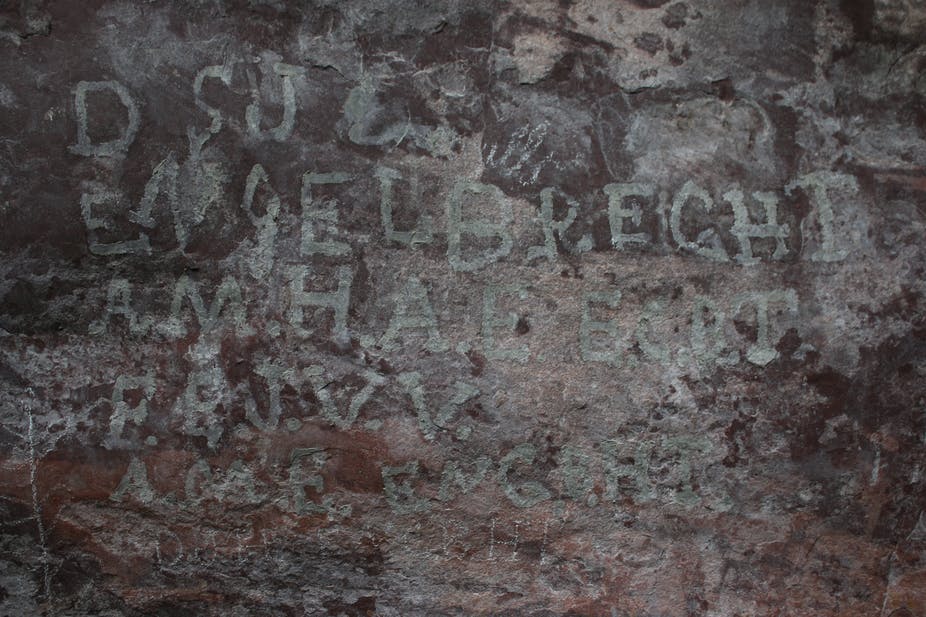
There you can see images of women in crinoline dresses, as well as names and initials, painted onto the rock. The surname ‘Engelbrecht’ is repeated in several places with the initials ‘A.M.H.A.E.’ as well as ‘D.S.J.’ and ‘A.M.E.’. Other names and initials include ‘J.D. van Schalkwyk’ and ‘E(F?).B.J.V.V.’.

This “graffiti” was made by Boer women hiding from British soldiers during the South African War, also known as the Boer War. “Boer” is an Afrikaans word which translates to “farmers” but also refers to the forebears of South Africa’s Afrikaans people. These women left their farm homes and lived outdoors in the countryside to avoid being captured by British forces and sent to a concentration camp.

My colleagues and I wanted to know more about the site’s occupants, their lives while in hiding, and the “graffiti” they left behind. So we analysed these painted images, as well as others left there earlier by different groups like indigenous hunter-gatherers, herders and farmers. This helped us to understand the site’s painted sequence and the context of its occupation over time. An examination of family stories helped fill in the gaps in the women’s stories.

Stories like the kind stored in this place, known as Telperion Shelter, provide history to a landscape and people. Women were important participants in the war through the contributions and support they provided to commandos, units of Boer fighters. This is seldom spoken of; their stories and experiences are neglected. Telperion confronts these hidden stories.

The South African War

The South African War was declared between the British and Boers in 1899 after a period of economic and political instability.

The scattered Boer troops engaged in guerrilla tactics, crippling British resources, terrorising battalions and cutting off supply lines.

Two of the strategies the British used had devastating effects on the Boers’ home life. One involved burning down farmsteads and destroying crops and livestock. The other was to intern the Boers in concentration camps.

Women left without homes would often be forced to subsist in the veld – the open, uncultivated grasslands. It was a dangerous option: they faced capture, retribution, food insecurity, disease and death. But it meant avoiding the concentration camps, which were overcrowded, undersupplied and poorly maintained, with a constant threat of disease. Nearly 50,000 people died in the camps.

While in the veld, women were also able to give their husbands in the commandos supplies and information about soldier movements. This was often vital to a commando’s ability to continue fighting. Going to the veld, in this sense, was about resilience, rebellion and defiance. Unfortunately, because most of these stories, histories or experiences were never written down or recorded, they are poorly known.

Stories on the stone

When we first visited Telperion Shelter, the farm manager told us a story about those who had lived there. Black, Sotho-speaking families and white Boer families hid there from patrolling British troops. They set up a small garden inside a poplar tree thicket nearby and even kept a pig.

One day the pig escaped and nearby troops happened upon it; this led them to discover the families. All were captured and sent to a concentration camp.

Nothing more is known. But we felt that the paintings inside the shelter might tell us more about the site’s occupants and their experiences.

The “graffiti” includes the names I’ve mentioned as well as images of two groups of people. One group is five women wearing large crinoline dresses, which would have been worn at the time of this war, and holding what look to be stalks, which could be maize or something yet to be identified. The second group is to the right and almost identically resembles Sotho images of people, painted by earlier Sotho communities using the site for boys’ initiation. It is drawn in the same paint as the women. These two groups might reflect the two occupant communities using the shelter.

Our most important task was to find out who used the site and what happened to them; if we could do so we would be able to assess whether the story we were told was accurate and perhaps add to it. Fortunately, all of the concentration camp records have been digitised and are available online.

Poring through these records, we were eventually able to identify Alida Maria Hendrika Aletta Engelbrecht (A.M.H.A.E) and her husband and children, some of whom also have their names painted in the site. According to the records, she and her children were all captured on the farm Sterkfontein, where Telperion Shelter is found. It appears as though we have found the people in the story and who used the site.

These images do more than just verify the story we were told. They add layering to it. And they commemorate the experiences that many women and children underwent and the difficulties of living in the veld. Ultimately, they are a different form of story telling.The Conversation

Tim Forssman, Senior lecturer, University of Pretoria

This article is republished from The Conversation under a Creative Commons license. Read the original article.

Afrikaans schools win first round against forced anglicization

Disgruntled parents of single-medium Afrikaans schools dragged Gauteng education MEC Panyaza Lesufi to court and won the first round.

Fedsas said Lesufi’s decision to make parents apply for admission electronically was merely an effort to take control of the placement of pupils.

The Federation of Governing Bodies of SA Schools’ (Fedsas) chief executive officer, Paul Colditz, said Lesufi’s decision undermined the Schools Act, which stated school governing bodies are responsible for schools’ admissions policy.

The South Gauteng High Court on Tuesday reinforced the status quo when it ordered that a process by which school governing bodies submit to school district directors lists of both successful and unsuccessful candidates for the 2016 school year, should continue.

After lengthy court proceedings, the Federation of Governing Bodies of South African Schools (Fedsas) won part of its battle in an urgent interdict against what it sees as a deliberate strategy by the Gauteng education department to turn Afrikaans-only schools into English institutions.

The MEC announced earlier this year no parent should have to queue outside school buildings to try to ensure admission to a school of their choice. These application should be done electronically at all Gauteng schools.

Fedsas had sent an urgent letter to the head of education in Gauteng, Boy Ngobeni, demanding the allegedly irregular requirements of the electronic system be retracted.

Fedsas came into possession of leaked departmental documents last month, in which only Afrikaans single-medium schools, 124 of them, were to be targeted to become English schools.

The education department insisted on moving forward with the electronic admission selection, which resulted in Fedsas taking the department to court. Colditz said the e-platform in its current form does not allow for schools’ admissions and language policy, which also goes against the Schools Act.

“The e-platform takes into account two criteria for placement: whether a parent or guardian lives or works within the school’s area and whether an applicant has a sibling in the same school.”

Colditz said Lesufi’s copy-and-paste project would destroy schools instead of building them up.

“Parents take their children to school looking at the culture, language and the standard of the school. Letting this e-platform take over would mean the school would not have control over who they admit.

“We request parents to apply at the school of their choice as a matter of urgency and to avoid applying electronically. Applications via the central e-platform will lead to schools having no record of applications,” said Colditz.

“It is shocking that, even though Fedsas was successful with a court case in which large sections of the admissions regulations were scrapped in 2013, the department is still interfering with schools’ admissions and language policies.

“We want to make it very clear Fedsas is in favour of cooperating with education role-players.”

Colditz said improved processes “should not complicate matters further”.

Source: The Citizen

Flickr tags blacks as ‘apes’

Flickr is facing a user revolt after a new auto-tagging system labelled images of black people with tags such as “ape” and “animal” as well as tagging pictures of concentration camps with “sport” or “jungle gym”.

The system, which was introduced in early May, uses what Flickr describes as “advanced image recognition technology” to automatically categorise photos into a number of broad groups.

For instance, a picture of a newspaper cartoon can be automatically given the tags “drawing”, “sketch”, “cartoon”, “text”, and “writing”, in addition to whatever else the uploader decides to add to the photo. Other tags the system can automatically append include “outdoors” and “blackandwhite” – referring to the picture’s setting and image type.

But the system appears to be misfiring frequently, and often in offensive ways. A portrait taken by Corey Deshon of a black man named William has been auto- tagged with “blackandwhite” and “monochrome” – but also with the words “animal” and “ape”.

The system itself doesn’t appear to be applying race as a factor, since at least one other photo, of a white woman, was also given the “animal” and “ape” tags.

Elsewhere, photos of Dachau concentration camp have been auto-tagged with the “jungle gym”, “sport” and “trellis” tags, while an instantly recognisable photo of the entrance to Auschwitz was given the “sport” tag.

A Flickr spokesperson said: “We are aware of issues with inaccurate auto-tags on Flickr and are working on a fix. While we are very proud of this advanced image-recognition technology, we’re the first to admit there will be mistakes and we are constantly working to improve the experience. If you delete an incorrect tag, our algorithm learns from that mistake and will perform better in the future. The tagging process is completely automated – no human will ever view your photos to tag them”.

The company is already reacting in a piecemeal manner to the mistags, removing the “sport” tag from many concentration camp photos, and apparently removing “ape” from the auto-tagging software’s lexicon entirely (neither of the photos which were tagged “ape” are tagged as such any more, though both still have the “animal” tag).

Source: The Guardian

Wheels reveal foreign policy choices

Joseph Stalin preferred the American Packard Twelve

The cars chosen by presidents, kings, prime ministers and other leaders of the world in the past and today, also reveal their tastes in foreign affairs.

The car fleet of the last Emperor of Russia Nicholas II in 1913 consisted of 29 vehicles and in 1917 there were 46. The Emperor’s main car was a French Delaunay-Belleville. It all ended badly for the ruler as well as the manufacturer, sadly.

When Vladimir Lenin became the leader of the Soviet Russia, strangely, he displayed a love of Western wheels, but apparently not ideology. In the 1920’s Lenin used a Rolls Royce 40/50 Silver Ghost and the only Rolls Royce-based sledge-car in the world.

Those discussions with Rolls about vast snowy landscapes with no roads for travel must have been long and interesting. Lenin famously erected the Gulags, similar to the concentration camps that the British invented in South Africa at the start of the 20th century.

Even more puzzling is that the next leader of the Soviet Union, Joseph Stalin, preferred the American Packard Twelve. A man of slight stature, he stood very tall as one of history’s most prolific killers. But he may not have had the only responsibility.

Stalin’s grasp on the Soviet Union featured many atrocities, including purges, expulsions, forced displacements, imprisonment in labor camps, manufactured famines, torture and good old-fashioned acts of mass murder and massacres.

Actually, most of the deaths are today attributed to Lavrenti Beria, head of Stalin’s Checka, and amounted to some 20 million lives, on top of the estimated 20 million Soviet troops and civilians who perished in the Second World War, for a total tally of 40 million. It was not called the Red Terror for nothing.

Both amoral psychopaths, acting like true gangsters, Stalin and Beria eliminated anyone and everyone who was a threat to their absolute power. Beria eventually killed his instrument of power (Stalin) too, new studies have shown, by poisoning him.

Chinese leader Mao Zedong had a Russian ZIS-110 which he got as a present from Stalin in 1949, although he managed to do a fair amount of killing himself.

Other Soviet leaders stuck with domestically produced cars. Nikita Khrushchev was driven in a ZIL-111 or a ZIL-111B convertible when he visited Berlin in 1960.

Leonid Brezhnev and the last Soviet leader Mikhail Gorbachev were both driven around in a ZIL. The latter had up to 20 of those on each of his foreign visits. This required seven Il-76 transport planes.

Russia’s first president Boris Yeltsin changed to an armoured ZIL-4105 when he became president in 1991. Later he changed it to a Mercedes S500 Pullman Guard (W140).

From then on German wheels seem to have prevailed. Russia’s current President Vladimir Putin is driven in a Mercedes S600 Pullman Guard (W-221).

John F. Kennedy, US president 1961-1963, used a Lincoln Continental. At the time of the assasination in Dallas, Texas, he was in a convertible Lincoln Continental SS-100-Х.

A man of the people, Uruguay’s acting President Jose Alberto Mujica spends almost all of his income on charity and his most expensive belonging is a powder blue VW Beetle, circa 1987.

No rattling along country roads for POTUS to meet fellow Americans, though. US President Barack Obama is transported in the armoured Cadillac One, also known as The Beast. The Bama took no cues from the Batman, clearly. His motorcade counts up to 40 vehicles transported on three Boeing С-17 Globemaster military transport planes.

British Queen Elizabeth sticks to the Bentley State Limousine, created in two copies specially for her in 2002 and British Prime Minister David Cameron still uses a Jaguar XJ X351 which he damaged in a road accident.

French President Francois Hollande changed from an armoured Renault Vel Satis to a Citroen and German Chancellor Angela Merkel drives an armoured Audi A8 L Security. She also has a BMW 760 Li E67 and a Mercedes-Benz S600 Guard V221 at her disposal.

Spain’s new King Felipe has English tastes. He prefers a Rolls Royce.

Julius Malema suddenly turns attention on Afrikaners after British visit

...or not to be? The British puppet dreams of a new scorched earth
…or not to be. The British puppet dreams of a new scorched earth

It never takes too long for any black politician in South Africa to become a paid puppet of a foreign colonial power.

Julius Malema wasted no time. Juju has suddenly turned all his attention on the white Afrikaners calling them the “Broederbond” or “Stellenbosch mafia”.

This happened strangely right after Malema’s interview with the FT which appeared on the front page last week.

They “control” South Africa, according to Economic Freedom Fighters (EFF) chief Malema. He declared Afrikaners a “mafia” on Saturday in Cape Town to launch his party’s provincial manifesto.

The new Boerhaat direction the EFF leader has adopted – a very old theme in Britain which led to thousands of white Afrikaners being killed in concentration camps – is directed mainly at white Afrikaner farmers.

It has long been suspected that Britain would like to see Afrikaners abandon their land as the British generously fund organisations such as PLAAS to bring about Zimbabwean-style “land reform”.

The British brought the ANC to power, some say, only so that South Africa could once again become part of the Commonwealth. It seems as though Malema has just been instructed to finish the ethnocide against Afrikaners.

The Broederbond was infiltrated and disbanded in the 1980’s and the few rich individuals in Stellenbosch do not represent Afrikaners. Nevertheless, South Africa could only achieve economic emancipation if the Broederbond was dismantled, Malema declared.

What Malema probably meant to say was that emancipation could only be achieved by “wiping out the last vestiges of Afrikanerdom”. Lord Kitchener, the architect of the phrase as well as the concentration camps that killed mostly women and children, also used black soldiers during the Anglo-Boer War to terrorise Afrikaners.

Malema mostly ranted on about the importance of the expropriation of white land without compensation, a centrepiece of his party’s election manifesto.

White farmers are being slaughtered daily while the South African Police Service watches idly, taking no interest in the ongoing internationally recognised genocide.

Malema entered the Mandela Park Stadium like a rock star, with marshalls struggling to hold back crowds of adoring fans.

“Don’t underestimate the Stellenbosch mafia. They control everything in South Africa,” Malema warned about 2.500 EFF supporters at the stadium in Khayelitsha.

“They control the judiciary, they control the economy, they control the land, they control the chain stores, they control the mines, they control the banks,” Malema said, ignoring the glaring reality of a firm British grip on the country since 1994.

A cursory glance at who owns what in South Africa shows that Afrikaners are, with the exception of a few lucky ones, barely represented in any sector, except education where they earn a pittance to teach blacks English.

The hate-filled rhetoric against Afrikaners sounded more like the old white Anglo-Saxon discourse, but blacks have often warmed to the theme.

Most Afrikaners are permanently locked out of the job market because they do not qualify for Affirmative Action and BBEE, and almost a million now live as squatters as a result. Nearly as many have emigrated to escape harsh racial laws and naked racial discrimination they have to face daily.

According to Malema, both the ANC and the DA take instructions from this “mafia”, even though both parties favour racial and ethnic discrimination against Afrikaners.

“If the Stellenbosch boys don’t want you to be anything, you will never become something in life.”

Malema said the Broederbond exerted influence through an “only white” and predominantly Afrikaner unit of the SA Revenue Service (Sars) to “destroy emerging individuals” and protect monopoly capital. “If the Broederbond says ‘this boy is a problem’, Sars (goes) after him,” he said.

Malema has been provisionally sequestrated by the High Court in Pretoria after an application by Sars over a R16 million tax debt.

He said this unit also had “one Indian who thinks like (a white)”.

“It is the unit in Sars that still reflects apartheid,” Malema said.

“Now that unit goes and terrorises every small business which is competing with the multinationals, including companies that are owned by Broederbond people.”

During his 45-minute speech, Malema also had the crowd in stitches with his insults to rivals.

Referring to President Jacob Zuma, whom he didn’t name, Malema said it was odd that someone with a head “that looks like butternut” still “couldn’t think”.

Turning his attention to “the madam” – Western Cape premier Helen Zille – he said when she “saw us from distance, she must be shivering in her heels”.

Mandela: myths vs. facts

landman_christoby Christo Landman

The ceremonies and media propaganda around the death of Nelson Mandela, cost millions of rands.  Those rands were to a large extent paid by taxpayers of whom the large majority are white.  By means of social grants, they also have to financially support 17 million people, the vast majority of whom are black.

The propaganda wave surrounding the life and death of the then President Mandela is a blend of myth and fact. Khehla Shubane of the Centre for Policy Studies verbalized the Mandela mythology on CNN, which hasnow  become the official Mandela mythology.

But Shimon Peres, a former Prime Minister of Israel, once said of the Israeli and Palestinian disputes: “Personally, I have very little patience for history. I believe that to imagine is more important than to remember.”  Myths are figments of the imagination, but to remember is the recollection of facts.

Imagination is the fertile ground in which myths flourish. Imagine what Mandela was thinking as he looked through the bars of his prison window overlooking Table Mountain.  The myth developed that he had had a Damascene experience and converted from a man who planned violence as the only way to achieve his political objectives, to a man who rejects all forms of violence and instead embraces reconciliation, forgiveness, tolerance and accommodating interpersonal and group differences.

Imagination became perception, which grew into mythical proportions to be finally presented as historical fact.  It is true that he was a skillful politician and a worthy opponent, who never allowed side issues to influence the core issues on the table. It was a fact that during his five-year tenure as the country’s first black president, he achieved more for peace and harmony in a deeply divided South Africa than Mbeki and Zuma, who succeeded him during the fifteen years thereafter. The success of his policy of accommodating differences between cultural groups during his reign supported the growing myth of the saintly Madiba.

But the historical facts that emerged since his retirement do not support the notion of Mandela’s fundamental sense of righteousness and moral values. During the fifteen years since his retirement he never ever pronounced his displeasure at the way the ANC had converted from a liberation movement to a plundering national mafia.  Did he condone what his successors were doing?  Did he condone their immoral return to outdated tribal customs in the face of the need for a unified South Africa, where one race group is not superior to another? Or did he merely lack the courage to defend his moral convictions such as Archbishop Tutu so often does?

That failure on his part drew a line through the Mandela myth and has exposed him as a shrewd political strategist and not the moralist he is made out to be. The world conveniently has conveniently forgotten about the last fifteen years of Mandela’s life on earth before catapulting him as a saint into future mythology.

It is therefore fitting to review the actual historical facts of South Africa in order to gain a perspective to evaluate the pre- and post-Mandela era.

It seems that mythmaking is a fact of life in the history of countries and peoples.  South Africa is no exception.

  • Among Afrikaners the myth is accepted as fact that the Dutch came to RSA with the godly purpose to Christianize blacks. In fact, they came to the Cape of Good Hope to open a trade mission between Europe and India.
  • On the other hand, blacks believe sincerely that they were indigenous to RSA and that their land was stolen by whites. The fact is that the black tribes originated in the central parts of Africa and moved to the south in three great streams. In Southern Africa different language groups occupied different geographical areas. This is still so! The constitution of SA 1996 lists the following black language communities:  Sepedi, Sesotho, Setswana, siSwazi, Tshivenga, Xitsonga, isiNdebele, isiXhoas and isiZulu. In the 1993/4 financial year the government spent R650 mill on 4 554 tribal leaders, which included 18 kings and queens.

The further fact is that the Dutch occupied land at the Cape which was deemed to be “no-man’s-land”. Here and there nomadic Khoi and San tribes were found but what was absent was a government over an identifiable territory with fixed borders and with its own administration.

Another severe problem is that the original history of the black peoples of Southern Africa is not a written one, but a verbal one — so that mythmaking is obviously at the order of the day. The history of the whites is a written one, of which the facts are verifiable. Some of these facts include the following:

  • Dutch temporary occupation was a business transaction and when the Free Burger farmers emerged and moved to the interior, the occupation of the Cape in international law obtained a permanent character.
  •  The numbers of the Dutch were strengthened by the French Huguenots and by some Germans and later, after the first and second British occupation of the Cape, by some English and Scots.
  • White civilization over a period of 2 700 years grew through the following phases: organized agriculture, education, mining, technological innovations, industrialization and an electronic revolution. Differently said: through a pre-modern society to modernism and rationalism to post-modernism!
  • On the other hand, when the first contacts of the whites with blacks other than the Khoi and San “first peoples” took place in 1675, their agricultural tradition was not organized at all and land ownership was the collective property of the tribal king … as is still the case in many of the tribal communities today.
  •  As a matter of fact, the land ownership at Qunu, where Nelson Mandela is buried, is owned by the Tembu King who is the trustee of land ownership. This is the case in many a Southern African country, such as Zimbabwe, Mozambique, Swaziland and others. In RSA there are strong forces at work to abolish private ownership of land.

Ideologically speaking, the divide between white and black is just as strong. British colonialism made a huge impact on Afrikaners and the black peoples. In the case of the Afrikaners British colonialism tried to impose the British way of life on them. Those Afrikaners and black elite groups who adopted the English life-style were in a limited way integrated. Hence, the British influence in RSA actually laid the foundation for a class system; which system is now, after the demise of a policy of ethnic diversity, dominant.

The Afrikaners, on the other hand, advocated the Republican system of government.  British liberalism based on the advancement of individual rights, as manifested in Chapter 2 of the Constitution of SA 1996, had a great impact on Afrikaner political thinking. As a matter of fact, a dominant group of Afrikaners now vote for the Democratic Alliance, which Alliance adopts liberal democracy as the only viable alternative to ANC collectivism and the workings of social democracy.

Black political thinking in the leadership of the so-called liberation movements was heavily influenced and supported by the philosophy of Marxism and Soviet Communism whose ideological thinking was closer to the collectivism of the traditional social organization of the various black ethnic groups.

The political development of SA since 1652 developed in various phases:

  • Since 1652 the Dutch forefathers of the Afrikaners established themselves in the Cape as a permanent settlement.
  • This was followed by two occupations by the United Kingdom, which led to the advancement of the Voortrekkers to the interior.
  • It was during their move to the interior that the Vootrekkers encountered the AmaXhosa.
  • The British introduced segregation of the races to supplement the segregation of a social class system.
  • The Voortrekkers established themselves in two main Republics: of the Transvaal and the Orange Free State.
  • The gold rush to the Witwatersrand in the Transvaal Republic inspired British colonialism to occupy the Transvaal Republic as well as of the Orange Free State.
  •  The British were defeated in the First War of Liberation.
  • During the second War of Liberation, British colonialism became famous for its concentration camp policy whereby 27 000 Afrikaner women and children (one third of all children in the Boer Republics) died of starvation and diseases.

In 1910 the Union of SA came into being which resulted in the amalgamation of four provinces and a large number of traditional tribal authorities. However, Lesotho, Swaziland and Botswana, although politically part of British SA and geographically part of Southern Africa, were given the option to remain outside the Union, which they did. In so doing they created three ethnic sovereign states.  The other language communities found themselves in subordinate positions as part of the Union. In 1913 their territorial bases were acknowledged by law.

The underdeveloped status of the tribal authorities and the gold rush led to an unprecedented influx of blacks to the four (European-style) provinces. To such an extent that the European-style governments in the provinces introduced extraordinary measures to protect Western standards in policies which became known as “petty apartheid”.

In 1948, when the Afrikaners took over the power of government, they tried to unscramble the egg, made by British colonialism and imperialism.  “Petty apartheid” then became only the object of a broader policy of territorially based nation states. In 1960 SA became a Republic outside the British Commonwealth.  The so-called TBVC states (Transkei, Botswana, Venda and Ciskei) opted for independence, but lacked recognition by the international community. The role of the Marxist-inspired liberation movements, such as the African National Congress, as a tool of communist expansionism in the cold war, cannot be emphasized enough.

Eventually apartheid and Zionism were declared racist ideologies by the UN. The propaganda onslaught against the policy of separate but equal development became notorious. In the meantime SA was plagued by terrorist acts, such as the Rivonia case, in which outcome Nelson Mandela and others were given life sentences. The fact remains that the then government of SA was never defeated by acts of violence. In his later years the Mandela groups could have been released much earlier, if only they were prepared to renounce violence.

In the end both the ruling National Party of SA and the liberation groups had to negotiate a peaceful settlement. The settlement comprised the following:

  • 34 constitutional principles for state formation, of which principle 12 read that collective self-determination be acknowledged.
  • An interim Constitution of 1993.
  • A final Constitution of 1996.

The 1993 Constitution provided for the Afrikaners a Volkstaat Council to investigate forms or models of self-determination. It also included a non-diminution clause for the protection of the Afrikaans language.

The 1996 Constitution included the following clauses to enhance the right of self-determination of (language) communities:

  • Internal autonomy for organs of civil society [s.31(1)(b)].
  • Constitutional councils for the protection and promotion of the collective rights of (language, religious, cultural and other) communities (s.185)
  • Territorial self-determination for blacks on their collectively owned tribal lands (s.211 and 212)
  • Territorial self-determination for communities other than communities based on customary law (s.235)
  • A (constitutional) Commission for the Promotion and the Protection of the Rights of Language, Religious, Cultural and other Communities (s.185)

In other words, to a large extent, the ANC is party to a constitution which recognizes many of the principles now post facto discredited as apartheid measures. However, the constitution says one thing, but in practice the ANC-government governs SA as if a negotiated settlement never occurred.

Economically speaking, the development of the so-called homelands is still stunted, due to the non-cooperation of the tribes with the economic system of border industries and industries in the tribal lands on an agency basis.  It is also a best-kept secret that white South Africans simply had no rights within the tribal lands, but a lot of propaganda is being made regarding “petty apartheid” measures in the then four provinces.

In conclusion: because of the resistance of the liberation movements to adopting the policies of separate but equal development, the tribal lands are still underdeveloped and their people pre-modern in their outlook. What we see in SA after the failure of so-called apartheid is new colonialism of a special kind: namely the imposition of African collectivism on inter alia the white population with their European heritage. It is an invasion of masses of Africans, and the creation of innumerable so-called informal settlements in conditions of poverty around the cities. It is estimated that about 8 million illegal immigrants from other African countries invaded the liberated South African society. At the same time what we observe is a class of super-rich Blacks with their limos and then 17 million Blacks on social welfare. The real catastrophe facing SA is when the declining economy of the country becomes incapable of paying social grants; a condition which will start a fire that will burn down SA as well as all the myths on which the present de facto government is based.

The Mandela myth would then have failed to liberate the country, as it ignored the hard realities of a developing state with the need for an economy based on sound principles of modernity, competitiveness and hard work.

Dr. Christo Landman is a former South African diplomat and currently active in Afrikaner cultural organisations. His columns in Afrikaans may be read here.

Black mob threatens school over its Afrikaans language medium

Heidelberg_ANCA mob chanting that they will burn the headmaster of an old and prestigious high school east of Johannesburg yesterday marched on the school, led by local politicians from the South African Communist Party and the ANC.

One of the ANC-Communist apparatchiks who participated in yesterday’s march in Heidelberg, Recato Eberwein, had previously written on a blog:

I personally hope genocide happens. Then we get rid of amabhunu’s that life (sic) in cuckoo land. Kill a Boer, Kill a Farmer. Until Jesus comes we the ANC will rule

The ANC-Communist Party provincial government in Gauteng is currently on an offensive to stamp out Afrikaans in schools under its radical MEC, Ms. Barbara Creecy, a self-confessed Marxist revolutionary.

After an incident during which a black pupil at Volkskool Heidelberg had tried to kill a white classmate, the school suspended the pupil concerned, pending a disciplinary hearing. Due to the race of the suspended pupil, it was immediately denounced as racism by local ANC-Communist Party officials.

After a previous protest had been prohibited by court order, a march was held yesterday to protest against the suspension of the murderous pupil, as well as 10 others who had been investigated for drug possession and abuse. This too, was denounced as “racism”.

Mr. Johan Bester, the school governing body’s representative for safety and security, said the suspended pupils were suspected of taking drugs.

“We have a drug monitoring system and we regularly test pupils for drugs,” said Bester.

“If they test positive they are suspended and we put them on a programme to help them.”

Anglo-black genocide pact

A retired historian in Nigel, a nearby town, told praag.org: “What we are seeing are old rancours coming to the fore. During the Anglo-Boer War the British military in these parts had encouraged armed Bantu men to kill and rape the Boer women. Boer civilians were also put into concentration camps where they were starved to death or left without water.

Children's graves at the British concentration camp site in Heidelberg
Children’s graves at the British concentration camp site in Heidelberg Photo: Boerevryheid

“This particular high school was founded just after the war, in a desperate attempt to save the Afrikaans language from being extirpated by the British administration. The fact that the school is today highly successful, displined and one of the top-performing schools in the province, is just too much to bear for Mrs. Creecy and pro-British genocidaires who are still nursing the Afrikaner hatred from hundred years ago.”

The mob was demanding that the century-old patriotic name of the school be changed to that of a local communist, Robert Nkosi. Another member of the South African Communist Party, Archie Mokonane of the South African Communist Party (SACP) told the crowd that the school was racist because it taught in Afrikaans.

“English is the language of proletarian internationalism, therefore all other languages are racist. Those people in Europe who teach in Dutch or German or French are racists too!”

Sipho Nhlengethwa, a local ANC councillor, said they would campaign for the school to be named after Obed Nkosi, a terrorist from Ratanda, the black township in the area. “This is our public school now, we have conquered the Boers,” said Nhlengethwa.

Regional leaders from the ANC, SA Communist Party, Cosatu and the Young Communist League handed over a memorandum of demands.

They want the school’s civilian governing body to be dissolved and replaced with a revolutionary communist council of “education workers”.

‘We will necklace them, we will burn them’

Young Red Guards chanting “we will necklace them, we will burn them”, referring to the Afrikaner pupils at Heidelberg Volkskool, disrupted and brought to a halt all education in the black township of Ratanda. School children were forced to participate in the protest, with both primary and high schools being deserted for the rest of the day. Bystanders put the number of marchers at 8 000. Teachers had told children that there would be no classes on Monday as “everybody had to march against the Afrikaner cockroaches”.

Volkskool was also accused of being racist because there were white players in the rugby team, with some members of the mob claiming that governmental race quotas for rugby only allowed one or two white players per team. “We want no whites in the team, it hurts our eyes to see whites,” said one.

A spokesman for the school blamed the inflamed racial tensions in the town on the provincial government’s failure to build an extra English-language high school, as promised in 1998. Cornelius Human, a member of the school’s governing body responsible for its legal affairs, said:

“What we found ourselves in was just a situation with wild allegations, with no substance – and we’re expected to act on them. It’s exactly the same situation that we have now.”

In hundred years, not much has changed in Heidelberg. The British concentration camp has gone, leaving a children’s graveyard like so many others in South Africa, but the hatred of Afrikaner children has stayed.

Why I am ashamed of being South African

By definition, excess stands outside reason. (Georges Bataille)

South Africa is known as the rape and murder capital of the world. But that sounds almost anodyne, telling us nothing about the millions of psychos let loose by this crazy government and its many foreign backers.

Just this morning I learned about the macabre murder of a woman of Italian extraction, Vivien Ponté. She was tied up, presumably raped, then slaughtered (there were blood stains all over) and finally set alight upon her own double bed. The Johannesburg Beeld published a picture of her charred bed.

roodt_dan_wikiThe mainstream media in South Africa have long ceased to keep us informed of all the murders in the country, especially black-on-white murders. The 200 foreign correspondents from the world’s major news media based in Johannesburg generally eschew reporting on anything that would disturb their carefully constructed myth of South Africa as a liberal democracy with a “model constitution”. According to them, our pristine utopia is only occasionally marred by the presence of “die-hard white racists” and people who commit speech crimes like using the “k-word” or even just insinuating that all is not well in Mandelatopia.

Murder, rape, burning women on their beds? What’s that? These incidents almost never make it into print in international English and if they do, they are carefully sanitised so as to remove the grisly, unspeakable, dehumanising details. Currently there is almost a pandemic of child rapes. Even toddlers and babies are regularly subjected to sexual violence. In one case, the maniac of Thokoza, a 42-year old black man called Sifiso Makhubo, raped 34 underage girls and two adult women before he was finally arrested. Makhubo believed that raping girls as young as ten could cure him of HIV-Aids. Of course, in the process he infected many of them. The fact that he conveniently committed suicide on the eve of his trial, did nothing to expiate his crimes.

Sifiso Makhubo
Sifiso Makhubo

I must confess: I am ashamed to bear the South African nationality. I cringe whenever someone pronounces the phrase “We South Africans…” To me, everything about South Africa is tainted by the wave of sadistic violence, corruption and mediocrity that have swept the country since 1994. The flag, the anthem, the constitution, our very identity, have all been blighted by our “transformation” – that politically correct cliché – into a criminal, deviant society.

One cannot be proud of anything in South Africa, except perhaps the Drakensberg mountains and the Kruger National Park. Appropriately, the ANC government wants to rename the Kruger and inside its animals, such as rhinos, are being poached. So even there, decay has already set in. Maybe they will rename the Drakensberg too, after some terrorist like Magoo’s Bar bomber Robert McBride or Abu Bakr Ismail, the “commander” – so-called – of the Church Street bomb.

South Africa is a social and political Chernobyl. The disaster predates the leftist coup of 1994 and may be traced to the very foundation of the current state in 1910. Britain, too, committed war crimes and atrocities on our soil during the Anglo-Boer war, but those were swept under the carpet for the sake of “reconciliation between the two white races, English and Afrikaners” as it was put at the time. Boer women and children were harassed, raped and made to starve in the British concentration camps. Many of the atrocities were committed by so-called “armed blacks” that the English employed to terrorise Boer civilians.

So South Africa was more or less conceived in the British camps. It is the fruit of a forced union, then as now. The rape and rapine that Britain and its black helpers visited upon us in 1900 would become the sediment of the slimy and shameful compromises and forgetfulness of politicians. Alas, during the twentieth century we had few leaders of integrity. Verwoerd was a rare exception and without him we would not have been a republic now. For that he was vilified and finally assassinated.

Ruins of the Château de Lacoste in the Vaucluse department, home of the Marquis de Sade

Remarkably, South Africa has largely escaped war on its own soil for more than a century, even though we participated in both world wars on the Allied side. “Never a good deed shall go unpunished,” as the saying goes, and for our loyalty to Britain and the US we have been crucified, calumnied and finally incarcerated in this putative “New South Africa”. Except it is not new. It is old, very old, primitive, even primaeval. It wears the grimace of ancient rituals, killings, human sacrifices. If 1994 were a “liberation” at all, it was the liberation of Freud’s two primal drives: Eros and Thanatos, the latter being the death drive. When the two of them combine, as they have in South Africa, you encounter the set of impulses that still bear the name of an eighteenth-century French writer, the Marquis de Sade.

Every South African is a sadist. The utter perversity and complete lack of any moral compass in our society testify to the almost pristine state of amoral utopia that we have reached: a paradise of cruelty. Everything is permitted; everyone may be bought or bought off and everyone will look the other way, either because they are in on the deal or out of fear.

People often ask me: “If you are so ashamed and disgusted by South Africa, why don’t you leave?” I think the short answer is that, given the decades of slander directed at Afrikaners, most other countries would rather welcome a Rwandan war criminal than an Afrikaans writer, so no other state would have me. But then, I ask myself, if our women could “walk barefoot over the Drakensberg” as Susanna Smit famously put it, why should we simply abandon our land to these squads of sadists? The more complex answer is that a place as sick as South Africa needs a few psychiatrists, a few sane people to at least write up the manic convulsions of the patient.

It feels as if I have only broached the subject. There is so much more to say and to explain, of how we got to be inmates in this, our sadists’ castle.

This could well turn into a series, on the shame of being South African.

‘We are the country that invented the concentration camp’ – Jeremy Clarkson

Jeremy Clarkson

 “Britain is a nation of 62 million complete and utter bastards”, according to Jeremy Clarkson. The Mirror reports that he does not have a high opinion of his countrymen, the British.

The Top Gear presenter also says that Brits invented torture and slavery and sent the White Russians to be slaughtered by Stalin.

Jeremy Clarkson has branded the whole country “complete and utter bastards” after Twitter trolls mocked him over the death of his dog.

During the outspoken presenter’s astonishing rant in Top Gear magazine, Clarkson said that Brits invented torture and slavery and sent the White Russians to be slaughtered by Stalin.

He wrote: “A few moments ago , my dog died, and, as an experiment, I announced the fact on Twitter.

“Now, everyone must have known that when a family pet is put down, the family in question is bound to be upset.

“So you’d expect a bit of sympathy. And, in America, that’s what you’d get.

“Not in Britain, though. Moments after I posted my Tweet, a man called Ryan Paisey asked: “How does she smell?”

Clarkson’s latest outburst comes after he revealed he suffered a ‘tirade of abuse’ within minutes of Tweeting about the death of his black Labrador Whoopi.

He added: “Britain is a nation of 62 million complete and utter bastards. We are the country that invented the concentration camp, and international slavery.

“Hanging, drawing, quartering: that was us too. And who was it that sent the White Russians home to be slaughtered by Stalin? Yup. Us.

“Outwardly, we hated communist Russia; inwardly, it’s what 95 per cent of the country wants .

“Bankers, Estate Agents, Politicians, Journalists. Anyone in a suit is basically evil and must, after they’ve been sacked, go to prison.

“Anyone in a donkey jacket? They’re basically good and must have a plasma television immediately.”

Clarkson is known for being outspoken.

In November 30 last year, on the evening of Britain’s biggest public sector strikes for 30 years, Clarkson said that he would take the striking workers outside and “execute them in front of their families”.

Clarkson was forced to apologise and the regulator launched an investigation after his remark, made on The One Show, sparked around 31,700 complaints and led to condemnation from union leaders and politicians, with Prime Minister David Cameron branding the TV star’s statement “silly”.

However, Ofcom later ruled that his comments did not breach broadcasting rules.