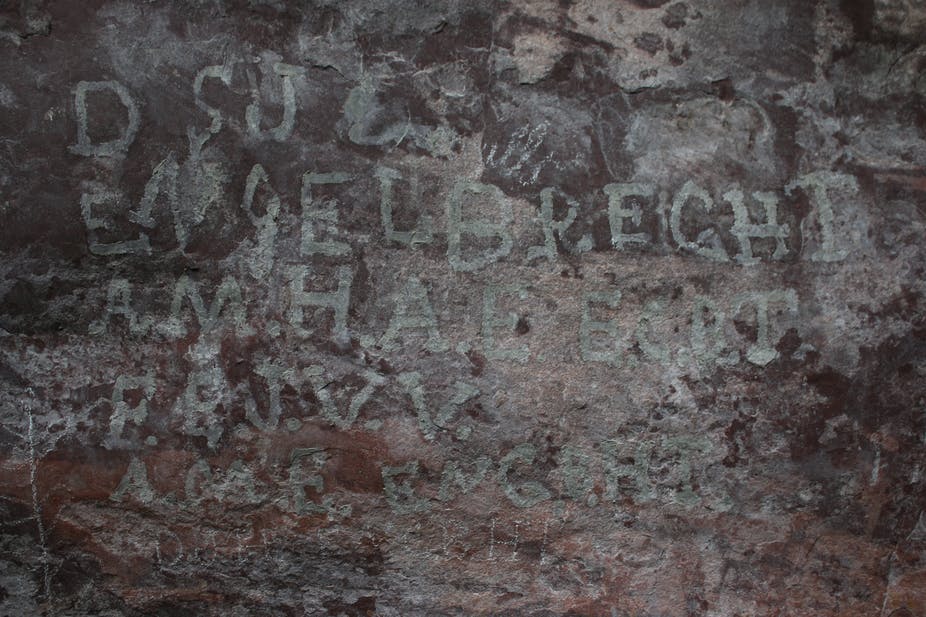
A ‘graffiti’ wall reveals women’s stories from the Anglo-Boer War

Tim Forssman, University of Pretoria

About 80km east of Pretoria in South Africa, near the town of Bronkhorstspruit, there’s a rocky outcrop in a secluded ravine in the countryside. There’s nothing remarkable about this outcrop – which has, over the years, made it a good place to shelter or hide. But the rock shelter’s back wall contains a remarkable piece of South African history.

There you can see images of women in crinoline dresses, as well as names and initials, painted onto the rock. The surname ‘Engelbrecht’ is repeated in several places with the initials ‘A.M.H.A.E.’ as well as ‘D.S.J.’ and ‘A.M.E.’. Other names and initials include ‘J.D. van Schalkwyk’ and ‘E(F?).B.J.V.V.’.

This “graffiti” was made by Boer women hiding from British soldiers during the South African War, also known as the Boer War. “Boer” is an Afrikaans word which translates to “farmers” but also refers to the forebears of South Africa’s Afrikaans people. These women left their farm homes and lived outdoors in the countryside to avoid being captured by British forces and sent to a concentration camp.

My colleagues and I wanted to know more about the site’s occupants, their lives while in hiding, and the “graffiti” they left behind. So we analysed these painted images, as well as others left there earlier by different groups like indigenous hunter-gatherers, herders and farmers. This helped us to understand the site’s painted sequence and the context of its occupation over time. An examination of family stories helped fill in the gaps in the women’s stories.

Stories like the kind stored in this place, known as Telperion Shelter, provide history to a landscape and people. Women were important participants in the war through the contributions and support they provided to commandos, units of Boer fighters. This is seldom spoken of; their stories and experiences are neglected. Telperion confronts these hidden stories.

The South African War

The South African War was declared between the British and Boers in 1899 after a period of economic and political instability.

The scattered Boer troops engaged in guerrilla tactics, crippling British resources, terrorising battalions and cutting off supply lines.

Two of the strategies the British used had devastating effects on the Boers’ home life. One involved burning down farmsteads and destroying crops and livestock. The other was to intern the Boers in concentration camps.

Women left without homes would often be forced to subsist in the veld – the open, uncultivated grasslands. It was a dangerous option: they faced capture, retribution, food insecurity, disease and death. But it meant avoiding the concentration camps, which were overcrowded, undersupplied and poorly maintained, with a constant threat of disease. Nearly 50,000 people died in the camps.

While in the veld, women were also able to give their husbands in the commandos supplies and information about soldier movements. This was often vital to a commando’s ability to continue fighting. Going to the veld, in this sense, was about resilience, rebellion and defiance. Unfortunately, because most of these stories, histories or experiences were never written down or recorded, they are poorly known.

Stories on the stone

When we first visited Telperion Shelter, the farm manager told us a story about those who had lived there. Black, Sotho-speaking families and white Boer families hid there from patrolling British troops. They set up a small garden inside a poplar tree thicket nearby and even kept a pig.

One day the pig escaped and nearby troops happened upon it; this led them to discover the families. All were captured and sent to a concentration camp.

Nothing more is known. But we felt that the paintings inside the shelter might tell us more about the site’s occupants and their experiences.

The “graffiti” includes the names I’ve mentioned as well as images of two groups of people. One group is five women wearing large crinoline dresses, which would have been worn at the time of this war, and holding what look to be stalks, which could be maize or something yet to be identified. The second group is to the right and almost identically resembles Sotho images of people, painted by earlier Sotho communities using the site for boys’ initiation. It is drawn in the same paint as the women. These two groups might reflect the two occupant communities using the shelter.

Our most important task was to find out who used the site and what happened to them; if we could do so we would be able to assess whether the story we were told was accurate and perhaps add to it. Fortunately, all of the concentration camp records have been digitised and are available online.

Poring through these records, we were eventually able to identify Alida Maria Hendrika Aletta Engelbrecht (A.M.H.A.E) and her husband and children, some of whom also have their names painted in the site. According to the records, she and her children were all captured on the farm Sterkfontein, where Telperion Shelter is found. It appears as though we have found the people in the story and who used the site.

These images do more than just verify the story we were told. They add layering to it. And they commemorate the experiences that many women and children underwent and the difficulties of living in the veld. Ultimately, they are a different form of story telling.The Conversation

Tim Forssman, Senior lecturer, University of Pretoria

This article is republished from The Conversation under a Creative Commons license. Read the original article.

Ilana Mercer: Boers need a Hannah Arendt to give voice to their genocide

April the 15th marked Holocaust Memorial Day. Nearly everyone knows about the industrial killing of 6 million Jews, for no other reason than that they were Jews. “Serious historiography” of the subject has ensured that The Shoah, Holocaust in Hebrew, is “consigned to posterity”; its lessons remembered and commemorated throughout the civilized world.

ilana_nuut2Although she failed to dignify the Armenian genocide of 1915, CNN’s Christiane Amanpour certainly covered the Holocaust, the killing fields of Cambodia, Bosnia, northern Iraq, Rwanda and Darfur, for a 2008 documentary about genocide. In the interest of pacifying its Turkish allies, American officialdom has generally aped Amanpour, refusing to implicate the Ottomans in the mass murder of up to 1.5 million Armenians, 100 years ago.

This month, Kim Kardashian and Pope Francis, in order of importance, remedied the Armenian “omission.” The Pontiff called the massacre “the first genocide of the 20th century.” The Armenian-American reality TV star, her posterior and the rest of her entourage, visited the Genocide Memorial in Yerevan, Armenia, to pay their respects.

There is no philosopher of Hannah Arendt’s caliber, today, to give dignity to the victims of the Stalinist, systematic starvation of the Boers by the British, during the Second Boer War. Fifteen percent of the Afrikaner population was rounded up, interned and starved to death–27,000 women and children. The image of young Lizzie van Zyl, who died in the Bloemfontein concentration camp, ought to be engraved in popular memory. It is not! When she died, Lizzie looked like the Jewish bags of bones who perished in the Nazi death and concentration camps.

Mention of Hannah Arendt is a must since this remarkable Jewish philosopher illustrated the similarities between “our century’s two totalitarianisms,” the Nazis and the Soviets. Arendt’s “Origins of Totalitarianism” spoke to a truth unmentioned until the publication of “The Black Book of Communism”: Both “systems massacred their victims not for what they did (such as resisting the regime) but for who they were, whether Jews or kulaks.”

If anything, “The Black Book” treads too lightly when it comes to qualitative comparisons between the Nazi and “Marxist-Leninist phenomenon.” On the quantitative front, “Nazism, at an estimated 25 million,” turned out to be distinctly less murderous than Communism, whose “grand total of victims [is] variously estimated at between 85 million and 100 million murdered. … the most colossal case of political carnage in history.”

Qualitatively, the “‘class genocide’ of Communism” is certainly comparable to the “‘race genocide’ of Nazism.” In its reach and methods, moreover, nothing compares to Communism’s continual, ongoing invention of new classes of “enemies of the people” to liquidate. “Mass violence against the population was a deliberate policy of the new revolutionary order; and its scope and inhumanity far exceeded anything in the national past.”

The fact that socialists and communists are still voted into power—with swagger in Greece—demonstrates that communists, despite their murderous past, “belong to the camp of democratic progress,” whereas the Right is forever open to suspicions of unforgiven fascist and Nazi sympathies.

The Jewish people have carried out “the solemn obligation to keep the memory of its martyrs alive in the conscience of the world.” The civilized world has internalized the methods and meaning of the Final Solution. As “The Black Book” observes approvingly, “Hitler and Nazism are now a constant presence in Western print and on Western television.”

Alas, although “their practices were comparable,” the “moral auras” of Nazism and Communism are still “antithetical.” “The Communist project” is permitted to claim “a commitment to universalistic and egalitarian goals, whereas the Nazi project” is said to offer only “unabashed national egoism.” The liberal world has refused to similarly stigmatize Communism. “The status of ex-Communist carries with it no stigma, even when unaccompanied by any expression of regret.”

Even more skewed is the situation in the East. No Gulag camps have been turned into museums to commemorate their inmates; all were bulldozed into the ground during Khrushchev’s de-Stalinization. The only memorial to Stalin’s victims is a modest stone brought to Moscow from the Arctic camp of Solovki and placed in Lubyanka Square (though well off to the side), where the KGB’s former headquarters still stands. Nor are there any regular visitors to this lonely slab (one must cross a stream of traffic to reach it) and no more than an occasional wilted bouquet. By contrast, Lenin’s statue still dominates most city centers, and his mummy reposes honorably in its Mausoleum. Throughout the former Communist world, moreover, virtually none of its responsible officials has been put on trial or punished. Indeed, everywhere Communist parties, though usually under new names, compete in politics.

The regime that was launched “in Sarajevo in 1914 and ended in Moscow in 1991” turned “mass crime into a full-blown system of government.” “Crime [was] the defining characteristic of the Communist system throughout its existence.”

“Islamo-Nazies” is how rightists have taken to dubbing the ISIS Islamists. But nothing beat the communists when it came to the execution by “firing squads, hanging, drowning, battering, [even gassing and beheading], poisoning; the destruction of the population by starvation, through man-made famine, the withholding of food, or both; deportation, through which death can occur in transit (either through physical exhaustion or through confinement in an enclosed space), at one’s place of residence, or through forced labor (exhaustion, illness, hunger, cold),” all meticulously planned and documented by the central authorities.

Perpetuated by the Left and acquiesced to by a perpetually frightened Right, the double standard adopted toward Communism is “scandalously out of line with the century’s real balance sheet of political crime.”

It must end!

On the week in which we commemorate the Holocaust, let us remember the forgotten victims of Communism who, too, were exterminated for who they were:

U.S.S.R.: 20 million dead
China: 65 million dead
Vietnam: 1 million dead
North Korea: 2 million dead
Cambodia: 2 million dead
Eastern Europe: 1 million dead
Latin America: 150,000 dead
Africa: 1.7 million dead
Afghanistan: 1.5 million dead
The international Communist movement and Communist parties not in power: about 10,000 dead

As suggested by Ilya Somin of The Volokh Conspiracy, a “Victims of Communism Day” is long overdue.

© 2015 by Ilana Mercer

Like Ilana Mercer’s Facebook page

Read Ilana in German on Junge Freiheit.

Rugby and the Afrikaner

pienaar+mandelaby Albert Brenner

You`ll find him sauntering through the streets of many a city in the West – especially in Commonwealth capitals like London, Dublin and Sydney.

And in the cities and towns of South Africa he is a common sight… the lone big Afrikaner man wearing the Springbok jersey with rightful pride. It is as if wearing the jersey of the national rugby team makes him the real Springbok player, that winner – if only for a moment.

And who can blame him? The Springboks – those gloriously sculptured athletes of a physical game perfectly suited for the rough-and-tumble Afrikaner man – are legends. They have always been one of the top two teams on the planet. It is a tremendous source of pride… for winners they are!

By wearing the Springbok jersey in public, Afrikaner men are finally receiving that positive recognition, that international ego-boost, which they have been denied ever since being blamed – by their peers in the West – for all the woes besetting blacks in South Africa.

It is, in fact, the only source of pride the Afrikaner is allowed to nurture… the sole recognition s/he may claim. For they find themselves in a socio-cultural and politico-economic environment that still regard them, their whole being, only in terms of Apartheid. Not unlike post-WWII Germans, the Afrikaner has, literally, been stripped of all his achievements – his very historical being – before Apartheid.

His unique language, Afrikaans – the third youngest Germanic language on the planet – is still being criminalized and marginalized as the “language of the oppressor” … and derided as the uncool “dumb Dutchman” language by arrogant native English-speakers in South Africa.

His legendary military prowess – as, once again, displayed in the Angolan War – has also been criminalized. Those brave young Afrikaner men – many of them 18-years old at the time – who helped win the Cold War for the West have been vilified as nothing but cruel Apartheid “killers” by the black-run ANC government… which actually rooted for the other side.

His remarkable performance and achievement in having built South Africa into the richest, most powerful and most developed country in Africa have been all but wiped from History by the black government and white liberals in the West – simply because they assume that South Africa`s blacks would have done so any case, had it not been for the “evil” Afrikaner’s Apartheid “intervention”.

Not even to speak of the Afrikaner’s incredible guts and determination for having literally pulled himself, without any help, from the ashes left by Lord Milner’s cowardly scorched-earth “warfare” during the Anglo-Boer War. A war in which the Afrikaner was outnumbered 10/1, a war that left 33 000 of his women and children dead in British concentration camps – and reduced the Afrikaner to the poorest white nation on the planet at the time.

In short; the Afrikaner’s whole historical being has suffered the same fate as his farms during Milner’s attempted genocide a century ago… except this time round it is his mind that has been scorched!

But this doesn`t bother the international community in the least. And most disturbing of all; it does not seem to bother the majority of the modern Afrikaner. Why? I mean, how come a unique people with an incredible history simply forget, as if nothing has happened?

Well, this is where rugby comes in. The recognition the (majority of the) Afrikaner gets through rugby seemingly suffices to keep him happy… even amid all the barbaric chaos in Mandelatopia.

The search for recognition (thymos) is one of the most powerful drives in the human psyche. So powerful that it has even been postulated as the motor of history, by Francis Fukuyama. His (rather trite) book, The End of History and the Last Man, had many a Western leader in hysterical glee, because it provided a utopian underpinning/validation for neo-liberalism, after the Cold War against Communism had been won.

Be that as it may; all of us crave recognition – some more (and on a larger scale) than others. The puberty-wing on the boot of a Ford Escort may be that thing which strokes your ego the most, or a beach house in Hermanus, or a Dr. title before your name, or a multi-national company that gets you invites to Davos (like Kdoos Bekker of Naspers). Whatever the size and shape of your ego, you will go through hell and high water to have it stroked. And when it finally gets stroked, you are that winner… you have craved to be for so long.

And that is exactly why Afrikaners are willing to live with a scorched mind in a lost kingdom run by “noble” savages. For winning in rugby is all the recognition he (thinks he) needs, because just like the Springboks he has never really lost. He is still the “Baas of the Plaas” in his mind.

The dastardly Old Empire Brits won the Anglo-Boer War, but they never succeeded in breaking the Afrikaner’s spirit. The Afrikaner won the Angolan War outright, even though they lost the peace, thanks to the treachery of their half-wit leaders. The Afrikaner never lost their “kingdom” to god-Mandela; they simply gave it to him – like the Springbok jersey they gave him at the closing ceremony of the 1995 RWC.

All in all, Afrikaners, as individuals, are still (on average) winners in Mandelatopia, and globally as expats – especially financially – just like their Springbok heroes and role-models.

The only problem is that rugby is a team sport, like a nation… like a civilization. Even the mighty Springboks can only remain winners, provided they play as a team. That is why fewer and fewer lone big Afrikaner men wearing Springbok jerseys will saunter pridefully through the streets of the cities of the West in the future.

Read Albert’s blog.

Lees dié rubriek in Afrikaans.

Why I am ashamed of being South African

By definition, excess stands outside reason. (Georges Bataille)

South Africa is known as the rape and murder capital of the world. But that sounds almost anodyne, telling us nothing about the millions of psychos let loose by this crazy government and its many foreign backers.

Just this morning I learned about the macabre murder of a woman of Italian extraction, Vivien Ponté. She was tied up, presumably raped, then slaughtered (there were blood stains all over) and finally set alight upon her own double bed. The Johannesburg Beeld published a picture of her charred bed.

roodt_dan_wikiThe mainstream media in South Africa have long ceased to keep us informed of all the murders in the country, especially black-on-white murders. The 200 foreign correspondents from the world’s major news media based in Johannesburg generally eschew reporting on anything that would disturb their carefully constructed myth of South Africa as a liberal democracy with a “model constitution”. According to them, our pristine utopia is only occasionally marred by the presence of “die-hard white racists” and people who commit speech crimes like using the “k-word” or even just insinuating that all is not well in Mandelatopia.

Murder, rape, burning women on their beds? What’s that? These incidents almost never make it into print in international English and if they do, they are carefully sanitised so as to remove the grisly, unspeakable, dehumanising details. Currently there is almost a pandemic of child rapes. Even toddlers and babies are regularly subjected to sexual violence. In one case, the maniac of Thokoza, a 42-year old black man called Sifiso Makhubo, raped 34 underage girls and two adult women before he was finally arrested. Makhubo believed that raping girls as young as ten could cure him of HIV-Aids. Of course, in the process he infected many of them. The fact that he conveniently committed suicide on the eve of his trial, did nothing to expiate his crimes.

Sifiso Makhubo
Sifiso Makhubo

I must confess: I am ashamed to bear the South African nationality. I cringe whenever someone pronounces the phrase “We South Africans…” To me, everything about South Africa is tainted by the wave of sadistic violence, corruption and mediocrity that have swept the country since 1994. The flag, the anthem, the constitution, our very identity, have all been blighted by our “transformation” – that politically correct cliché – into a criminal, deviant society.

One cannot be proud of anything in South Africa, except perhaps the Drakensberg mountains and the Kruger National Park. Appropriately, the ANC government wants to rename the Kruger and inside its animals, such as rhinos, are being poached. So even there, decay has already set in. Maybe they will rename the Drakensberg too, after some terrorist like Magoo’s Bar bomber Robert McBride or Abu Bakr Ismail, the “commander” – so-called – of the Church Street bomb.

South Africa is a social and political Chernobyl. The disaster predates the leftist coup of 1994 and may be traced to the very foundation of the current state in 1910. Britain, too, committed war crimes and atrocities on our soil during the Anglo-Boer war, but those were swept under the carpet for the sake of “reconciliation between the two white races, English and Afrikaners” as it was put at the time. Boer women and children were harassed, raped and made to starve in the British concentration camps. Many of the atrocities were committed by so-called “armed blacks” that the English employed to terrorise Boer civilians.

So South Africa was more or less conceived in the British camps. It is the fruit of a forced union, then as now. The rape and rapine that Britain and its black helpers visited upon us in 1900 would become the sediment of the slimy and shameful compromises and forgetfulness of politicians. Alas, during the twentieth century we had few leaders of integrity. Verwoerd was a rare exception and without him we would not have been a republic now. For that he was vilified and finally assassinated.

Ruins of the Château de Lacoste in the Vaucluse department, home of the Marquis de Sade

Remarkably, South Africa has largely escaped war on its own soil for more than a century, even though we participated in both world wars on the Allied side. “Never a good deed shall go unpunished,” as the saying goes, and for our loyalty to Britain and the US we have been crucified, calumnied and finally incarcerated in this putative “New South Africa”. Except it is not new. It is old, very old, primitive, even primaeval. It wears the grimace of ancient rituals, killings, human sacrifices. If 1994 were a “liberation” at all, it was the liberation of Freud’s two primal drives: Eros and Thanatos, the latter being the death drive. When the two of them combine, as they have in South Africa, you encounter the set of impulses that still bear the name of an eighteenth-century French writer, the Marquis de Sade.

Every South African is a sadist. The utter perversity and complete lack of any moral compass in our society testify to the almost pristine state of amoral utopia that we have reached: a paradise of cruelty. Everything is permitted; everyone may be bought or bought off and everyone will look the other way, either because they are in on the deal or out of fear.

People often ask me: “If you are so ashamed and disgusted by South Africa, why don’t you leave?” I think the short answer is that, given the decades of slander directed at Afrikaners, most other countries would rather welcome a Rwandan war criminal than an Afrikaans writer, so no other state would have me. But then, I ask myself, if our women could “walk barefoot over the Drakensberg” as Susanna Smit famously put it, why should we simply abandon our land to these squads of sadists? The more complex answer is that a place as sick as South Africa needs a few psychiatrists, a few sane people to at least write up the manic convulsions of the patient.

It feels as if I have only broached the subject. There is so much more to say and to explain, of how we got to be inmates in this, our sadists’ castle.

This could well turn into a series, on the shame of being South African.

‘Apartheid’ as metonym for Afrikaners

In a multiethnic society like South Africa, groups will always blame each other for their lack of wealth, education, political power, and so on. In this respect, SA is no different to Malaysia, Sri Lanka, Northern Ireland, Belgium or anywhere else.

Apartheid is a national obessession. To some extent it has imparted some sort of inverse identity to the so-called New South Africa where people wonder whether we are really the 51st state of the USA, the southern province of Zimbabwe or part of the British Empire. Of course, one of the first steps after 27 April 1994 was to rejoin the Commonwealth so in a sense that made many people feel “whole” again.

Apartheid is, however, also a metonym. Being an Afrikaans word, sometimes the only Afrikaans word that many people know, it stands for “Afrikaners”. A statement like “apartheid destroyed black wealth” decodes as “Afrikaners destroyed black wealth”. The massive participation of Afrikaners in education between 1948 and 1994, mainly because the angelic English owned all the mines and industries, may therefore be seen as “de-educating South Africa”. At one point 50% of teachers in English-language white schools were also Afrikaners. Soon these “deprived” Engelse will be blaming Afrikaners for not having won more Nobel prizes for science, not having founded Google or Microsoft or not inventing the Ipod. Instead, they were “forced” to read Somer by CM van den Heever or some Afrikaans poetry in their second-language class, which “dehumanised” them.

Of course, Afrikaner teachers also taught millions of people science and mathematics, but as some minister once said: “Verwoerd made it too difficult, because he was a racist.” Fortunately Kader Asmal introduced “mathematical literacy” which is is the non-racist version.

As Paul Berkowitz so eloquently argues in How do you solve a problem like Apartheid?: “In the end, perception usually trumps truth.” Someone will have to be blamed for the fact that the average black South African does not enjoy the same standard of living as the average citizen of Luxembourg or Norway. Nor does the average white, of course, but that is besides the point.

Apartheid, like Satan, still lurks within dark corners of South Africa, usually on farms or in Afrikaans schools or within the homes of poorer Afrikaners living on smallholdings such as in Muldersdrift or Kameeldrif.

Within the metonymic logic of South African ethnic discourse, eliminating apartheid is easy: you have just have to eliminate Afrikaners. This can be done in three ways: putting them all on a boat to Australia, assimilating them completely, or by killing them en masse. Or maybe one by one, family by family.

In Muldersdrift, Kameeldrif, on farms and even in the cities, the clarion call to “eliminate the last vestiges of apartheid” is being responded to with vicious enthusiasm. Remember that Lord Milner or one of his contemporaries also used those terms on the eve of the Anglo-Boer War: “eliminating the last vestiges of Afrikanerism from South Africa”. Afterwards 500 000 British soldiers and 100 000 armed blacks put the Boer women and children in concentration camps and burned everything to the ground, homes, barns, even churches. In fact, the British were the only Western people to have burnt churches in the modern era.

According to historians, it took Germany 120 years to recover from the Thirty Years War (1618-1648) when a similar “scorched earth policy” had been followed on its soil. However, no-one – least of all the omniscient apartheid theorists of today – has ever argued that the Anglo-Boer had any economic effect whatsoever. On the contrary, the economic effect is generally seen as positive, in having put control of the economy firmly in English hands. Confiscated Boer livestock and grain were sold to the British army by English companies whose names have changed since, some of which are today listed on the JSE. “Apartheid capital” therefore metamorphosed into “English entrepreneurial flair”. This was the first form of BEE, or British Economic Empowerment. Arguably, the current form of BEE still benefits bankers and stockbrokers more than it does blacks, because these rake in huge fees for enriching a few high-profile blacks.

After the war, irate letter writers from Natal castigated Milner and others for not having killed all the Boers and “cleansing the country for England”. That would have been one way of nipping apartheid in the bud, as it were.

But it is never too late and we can all agree that apartheid is being eliminated every day, whether metaphorically by erasing Afrikaans names of towns or streets, or physically by terminating the bearers of the disease. There is an uncanny resemblance between the gentlemanly style of the British in 1900-1902 and the methods of the current crop of freedom fighters, who appreciate that children, especially girl children, represent the next generation and it therefore makes sense to eliminate them first. The names of Alyssa Botha and Danielle Esterhuizen come to mind, but there are many others too.

Were Afrikaners ‘dirty African peasants’?

by Dan Roodt

Pauline Morris in Boer women and children died ‘due to backwardness wants to “open up a critical debate on the realities of the Boer War concentration camps”, as part of the wider “de-mythologising” of South African history.

I can only say: “Bring it on!” Let us open the archives and reread the tens of thousands of letters and other evidence that have been gathering dust for over a hundred years. In fact, I recently visited the archives in Pretoria and was the first person ever to peruse some of the files related to the barbaric destruction inflicted by Britain on each and every farm and household in the Transvaal and especially the Free State. Some, but not all, victims received derisory compensation for their losses after the war.

To some extent, dr. Elma Ross has already revealed the true nature of the camps by describing her own family history, characterising the British as “terrorists”. Britain was a signatory to the Hague Convention of 1899, a forerunner of the Geneva Conventions prohibiting war and atrocities upon civilians. The Hague Convention entered into force on September 4, 1900, just in time to apply to the form of “total war” that Kitchener and Roberts waged upon the entire Boer population during the second, non-conventional phase of the war.

There can be no doubt that, were it not for the policy of “reconciliation between the two white races” followed after the war, culminating in Union in 1910, Britain would have been prosecuted for war crimes under the Hague Convention, just like Germany was after World War II. Some Afrikaner groups believe that Britain could still be prosecuted even today. At the very least Britain should be made to acknowledge its war crimes at the European level, similar to demands by former French President Chirac that Turkey should “recognise its past” and the Armenian genocide (1915-23) before being able to join the EU.

Whatever the sophistries thought up these days by British historians and their colleagues at jingoist institutions like the University of Cape Town where Elizabeth van Heyningen is apparently a professor of history, it cannot be denied that the camps formed part of a military operation. That they were partly successful in breaking Boer resolve to defend their sovereignty, is also widely acknowledged.

The jingoist case for Afrikaner women and children “dying due to ignorance and lack of hygiene” seems to rest upon the wider English belief (or myth?) that pioneer Afrikaners in the nineteenth century were not, as Prof. Elizabeth van Heyningen puts it in one of her journal articles, “civilised Europeans” but “dirty African peasants”.

That these “dirty African peasants” were literate enough to write letters and diaries about their war and concentration camp experiences and that their “civilised” British captors found it necessary to destroy their pianos and other musical instruments while burning down their homes, seem to contradict many a confident English stereotype.

Perhaps we should also enquire about the hygienic habits of Johannesburg’s much-admired uitlander population in the 1890s when the outbreak of syphilis relating to widespread prostitution presented a major public health problem to Paul Kruger’s Republican government.

Boer women and children died ‘due to backwardness’

The emaciated Lizzie van Zyl. She and other children died in British concentrations camps due to 'Boer backwardness', claims UCT academic

A letter writer in Business Day, as well as an academic at the University of Cape Town, Elizabeth van Heyningen, claim that Boer women and children died in British concentration camps during the Anglo-Boer war because they were “backward” and did not know about soap and water.

Van Heyningen implies that it was really a “myth” that Afrikaners were “civilised Europeans… and not dirty African peasants”.

In her reply yesterday to a previous letter by Dr. Dan Roodt of PRAAG, Pauline Morris of Johannesburg writes:

I REFER to Dan Roodt’s Apartheid revisionism no threat (Letters, September 25). Mr Roodt must realise that historical revisionism applies to all history.

Let’s take the Anglo-Boer War which it seems is the bedrock of Afrikaner identity. A focus feeding this identity is the “genocide” of women and children in the refugee or concentration camps by the British.

I have been reading and interpreting letters that have recently been uncovered in a family archive in Sweden. One of the writers was a medical doctor who served in an ambulance on the side of the Boers at the Ladysmith front, and then in their retreat to the Biggarsberg after the British relieved the siege of Ladysmith.

The opinions expressed by this doctor support the recent research finding on these camps by historian Elizabeth van Heyningen that the “atrocities” in these camps were exaggerated into mythical proportions to support Afrikaner nationalism in the 1920s and 1930s.

The reality as I understand it is that there were many cultural and socioeconomic factors that exacerbated the deaths in the camps. Many of those in the camps were very poor bywoners, and many were indigent. Also, not surprisingly the “modern” medicine administered at the time by the British was unfamiliar to the Boer population who had been living in isolation for so many years.

I agree that we “need to find our own truth, commensurate with our own reality.” This means opening up a critical debate on the realities of the Boer War concentration camps. I take it this will pose no threat to yourself and other Afrikaners.

In an article published in the journal Historia 55,2, November 2010, pp 12-33, Elizabeth van Heyningen, a professor of history at the University of Cape Town, suggests that it was really a “myth” that Afrikaners were “civilised Europeans… and not dirty African peasants”.

She quotes from the British “Blue Books” which blamed the Boers themselves for dying of hunger and disease in the camps:

“The high death rate among the children, I would like to emphasise again, is in no way due to want of care or dereliction of duty on the part of those responsible for this camp. It is, in my opinion, due to the people themselves; to their dirty habits both as regards their own personal cleanliness and the cleanliness of their children and their surroundings; to their prejudices; their ignorance; and their distrust of others, even their own nationality, when their advice runs counter to their own preconceived and antiquated ideas. This is specially noted in connection with their treatment of the sick, to their rooted objection to soap and water, and to hospitals.”

According to Van Heyningen, the mortality rate in the camps, where 34 000 women and mostly children died, was not much higher than in Afrikaner towns in the Cape before the “civilised” British introduced public health reforms in the 1880s:

“Lack of sanitation was not confined to the camps. The Boer laagers, when they remained stationery for any length of time, were filthy. A number of commentators remarked on the insanitary state of the laagers besieging Mafeking. Flies were a major problem because the offal of slaughtered animals was never cleared away. The interiors of the wagons and tents were black with the “little devils” and flies flew into the mouths of the burghers as they struggled to eat. The stench from the latrines, built too close to the laager, was unbearable, the Rev Abraham Stafleu complained. Paardeberg and Modderspruit, too, were gripped by disease and foreign doctors attached to the Boer forces, particularly, were critical of the lack of hygiene in the Boer laagers.

“Lack of sanitation was certainly not unique to the Boer republics. The camps have been seen too much in isolation, as sui generis, a unique experience. In the Cape Colony, as public health reforms were introduced by modernising doctors from the 1880s, and district surgeons’ reports and statistics were published, it became clear that many country towns lacked effective sanitation and mortality rates, especially those of children, were very high indeed.”

Elizabeth van Heyningen argues that the vast majority of the camp inmates were lower-class bywoners or “white trash” who knew nothing about basic hygiene and therefore died of their own accord. She then goes on to explain how Afrikaner nationalists have misrepresented the British concentration camps that were really an attempt at “poverty relief” for Afrikaners instead of the military exercise against the Boer civilian population that they were. She also glosses over the burning down of most of Northern South Africa by the British sodiers, leaving the civilian population without food, to be herded into camps where many were again denied food or placed on below-subsistence rations.

Van Heyningen equally neglects to mention the many reports of poisoning by the camp commanders and nursing staff of inmates under the pretext of administering “medicine”.

Writing in Die Burger on 10 July 2010, journalist and historian Marthinus van Bart offered the following criticism of Van Heyningen’s jingoist apology for the British concentration camps:

“Other experts have emphasised that the main reasons for the deaths were malnutrition and lack of food, exposure, polluted food and water, a dearth of soap and other cleaning aids, open furrow toilets and the bucket system, the serious overpopulation of the camps, immunity deficiency, little or no fuel to boil water or do cooking, the denial of the disaster and inaction to set things right after the British opposition had demanded it in parliament in London.”

In the 2001 documentary Scorched Earth “it was indicated that the women and children were civilians against whom war was literally conducted. Their farms (more than 30 000) and furniture were burnt down, food and livestock were destroyed, they were molested and raped, and they were violently herded into the camps.

[ad 1]

“Up to 18 people were divided into a single bell-shaped tent – mostly old, worn-down army tents giving no protection against the scorching Karoo sun, rain and wind storms, bouts of hail and snow. Diseases like pneumonia were widespread due to exposure to the elements, which was worsened by malnutritiion and deficient medication.

“The toilet facilities were one bucket for every 300 people. In one camp there were only 28 bucket toilets for 4 600 inmates. The toilet holes of many camps were 1 km from the tents.

“Most people suffered from diarrhea due to the polluted water and bad meat. Water was limited to one bucket per family per day, in other cases to one small kettle of water per day – not even a cup of water per person per day.

“There was mostly no water for washing, either their bodies or clothes and bedlinen. The elderly and children who fell into the toilet furrows could not be properly washed afterwards.

“In addition families of burghers in the field were placed on half rations, a diabolical plan to slowly but surely exterminate these inmates. That was one of the notorious Methods of Barbarism to which historian S.B. Spies refers in his book.

“There were approximately 235 000 camp inmates and 240 000 soldiers that had to be fed by the British army. The deficient infrastructure made a disaster inevitable.”