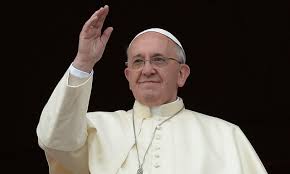
Pope Francis is more than head of the Catholic Church — he’s also the head of state of the Vatican, which as a government has possibly the most restrictive immigration and citizenship policies of any nation in the world.
The pope, traveling to the U.S. for the first time, has made a special appeal to Americans to welcome immigrants, using his address to a joint meeting of Congress Thursday to invoke the Golden Rule in demanding generosity toward the millions of Central and South Americans seeking to come to the country.
“Thousands of persons are led to travel north in search of a better life for themselves and for their loved ones, in search of greater opportunities. Is this not what we want for our own children?” he said. “We need to avoid a common temptation nowadays: to discard whatever proves troublesome. Let us remember the Golden Rule: ‘Do unto others as you would have them do unto you.’”
Immigrant rights groups had eagerly anticipated the pope’s message, as had illegal immigrants themselves.
Sophie Cruz, a five-year-old U.S. citizen whose parents are illegal immigrants from Mexico, broke through the tight security around the pope during a parade on the National Mall on Wednesday to hand him a letter begging him to pressure Congress and the White House to take steps to grant her parents legal status.
The pontiff didn’t mention illegal immigration during his speech Thursday, but did refer to the large numbers of people coming from Latin America. Advocacy groups cheered his words.
The Vatican, for its part, welcomes millions of visitors a year — but allows only a very select few, who meet strict criteria, to be admitted as residents or citizens.
Only about 450 of its 800 or so residents actually hold citizenship, according to a 2012 study by the Library of Congress. That study said citizens are either church cardinals who reside in the Vatican, the Holy See’s diplomats around the world, and those who have to reside in the city because of their jobs, such as the Swiss Guard.
Spouses and children who live in the city because of their relationship with citizens — including the Swiss Guard and workers such as the gardener — have also been granted citizenship. But that means few of the Vatican’s citizens are women.
A Vatican spokesman did not return an email seeking comment on its policy.
April the 15th marked Holocaust Memorial Day. Nearly everyone knows about the industrial killing of 6 million Jews, for no other reason than that they were Jews. “Serious historiography” of the subject has ensured that The Shoah, Holocaust in Hebrew, is “consigned to posterity”; its lessons remembered and commemorated throughout the civilized world.
Although she failed to dignify the Armenian genocide of 1915, CNN’s Christiane Amanpour certainly covered the Holocaust, the killing fields of Cambodia, Bosnia, northern Iraq, Rwanda and Darfur, for a 2008 documentary about genocide. In the interest of pacifying its Turkish allies, American officialdom has generally aped Amanpour, refusing to implicate the Ottomans in the mass murder of up to 1.5 million Armenians, 100 years ago.
This month, Kim Kardashian and Pope Francis, in order of importance, remedied the Armenian “omission.” The Pontiff called the massacre “the first genocide of the 20th century.” The Armenian-American reality TV star, her posterior and the rest of her entourage, visited the Genocide Memorial in Yerevan, Armenia, to pay their respects.
There is no philosopher of Hannah Arendt’s caliber, today, to give dignity to the victims of the Stalinist, systematic starvation of the Boers by the British, during the Second Boer War. Fifteen percent of the Afrikaner population was rounded up, interned and starved to death–27,000 women and children. The image of young Lizzie van Zyl, who died in the Bloemfontein concentration camp, ought to be engraved in popular memory. It is not! When she died, Lizzie looked like the Jewish bags of bones who perished in the Nazi death and concentration camps.
Mention of Hannah Arendt is a must since this remarkable Jewish philosopher illustrated the similarities between “our century’s two totalitarianisms,” the Nazis and the Soviets. Arendt’s “Origins of Totalitarianism” spoke to a truth unmentioned until the publication of “The Black Book of Communism”: Both “systems massacred their victims not for what they did (such as resisting the regime) but for who they were, whether Jews or kulaks.”
If anything, “The Black Book” treads too lightly when it comes to qualitative comparisons between the Nazi and “Marxist-Leninist phenomenon.” On the quantitative front, “Nazism, at an estimated 25 million,” turned out to be distinctly less murderous than Communism, whose “grand total of victims [is] variously estimated at between 85 million and 100 million murdered. … the most colossal case of political carnage in history.”
Qualitatively, the “‘class genocide’ of Communism” is certainly comparable to the “‘race genocide’ of Nazism.” In its reach and methods, moreover, nothing compares to Communism’s continual, ongoing invention of new classes of “enemies of the people” to liquidate. “Mass violence against the population was a deliberate policy of the new revolutionary order; and its scope and inhumanity far exceeded anything in the national past.”
The fact that socialists and communists are still voted into power—with swagger in Greece—demonstrates that communists, despite their murderous past, “belong to the camp of democratic progress,” whereas the Right is forever open to suspicions of unforgiven fascist and Nazi sympathies.
The Jewish people have carried out “the solemn obligation to keep the memory of its martyrs alive in the conscience of the world.” The civilized world has internalized the methods and meaning of the Final Solution. As “The Black Book” observes approvingly, “Hitler and Nazism are now a constant presence in Western print and on Western television.”
Alas, although “their practices were comparable,” the “moral auras” of Nazism and Communism are still “antithetical.” “The Communist project” is permitted to claim “a commitment to universalistic and egalitarian goals, whereas the Nazi project” is said to offer only “unabashed national egoism.” The liberal world has refused to similarly stigmatize Communism. “The status of ex-Communist carries with it no stigma, even when unaccompanied by any expression of regret.”
Even more skewed is the situation in the East. No Gulag camps have been turned into museums to commemorate their inmates; all were bulldozed into the ground during Khrushchev’s de-Stalinization. The only memorial to Stalin’s victims is a modest stone brought to Moscow from the Arctic camp of Solovki and placed in Lubyanka Square (though well off to the side), where the KGB’s former headquarters still stands. Nor are there any regular visitors to this lonely slab (one must cross a stream of traffic to reach it) and no more than an occasional wilted bouquet. By contrast, Lenin’s statue still dominates most city centers, and his mummy reposes honorably in its Mausoleum. Throughout the former Communist world, moreover, virtually none of its responsible officials has been put on trial or punished. Indeed, everywhere Communist parties, though usually under new names, compete in politics.
The regime that was launched “in Sarajevo in 1914 and ended in Moscow in 1991” turned “mass crime into a full-blown system of government.” “Crime [was] the defining characteristic of the Communist system throughout its existence.”
“Islamo-Nazies” is how rightists have taken to dubbing the ISIS Islamists. But nothing beat the communists when it came to the execution by “firing squads, hanging, drowning, battering, [even gassing and beheading], poisoning; the destruction of the population by starvation, through man-made famine, the withholding of food, or both; deportation, through which death can occur in transit (either through physical exhaustion or through confinement in an enclosed space), at one’s place of residence, or through forced labor (exhaustion, illness, hunger, cold),” all meticulously planned and documented by the central authorities.
Perpetuated by the Left and acquiesced to by a perpetually frightened Right, the double standard adopted toward Communism is “scandalously out of line with the century’s real balance sheet of political crime.”
It must end!
On the week in which we commemorate the Holocaust, let us remember the forgotten victims of Communism who, too, were exterminated for who they were:
U.S.S.R.: 20 million dead
China: 65 million dead
Vietnam: 1 million dead
North Korea: 2 million dead
Cambodia: 2 million dead
Eastern Europe: 1 million dead
Latin America: 150,000 dead
Africa: 1.7 million dead
Afghanistan: 1.5 million dead
The international Communist movement and Communist parties not in power: about 10,000 dead
As suggested by Ilya Somin of The Volokh Conspiracy, a “Victims of Communism Day” is long overdue.
A “piecemeal” World War III may have already begun with the current spate of crimes, massacres and destruction, Pope Francis has warned.
“War is madness,” the Pope said at a memorial to 100,000 Italian soldiers at Redipuglia cemetery near Slovenia. The Argentine Pope has often condemned the idea of war in God’s name.
Only last month, Pope Francis said the international community would be justified in using force to stop what he called “unjust aggression” by Islamic State militants, who have killed or displaced thousands of people in Iraq and Syria, including many Christians, the BBC’s David Willey reports.
In Saturday’s homily, standing at the altar beneath Italy’s fascist-era Redipuglia memorial – where 100,000 Italian soldiers killed during WWI are buried, 60,000 of them unnamed, the Pope paid tribute to the victims of all wars.
“Humanity needs to weep, and this is the time to weep,” he said. “Even today, after the second failure of another world war, perhaps one can speak of a third war, one fought piecemeal, with crimes, massacres, destruction,” he said.
Pope Francis on Monday denounced those getting rich through speculation in financial markets.
“It is increasingly intolerable that financial markets are shaping the destiny of peoples rather than serving their needs, or that the few derive immense wealth from financial speculation while the many are deeply burdened by the consequences,” he said.
The pope, who has said he wants to create “a poor church for the poor”, has frequently spoken out against the “idolatry of money”.
The 77-year-old said that markets should “serve the interests of peoples and the common good of humanity”.
Francis singled out speculation in agricultural markets calling it “a scandal which seriously compromises access to food on the part of the poorest members of our human family”.
Many of the world’s largest banks, including Barclays, Deutsche Bank and UBS, have sold off or slashed the size of their commodities businesses in the face of heavy criticism for speculating in commodities markets.
Instead, the pope called on people to put their money into ethical banks and “impact investors”, who use investments to help the poor.
The main stage set up for the pontiff, who arrived early Sunday in Bethlehem by helicopter from Jordan, was adorned with a giant tableau depicting Jesus’s birth in Manger Square.
On Sunday in Bethlehem, Pope Francis called for recognition of an independent Palestinian state. CNN reports that he asked for “the acknowledgment by all of the right of two states to exist and to live in peace and security within internationally recognized borders.”
From dawn, wave upon wave of pilgrims had flooded into the buzzing square, through barriers and metal detectors set up by watchful Palestinian security forces.
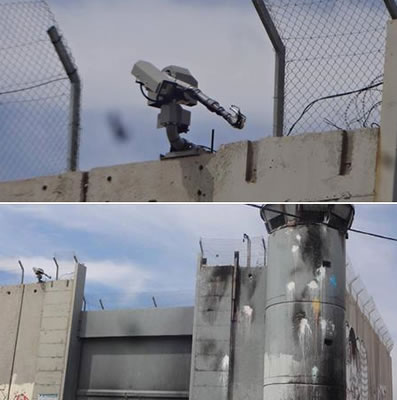
In Bethlehem before the mass, as his convoy passed near the controversial separation wall erected by the Israelis, he stopped and climbed out.
Flanked by anxious Palestinian security guards, he walked over to the eight-metre high concrete barrier topped by a guard tower and machine gun.
Bowing his head in silent prayer, he paused for several minutes in front of the graffiti-daubed barrier, his right hand and forehead resting against the concrete.
“Pope we need to see someone to speak about justice. Bethlehem look like Warsaw ghetto. Free Palestine,” read one bit of graffiti in English.
Pilgrims said they hoped that Francis’s presence here could bring real change on the ground in a volatile region.
A banner hanging on a mosque read: “The detainees in the occupation’s (Israeli) prisons are pleading for freedom and dignity.”
Francis is to meet Jewish and Muslim leaders in Jerusalem on Monday in efforts to better interfaith relations.
Israel has closed its embassies around the world as about 1 200 foreign ministry employees declare a strike over low salaries.
The strike by Israeli diplomats has affected Israel’s 102 missions abroad.
Israeli diplomats launched an unprecedented strike on Sunday, forcing the complete closure of embassies around the world as they escalated a dispute over pay, officials said.
The industrial action has already threatened to postpone a visit by Pope Francis to Israel planned for May – one of 25 trips by foreign officials affected by a work slowdown the diplomats began on March 5 when wage talks broke down.
By escalating the action to a full strike – the first by the diplomatic corps since the country’s establishment in 1948 – the diplomats will close all of Israel’s 102 missions abroad, paralysing most diplomatic work with other countries and the United Nations.
“We are completely shutting down the [foreign ministry] office and missions abroad. This is the first time ever,” ministry spokesperson Yigal Palmor said.
Another ministry official said: “As of now, the foreign ministry doesn’t exist. It’s not possible even to submit complaints”.
Foreign Minister Avigdor Lieberman called the strike “irresponsible” and “a wretched decision and a display of a loss of control on union’s part.”
“We shall do whatever possible to minimise the damage to the country and its citizens,” Lieberman said.
Diplomats said the strike – involving around 1 200 foreign service employees – was open-ended and had been called after the treasury failed to present any acceptable proposals.
They are demanding an increase in monthly salaries, which they put at 6 000 to 9 000 shekels (R18 800 to R28 200), and want compensation for spouses forced to quit jobs owing to foreign postings. They say about a third of their number has quit in the past 15 years because of poor wages.
Yacov Livne, spokesperson for the diplomats’ union, said: “the treasury is determined to destroy the foreign ministry and Israeli diplomacy.” –
Having outfoxed him on Syria, Russian President Vladimir Putin has pipped Barack Obama to the title of the world’s most powerful leader as ranked by Forbes on Wednesday.
It was the first time in three years that the US president has dropped to second place on the magazine’s list and came as US-Russia relations slid to a new low.
Putin, who has enjoyed 13 years of dominant rule over Russia, was again elected president in March 2012.
Obama, on the other hand, has just emerged scathed from an embarrassing 16-day US government shutdown caused by a budget and debt crisis in Washington.
“Putin has solidified his control over Russia, while Obama’s lame duck period has seemingly set in earlier than usual for a two-term president — latest example: the government shutdown mess,” wrote Forbes.
In August, Russia granted asylum to former National Security Agency contractor Edward Snowden, wanted in the United States over a mammoth intelligence leak.
A month later, Putin played the trump card again by averting Obama’s threatened missile strikes on Syria with a plan for Damascus to hand over chemical weapons.
“Anyone watching this year?s chess match over Syria and NSA leaks has a clear idea of the shifting individual power dynamics,” Forbes wrote.
The 2013 list of 72 powerbrokers was chosen to reflect one for every 100 million lesser mortals on Earth.
Third prize went to Chinese President Xi Jinping, who is expected to rule for a decade in which China is set to eclipse the US as the world’s largest economy.
Pope Francis made his debut at number four and German Chancellor Angela Merkel rounded out the top five.
Among 13 newcomers were Samsung Chairman Lee Kun-Hee at number 41 and Nigerian billionaire Aliko Dangote, the richest man in Africa, in at number 64.
There were 17 heads of state who run nations with a combined GDP of $48 trillion and 27 CEOs and chairs who control over $3 trillion in annual revenues.
Only nine women made the cut despite representing half the world’s population. – breitbart.com
Pope Francis waving to supporters in the streets of Rio
Pope Francis wants to ignite the passion of Roman Catholics for their faith while on his first international trip, and the boisterous, sometimes frenzied welcome he got on his first day in Rio seemed to fill those hopes.
Returning to his home continent for the first time since becoming pontiff, Francis smiled broadly as thousands of people rushed his car Monday after it became stuck behind buses and taxis when his driver made a wrong turn on a main avenue in Rio’s center.
It was a nightmarish scene for security officials, but clearly a delight and another opportunity to connect for this pope, who was scheduled to take a day off Tuesday for rest and private meetings.
The ecstatic throngs forced his motorcade to repeatedly come to a standstill, weeks after violent protests against the government paralyzed parts of Brazil. Francis’ driver turned into the wrong side of a boulevard at one point, missing lanes that had been cleared. Other parts of the pope’s route to the city center weren’t lined with fencing, giving the throngs more chances to get close, with uniformed police nowhere in sight to act as crowd control.
The three dozen visible Vatican and Brazilian plainclothes security officials struggled to keep the crowds at bay. Francis not only looked calm but got even closer to the people. He rolled down his back-seat window, waved to the crowd and touched those who reached inside. He kissed a baby a woman handed to him.
“His secretary was afraid, but the pope was happy,” said the papal spokesman, the Rev. Federico Lombardi.
The pope is here on a seven-day visit meant to fan the fervor of the faithful around the globe. That task has grown more challenging as Catholics stray, even in strongholds of the religion such as Brazil, yet it seemed to come easily to Francis even on the drive from the airport to an official opening ceremony.
After finally making it past crowds and blocked traffic, Francis switched to an open-air vehicle for a cruise along main streets past crowds of people who screamed wildly as he waved and smiled. He left his popemobile – the bulletproof one – in the Vatican garage so he could better connect with people during the church’s World Youth Day.
Vatican officials insisted they had no concern for the pope’s safety as his vehicles eased through the masses, but Lombardi acknowledged there might have been some “errors” that need correcting.
“This is something new, maybe also a lesson for the coming days,” Lombardi said.
Many in the crowd looked stunned to see the pope, with some standing still and others sobbing loudly.
“I can’t travel to Rome, but he came here to make my country better … and to deepen our faith,” Idaclea Rangel, a 73-year-old Catholic, said, choking through her tears after the pope passed by.
As many as 1 million young people from around the world are expected in Rio for the Catholic youth fest, a seemingly tailor-made event for the Argentine-born pope, who has proven enormously popular in his four months on the job. But the fervor of the crowds that regularly greet Francis in St. Peter’s Square was nothing compared with the raucous welcome in Rio.
Popes generally get a warm welcome in Latin America; even the more aloof Pope Benedict XVI received a hero’s welcome when he visited Mexico and Cuba in 2012. John Paul II frequently received rock star treatment, and during one 1996 visit to Venezuela, his motorcade was similarly mobbed when he stopped to greet well-wishers.
Outside Rio’s Guanabara government palace where the pope was officially welcomed, Alicia Velazquez, a 55-year-old arts teacher from Buenos Aires, waited to catch a glimpse of the man she knew well when he was archbishop of her hometown.
“It was so amazing when he was selected, we just couldn’t believe it. We cried and hugged one another,” Velazquez said. “I personally want to see if he’s still the same man as simple and humble whom we all knew. I have faith that he’s remained the same.”
Francis displayed that humility in greeting President Dilma Rousseff, saying he understood that to really know Brazilians, one must pass through their heart.
“So let me knock gently at this door,” Francis said in Portuguese at the official welcoming ceremony. “I have neither silver nor gold, but I bring with me the most precious thing given to me: Jesus Christ.”
On the plane trip to Rio, Francis had lamented that an entire generation of young people risked not knowing what it’s like to work thanks to an economic crisis that has seen youth unemployment skyrocket in many European countries while leaving the poor of the developing world behind.
“People get their dignity from work, they earn their bread,” he told reporters aboard the plane. “Young people in this moment are in crisis.”
Francis arrived at a tense time for Brazil, as the country reels from sometimes violent demonstrations that began last month as a protest against public transport price hikes and mushroomed into a wave of protests against government corruption, inefficiency and spending for the 2014 World Cup and 2016 Olympics.
Those protests continued after Francis’ arrival. Police and anti-government protesters clashed outside the government palace.
The government has spent about $52 million for Francis’ visit, but he does not appear to be a focus of protesters’ rage.
“We’ve got nothing against the pope. Nobody here is against him,” said Christopher Creindel, a 22-year-old art student and Rio native protesting outside the government palace. “This protest is against our politicians.”
Lombardi confirmed that a homemade explosive device was found Sunday by Brazilian authorities in a public toilet near the basilica at Aparecida, a Marian shrine that Francis is to visit Wednesday. Vatican security was informed of the device but didn’t think it was aimed at the pope, Lombardi said.
“There are no concerns for security. The concerns are that the enthusiasm is so great that it’s difficult to respond to so much enthusiasm for the pope. But there is no fear and no concern,” he told reporters.
Francis’ weeklong schedule underscores his commitment to make his pontificate focus on the poor. He will walk through one of Rio’s shantytowns, or favelas, and meet with juvenile offenders, an extension of his call for a more missionary church that goes to the peripheries to preach.
He will also pray at Aparecida, an indication of his strong Marian devotion that is shared in much of Latin America. And, in a rather incongruous matchup, he will preside over a procession re-enacting Christ’s crucifixion on the beach at Copacabana, ground zero of Rio’s Sin City.
Alex Augusto, a 22-year-old seminarian dressed in the bright green official T-shirt for pilgrims, said Monday that he and five friends made the journey from Brazil’s Sao Paulo state to “show that contrary to popular belief, the church isn’t only made up of older people, it’s full of young people. We want to show the real image of the church.” – AP
This website uses cookies to improve your experience. We'll assume you're ok with this, but you can opt-out if you wish. Cookie settingsACCEPT
Privacy & Cookies Policy
Privacy Overview
This website uses cookies to improve your experience while you navigate through the website. Out of these cookies, the cookies that are categorized as necessary are stored on your browser as they are essential for the working of basic functionalities of the website. We also use third-party cookies that help us analyze and understand how you use this website. These cookies will be stored in your browser only with your consent. You also have the option to opt-out of these cookies. But opting out of some of these cookies may have an effect on your browsing experience.
Necessary cookies are absolutely essential for the website to function properly. This category only includes cookies that ensures basic functionalities and security features of the website. These cookies do not store any personal information.
Any cookies that may not be particularly necessary for the website to function and is used specifically to collect user personal data via analytics, ads, other embedded contents are termed as non-necessary cookies. It is mandatory to procure user consent prior to running these cookies on your website.